engine TOYOTA GT86 2014 Owners Manual
[x] Cancel search | Manufacturer: TOYOTA, Model Year: 2014, Model line: GT86, Model: TOYOTA GT86 2014Pages: 464, PDF Size: 10.65 MB
Page 304 of 464
304 4-3. Do-it-yourself maintenance
Engine oil consumption
A certain amount of engine oil will be consumed while driving. In the follow-
ing situations, oil consumption may increase, and engine oil may need to be
refilled in between oil maintenance intervals.
When the engine is new, for example directly after purchasing the vehicle
or after replacing the engine
If low quality oil or oil of an inappropriate viscosity is used
When driving at high engine speeds or with a heavy load, or when driving
while accelerating or decelerating frequently
When leaving the engine idling for a long time, or when driving frequently
through heavy traffic
CAUTION
Used engine oil
Used engine oil contains potentially harmful contaminants which may
cause skin disorders such as inflammation or skin cancer, so care should
be taken to avoid prolonged and repeated contact. To remove used engine
oil from your skin, wash thoroughly with soap and water.
Dispose of used oil and filters only in a safe and acceptable manner. Do
not dispose of used oil and filters in household trash, in sewers or onto the
ground.
Call any authorized Toyota dealer or repairer, or another duly qualified and
equipped professional, service station or auto parts store for information
concerning recycling or disposal.
Do not leave used engine oil within the reach of children.
Page 305 of 464
305 4-3. Do-it-yourself maintenance
4
Maintenance and care
Engine coolant
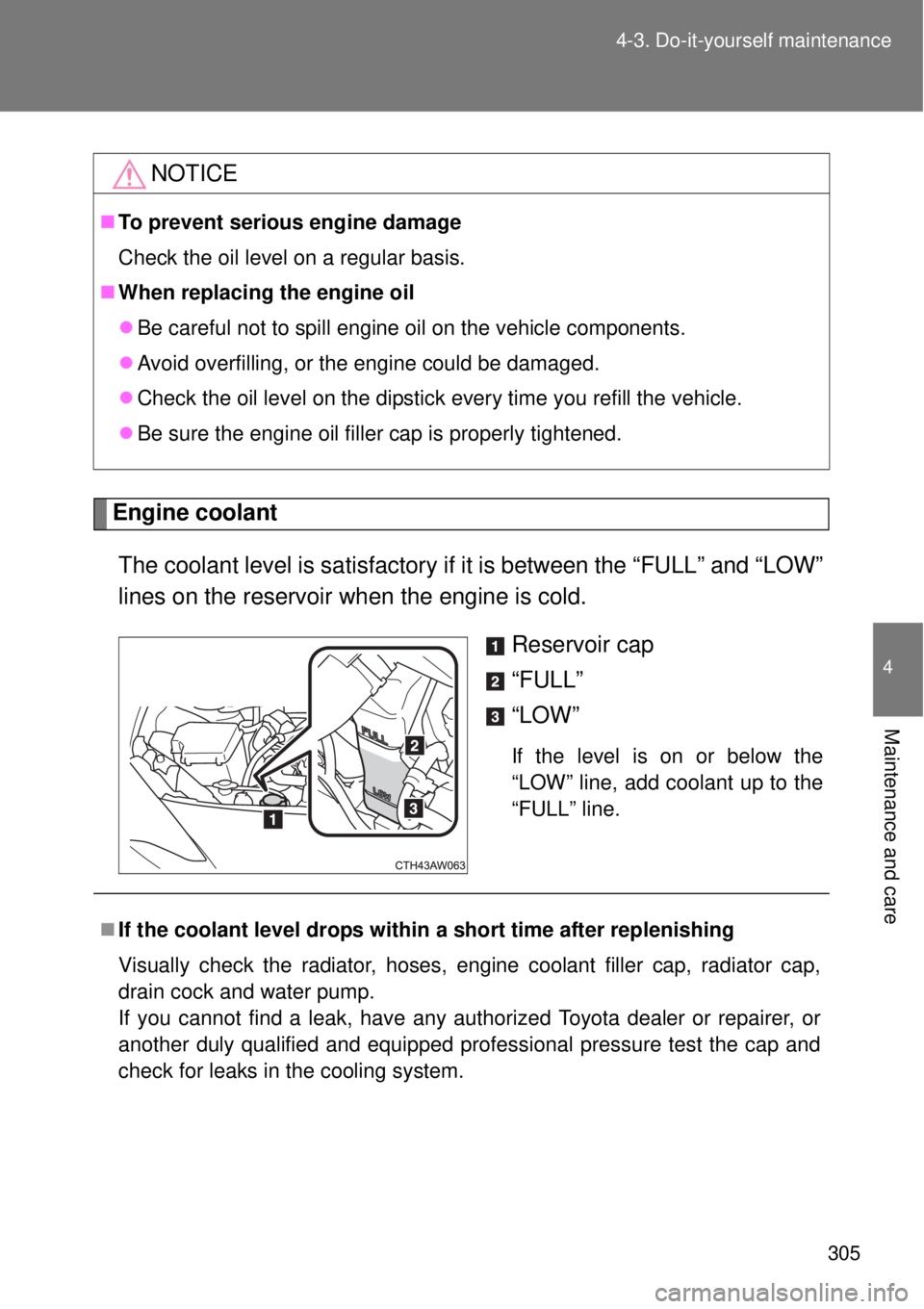
The coolant level is satisfactory if it is between the “FULL” and “LOW”
lines on the reservoir when the engine is cold.
Reservoir cap
“FULL”
“LOW”
If the level is on or below the
“LOW” line, add coolant up to the
“FULL” line.
NOTICE
To prevent serious engine damage
Check the oil level on a regular basis.
When replacing the engine oil
Be careful not to spill engine oil on the vehicle components.
Avoid overfilling, or the engine could be damaged.
Check the oil level on the dipstick every time you refill the vehicle.
Be sure the engine oil filler cap is properly tightened.
If the coolant level drops within a short time after replenishing
Visually check the radiator, hoses, engine coolant filler cap, radiator cap,
drain cock and water pump.
If you cannot find a leak, have any authorized Toyota dealer or repairer, or
another duly qualified and equipped professional pressure test the cap and
check for leaks in the cooling system.
Page 306 of 464
306 4-3. Do-it-yourself maintenance
Coolant selection
Only use “TOYOTA Genuine 50/50 Pre-mixed Super Long Life Coolant
BLUE” or similar high-quality ethylene glycol-based non-silicate, non-amine,
non-nitrite, and non-borate coolant with long-life hybrid organic acid technol-
ogy.
“TOYOTA Genuine 50/50 Pre-mixed Super Long Life Coolant BLUE” is a
mixture of 50% coolant and 50% deionized water. (Enabled: -35C [-31F])
For more details about engine coolant, contact any authorized Toyota dealer
or repairer, or another duly qualified and equipped professional.
CAUTION
When the engine is hot
Do not remove the radiator cap.
The cooling system may be under pressure and may spray hot coolant if the
cap is removed, causing serious injuries, such as burns.
NOTICE
When adding engine coolant
Coolant is neither plain water nor straight antifreeze. The correct mixture of
water and antifreeze must be used to provide proper lubrication, corrosion
protection and cooling. Be sure to read the antifreeze or coolant label.
If you spill coolant
Be sure to wash it off with water to prevent it from damaging parts or paint.
Page 307 of 464
307 4-3. Do-it-yourself maintenance
4
Maintenance and care
Radiator and condenser
Check the radiator and condenser and clear any foreign objects.
If either of the above parts are extremely dirty or you are not sure of
their condition, have your vehicle checked by any authorized Toyota
dealer or repairer, or another duly qualified and equipped profes-
sional.
CAUTION
When the engine is hot
Do not touch the radiator or condenser as they may be hot and cause seri-
ous injuries, such as burns.
Page 310 of 464
310 4-3. Do-it-yourself maintenance
Before recharging
When recharging, the battery produces hydrogen gas which is flammable
and explosive. Therefore, before recharging:
If recharging with the battery installed on the vehicle, be sure to discon-
nect the ground cable.
Make sure the power switch on the charger is off when connecting and
disconnecting the charger cables to the battery.
After recharging/reconnecting the battery (vehicles with a smart entry
& start system)
Unlocking the doors using the smart entry & start system may not be
possible immediately after reconnecting the battery. If this happens, use
the wireless remote control or the mechanical key to lock/unlock the
doors.
Start the engine with the “ENGINE START STOP” switch in ACCES-
SORY mode. The engine may not start with the “ENGINE START STOP”
switch turned off. However, the engine will operate normally from the sec-
ond attempt.
The “ENGINE START STOP” switch mode is recorded by the vehicle. If
the battery is reconnected, the vehicle will return the “ENGINE START
STOP” switch mode to the status it was in before the battery was discon-
nected. Make sure to turn off the engine before disconnect the battery.
Take extra care when connecting the battery if the “ENGINE START
STOP” switch mode prior to discharge is unknown.
If the engine will not start even after multiple attempts, contact any
authorized Toyota dealer or repairer, or another duly qualified and equipped
professional.
Page 312 of 464
312 4-3. Do-it-yourself maintenance
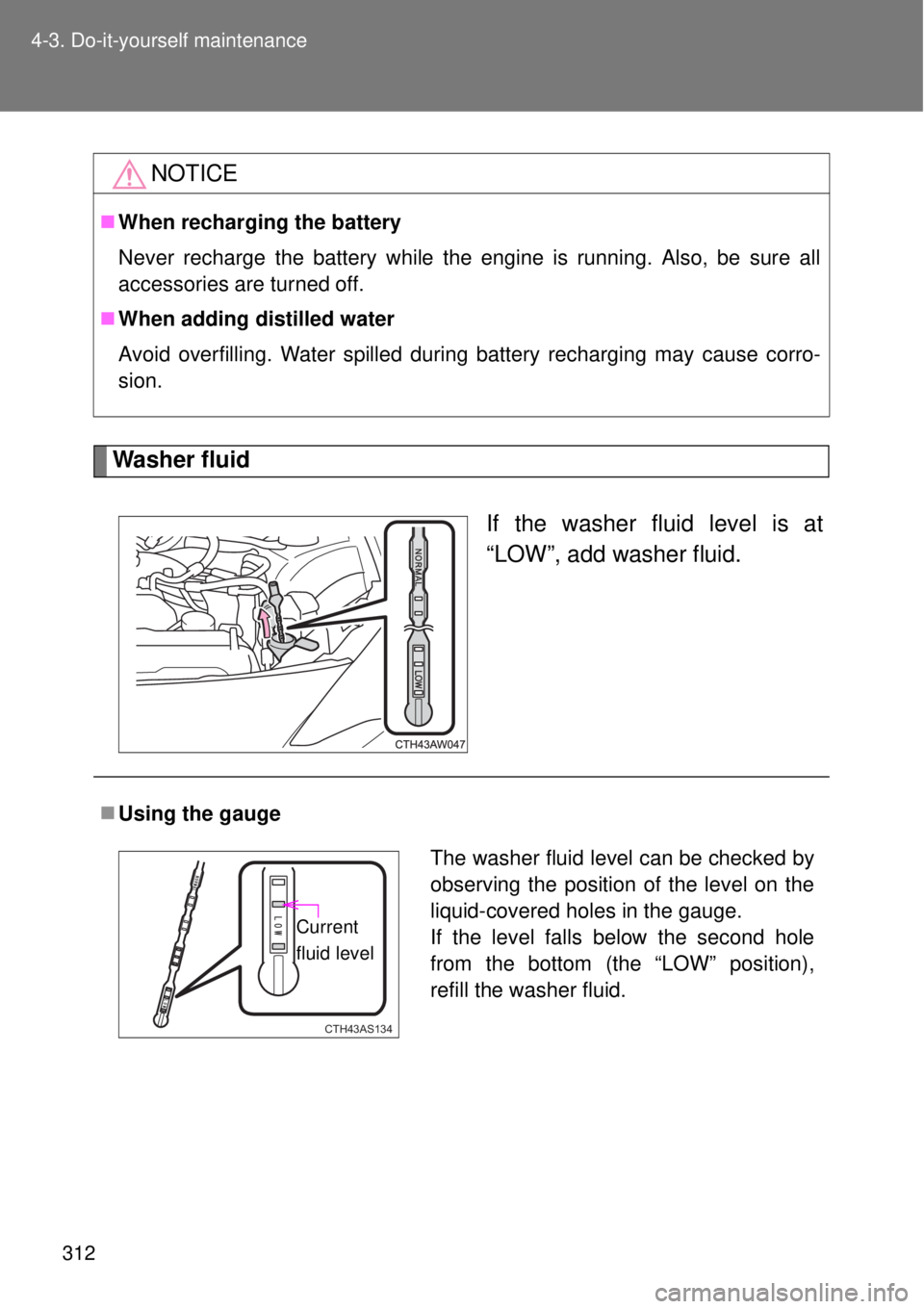
Washer fluid
If the washer fluid level is at
“LOW”, add washer fluid.
NOTICE
When recharging the battery
Never recharge the battery while the engine is running. Also, be sure all
accessories are turned off.
When adding distilled water
Avoid overfilling. Water spilled during battery recharging may cause corro-
sion.
Using the gauge
The washer fluid level can be checked by
observing the position of the level on the
liquid-covered holes in the gauge.
If the level falls below the second hole
from the bottom (the “LOW” position),
refill the washer fluid.
CTH43AS134
Current
fluid level
Page 313 of 464
313 4-3. Do-it-yourself maintenance
4
Maintenance and care
CAUTION
When adding washer fluid
Do not add washer fluid when the engine is hot or running, as washer fluid
contains alcohol and may catch fire if spilled on the engine etc.
NOTICE
Washer fluid
Do not use soapy water or engine antifreeze instead of washer fluid.
Doing so may cause streaking on the vehicle’s painted surfaces.
Diluting washer fluid
Dilute washer fluid with water as necessary.
Refer to the freezing temperatures listed on the label of the washer fluid bot-
tle.
Page 316 of 464
316 4-3. Do-it-yourself maintenance
How to initialize the tire pressure warning system
Park the vehicle in a safe place and turn the “ENGINE START
STOP” switch (vehicles with a smart entry & start system) or
the engine switch (vehicles without a smart entry & start sys-
tem) off.
Initialization cannot be performed while the vehicle is moving.
Adjust the tire inflation pressure to the specified cold tire infla-
tion pressure level. (P. 443)
Make sure to adjust the tire pressure to the specified cold tire infla-
tion pressure level. The tire pressure warning system will operate
based on this pressure level.
Turn the “ENGINE START STOP” switch to IGNITION ON
mode (vehicles with a smart entry & start system) or engine
switch to the “ON” position (vehicles without a smart entry &
start system).
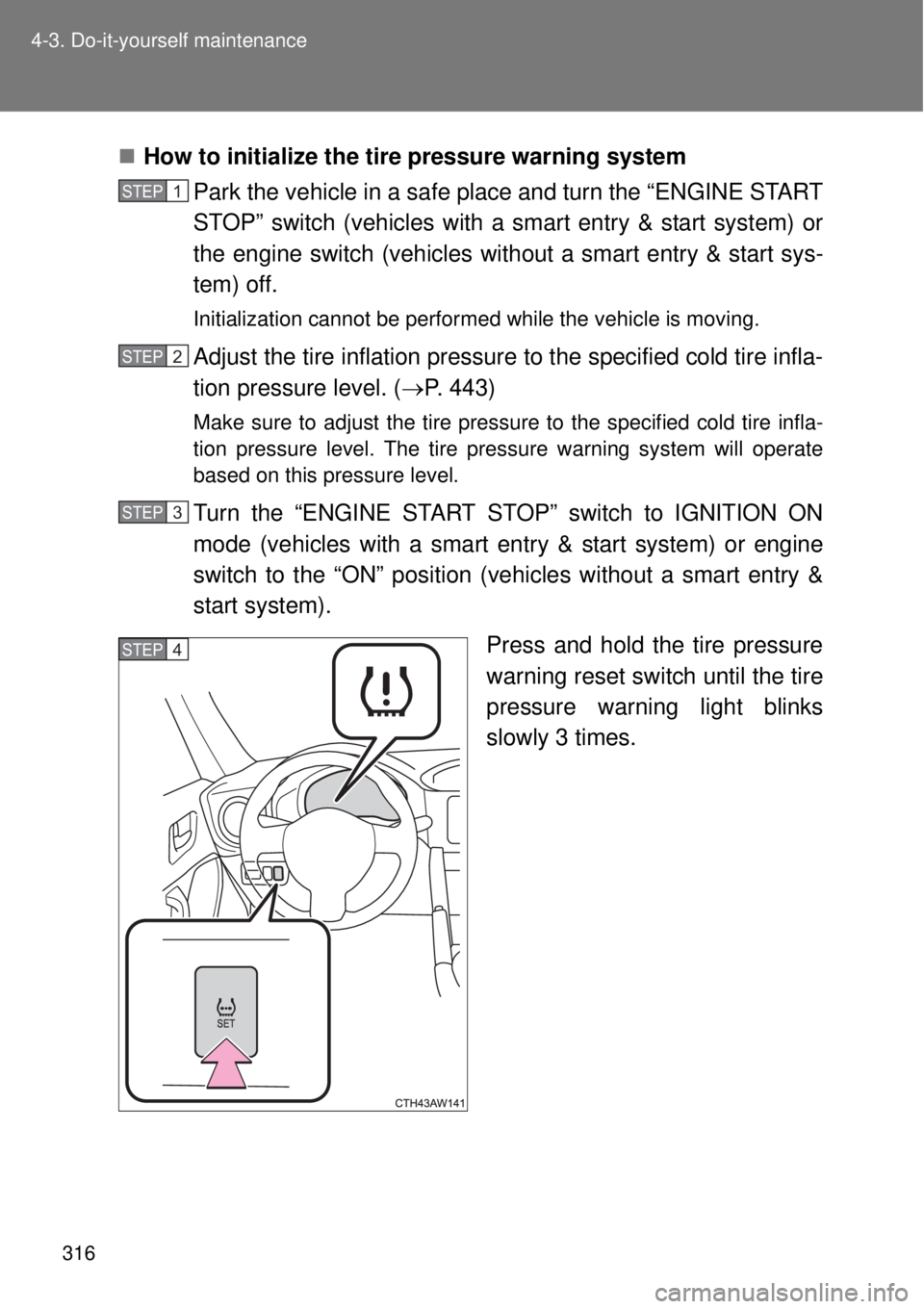
Press and hold the tire pressure
warning reset switch until the tire
pressure warning light blinks
slowly 3 times.
STEP 1
STEP 2
STEP 3
STEP 4
Page 317 of 464
317 4-3. Do-it-yourself maintenance
4
Maintenance and care
Vehicles with a smart entry & start system: Wait for a few min-
utes with the “ENGINE START STOP” switch in IGNITION ON
mode and then turn the “ENGINE START STOP” switch off.
Vehicles without a smart entry & start system: Wait for a few
minutes with the engine switch in the “ON” position and then
turn the engine switch to the “ACC” or “LOCK” position.
Registering ID codes
The tire pressure warning valve and transmitter is equipped with a
unique ID code. When replacing a tire pressure warning valve and
transmitter, it is necessary to register the ID code. Have the ID code
registered by any authorized Toyota dealer or repairer, or another
duly qualified and equipped professional.
STEP 5
Page 328 of 464
328
4-3. Do-it-yourself maintenance
Air conditioning filter
The air conditioning filter must be changed regularly to maintain air
conditioning efficiency.
Removal method
Vehicles without a smart entry & start system
Turn the engine switch off.
Vehicles with a smart entry & start system
Turn the “ENGINE START STOP” switch off.
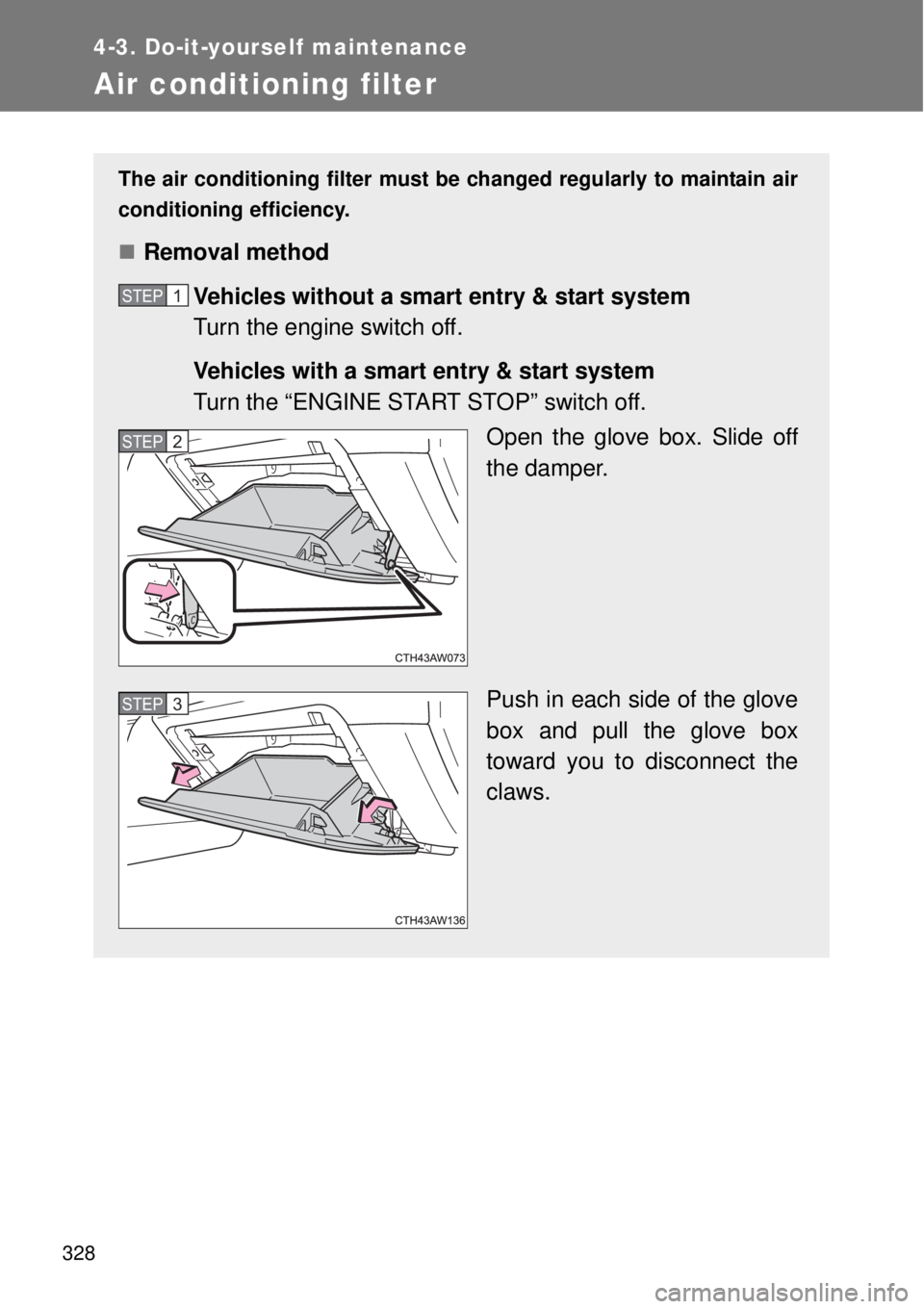
Open the glove box. Slide off
the damper.
Push in each side of the glove
box and pull the glove box
toward you to disconnect the
claws.
STEP 1
STEP 2
STEP 3