instrument panel TOYOTA GT86 2014 User Guide
[x] Cancel search | Manufacturer: TOYOTA, Model Year: 2014, Model line: GT86, Model: TOYOTA GT86 2014Pages: 464, PDF Size: 10.65 MB
Page 127 of 464
127 1-7. Safety information
1
Before driving
CAUTION
SRS airbag precautions
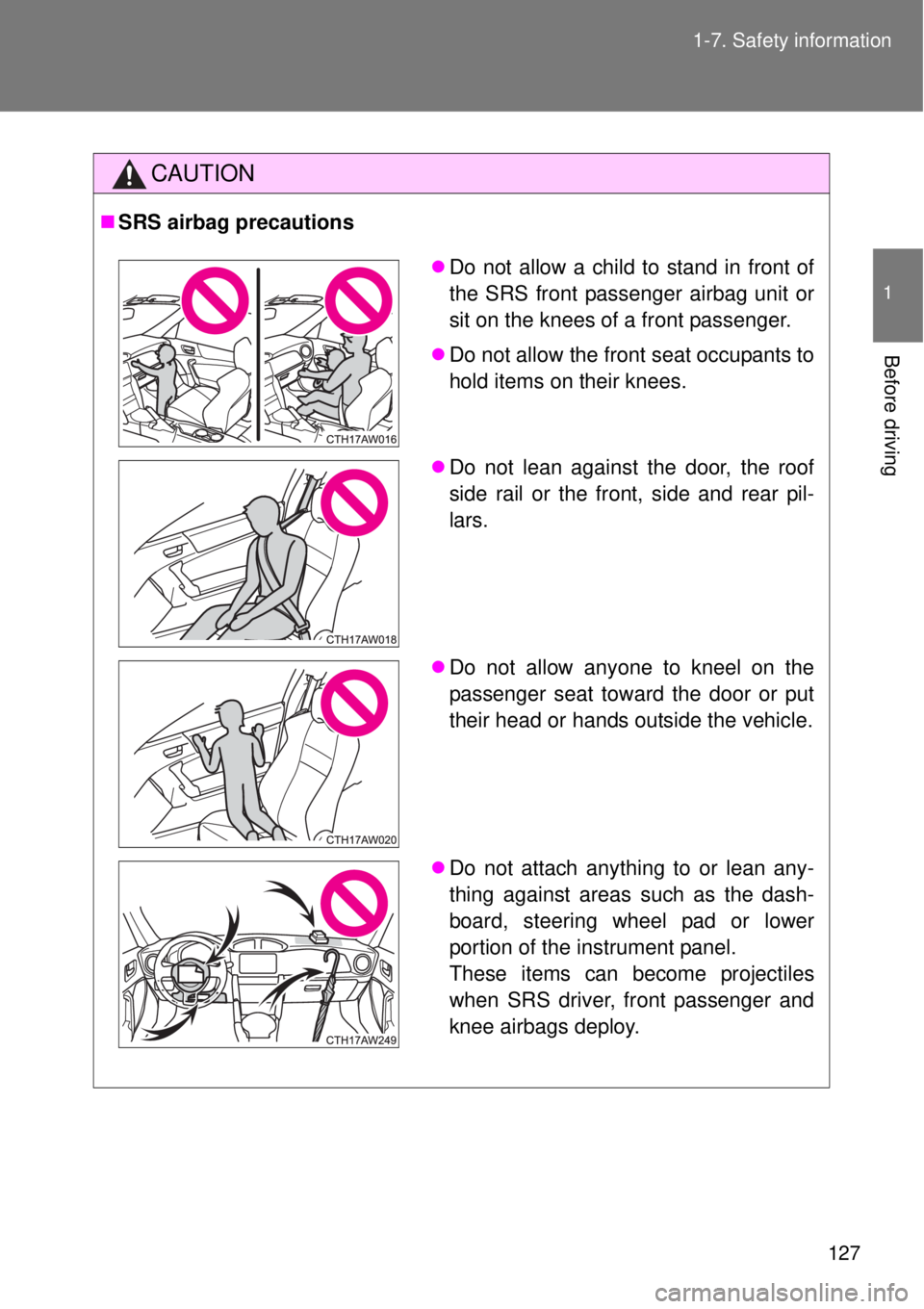
Do not allow a child to stand in front of
the SRS front passenger airbag unit or
sit on the knees of a front passenger.
Do not allow the front seat occupants to
hold items on their knees.
Do not lean against the door, the roof
side rail or the front, side and rear pil-
lars.
Do not allow anyone to kneel on the
passenger seat toward the door or put
their head or hands outside the vehicle.
Do not attach anything to or lean any-
thing against areas such as the dash-
board, steering wheel pad or lower
portion of the instrument panel.
These items can become projectiles
when SRS driver, front passenger and
knee airbags deploy.
Page 129 of 464

129 1-7. Safety information
1
Before driving
CAUTION
SRS airbag precautions
If the areas where the SRS airbags are stored, such as the steering wheel
pad and front and rear pillar garnishes, are damaged or cracked, have
them replaced by any authorized Toyota dealer or repairer, or another duly
qualified and equipped professional.
The SRS side airbag and SRS curtain shield airbag are designed only to
be a supplement to the primary protection provided by the seat belt. They
do not do away with the need to fasten seat belts. It is also important to
wear your seat belt to help avoid injuries that can result when an occupant
is not seated in a proper upright position.
Modification and disposal of SRS airbag system components
Do not dispose of your vehicle or perform any of the following modifications
without consulting any authorized Toyota dealer or repairer, or another duly
qualified and equipped professional.
The SRS airbags may malfunction or deploy (inflate) accidentally, causing
death or serious injury.
Installation, removal, disassembly and repair of the SRS airbags.
Repairs, modifications, removal or replacement of the steering wheel,
instrument panel, dashboard, seats or seat upholstery, front, side and rear
pillars or roof side rails.
Repairs or modifications of the front fender, front bumper, or side of the
occupant compartment.
Installation of a grille guard (bull bars, kangaroo bar, etc.), snow plows,
winches.
Modifications to the vehicle's suspension system.
Installation of electronic devices such as mobile two-way radios and CD
players.
Installation of electronic devices such as an RF-transmitter and CD play-
ers.
Modifications to your vehicle for a person with a physical disability.
Page 131 of 464

131 1-7. Safety information
1
Before driving
Side airbag sensor
• Center pillar right-hand side
• Center pillar left-hand side
Side airbag module
• Driver’s side
• Front passenger’s side
Curtain shield airbag sensor
• Rear wheel house right-hand side
• Rear wheel house left-hand side
Curtain shield airbag module
• Right-hand side
• Left-hand side
Satellite safing sensor (under the center of the rear seats)
Seat belt pretensioner
• Driver’s side
• Front passenger’s side
All related wiring
Door impact sensor
• Right-hand side
• Left-hand side
Front passenger’s front airbag cut off switch (passenger's side of
instrument panel)
Front passenger’s front airbag ON and OFF indicator
Page 164 of 464

164 2-1. Driving procedures
CAUTION
When the vehicle is parked
Do not leave glasses, cigarette lighters, spray cans, or soft drink cans in
the vehicle when it is in the sun.
Doing so may result in the following:
• Gas may leak from a cigarette lighter or spray can, and may lead to a
fire.
• The temperature inside the vehicle may cause the plastic lenses and
plastic material of glasses to deform or crack.
• Soft drink cans may fracture, causing the contents to spray over the
interior of the vehicle, and may also cause a short circuit in the vehi-
cle's electrical components.
Do not leave cigarette lighters in the vehicle. If a cigarette lighter is in a
place such as the glove box or on the floor, it may be lit accidentally when
luggage is loaded or the seat is adjusted, causing a fire.
Do not attach suction cups to the windshield or windows. Do not place
containers such as air fresheners on the instrument panel or dashboard.
Suction cups or containers may act as lenses, causing a fire in the vehicle.
Do not leave a door or window open if the curved glass is coated with a
metallized film such as a silver-colored one. Reflected sunlight may cause
the glass to act as a lens, causing a fire.
Always apply the parking brake, shift the shift lever to P (vehicles with an
automatic transmission only), stop the engine and lock the vehicle.
Do not leave the vehicle unattended while the engine is running.
Do not touch the exhaust pipe while the engine is running or immediately
after turning the engine off.
Doing so may cause burns.
Do not leave the engine running in an area with snow build-up, or where it
is snowing. If snowbanks build up around the vehicle while the engine is
running, exhaust gases may collect and enter the vehicle. This may lead
to death or a serious health hazard.
Page 196 of 464
196 2-2. Instrument cluster
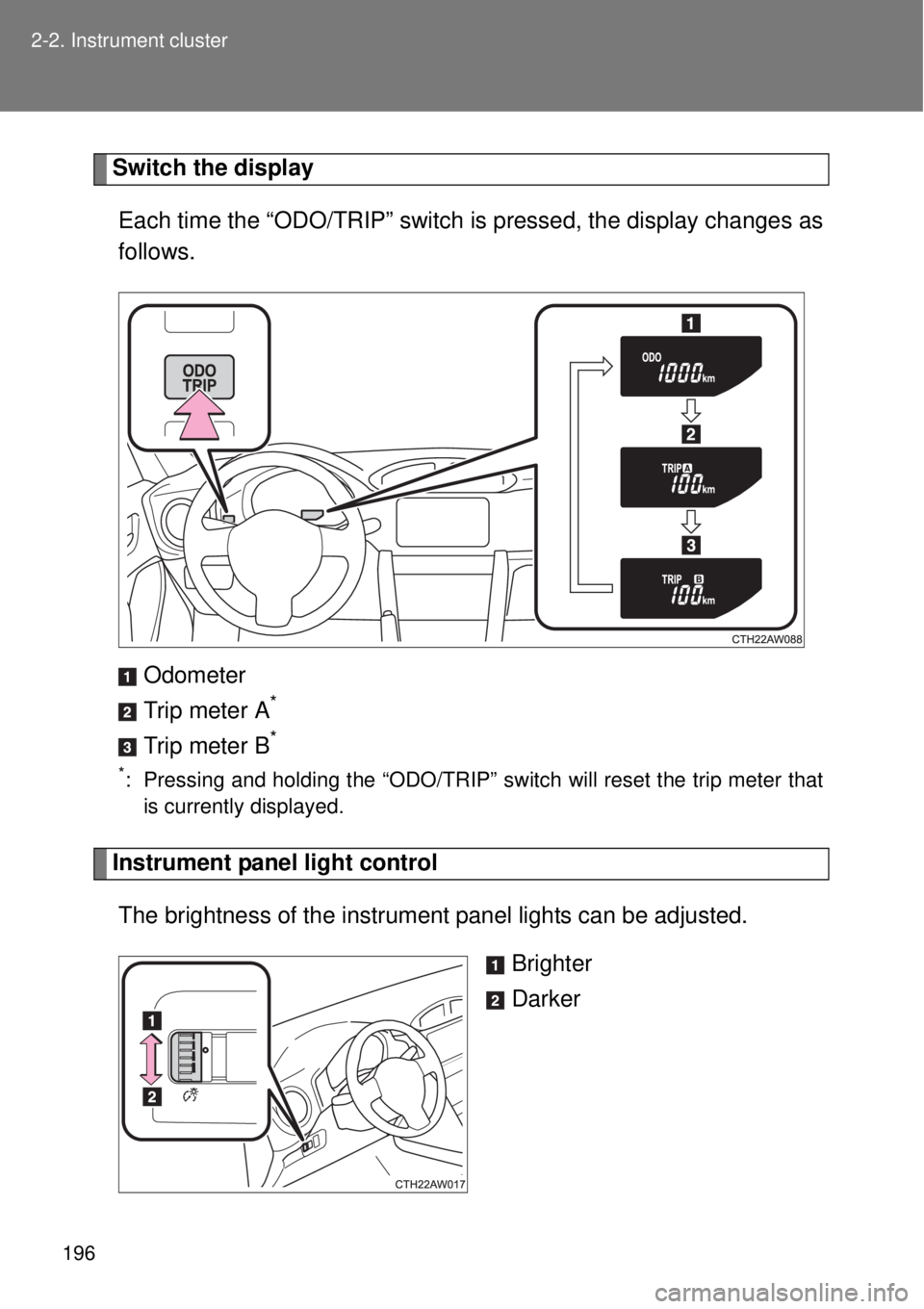
Switch the display
Each time the “ODO/TRIP” switch is pressed, the display changes as
follows.
Odometer
Trip meter A
*
Trip meter B*
*: Pressing and holding the “ODO/TRIP” switch will reset the trip meter that
is currently displayed.
Instrument panel light control
The brightness of the instrument panel lights can be adjusted.
Brighter
Darker
Page 197 of 464

197 2-2. Instrument cluster
2
When driving
The brightness of the instrument panel lights
When the front position lights or the headlights turn on, the instrument panel
lights will dim. However, when the instrument panel brightness control dial is
turned to the up most position, the instrument panel lights will not dim even
when the front position lights or headlights turn on.
NOTICE
To prevent damage to the engine and its components
Do not let the indicator needle of the tachometer enter the red zone, which
indicates the maximum engine speed.
The engine may be overheating if the temperature gauge is in the red
zone (H). In this case, immediately stop the vehicle in a safe place, and
check the engine after it has cooled completely. (
P. 423)
Page 198 of 464
198
2-2. Instrument cluster
Indicators and warning lights
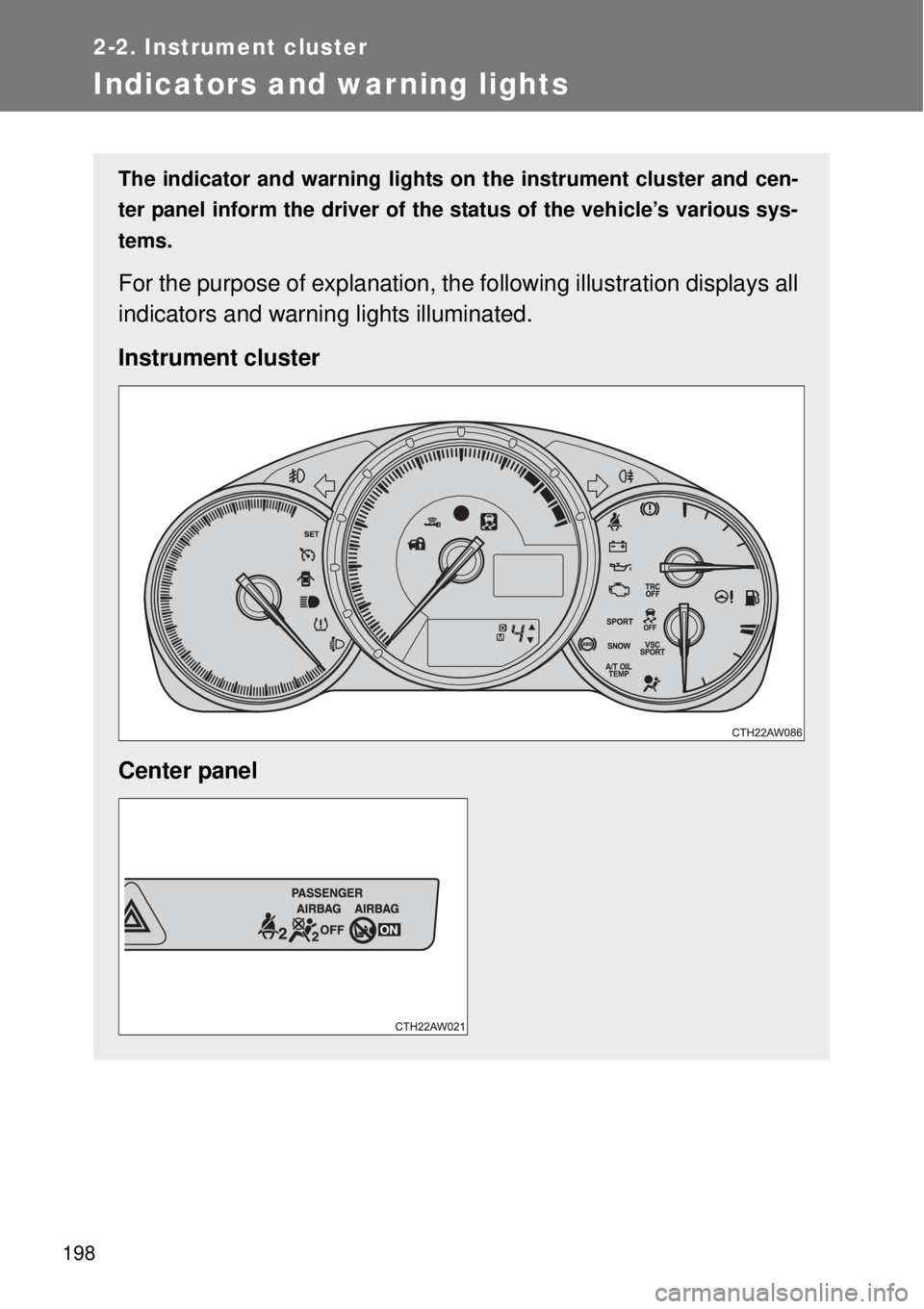
The indicator and warning lights on the instrument cluster and cen-
ter panel inform the driver of the status of the vehicle’s various sys-
tems.
For the purpose of explanation, the following illustration displays all
indicators and warning lights illuminated.
Instrument cluster
Center panel
Page 232 of 464

232 2-5. Driving information
CAUTION
Storage precautions
Observe the following precautions.
Failure to do so may result in death or serious injury.
Stow cargo and luggage in the trunk whenever possible.
To prevent cargo and luggage from sliding forward during braking, do
not stack anything in the enlarged trunk. Keep cargo and luggage low,
as close to the floor as possible.
When you fold down the rear seats, long items should not be placed
directly behind the front seats.
Never allow anyone to ride in the enlarged trunk. It is not designed for
passengers. They should ride in their seats with their seat belts prop-
erly fastened. Otherwise, they are much more likely to suffer death or
serious bodily injury, in the event of sudden braking, sudden swerving
or an accident.
Do not place cargo or luggage in or on the following locations as the
item may get under the clutch, brake or accelerator pedal and prevent
the pedals from being depressed properly, block the driver’s vision, or
hit the driver or passengers, causing an accident:
• At the feet of the driver
• On the front passenger or rear seats (when stacking items)
• On the package tray
• On the instrument panel
• On the dashboard
Secure all items in the occupant compartment, as they may shift and
injure someone during sudden braking, sudden swerving or an acci-
dent.
Load and distribution
Do not overload your vehicle.
Do not apply loads unevenly.
Improper loading may cause deterioration of steering or braking control
which may cause death or serious injury.
Page 286 of 464

286 4-1. Maintenance and care
Caring for leather areas
Toyota recommends cleaning the interior of the vehicle at least twice a year
to maintain the quality of the vehicle’s interior.
Shampooing the carpets
There are several commercial foaming-type cleaners available. Use a
sponge or brush to apply the foam. Rub in overlapping circles. Do not apply
water. Excellent results are obtained by keeping the carpet as dry as possi-
ble.
Seat belts
Clean with mild soap and lukewarm water using a cloth or sponge. Also
check the belts periodically for excessive wear, fraying or cuts.
CAUTION
Water in the vehicle
Do not splash or spill liquid in the vehicle.
Doing so may cause electrical components etc. to malfunction or catch
fire.
Do not get any of the SRS components or wiring in the vehicle interior wet.
(P. 109)
Electrical malfunction may cause the airbags to deploy or not function
properly, resulting in death or severe injury.
Cleaning the interior (especially instrument panel)
Do not use polish wax or polish cleaner. The instrument panel may reflect off
the windshield, obstructing the driver's view and leading to an accident,
resulting in death or serious injury.
Page 287 of 464

287 4-1. Maintenance and care
4
Maintenance and care
NOTICE
Cleaning detergents
Do not use organic substances such as benzene or gasoline, acidic or
alkaline solutions, dye, bleach or other detergent. Doing so may discolor
the vehicle interior or cause streaks or damage to painted surfaces.
Do not use polish wax or polish cleaner. The instrument panel's or other
interior part’s painted surface may be damaged.
Do not use a chemical agent containing silicone (highly-polymerized sili-
con compound) when cleaning any of the electrical appliances such as the
air conditioning, all switches and their surrounding areas.
If silicon (highly-polymerized silicon compound) contacts these compo-
nents, it may cause the electrical appliances to malfunction.
Preventing damage to leather surfaces
Observe the following precautions to avoid damage to and deterioration of
leather surfaces.
Remove any dust, dirt, sand, oil spots etc. on leather surfaces immedi-
ately.
Do not expose the vehicle to direct sunlight for extended periods of time.
Park the vehicle in the shade, especially during summer.
Do not place items made of vinyl, plastic, or that contain wax on the uphol-
stery, as they may stick to the leather surface if the vehicle interior heats
up significantly.
Water on the floor
Do not wash the vehicle floor with water.
Vehicle systems such as the audio system may be damaged if water comes
into contact with electrical components under the floor of the vehicle, and
may also cause the body to rust.