check engine TOYOTA GT86 2014 Owner's Manual
[x] Cancel search | Manufacturer: TOYOTA, Model Year: 2014, Model line: GT86, Model: TOYOTA GT86 2014Pages: 464, PDF Size: 10.65 MB
Page 191 of 464
191
2-1. Driving procedures
2
When driving
Turn signal lever
Turn signals can be operated when
Vehicles without a smart entry & start system
The engine switch is in the “ON” position.
Vehicles with a smart entry & start system
The “ENGINE START STOP” switch is in IGNITION ON mode.
If the indicators flash faster than usual
Check that a light bulb in the turn signal lights has not burned out.
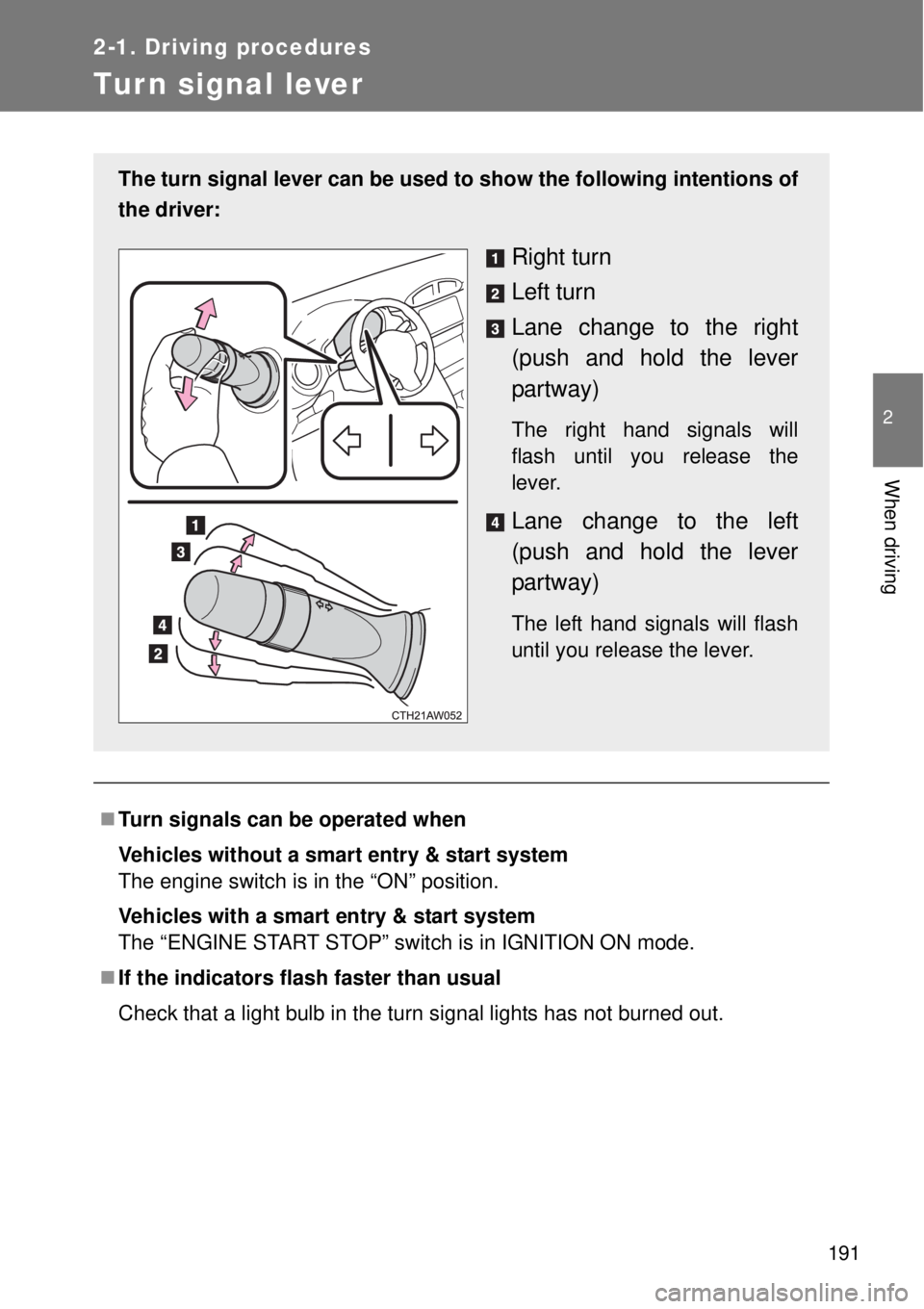
The turn signal lever can be used to show the following intentions of
the driver:
Right turn
Left turn
Lane change to the right
(push and hold the lever
partway)
The right hand signals will
flash until you release the
lever.
Lane change to the left
(push and hold the lever
partway)
The left hand signals will flash
until you release the lever.
Page 197 of 464

197 2-2. Instrument cluster
2
When driving
The brightness of the instrument panel lights
When the front position lights or the headlights turn on, the instrument panel
lights will dim. However, when the instrument panel brightness control dial is
turned to the up most position, the instrument panel lights will not dim even
when the front position lights or headlights turn on.
NOTICE
To prevent damage to the engine and its components
Do not let the indicator needle of the tachometer enter the red zone, which
indicates the maximum engine speed.
The engine may be overheating if the temperature gauge is in the red
zone (H). In this case, immediately stop the vehicle in a safe place, and
check the engine after it has cooled completely. (
P. 423)
Page 200 of 464
200 2-2. Instrument cluster
*1:Vehicles without a smart entry & start system
These lights turn on when the engine switch is turned to the “ON”
position to indicate that a system check is being performed. They
will turn off after the engine is started, or after a few seconds. There
may be a malfunction in a system if a light does not come on, or if
the lights do not turn off. Have the vehicle inspected by any autho-
rized Toyota dealer or repairer, or another duly qualified and
equipped professional for details.
Vehicles with a smart entry & start system
These lights turn on when the “ENGINE START STOP” switch is
turned to IGNITION ON mode to indicate that a system check is
being performed. They will turn off after the engine is started, or
after a few seconds. There may be a malfunction in a system if a
light does not come on, or if the lights do not turn off. Have the vehi-
cle inspected by any authorized Toyota dealer or repairer, or
another duly qualified and equipped professional for details.
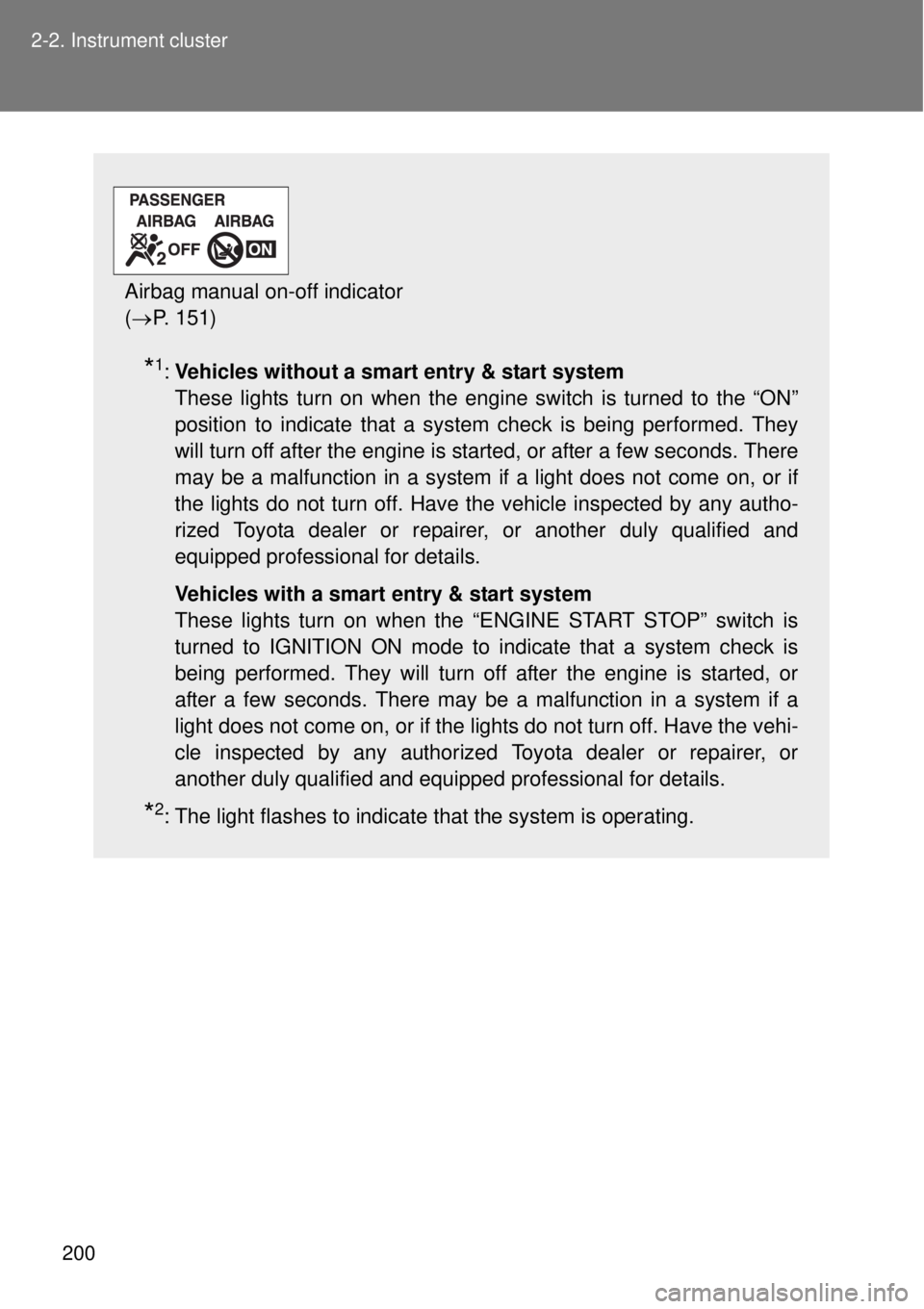
*2: The light flashes to indicate that the system is operating.
Airbag manual on-off indicator
(P. 151)
Page 201 of 464
201 2-2. Instrument cluster
2
When driving
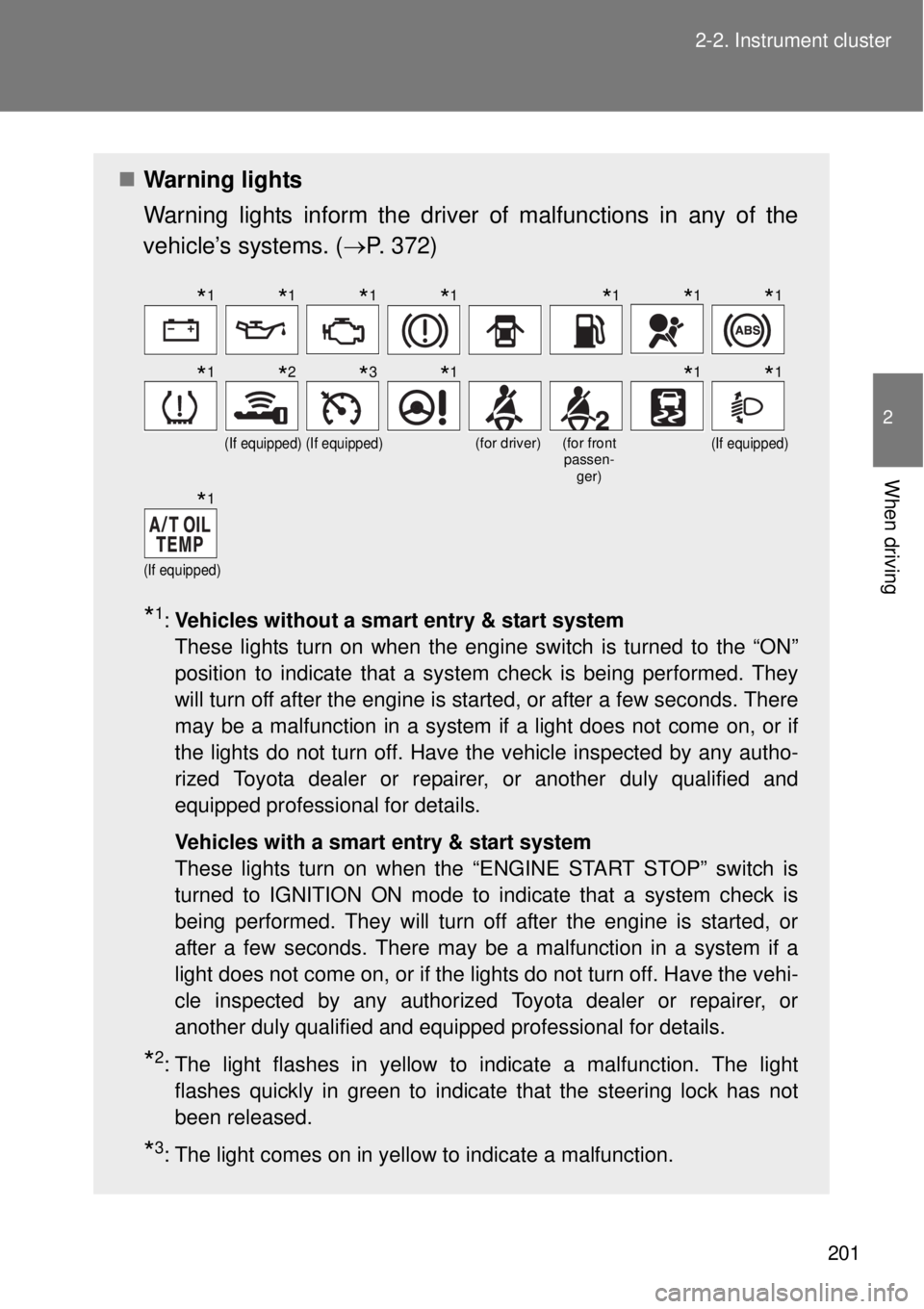
Warning lights
Warning lights inform the driver of malfunctions in any of the
vehicle’s systems. (P. 372)
*1:Vehicles without a smart entry & start system
These lights turn on when the engine switch is turned to the “ON”
position to indicate that a system check is being performed. They
will turn off after the engine is started, or after a few seconds. There
may be a malfunction in a system if a light does not come on, or if
the lights do not turn off. Have the vehicle inspected by any autho-
rized Toyota dealer or repairer, or another duly qualified and
equipped professional for details.
Vehicles with a smart entry & start system
These lights turn on when the “ENGINE START STOP” switch is
turned to IGNITION ON mode to indicate that a system check is
being performed. They will turn off after the engine is started, or
after a few seconds. There may be a malfunction in a system if a
light does not come on, or if the lights do not turn off. Have the vehi-
cle inspected by any authorized Toyota dealer or repairer, or
another duly qualified and equipped professional for details.
*2: The light flashes in yellow to indicate a malfunction. The light
flashes quickly in green to indicate that the steering lock has not
been released.
*3: The light comes on in yellow to indicate a malfunction.
(If equipped)(If equipped)(for driver)(for front
passen-
ger)(If equipped)
(If equipped)
*1*1*1*1*1*1*1
*1*2*3*1*1*1
*1
Page 218 of 464
218 2-3. Operating the lights and windshield wipers
The windshield wipers and washer can be operated when
Vehicles without a smart entry & start system
The engine switch is in the “ON” position.
Vehicles with a smart entry & start system
The “ENGINE START STOP” switch is in IGNITION ON mode.
If no windshield washer fluid sprays
Check that the washer nozzles are not blocked if there is washer fluid in the
windshield washer fluid reservoir.
CAUTION
Caution regarding the use of washer fluid
When it is cold, do not use the washer fluid until the windshield becomes
warm. The fluid may freeze on the windshield and cause low visibility. This
may lead to an accident, resulting in death or serious injury.
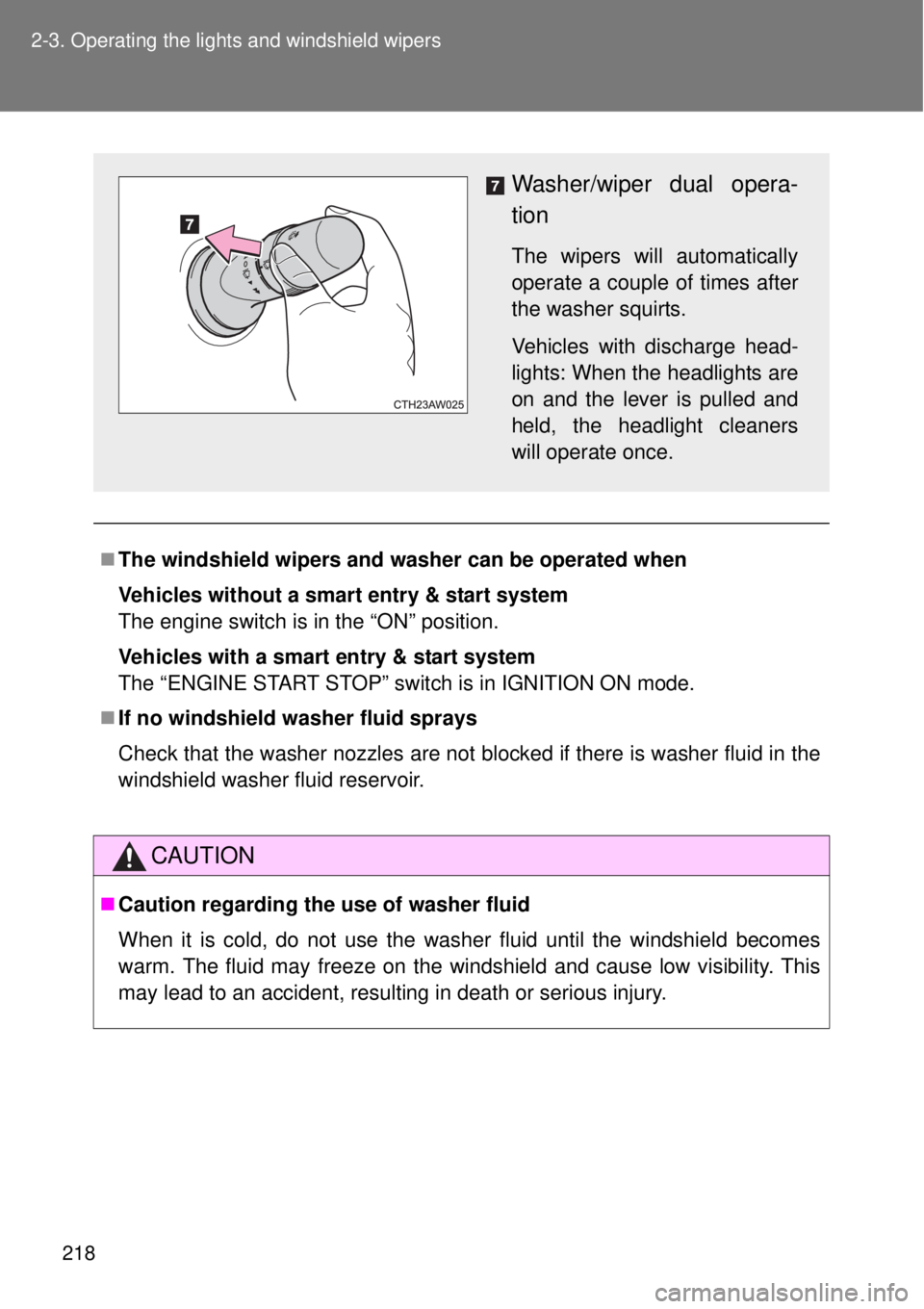
Washer/wiper dual opera-
tion
The wipers will automatically
operate a couple of times after
the washer squirts.
Vehicles with discharge head-
lights: When the headlights are
on and the lever is pulled and
held, the headlight cleaners
will operate once.
Page 233 of 464
233
2-5. Driving information
2
When driving
Winter driving tips
Carry out the necessary preparations and inspections before driving
the vehicle in winter. Always drive the vehicle in a manner appropri-
ate to the prevailing weather conditions.
Pre-winter preparations
Use fluids that are appropriate to the prevailing outside tem-
peratures.
• Engine oil
• Washer fluid
Have a service technician inspect the condition of the battery.
Have the vehicle fitted with four snow tires or purchase a set
of tire chains for the rear tires.
Make sure to install 4 tires that are of the specified size, and that all
4 tires are the same size, same maker, same brand and tread pat-
tern. Also, make sure to use tire chains that match the size of the
tires.
Before driving the vehicle
Perform the following according to the driving conditions.
Do not try to forcibly open a window or move a wiper that is
frozen. Pour warm water over the frozen area to melt the ice.
Wipe away the water immediately to prevent it from freezing.
To ensure proper operation of the climate control system fan,
remove any snow that has accumulated on the air inlet vents
in front of the windshield.
Check for and remove any excess ice or snow that may have
accumulated on the exterior lights, vehicle's roof, chassis,
around the tires or on the brakes.
Remove any snow or mud from the bottom of your shoes
before getting in the vehicle.
Page 276 of 464
276 3-5. Other interior features
CAUTION
Observe the following precautions.
Failure to do so may cause the driver's floor mat to slip, possibly interfering
with the pedals while driving. An unexpectedly high speed may result or it may
become difficult to stop the vehicle, leading to a serious accident, resulting in
death or serious injury.
When installing a floor mat
Do not use floor mats designed for other models or different model year
vehicles, even if they are Toyota Genuine floor mats.
Driver’s seat floor mat: Only use floor mats designed for the driver's seat.
Front: Always install the floor mat securely using the retaining hooks (clips)
provided.
Do not use two or more floor mats on top of each other.
Do not place the floor mat bottom-side up or upside-down.
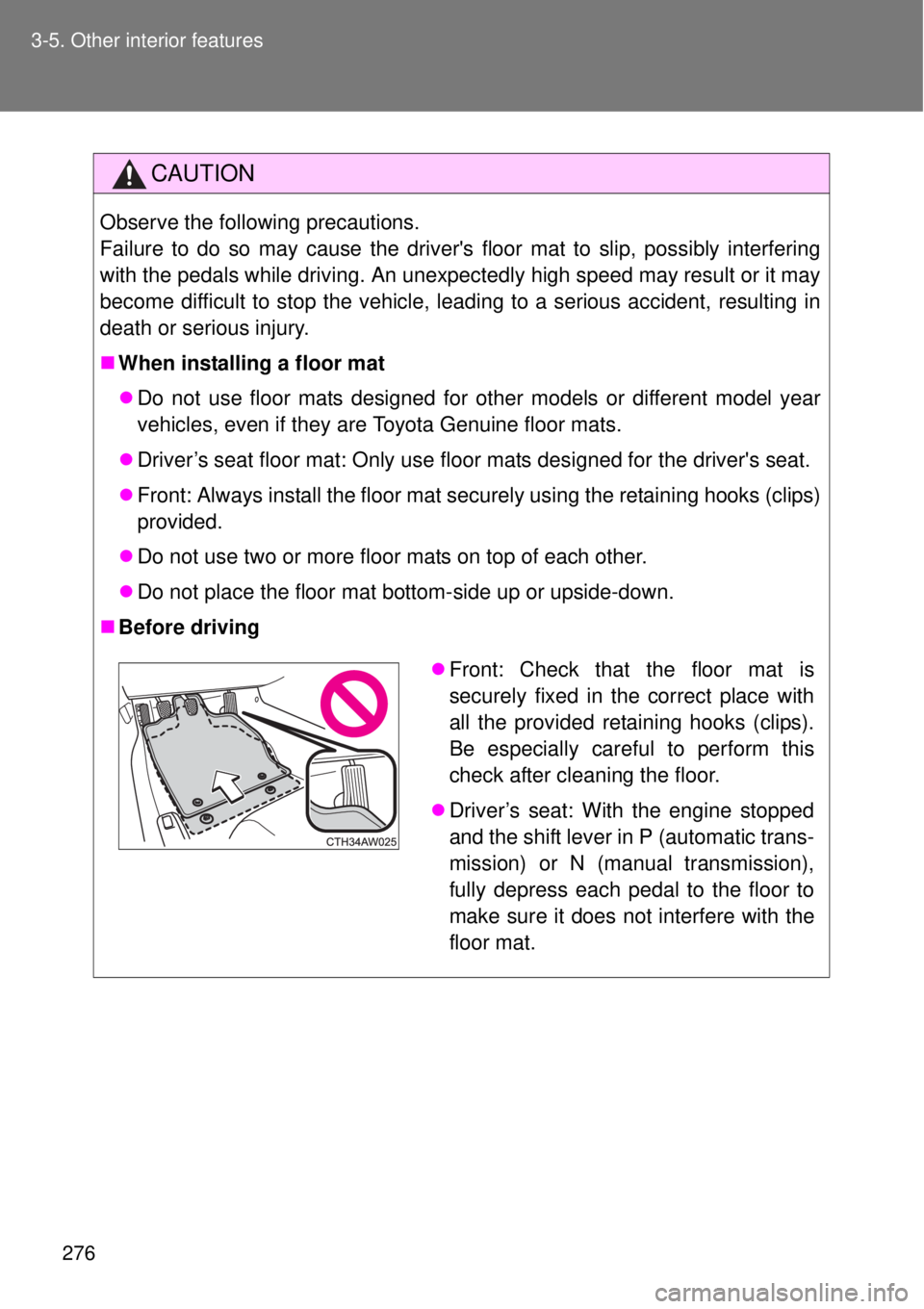
Before driving
Front: Check that the floor mat is
securely fixed in the correct place with
all the provided retaining hooks (clips).
Be especially careful to perform this
check after cleaning the floor.
Driver’s seat: With the engine stopped
and the shift lever in P (automatic trans-
mission) or N (manual transmission),
fully depress each pedal to the floor to
make sure it does not interfere with the
floor mat.
Page 281 of 464
4Maintenance and care
281
4-1. Maintenance and care
Cleaning and protecting
the vehicle exterior ......... 282
Cleaning and protecting
the vehicle interior .......... 285
Cleaning and protecting
the Alcantara
® area ........ 289
4-2. Maintenance
Maintenance
requirements................... 291
4-3. Do-it-yourself
maintenance
Do-it-yourself service
precautions ..................... 294
Hood ................................. 297
Positioning a floor jack ...... 299
Engine compartment......... 301
Tires .................................. 314
Tire inflation pressure ....... 323
Wheels .............................. 325
Air conditioning filter ......... 328
Wireless remote control/
electronic key battery...... 331
Checking and replacing
fuses ............................... 335
Light bulbs ........................ 343
Page 292 of 464

292 4-2. Maintenance
Where to go for maintenance service?
In order to maintain your vehicle in the highest possible condition, Toyota
recommends that all repairs and service operations be carried out by autho-
rized Toyota dealers or repairers or other duly qualified and equipped profes-
sionals. For repairs and services covered by your warranty, please visit an
authorized Toyota dealer or repairer, who will use genuine Toyota parts in
repairing any difficulties you may encounter. There can also be advantages
in utilizing authorized Toyota dealers or repairers for non-warranty repairs
and services, as members of the Toyota network will be able to expertly
assist you with any difficulties you may encounter.
Your Toyota dealer or repairer, or another duly qualified and equipped pro-
fessional service department will perform all of the scheduled maintenance
on your vehicle - reliably and economically due to their experience with
Toyota vehicles.
Does your vehicle need repairs?
Be on the alert for changes in performance and sounds, and visual tip-offs
that indicate service is needed. Some important clues are:
Engine missing, stumbling or pinging
Appreciable loss of power
Strange engine noises
A fluid leak under the vehicle (However, water dripping from the air condi-
tioning system after use is normal.)
Change in exhaust sound (This may indicate a dangerous carbon mon-
oxide leak. Drive with the windows open and have the exhaust system
checked immediately.)
Flat-looking tires, excessive tire squeal when cornering, uneven tire wear
Vehicle pulls to one side when driven straight on a level road
Strange noises related to suspension movement
Loss of brake effectiveness, spongy feeling brake pedal or clutch pedal,
pedal almost touches the floor, vehicle pulls to one side when braking
Engine coolant temperature continually higher than normal
If you notice any of these clues, take your vehicle to any authorized Toyota
dealer or repairer, or another duly qualified and equipped professional as
soon as possible. Your vehicle may need adjustment or repair.
Page 298 of 464

298 4-3. Do-it-yourself maintenance
CAUTION
Pre-driving check
Check that the hood is fully closed and locked.
If the hood is not locked properly it may open while the vehicle is in motion
and cause an accident, which may result in death or serious injury.
NOTICE
When opening the hood
Do not lift up or operate the wipers. Doing so may cause the hood and wip-
ers to contact, scratching the hood.
Use caution when opening the engine hood in windy weather as it may
close suddenly in strong wind.
Do not attach any accessories other than genuine Toyota products to the
engine hood. Such additional weight on the engine hood may cause it to
be too heavy to be supported by the supporting rod when opened.
When closing the hood
Do not apply excessive weight or force when closing the hood as doing so
may result in damage.