engine TOYOTA GT86 2014 Owner's Manual
[x] Cancel search | Manufacturer: TOYOTA, Model Year: 2014, Model line: GT86, Model: TOYOTA GT86 2014Pages: 464, PDF Size: 10.65 MB
Page 88 of 464
88 1-5. Refueling
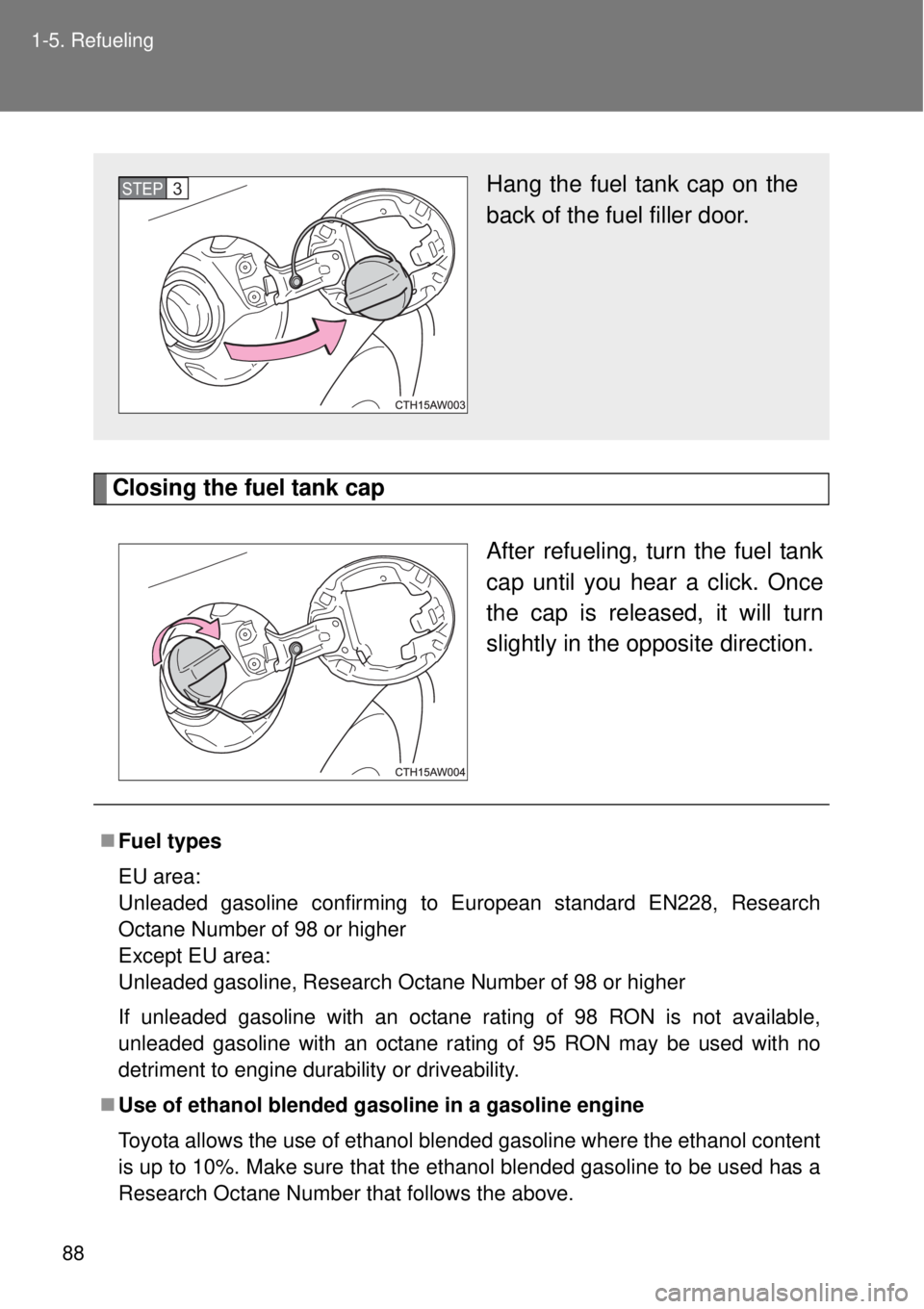
Closing the fuel tank cap
After refueling, turn the fuel tank
cap until you hear a click. Once
the cap is released, it will turn
slightly in the opposite direction.
Hang the fuel tank cap on the
back of the fuel filler door.STEP 3
Fuel types
EU area:
Unleaded gasoline confirming to European standard EN228, Research
Octane Number of 98 or higher
Except EU area:
Unleaded gasoline, Research Octane Number of 98 or higher
If unleaded gasoline with an octane rating of 98 RON is not available,
unleaded gasoline with an octane rating of 95 RON may be used with no
detriment to engine durability or driveability.
Use of ethanol blended gasoline in a gasoline engine
Toyota allows the use of ethanol blended gasoline where the ethanol content
is up to 10%. Make sure that the ethanol blended gasoline to be used has a
Research Octane Number that follows the above.
Page 90 of 464

90 1-5. Refueling
CAUTION
When refueling
Observe the following precautions to prevent fuel overflowing from the fuel
tank:
Securely insert the fuel nozzle into the fuel filler neck.
Stop filling the tank after the fuel nozzle automatically clicks off.
Do not top off the fuel tank.
Observe other precautions that are posted at the service station.
Turn the cap to the right until it clicks to ensure that it is fully tightened. If
the cap is not securely tightened, fuel spillage could occur in the event of
an accident, creating a fire hazard.
When replacing the fuel cap
Do not use anything but a genuine Toyota fuel tank cap designed for your
vehicle. Doing so may cause a fire or other incident which may result in
death or serious injury.
NOTICE
Refueling
Do not spill fuel during refueling.
Doing so may damage the vehicle, such as causing the emission control
system to operate abnormally or damaging fuel system components or the
vehicle's painted surface.
Never add any cleaning agents to the fuel tank. The addition of a cleaning
agent may cause damage to the fuel system.
Immediately put fuel in the tank whenever the low fuel warning light illumi-
nates. Engine misfires as a result of an empty tank could cause damage to
the engine.
Page 91 of 464
91
1
Before driving
1-6. Theft deterrent system
Engine immobilizer system
The vehicle's keys have built-in transponder chips that prevent the
engine from starting if the key has not been previously registered in
the vehicle's on-board computer.
Never leave the keys inside the vehicle when you leave the vehicle.
This system is designed to help prevent vehicle theft but does not
guarantee absolute security against all vehicle thefts.
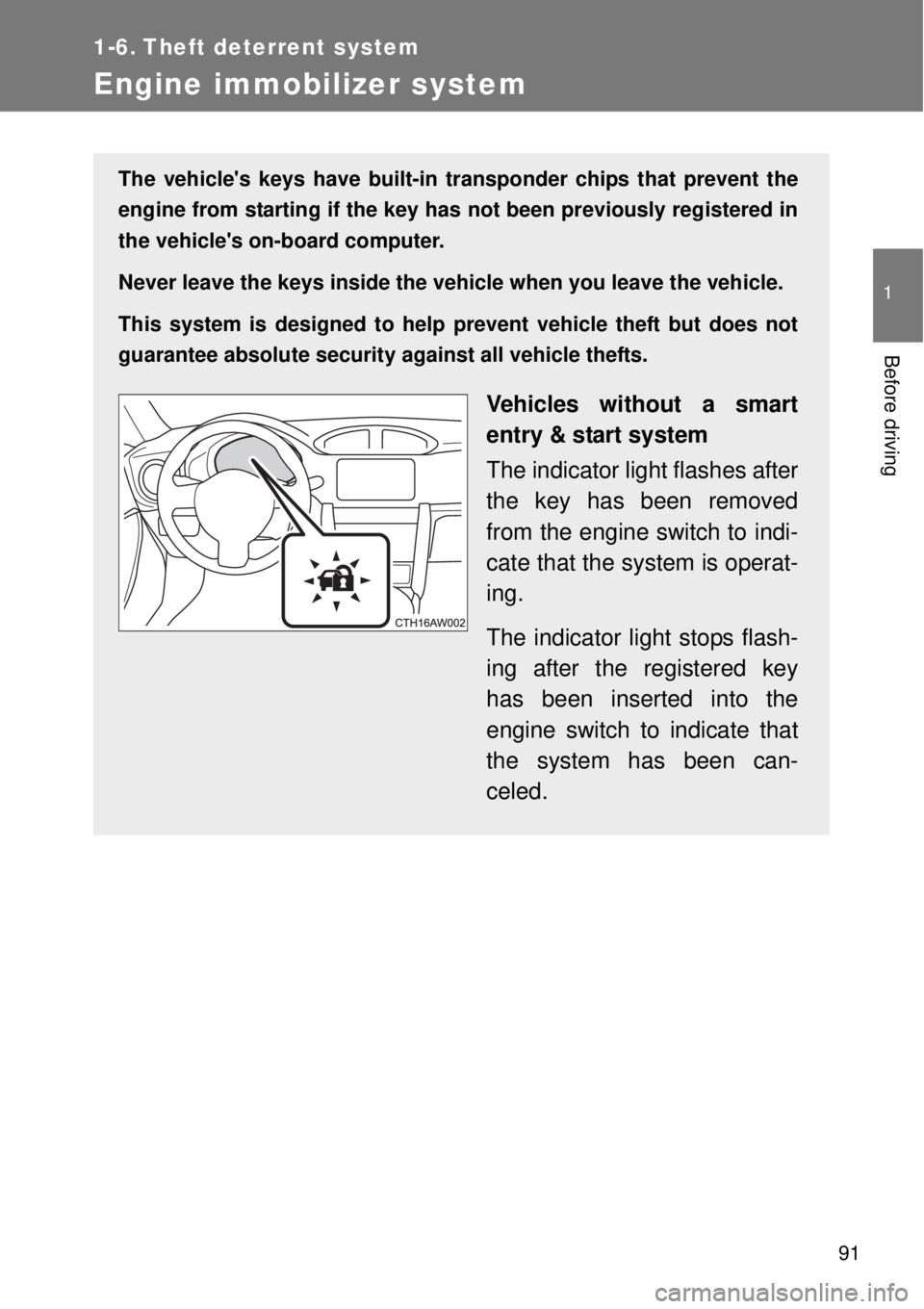
Vehicles without a smart
entry & start system
The indicator light flashes after
the key has been removed
from the engine switch to indi-
cate that the system is operat-
ing.
The indicator light stops flash-
ing after the registered key
has been inserted into the
engine switch to indicate that
the system has been can-
celed.
Page 92 of 464
92 1-6. Theft deterrent system
When the vehicle cannot be started with the registered key (vehicles
without a smart entry & start system)
Remove the key and try again.
System maintenance
The vehicle has a maintenance-free type engine immobilizer system.
Conditions that may cause the system to malfunction
If the key is in contact with a metallic object
If the key is in close proximity to or touching a key to the security system
(key with a built-in transponder chip) of another vehicle
Vehicles with a smart entry
& start system
The indicator light flashes after
the “ENGINE START STOP”
switch has been turned off to
indicate that the system is
operating.
The indicator light stops flash-
ing after the “ENGINE START
STOP” switch has been turned
to ACCESSORY or IGNITION
ON mode to indicate that the
system has been canceled.
Page 93 of 464
93 1-6. Theft deterrent system
1
Before driving
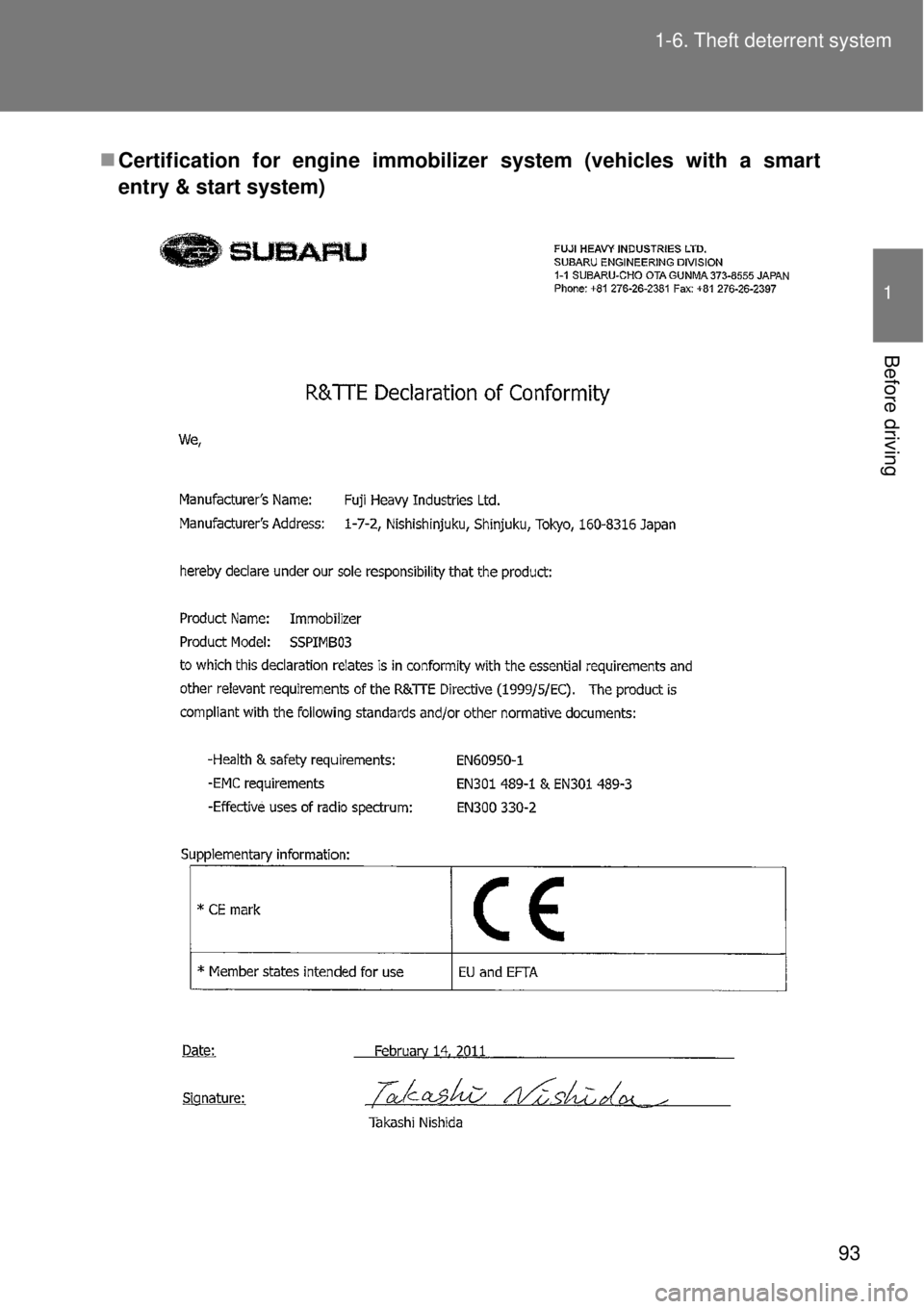
Certification for engine immobilizer system (vehicles with a smart
entry & start system)
Page 97 of 464
97 1-6. Theft deterrent system
1
Before driving
Certification for engine immobilizer system (vehicles without a smart
entry & start system)
Page 100 of 464
100
1-6. Theft deterrent system
Double locking system
Setting the double locking system
Vehicles without a smart entry & start system: Turn the engine switch
off, have all the passengers exit the vehicle and ensure that all the
doors are closed.
Vehicles with a smart entry & start system: Turn the “ENGINE START
STOP” switch off, have all the passengers exit the vehicle and ensure
that all the doors are closed.
Using the entry function (vehicles with a smart entry & start system):
Press the lock button on the outside door handle.
Using the wireless remote control:
Press .
: If equipped
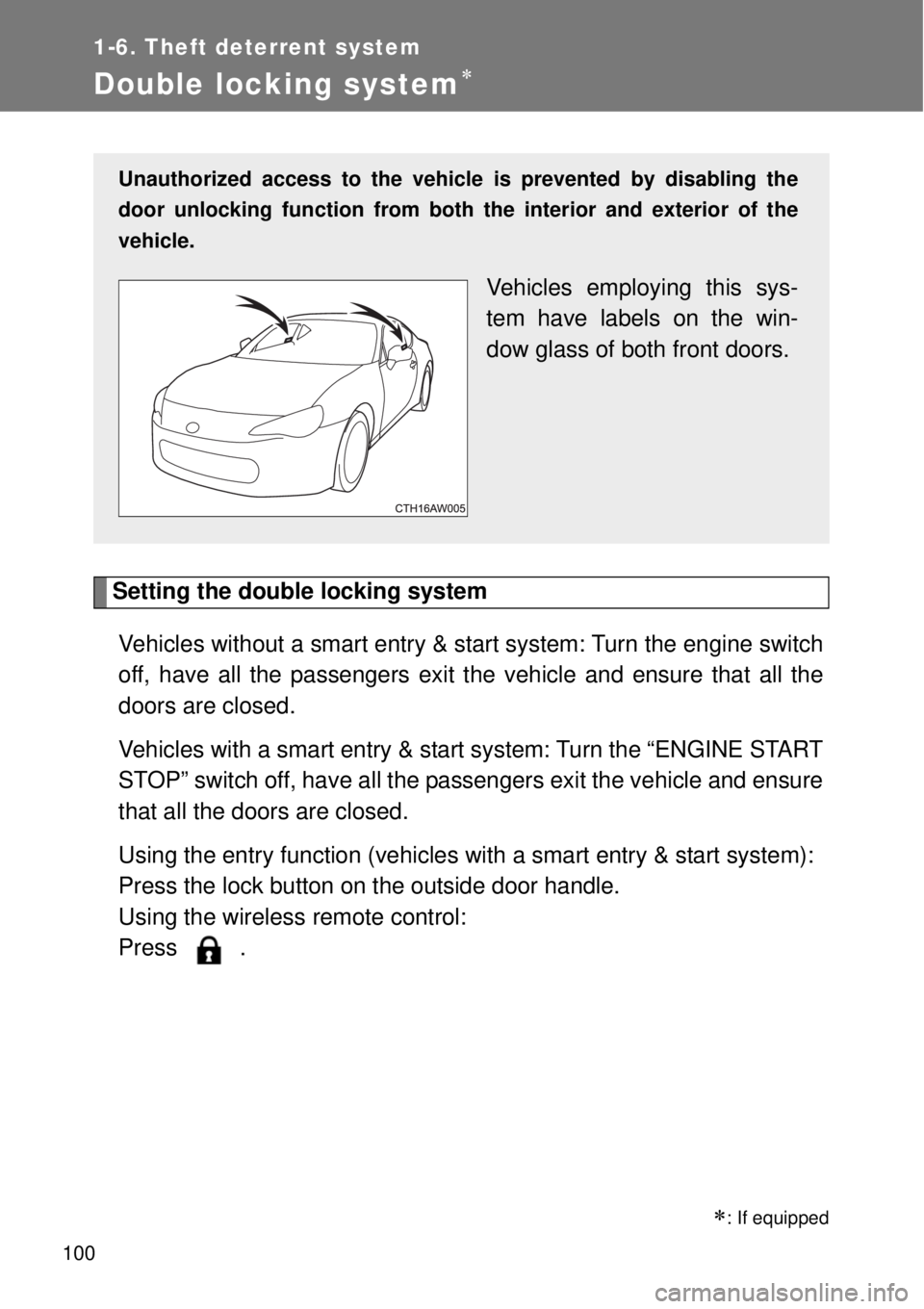
Unauthorized access to the vehicle is prevented by disabling the
door unlocking function from both the interior and exterior of the
vehicle.
Vehicles employing this sys-
tem have labels on the win-
dow glass of both front doors.
Page 114 of 464

114 1-7. Safety information
The SRS airbag can function only when the engine switch is in the “ON”
position (vehicles without a smart entry & start system) or when the
“ENGINE START STOP” switch is in IGNITION ON mode (vehicles with a
smart entry & start system).
If the front sub sensors located on both the right and left sides at the front of
the vehicle and the impact sensors in the airbag control module detect a cer-
tain predetermined amount of force during a front collision, the control mod-
ule sends signals to the front airbag modules instructing them to inflate the
SRS front airbags. Then both airbag modules produce gas, which instantly
inflates driver’s and passenger’s SRS front airbags. The knee airbag is also
inflated in combination with the SRS front airbags.
After deployment, the SRS airbags immediately start to deflate so that the
driver’s vision is not obstructed. The time required from detecting impact to
the deflation of the SRS airbag after deployment is shorter than the blink of
an eye.
Although it is highly unlikely that the SRS airbag would activate in a non-
accident situation, should it occur, the SRS airbag will deflate quickly, not
obscuring vision and will not interfere with the driver's ability to maintain con-
trol of the vehicle.
When the SRS airbag deploys, a sudden, fairly loud inflation noise will be
heard and some smoke will be released. These occurrences are normal
result of the deployment. This smoke does not indicate a fire in the vehicle.
Page 119 of 464
119 1-7. Safety information
1
Before driving
SRS side airbag and SRS curtain shield airbag
The SRS side airbag is stored in the door side of each front seat seatback,
which bears an “SRS AIRBAG” label.
In a moderate to severe side impact collision, the SRS side airbag on the
impacted side of the vehicle deploys between the occupant and the door
panel and supplements the seat belt by reducing the impact on the occupant’s
chest.
The curtain shield airbag on each side of the cabin is stored in the roof side
(between the front pillar and a point over the rear seat). An “SRS AIRBAG”
mark is located at the top of each front and rear pillar.
In a moderate to severe side impact collision, the SRS curtain shield airbag on
the impacted side of the vehicle deploys between the occupant and the side
window and supplements the seat belt by reducing the impact on the occu-
pant’s head.
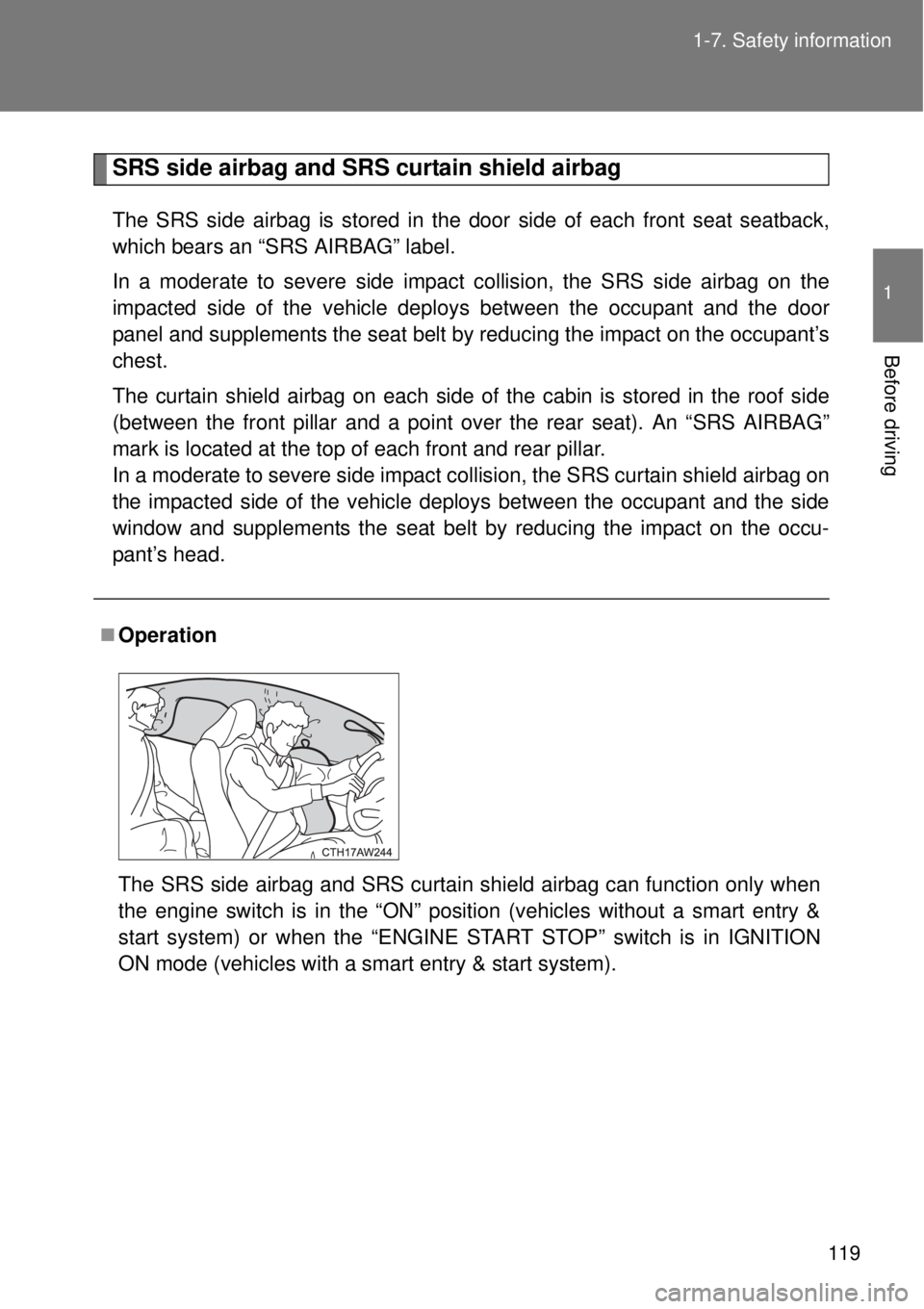
Operation
The SRS side airbag and SRS curtain shield airbag can function only when
the engine switch is in the “ON” position (vehicles without a smart entry &
start system) or when the “ENGINE START STOP” switch is in IGNITION
ON mode (vehicles with a smart entry & start system).
Page 130 of 464
130 1-7. Safety information
SRS airbag system monitor
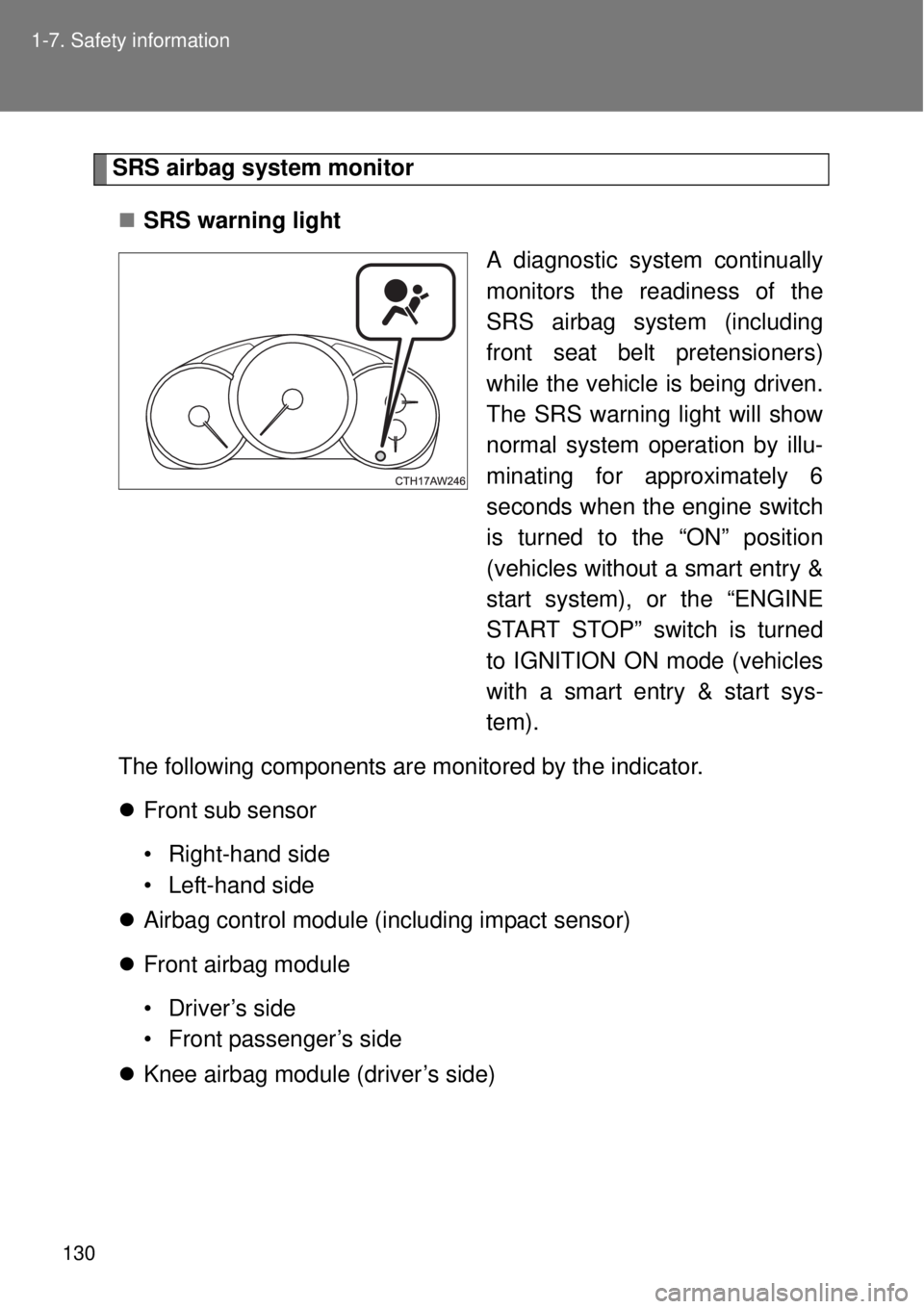
SRS warning light
A diagnostic system continually
monitors the readiness of the
SRS airbag system (including
front seat belt pretensioners)
while the vehicle is being driven.
The SRS warning light will show
normal system operation by illu-
minating for approximately 6
seconds when the engine switch
is turned to the “ON” position
(vehicles without a smart entry &
start system), or the “ENGINE
START STOP” switch is turned
to IGNITION ON mode (vehicles
with a smart entry & start sys-
tem).
The following components are monitored by the indicator.
Front sub sensor
• Right-hand side
• Left-hand side
Airbag control module (including impact sensor)
Front airbag module
• Driver’s side
• Front passenger’s side
Knee airbag module (driver’s side)