fuel TOYOTA GT86 2014 Owner's Manual
[x] Cancel search | Manufacturer: TOYOTA, Model Year: 2014, Model line: GT86, Model: TOYOTA GT86 2014Pages: 464, PDF Size: 10.65 MB
Page 231 of 464
231
2
When driving
2-5. Driving information
Cargo and luggage
CAUTION
Things that must not be carried in the trunk
The following things may cause a fire if loaded in the trunk:
Receptacles containing gasoline
Aerosol cans
Take notice of the following information about storage precautions,
cargo capacity and load:
Stow cargo and luggage in the trunk whenever possible.
Be sure all items are secured in place.
To maintain vehicle balance while driving, position luggage
evenly within the luggage compartment.
For better fuel economy, do not carry unnecessary weight.
Page 282 of 464
282
4-1. Maintenance and care
Cleaning and protecting the vehicle exterior
Automatic car washes
Fold the mirrors before washing the vehicle. Start washing from the front
of the vehicle. Make sure to extend the mirrors before driving.
Brushes used in automatic car washes may scratch the vehicle surface
and harm your vehicle’s paint.
Vehicles with a rear spoiler: In certain automatic car washes, the rear
spoiler may interfere with machine operation. This may prevent the vehi-
cle from being cleaned properly or result in damage to the rear spoiler.
High pressure car washes
Do not allow the nozzles of the car wash to come within close proximity
of the windows.
Before car wash, check that the fuel filler door on your vehicle is closed
properly.
Perform the following to protect the vehicle and maintain it in prime
condition.
Working from top to bottom, liberally apply water to the vehicle
body, wheel wells and underside of the vehicle to remove any
dirt and dust.
Wash the vehicle body using a sponge or soft cloth, such as a
chamois.
For hard-to-remove marks, use car wash soap and rinse thor-
oughly with water.
Wipe away any water.
Wax the vehicle when the waterproof coating deteriorates.
If water does not bead on a clean surface, apply wax when the vehicle
body is cool.
Page 295 of 464
295 4-3. Do-it-yourself maintenance
4
Maintenance and care
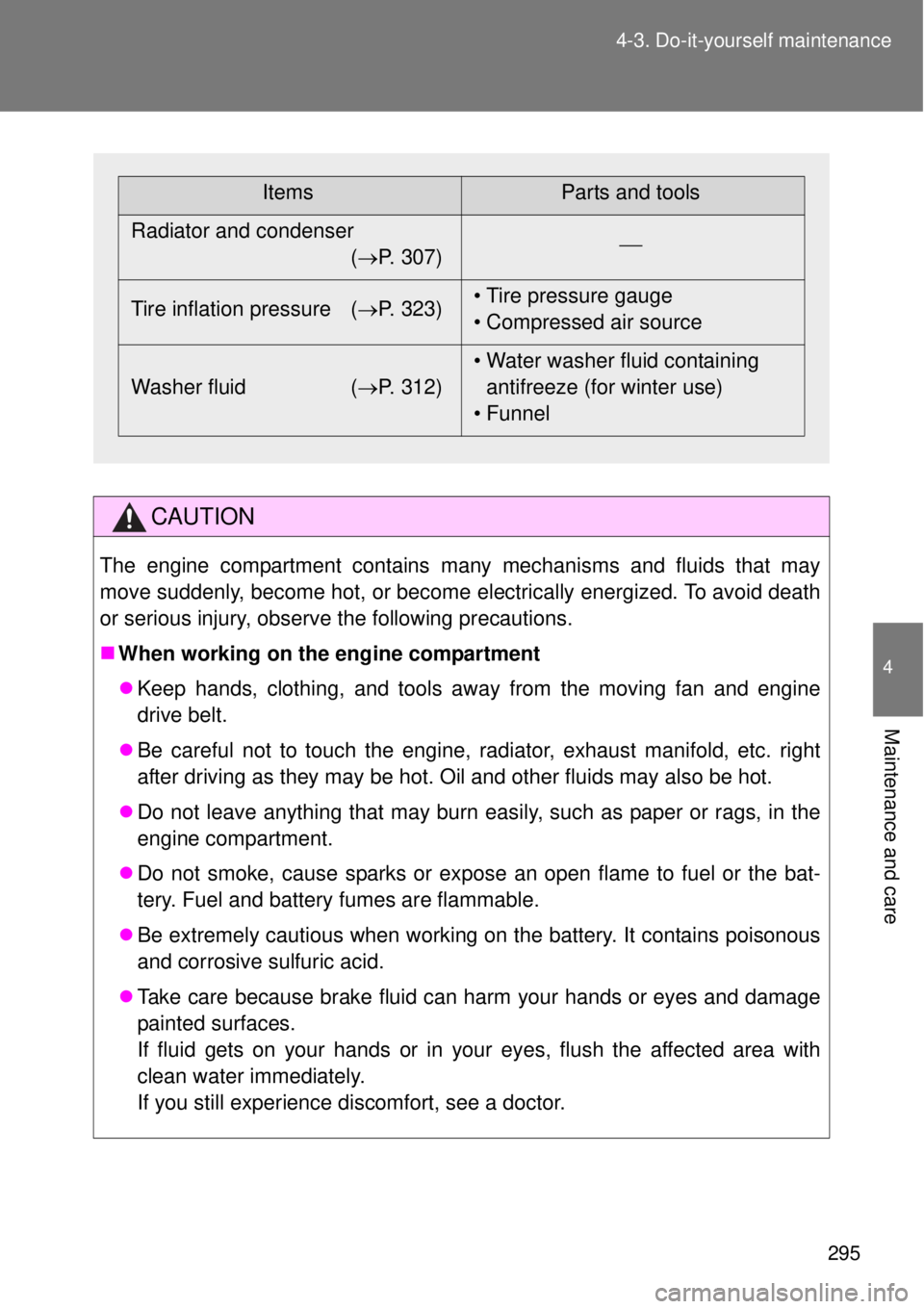
CAUTION
The engine compartment contains many mechanisms and fluids that may
move suddenly, become hot, or become electrically energized. To avoid death
or serious injury, observe the following precautions.
When working on the engine compartment
Keep hands, clothing, and tools away from the moving fan and engine
drive belt.
Be careful not to touch the engine, radiator, exhaust manifold, etc. right
after driving as they may be hot. Oil and other fluids may also be hot.
Do not leave anything that may burn easily, such as paper or rags, in the
engine compartment.
Do not smoke, cause sparks or expose an open flame to fuel or the bat-
tery. Fuel and battery fumes are flammable.
Be extremely cautious when working on the battery. It contains poisonous
and corrosive sulfuric acid.
Take care because brake fluid can harm your hands or eyes and damage
painted surfaces.
If fluid gets on your hands or in your eyes, flush the affected area with
clean water immediately.
If you still experience discomfort, see a doctor.
ItemsParts and tools
Radiator and condenser
(P. 307)
Tire inflation pressure (P. 323)• Tire pressure gauge
• Compressed air source
Washer fluid (P. 312)• Water washer fluid containing
antifreeze (for winter use)
• Funnel
Page 323 of 464
323
4-3. Do-it-yourself maintenance
4
Maintenance and care
Tire inflation pressure
Effects of incorrect tire inflation pressure
Driving with incorrect tire inflation pressure may result in the following:
Reduced fuel efficiency
Reduced driving comfort and tire life
Reduced safety
Damage to the drive train
If a tire needs frequent refilling, have it checked by any authorized Toyota
dealer or repairer, or another duly qualified and equipped professional.
Instructions for checking tire pressure
When checking tire inflation pressure, observe the following:
Check only when the tires are cold.
If your vehicle has been parked for at least 3 hours and has not been
driven for more than 1.5 km or 1 mile, you will get an accurate cold tire
inflation pressure reading.
Always use a tire pressure gauge.
The appearance of the tire can be misleading. In addition, tire inflation
pressures that are even just a few pounds off can degrade ride and han-
dling.
Do not bleed or reduce tire inflation pressure after driving. It is normal for
the tire inflation pressure to be higher after driving.
Never exceed the vehicle capacity weight.
Passengers and luggage weight should be placed so that the vehicle is
balanced.
Make sure to maintain the proper tire inflation pressure. Tire inflation
pressure should be checked at least once per month. However,
Toyota recommends that tire inflation pressure be checked once
every two weeks. (P. 443)
Page 339 of 464
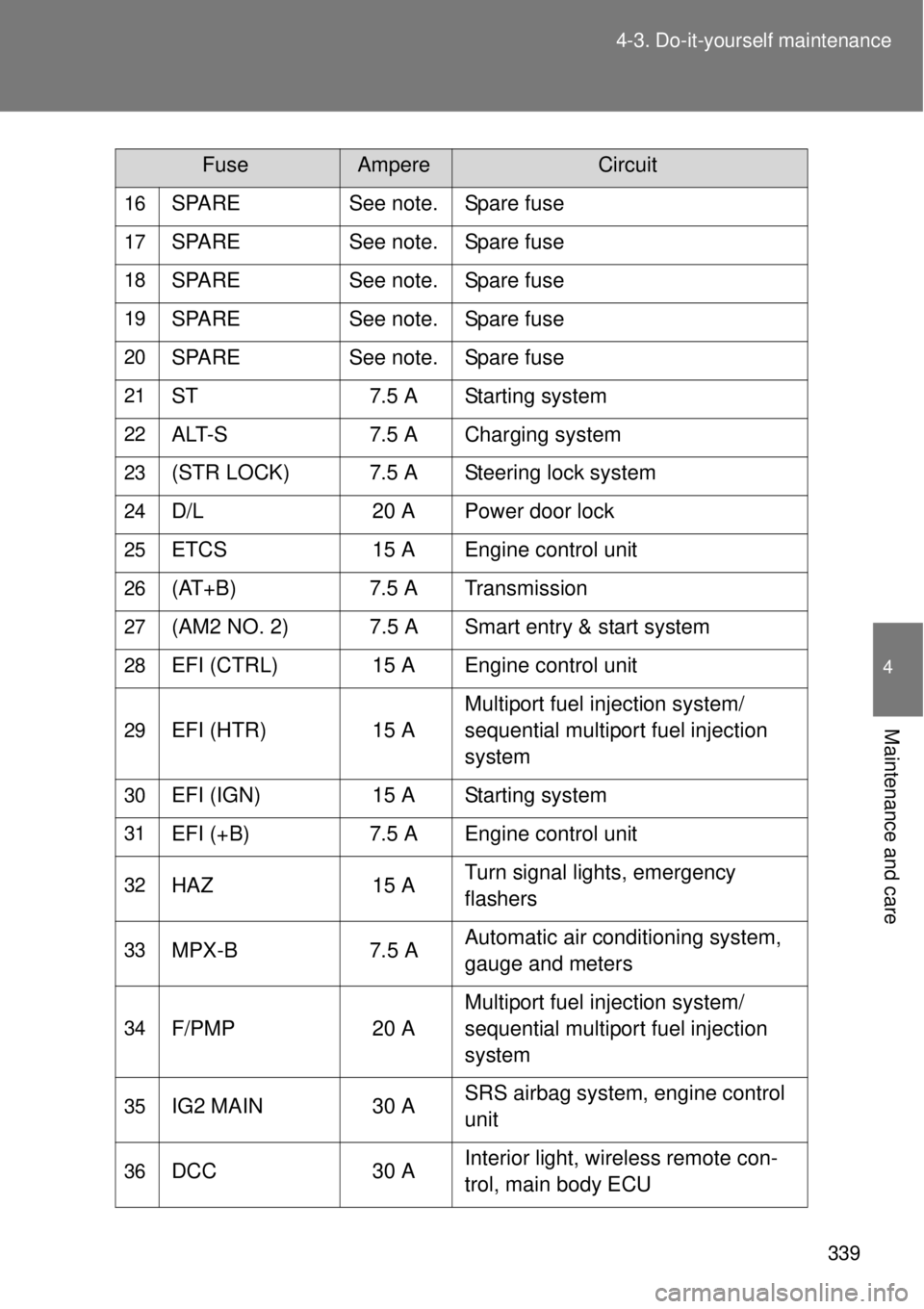
339 4-3. Do-it-yourself maintenance
4
Maintenance and care
16SPARE See note. Spare fuse
17SPARE See note. Spare fuse
18SPARE See note. Spare fuse
19SPARE See note. Spare fuse
20SPARE See note. Spare fuse
21ST 7.5 A Starting system
22ALT-S 7.5 A Charging system
23(STR LOCK) 7.5 A Steering lock system
24D/L 20 A Power door lock
25ETCS 15 A Engine control unit
26(AT+B) 7.5 A Transmission
27(AM2 NO. 2) 7.5 A Smart entry & start system
28EFI (CTRL) 15 A Engine control unit
29EFI (HTR) 15 AMultiport fuel injection system/
sequential multiport fuel injection
system
30EFI (IGN) 15 A Starting system
31EFI (+B) 7.5 A Engine control unit
32HAZ 15 ATurn signal lights, emergency
flashers
33MPX-B 7.5 AAutomatic air conditioning system,
gauge and meters
34F/PMP 20 AMultiport fuel injection system/
sequential multiport fuel injection
system
35IG2 MAIN 30 ASRS airbag system, engine control
unit
36DCC 30 AInterior light, wireless remote con-
trol, main body ECU
FuseAmpereCircuit
Page 340 of 464
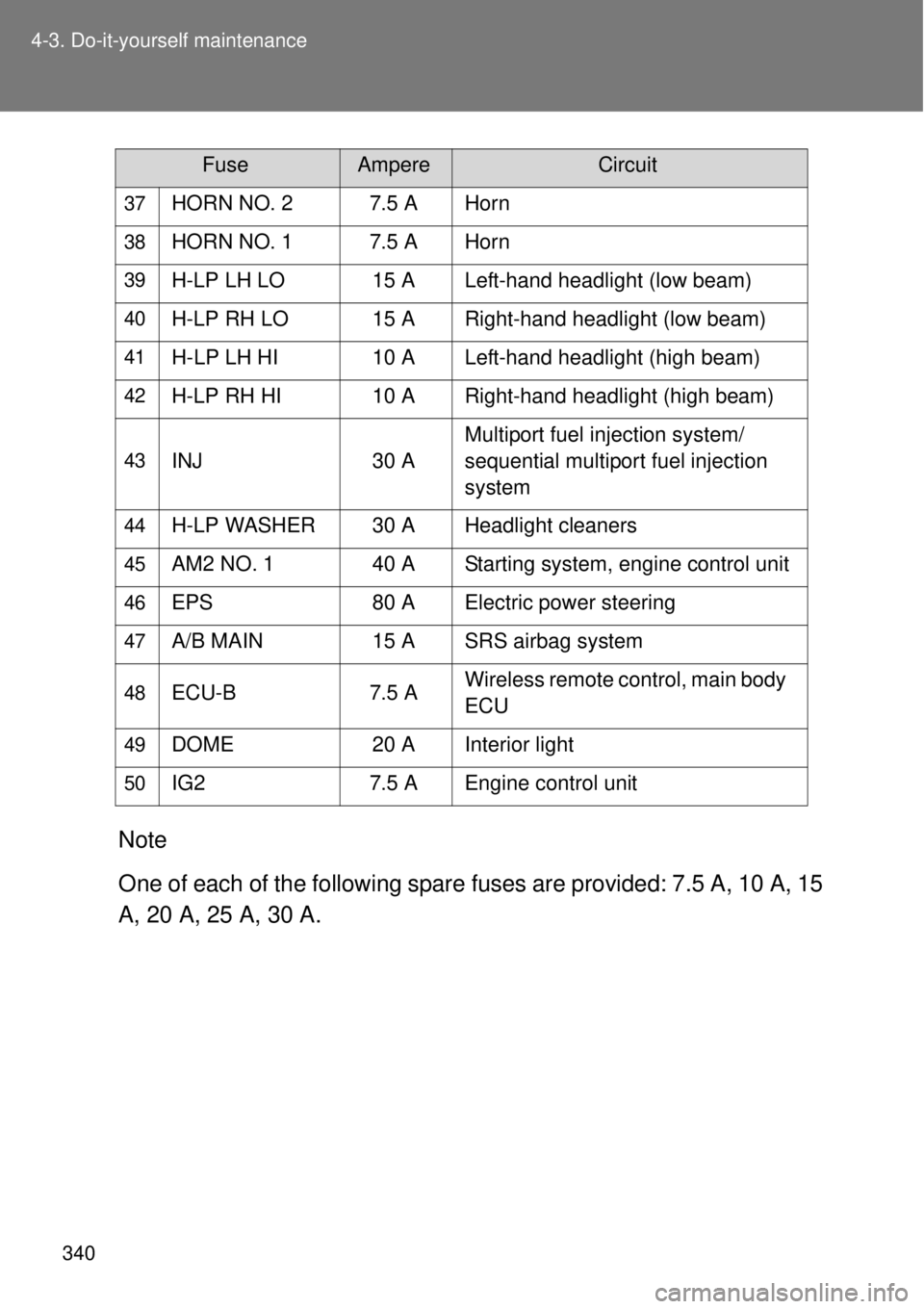
340 4-3. Do-it-yourself maintenance
Note
One of each of the following spare fuses are provided: 7.5 A, 10 A, 15
A, 20 A, 25 A, 30 A.
37HORN NO. 2 7.5 A Horn
38HORN NO. 1 7.5 A Horn
39H-LP LH LO 15 A Left-hand headlight (low beam)
40H-LP RH LO 15 A Right-hand headlight (low beam)
41H-LP LH HI 10 A Left-hand headlight (high beam)
42H-LP RH HI 10 A Right-hand headlight (high beam)
43INJ 30 AMultiport fuel injection system/
sequential multiport fuel injection
system
44H-LP WASHER 30 A Headlight cleaners
45AM2 NO. 1 40 A Starting system, engine control unit
46EPS 80 A Electric power steering
47A/B MAIN 15 A SRS airbag system
48ECU-B 7.5 AWireless remote control, main body
ECU
49DOME 20 A Interior light
50IG2 7.5 A Engine control unit
FuseAmpereCircuit
Page 361 of 464
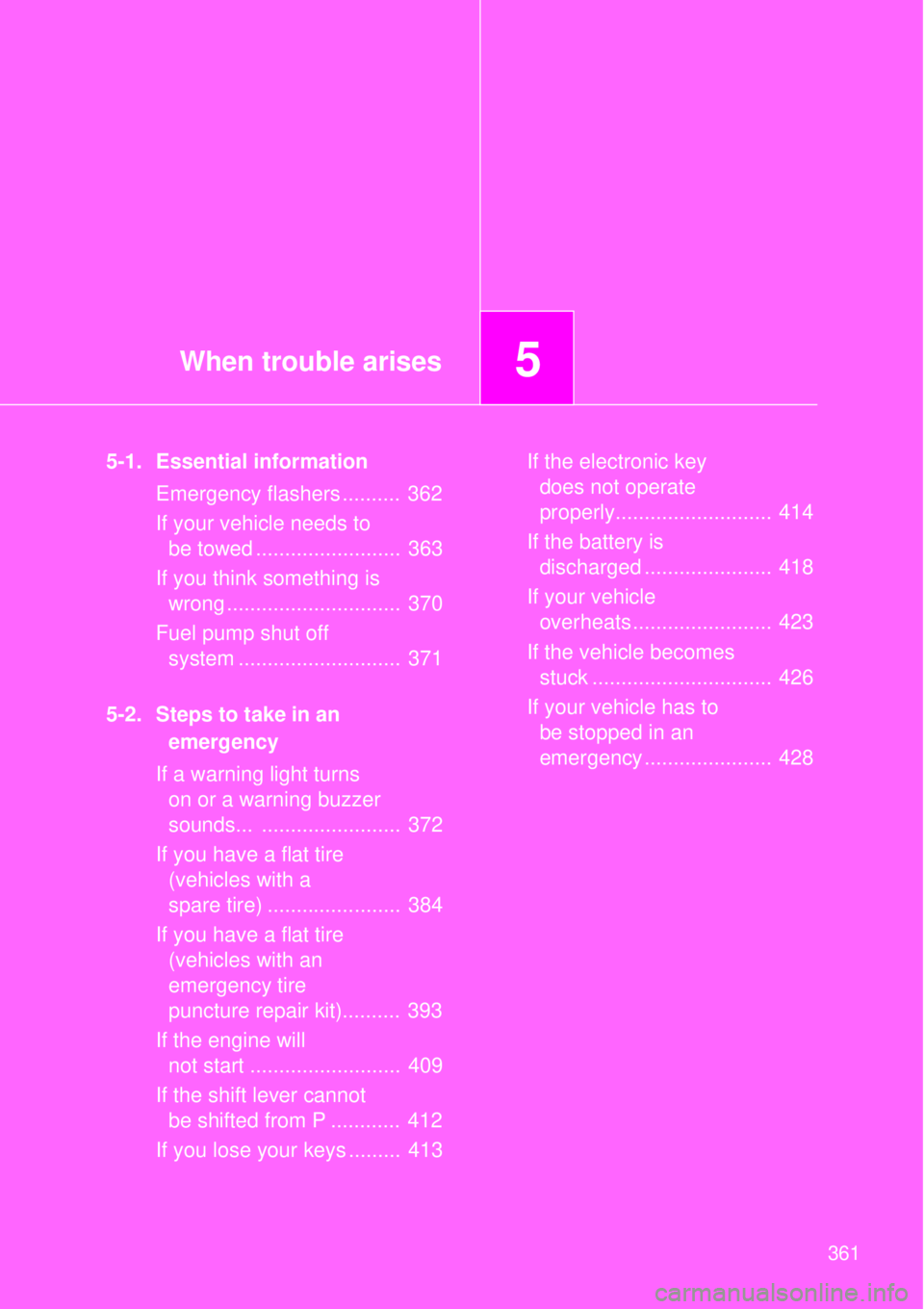
5When trouble arises
361
5-1. Essential information
Emergency flashers .......... 362
If your vehicle needs to
be towed ......................... 363
If you think something is
wrong .............................. 370
Fuel pump shut off
system ............................ 371
5-2. Steps to take in an
emergency
If a warning light turns
on or a warning buzzer
sounds... ........................ 372
If you have a flat tire
(vehicles with a
spare tire) ....................... 384
If you have a flat tire
(vehicles with an
emergency tire
puncture repair kit).......... 393
If the engine will
not start .......................... 409
If the shift lever cannot
be shifted from P ............ 412
If you lose your keys ......... 413If the electronic key
does not operate
properly........................... 414
If the battery is
discharged ...................... 418
If your vehicle
overheats ........................ 423
If the vehicle becomes
stuck ............................... 426
If your vehicle has to
be stopped in an
emergency ...................... 428
Page 371 of 464
5
371
5-1. Essential information
When trouble arises
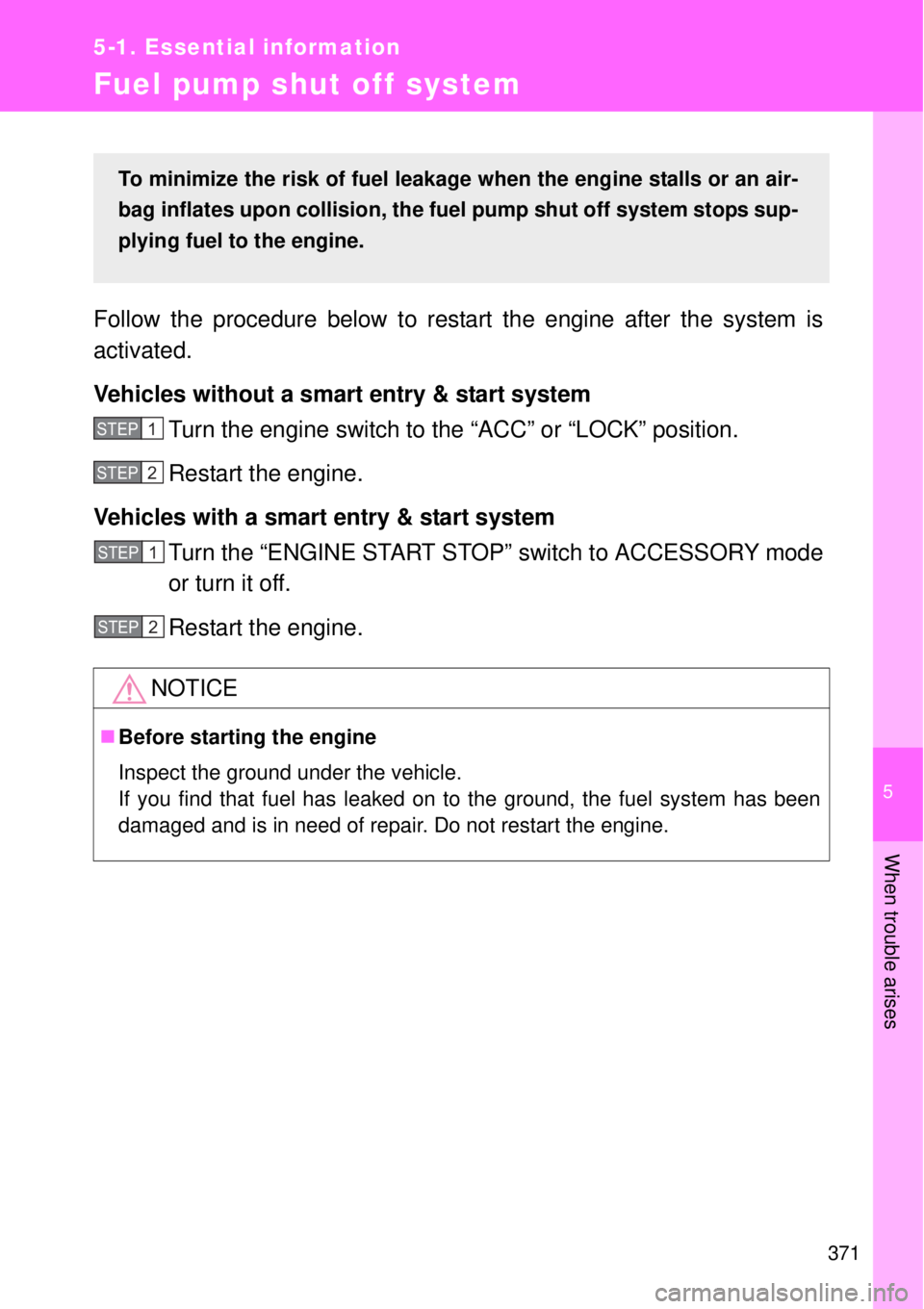
Fuel pump shut off system
Follow the procedure below to restart the engine after the system is
activated.
Vehicles without a smart entry & start system
Turn the engine switch to the “ACC” or “LOCK” position.
Restart the engine.
Vehicles with a smart entry & start system
Turn the “ENGINE START STOP” switch to ACCESSORY mode
or turn it off.
Restart the engine.
NOTICE
Before starting the engine
Inspect the ground under the vehicle.
If you find that fuel has leaked on to the ground, the fuel system has been
damaged and is in need of repair. Do not restart the engine.
To minimize the risk of fuel leakage when the engine stalls or an air-
bag inflates upon collision, the fuel pump shut off system stops sup-
plying fuel to the engine.
STEP 1
STEP 2
STEP 1
STEP 2
Page 374 of 464
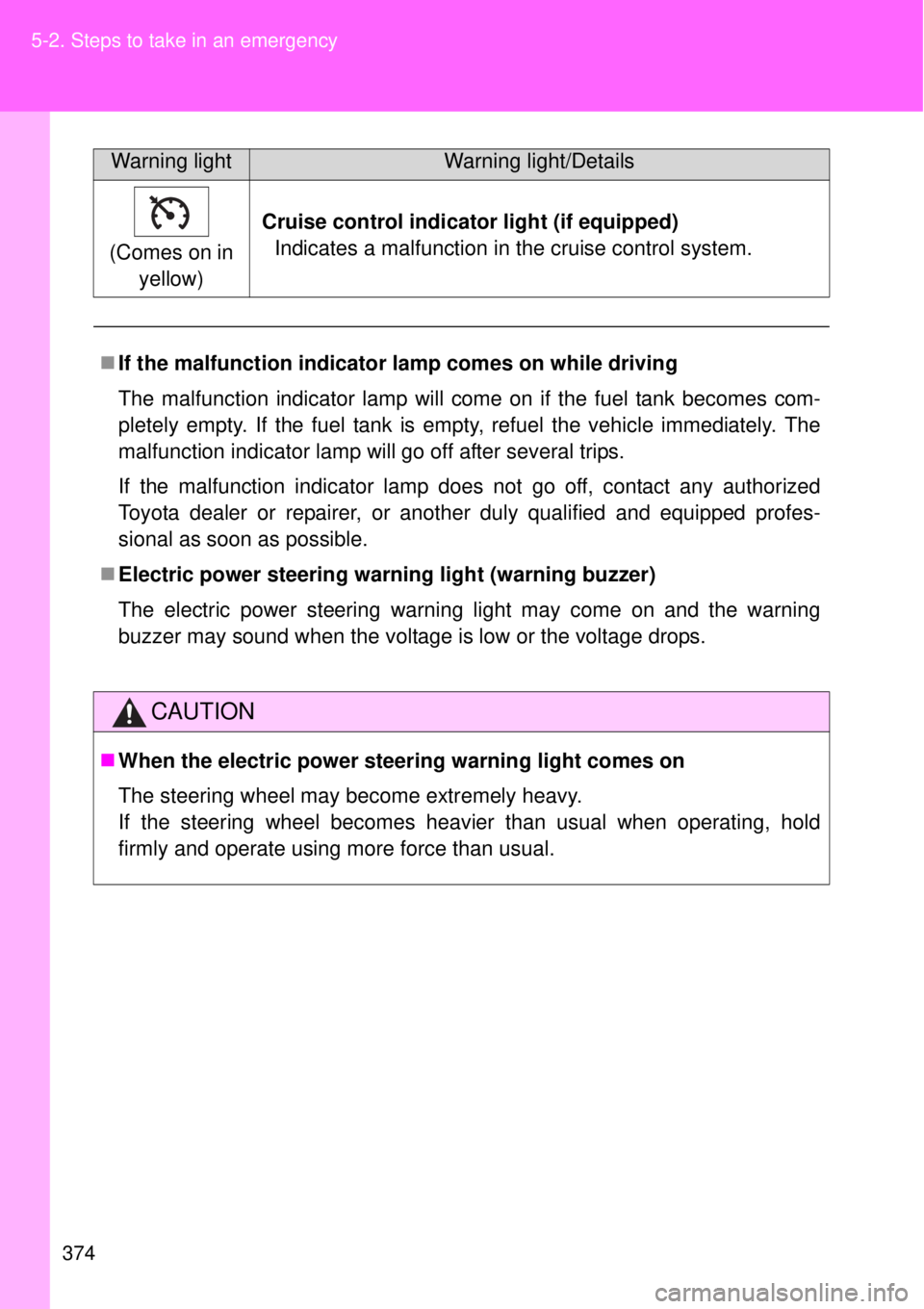
374 5-2. Steps to take in an emergency
(Comes on in
yellow)Cruise control indicator light (if equipped)
Indicates a malfunction in the cruise control system.
If the malfunction indicator lamp comes on while driving
The malfunction indicator lamp will come on if the fuel tank becomes com-
pletely empty. If the fuel tank is empty, refuel the vehicle immediately. The
malfunction indicator lamp will go off after several trips.
If the malfunction indicator lamp does not go off, contact any authorized
Toyota dealer or repairer, or another duly qualified and equipped profes-
sional as soon as possible.
Electric power steering warning light (warning buzzer)
The electric power steering warning light may come on and the warning
buzzer may sound when the voltage is low or the voltage drops.
CAUTION
When the electric power steering warning light comes on
The steering wheel may become extremely heavy.
If the steering wheel becomes heavier than usual when operating, hold
firmly and operate using more force than usual.
Warning lightWarning light/Details
Page 375 of 464
5
375 5-2. Steps to take in an emergency
When trouble arises
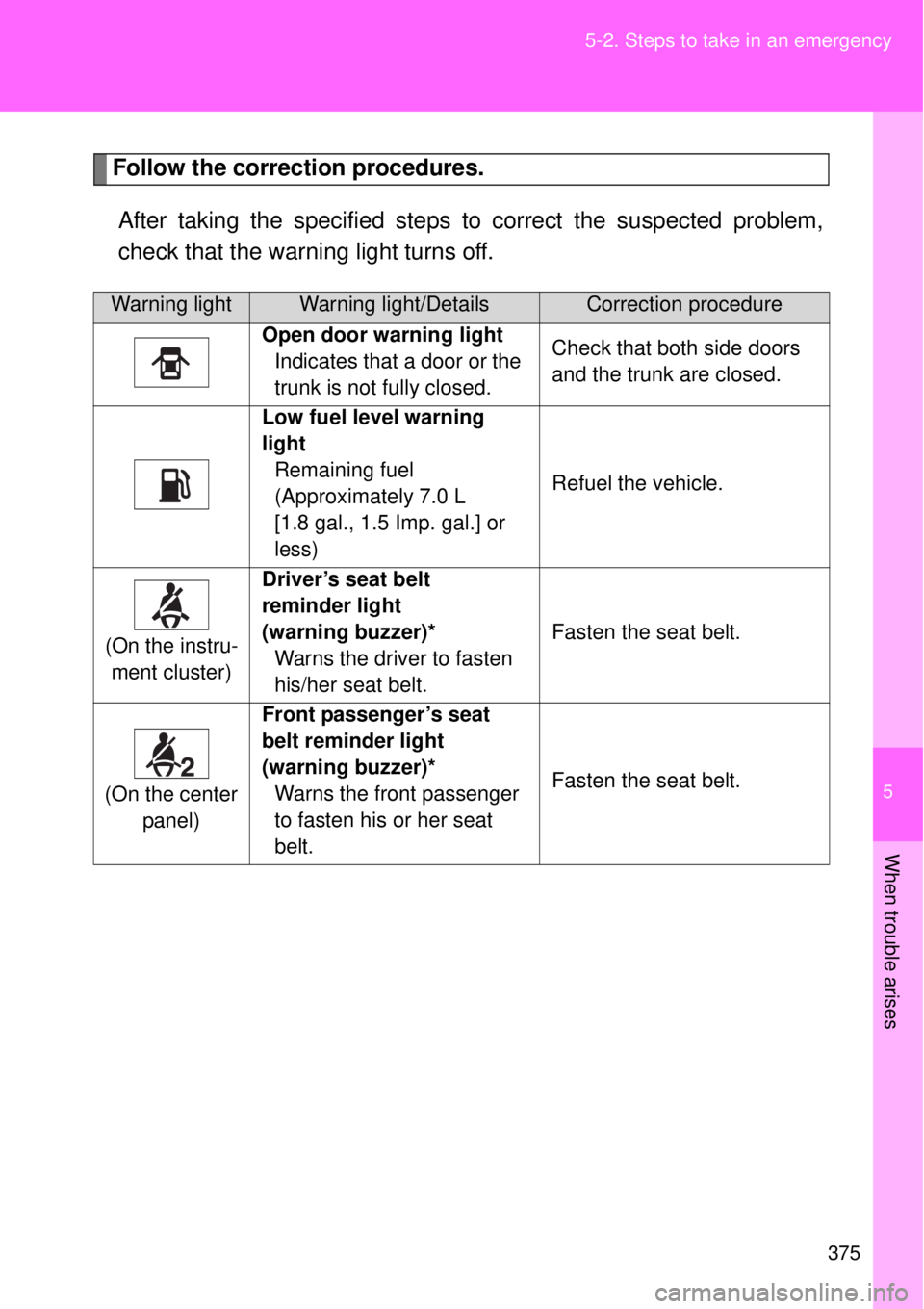
Follow the correction procedures.
After taking the specified steps to correct the suspected problem,
check that the warning light turns off.
Warning lightWarning light/DetailsCorrection procedure
Open door warning light
Indicates that a door or the
trunk is not fully closed.Check that both side doors
and the trunk are closed.
Low fuel level warning
light
Remaining fuel
(Approximately 7.0 L
[1.8 gal., 1.5 Imp. gal.] or
less)Refuel the vehicle.
(On the instru-
ment cluster)Driver’s seat belt
reminder light
(warning buzzer)*
Warns the driver to fasten
his/her seat belt.Fasten the seat belt.
(On the center
panel)Front passenger’s seat
belt reminder light
(warning buzzer)*
Warns the front passenger
to fasten his or her seat
belt.Fasten the seat belt.