warning TOYOTA GT86 2014 Owner's Manual
[x] Cancel search | Manufacturer: TOYOTA, Model Year: 2014, Model line: GT86, Model: TOYOTA GT86 2014Pages: 464, PDF Size: 10.65 MB
Page 316 of 464
316 4-3. Do-it-yourself maintenance
How to initialize the tire pressure warning system
Park the vehicle in a safe place and turn the “ENGINE START
STOP” switch (vehicles with a smart entry & start system) or
the engine switch (vehicles without a smart entry & start sys-
tem) off.
Initialization cannot be performed while the vehicle is moving.
Adjust the tire inflation pressure to the specified cold tire infla-
tion pressure level. (P. 443)
Make sure to adjust the tire pressure to the specified cold tire infla-
tion pressure level. The tire pressure warning system will operate
based on this pressure level.
Turn the “ENGINE START STOP” switch to IGNITION ON
mode (vehicles with a smart entry & start system) or engine
switch to the “ON” position (vehicles without a smart entry &
start system).
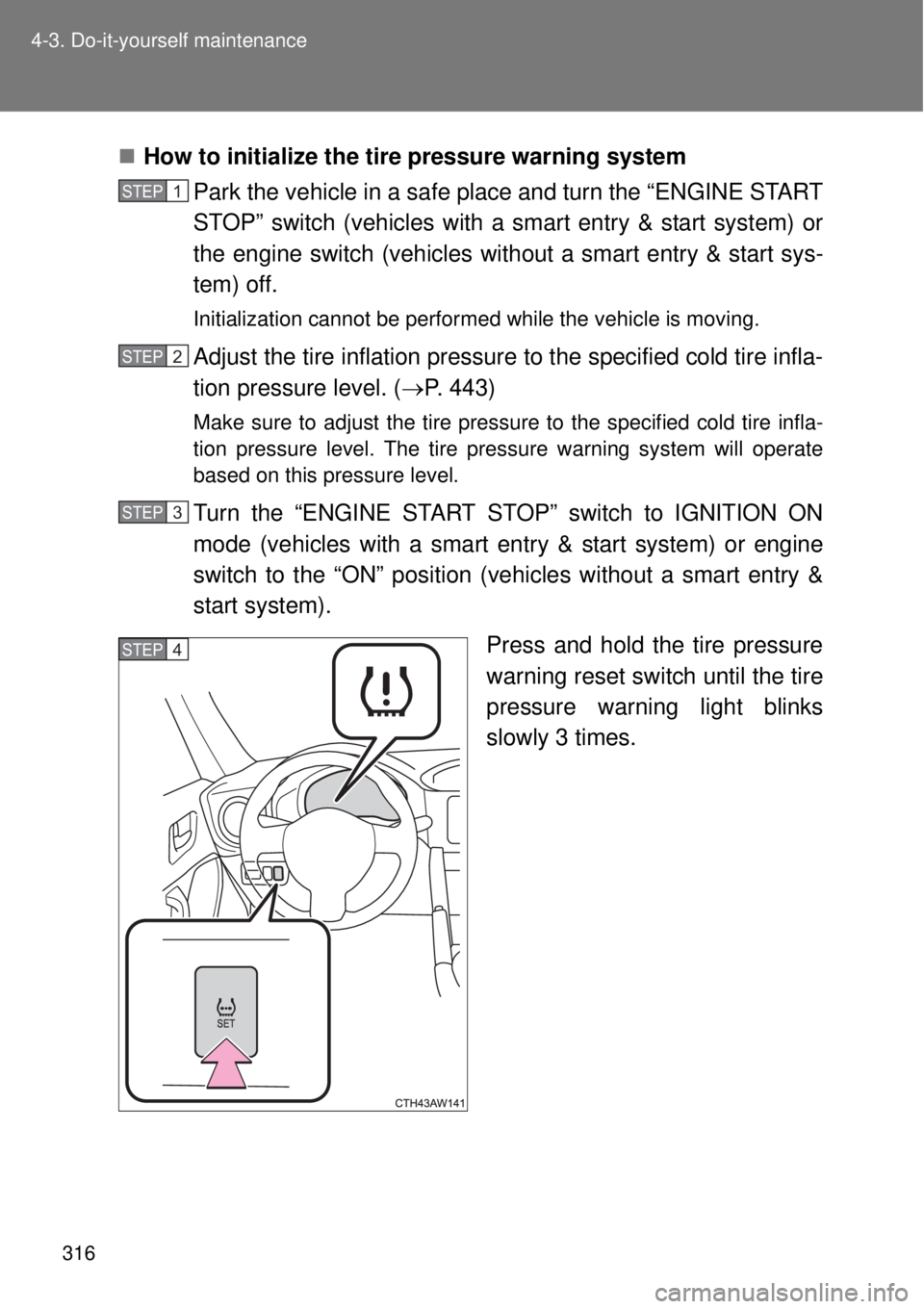
Press and hold the tire pressure
warning reset switch until the tire
pressure warning light blinks
slowly 3 times.
STEP 1
STEP 2
STEP 3
STEP 4
Page 317 of 464

317 4-3. Do-it-yourself maintenance
4
Maintenance and care
Vehicles with a smart entry & start system: Wait for a few min-
utes with the “ENGINE START STOP” switch in IGNITION ON
mode and then turn the “ENGINE START STOP” switch off.
Vehicles without a smart entry & start system: Wait for a few
minutes with the engine switch in the “ON” position and then
turn the engine switch to the “ACC” or “LOCK” position.
Registering ID codes
The tire pressure warning valve and transmitter is equipped with a
unique ID code. When replacing a tire pressure warning valve and
transmitter, it is necessary to register the ID code. Have the ID code
registered by any authorized Toyota dealer or repairer, or another
duly qualified and equipped professional.
STEP 5
Page 318 of 464

318 4-3. Do-it-yourself maintenance
When to replace your vehicle’s tires
Tires should be replaced if:
You have tire damage such as cuts, splits, cracks deep enough to
expose the fabric or bulges indicating internal damage
A tire goes flat repeatedly or cannot be properly repaired due to the size
or location of a cut or other damage
If you are not sure, consult with any authorized Toyota dealer or repairer, or
another duly qualified and equipped professional.
Replacing tires and wheels
If the ID code of the tire pressure warning valve and transmitter is not regis-
tered, the tire pressure warning system will not work properly. After driving
for about 10 minutes, the tire pressure warning light comes on after blinking
for 1 minute to indicate a system malfunction.
Tire life
Any tires over 6 years old must be checked by a qualified technician even if
they have seldom or never been used or damage is not obvious.
Routine tire inflation pressure checks
The tire pressure warning system does not replace routine tire inflation pres-
sure checks. Make sure to check tire inflation pressure as part of your rou-
tine of daily vehicle checks.
If the tread on snow tires wears down 4 mm (0.16 in.)
The effectiveness of snow tires is lost.
Low profile tires (vehicles with 17-inch tires)
Generally, low profile tires will wear more rapidly and tire grip performance
will be reduced on snowy and/or icy roads when compared to standard tires.
Be sure to use snow tires or tire chains on snowy and/or icy roads and drive
carefully at a speed appropriate for road and weather conditions.
If you press the tire pressure warning reset switch accidentally
If initialization is performed, adjust the tire inflation pressure to the specified
level and initialize the tire pressure warning system again.
Page 319 of 464
319 4-3. Do-it-yourself maintenance
4
Maintenance and care
Tire pressure warning system certification
Page 321 of 464
321 4-3. Do-it-yourself maintenance
4
Maintenance and care
CAUTION
Tire pressure warning system operation
The tire pressure warning system may not provide warning immediately if a
tire bursts or if sudden air leakage occurs.
When inspecting or replacing tires
Observe the following precautions to prevent accidents.
Failure to do so may cause damage to parts of the drive train, as well as
dangerous handling characteristics, which may lead to an accident resulting
in death or serious injury.
Make sure to install 4 tires that are of the specified size, and that all 4 tires
are the same size, same maker, same brand and tread pattern.
Do not use tire sizes other than those recommended by Toyota.
Only use radial tires.
Do not mix summer, all season and snow tires.
Do not use tires that have been used on another vehicle.
Do not use tires if you do not know how they were used previously.
When initializing the tire pressure warning system
Do not operate the tire pressure warning reset switch without first adjusting
the tire inflation pressure to the specified level. Otherwise, the tire pressure
warning light may not come on even if the tire inflation pressure is low, or it
may come on when the tire inflation pressure is actually normal.
Page 322 of 464

322 4-3. Do-it-yourself maintenance
NOTICE
Repairing or replacing tires, wheels, tire pressure warning valves,
transmitters and tire valve caps
When removing or fitting the wheels, tires or the tire pressure warning
valves and transmitters, contact any authorized Toyota dealer or repairer,
or another duly qualified and equipped professional as the tire pressure
warning valves and transmitters may be damaged if not handled correctly.
Make sure to install the tire valve caps. If the tire valve caps are not
installed, water could enter the tire pressure warning valves and the tire
pressure warning valves could be bound.
When replacing tire valve caps, do not use tire valve caps other than those
specified. The cap may become stuck.
To avoid damage to the tire pressure warning valves and transmitters
When a tire is repaired with liquid sealants, the tire pressure warning valve
and transmitter may not operate properly. If a liquid sealant is used, contact
any authorized Toyota dealer or repairer, or another duly qualified and
equipped professional or other qualified service shop as soon as possible.
Make sure to replace the tire pressure warning valve and transmitter when
replacing the tire. (P. 315)
Driving on rough roads
Take particular care when driving on roads with loose surfaces or pot holes.
These conditions may cause losses in tire air pressure, reducing the cush-
ioning ability of the tires. In addition driving on rough roads may cause dam-
age to the tires themselves, as well as the vehicle’s wheels and body.
Low profile tires and wheels (vehicles with 17-inch tires)
Low profile tires may cause greater damage than usual to the tire wheel
when receiving impact from the road surface. Therefore pay attention to the
following:
Be sure to use proper tire inflation pressure. If tires are under-inflated, they
may be damaged more severely.
Avoid pot holes, uneven pavement, curbs and other road hazards. Failure
to do so can lead to severe tire and wheel damage.
If tire pressures become low while driving
Do not continue driving, or your tires and/or wheels may be ruined.
Page 326 of 464
326 4-3. Do-it-yourself maintenance
When replacing wheels
The wheels of your Toyota are equipped with tire pressure warning valves
and transmitters that allow the tire pressure warning system to provide
advance warning in the event of a loss in tire inflation pressure. Whenever
wheels are replaced, the tire pressure warning valves and transmitters must
be installed. (P. 315)
CAUTION
When replacing wheels
Do not use wheels that are a different size from those recommended in the
Owner’s Manual, as this may result in loss of handling control.
Never use an inner tube in a leaking wheel which is designed for a tube-
less tire. Doing so may result in an accident, causing death or serious
injury.
When installing the wheel nuts
Never use oil or grease on the wheel bolts or wheel nuts.
Oil and grease may cause the wheel nuts to be excessively tightened,
leading to bolt or disc wheel damage. In addition, the oil or grease can
cause the wheel nuts to loosen and the wheel may fall off, causing an acci-
dent and resulting in death or serious injury. Remove any oil or grease
from the wheel bolts or wheel nuts.
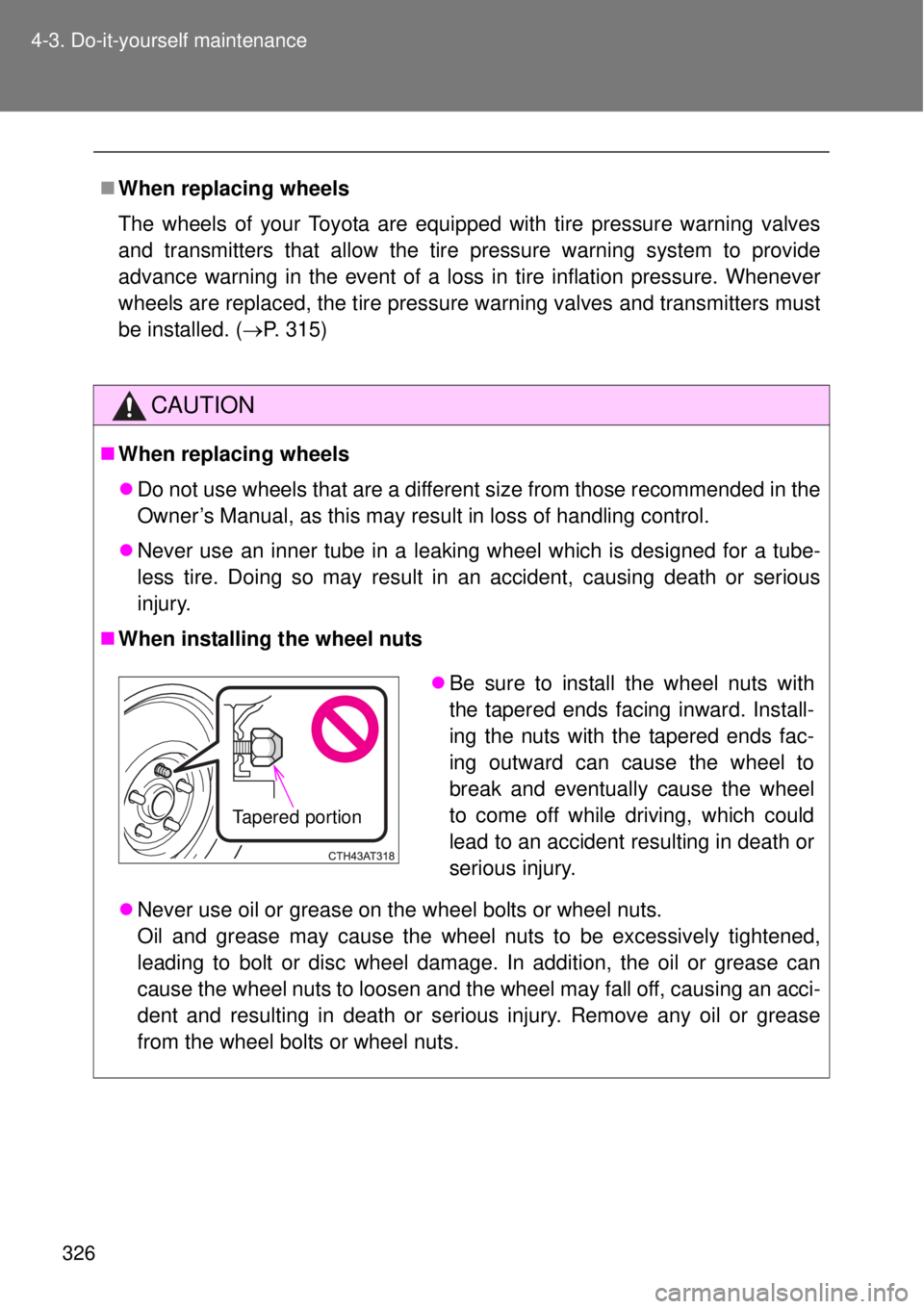
Be sure to install the wheel nuts with
the tapered ends facing inward. Install-
ing the nuts with the tapered ends fac-
ing outward can cause the wheel to
break and eventually cause the wheel
to come off while driving, which could
lead to an accident resulting in death or
serious injury.
Tapered portion
Page 327 of 464

327 4-3. Do-it-yourself maintenance
4
Maintenance and care
NOTICE
Replacing tire pressure warning valves and transmitters
Because tire repair or replacement may affect the tire pressure warning
valves and transmitters, make sure to have tires serviced by any autho-
rized Toyota dealer or repairer, or another duly qualified and equipped pro-
fessional or other qualified service shop. In addition, make sure to
purchase your tire pressure warning valves and transmitters at any autho-
rized Toyota dealer or repairer, or another duly qualified and equipped pro-
fessional.
Ensure that only genuine Toyota wheels are used on your vehicle.
Tire pressure warning valves and transmitters may not work properly with
non-genuine wheels.
Page 361 of 464
5When trouble arises
361
5-1. Essential information
Emergency flashers .......... 362
If your vehicle needs to
be towed ......................... 363
If you think something is
wrong .............................. 370
Fuel pump shut off
system ............................ 371
5-2. Steps to take in an
emergency
If a warning light turns
on or a warning buzzer
sounds... ........................ 372
If you have a flat tire
(vehicles with a
spare tire) ....................... 384
If you have a flat tire
(vehicles with an
emergency tire
puncture repair kit).......... 393
If the engine will
not start .......................... 409
If the shift lever cannot
be shifted from P ............ 412
If you lose your keys ......... 413If the electronic key
does not operate
properly........................... 414
If the battery is
discharged ...................... 418
If your vehicle
overheats ........................ 423
If the vehicle becomes
stuck ............................... 426
If your vehicle has to
be stopped in an
emergency ...................... 428
Page 372 of 464
372
5-2. Steps to take in an emergency
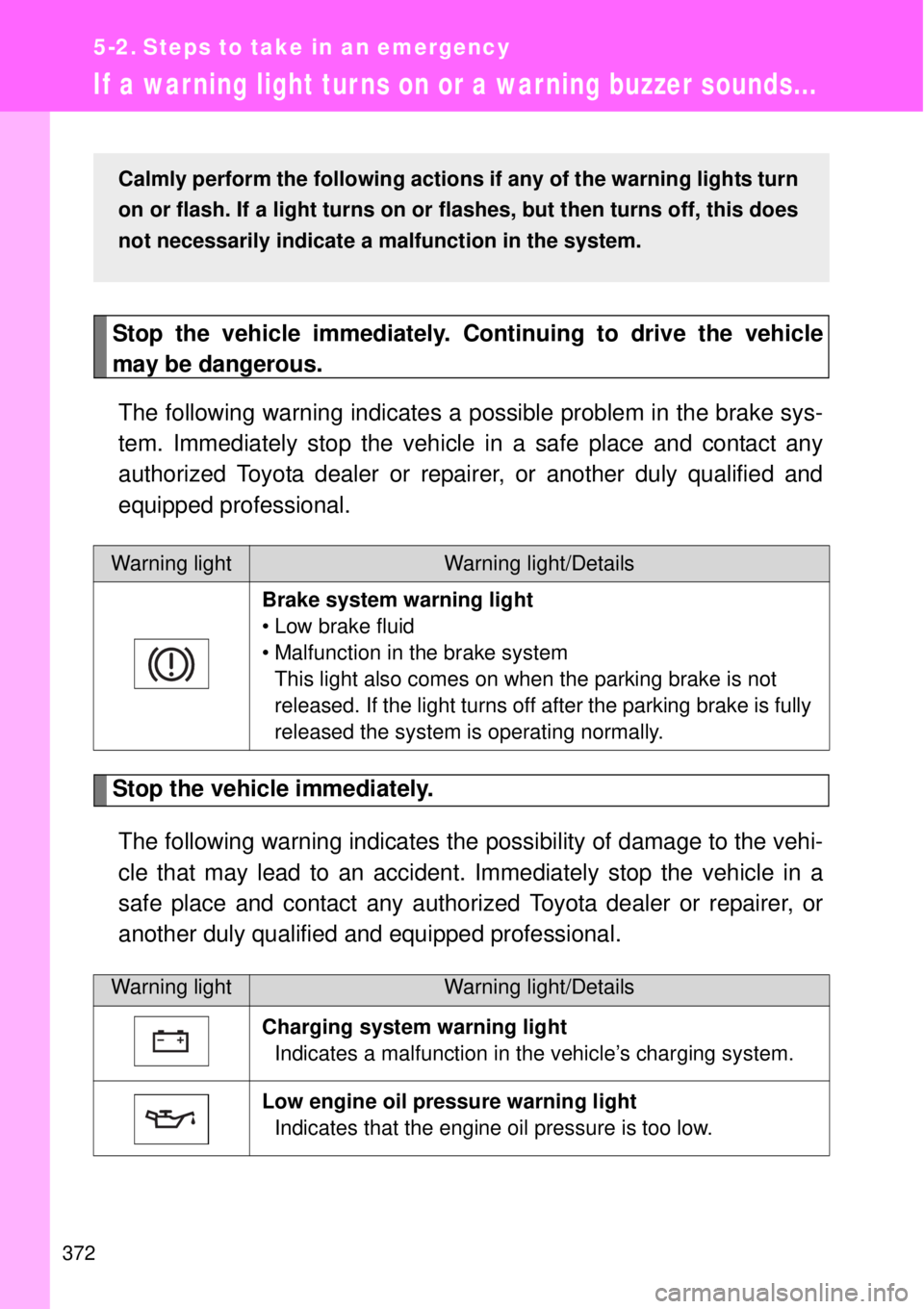
If a war ning light tur ns on or a warning buzzer sounds...
Stop the vehicle immediately. Continuing to drive the vehicle
may be dangerous.
The following warning indicates a possible problem in the brake sys-
tem. Immediately stop the vehicle in a safe place and contact any
authorized Toyota dealer or repairer, or another duly qualified and
equipped professional.
Stop the vehicle immediately.
The following warning indicates the possibility of damage to the vehi-
cle that may lead to an accident. Immediately stop the vehicle in a
safe place and contact any authorized Toyota dealer or repairer, or
another duly qualified and equipped professional.
Warning lightWarning light/Details
Brake system warning light
• Low brake fluid
• Malfunction in the brake system
This light also comes on when the parking brake is not
released. If the light turns off after the parking brake is fully
released the system is operating normally.
Warning lightWarning light/Details
Charging system warning light
Indicates a malfunction in the vehicle’s charging system.
Low engine oil pressure warning light
Indicates that the engine oil pressure is too low.
Calmly perform the following actions if any of the warning lights turn
on or flash. If a light turns on or flashes, but then turns off, this does
not necessarily indicate a malfunction in the system.