maintenance TOYOTA GT86 2014 Owner's Guide
[x] Cancel search | Manufacturer: TOYOTA, Model Year: 2014, Model line: GT86, Model: TOYOTA GT86 2014Pages: 464, PDF Size: 10.65 MB
Page 307 of 464
307 4-3. Do-it-yourself maintenance
4
Maintenance and care
Radiator and condenser
Check the radiator and condenser and clear any foreign objects.
If either of the above parts are extremely dirty or you are not sure of
their condition, have your vehicle checked by any authorized Toyota
dealer or repairer, or another duly qualified and equipped profes-
sional.
CAUTION
When the engine is hot
Do not touch the radiator or condenser as they may be hot and cause seri-
ous injuries, such as burns.
Page 308 of 464
308 4-3. Do-it-yourself maintenance
Battery
Check the battery as follows.
Caution symbols
The meanings of each caution symbol on the top of the battery are as
follows:
Battery exterior
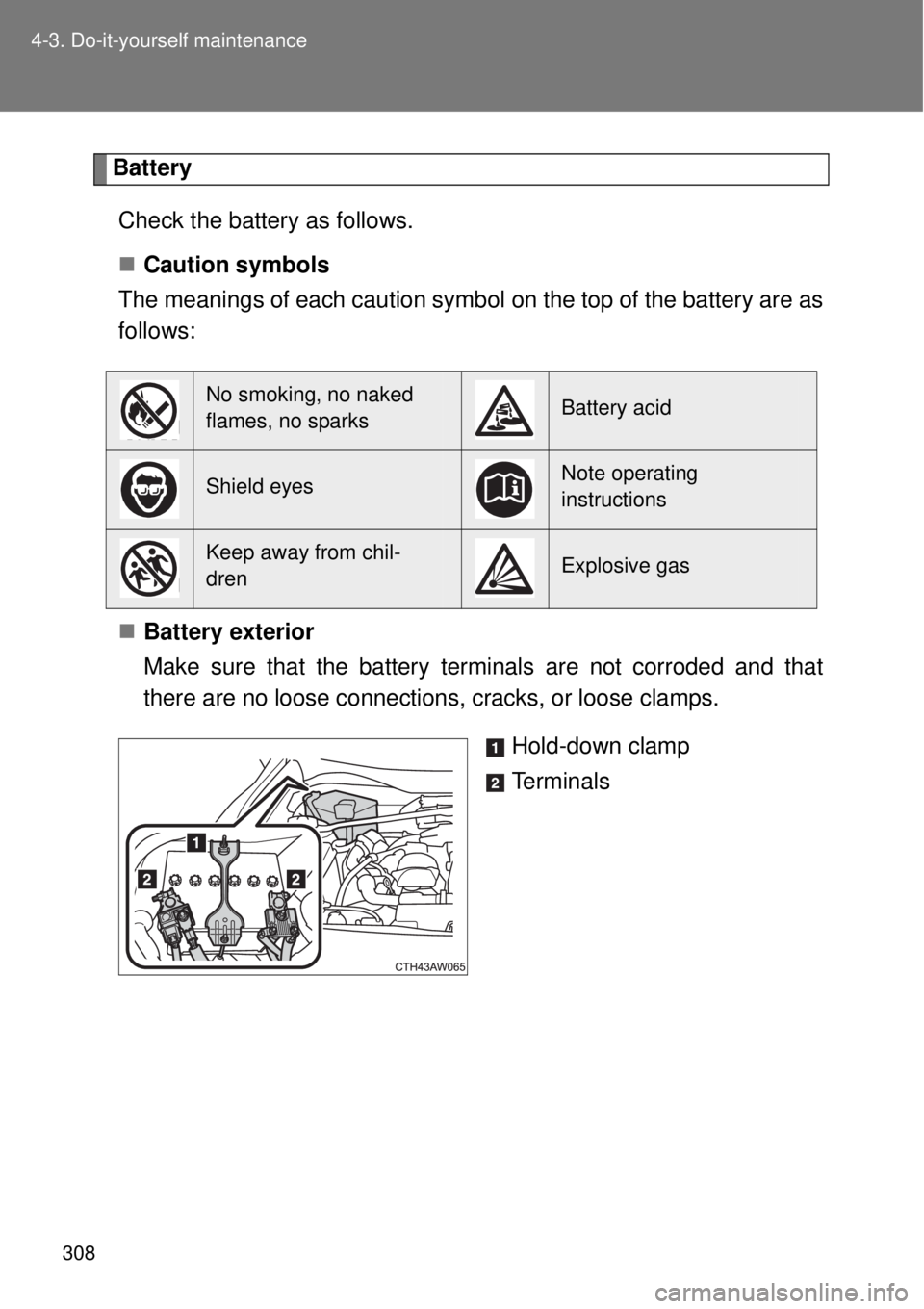
Make sure that the battery terminals are not corroded and that
there are no loose connections, cracks, or loose clamps.
Hold-down clamp
Terminals
No smoking, no naked
flames, no sparksBattery acid
Shield eyesNote operating
instructions
Keep away from chil-
drenExplosive gas
Page 309 of 464
309 4-3. Do-it-yourself maintenance
4
Maintenance and care
Checking battery fluid
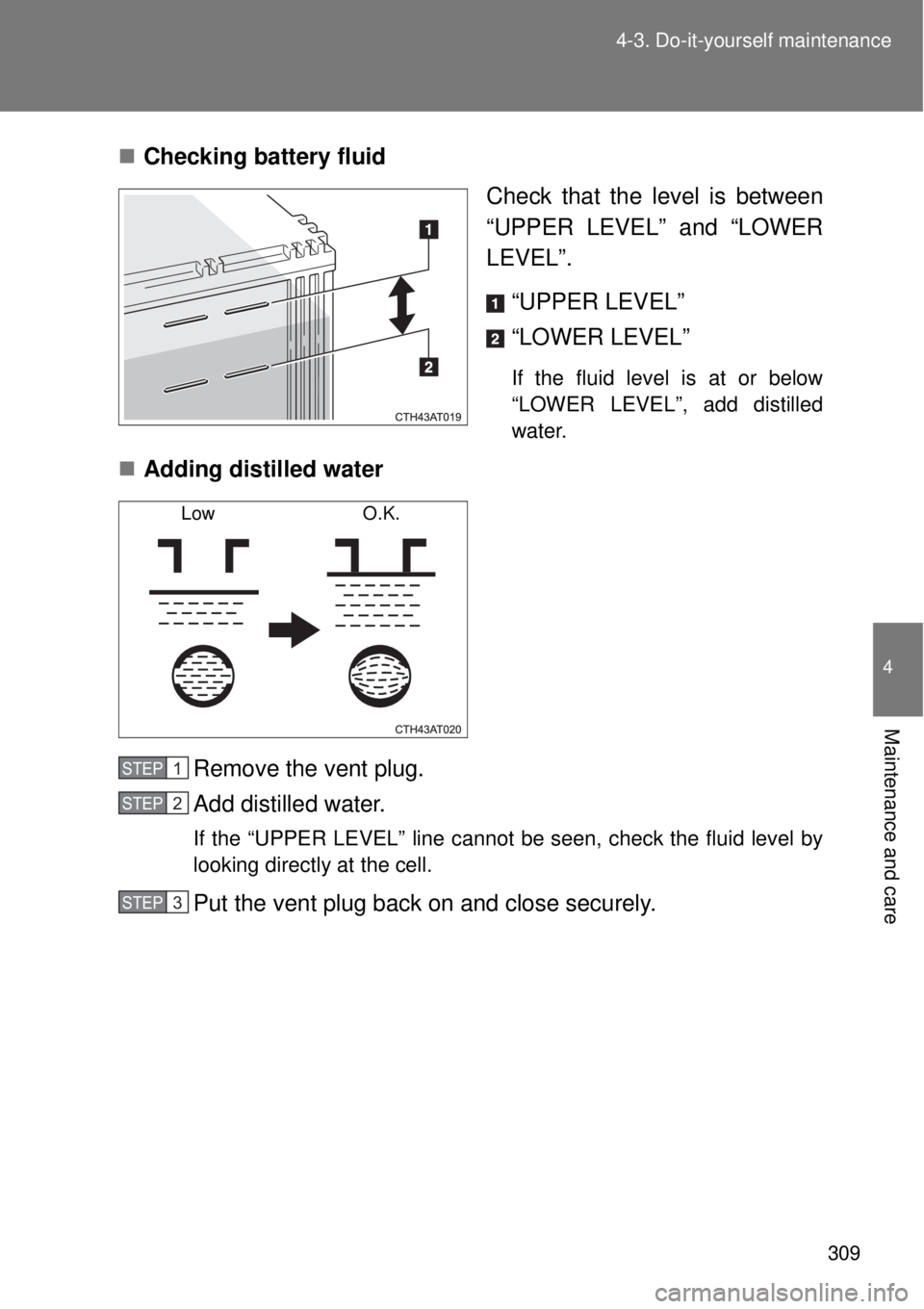
Check that the level is between
“UPPER LEVEL” and “LOWER
LEVEL”.
“UPPER LEVEL”
“LOWER LEVEL”
If the fluid level is at or below
“LOWER LEVEL”, add distilled
water.
Adding distilled water
Remove the vent plug.
Add distilled water.
If the “UPPER LEVEL” line cannot be seen, check the fluid level by
looking directly at the cell.
Put the vent plug back on and close securely.
Low O.K.
STEP 1
STEP 2
STEP 3
Page 310 of 464

310 4-3. Do-it-yourself maintenance
Before recharging
When recharging, the battery produces hydrogen gas which is flammable
and explosive. Therefore, before recharging:
If recharging with the battery installed on the vehicle, be sure to discon-
nect the ground cable.
Make sure the power switch on the charger is off when connecting and
disconnecting the charger cables to the battery.
After recharging/reconnecting the battery (vehicles with a smart entry
& start system)
Unlocking the doors using the smart entry & start system may not be
possible immediately after reconnecting the battery. If this happens, use
the wireless remote control or the mechanical key to lock/unlock the
doors.
Start the engine with the “ENGINE START STOP” switch in ACCES-
SORY mode. The engine may not start with the “ENGINE START STOP”
switch turned off. However, the engine will operate normally from the sec-
ond attempt.
The “ENGINE START STOP” switch mode is recorded by the vehicle. If
the battery is reconnected, the vehicle will return the “ENGINE START
STOP” switch mode to the status it was in before the battery was discon-
nected. Make sure to turn off the engine before disconnect the battery.
Take extra care when connecting the battery if the “ENGINE START
STOP” switch mode prior to discharge is unknown.
If the engine will not start even after multiple attempts, contact any
authorized Toyota dealer or repairer, or another duly qualified and equipped
professional.
Page 311 of 464
311 4-3. Do-it-yourself maintenance
4
Maintenance and care
CAUTION
Chemicals in the battery
A battery contains poisonous and corrosive sulfuric acid and may produce
hydrogen gas which is flammable and explosive. To reduce the risk of death
or serious injury, take the following precautions while working on or near the
battery:
Do not cause sparks by touching the battery terminals with tools.
Do not smoke or light a match near the battery.
Avoid contact with eyes, skin and clothes.
Never inhale or swallow electrolyte.
Wear protective safety glasses when working near the battery.
Keep children away from the battery.
Where to safely charge the battery
Always charge the battery in an open area. Do not charge the battery in a
garage or closed room where there is not sufficient ventilation.
Emergency measures regarding electrolyte
If electrolyte gets in your eyes
Flush your eyes with clean water for at least 15 minutes and get immedi-
ate medical attention. If possible, continue to apply water with a sponge or
cloth while traveling to the nearest medical facility.
If electrolyte gets on your skin
Wash the affected area thoroughly. If you feel pain or burning, get medical
attention immediately.
If electrolyte gets on your clothes
It can soak through clothing on to your skin. Immediately take off the cloth-
ing and follow the procedure above if necessary.
If you accidentally swallow electrolyte
Drink a large quantity of water or milk. Get emergency medical attention
immediately.
Page 312 of 464
312 4-3. Do-it-yourself maintenance
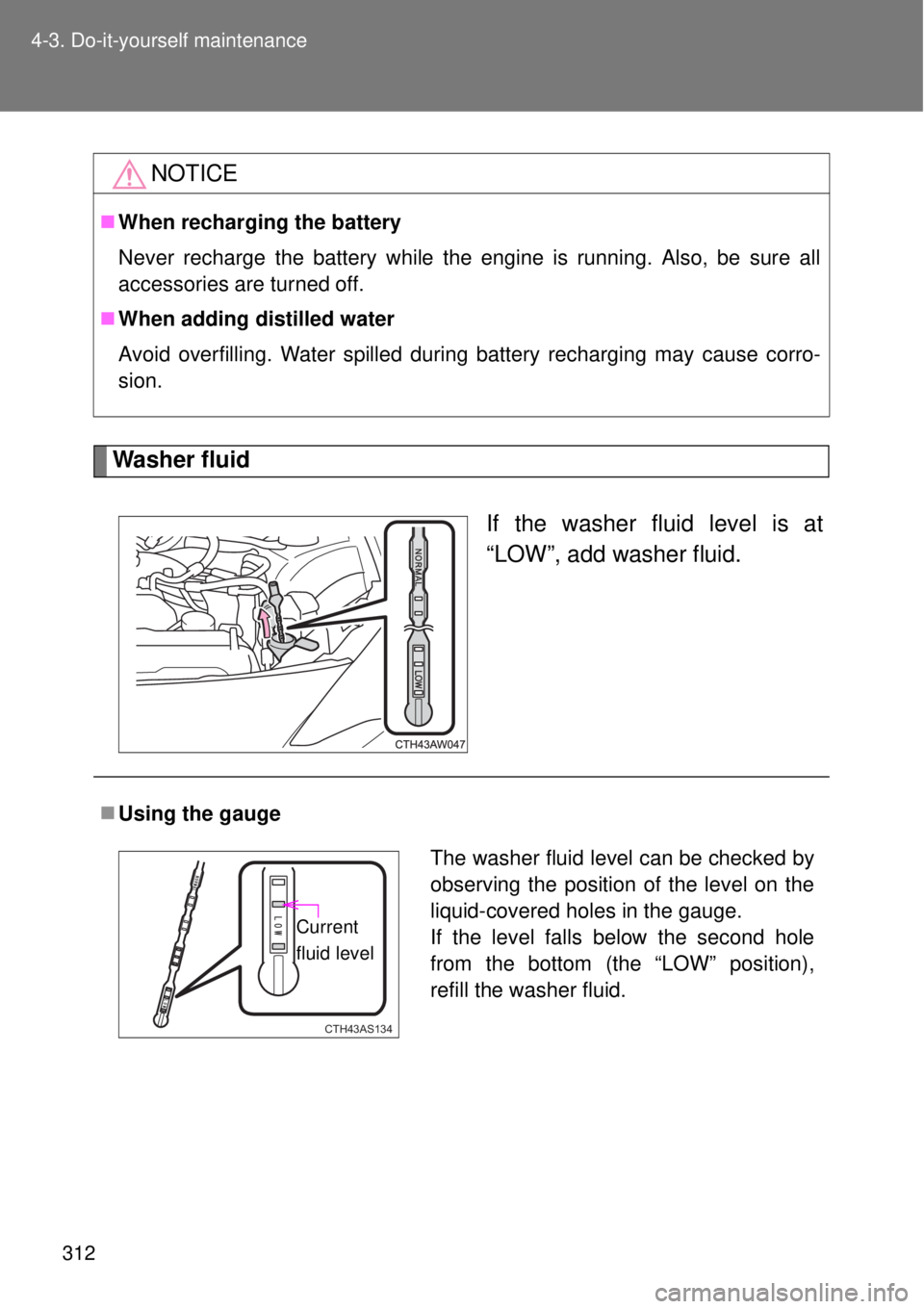
Washer fluid
If the washer fluid level is at
“LOW”, add washer fluid.
NOTICE
When recharging the battery
Never recharge the battery while the engine is running. Also, be sure all
accessories are turned off.
When adding distilled water
Avoid overfilling. Water spilled during battery recharging may cause corro-
sion.
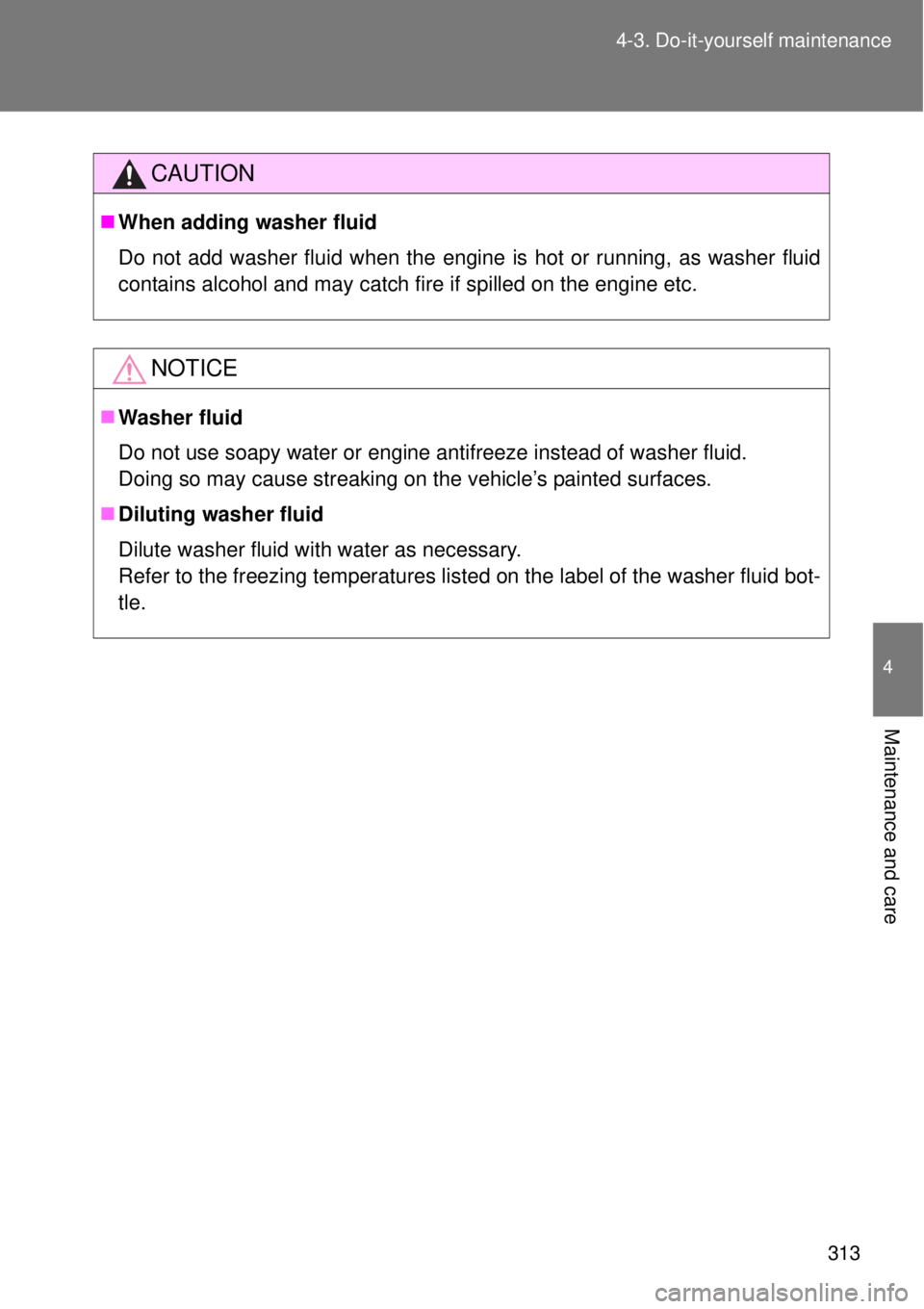
Using the gauge
The washer fluid level can be checked by
observing the position of the level on the
liquid-covered holes in the gauge.
If the level falls below the second hole
from the bottom (the “LOW” position),
refill the washer fluid.
CTH43AS134
Current
fluid level
Page 313 of 464
313 4-3. Do-it-yourself maintenance
4
Maintenance and care
CAUTION
When adding washer fluid
Do not add washer fluid when the engine is hot or running, as washer fluid
contains alcohol and may catch fire if spilled on the engine etc.
NOTICE
Washer fluid
Do not use soapy water or engine antifreeze instead of washer fluid.
Doing so may cause streaking on the vehicle’s painted surfaces.
Diluting washer fluid
Dilute washer fluid with water as necessary.
Refer to the freezing temperatures listed on the label of the washer fluid bot-
tle.
Page 314 of 464
314
4-3. Do-it-yourself maintenance
Tires
Replace or rotate tires in accordance with maintenance schedules
and treadwear.
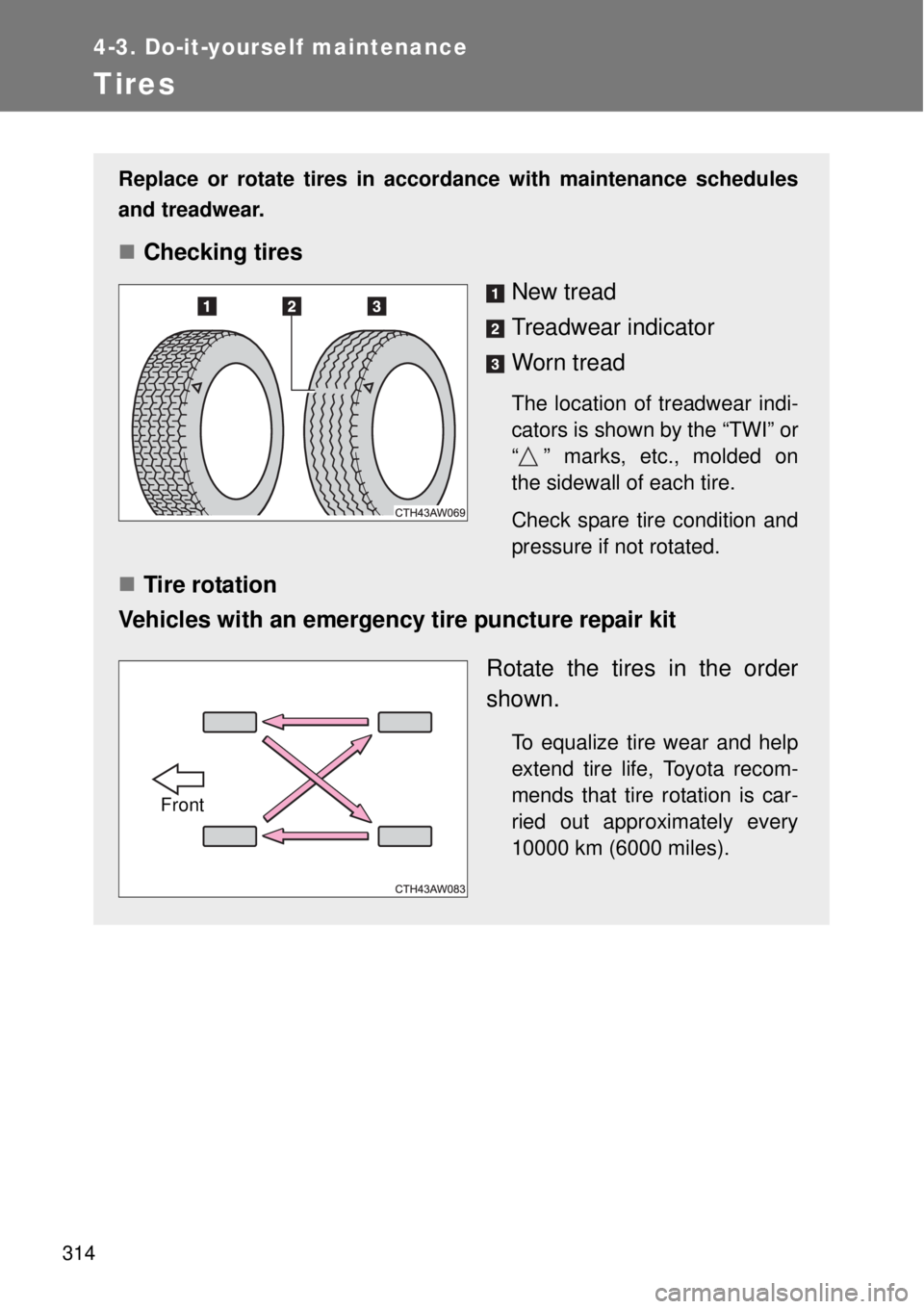
Checking tires
New tread
Treadwear indicator
Worn tread
The location of treadwear indi-
cators is shown by the “TWI” or
“ ” marks, etc., molded on
the sidewall of each tire.
Check spare tire condition and
pressure if not rotated.
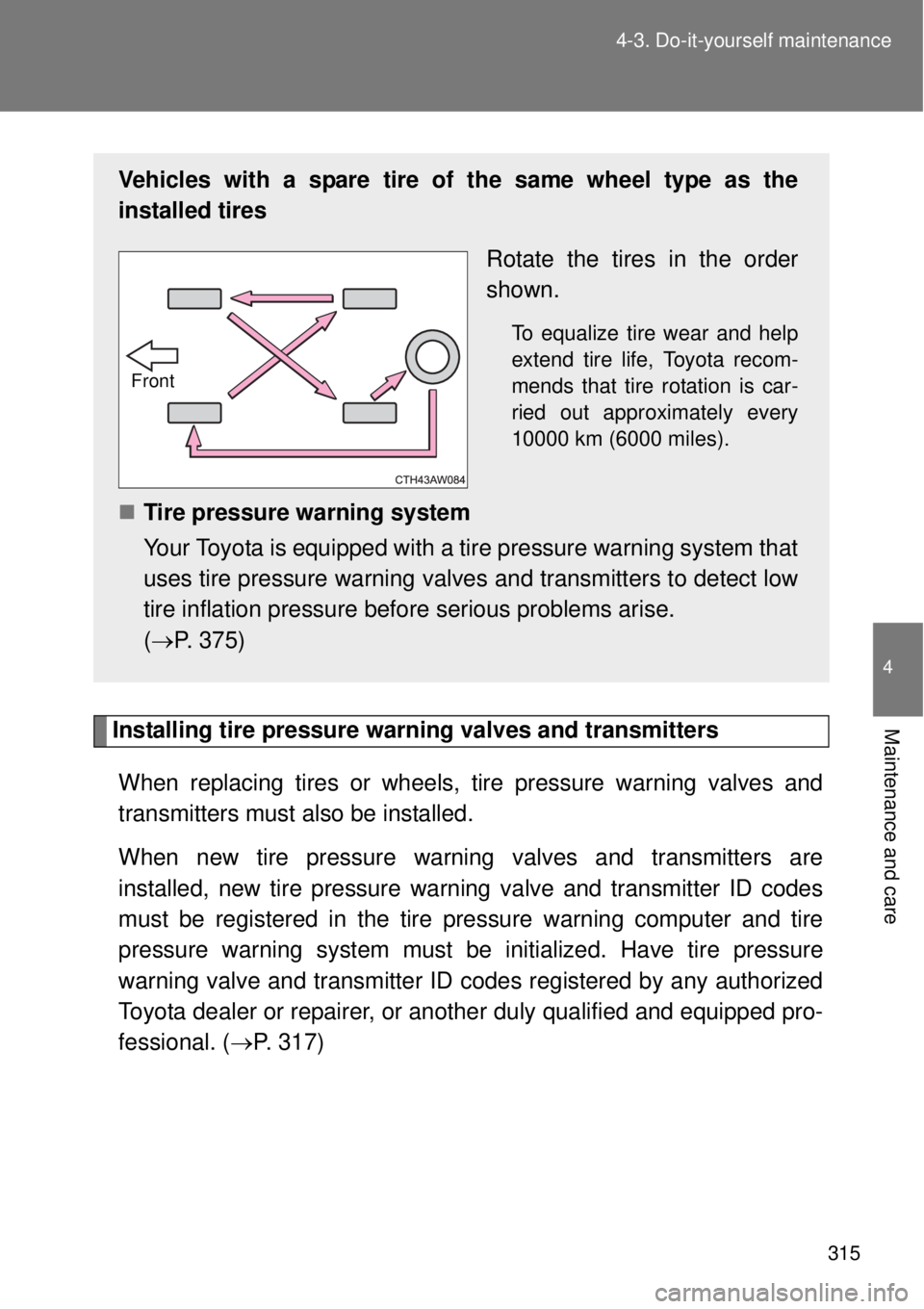
Tire rotation
Vehicles with an emergency tire puncture repair kit
Rotate the tires in the order
shown.
To equalize tire wear and help
extend tire life, Toyota recom-
mends that tire rotation is car-
ried out approximately every
10000 km (6000 miles).
Front
Page 315 of 464
315 4-3. Do-it-yourself maintenance
4
Maintenance and careInstalling tire pressure warning valves and transmitters
When replacing tires or wheels, tire pressure warning valves and
transmitters must also be installed.
When new tire pressure warning valves and transmitters are
installed, new tire pressure warning valve and transmitter ID codes
must be registered in the tire pressure warning computer and tire
pressure warning system must be initialized. Have tire pressure
warning valve and transmitter ID codes registered by any authorized
Toyota dealer or repairer, or another duly qualified and equipped pro-
fessional. (P. 317)
Vehicles with a spare tire of the same wheel type as the
installed tires
Rotate the tires in the order
shown.
To equalize tire wear and help
extend tire life, Toyota recom-
mends that tire rotation is car-
ried out approximately every
10000 km (6000 miles).
Tire pressure warning system
Your Toyota is equipped with a tire pressure warning system that
uses tire pressure warning valves and transmitters to detect low
tire inflation pressure before serious problems arise.
(P. 375)
Front
Page 316 of 464
316 4-3. Do-it-yourself maintenance
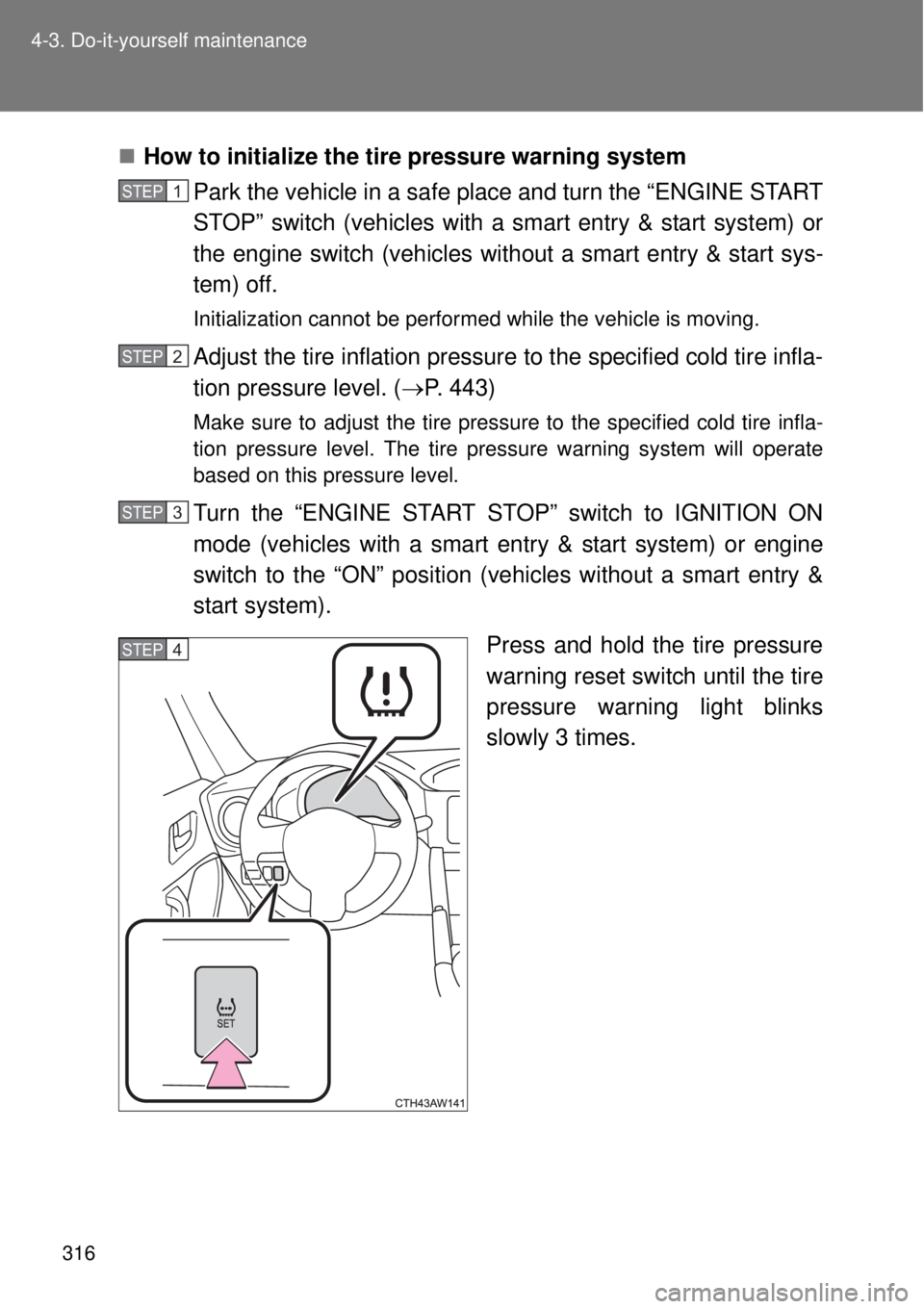
How to initialize the tire pressure warning system
Park the vehicle in a safe place and turn the “ENGINE START
STOP” switch (vehicles with a smart entry & start system) or
the engine switch (vehicles without a smart entry & start sys-
tem) off.
Initialization cannot be performed while the vehicle is moving.
Adjust the tire inflation pressure to the specified cold tire infla-
tion pressure level. (P. 443)
Make sure to adjust the tire pressure to the specified cold tire infla-
tion pressure level. The tire pressure warning system will operate
based on this pressure level.
Turn the “ENGINE START STOP” switch to IGNITION ON
mode (vehicles with a smart entry & start system) or engine
switch to the “ON” position (vehicles without a smart entry &
start system).
Press and hold the tire pressure
warning reset switch until the tire
pressure warning light blinks
slowly 3 times.
STEP 1
STEP 2
STEP 3
STEP 4