steering TOYOTA GT86 2014 Repair Manual
[x] Cancel search | Manufacturer: TOYOTA, Model Year: 2014, Model line: GT86, Model: TOYOTA GT86 2014Pages: 464, PDF Size: 10.65 MB
Page 364 of 464
364 5-1. Essential information
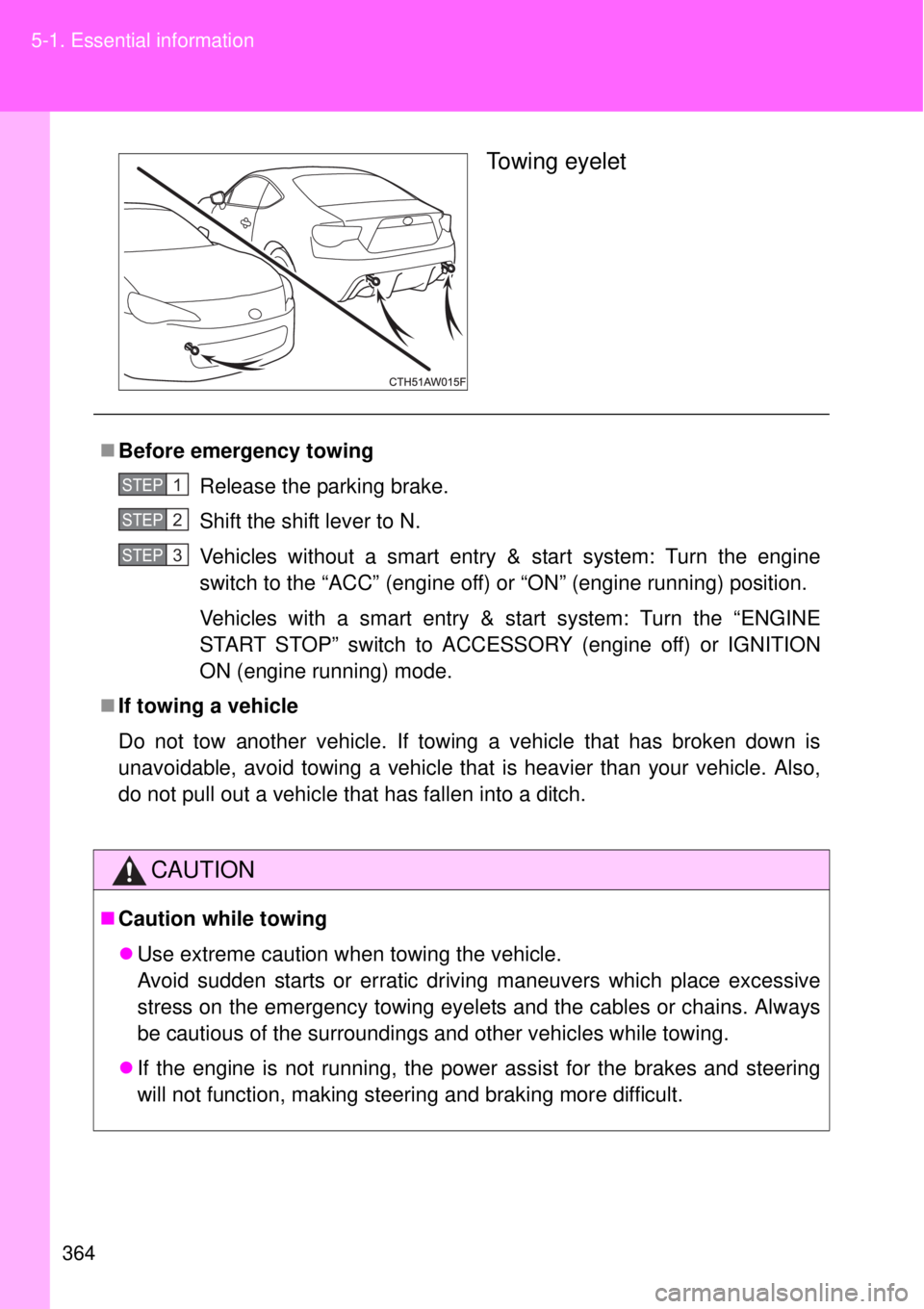
Towing eyelet
Before emergency towing
Release the parking brake.
Shift the shift lever to N.
Vehicles without a smart entry & start system: Turn the engine
switch to the “ACC” (engine off) or “ON” (engine running) position.
Vehicles with a smart entry & start system: Turn the “ENGINE
START STOP” switch to ACCESSORY (engine off) or IGNITION
ON (engine running) mode.
If towing a vehicle
Do not tow another vehicle. If towing a vehicle that has broken down is
unavoidable, avoid towing a vehicle that is heavier than your vehicle. Also,
do not pull out a vehicle that has fallen into a ditch.
CAUTION
Caution while towing
Use extreme caution when towing the vehicle.
Avoid sudden starts or erratic driving maneuvers which place excessive
stress on the emergency towing eyelets and the cables or chains. Always
be cautious of the surroundings and other vehicles while towing.
If the engine is not running, the power assist for the brakes and steering
will not function, making steering and braking more difficult.
STEP 1
STEP 2
STEP 3
Page 368 of 464
368 5-1. Essential information
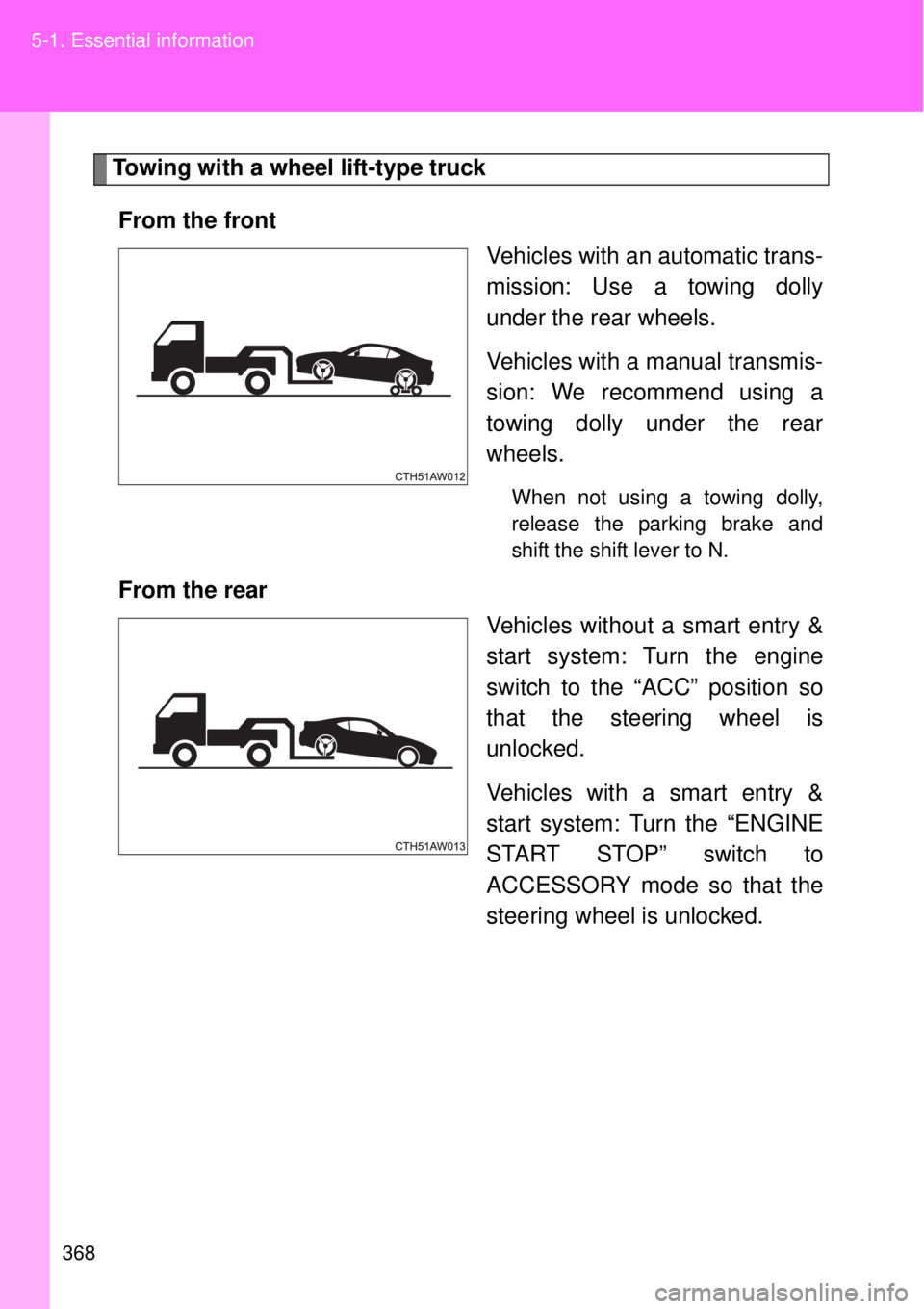
Towing with a wheel lift-type truck
From the front
Vehicles with an automatic trans-
mission: Use a towing dolly
under the rear wheels.
Vehicles with a manual transmis-
sion: We recommend using a
towing dolly under the rear
wheels.
When not using a towing dolly,
release the parking brake and
shift the shift lever to N.
From the rear
Vehicles without a smart entry &
start system: Turn the engine
switch to the “ACC” position so
that the steering wheel is
unlocked.
Vehicles with a smart entry &
start system: Turn the “ENGINE
START STOP” switch to
ACCESSORY mode so that the
steering wheel is unlocked.
Page 369 of 464
5
369 5-1. Essential information
When trouble arises
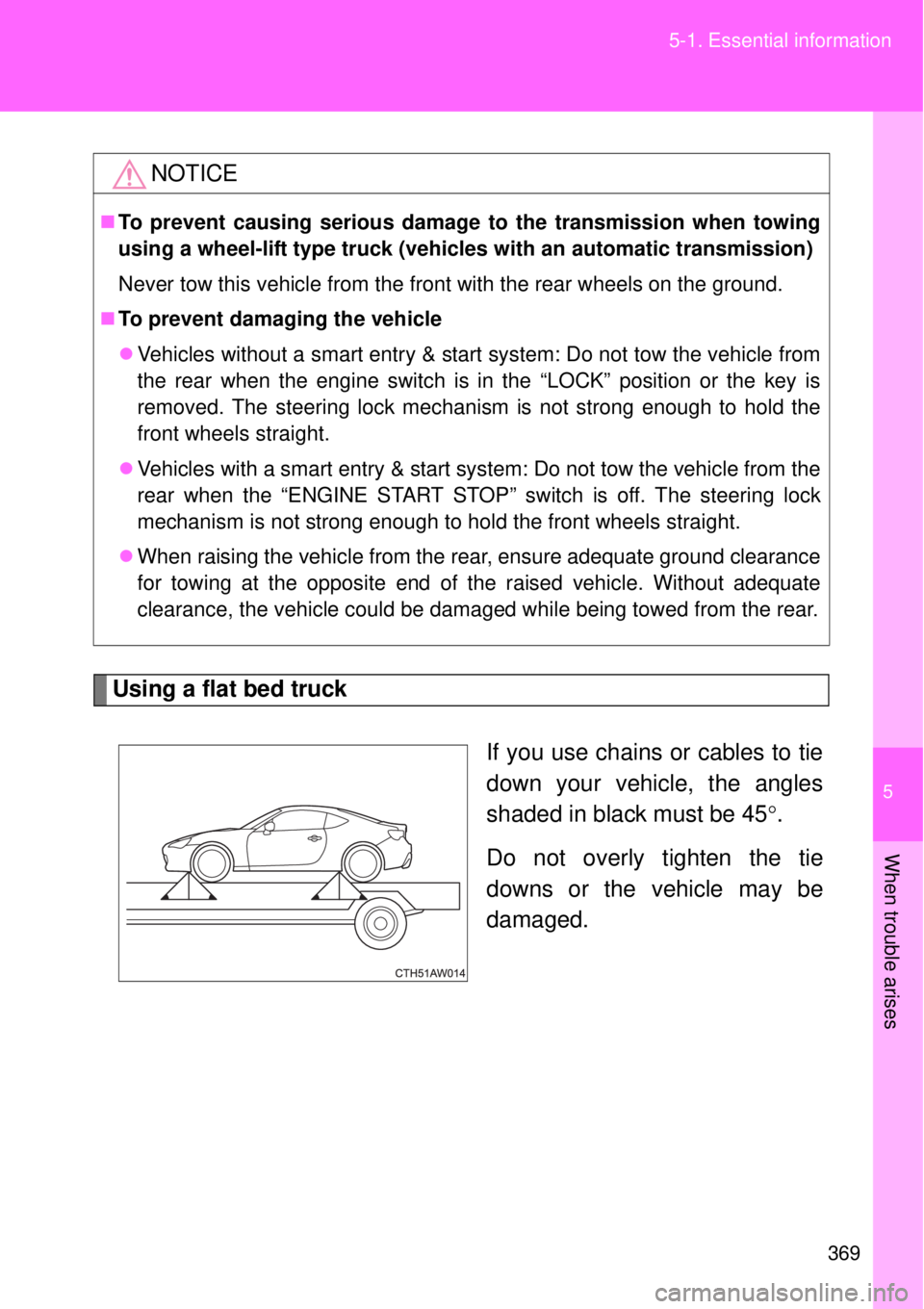
Using a flat bed truck
If you use chains or cables to tie
down your vehicle, the angles
shaded in black must be 45.
Do not overly tighten the tie
downs or the vehicle may be
damaged.
NOTICE
To prevent causing serious damage to the transmission when towing
using a wheel-lift type truck (vehicles with an automatic transmission)
Never tow this vehicle from the front with the rear wheels on the ground.
To prevent damaging the vehicle
Vehicles without a smart entry & start system: Do not tow the vehicle from
the rear when the engine switch is in the “LOCK” position or the key is
removed. The steering lock mechanism is not strong enough to hold the
front wheels straight.
Vehicles with a smart entry & start system: Do not tow the vehicle from the
rear when the “ENGINE START STOP” switch is off. The steering lock
mechanism is not strong enough to hold the front wheels straight.
When raising the vehicle from the rear, ensure adequate ground clearance
for towing at the opposite end of the raised vehicle. Without adequate
clearance, the vehicle could be damaged while being towed from the rear.
Page 373 of 464
5
373 5-2. Steps to take in an emergency
When trouble arises
Have the vehicle inspected immediately.
Failing to investigate the cause of the following warnings may lead to
the system operating abnormally and possibly cause an accident.
Have the vehicle inspected by any authorized Toyota dealer or
repairer, or another duly qualified and equipped professional immedi-
ately.
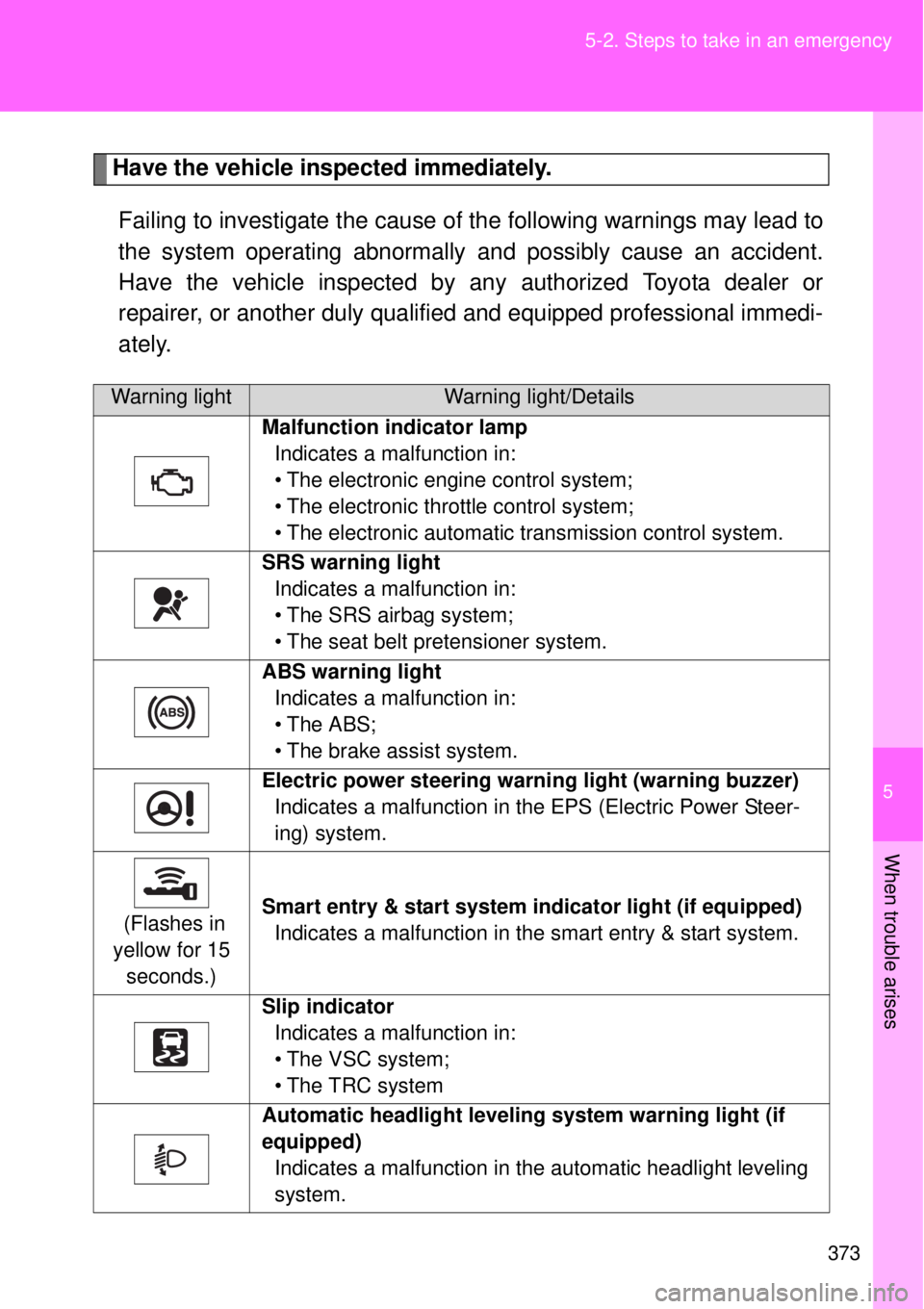
Warning lightWarning light/Details
Malfunction indicator lamp
Indicates a malfunction in:
• The electronic engine control system;
• The electronic throttle control system;
• The electronic automatic transmission control system.
SRS warning light
Indicates a malfunction in:
• The SRS airbag system;
• The seat belt pretensioner system.
ABS warning light
Indicates a malfunction in:
• The ABS;
• The brake assist system.
Electric power steering warning light (warning buzzer)
Indicates a malfunction in the EPS (Electric Power Steer-
ing) system.
(Flashes in
yellow for 15
seconds.)Smart entry & start system indicator light (if equipped)
Indicates a malfunction in the smart entry & start system.
Slip indicator
Indicates a malfunction in:
• The VSC system;
• The TRC system
Automatic headlight leveling system warning light (if
equipped)
Indicates a malfunction in the automatic headlight leveling
system.
Page 374 of 464
374 5-2. Steps to take in an emergency
(Comes on in
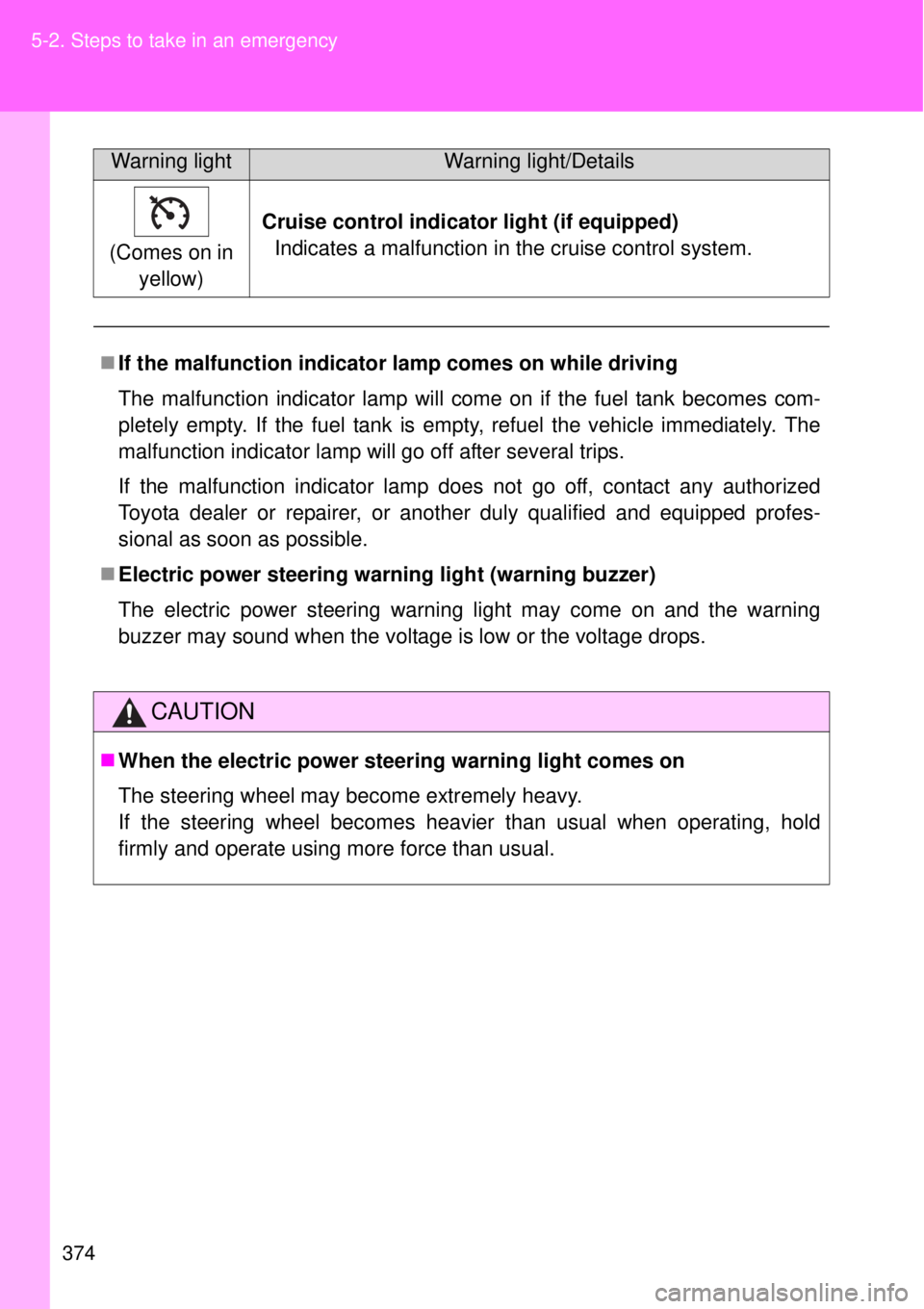
yellow)Cruise control indicator light (if equipped)
Indicates a malfunction in the cruise control system.
If the malfunction indicator lamp comes on while driving
The malfunction indicator lamp will come on if the fuel tank becomes com-
pletely empty. If the fuel tank is empty, refuel the vehicle immediately. The
malfunction indicator lamp will go off after several trips.
If the malfunction indicator lamp does not go off, contact any authorized
Toyota dealer or repairer, or another duly qualified and equipped profes-
sional as soon as possible.
Electric power steering warning light (warning buzzer)
The electric power steering warning light may come on and the warning
buzzer may sound when the voltage is low or the voltage drops.
CAUTION
When the electric power steering warning light comes on
The steering wheel may become extremely heavy.
If the steering wheel becomes heavier than usual when operating, hold
firmly and operate using more force than usual.
Warning lightWarning light/Details
Page 379 of 464

5
379 5-2. Steps to take in an emergency
When trouble arises
CAUTION
If the tire pressure warning light comes on
Be sure to observe the following precautions. Failure to do so could cause
loss of vehicle control and result in death or serious injury.
Stop your vehicle in a safe place as soon as possible. Adjust the tire infla-
tion pressure immediately.
If the tire pressure warning light comes on even after tire inflation pressure
adjustment, it is probable that you have a flat tire. Check the tires. If the
tire is flat, change to the spare tire and have the flat tire repaired by the
nearest any authorized Toyota dealer or repairer, or another duly qualified
and equipped professional.
Avoid abrupt maneuvering and braking. If the vehicle tires deteriorate, you
could lose control of the steering wheel or the brakes.
If a blowout or sudden air leakage should occur
The tire pressure warning system may not activate immediately.
NOTICE
To ensure the tire pressure warning system operates properly
Do not install tires with different specifications or makers, as the tire pres-
sure warning system may not operate properly.
Page 382 of 464
382 5-2. Steps to take in an emergency
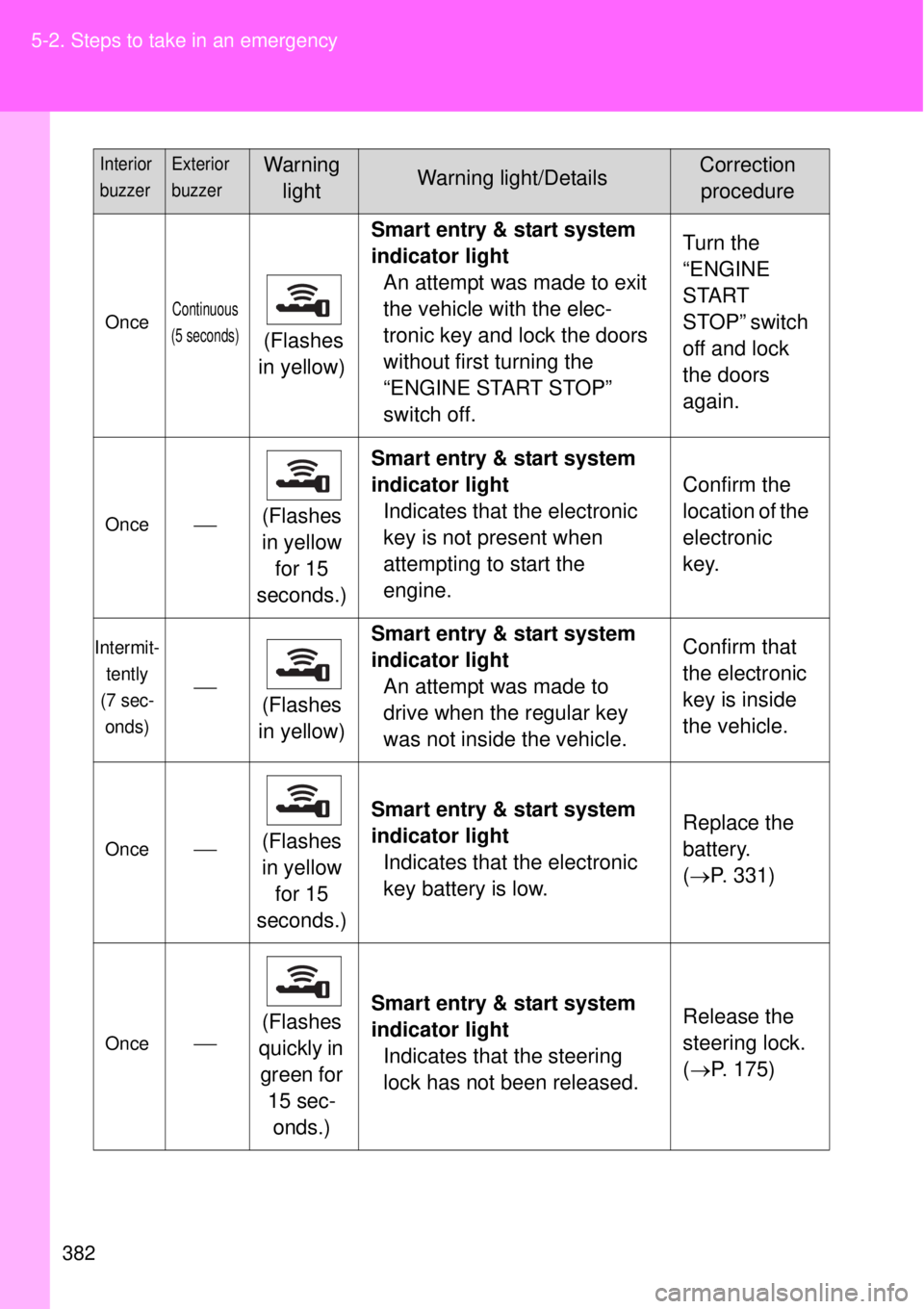
OnceContinuous
(5 seconds)
(Flashes
in yellow)Smart entry & start system
indicator light
An attempt was made to exit
the vehicle with the elec-
tronic key and lock the doors
without first turning the
“ENGINE START STOP”
switch off.Turn the
“ENGINE
START
STOP” switch
off and lock
the doors
again.
Once(Flashes
in yellow
for 15
seconds.)Smart entry & start system
indicator light
Indicates that the electronic
key is not present when
attempting to start the
engine.Confirm the
location of the
electronic
key.
Intermit-
tently
(7 sec-
onds)
(Flashes
in yellow)Smart entry & start system
indicator light
An attempt was made to
drive when the regular key
was not inside the vehicle.Confirm that
the electronic
key is inside
the vehicle.
Once(Flashes
in yellow
for 15
seconds.)Smart entry & start system
indicator light
Indicates that the electronic
key battery is low.Replace the
battery.
(P. 331)
Once(Flashes
quickly in
green for
15 sec-
onds.)Smart entry & start system
indicator light
Indicates that the steering
lock has not been released.Release the
steering lock.
(P. 175)
Interior
buzzerExterior
buzzerWarning
lightWarning light/DetailsCorrection
procedure
Page 406 of 464

406 5-2. Steps to take in an emergency
CAUTION
When fixing the flat tire
After inflation of the tire has completed, the sealant may splatter when the
hose is disconnected or some air is let out of the tire.
Follow the operation procedure to repair the tire. If the procedures not fol-
lowed, the sealant may spray out.
Keep back from the tire while it is being repaired, as there is a chance of it
bursting while the repair operation is being performed. If you notice any
cracks or deformation of the tire, turn off the compressor switch and stop
the repair operation immediately.
The repair kit may overheat if operated for a long period of time. Do not
operate the repair kit continuously for more than 10 minutes.
Parts of the repair kit become hot during operation. Be careful when han-
dling the repair kit during and after operation. Do not touch the metal part
around the connecting area between the bottle and compressor. It will be
extremely hot.
Do not attach the vehicle speed warning sticker to an area other than the
one indicated. If the sticker is attached to an area where an SRS airbag is
located, such as the pad of the steering wheel, it may prevent the SRS air-
bag from operating properly.
Driving to spread the liquid sealant evenly
Observe the following precautions to reduce the risk of accidents.
Failing to do so may result in a loss of vehicle control and cause death or
serious injury.
Drive the vehicle carefully at a low speed. Be especially careful when turn-
ing and cornering.
If the vehicle does not drive straight or you feel a pull through the steering
wheel, stop the vehicle and check the following.
• Tire condition. The tire may have separated from the wheel.
• Tire inflation pressure. If the tire inflation pressure is 130 kPa (1.3
kgf/cm
2 or bar, 19 psi) or less, the tire may be severely damaged.
Page 410 of 464
410 5-2. Steps to take in an emergency
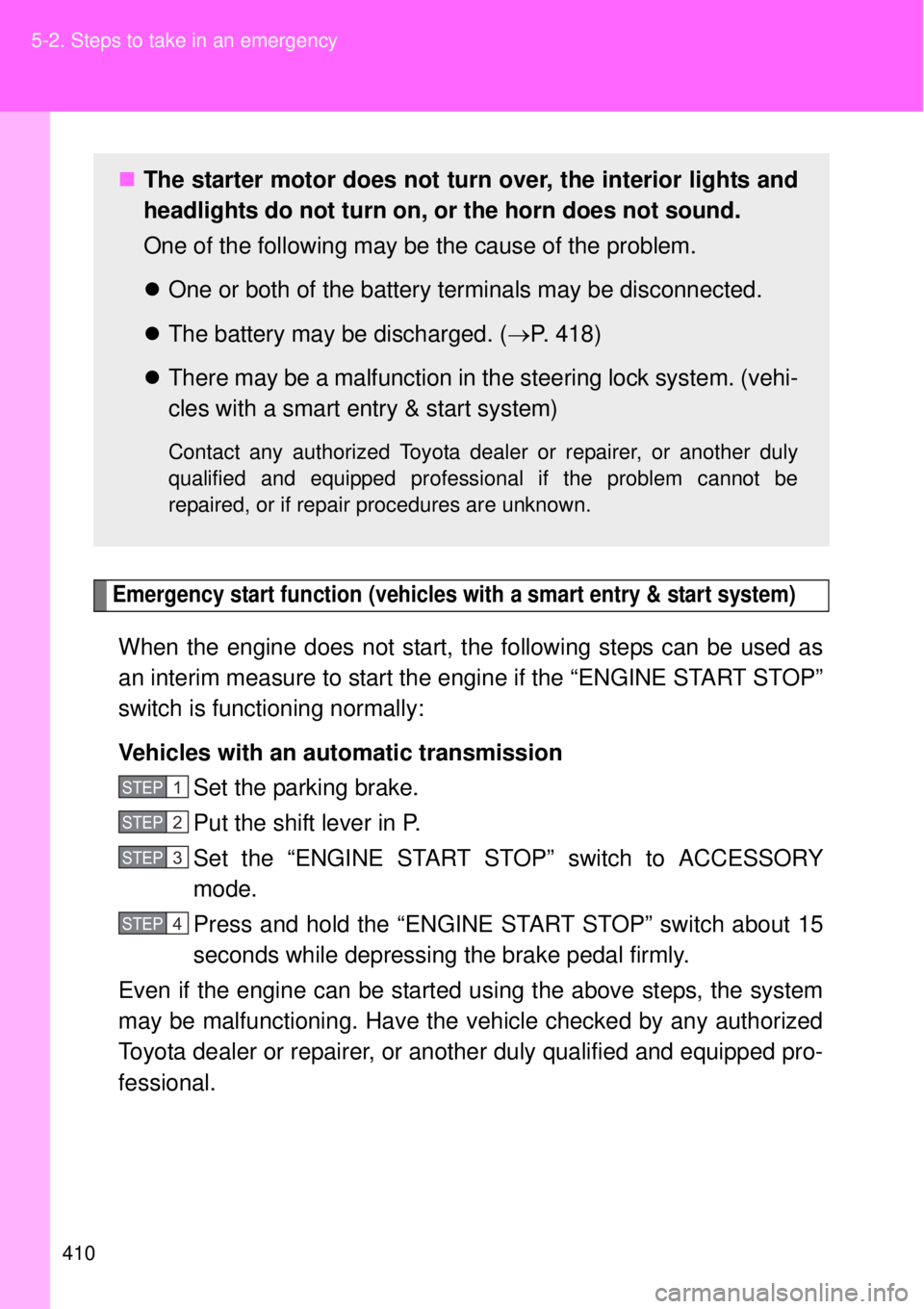
Emergency start function (vehicles with a smart entry & start system)
When the engine does not start, the following steps can be used as
an interim measure to start the engine if the “ENGINE START STOP”
switch is functioning normally:
Vehicles with an automatic transmission
Set the parking brake.
Put the shift lever in P.
Set the “ENGINE START STOP” switch to ACCESSORY
mode.
Press and hold the “ENGINE START STOP” switch about 15
seconds while depressing the brake pedal firmly.
Even if the engine can be started using the above steps, the system
may be malfunctioning. Have the vehicle checked by any authorized
Toyota dealer or repairer, or another duly qualified and equipped pro-
fessional.
The starter motor does not turn over, the interior lights and
headlights do not turn on, or the horn does not sound.
One of the following may be the cause of the problem.
One or both of the battery terminals may be disconnected.
The battery may be discharged. (P. 418)
There may be a malfunction in the steering lock system. (vehi-
cles with a smart entry & start system)
Contact any authorized Toyota dealer or repairer, or another duly
qualified and equipped professional if the problem cannot be
repaired, or if repair procedures are unknown.
STEP 1
STEP 2
STEP 3
STEP 4
Page 429 of 464
5
429 5-2. Steps to take in an emergency
When trouble arises
CAUTION
If the engine has to be turned off while driving
Power assist for the brakes and steering wheel will be lost, making the
brake pedal harder to depress and the steering wheel heavier to turn.
Decelerate as much as possible before turning off the engine.
Vehicles without a smart entry & start system: Never attempt to remove
the key, as doing so will lock the steering wheel.
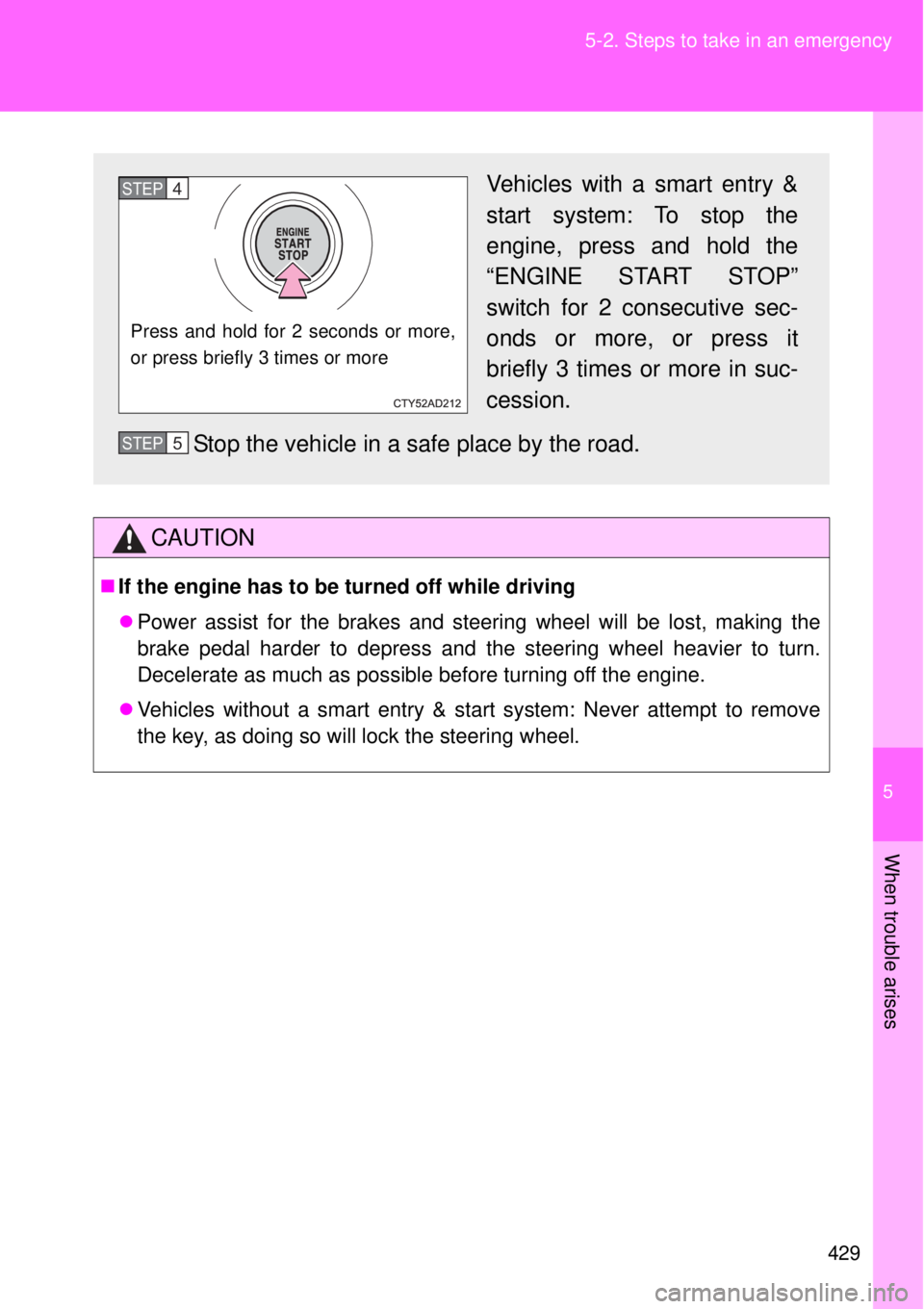
Vehicles with a smart entry &
start system: To stop the
engine, press and hold the
“ENGINE START STOP”
switch for 2 consecutive sec-
onds or more, or press it
briefly 3 times or more in suc-
cession.
Stop the vehicle in a safe place by the road.
Press and hold for 2 seconds or more,
or press briefly 3 times or more
STEP 4
STEP 5