reset TOYOTA GT86 2014 Owners Manual
[x] Cancel search | Manufacturer: TOYOTA, Model Year: 2014, Model line: GT86, Model: TOYOTA GT86 2014Pages: 464, PDF Size: 10.65 MB
Page 14 of 464
14
C
BB
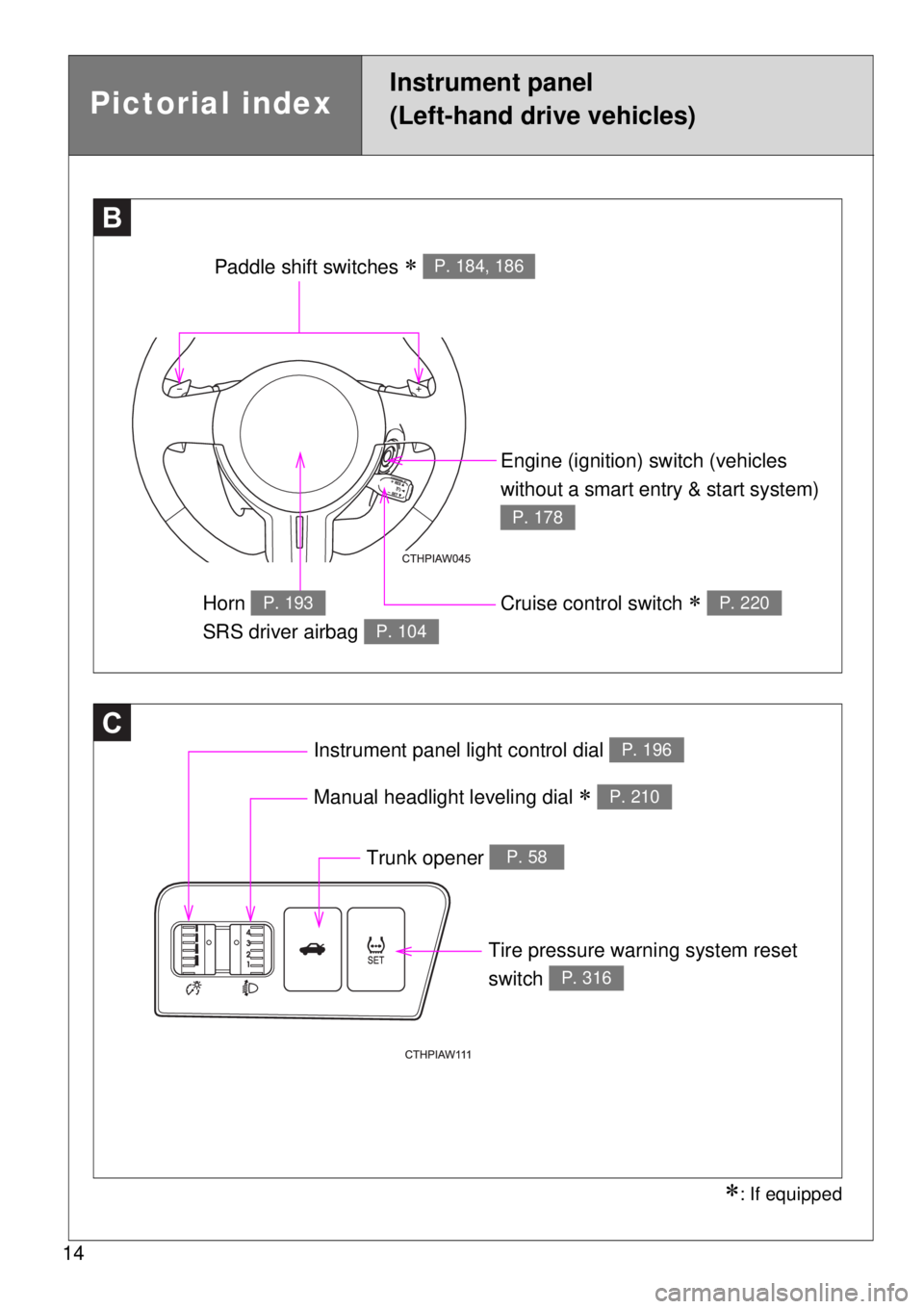
Paddle shift switches P. 184, 186
Engine (ignition) switch (vehicles
without a smart entry & start system)
P. 178
Cruise control switch P. 220Horn
SRS driver airbag P. 193
P. 104
Instrument panel light control dial P. 196
Manual headlight leveling dial P. 210
Trunk opener P. 58
: If equipped
Pictorial index
Instrument panel
(Left-hand drive vehicles)
Tire pressure warning system reset
switch
P. 316
Page 21 of 464
21
C
B
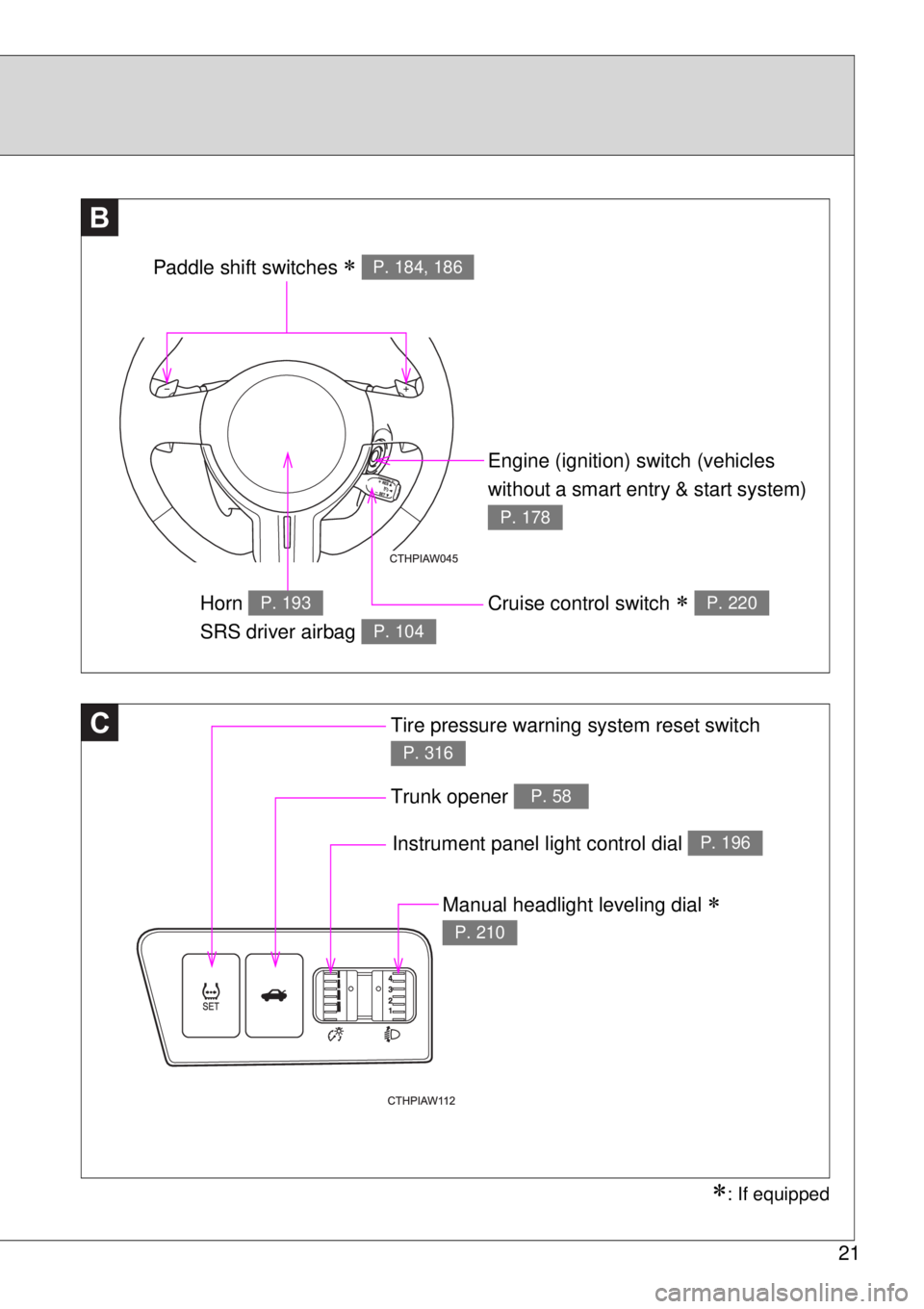
Engine (ignition) switch (vehicles
without a smart entry & start system)
P. 178
Cruise control switch P. 220Horn
SRS driver airbag P. 193
P. 104
Instrument panel light control dial P. 196
Manual headlight leveling dial
P. 210
Trunk opener P. 58
: If equipped
Paddle shift switches P. 184, 186
Tire pressure warning system reset switch
P. 316
Page 195 of 464
195 2-2. Instrument cluster
2
When driving
Odometer, trip meter and multi-information display
Odometer: Displays the total distance the vehicle has been driven.
Trip meter: Displays the distance the vehicle has been driven since the
meter was last reset. Trip meters A and B can be used to record and
display different distances independently.
Multi-information display: Presents the driver with a variety of driving-
related data. (P. 203)
“DISP” switch
P. 204
“ODO/TRIP” switch
P. 196
“km/h MPH” switch (if equipped)
Each time the switch is pressed, the display inside the meter changes
between km/h and MPH.
Page 196 of 464
196 2-2. Instrument cluster
Switch the display
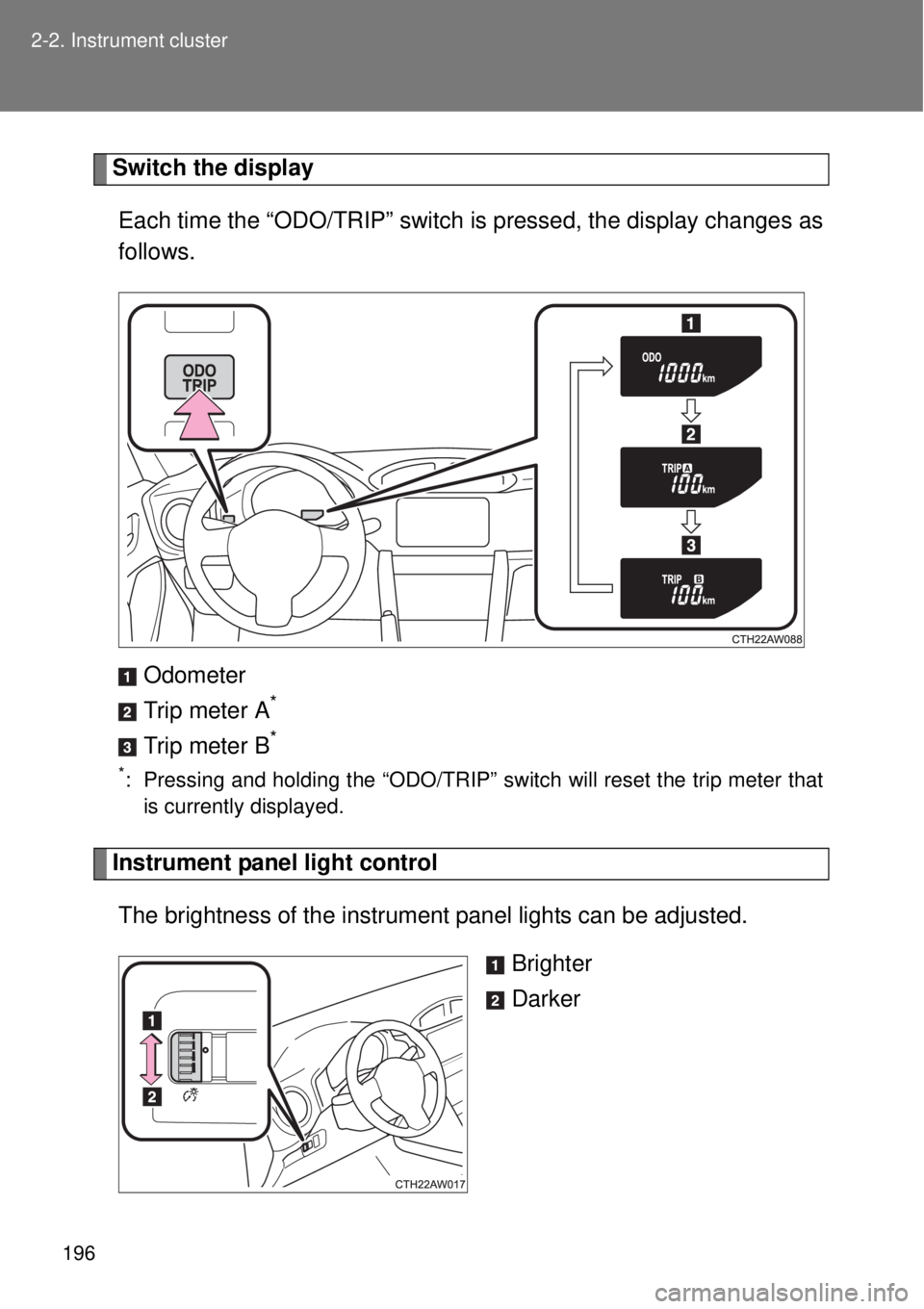
Each time the “ODO/TRIP” switch is pressed, the display changes as
follows.
Odometer
Trip meter A
*
Trip meter B*
*: Pressing and holding the “ODO/TRIP” switch will reset the trip meter that
is currently displayed.
Instrument panel light control
The brightness of the instrument panel lights can be adjusted.
Brighter
Darker
Page 204 of 464
204 2-2. Instrument cluster
Switch the display
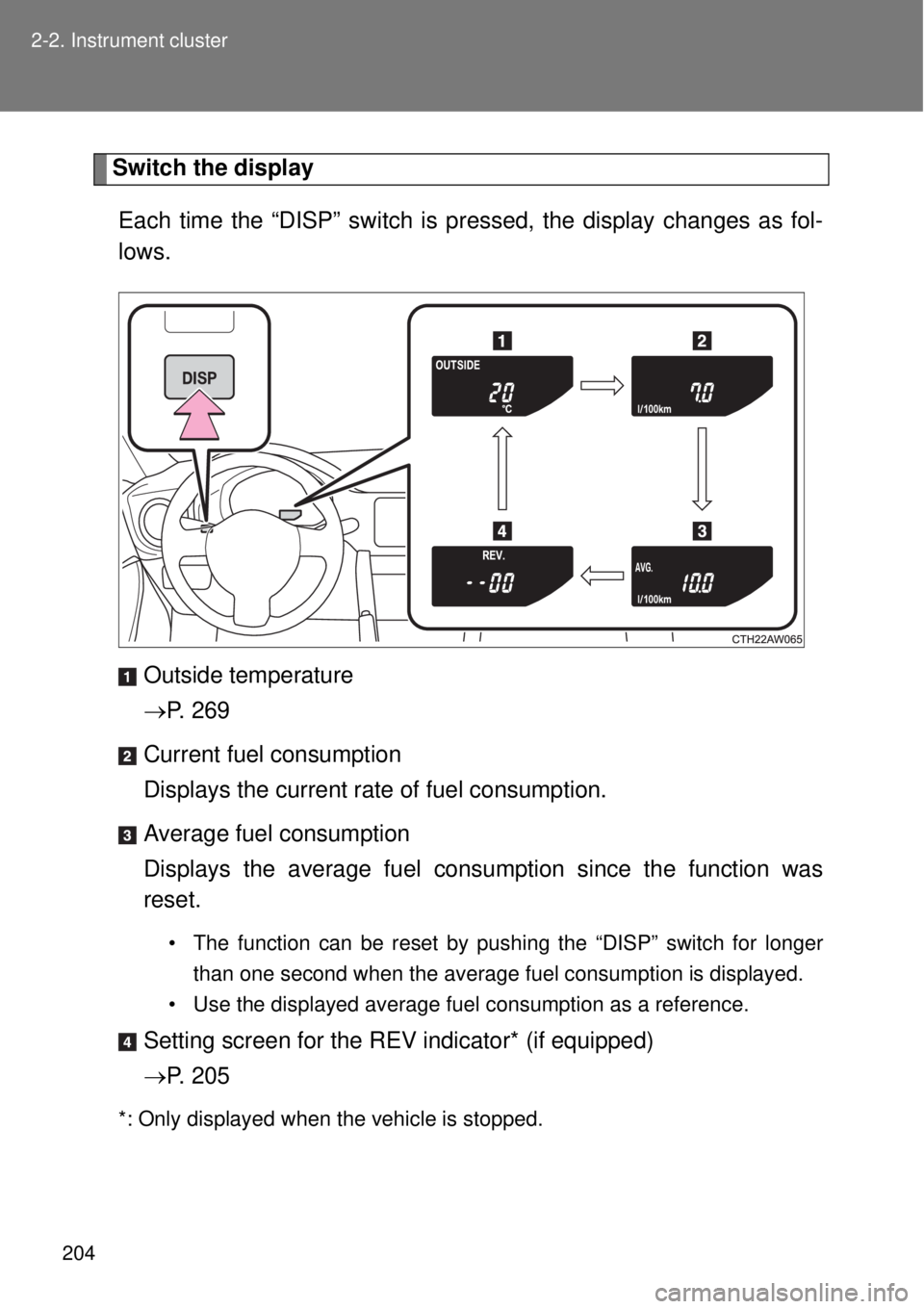
Each time the “DISP” switch is pressed, the display changes as fol-
lows.
Outside temperature
P. 269
Current fuel consumption
Displays the current rate of fuel consumption.
Average fuel consumption
Displays the average fuel consumption since the function was
reset.
• The function can be reset by pushing the “DISP” switch for longer
than one second when the average fuel consumption is displayed.
• Use the displayed average fuel consumption as a reference.
Setting screen for the REV indicator* (if equipped)
P. 205
*: Only displayed when the vehicle is stopped.
Page 234 of 464
234 2-5. Driving information
If a door is opened and closed when its side window is frozen,
the window safety device will operate and the side window
open/close function linked to door operation may not operate
correctly. If this occurs, perform the following after the ice has
melted.
Open the side window until it is approximately halfway
open.
Fully close the window by pulling the switch up to the one-
touch closing position and continue holding the switch for 1
second or more after the window fully closes.
The window position is reset and the safety device operations will
be released.
When driving the vehicle
Accelerate the vehicle slowly, keep a safe distance between you
and the vehicle ahead, and drive at a reduced speed suitable to
road conditions.
When parking the vehicle (in the winter time or in the cold
latitudes)
Park the vehicle and move the shift lever to P (automatic trans-
mission) or 1 or R (manual transmission) without setting the
parking brake. The parking brake may freeze up, preventing it
from being released. If necessary, block the wheels to prevent
inadvertent sliding or creeping.
STEP 1
STEP 2
Page 268 of 464
268
3-5. Other interior features
Clock
The clock is displayed when
Vehicles without a smart entry & start system
The engine switch is in the “ACC” or “ON” position.
Vehicles with a smart entry & start system
The “ENGINE START STOP” switch is in ACCESSORY or IGNITION ON
mode.
When disconnecting and reconnecting battery terminals
The clock data will be reset.
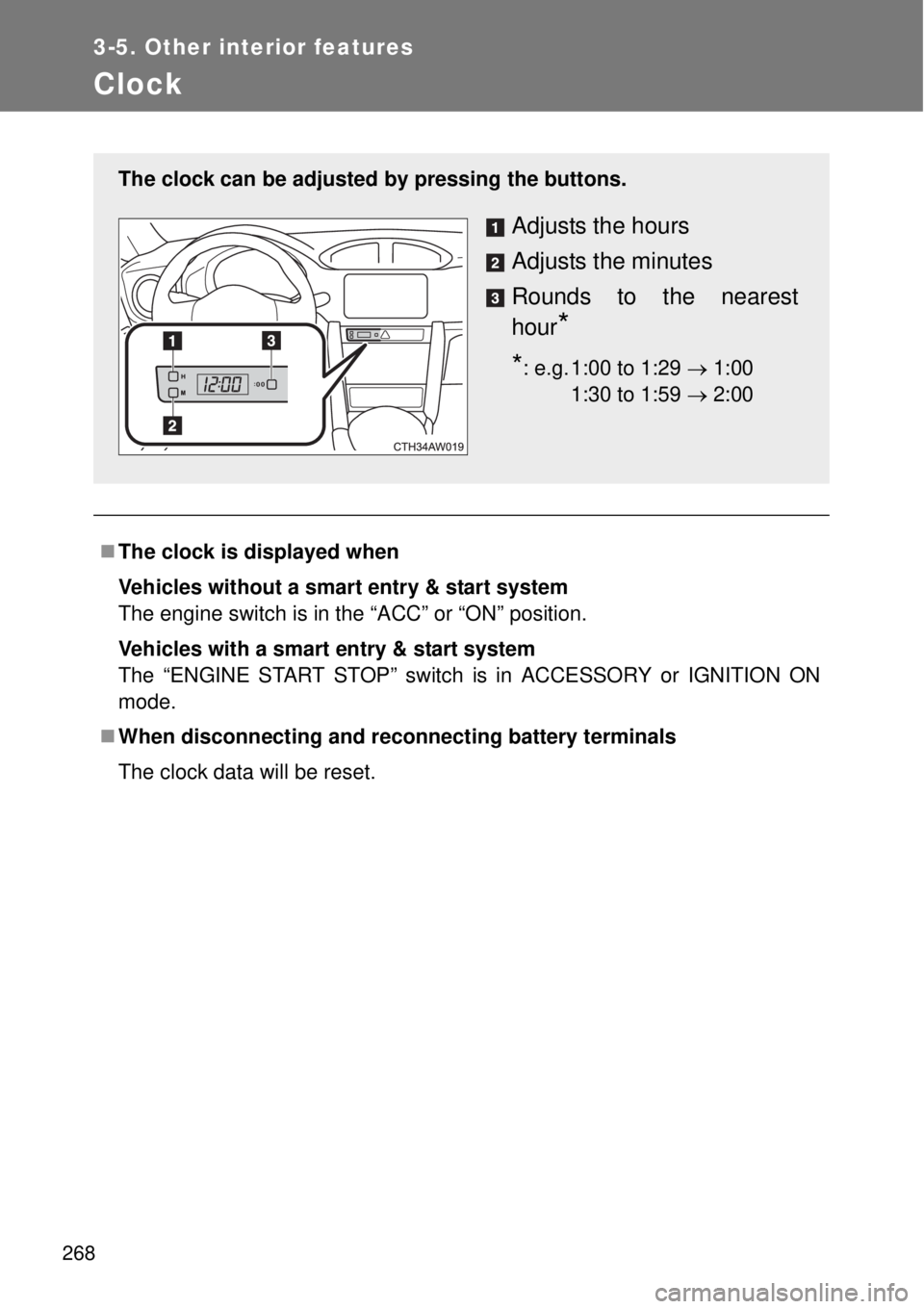
The clock can be adjusted by pressing the buttons.
Adjusts the hours
Adjusts the minutes
Rounds to the nearest
hour
*
*: e.g. 1:00 to 1:29 1:00
1:30 to 1:59 2:0000
Page 316 of 464
316 4-3. Do-it-yourself maintenance
How to initialize the tire pressure warning system
Park the vehicle in a safe place and turn the “ENGINE START
STOP” switch (vehicles with a smart entry & start system) or
the engine switch (vehicles without a smart entry & start sys-
tem) off.
Initialization cannot be performed while the vehicle is moving.
Adjust the tire inflation pressure to the specified cold tire infla-
tion pressure level. (P. 443)
Make sure to adjust the tire pressure to the specified cold tire infla-
tion pressure level. The tire pressure warning system will operate
based on this pressure level.
Turn the “ENGINE START STOP” switch to IGNITION ON
mode (vehicles with a smart entry & start system) or engine
switch to the “ON” position (vehicles without a smart entry &
start system).
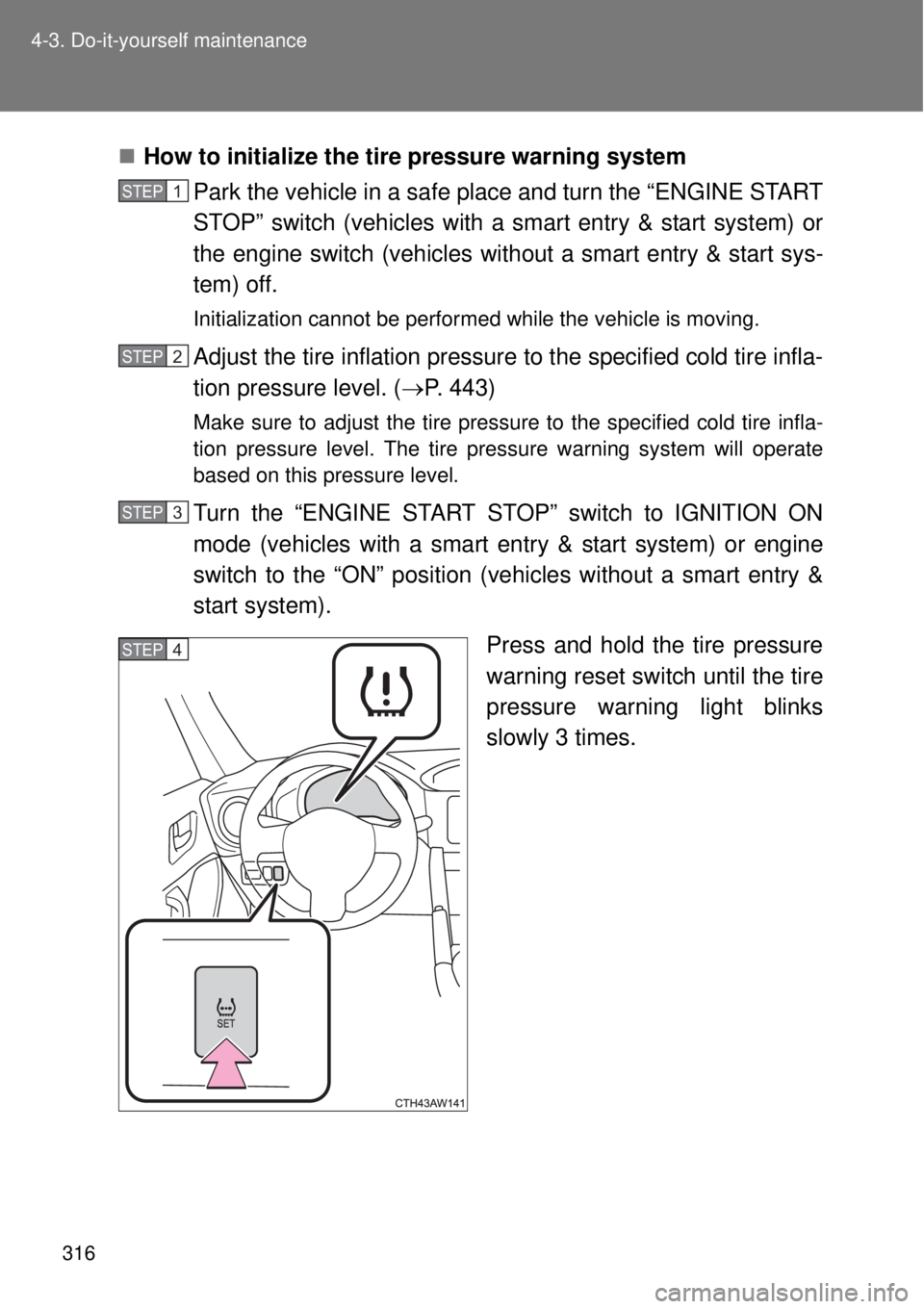
Press and hold the tire pressure
warning reset switch until the tire
pressure warning light blinks
slowly 3 times.
STEP 1
STEP 2
STEP 3
STEP 4
Page 318 of 464

318 4-3. Do-it-yourself maintenance
When to replace your vehicle’s tires
Tires should be replaced if:
You have tire damage such as cuts, splits, cracks deep enough to
expose the fabric or bulges indicating internal damage
A tire goes flat repeatedly or cannot be properly repaired due to the size
or location of a cut or other damage
If you are not sure, consult with any authorized Toyota dealer or repairer, or
another duly qualified and equipped professional.
Replacing tires and wheels
If the ID code of the tire pressure warning valve and transmitter is not regis-
tered, the tire pressure warning system will not work properly. After driving
for about 10 minutes, the tire pressure warning light comes on after blinking
for 1 minute to indicate a system malfunction.
Tire life
Any tires over 6 years old must be checked by a qualified technician even if
they have seldom or never been used or damage is not obvious.
Routine tire inflation pressure checks
The tire pressure warning system does not replace routine tire inflation pres-
sure checks. Make sure to check tire inflation pressure as part of your rou-
tine of daily vehicle checks.
If the tread on snow tires wears down 4 mm (0.16 in.)
The effectiveness of snow tires is lost.
Low profile tires (vehicles with 17-inch tires)
Generally, low profile tires will wear more rapidly and tire grip performance
will be reduced on snowy and/or icy roads when compared to standard tires.
Be sure to use snow tires or tire chains on snowy and/or icy roads and drive
carefully at a speed appropriate for road and weather conditions.
If you press the tire pressure warning reset switch accidentally
If initialization is performed, adjust the tire inflation pressure to the specified
level and initialize the tire pressure warning system again.
Page 321 of 464
321 4-3. Do-it-yourself maintenance
4
Maintenance and care
CAUTION
Tire pressure warning system operation
The tire pressure warning system may not provide warning immediately if a
tire bursts or if sudden air leakage occurs.
When inspecting or replacing tires
Observe the following precautions to prevent accidents.
Failure to do so may cause damage to parts of the drive train, as well as
dangerous handling characteristics, which may lead to an accident resulting
in death or serious injury.
Make sure to install 4 tires that are of the specified size, and that all 4 tires
are the same size, same maker, same brand and tread pattern.
Do not use tire sizes other than those recommended by Toyota.
Only use radial tires.
Do not mix summer, all season and snow tires.
Do not use tires that have been used on another vehicle.
Do not use tires if you do not know how they were used previously.
When initializing the tire pressure warning system
Do not operate the tire pressure warning reset switch without first adjusting
the tire inflation pressure to the specified level. Otherwise, the tire pressure
warning light may not come on even if the tire inflation pressure is low, or it
may come on when the tire inflation pressure is actually normal.