belt TOYOTA HIGHLANDER 2008 XU40 / 2.G Owners Manual
[x] Cancel search | Manufacturer: TOYOTA, Model Year: 2008, Model line: HIGHLANDER, Model: TOYOTA HIGHLANDER 2008 XU40 / 2.GPages: 577, PDF Size: 11.46 MB
Page 2 of 577
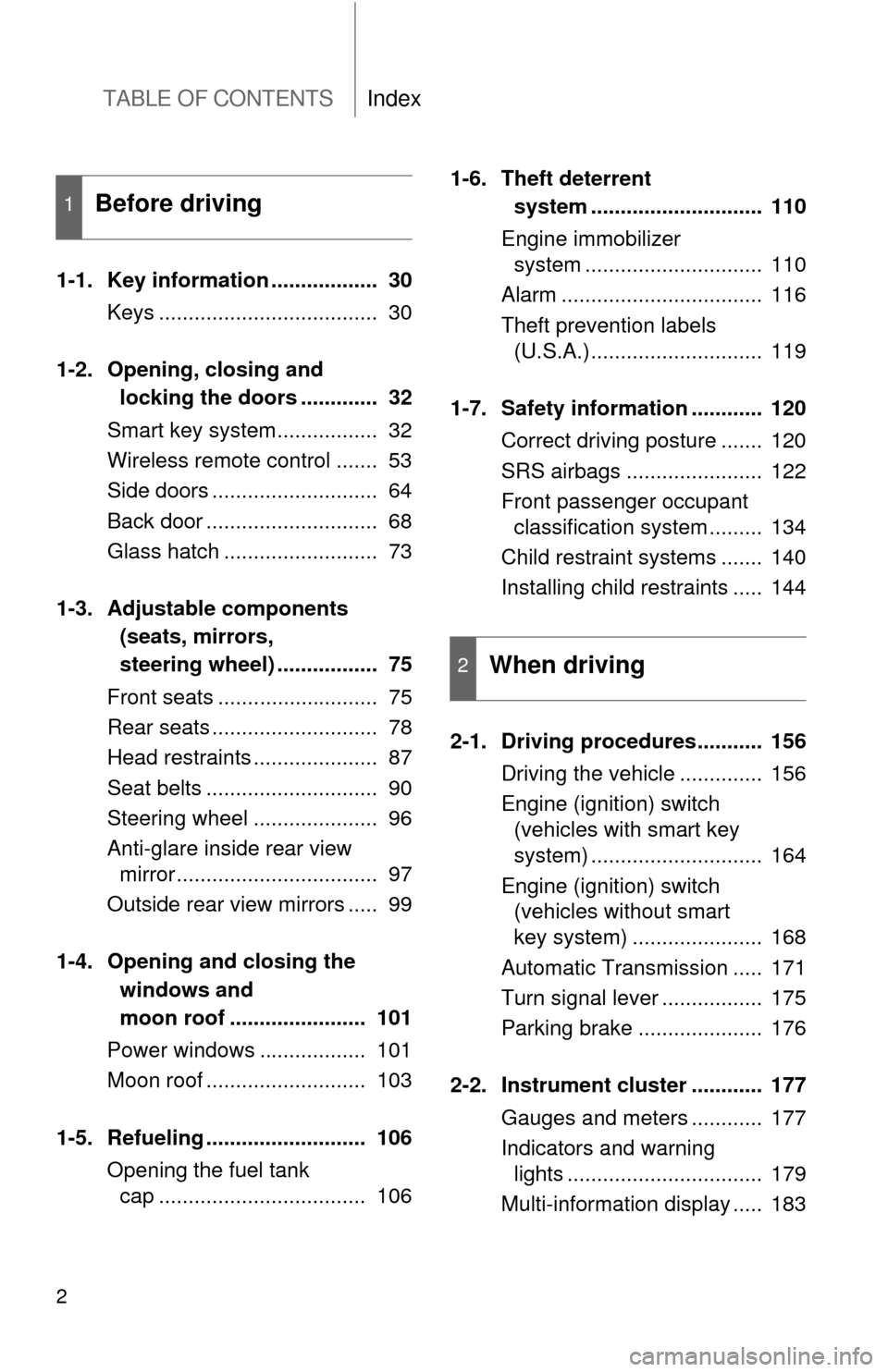
TABLE OF CONTENTSIndex
2
1-1. Key information .................. 30Keys ..................................... 30
1-2. Opening, closing and locking the doors ............. 32
Smart key system................. 32
Wireless remote control ....... 53
Side doors ............................ 64
Back door ............................. 68
Glass hatch .......................... 73
1-3. Adjustable components (seats, mirrors,
steering wheel) ................. 75
Front seats ........................... 75
Rear seats ............................ 78
Head restraints ..................... 87
Seat belts ............................. 90
Steering wheel ..................... 96
Anti-glare inside rear view mirror .................................. 97
Outside rear view mirrors ..... 99
1-4. Opening and closing the windows and
moon roof ....................... 101
Power windows .................. 101
Moon roof ........................... 103
1-5. Refueling ........................... 106 Opening the fuel tank cap ................................... 106 1-6. Theft deterrent
system ............................. 110
Engine immobilizer system .............................. 110
Alarm .................................. 116
Theft prevention labels (U.S.A.)............................. 119
1-7. Safety information ............ 120 Correct driving posture ....... 120
SRS airbags ....................... 122
Front passenger occupant classification system ......... 134
Child restraint systems ....... 140
Installing child restraints ..... 144
2-1. Driving procedures........... 156 Driving the vehicle .............. 156
Engine (ignition) switch (vehicles with smart key
system) ............................. 164
Engine (ignition) switch (vehicles without smart
key system) ...................... 168
Automatic Transmission ..... 171
Turn signal lever ................. 175
Parking brake ..................... 176
2-2. Instrument cluster ............ 177 Gauges and meters ............ 177
Indicators and warning lights ................................. 179
Multi-information display ..... 183
1Before driving
2When driving
Page 10 of 577
10
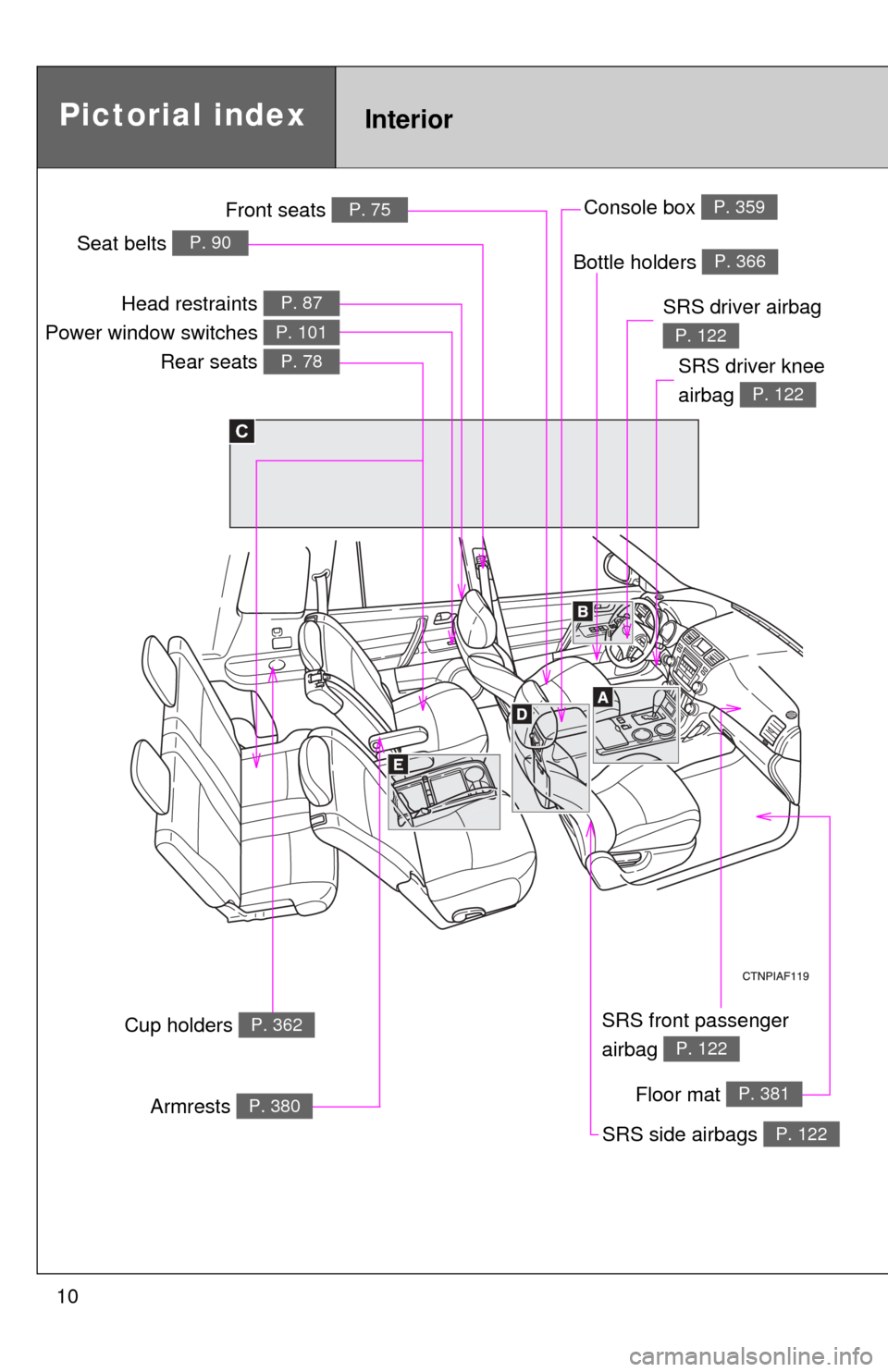
SRS side airbags P. 122
Console box P. 359
C
Cup holders P. 362
Armrests P. 380
SRS front passenger
airbag
P. 122
Seat belts P. 90
Front seats P. 75
Bottle holders P. 366
SRS driver airbag
P. 122
SRS driver knee
airbag
P. 122
Head restraints
Power window switches Rear seats P. 87
P. 101
P. 78
Pictorial indexInterior
Floor mat P. 381
Page 24 of 577

24
For your information
Main Owners Manual
Please note that this manual covers all models and all equipment, including
options. Therefore, you may find some explanations for equipment not
installed on your vehicle.
All specifications provided in this manual are current at the time of printing.
However, because of the Toyota policy of continual product improvement, we
reserve the right to make changes at any time without notice.
Depending on specifications, the vehicle shown in the illustrations may differ
from your vehicle in terms of equipment.
Accessories, spare parts and modification of your Toyota
A wide variety of non-genuine spare parts and accessories for Toyota
vehicles are currently available on the market. You should know that these
parts are not covered by Toyota warranty and that Toyota is not responsible
for their performance, repair, or replacement, or for any damage they may
cause to, or adverse effect they may have on, your Toyota vehicle.
This vehicle should not be modified with non-genuine Toyota products.
Modification with non-genuine Toyota products may affect performance,
safety or durability, and may even violate governmental regulations. In
addition, damage or performance problems resulting from the modification
may not be covered under warranty.
Installation of a mobile two-way radio system
As the installation of a mobile two-way radio system in your vehicle may
affect electronic systems such as the multi-port fuel injection system/sequen-
tial multi-port fuel injection system, cruise control system, anti-lock brake
system, SRS airbag system or seat belt pretensioner system, be sure to
check with your Toyota dealer for precautionary measures or special instruc-
tions regarding installation.
Page 25 of 577

25
Scrapping of your Toyota
The SRS airbag and seat belt pretensioner devices in your Toyota contain
explosive chemicals. If the vehicle is scrapped with the airbags and seat belt
pretensioners left as they are, this may cause an accident such as fire. Be
sure to have the systems of the SRS airbag and seat belt pretensioner
removed and disposed of by a qualified service shop or by your Toyota
dealer before you scrap your vehicle.
Perchlorate Material
Special handling may apply, See www.dtsc.ca.gov/hazardouswaste/perchlorate.
Your vehicle has components that may contain perchlorate. These compo-
nents may include airbag, seat belt pretensioners, and wireless remote con-
trol batteries.
Page 29 of 577
Before driving1
29
1-1. Key information................ 30Keys ................................... 30
1-2. Opening, closing and locking the doors ........... 32
Smart key system .............. 32
Wireless remote control ..... 53
Side doors .......................... 64
Back door ........................... 68
Glass hatch ........................ 73
1-3. Adjustable components (seats, mirrors,
steering wheel)............... 75
Front seats ......................... 75
Rear seats.......................... 78
Head restraints................... 87
Seat belts ........................... 90
Steering wheel ................... 96
Anti-glare inside rear view mirror ............................... 97
Outside rear view mirrors ... 99 1-4. Opening and closing the
windows and
moon roof ..................... 101
Power windows ................ 101
Moon roof ......................... 103
1-5. Refueling......................... 106 Opening the fuel tank cap ................................. 106
1-6. Theft deterrent system .......................... 110
Engine immobilizer system ........................... 110
Alarm................................ 116
Theft prevention labels (U.S.A.) .......................... 119
1-7. Safety information ......... 120 Correct driving posture..... 120
SRS airbags ..................... 122
Front passenger occupant classification system ...... 134
Child restraint systems..... 140
Installing child restraints ........................ 144
Page 67 of 577
67
1-2. Opening, closing and locking the doors
1
Before driving
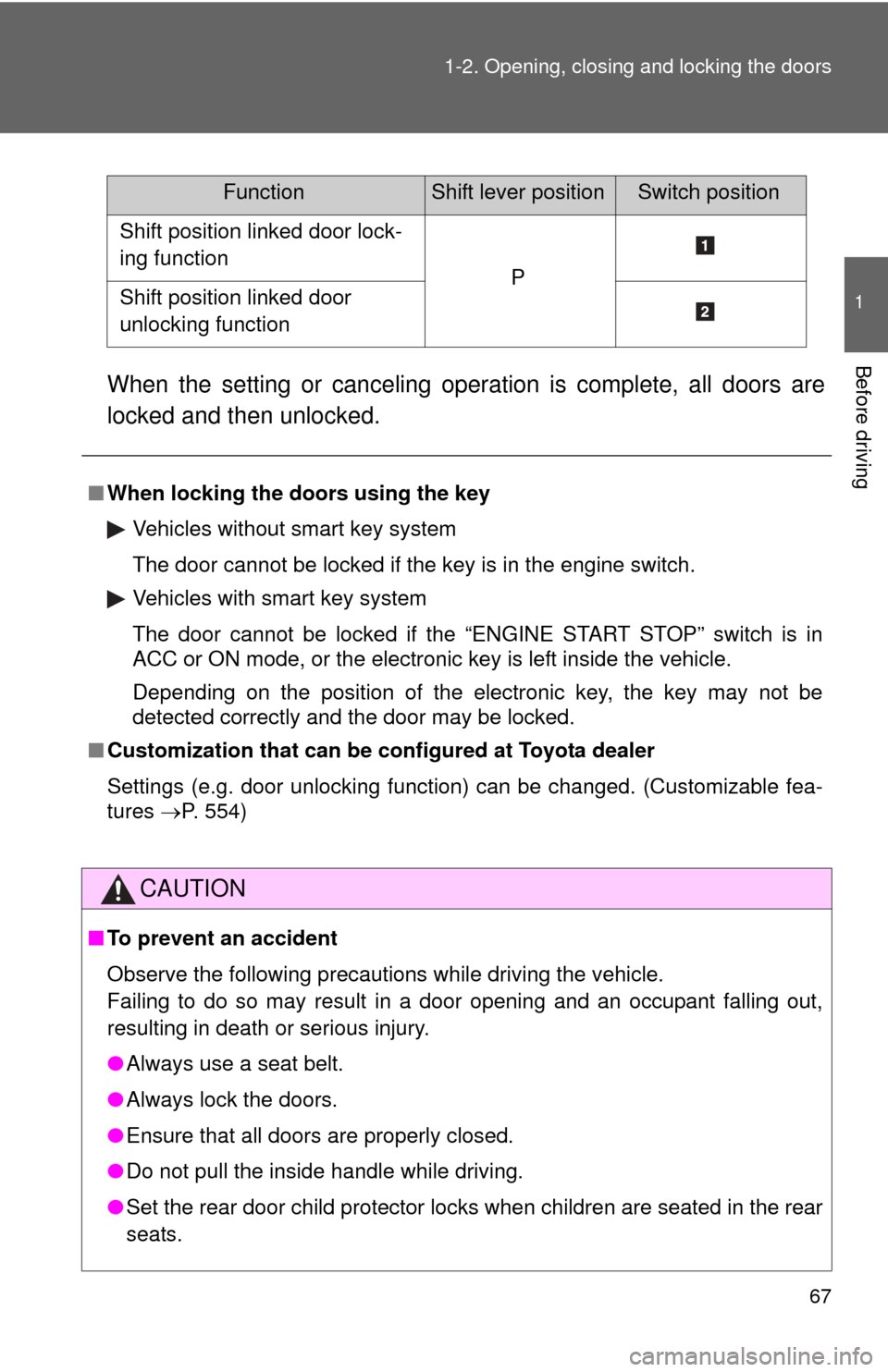
When the setting or canceling operation is complete, all doors are
locked and then unlocked.
FunctionShift lever positionSwitch position
Shift position linked door lock-
ing function
PShift position linked door
unlocking function
■
When locking the doors using the key
Vehicles without smart key system
The door cannot be locked if the key is in the engine switch.
Vehicles with smart key system
The door cannot be locked if the “ENGINE START STOP” switch is in
ACC or ON mode, or the electronic key is left inside the vehicle.
Depending on the position of the electronic key, the key may not be
detected correctly and the door may be locked.
■ Customization that can be co nfigured at Toyota dealer
Settings (e.g. door unlocking function) can be changed. (Customizable fea-
tures P. 554)
CAUTION
■To prevent an accident
Observe the following precautions while driving the vehicle.
Failing to do so may result in a door opening and an occupant falling out,
resulting in death or serious injury.
●Always use a seat belt.
● Always lock the doors.
● Ensure that all doors are properly closed.
● Do not pull the inside handle while driving.
● Set the rear door child protector locks when children are seated in the rear
seats.
Page 77 of 577
77
1-3. Adjustable components (s
eats, mirrors, steering wheel)
1
Before driving
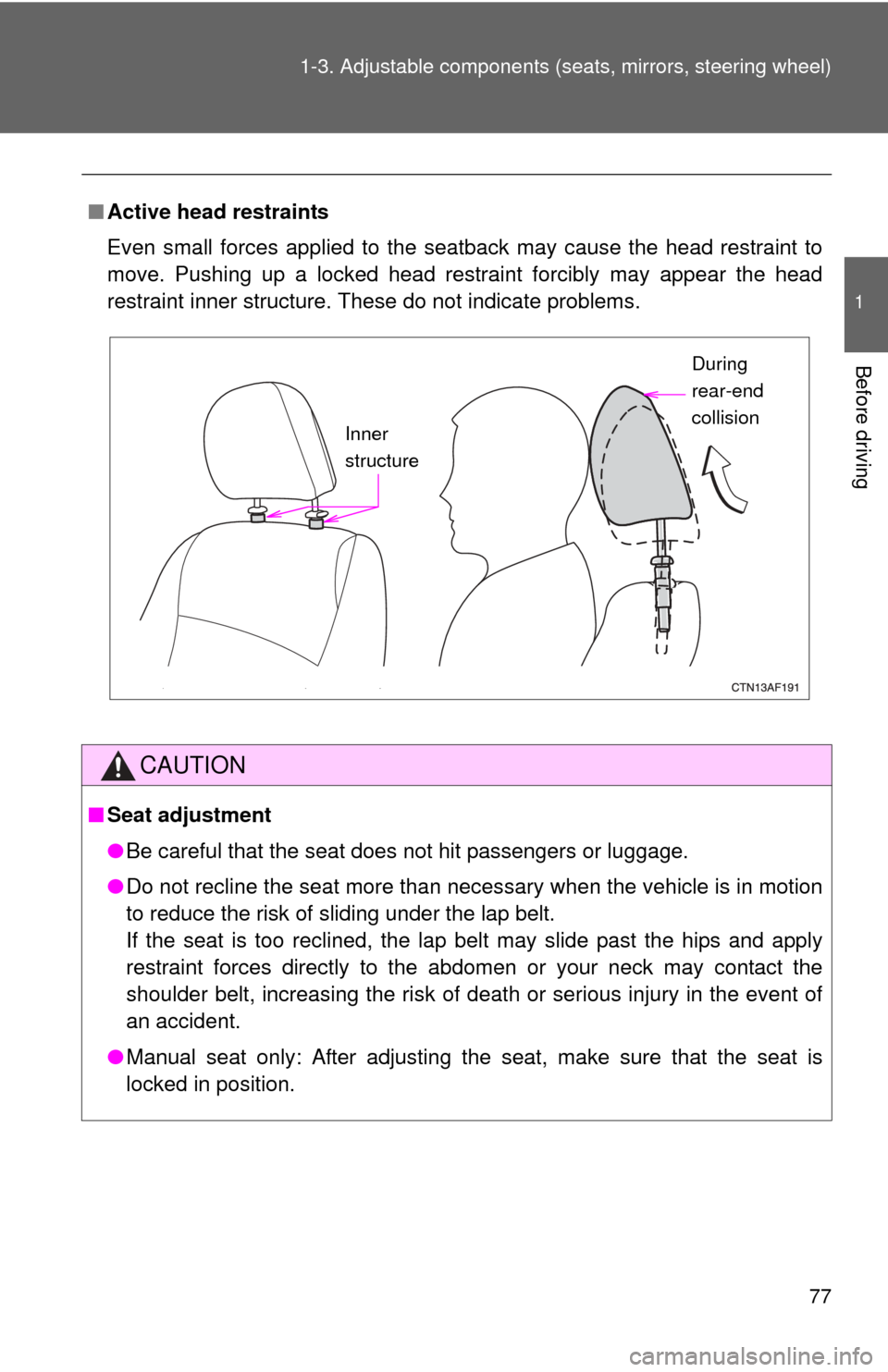
■Active head restraints
Even small forces applied to the seatback may cause the head restraint to
move. Pushing up a locked head restraint forcibly may appear the head
restraint inner structure. These do not indicate problems.
CAUTION
■Seat adjustment
●Be careful that the seat does not hit passengers or luggage.
● Do not recline the seat more than necessary when the vehicle is in motion
to reduce the risk of sliding under the lap belt.
If the seat is too reclined, the lap belt may slide past the hips and apply
restraint forces directly to the abdomen or your neck may contact the
shoulder belt, increasing the risk of death or serious injury in the event of
an accident.
● Manual seat only: After adjusting the seat, make sure that the seat is
locked in position.
Inner
structure During
rear-end
collision
Page 80 of 577
80 1-3. Adjustable components (seats, mirrors, steering wheel)
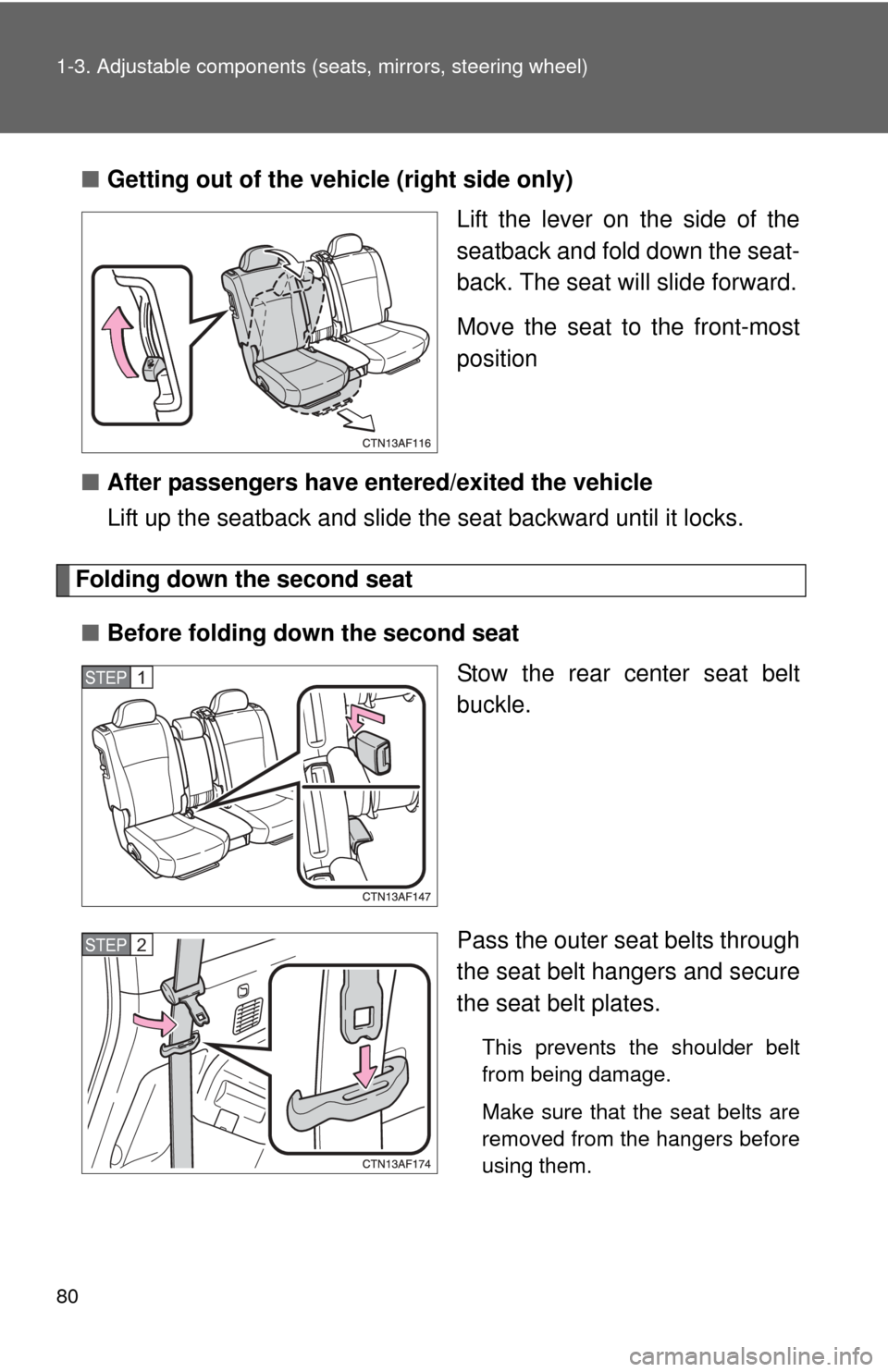
■Getting out of the vehicle (right side only)
Lift the lever on the side of the
seatback and fold down the seat-
back. The seat will slide forward.
Move the seat to the front-most
position
■ After passengers have entered/exited the vehicle
Lift up the seatback and slide the seat backward until it locks.
Folding down the second seat
■ Before folding down the second seat
Stow the rear center seat belt
buckle.
Pass the outer seat belts through
the seat belt hangers and secure
the seat belt plates.
This prevents the shoulder belt
from being damage.
Make sure that the seat belts are
removed from the hangers before
using them.
STEP1
STEP2
Page 82 of 577
82 1-3. Adjustable components (seats, mirrors, steering wheel)
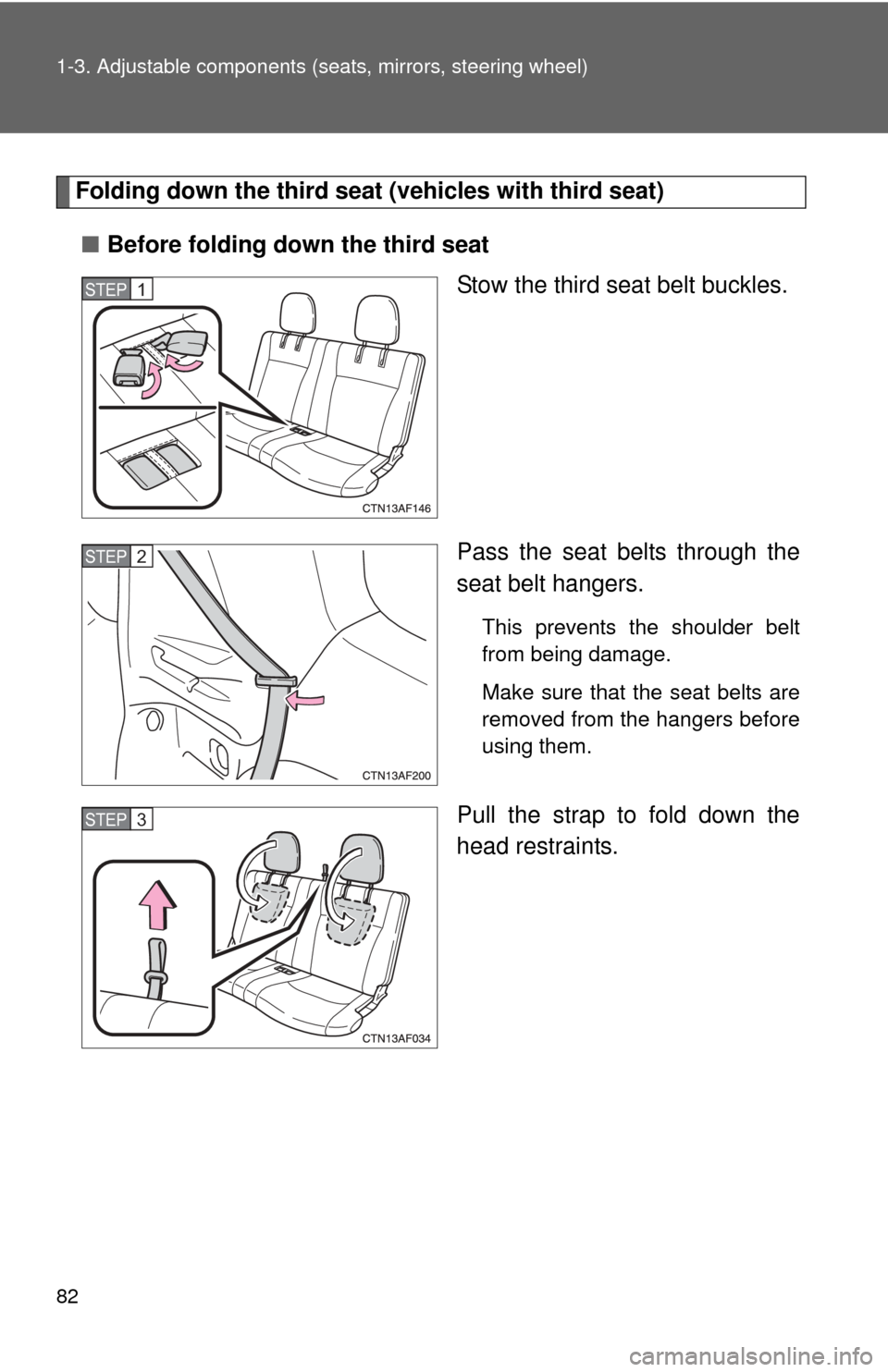
Folding down the third seat (vehicles with third seat)
■ Before folding down the third seat
Stow the third seat belt buckles.
Pass the seat belts through the
seat belt hangers.
This prevents the shoulder belt
from being damage.
Make sure that the seat belts are
removed from the hangers before
using them.
Pull the strap to fold down the
head restraints.
STEP1
STEP2
STEP3
Page 86 of 577
86 1-3. Adjustable components (seats, mirrors, steering wheel)
CAUTION
■When adjusting a rear seat or removing the second center seat
● Be careful that the seat does not hit passengers or luggage.
● Do not recline the seat more than necessary when the vehicle is in motion
to reduce the risk of sliding under the lap belt. If the seat is too reclined,
the lap belt may slide past the hips and apply restraint forces directly to the
abdomen or your neck may contact the shoulder belt, increasing the risk of
death or serious injury in the event of an accident.
● Be careful not to get your hands or feet caught in the seat.
■ Before folding down a rear seat
Do not fold down a rear seat when there are passengers sitting in the rear
seats or when there is luggage placed on the rear seats.
■ After adjusting a seat
Observe the following precautions. Failure to do so may result in death or
serious injury.
●Make sure that the seat and seatback are securely locked in position by
lightly rocking it back and forth.
● Second center seat: Make sure the seat is locked in place by trying to
shake the seatback and lift up the rear part of the seat cushion.
● Check that the seat belts are not twisted or caught under the seat.
■ Caution while driving
Keep the console box closed.
Injuries may result in the event of an accident or sudden braking.
NOTICE
■When folding down the second seats
Do not fold the seatback forward with the luggage cover hooks attached.
■ Removed second center seat
Avoid putting heavy loads on the seat. The metallic seat pins may be dam-
aged, and you may be unable to correctly reinstall the seat.