oil TOYOTA HIGHLANDER HYBRID 2021 Owners Manual (in English)
[x] Cancel search | Manufacturer: TOYOTA, Model Year: 2021, Model line: HIGHLANDER HYBRID, Model: TOYOTA HIGHLANDER HYBRID 2021Pages: 578, PDF Size: 16.92 MB
Page 1 of 578
1
2
3
4
5
6
7
8
9
9
HIGHLANDER HV_U
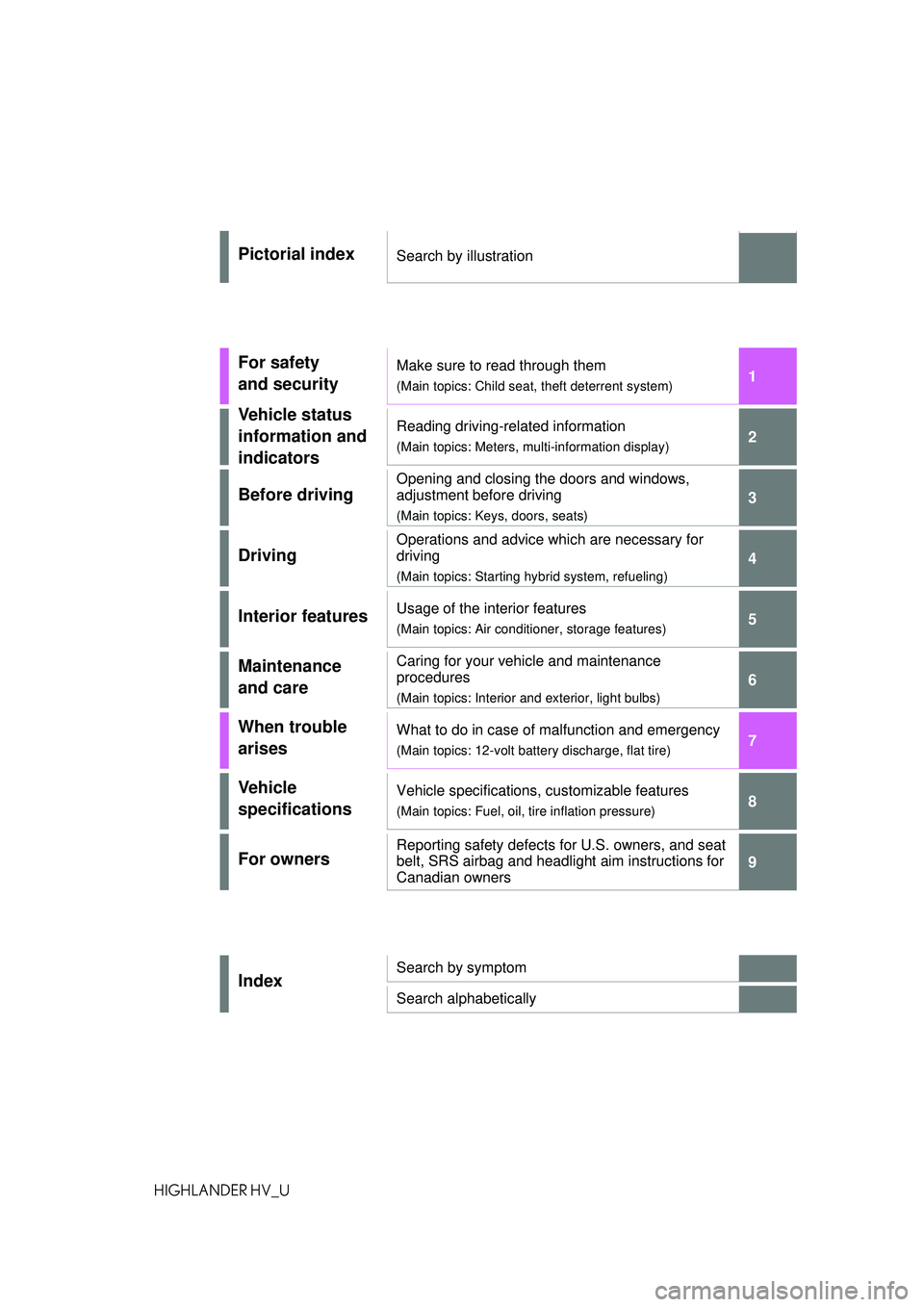
Pictorial indexSearch by illustration
For safety
and securityMake sure to read through them
(Main topics: Child seat, theft deterrent system)
Vehicle status
information and
indicatorsReading driving-related information
(Main topics: Meters, multi-information display)
Before driving
Opening and closing the doors and windows,
adjustment before driving
(Main topics: Keys, doors, seats)
Driving
Operations and advice which are necessary for
driving
(Main topics: Starting hybrid system, refueling)
Interior featuresUsage of the interior features
(Main topics: Air conditioner, storage features)
Maintenance
and careCaring for your vehicle and maintenance
procedures
(Main topics: Interior and exterior, light bulbs)
When trouble
arisesWhat to do in case of malfunction and emergency
(Main topics: 12-volt battery discharge, flat tire)
Vehicle
specificationsVehicle specifications, customizable features
(Main topics: Fuel, oil, tire inflation pressure)
For ownersReporting safety defects for U.S. owners, and seat
belt, SRS airbag and headlight aim instructions for
Canadian owners
IndexSearch by symptom
Search alphabetically
Page 4 of 578
4TABLE OF CONTENTS
HIGHLANDER HV_U
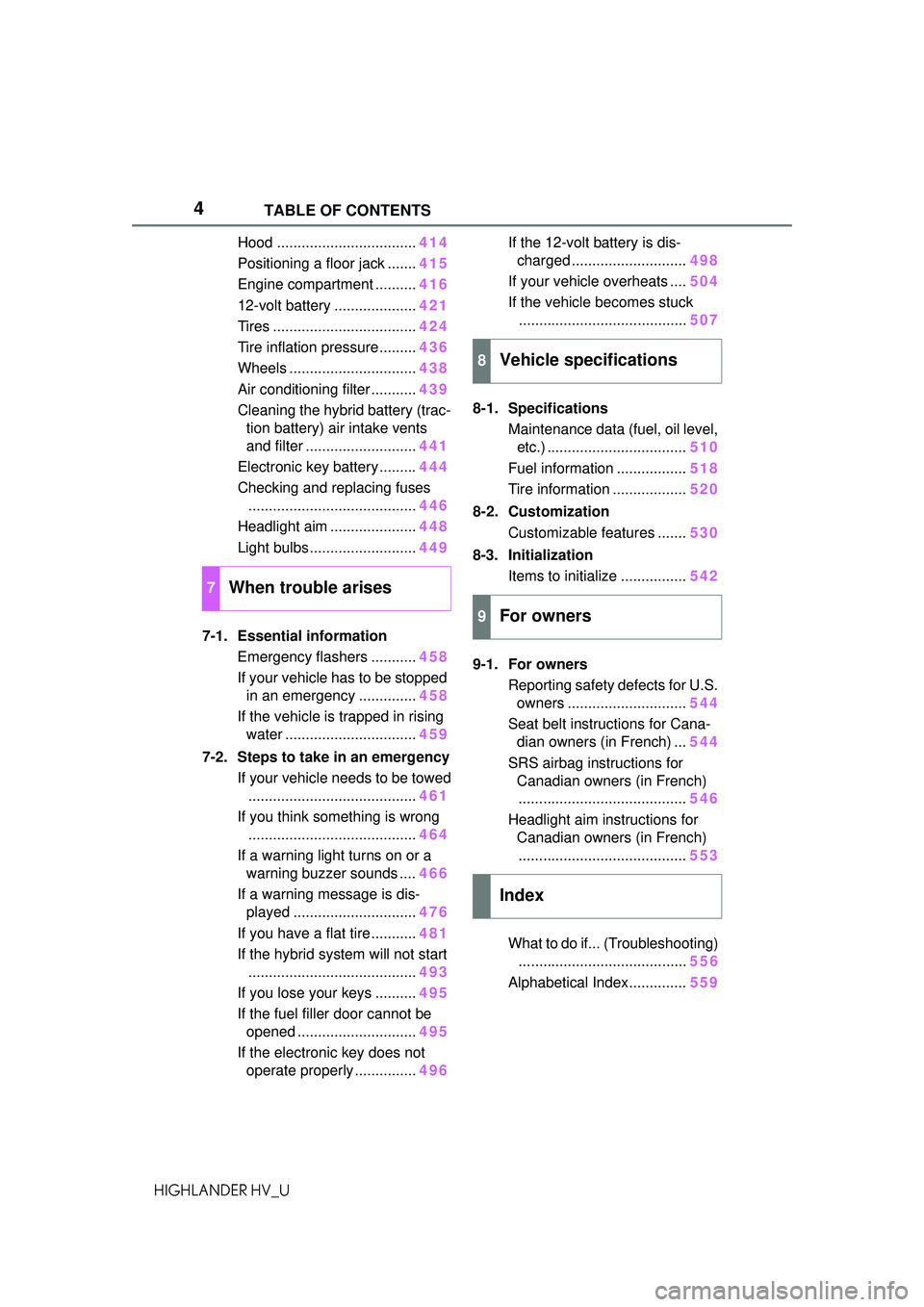
Hood ..................................414
Positioning a floor jack ....... 415
Engine compartment .......... 416
12-volt battery .................... 421
Tires ................................... 424
Tire inflation pressure......... 436
Wheels ............................... 438
Air conditioning filter ........... 439
Cleaning the hybrid battery (trac- tion battery) air intake vents
and filter ........................... 441
Electronic key battery ......... 444
Checking and replacing fuses ......................................... 446
Headlight aim ..................... 448
Light bulbs .......................... 449
7-1. Essential information Emergency flashers ........... 458
If your vehicle has to be stopped in an emergency .............. 458
If the vehicle is trapped in rising water ................................ 459
7-2. Steps to take in an emergency If your vehicle needs to be towed......................................... 461
If you think something is wrong ......................................... 464
If a warning light turns on or a warning buzzer sounds .... 466
If a warning message is dis- played .............................. 476
If you have a flat tire ........... 481
If the hybrid system will not start ......................................... 493
If you lose your keys .......... 495
If the fuel filler door cannot be opened ............................. 495
If the electronic key does not operate properly ............... 496If the 12-volt battery is dis-
charged ............................ 498
If your vehicle overheats .... 504
If the vehicle becomes stuck ......................................... 507
8-1. Specifications Maintenance data (fuel, oil level, etc.) .................................. 510
Fuel information ................. 518
Tire information .................. 520
8-2. Customization Customizable features ....... 530
8-3. Initialization Items to initialize ................ 542
9-1. For owners Reporting safety defects for U.S. owners ............................. 544
Seat belt instructions for Cana- dian owners (in French) ... 544
SRS airbag instructions for Canadian owners (in French)......................................... 546
Headlight aim instructions for Canadian owners (in French)......................................... 553
What to do if... (Troubleshooting) ......................................... 55
6
Alphabetical Index.............. 559
7When trouble arises
8Vehicle specifications
9For owners
Index
Page 13 of 578
13Pictorial index
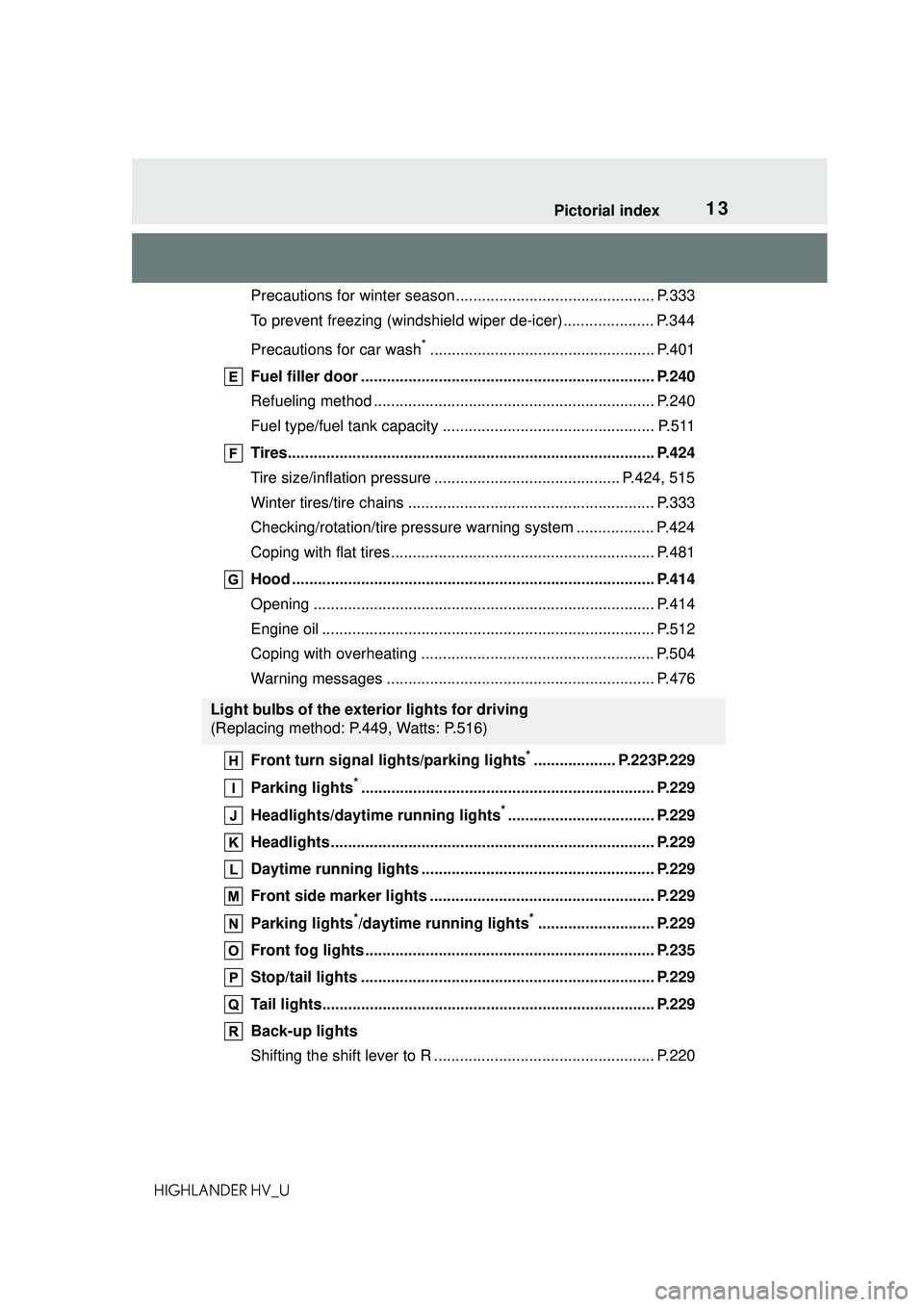
HIGHLANDER HV_UPrecautions for winter season....
.......................................... P.333
To prevent freezing (windshield wiper de-icer) ..................... P.344
Precautions for car wash
*.................................................... P.401
Fuel filler door .................................................................... P.240
Refueling method ................................................................. P.240
Fuel type/fuel tank capacity ................................................. P.511
Tires..................................................................................... P.424
Tire size/inflation pressure ........................................... P.424, 515
Winter tires/tire chains ......................................................... P.333
Checking/rotation/tire pressure warning system .................. P.424
Coping with flat tires............................................................. P.481
Hood .................................................................................... P.414
Opening ............................................................................... P.414
Engine oil ............................................................................. P.512
Coping with overheating ...................................................... P.504
Warning messages .............................................................. P.476
Front turn signal lights/parking lights
*................... P.223P.229
Parking lights
*.................................................................... P.229
Headlights/daytime running lights
*.................................. P.229
Headlights........................................................................... P.229
Daytime running lights ............... ....................................... P.229
Front side marker lights .................................................... P.229
Parking lights
*/daytime running lights*........................... P.229
Front fog lights ................................................................... P.235
Stop/tail lights .................................................................... P.229
Tail lights............................................................................. P.229
Back-up lights
Shifting the shift lever to R ................................................... P.220
Light bulbs of the exterior lights for driving
(Replacing method: P.449, Watts: P.516)
Page 85 of 578
852-1. Instrument cluster
2
Vehicle status information and indicators
HIGHLANDER HV_U
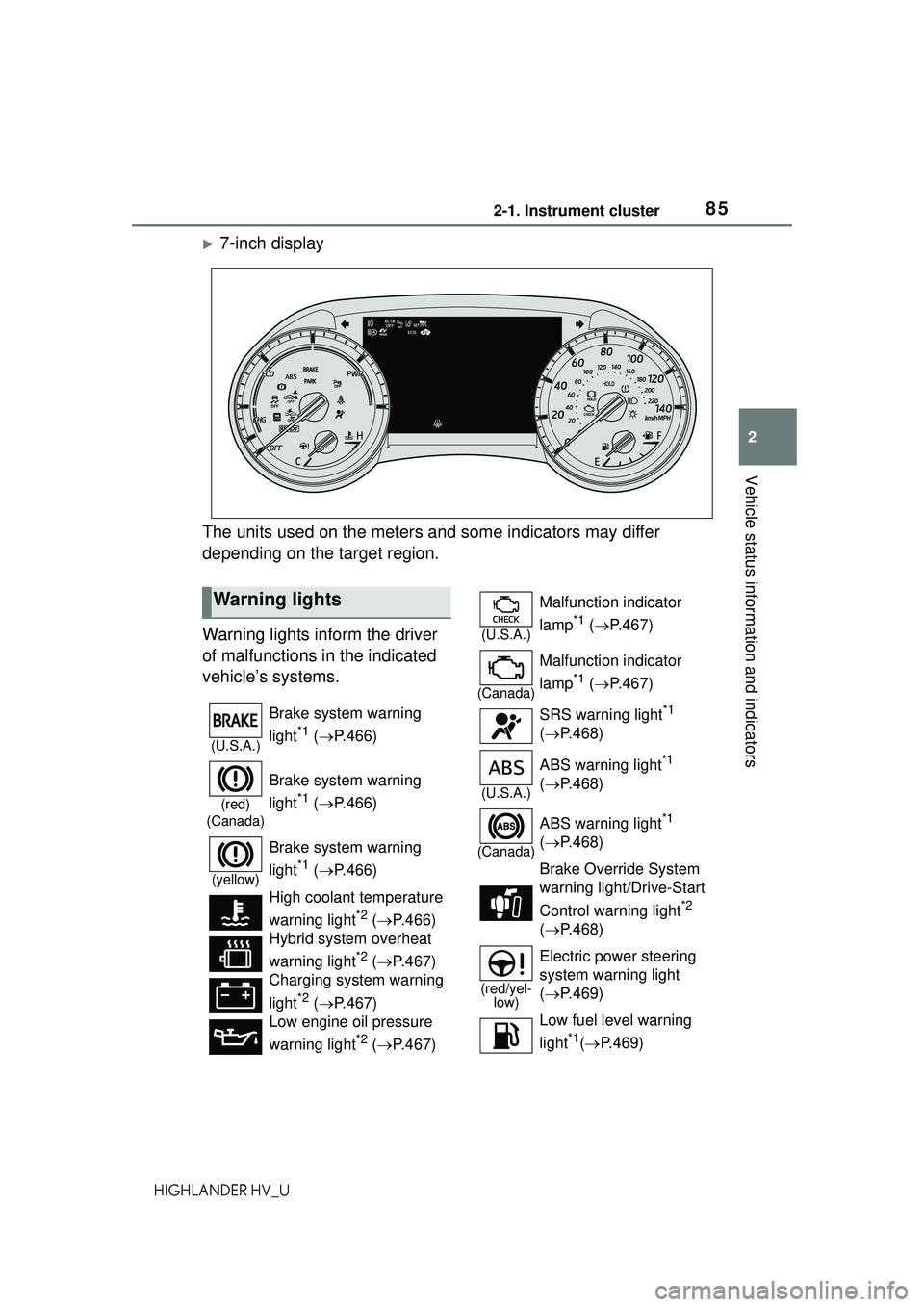
7-inch display
The units used on the meters and some indicators may differ
depending on the target region.
Warning lights inform the driver
of malfunctions in the indicated
vehicle’s systems.
Warning lights
(U.S.A.)
Brake system warning
light
*1 ( P.466)
(red)
(Canada)
Brake system warning
light
*1 ( P.466)
(yellow)
Brake system warning
light
*1 ( P.466)
High coolant temperature
warning light
*2 ( P.466)
Hybrid system overheat
warning light
*2 ( P.467)
Charging system warning
light
*2 ( P.467)
Low engine oil pressure
warning light
*2 ( P.467)
(U.S.A.)
Malfunction indicator
lamp
*1 ( P.467)
(Canada)
Malfunction indicator
lamp
*1 ( P.467)
SRS warning light
*1
( P.468)
(U.S.A.)
ABS warning light*1
( P.468)
(Canada)
ABS warning light*1
( P.468)
Brake Override System
warning light/Drive-Start
Control warning light
*2
( P.468)
(red/yel-
low)
Electric power steering
system warning light
( P.469)
Low fuel level warning
light
*1( P.469)
Page 147 of 578
1473-2. Opening, closing and locking the doors
3
Before driving
HIGHLANDER HV_U
●When an interior alarm sounds
continuously
■Battery-saving function
The battery-saving function will be
activated in order to prevent the
electronic key battery and the
12-volt battery from being dis-
charged while the vehicle is not
operated for a long time.
●In the following situations, the
smart key system may take some
time to unlock the doors.
• The electronic key has been left in
an area of approximately 6 ft. (2
m) of the outside of the vehicle for
10 minutes or longer.
• The smart key system has not been used for 5 days or longer.
●If the smart key system has not
been used for 14 days or longer,
the doors cannot be unlocked at
any doors except the driver’s door.
In this case, take hold of the
driver’s door handle, or use the wireless remote control or the
mechanical key, to unlock the
doors.
■Turning an electronic key to
battery-saving mode
When battery-saving mode is set,
battery depletion is minimized by
stopping the electronic key from
receiving radio waves.
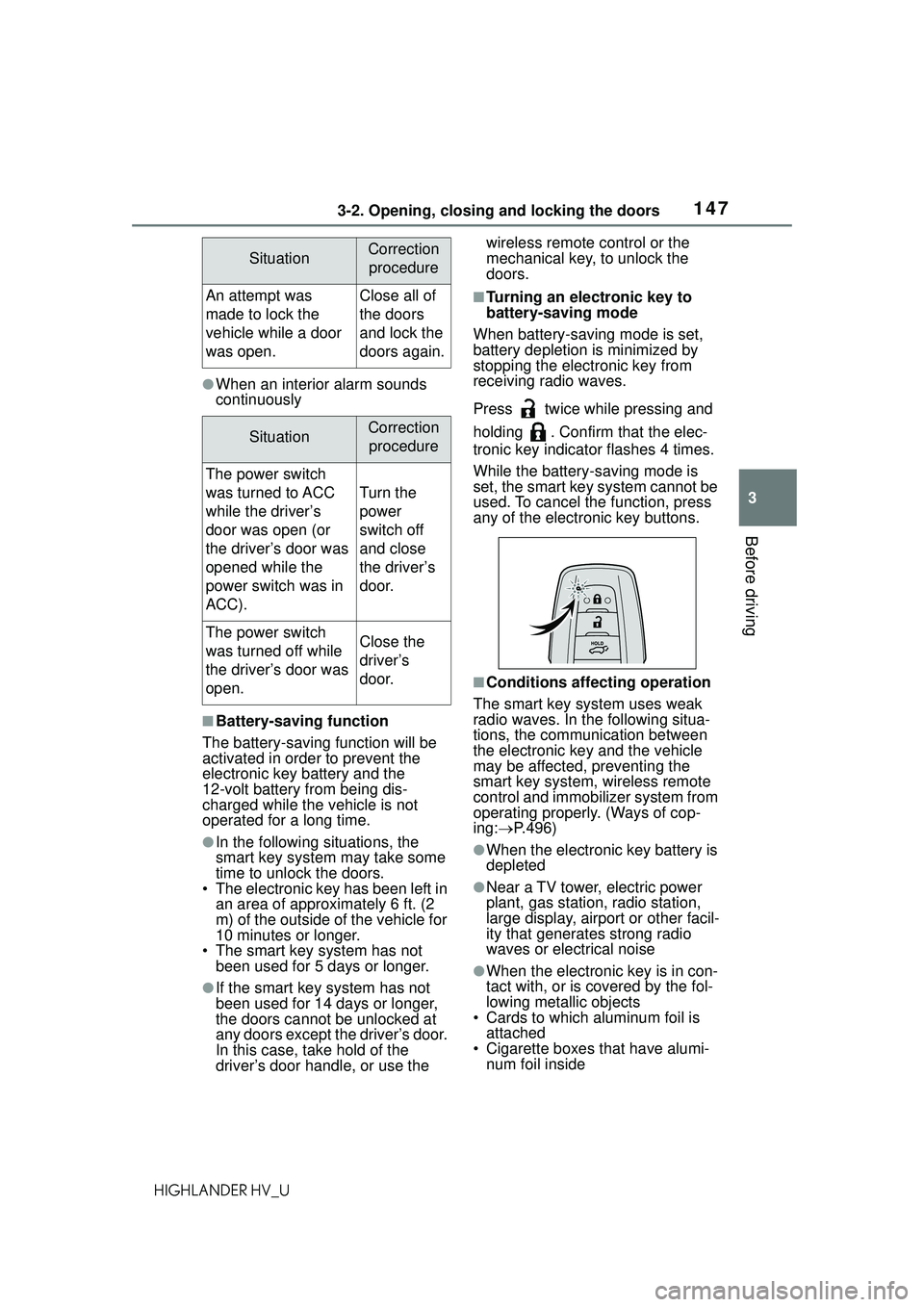
Press twice while pressing and
holding . Confirm that the elec-
tronic key indicator flashes 4 times.
While the battery-saving mode is
set, the smart key system cannot be
used. To cancel the function, press
any of the electronic key buttons.
■Conditions affecting operation
The smart key system uses weak
radio waves. In the following situa-
tions, the communication between
the electronic key and the vehicle
may be affected, preventing the
smart key system, wireless remote
control and immobilizer system from
operating properly. (Ways of cop-
ing: P.496)
●When the electronic key battery is
depleted
●Near a TV tower, electric power
plant, gas station, radio station,
large display, airport or other facil-
ity that generates strong radio
waves or electrical noise
●When the electronic key is in con-
tact with, or is covered by the fol-
lowing metallic objects
• Cards to which aluminum foil is attached
• Cigarette boxes that have alumi- num foil inside
SituationCorrection
procedure
An attempt was
made to lock the
vehicle while a door
was open.Close all of
the doors
and lock the
doors again.
SituationCorrection procedure
The power switch
was turned to ACC
while the driver’s
door was open (or
the driver’s door was
opened while the
power switch was in
ACC).
Turn the
power
switch off
and close
the driver’s
door.
The power switch
was turned off while
the driver’s door was
open.Close the
driver’s
door.
Page 196 of 578
1964-1. Before driving
HIGHLANDER HV_U
NOTICE
■When parking the vehicle
Always set the parking brake and
shift the shift lever to P. Failure to
do so may cause the vehicle to
move or the vehi cle may acceler-
ate suddenly if the accelerator
pedal is accidentally depressed.
■Avoiding damage to vehicle
parts
●Do not turn the steering wheel
fully in either direction and hold
it there for an extended period
of time.
Doing so may damage the
power steering motor.
●When driving over bumps on
the road, drive as slowly as pos-
sible to avoid damaging the
wheels, underside of the vehi-
cle, etc.
■If you get a flat tire while driv-
ing
A flat or damaged tire may cause
the following situations. Hold the
steering wheel firmly and gradu-
ally depress the brake pedal to
slow down the vehicle.
●It may be difficult to control your
vehicle.
●The vehicle will make abnormal
sounds or vibrations.
●The vehicle will lean abnor-
mally.
Information on what to do in case
of a flat tire (
P.481)
■When encountering flooded
roads
Do not drive on a road that has
flooded after heavy rain etc.
Doing so may cause the following
serious damage to the vehicle:
●Engine stalling
●Short in electrical components
●Engine damage caused by
water immersion
In the event that you drive on a
flooded road and the vehicle is
flooded, be sure to have your Toy-
ota dealer check the following:
●Brake function
●Changes in quantity and quality
of oil and fluid used for the
engine, hybrid transaxle (front
and rear [AWD models]), etc.
●Lubricant condition for bearings
and suspension joints (where
possible), and the function of all
joints, bearings, etc.
Page 260 of 578
2604-5. Using the driving support systems
HIGHLANDER HV_Upre-collision brak
e assist and
pre-collision braking functions are
also disabled.
●The PCS warning light will turn on
and “VSC Turned OFF Pre-Colli-
sion Brake System Unavailable”
will be displayed on the
multi-information display.
LTA (Lane Tracing
Assist)
While driving on a road with
clear white (yellow) lane
lines, the LTA system warns
the driver if the vehicle may
deviate from the current
lane or course
*, and also
can slightly operate the
steering wheel to help avoid
deviation from the lane or
course
*. Also, while the
dynamic radar cruise con-
trol with full-speed range
( P.271) is operating, this
system will operate the
steering wheel to maintain
the vehicle’s lane position.
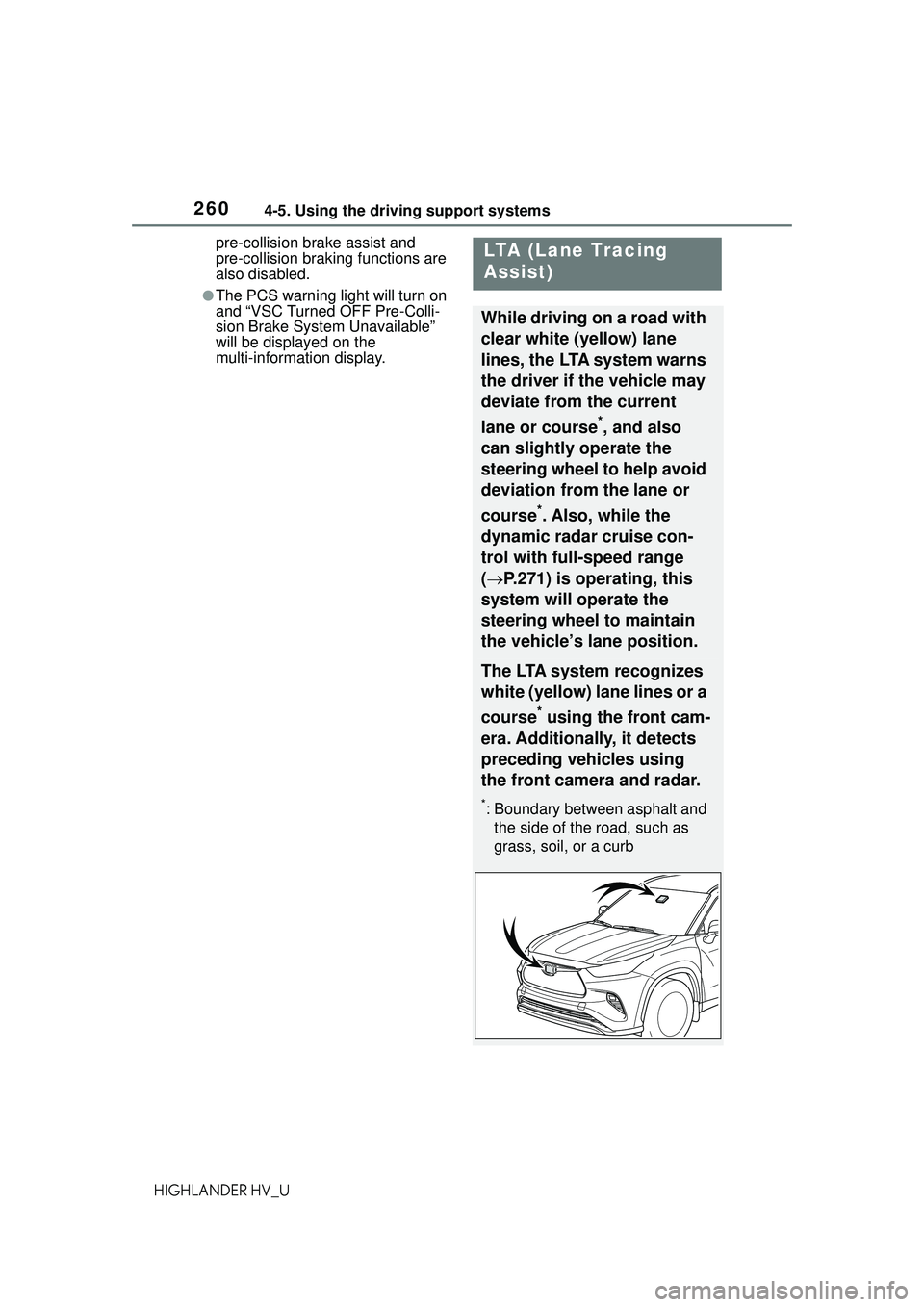
The LTA system recognizes
white (yellow) lane lines or a
course
* using the front cam-
era. Additionally, it detects
preceding vehicles using
the front camera and radar.
*: Boundary between asphalt and the side of the road, such as
grass, soil, or a curb
Page 264 of 578
2644-5. Using the driving support systems
HIGHLANDER HV_U
■Lane departure alert func-
tion
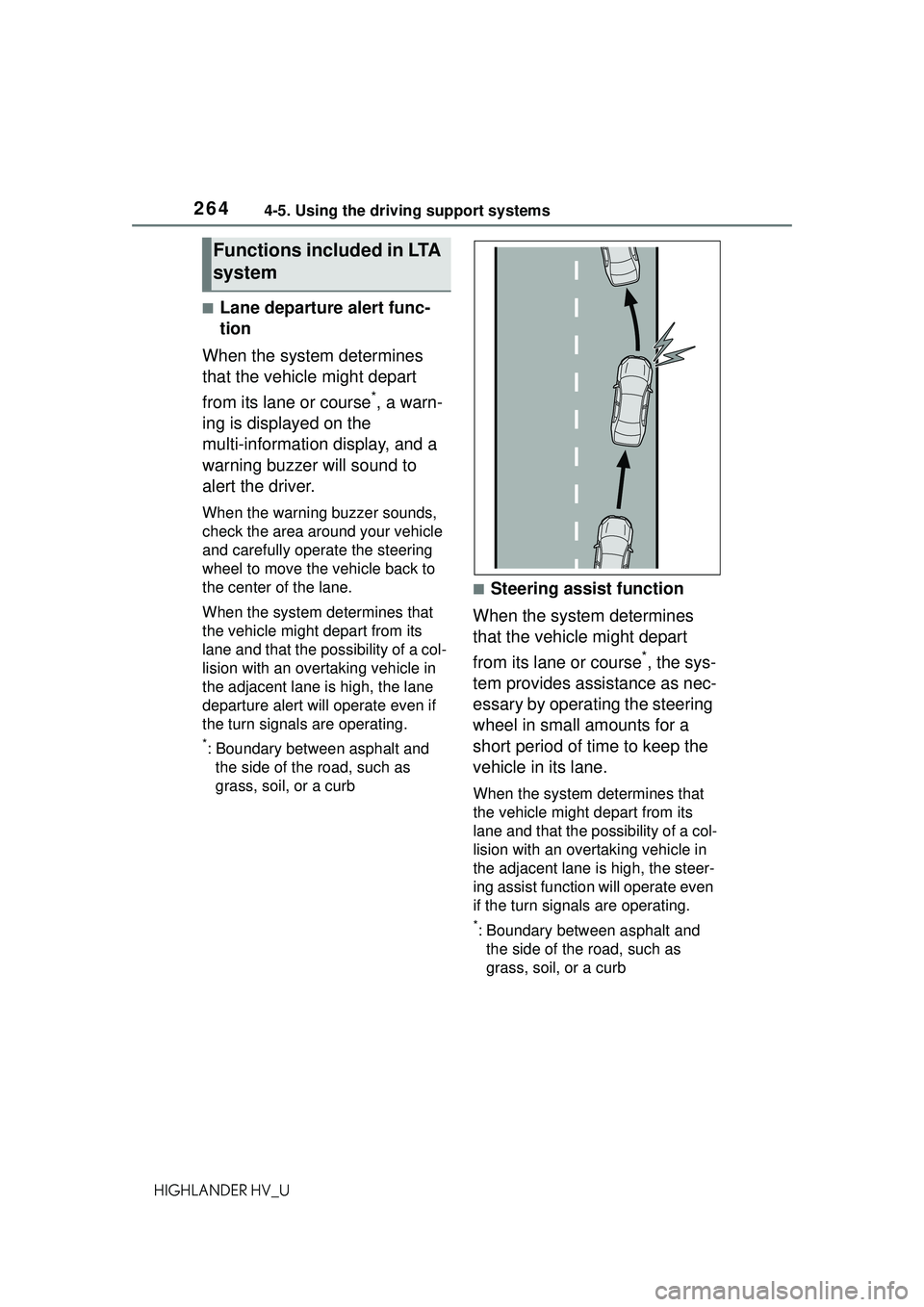
When the system determines
that the vehicle might depart
from its lane or course
*, a warn-
ing is displayed on the
multi-information display, and a
warning buzzer will sound to
alert the driver.
When the warning buzzer sounds,
check the area around your vehicle
and carefully operate the steering
wheel to move the vehicle back to
the center of the lane.
When the system de termines that
the vehicle might depart from its
lane and that the possibility of a col-
lision with an overtaking vehicle in
the adjacent lane is high, the lane
departure alert will operate even if
the turn signals are operating.
*: Boundary between asphalt and the side of the road, such as
grass, soil, or a curb
■Steering assist function
When the system determines
that the vehicle might depart
from its lane or course
*, the sys-
tem provides assistance as nec-
essary by operating the steering
wheel in small amounts for a
short period of time to keep the
vehicle in its lane.
When the system determines that
the vehicle might depart from its
lane and that the possibility of a col-
lision with an overtaking vehicle in
the adjacent lane is high, the steer-
ing assist function will operate even
if the turn signals are operating.
*: Boundary between asphalt and the side of the road, such as
grass, soil, or a curb
Functions included in LTA
system
Page 267 of 578
2674-5. Using the driving support systems
4
Driving
HIGHLANDER HV_Uassistance of the steering assist
function or lane centering function
is operating.
Flashing in orange: Lane departure
alert function is operating.
Operation display of steering
wheel operation support
Displayed when the multi-informa-
tion display is switched to the driv-
ing support system information
display.
Indicates that steering wheel assis-
tance of the steering assist function
or lane centering function is operat-
ing.
Both outer sides of the lane are dis-
played: Indicates that steering
wheel assist of the lane centering
function is operating.
One outer side of the lane is dis-
played: Indicates that steering
wheel assist of the steering assist
function is operating.
Both outer sides of the lane are
flashing: Alerts the driver that their
input is necessary to stay in the
center of the lane (lane centering
function).
Lane departure alert function
display
Displayed when the multi-informa-
tion display is switched to the driv-
ing support system information
display.
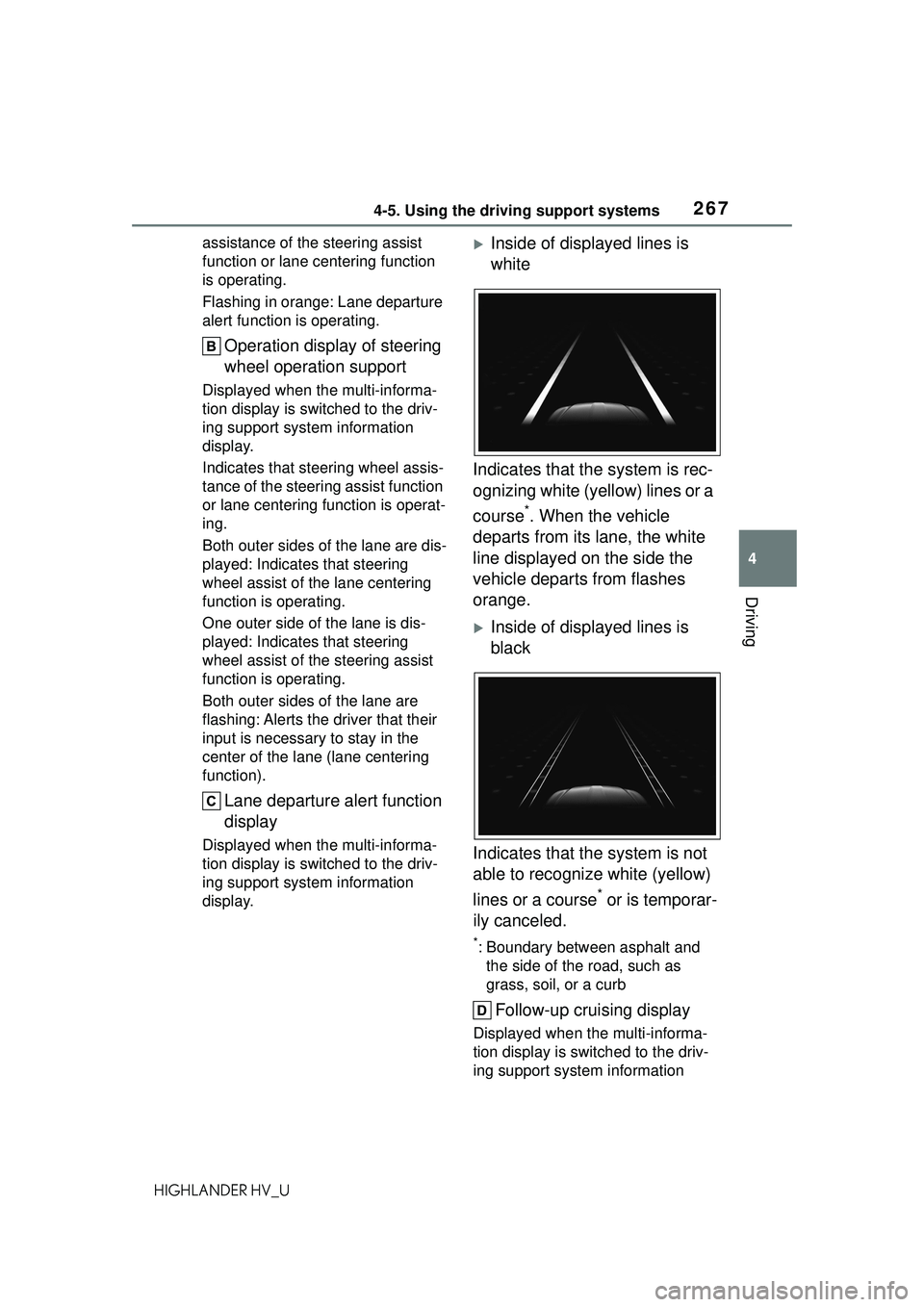
Inside of displayed lines is
white
Indicates that the system is rec-
ognizing white (yellow) lines or a
course
*. When the vehicle
departs from its lane, the white
line displayed on the side the
vehicle departs from flashes
orange.
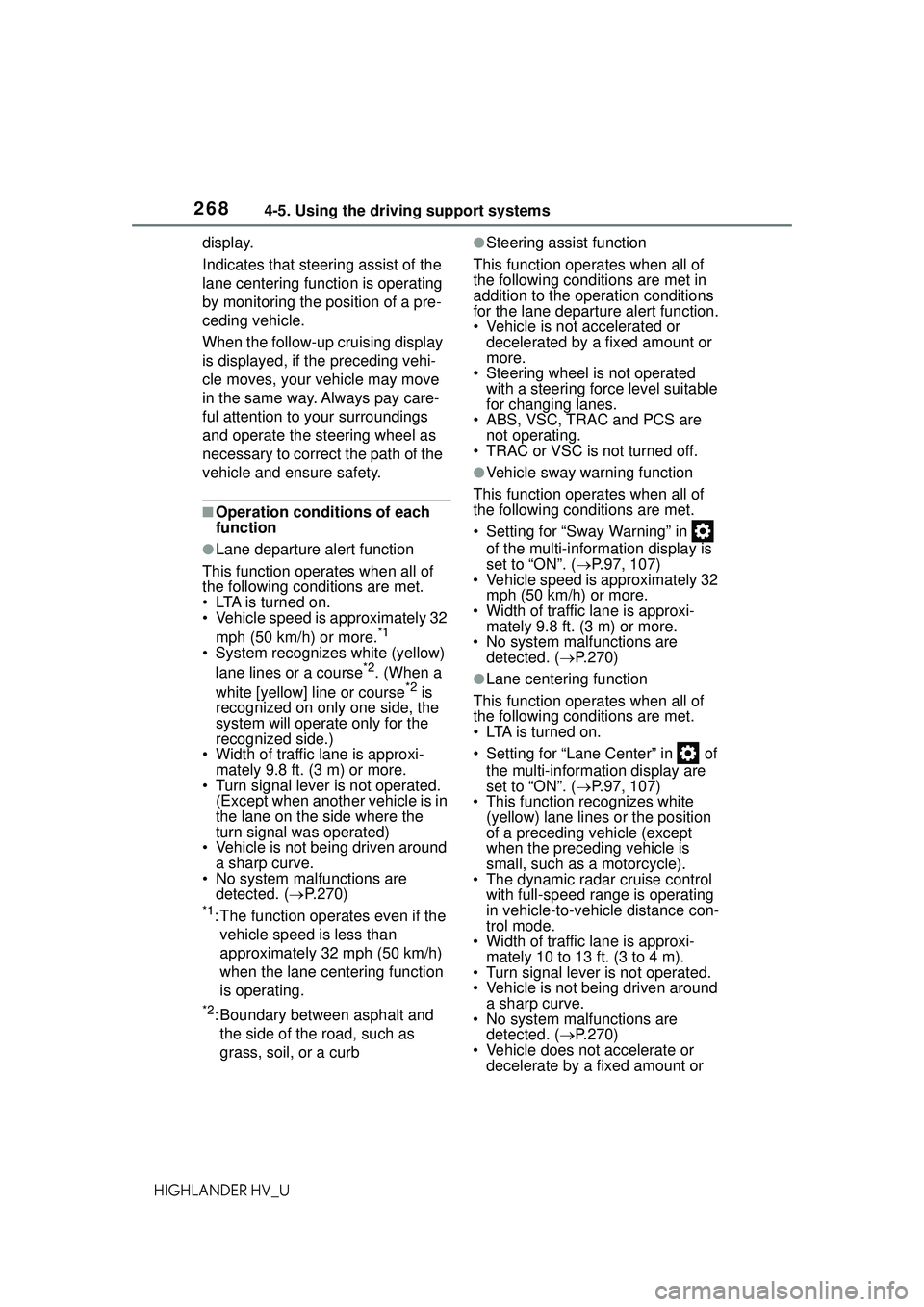
Inside of displayed lines is
black
Indicates that the system is not
able to recognize white (yellow)
lines or a course
* or is temporar-
ily canceled.
*: Boundary between asphalt and the side of the road, such as
grass, soil, or a curb
Follow-up cruising display
Displayed when the multi-informa-
tion display is switched to the driv-
ing support system information
Page 268 of 578
2684-5. Using the driving support systems
HIGHLANDER HV_Udisplay.
Indicates that steering assist of the
lane centering function is operating
by monitoring the position of a pre-
ceding vehicle.
When the follow-up cruising display
is displayed, if the preceding vehi-
cle moves, your vehicle may move
in the same way. Always pay care-
ful attention to your surroundings
and operate the steering wheel as
necessary to correct the path of the
vehicle and ensure safety.
■Operation conditions of each
function
●Lane departure alert function
This function operates when all of
the following conditions are met.
• LTA is turned on.
• Vehicle speed is approximately 32 mph (50 km/h) or more.
*1
• System recognizes white (yellow) lane lines or a course*2. (When a
white [yellow] line or course*2 is
recognized on only one side, the
system will operate only for the
recognized side.)
• Width of traffic lane is approxi- mately 9.8 ft. (3 m) or more.
• Turn signal lever is not operated. (Except when another vehicle is in
the lane on the side where the
turn signal was operated)
• Vehicle is not being driven around a sharp curve.
• No system malfunctions are
detected. ( P.270)
*1: The function operates even if the
vehicle speed is less than
approximately 32 mph (50 km/h)
when the lane centering function
is operating.
*2: Boundary between asphalt and the side of the road, such as
grass, soil, or a curb
●Steering assist function
This function operates when all of
the following conditions are met in
addition to the operation conditions
for the lane departure alert function.
• Vehicle is not accelerated or decelerated by a fixed amount or
more.
• Steering wheel is not operated with a steering force level suitable
for changing lanes.
• ABS, VSC, TRAC and PCS are not operating.
• TRAC or VSC is not turned off.
●Vehicle sway warning function
This function operates when all of
the following conditions are met.
• Setting for “Sway Warning” in of the multi-information display is
set to “ON”. ( P.97, 107)
• Vehicle speed is approximately 32 mph (50 km/h) or more.
• Width of traffic lane is approxi- mately 9.8 ft. (3 m) or more.
• No system malfunctions are
detected. ( P.270)
●Lane centering function
This function operates when all of
the following conditions are met.
• LTA is turned on.
• Setting for “Lane Center” in of the multi-information display are
set to “ON”. ( P.97, 107)
• This function recognizes white (yellow) lane lines or the position
of a preceding vehicle (except
when the preceding vehicle is
small, such as a motorcycle).
• The dynamic radar cruise control with full-speed range is operating
in vehicle-to-vehicle distance con-
trol mode.
• Width of traffic lane is approxi-
mately 10 to 13 ft. (3 to 4 m).
• Turn signal lever is not operated.
• Vehicle is not being driven around a sharp curve.
• No system malfunctions are detected. ( P.270)
• Vehicle does not accelerate or decelerate by a fixed amount or