trailer TOYOTA HILUX 2013 Owners Manual (in English)
[x] Cancel search | Manufacturer: TOYOTA, Model Year: 2013, Model line: HILUX, Model: TOYOTA HILUX 2013Pages: 644, PDF Size: 34.35 MB
Page 3 of 644
1
2
3
4
5
6
3
HILUX_OM_OM0K189E_(EE)
2-1. Driving procedures
Driving the vehicle .............. 146
Engine (ignition) switch ....... 162
Automatic transmission....... 166
Manual transmission ........... 170
Turn signal lever ................. 173
Parking brake...................... 174
Horn .................................... 175
2-2. Instrument cluster
Gauges and meters ............ 176
Indicators and warning
lights ................................. 180
Multi-information display ..... 1852-3. Operating the lights
and wipers
Headlight switch ................. 191
Fog light switch .................. 195
Windshield wipers
and washer ...................... 199
Headlight cleaner switch .... 201
2-4. Using other driving systems
Cruise control ..................... 202
Rear view monitor
system.............................. 207
Four-wheel drive system .... 212
Rear differential lock
system.............................. 217
Driving assist systems........ 221
DPF (Diesel Particulate
Filter) system ................... 227
2-5. Driving information
Cargo and luggage............. 232
Winter driving tips............... 235
Trailer towing...................... 239
2When driving
Page 145 of 644
2When driving
145
HILUX_OM_OM0K189E_(EE)
2-1. Driving procedures
Driving the vehicle ............ 146
Engine (ignition) switch..... 162
Automatic transmission .... 166
Manual transmission......... 170
Turn signal lever ............... 173
Parking brake ................... 174
Horn .................................. 175
2-2. Instrument cluster
Gauges and meters .......... 176
Indicators and warning
lights ............................... 180
Multi-information
display ............................ 1852-3. Operating the lights
and wipers
Headlight switch................ 191
Fog light switch ................. 195
Windshield wipers
and washer ..................... 199
Headlight cleaner switch ... 201
2-4. Using other driving systems
Cruise control.................... 202
Rear view monitor
system ............................ 207
Four-wheel drive system... 212
Rear differential lock
system ............................ 217
Driving assist systems ...... 221
DPF (Diesel Particulate
Filter) system .................. 227
2-5. Driving information
Cargo and luggage ........... 232
Winter driving tips ............. 235
Trailer towing .................... 239
Page 149 of 644
149 2-1. Driving procedures
2
When driving
HILUX_OM_OM0K189E_(EE)
Driving in the rain
Drive carefully when it is raining, because visibility will be reduced, the
windows may become fogged-up, and the road will be slippery.
Drive carefully when it starts to rain, because the road surface will be
especially slippery.
Refrain from high speeds when driving on an expressway in the rain,
because there may be a layer of water between the tires and the road
surface, preventing the steering and brakes from operating properly.
Breaking in your new Toyota
To extend the life of the vehicle, observing the following precautions is rec-
ommended:
For the first 300 km (200 miles):
Avoid sudden stops.
For the first 800 km (500 miles):
Do not tow a trailer.
For the first 1000 km (600 miles):
• Do not drive at extremely high speeds.
• Avoid sudden acceleration.
• Do not drive continuously in the low gears.
• Do not drive at a constant speed for extended periods.
• Do not drive slowly with the manual transmission in a high gear.
Page 157 of 644
157 2-1. Driving procedures
2
When driving
HILUX_OM_OM0K189E_(EE)
CAUTION
Do not touch the exhaust pipes while the engine is running or immediately
after turning the engine off.
Doing so may cause burns.
Do not leave the engine running in an area with snow build-up, or where it
is snowing. If snowbanks build up around the vehicle while the engine is
running, exhaust gases may collect and enter the vehicle. This may lead
to death or a serious health hazard.
Exhaust gases
Exhaust gases include harmful carbon monoxide (CO), which is colorless
and odorless. Inhaling exhaust gases may lead to death or a serious health
hazard.
If the vehicle is in a poorly ventilated area, stop the engine. In a closed
area, such as a garage, exhaust gases may collect and enter the vehicle.
This may lead to death or a serious health hazard.
The exhaust system should be checked occasionally. If there is a hole or
crack caused by corrosion, damage to a joint or abnormal exhaust noise,
be sure to have the vehicle inspected and repaired by any authorized
Toyota dealer or repairer, or another duly qualified and equipped profes-
sional. Failure to do so may allow exhaust gases to enter the vehicle,
resulting in death or a serious health hazard.
Toyota does not recommend occupying the rear cargo area when it is fitted
with a slide-in camper, camper shell or other type cover while the engine is
running. This caution applies to both driving and stopped or parked situa-
tions with the engine running. Particular care should be taken to prevent
exhaust gases from entering camper bodies, trailers or other enclosures
on or around your vehicle. If exhaust fumes are detected, open all win-
dows and thoroughly ventilate the area.
Page 206 of 644
206 2-4. Using other driving systems
HILUX_OM_OM0K189E_(EE)
CAUTION
To avoid operating the cruise control by mistake
Switch the cruise control off using the “ON-OFF” button when not in use.
Situations unsuitable for cruise control
Do not use cruise control in any of the following situations.
Doing so may result in loss of control and could cause an accident resulting
in death or serious injury.
In heavy traffic
On roads with sharp bends
On winding roads
On slippery roads, such as those covered with rain, ice or snow
On steep hills
Vehicle speed may exceed the set speed when driving down a steep hill.
When your vehicle is towing a trailer or during emergency towing
Page 239 of 644
239
2-5. Driving information
2
When driving
HILUX_OM_OM0K189E_(EE)
Trailer towing
Your vehicle is designed primarily as a passenger carrying vehicle.
Towing a trailer will have an adverse effect on handling, perfor-
mance, braking, durability, and fuel consumption. Your safety and
satisfaction depend on the proper use of correct equipment and cau-
tious driving habits. For your safety and the safety of others, do not
overload the vehicle or trailer.
To tow a trailer safely, use extreme care and drive the vehicle in
accordance with the trailer’s characteristics and operating condi-
tions.
Toyota warranties do not apply to damage or malfunction caused by
towing a trailer for commercial purposes.
Ask your local authorized Toyota dealer or repairer, or another duly
qualified and equipped professional for further details before towing,
as there are additional legal requirements in some countries.
Weight limits
Check the allowable towing capacity, GVM (Gross Vehicle
Mass), MPAC (Maximum Permissible Axle Capacity), and per-
missible draw bar load before towing. (P. 603)
Towing hitch/bracket
Toyota recommends the use of the Toyota hitch/bracket for your
vehicle. Other products of a suitable nature and comparable
quality may also be used.
Page 240 of 644
240 2-5. Driving information
HILUX_OM_OM0K189E_(EE)
Important points regarding trailer loads
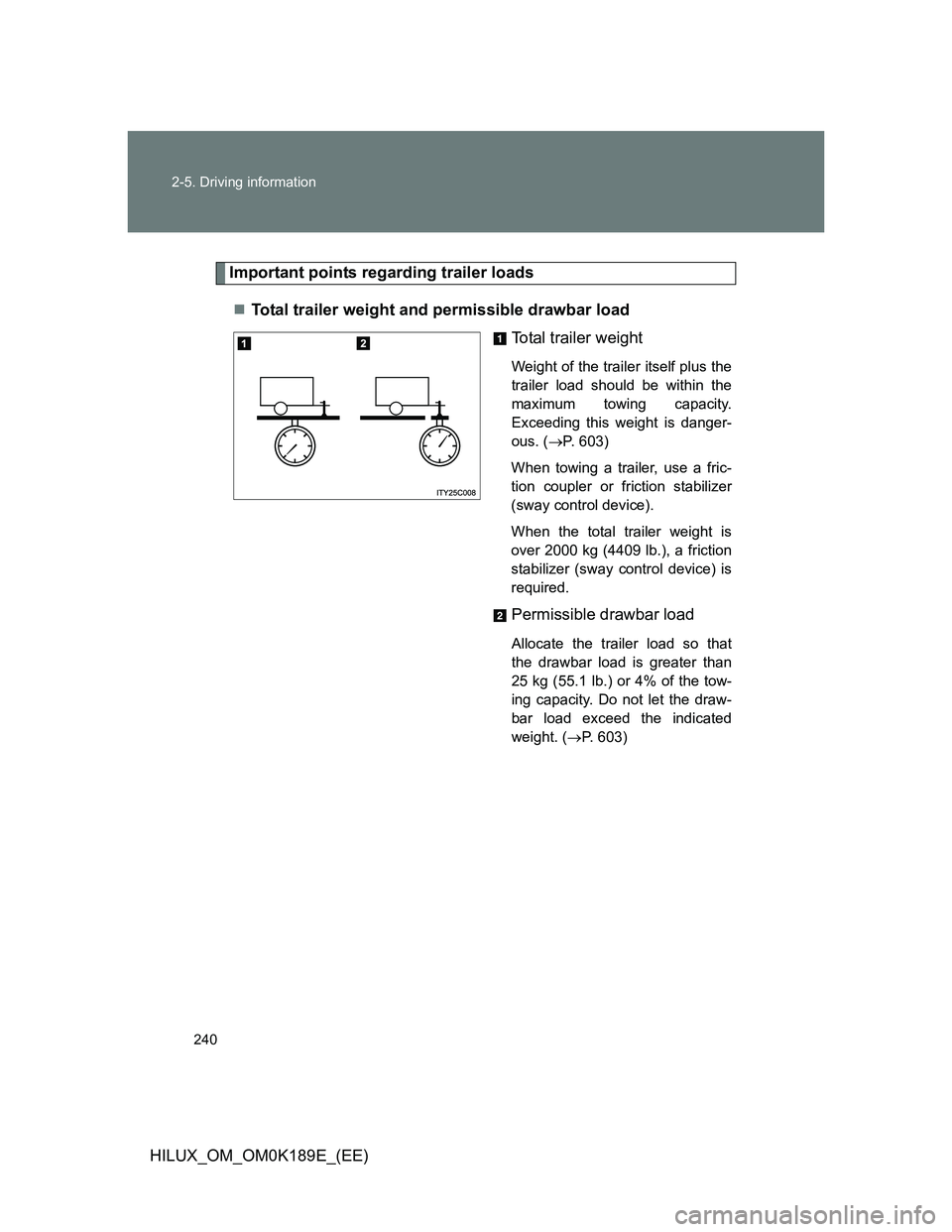
Total trailer weight and permissible drawbar load
Total trailer weight
Weight of the trailer itself plus the
trailer load should be within the
maximum towing capacity.
Exceeding this weight is danger-
ous. (P. 603)
When towing a trailer, use a fric-
tion coupler or friction stabilizer
(sway control device).
When the total trailer weight is
over 2000 kg (4409 lb.), a friction
stabilizer (sway control device) is
required.
Permissible drawbar load
Allocate the trailer load so that
the drawbar load is greater than
25 kg (55.1 lb.) or 4% of the tow-
ing capacity. Do not let the draw-
bar load exceed the indicated
weight. (P. 603)
Page 244 of 644
244 2-5. Driving information
HILUX_OM_OM0K189E_(EE)
Tire information
Ensure that your vehicle’s tires are properly inflated. (P. 620)
Increase the air pressure of the trailer tires in accordance with the total
trailer weight and according to the values recommended by the manufac-
turer of your trailer.
Trailer lights
Check that the turn signal lights and stoplights are operating correctly every
time you hitch up the trailer. Directly wiring up to your vehicle may damage
the electrical system and stop the lights from functioning correctly.
Break-in schedule
Toyota recommends that vehicles fitted with new power train components
should not be used for towing trailers for the first 800 km (500 miles).
Safety checks before towing
Check that the maximum load limit for the towing hitch/bracket hitch ball
is not exceeded. Bear in mind that the coupling weight of the trailer will
add to the load exerted on the vehicle. Also make sure that the total load
exerted on the vehicle is within the range of the weight limits. (P. 240)
Ensure that the trailer load is secure.
Supplementary outside rear view mirrors should be added to the vehicle
if the traffic behind cannot be clearly seen with standard mirrors. Adjust
the extending arms of these mirrors on both sides of the vehicle so that
they always provide maximum visibility of the road behind.
Page 246 of 644
246 2-5. Driving information
HILUX_OM_OM0K189E_(EE)
Guidance
Your vehicle will handle differently when towing a trailer. In order to
avoid accident, death or serious injury, keep the following in mind
when towing:
Checking connections between trailer and lights
Stop the vehicle and check the operation of the connection
between the trailer and lights after driving for a brief period as well
as before starting off.
Practicing driving with a coupled trailer
Get the feel for turning, stopping and reversing with the trailer
coupled by practicing in an area with no or light traffic.
When reversing with a coupled trailer, hold the section of the
steering wheel nearest to you and rotate clockwise to turn the
trailer left or counterclockwise to turn it right. Always rotate a lit-
tle at a time to prevent steering error. Have someone guide you
when reversing to lessen the risk of accident.
Increasing vehicle-to-vehicle distance
At a speed of 10 km/h (6 mph), the distance to the vehicle running
ahead of you should be equivalent to or greater than the combined
length of your vehicle and trailer. Avoid sudden braking that may
cause skidding. Otherwise, the vehicle may spin out of control.
This is especially true when driving on wet or slippery road sur-
faces.
Page 247 of 644
247 2-5. Driving information
2
When driving
HILUX_OM_OM0K189E_(EE)Sudden acceleration/steering input/cornering
Executing sharp turns when towing may result in the trailer collid-
ing with your vehicle. Decelerate well in advance when approach-
ing turns and take them slowly and carefully to avoid sudden
braking.
Important points regarding turning
The wheels of the trailer will travel closer to the inside of the curve
than the wheels of the vehicle. To make allowance for this, take the
turns wider than you would normally do.
Important points regarding stability
Vehicle movement resulting from uneven road surfaces and strong
crosswinds will affect handling. The vehicle may also be rocked by
passing buses or large trucks. Frequently check behind when mov-
ing alongside such vehicles. As soon as such vehicle movement
occurs, immediately start to decelerate smoothly by slowly apply-
ing the brakes. Always steer the vehicle straight ahead while brak-
ing.
Passing other vehicles
Consider the total combined length of your vehicle and trailer and
ensure that the vehicle-to-vehicle distance is sufficient before exe-
cuting lane changes.
Transmission information
To maintain engine braking efficiency when using engine braking,
do not use the transmission in D (automatic transmission) or in the
5th gear (manual transmission). (P. 166, 170)