windshield TOYOTA HILUX 2013 Owners Manual (in English)
[x] Cancel search | Manufacturer: TOYOTA, Model Year: 2013, Model line: HILUX, Model: TOYOTA HILUX 2013Pages: 644, PDF Size: 34.35 MB
Page 3 of 644
1
2
3
4
5
6
3
HILUX_OM_OM0K134E_(EE)
2-1. Driving procedures
Driving the vehicle .............. 146
Engine (ignition) switch ....... 162
Automatic transmission....... 166
Manual transmission ........... 170
Turn signal lever ................. 173
Parking brake...................... 174
Horn .................................... 175
2-2. Instrument cluster
Gauges and meters ............ 176
Indicators and warning
lights ................................. 180
Multi-information display ..... 1852-3. Operating the lights
and wipers
Headlight switch ................. 191
Fog light switch .................. 195
Windshield wipers
and washer ...................... 199
Headlight cleaner switch .... 201
2-4. Using other driving systems
Cruise control ..................... 202
Rear view monitor
system.............................. 207
Four-wheel drive system .... 212
Rear differential lock
system.............................. 217
Driving assist systems........ 221
DPF (Diesel Particulate
Filter) system ................... 227
2-5. Driving information
Cargo and luggage............. 232
Winter driving tips............... 235
Trailer towing...................... 239
2When driving
Page 8 of 644
8
HILUX_OM_OM0K134E_(EE)
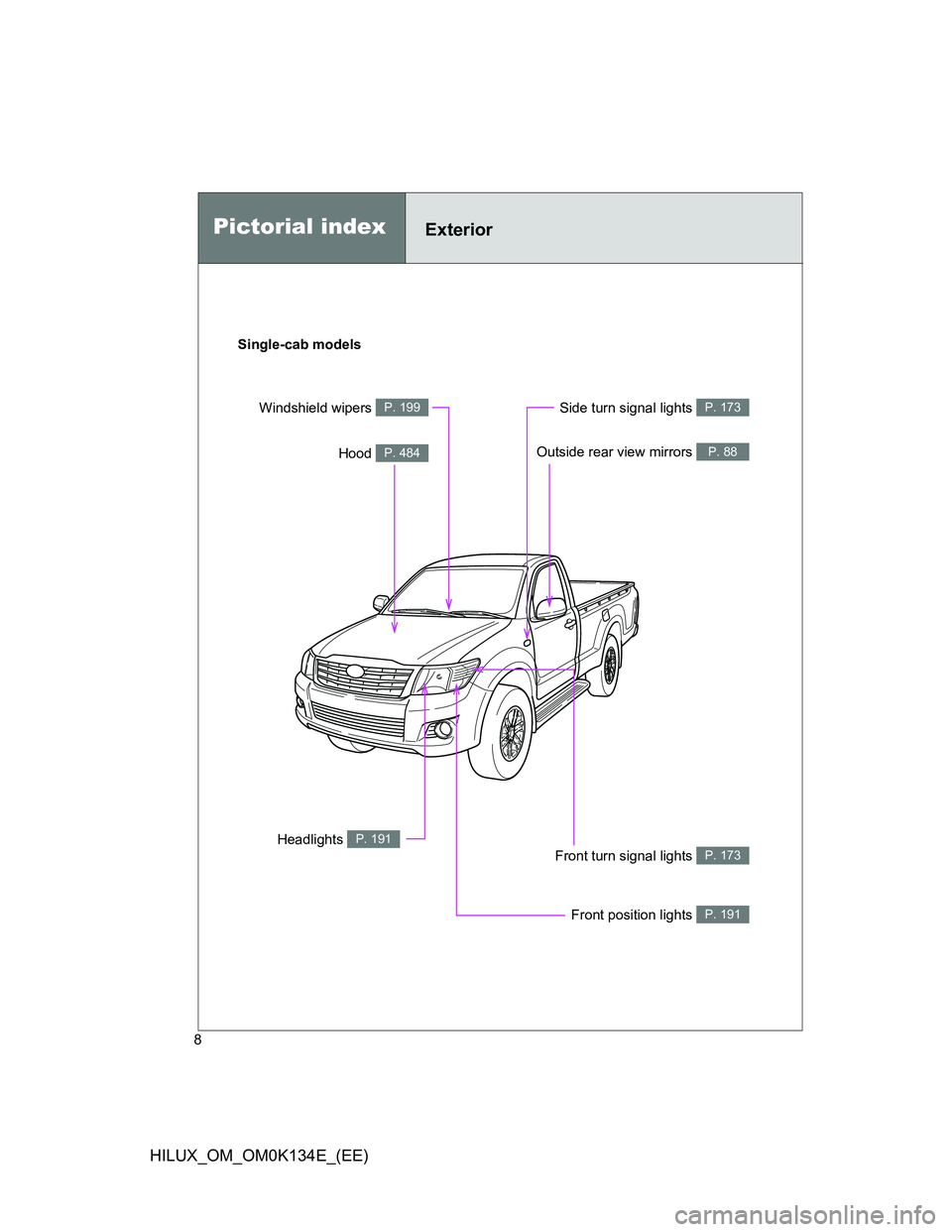
Pictorial indexExterior
Single-cab models
Windshield wipers
P. 199
Outside rear view mirrors P. 88Hood P. 484
Front turn signal lights P. 173
Front position lights P. 191
Headlights P. 191
Side turn signal lights P. 173
Page 10 of 644
10
HILUX_OM_OM0K134E_(EE)
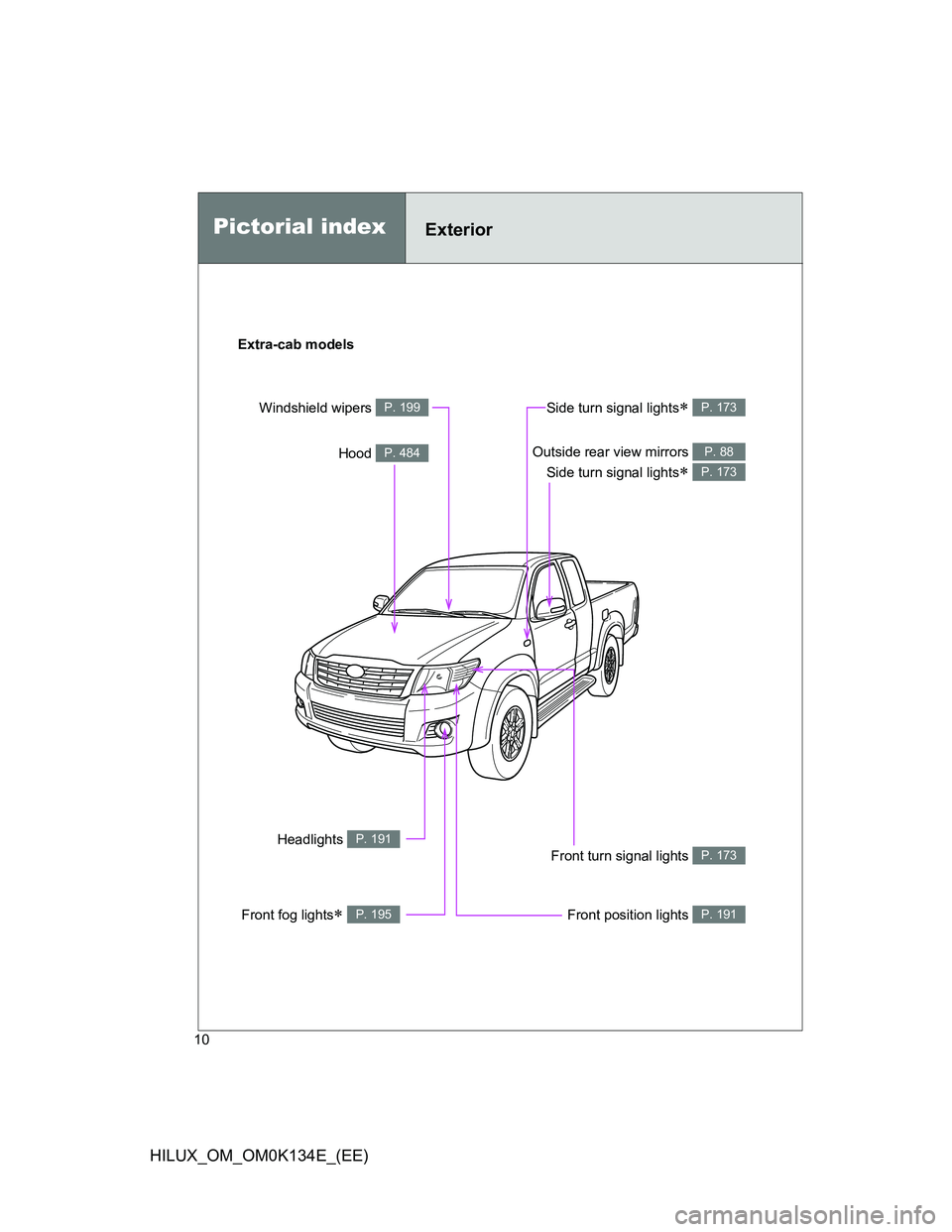
Pictorial indexExterior
Extra-cab models
Outside rear view mirrors
Side turn signal lights
P. 88
P. 173
Front fog lights P. 195
Side turn signal lights P. 173Windshield wipers P. 199
Hood P. 484
Front turn signal lights P. 173
Front position lights P. 191
Headlights P. 191
Page 12 of 644
12
HILUX_OM_OM0K134E_(EE)
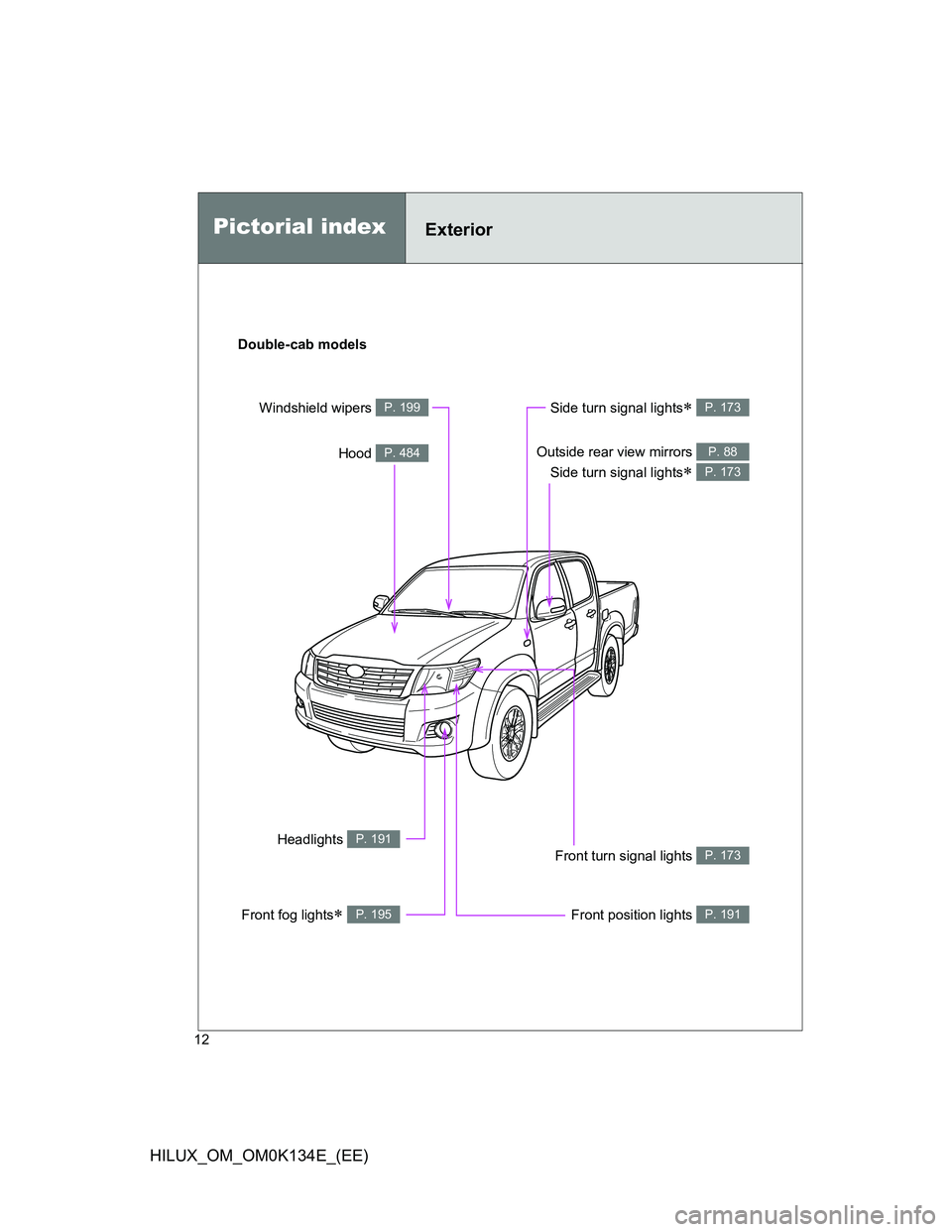
Pictorial indexExterior
Double-cab models
Front fog lights P. 195
Front turn signal lights P. 173
Front position lights P. 191
Outside rear view mirrors
Side turn signal lights
P. 88
P. 173
Side turn signal lights P. 173Windshield wipers P. 199
Hood P. 484
Headlights P. 191
Page 19 of 644
19
HILUX_OM_OM0K134E_(EE)
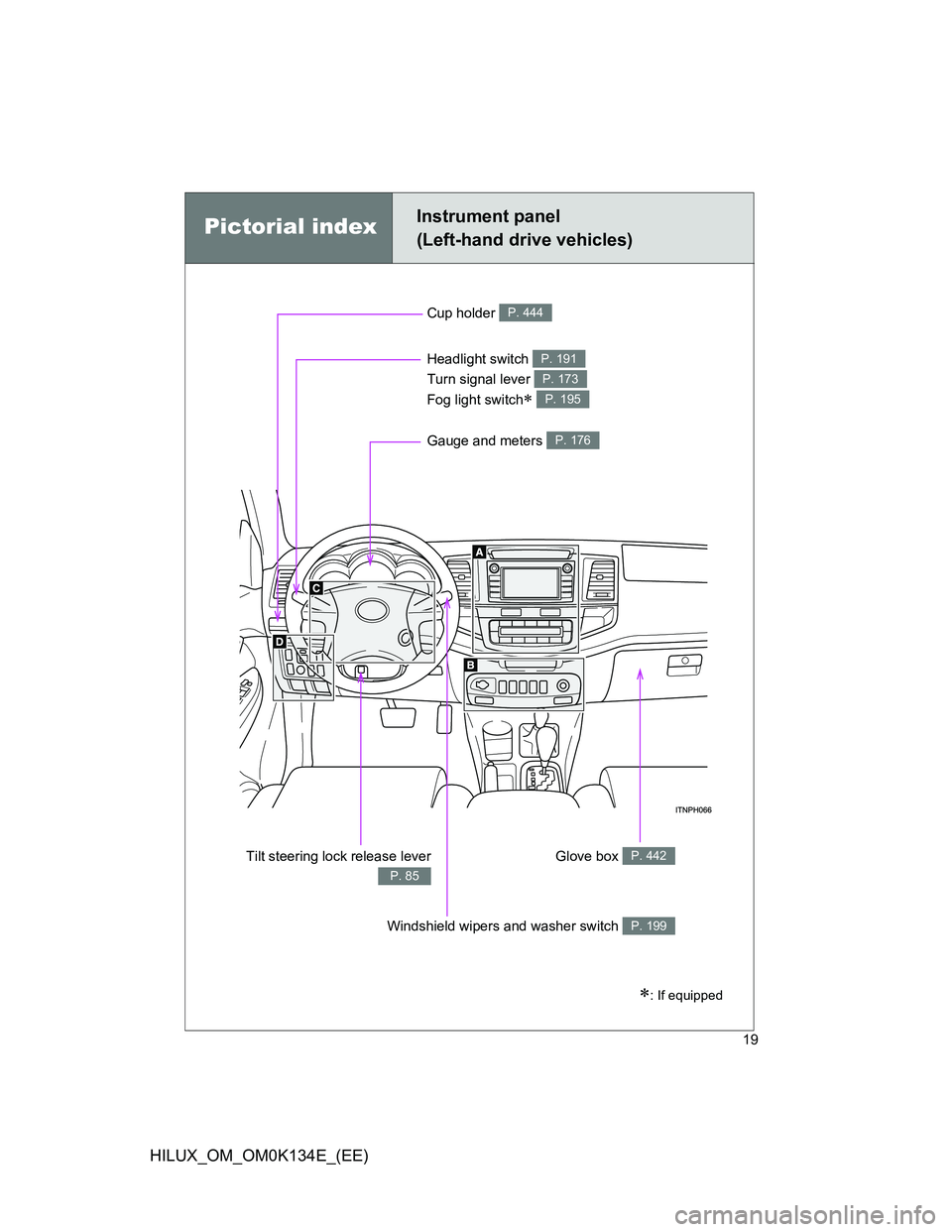
Pictorial indexInstrument panel
(Left-hand drive vehicles)
Cup holder P. 444
Headlight switch
Turn signal lever
Fog light switch
P. 191
P. 173
P. 195
Gauge and meters P. 176
Tilt steering lock release lever
P. 85
Glove box P. 442
Windshield wipers and washer switch P. 199
: If equipped
Page 30 of 644
30
HILUX_OM_OM0K134E_(EE)
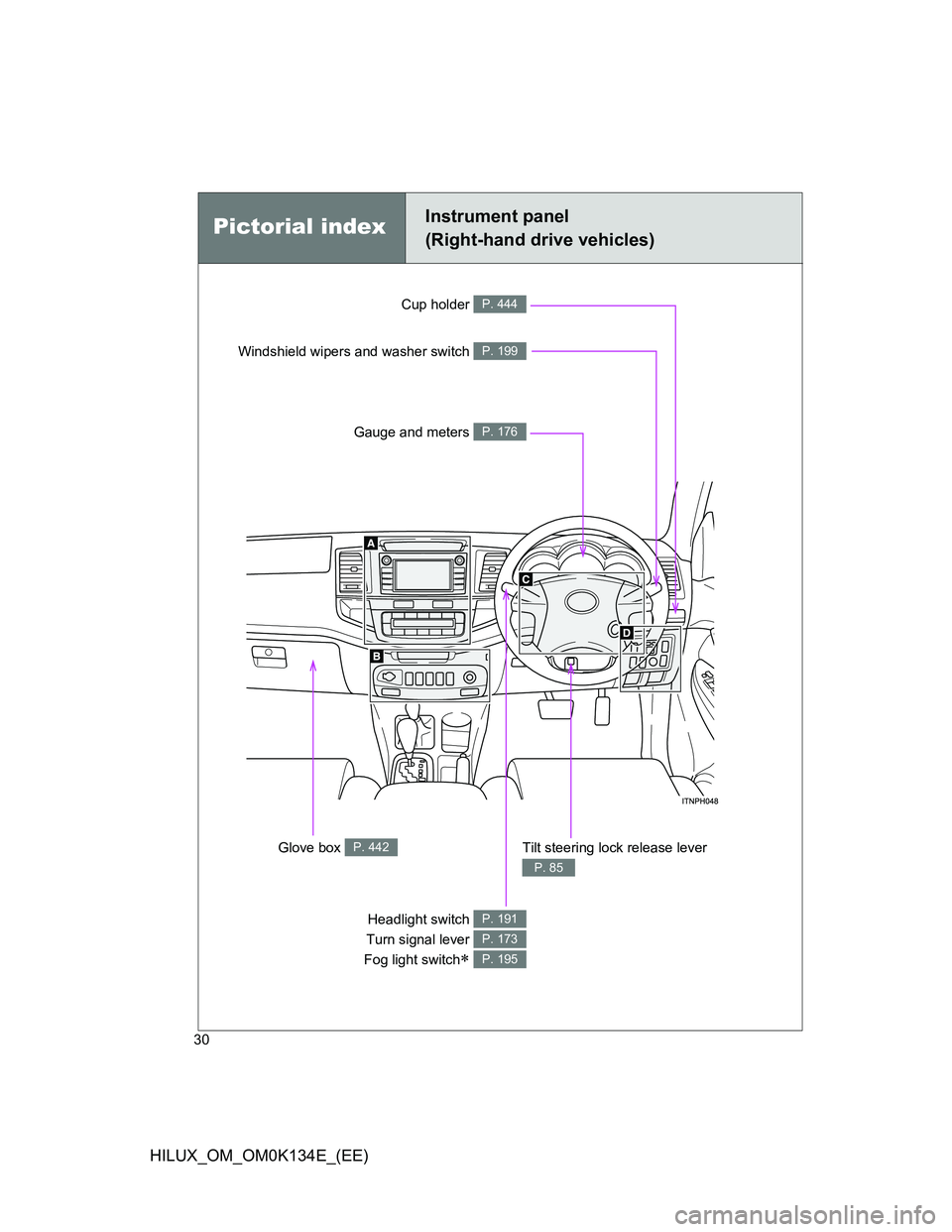
Pictorial indexInstrument panel
(Right-hand drive vehicles)
Cup holder P. 444
Headlight switch
Turn signal lever
Fog light switch
P. 191
P. 173
P. 195
Gauge and meters P. 176
Tilt steering lock release lever
P. 85
Glove box P. 442
Windshield wipers and washer switch P. 199
Page 112 of 644
112 1-7. Safety information
HILUX_OM_OM0K134E_(EE)
If the SRS airbags deploy (inflate)
Bruising and slight abrasions may result from contact with a deploying
(inflating) SRS airbag.
A loud noise and white powder will be emitted.
Vehicles without SRS curtain shield airbags: Parts of the airbag module
(steering wheel hub, airbag cover and inflator) as well as the seats may
be hot for several minutes. The airbag itself may also be hot.
Vehicles with SRS curtain shield airbags: Parts of the airbag module
(steering wheel hub, airbag cover and inflator) as well as the seats, parts
of the front and rear pillars, and roof side rails, may be hot for several
minutes. The airbag itself may also be hot.
The windshield may crack.
SRS airbag deployment conditions (SRS front airbags)
The SRS front airbags will deploy in the event of an impact that exceeds
the set threshold level (the level of force corresponding to an approxi-
mately 20 - 30 km/h [12 - 18 mph] frontal collision with a fixed wall that
does not move or deform).
However, this threshold velocity will be considerably higher if the vehicle
strikes an object, such as a parked vehicle and sign pole, which can move
or deform on impact, or if the vehicle is involved in an underride collision
(e.g. a collision in which the front of the vehicle “underrides”, or goes
under, the bed of a truck etc.).
Depending on the type of collision, it is possible that only the seat belt
pretensioners will activate.
SRS airbag deployment conditions (SRS side airbags and curtain
shield airbags)
The SRS side airbags and curtain shield airbags will deploy in the event of
an impact that exceeds the set threshold level (the level of force correspond-
ing to the impact force produced by an approximately 1500 kg [3300 lb.]
vehicle colliding with the vehicle cabin from a direction perpendicular to the
vehicle orientation at an approximate speed of 20 - 30 km/h [12 - 18 mph]).
Page 120 of 644
120 1-7. Safety information
HILUX_OM_OM0K134E_(EE)
CAUTION
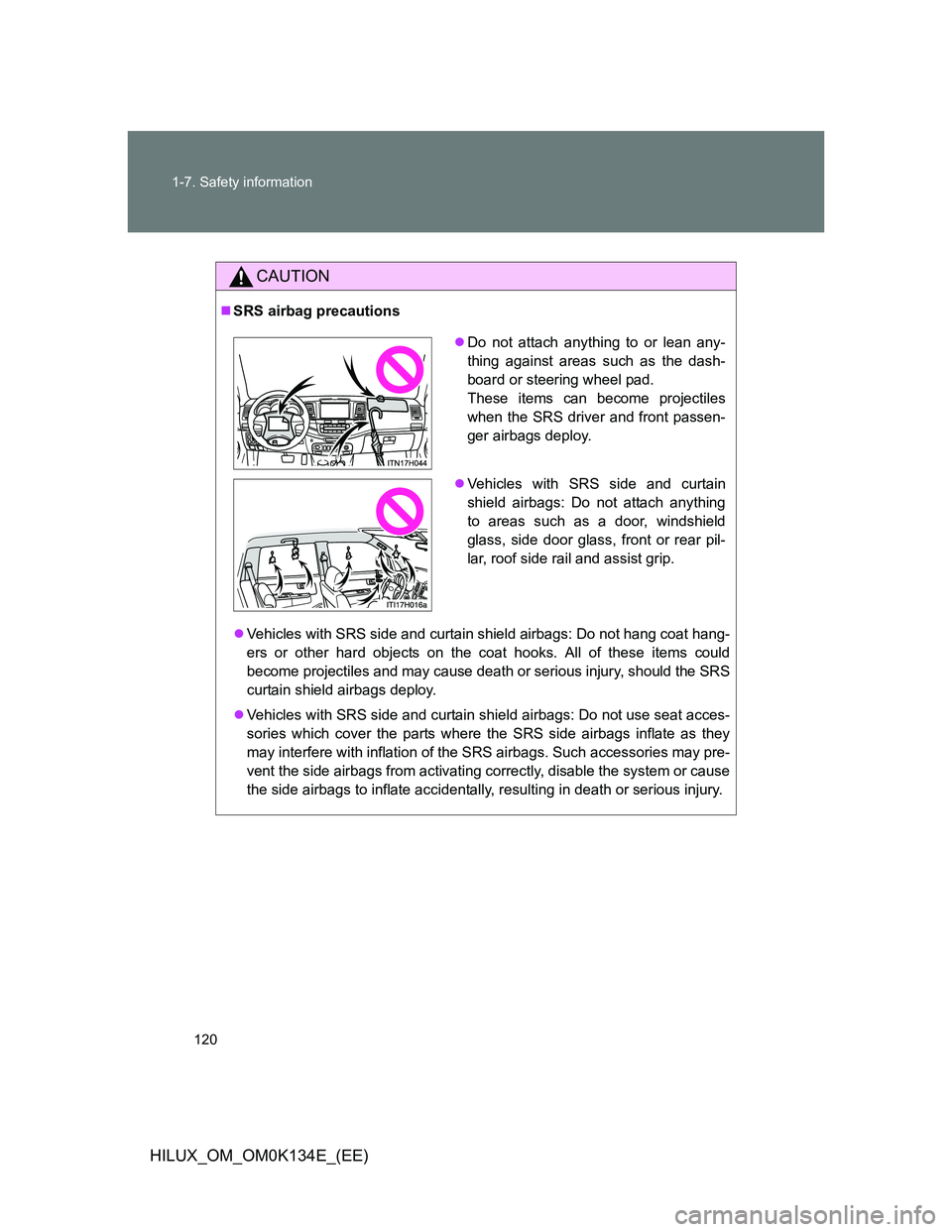
SRS airbag precautions
Vehicles with SRS side and curtain shield airbags: Do not hang coat hang-
ers or other hard objects on the coat hooks. All of these items could
become projectiles and may cause death or serious injury, should the SRS
curtain shield airbags deploy.
Vehicles with SRS side and curtain shield airbags: Do not use seat acces-
sories which cover the parts where the SRS side airbags inflate as they
may interfere with inflation of the SRS airbags. Such accessories may pre-
vent the side airbags from activating correctly, disable the system or cause
the side airbags to inflate accidentally, resulting in death or serious injury.
Do not attach anything to or lean any-
thing against areas such as the dash-
board or steering wheel pad.
These items can become projectiles
when the SRS driver and front passen-
ger airbags deploy.
Vehicles with SRS side and curtain
shield airbags: Do not attach anything
to areas such as a door, windshield
glass, side door glass, front or rear pil-
lar, roof side rail and assist grip.
Page 132 of 644
132 1-7. Safety information
HILUX_OM_OM0K134E_(EE)
CAUTION
Using a child restraint system
The use of a child restraint system not suitable for the vehicle may not prop-
erly secure the infant or child. It may result in death or serious injury (in the
event of sudden braking or an accident).
Child restraint precautions
For effective protection in automobile accidents and sudden stops, a child
must be properly restrained, using a seat belt or child restraint system
depending on the age and size of the child. Holding a child in your arms is
not a substitute for a child restraint system. In an accident, the child can be
crushed against the windshield, or between you and the vehicle’s interior.
Toyota strongly urges the use of a proper child restraint system that con-
forms to the size of the child, installed on the rear seat. According to acci-
dent statistics, the child is safer when properly restrained in the rear seat
than in the front seat.
Never install a rear-facing child restraint system on the front passenger
seat.
In the event of an accident, the force of the rapid inflation of the front pas-
senger airbag can cause death or serious injury to the child if the rear-fac-
ing child restraint system is installed on the front passenger seat.
A forward-facing child restraint system may be installed on the front pas-
senger seat only when it is unavoidable. Adjust the seatback as upright as
possible and always move the seat as far back as possible because the
front passenger airbag could inflate with considerable speed and force.
Otherwise, the child may be killed or seriously injured.
Page 145 of 644
2When driving
145
HILUX_OM_OM0K134E_(EE)
2-1. Driving procedures
Driving the vehicle ............ 146
Engine (ignition) switch..... 162
Automatic transmission .... 166
Manual transmission......... 170
Turn signal lever ............... 173
Parking brake ................... 174
Horn .................................. 175
2-2. Instrument cluster
Gauges and meters .......... 176
Indicators and warning
lights ............................... 180
Multi-information
display ............................ 1852-3. Operating the lights
and wipers
Headlight switch................ 191
Fog light switch ................. 195
Windshield wipers
and washer ..................... 199
Headlight cleaner switch ... 201
2-4. Using other driving systems
Cruise control.................... 202
Rear view monitor
system ............................ 207
Four-wheel drive system... 212
Rear differential lock
system ............................ 217
Driving assist systems ...... 221
DPF (Diesel Particulate
Filter) system .................. 227
2-5. Driving information
Cargo and luggage ........... 232
Winter driving tips ............. 235
Trailer towing .................... 239