tire pressure TOYOTA HILUX 2018 Owners Manual
[x] Cancel search | Manufacturer: TOYOTA, Model Year: 2018, Model line: HILUX, Model: TOYOTA HILUX 2018Pages: 708, PDF Size: 95.31 MB
Page 5 of 708
5
1
9
8
6
5
4
3
2
HILUX_OM_OM0K375E_(EE)
7
6-4. Using the other interior
features
Other interior features ........514
• Sun visors ......................514
• Vanity mirror ..................514
• Clock .............................515
• Power outlets .................516
• Grocery bag hooks ........518
• Coat hooks ....................519
• Armrest ..........................519
ERA-GLONASS/EVAK ......520
7-1. Maintenance and care
Cleaning and protecting
the vehicle exterior ..........526
Cleaning and protecting
the vehicle interior ...........529
7-2. Maintenance
Maintenance
requirements....................532
7-3. Do-it-yourself maintenance
Do-it-yourself service
precautions ......................535
Hood ..................................537
Engine compartment..........539
Tires ...................................558
Tire inflation pressure ........561
Wheels ...............................563
Air conditioning filter ..........565
Wireless remote control/
electronic key battery.......567
Checking and
replacing fuses ................570
Light bulbs .........................575
8-1. Essential information
Emergency flashers .......... 592
If your vehicle has to
be stopped in an
emergency ...................... 593
8-2. Steps to take in an
emergency
If your vehicle needs
to be towed ..................... 595
If you think something is
wrong .............................. 600
Fuel pump shut off
system (gasoline engine
only) ................................ 601
If a warning light turns on
or a warning buzzer
sounds ............................ 602
If a warning message is
displayed ......................... 610
If you have a flat tire .......... 616
If the engine will not
start ................................. 633
If the electronic key does
not operate properly
(vehicles with smart
entry & start system) ....... 635
If the vehicle battery is
discharged ...................... 639
If your vehicle
overheats ........................ 645
If you run out of fuel
and the engine stalls
(diesel engine only) ......... 648
If the vehicle becomes
stuck................................ 649
7Maintenance and care
8When trouble arises
Page 17 of 708
17Pictorial index
HILUX_OM_OM0K375E_(EE)
Windshield wipers . . . . . . . . . . . . . . . . . . . . . . . . . . . . . . . . . P. 302
Precautions against winter season . . . . . . . . . . . . . . . . . . . . . P. 403
To prevent freezing (windshield wiper de-icer)*1. . . . . . . . . . . P. 486
Fuel filler door*1 . . . . . . . . . . . . . . . . . . . . . . . . . . . . . . . . . . P. 304
Refueling method . . . . . . . . . . . . . . . . . . . . . . . . . . . . . . . . . . P. 304
Fuel type/fuel tank capacity . . . . . . . . . . . . . . . . . . . . . . . . . . . P. 660
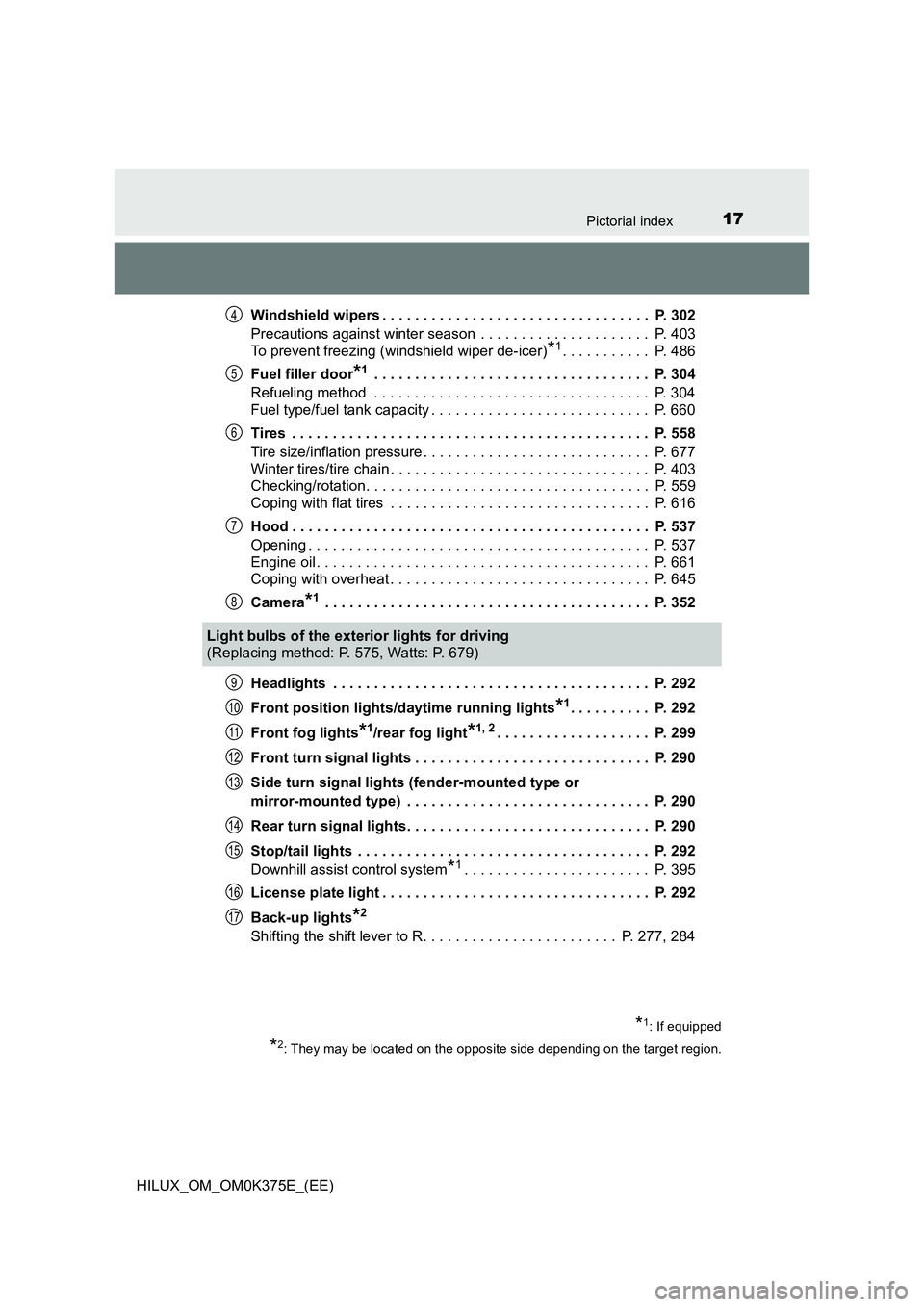
Tires . . . . . . . . . . . . . . . . . . . . . . . . . . . . . . . . . . . . . . . . . . . . P. 558
Tire size/inflation pressure . . . . . . . . . . . . . . . . . . . . . . . . . . . . P. 677
Winter tires/tire chain . . . . . . . . . . . . . . . . . . . . . . . . . . . . . . . . P. 403
Checking/rotation. . . . . . . . . . . . . . . . . . . . . . . . . . . . . . . . . . . P. 559
Coping with flat tires . . . . . . . . . . . . . . . . . . . . . . . . . . . . . . . . P. 616
Hood . . . . . . . . . . . . . . . . . . . . . . . . . . . . . . . . . . . . . . . . . . . . P. 537
Opening . . . . . . . . . . . . . . . . . . . . . . . . . . . . . . . . . . . . . . . . . . P. 537
Engine oil . . . . . . . . . . . . . . . . . . . . . . . . . . . . . . . . . . . . . . . . . P. 661
Coping with overheat . . . . . . . . . . . . . . . . . . . . . . . . . . . . . . . . P. 645
Camera*1 . . . . . . . . . . . . . . . . . . . . . . . . . . . . . . . . . . . . . . . . P. 352
Headlights . . . . . . . . . . . . . . . . . . . . . . . . . . . . . . . . . . . . . . . P. 292
Front position lights/daytime running lights*1. . . . . . . . . . P. 292
Front fog lights*1/rear fog light*1, 2. . . . . . . . . . . . . . . . . . . P. 299
Front turn signal lights . . . . . . . . . . . . . . . . . . . . . . . . . . . . . P. 290
Side turn signal lights (fender-mounted type or
mirror-mounted type) . . . . . . . . . . . . . . . . . . . . . . . . . . . . . . P. 290
Rear turn signal lights. . . . . . . . . . . . . . . . . . . . . . . . . . . . . . P. 290
Stop/tail lights . . . . . . . . . . . . . . . . . . . . . . . . . . . . . . . . . . . . P. 292
Downhill assist control system*1. . . . . . . . . . . . . . . . . . . . . . . P. 395
License plate light . . . . . . . . . . . . . . . . . . . . . . . . . . . . . . . . . P. 292
Back-up lights*2
Shifting the shift lever to R. . . . . . . . . . . . . . . . . . . . . . . . P. 277, 284
4
5
6
7
8
Light bulbs of the exterior lights for driving
(Replacing method: P. 575, Watts: P. 679)
*1: If equipped
*2: They may be located on the opposite side depending on the target region.
9
10
11
12
13
14
15
16
17
Page 259 of 708
2594-1. Before driving
4
Driving
HILUX_OM_OM0K375E_(EE)
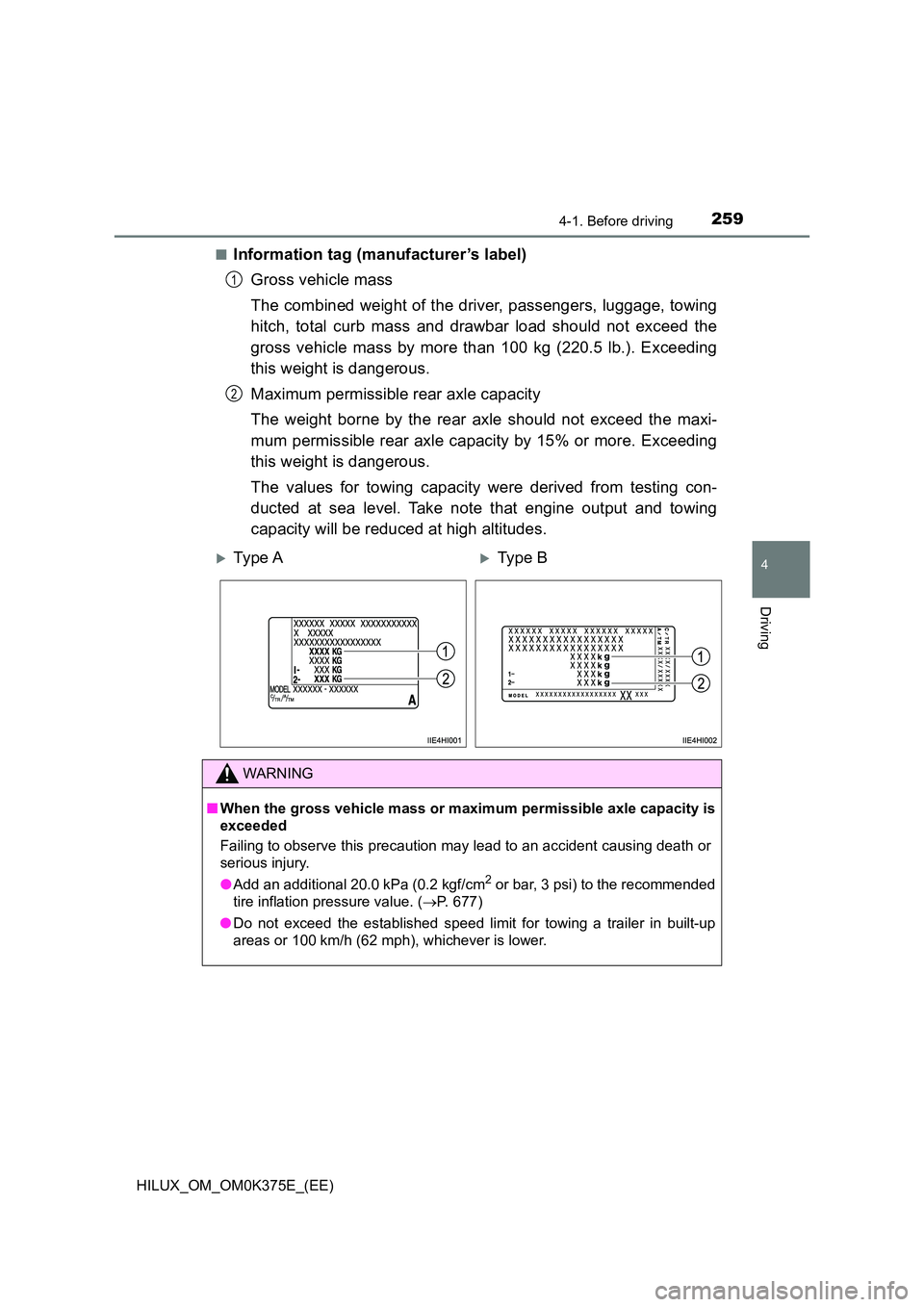
■Information tag (manufacturer’s label)
Gross vehicle mass
The combined weight of the driver, passengers, luggage, towing
hitch, total curb mass and drawbar load should not exceed the
gross vehicle mass by more than 100 kg (220.5 lb.). Exceeding
this weight is dangerous.
Maximum permissible rear axle capacity
The weight borne by the rear axle should not exceed the maxi-
mum permissible rear axle capacity by 15% or more. Exceeding
this weight is dangerous.
The values for towing capacity were derived from testing con-
ducted at sea level. Take note that engine output and towing
capacity will be reduced at high altitudes.
1
2
Ty pe AType B
WARNING
■ When the gross vehicle mass or maximum permissible axle capacity is
exceeded
Failing to observe this precaution may lead to an accident causing death or
serious injury.
● Add an additional 20.0 kPa (0.2 kgf/cm2 or bar, 3 psi) to the recommended
tire inflation pressure value. ( P. 677)
● Do not exceed the established speed limit for towing a trailer in built-up
areas or 100 km/h (62 mph), whichever is lower.
Page 260 of 708
2604-1. Before driving
HILUX_OM_OM0K375E_(EE)
■Tire information
● Increase the tire inflation pressure to 20.0 kPa (0.2 kgf/cm2 or bar, 3 psi)
greater than the recommended value when towing. ( P. 677)
● Increase the air pressure of the trailer tires in accordance with the total
trailer weight and according to the values recommended by the manufac-
turer of your trailer.
■ Tr a i l e r l i g h ts
Check that the turn signal lights and stoplights are operating correctly every
time you hitch up the trailer. Direct ly wiring up to your vehicle may damage
the electrical system and stop the lights from functioning correctly.
■ Break-in schedule
Toyota recommends that vehicles fitted with new power train components
should not be used for towing trailers for the first 800 km (500 miles).
■ Safety checks before towing
● Check that the maximum load limit for the towing hitch/bracket and hitch ball
is not exceeded. Bear in mind that the coupling weight of the trailer will add
to the load exerted on the vehicle. Also make sure that the total load exerted
on the vehicle is within the range of the weight limits. ( P. 258)
● Ensure that the trailer load is secure.
● Supplementary outside rear view mirrors should be added to the vehicle if
the traffic behind cannot be clearly seen with standard mirrors. Adjust the
extending arms of these mirrors on both sides of the vehicle so that they
always provide maximum visibility of the road behind.
■ Maintenance
● Maintenance must be performed more frequently when using the vehicle for
towing due to the greater weight burden placed on the vehicle compared to
normal driving.
● Retighten all bolts securing the hitching ball and bracket after towing for
approximately 1000 km (600 miles).
Page 263 of 708
2634-1. Before driving
4
Driving
HILUX_OM_OM0K375E_(EE)
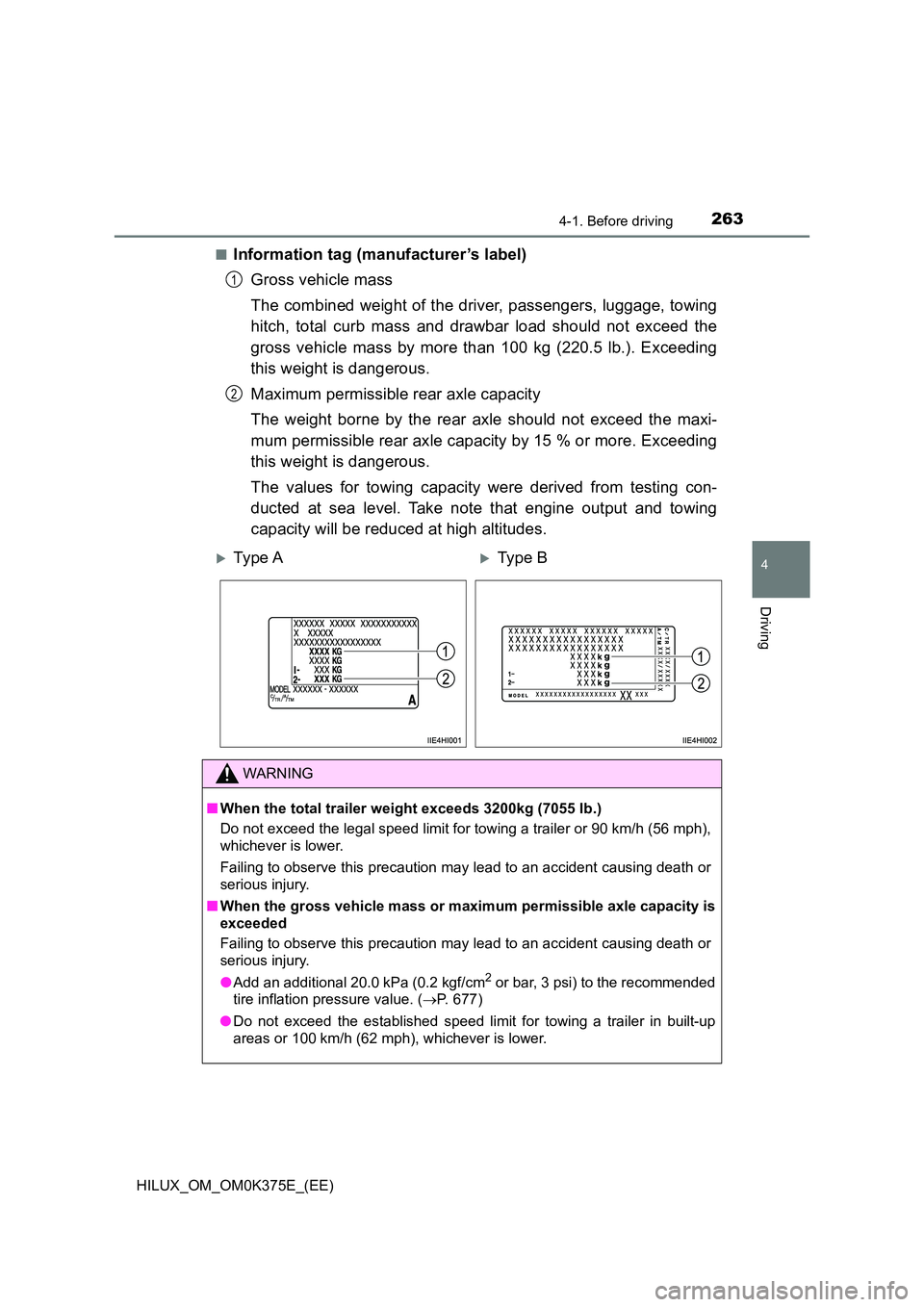
■Information tag (manufacturer’s label)
Gross vehicle mass
The combined weight of the driver, passengers, luggage, towing
hitch, total curb mass and drawbar load should not exceed the
gross vehicle mass by more than 100 kg (220.5 lb.). Exceeding
this weight is dangerous.
Maximum permissible rear axle capacity
The weight borne by the rear axle should not exceed the maxi-
mum permissible rear axle capacity by 15 % or more. Exceeding
this weight is dangerous.
The values for towing capacity were derived from testing con-
ducted at sea level. Take note that engine output and towing
capacity will be reduced at high altitudes.
1
2
Ty pe AType B
WARNING
■ When the total trailer weight exceeds 3200kg (7055 lb.)
Do not exceed the legal speed limit for towing a trailer or 90 km/h (56 mph),
whichever is lower.
Failing to observe this precaution may lead to an accident causing death or
serious injury.
■ When the gross vehicle mass or maximum permissible axle capacity is
exceeded
Failing to observe this precaution may lead to an accident causing death or
serious injury.
● Add an additional 20.0 kPa (0.2 kgf/cm2 or bar, 3 psi) to the recommended
tire inflation pressure value. ( P. 677)
● Do not exceed the established speed limit for towing a trailer in built-up
areas or 100 km/h (62 mph), whichever is lower.
Page 264 of 708
2644-1. Before driving
HILUX_OM_OM0K375E_(EE)
■Tire information
● Increase the tire inflation pressure to 20.0 kPa (0.2 kgf/cm2 or bar, 3 psi)
greater than the recommended value when towing. ( P. 677)
● Increase the air pressure of the trailer tires in accordance with the total
trailer weight and according to the values recommended by the manufac-
turer of your trailer.
■ Tr a i l e r l i g h ts
Check that the turn signal lights and stoplights are operating correctly every
time you hitch up the trailer. Direct ly wiring up to your vehicle may damage
the electrical system and stop the lights from functioning correctly.
■ Break-in schedule
Toyota recommends that vehicles fitted with new power train components
should not be used for towing trailers for the first 800 km (500 miles).
■ Safety checks before towing
● Check that the maximum load limit for the towing hitch/bracket and hitch ball
is not exceeded. Bear in mind that the coupling weight of the trailer will add
to the load exerted on the vehicle. Also make sure that the total load exerted
on the vehicle is within the range of the weight limits. ( P. 262)
● Ensure that the trailer load is secure.
● Supplementary outside rear view mirrors should be added to the vehicle if
the traffic behind cannot be clearly seen with standard mirrors. Adjust the
extending arms of these mirrors on both sides of the vehicle so that they
always provide maximum visibility of the road behind.
■ Maintenance
● Maintenance must be performed more frequently when using the vehicle for
towing due to the greater weight burden placed on the vehicle compared to
normal driving.
● Retighten all bolts securing the hitching ball and bracket after towing for
approximately 1000 km (600 miles).
Page 331 of 708
3314-5. Using the driving support systems
4
Driving
HILUX_OM_OM0K375E_(EE)
• When driving in inclement weather such as heavy rain, fog, snow or a
sandstorm
• When the vehicle is hit by water, snow, dust, etc. from a vehicle ahead
• When driving through steam or smoke
• When driving in a place where the surrounding brightness changes sud-
denly, such as at the entrance or exit of a tunnel
• When a very bright light, such as the sun or the headlights of oncoming
traffic, shines directly into the camera sensor
• When the surrounding area is dim, such as at dawn or dusk, or while at
night or in a tunnel
• After the engine has started the vehicle has not been driven for a certain
amount of time
• While making a left/right turn and for a few seconds after making a left/
right turn
• While driving on a curve and for a few seconds after driving on a curve
• If your vehicle is skidding
• If the wheels are misaligned
• If a wiper blade is blocking the camera sensor
• The vehicle is wobbling.
• The vehicle is being driven at extremely high speeds.
• When driving on a hill
• If the radar sensor or camera sensor is misaligned
● In some situations such as the following, sufficient braking force may not be
obtained, preventing the system from performing properly:
• If the braking functions cannot operate to their full extent, such as when
the brake parts are extremely cold, extremely hot, or wet
• If the vehicle is not properly maintained (brakes or tires are excessively
worn, improper tire inflation pressure, etc.)
• When the vehicle is being driven on a gravel road or other slippery sur-
face
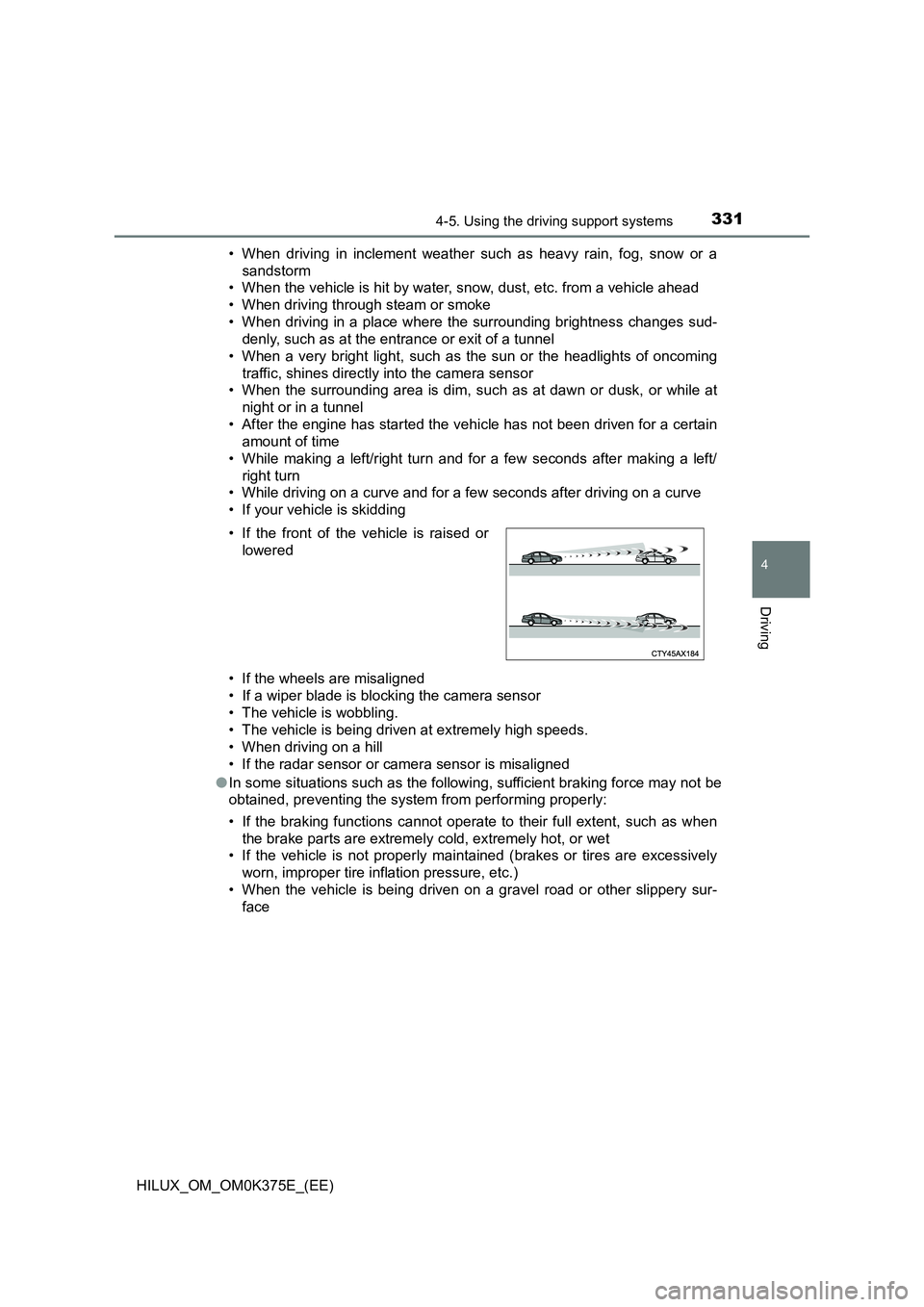
• If the front of the vehicle is raised or
lowered
Page 340 of 708
3404-5. Using the driving support systems
HILUX_OM_OM0K375E_(EE)
■ Conditions in which functions may not operate properly
In the following situations, the camera sensor may not detect white (yellow)
lines and various functions may not operate normally.
● There are shadows on the road that run parallel with, or cover, the white
(yellow) lines.
● The vehicle is driven in an area without white (yellow) lines, such as in front
of a tollgate or checkpoint, or at an intersection, etc.
● The white (yellow) lines are cracked, “Raised pavement marker” or stones
are present.
● The white (yellow) lines cannot be seen or are difficult to see due to sand,
etc.
● The vehicle is driven on a road surface that is wet due to rain, puddles, etc.
● The traffic lines are yellow (which may be more difficult to recognize than
lines that are white).
● The white (yellow) lines cross over a curb, etc.
● The vehicle is driven on a bright surface, such as concrete.
● The vehicle is driven on a surface that is bright due to reflected light, etc.
● The vehicle is driven in an area where the brightness changes suddenly,
such as at the entrances and exits of tunnels, etc.
● Light from the headlights of an oncoming vehicle, the sun, etc., enters the
camera.
● The vehicle is driven where the road diverges, merges, etc.
● The vehicle is driven on a slope.
● The vehicle is driven on a road which tilts left or right, or a winding road.
● The vehicle is driven on an unpaved or rough road.
● The vehicle is driven around a sharp curve.
● The traffic lane is excessively narrow or wide.
● The vehicle is extremely tilted due to carrying heavy luggage or having
improper tire pressure.
● The distance to the preceding vehicle is extremely short.
● The vehicle is moving up and down a large amount due to road conditions
during driving (poor r oads or road seams).
● The headlight lenses are dirty and emit a faint amount of light at night, or the
beam axis has deviated.
● The vehicle has just changed lanes or crossed an intersection.
Page 360 of 708
3604-5. Using the driving support systems
HILUX_OM_OM0K375E_(EE)
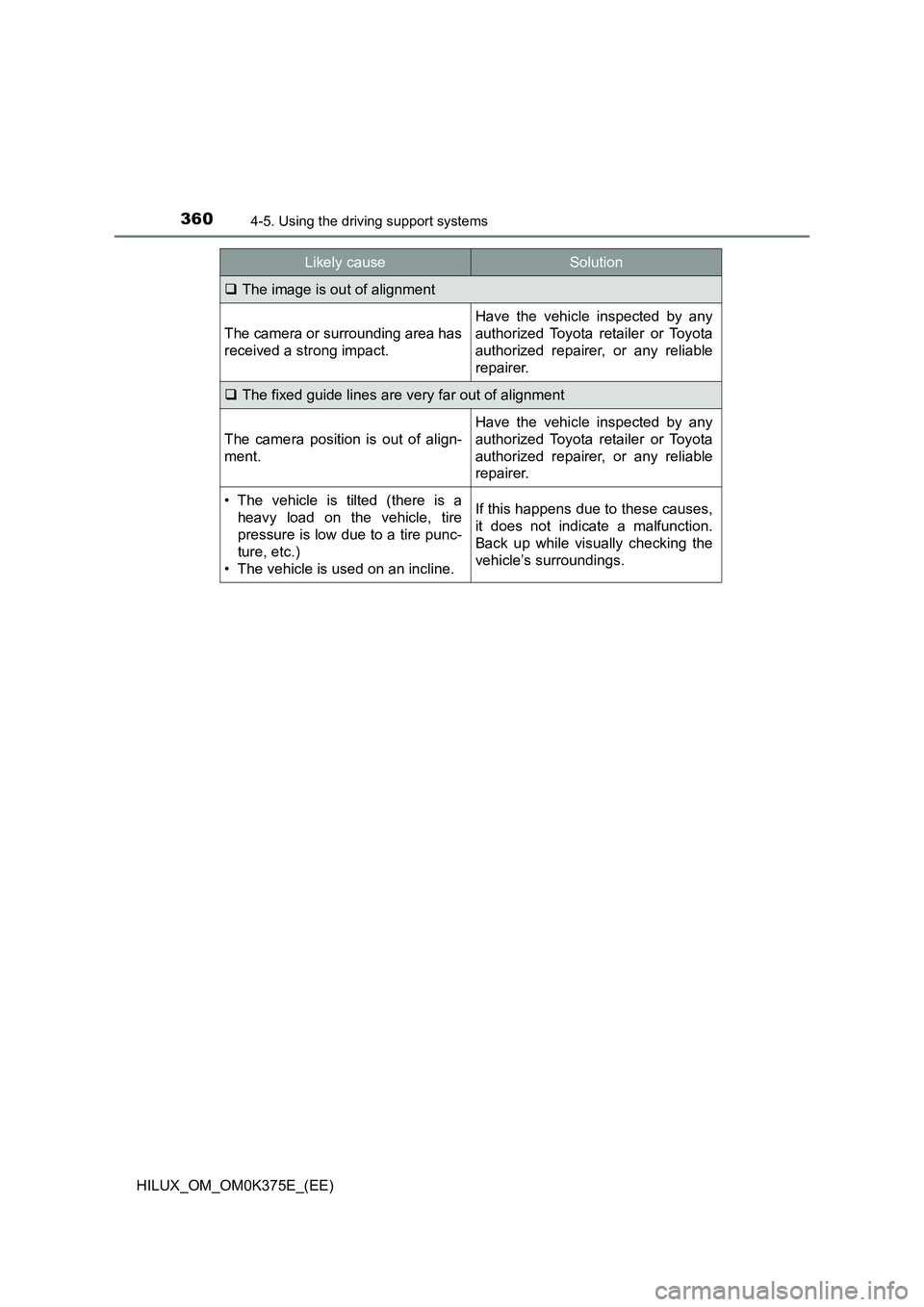
The image is out of alignment
The camera or surrounding area has
received a strong impact.
Have the vehicle inspected by any
authorized Toyota retailer or Toyota
authorized repairer, or any reliable
repairer.
The fixed guide lines are very far out of alignment
The camera position is out of align-
ment.
Have the vehicle inspected by any
authorized Toyota retailer or Toyota
authorized repairer, or any reliable
repairer.
• The vehicle is tilted (there is a
heavy load on the vehicle, tire
pressure is low due to a tire punc-
ture, etc.)
• The vehicle is used on an incline.
If this happens due to these causes,
it does not indicate a malfunction.
Back up while visually checking the
vehicle’s surroundings.
Likely causeSolution
Page 393 of 708
3934-5. Using the driving support systems
4
Driving
HILUX_OM_OM0K375E_(EE)
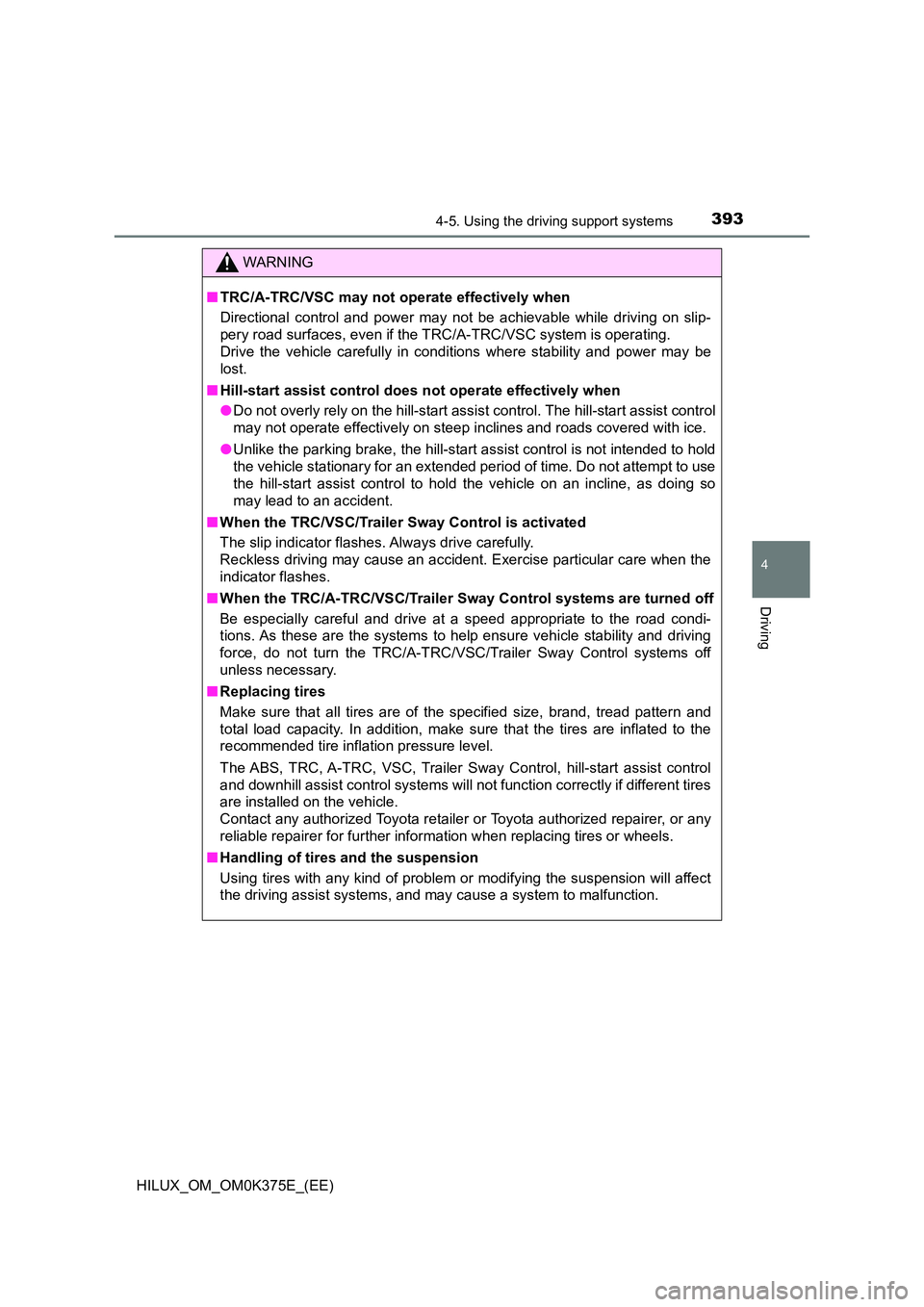
WARNING
■TRC/A-TRC/VSC may not operate effectively when
Directional control and power may not be achievable while driving on slip-
pery road surfaces, even if the TRC/A-TRC/VSC system is operating.
Drive the vehicle carefully in conditions where stability and power may be
lost.
■ Hill-start assist control does not operate effectively when
● Do not overly rely on the hill-start assist control. The hill-start assist control
may not operate effectively on steep inclines and roads covered with ice.
● Unlike the parking brake, the hill-start assist control is not intended to hold
the vehicle stationary for an extended period of time. Do not attempt to use
the hill-start assist control to hold the vehicle on an incline, as doing so
may lead to an accident.
■ When the TRC/VSC/Trailer Sway Control is activated
The slip indicator flashes. Always drive carefully.
Reckless driving may cause an accident. Exercise particular care when the
indicator flashes.
■ When the TRC/A-TRC/VSC/Trailer Sway Control systems are turned off
Be especially careful and drive at a speed appropriate to the road condi-
tions. As these are the systems to help ensure vehicle stability and driving
force, do not turn the TRC/A-TRC/VSC/Trailer Sway Control systems off
unless necessary.
■ Replacing tires
Make sure that all tires are of the specified size, brand, tread pattern and
total load capacity. In addition, make sure that the tires are inflated to the
recommended tire inflation pressure level.
The ABS, TRC, A-TRC, VSC, Trailer Sway Control, hill-start assist control
and downhill assist control systems will not function correctly if different tires
are installed on the vehicle.
Contact any authorized Toyota retailer or Toyota authorized repairer, or any
reliable repairer for further information when replacing tires or wheels.
■ Handling of tires and the suspension
Using tires with any kind of problem or modifying the suspension will affect
the driving assist systems, and may cause a system to malfunction.