light TOYOTA IQ 2012 Owners Manual
[x] Cancel search | Manufacturer: TOYOTA, Model Year: 2012, Model line: IQ, Model: TOYOTA IQ 2012Pages: 476, PDF Size: 23.52 MB
Page 404 of 476
404 5-2. Steps to take in an emergency
iQ_WE_74014E
If the malfunction indicator lamp comes on while driving
The malfunction indicator lamp will come on if the fuel tank becomes com-
pletely empty. If the fuel tank is empty, refuel the vehicle immediately. The
malfunction indicator lamp will go off after several trips.
If the malfunction indicator lamp does not go off, contact any authorized
Toyota dealer or repairer, or another duly qualified and equipped
professional as soon as possible.
Front passenger detection sensor and passenger seat belt reminder
If luggage is placed on the front passenger seat, the front passenger
detection sensor may cause the warning light to flash, even if a passen-
ger is not sitting in the seat.
If a cushion is placed on the seat, the sensor may not detect a passen-
ger, and the warning light may not operate properly.
Electric power steering system warning light (warning buzzer)
When the battery charge becomes insufficient or the voltage temporarily
drops, the electric power steering system warning light may come on and
warning buzzer may sound.
Customization that can be configured at any authorized Toyota dealer
or repairer, or another duly qualified and equipped professional
The vehicle speed linked seat belt reminder buzzer can be disabled.
(Customizable features P. 459)
CAUTION
When the electric power steering system warning light comes on
The steering wheel may become extremely heavy.
If the steering wheel becomes heavier than usual when operating, hold
firmly and operate using more force than usual.
Page 423 of 476
5
423
5-2. Steps to take in an emergency
When trouble arises
iQ_WE_74014E
If the engine will not start
If the engine still does not start after following the correct starting
procedure (P. 176, 179) or releasing the steering lock (P. 177,
182), confirm the following points.
The engine will not start even when the starter motor oper-
ates normally.
One of the following may be the cause of the problem.
There may not be sufficient fuel in the vehicle’s tank.
Refuel the vehicle.
The engine may be flooded.
Try to restart the engine once more following correct starting
procedures. (P. 176, 179)
There may be a malfunction in the engine immobilizer system.
(P. 108)
The starter motor turns over slowly, the interior lights and
headlights are dim, or the horn does not sound or sounds at
a low volume.
One of the following may be the cause of the problem.
The battery may be discharged. (P. 430)
The battery terminal connections may be loose or corroded.
The starter motor does not turn over. (vehicles with smart
entry & start system)
The engine starting system may be malfunctioning due to an
electrical problem such as an open circuit or a blown fuse. How-
ever, an interim measure is available to start the engine.
(P. 424)
Page 424 of 476
424 5-2. Steps to take in an emergency
iQ_WE_74014E
Emergency start function (vehicles with smart entry & start system)
When the engine does not start, the following steps can be used as
an interim measure to start the engine if the “ENGINE START STOP”
switch is functioning normally.
Set the parking brake.
Put the shift lever in P (Multidrive) or N (manual transmission).
Set the “ENGINE START STOP” switch to the ACCESSORY
mode.
Vehicles with a Multidrive: Press and hold the “ENGINE
START STOP” switch for about 15 seconds while depressing
the brake pedal firmly.
Vehicles with a manual transmission: Press and hold the
“ENGINE START STOP” switch for about 15 seconds while
depressing the brake pedal firmly and also depressing the
clutch pedal.
Even if the engine can be started using the above steps, the system
may be malfunctioning. Have the vehicle checked by any authorized
Toyota dealer or repairer, or another duly qualified and equipped pro-
fessional.
The starter motor does not turn over, the interior lights and
headlights do not turn on, or the horn does not sound.
One of the following may be the cause of the problem.
One or both of the battery terminals may be disconnected.
The battery may be discharged. (P. 430)
There may be a malfunction in the steering lock system (vehi-
cles with smart entry & start system).
Contact any authorized Toyota dealer or repairer, or another duly
qualified and equipped professional, if the problem cannot be
repaired, or if repair procedures are unknown.
Page 431 of 476
5
431 5-2. Steps to take in an emergency
When trouble arises
iQ_WE_74014E
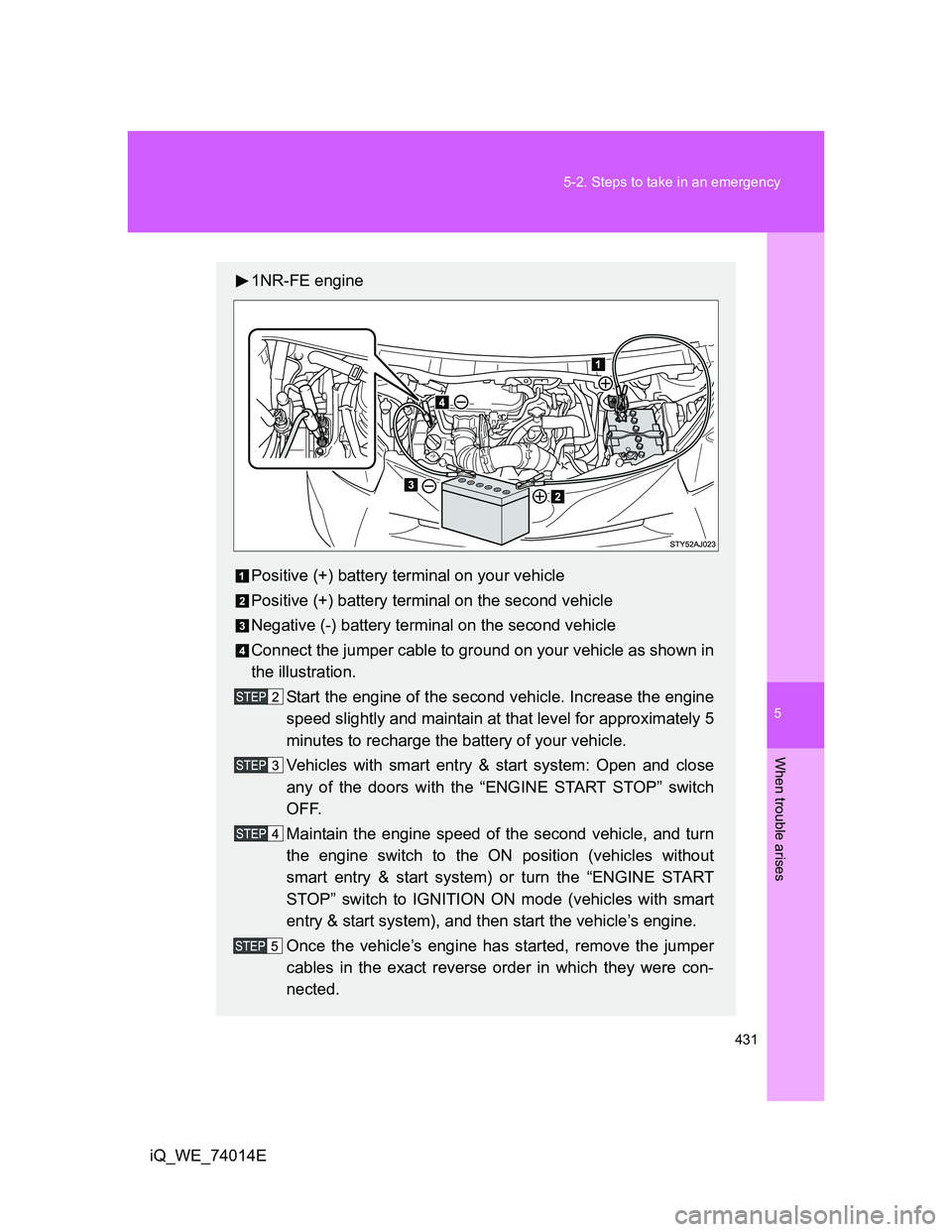
1NR-FE engine
Positive (+) battery terminal on your vehicle
Positive (+) battery terminal on the second vehicle
Negative (-) battery terminal on the second vehicle
Connect the jumper cable to ground on your vehicle as shown in
the illustration.
Start the engine of the second vehicle. Increase the engine
speed slightly and maintain at that level for approximately 5
minutes to recharge the battery of your vehicle.
Vehicles with smart entry & start system: Open and close
any of the doors with the “ENGINE START STOP” switch
OFF.
Maintain the engine speed of the second vehicle, and turn
the engine switch to the ON position (vehicles without
smart entry & start system) or turn the “ENGINE START
STOP” switch to IGNITION ON mode (vehicles with smart
entry & start system), and then start the vehicle’s engine.
Once the vehicle’s engine has started, remove the jumper
cables in the exact reverse order in which they were con-
nected.
Page 432 of 476
432 5-2. Steps to take in an emergency
iQ_WE_74014E
Starting the engine when the battery is discharged (vehicles with a
Multidrive)
The engine cannot be started by push-starting.
Avoiding a discharged battery
Turn off the headlights and the audio system while the engine is turned
off.
Turn off any unnecessary electrical components when the vehicle is run-
ning at a low speed for an extended period, such as in heavy traffic, etc.
When the vehicle battery is removed or discharged
Any data stored in the computer will be erased. When the vehicle battery
is discharged, have the vehicle checked at any authorized Toyota dealer
or repairer, or another duly qualified and equipped professional.
Vehicles with alarm: Make sure that the key is not inside the vehicle
when recharging or replacing the battery. The key may be locked in the
vehicle if the alarm is activated. (P. 120)
Reminders when the vehicle battery is discharged (vehicles with smart
entry & start system)
When the doors are attempted to be unlocked via the smart entry & start
system just after the vehicle battery has been discharged, it may fail. If
the doors cannot be unlocked, unlock the doors using a wireless remote
controller or a mechanical key.
The first engine start after the battery has been discharged may fail.
However, the engine should start after the second attempt, so it is not a
malfunction.
Once the engine starts, have the vehicle checked at any autho-
rized Toyota dealer or repairer, or another duly qualified and
equipped professional, as soon as possible.
Page 433 of 476
5
433 5-2. Steps to take in an emergency
When trouble arises
iQ_WE_74014E
The status of the “ENGINE START STOP” switch remains stored in the
vehicle memory. When the vehicle battery is discharged, the vehicle
returns to the status before the battery was discharged after disconnect-
ing and reconnecting the battery. When the battery needs to be discon-
nected, turn the “ENGINE START STOP” switch off before disconnecting
the battery. If the “ENGINE START STOP” switch status before the bat-
tery discharge is unknown, pay due attention to the vehicle when the bat-
tery is reconnected.
Charging the battery
The electricity stored in the battery will discharge gradually even when the
vehicle is not in use, due to natural discharge and the draining effects of cer-
tain electrical appliances. If the vehicle is left for a long time, the battery may
discharge, and the engine may be unable to start. (The battery recharges
automatically during driving.)
CAUTION
Avoiding battery fires or explosions
Observe the following precautions to prevent accidentally igniting the flam-
mable gas that may be emitted from the battery.
Make sure the jumper cable is connected to the correct terminal and that it
is not unintentionally in contact with any part other than the intended termi-
nal.
Do not allow the jumper cables to come into contact with the “+” and “-” ter-
minals.
Do not allow open flame or use matches, cigarette lighters or smoke near
the battery.
Battery precautions
The battery contains poisonous and corrosive acidic electrolyte, while
related parts contain lead and lead compounds. Observe the following pre-
cautions when handling the battery.
When working with the battery, always wear safety glasses and take care
not to allow any battery fluids (acid) to come into contact with skin, clothing
or the vehicle body.
Do not lean over the battery.
Page 435 of 476
5
435
5-2. Steps to take in an emergency
When trouble arises
iQ_WE_74014E
If your vehicle overheats
Correction procedures
Stop the vehicle in a safe place and turn off the air condition-
ing system, and then stop the engine.
If you see steam:
Carefully lift the hood after the steam subsides.
If you do not see steam:
Carefully lift the hood.
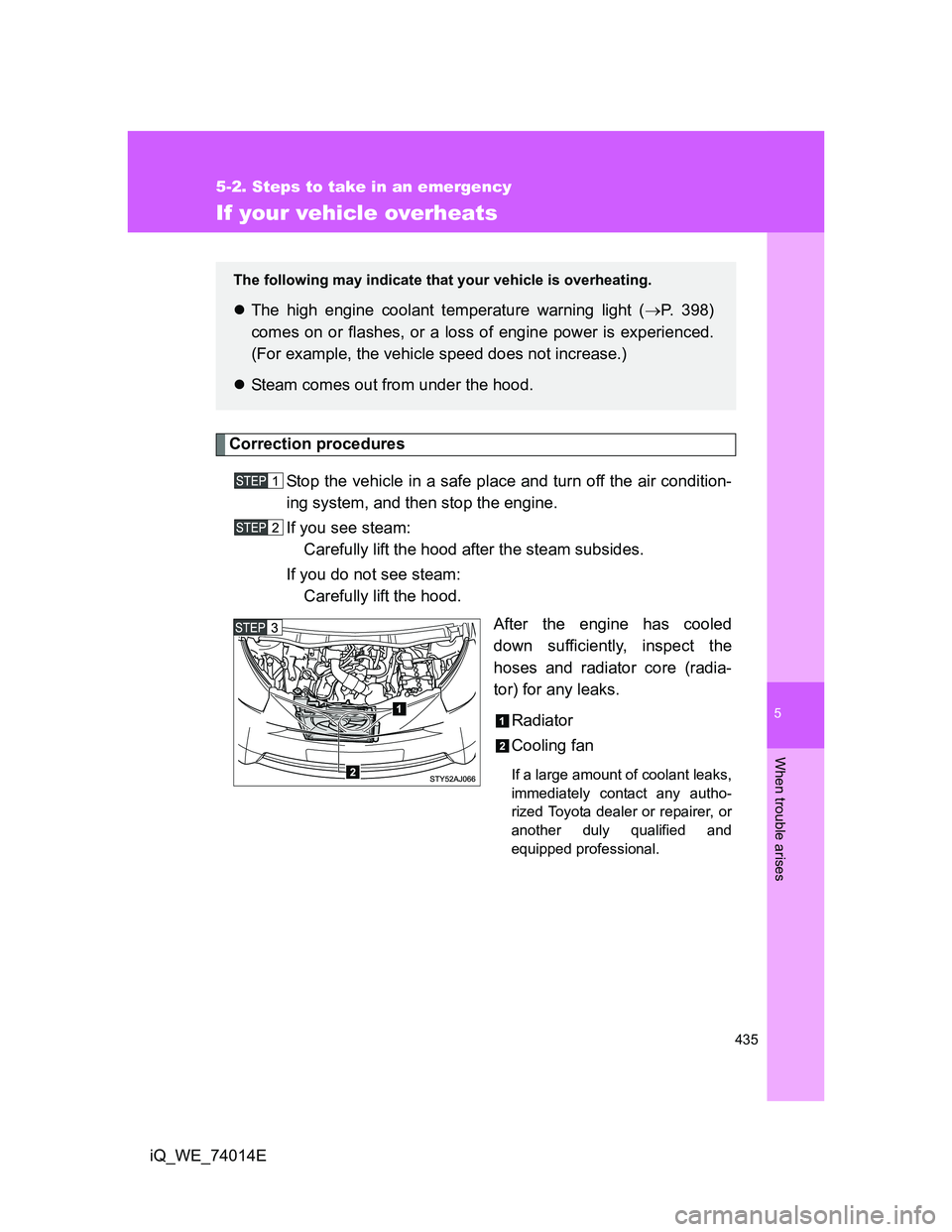
After the engine has cooled
down sufficiently, inspect the
hoses and radiator core (radia-
tor) for any leaks.
Radiator
Cooling fan
If a large amount of coolant leaks,
immediately contact any autho-
rized Toyota dealer or repairer, or
another duly qualified and
equipped professional.
The following may indicate that your vehicle is overheating.
The high engine coolant temperature warning light (P. 398)
comes on or flashes, or a loss of engine power is experienced.
(For example, the vehicle speed does not increase.)
Steam comes out from under the hood.
Page 456 of 476

456 6-1. Specifications
iQ_WE_74014E
Light bulbs
A: HIR2 bulbs
B: H11 halogen bulbs
C: Wedge base bulbs (amber)
D: Wedge base bulbs (clear)
CAUTION
When replacing tires and wheels
Observe the following precautions to prevent accidents.
Failure to do so may cause damage to the peripheral parts of the tires, as
well as dangerous handling characteristics, which may lead to fatal or injury
accidents.
Do not use tire sizes or wheel sizes other than those recommended by
To y o t a .
Light BulbsWTy p e
ExteriorHeadlights 55 A
Front turn signal lights 21 C
Front position lights 5 D
Front fog lights (if equipped) 55 B
Side turn signal lights 5 C
Rear turn signal lights 21 C
Back-up lights 21 D
Rear fog light 21 D
Tail/stop lights 5/21 D
License plate lights 5 D
Page 457 of 476
457
6-1. Specifications
6
Vehicle specifications
iQ_WE_74014E
Fuel infor mation
Fuel tank opening for unleaded gasoline
To help prevent incorrect fueling, your Toyota has a fuel tank opening that
only accommodates the special nozzle on unleaded fuel pumps.
If your engine knocks
Consult any authorized Toyota dealer or repairer, or another duly quali-
fied and equipped professional.
You may occasionally notice light knocking for a short time while acceler-
ating or driving uphill. This is normal and there is no need for concern.
NOTICE
Notice on fuel quality
Do not use improper fuels. If improper fuels are used the engine will be
damaged.
Do not use leaded gasoline.
Leaded gasoline will cause the three-way catalytic converter to lose its
effectiveness and emission control system to function improperly.
EU area:
Your vehicle must use only unleaded gasoline conforming to Euro-
pean standard EN228. For optimum engine performance, select
unleaded gasoline with a Research Octane Number of 95 or higher.
Except EU area:
Your vehicle must use only unleaded gasoline. For optimum engine
performance, select unleaded gasoline with a Research Octane
Number of 95 or higher.
Page 459 of 476
459
6
Vehicle specifications
iQ_WE_74014E
6-2. Customization
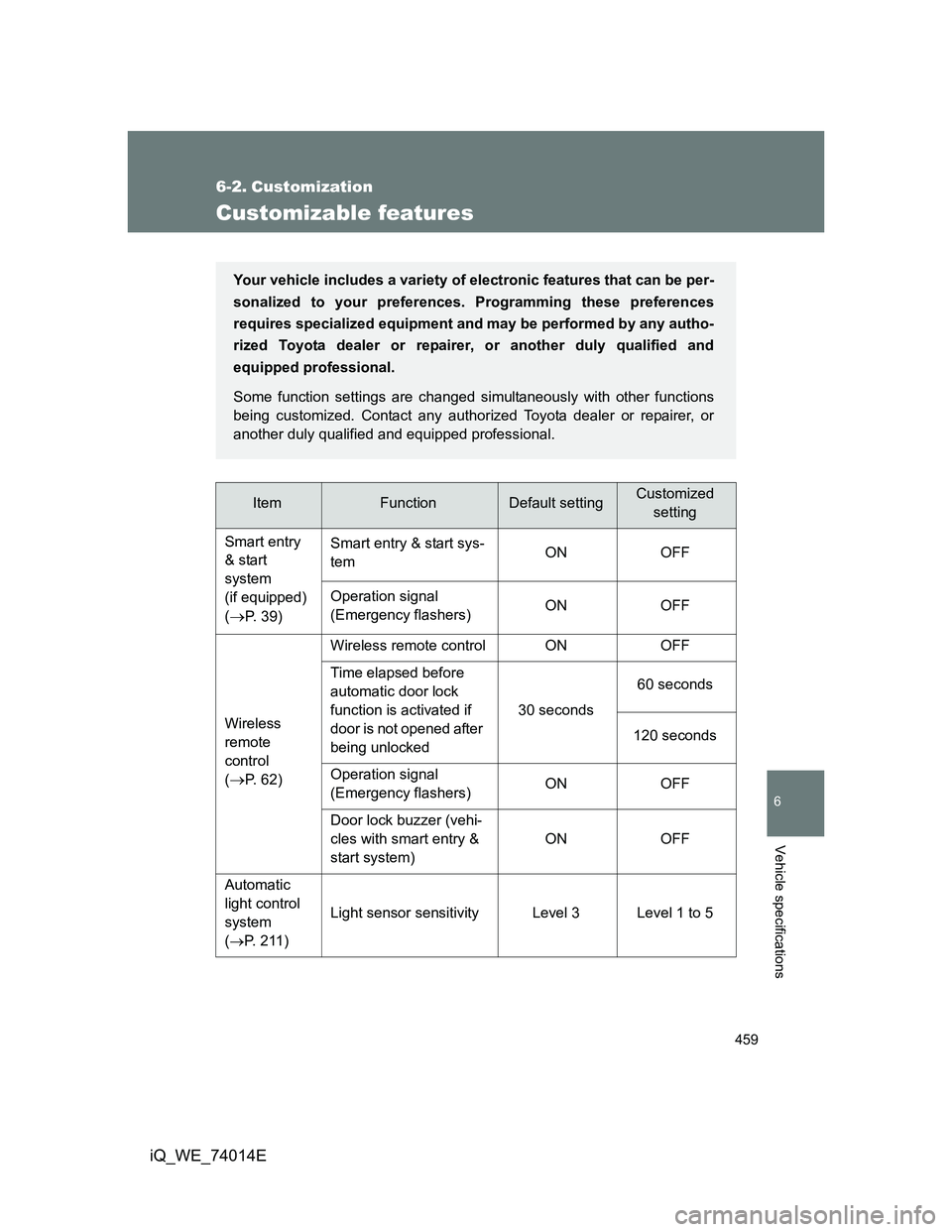
Customizable features
ItemFunctionDefault settingCustomized
setting
Smart entry
& start
system
(if equipped)
(
P. 39)Smart entry & start sys-
temON OFF
Operation signal
(Emergency flashers) ON OFF
Wireless
remote
control
(
P. 62)Wireless remote control ON OFF
Time elapsed before
automatic door lock
function is activated if
door is not opened after
being unlocked30 seconds60 seconds
120 seconds
Operation signal
(Emergency flashers)ON OFF
Door lock buzzer (vehi-
cles with smart entry &
start system)ON OFF
Automatic
light control
system
(P. 211)Light sensor sensitivity Level 3 Level 1 to 5
Your vehicle includes a variety of electronic features that can be per-
sonalized to your preferences. Programming these preferences
requires specialized equipment and may be performed by any autho-
rized Toyota dealer or repairer, or another duly qualified and
equipped professional.
Some function settings are changed simultaneously with other functions
being customized. Contact any authorized Toyota dealer or repairer, or
another duly qualified and equipped professional.