engine TOYOTA IQ 2012 Owners Manual
[x] Cancel search | Manufacturer: TOYOTA, Model Year: 2012, Model line: IQ, Model: TOYOTA IQ 2012Pages: 476, PDF Size: 23.52 MB
Page 439 of 476
5
439 5-2. Steps to take in an emergency
When trouble arises
iQ_WE_74014E
CAUTION
When attempting to free a stuck vehicle
If you choose to rock the vehicle back and forth to free it, make sure the sur-
rounding area is clear, to avoid striking other vehicles, objects or persons.
The vehicle may also lunge forward or lunge back suddenly as it becomes
free. Use extreme caution.
When shifting the shift lever (vehicles with a Multidrive)
Be careful not to shift the shift lever with the accelerator pedal depressed.
This may lead to unexpected rapid acceleration of the vehicle that may
cause an accident and result in death or serious injury.
NOTICE
To avoid damaging the transmission and other components
Avoid spinning the wheels and do not rev the engine.
If the vehicle remains stuck after trying these procedures, the vehicle may
require towing to be freed.
Page 440 of 476
440
5-2. Steps to take in an emergency
iQ_WE_74014E
If your vehicle has to be stopped in an emergency
Only in an emergency, such as if it becomes impossible to stop the
vehicle in the normal way, stop the vehicle using the following pro-
cedure:
Steadily step on the brake pedal with both feet and firmly
depress it.
Do not pump the brake pedal repeatedly as this will increase the
effort required to slow the vehicle.
Shift the shift lever to N.
If the shift lever is shifted to N.
After slowing down, stop the vehicle in a safe place by the
road.
Stop the engine.
If the shift lever cannot be shifted to N.
Keep depressing the brake pedal with both feet to reduce
vehicle speed as much as possible.
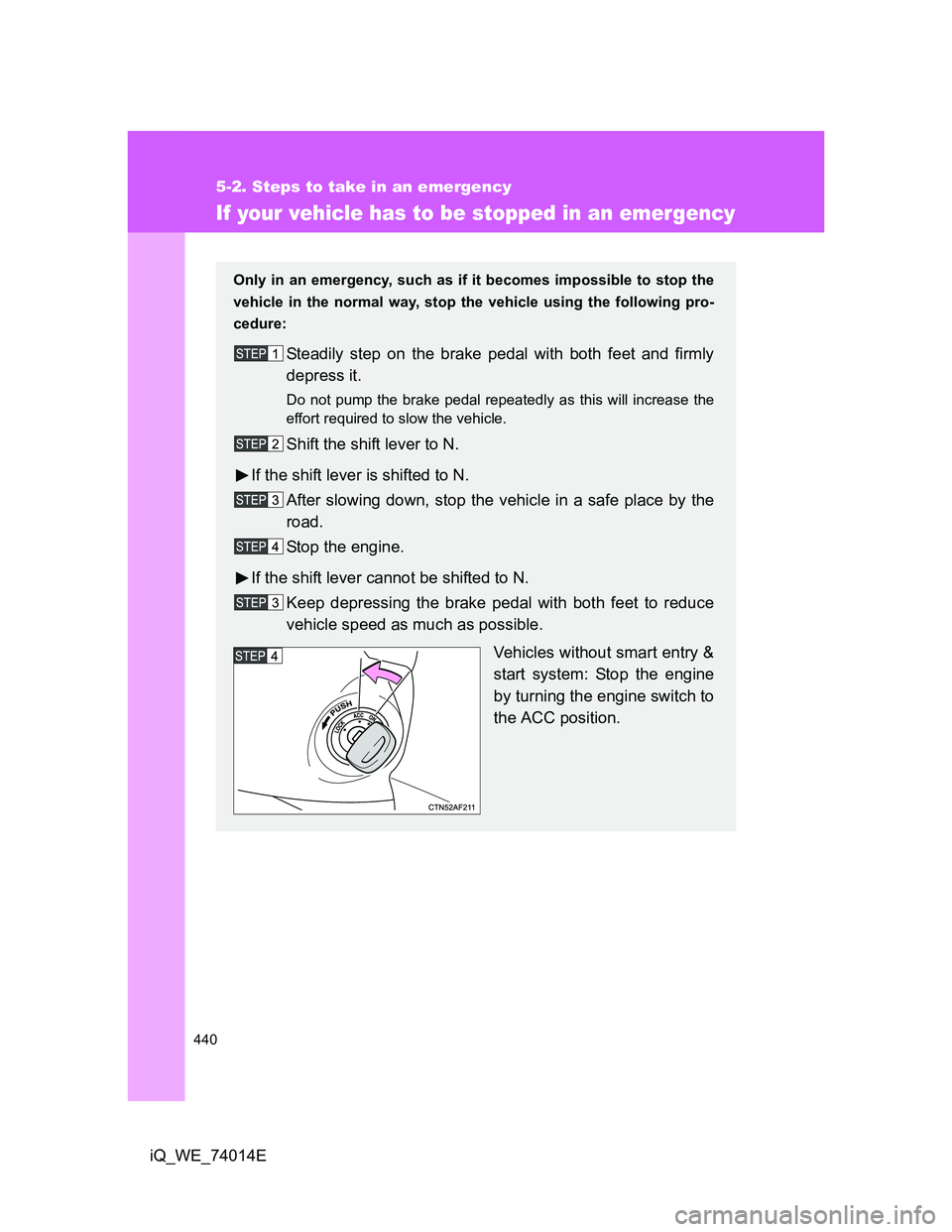
Vehicles without smart entry &
start system: Stop the engine
by turning the engine switch to
the ACC position.
Page 441 of 476
5
441 5-2. Steps to take in an emergency
When trouble arises
iQ_WE_74014E
CAUTION
If the engine has to be turned off while driving
Power assist for the brakes and steering wheel will be lost, making the
brake pedal harder to depress and the steering wheel heavier to turn.
Decelerate as much as possible before turning off the engine.
Vehicles without smart entry & start system: Never attempt to remove the
key, as doing so will lock the steering wheel.
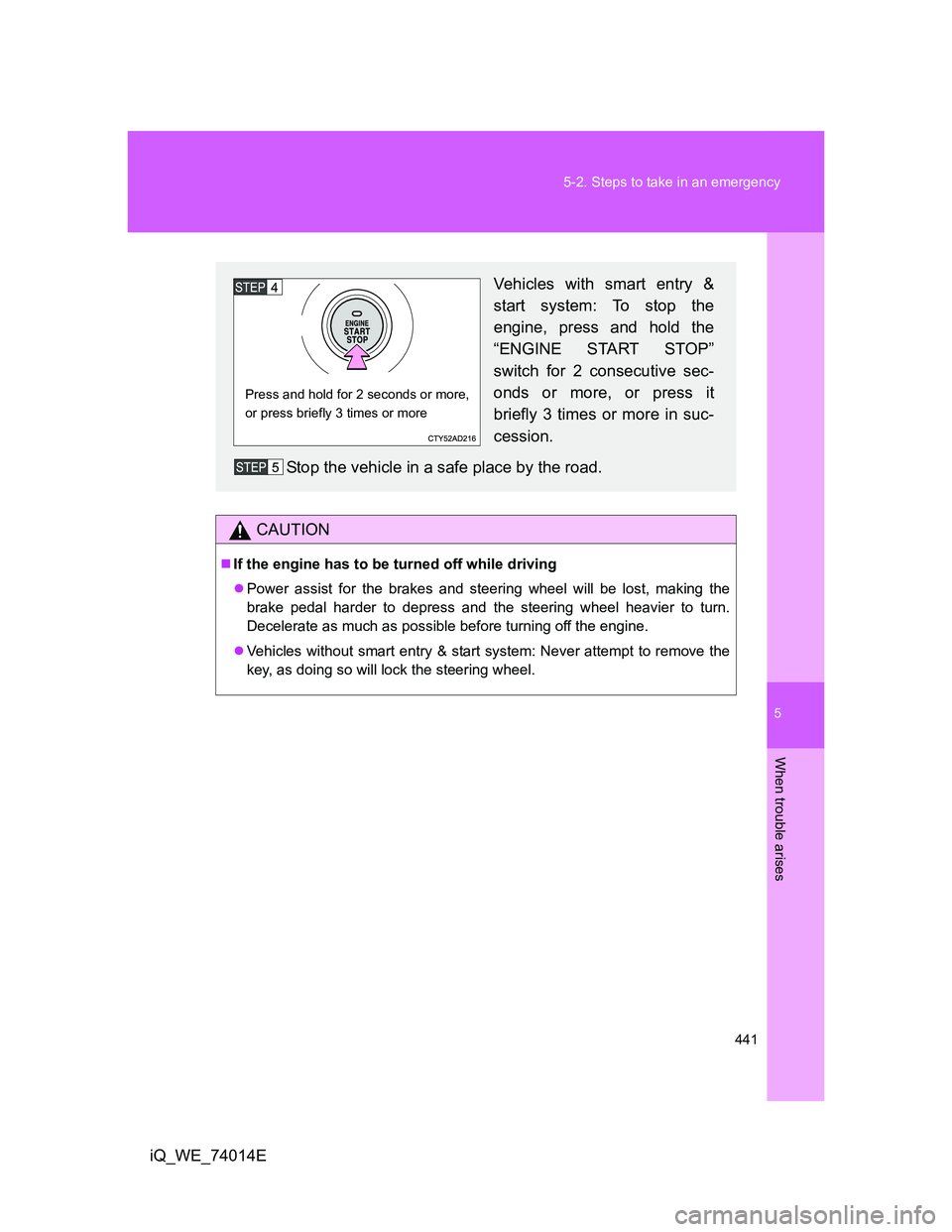
Vehicles with smart entry &
start system: To stop the
engine, press and hold the
“ENGINE START STOP”
switch for 2 consecutive sec-
onds or more, or press it
briefly 3 times or more in suc-
cession.
Stop the vehicle in a safe place by the road.
Press and hold for 2 seconds or more,
or press briefly 3 times or more
Page 444 of 476
444
iQ_WE_74014E
6-1. Specifications
Maintenance data (fuel, oil level, etc.)
Dimensions and weight
*: Unladen vehicles
Overall length 2985 mm (117.5 in.)
Overall width 1680 mm (66.1 in.)
Overall height*1500 mm (59.1 in.)
Wheelbase 2000 mm (78.7 in.)
TreadFront 1480 mm (58.3 in.)
Rear 1460 mm (57.5 in.)
Gross vehicle mass1KR-FE engine
1215 kg (2678 lb.)
1NR-FE engine
1270 kg (2799 lb.)
Maximum permis-
sible axle capacityFront 670 kg (1477 lb.)
Rear 630 kg (1388 lb.)
Page 446 of 476
446 6-1. Specifications
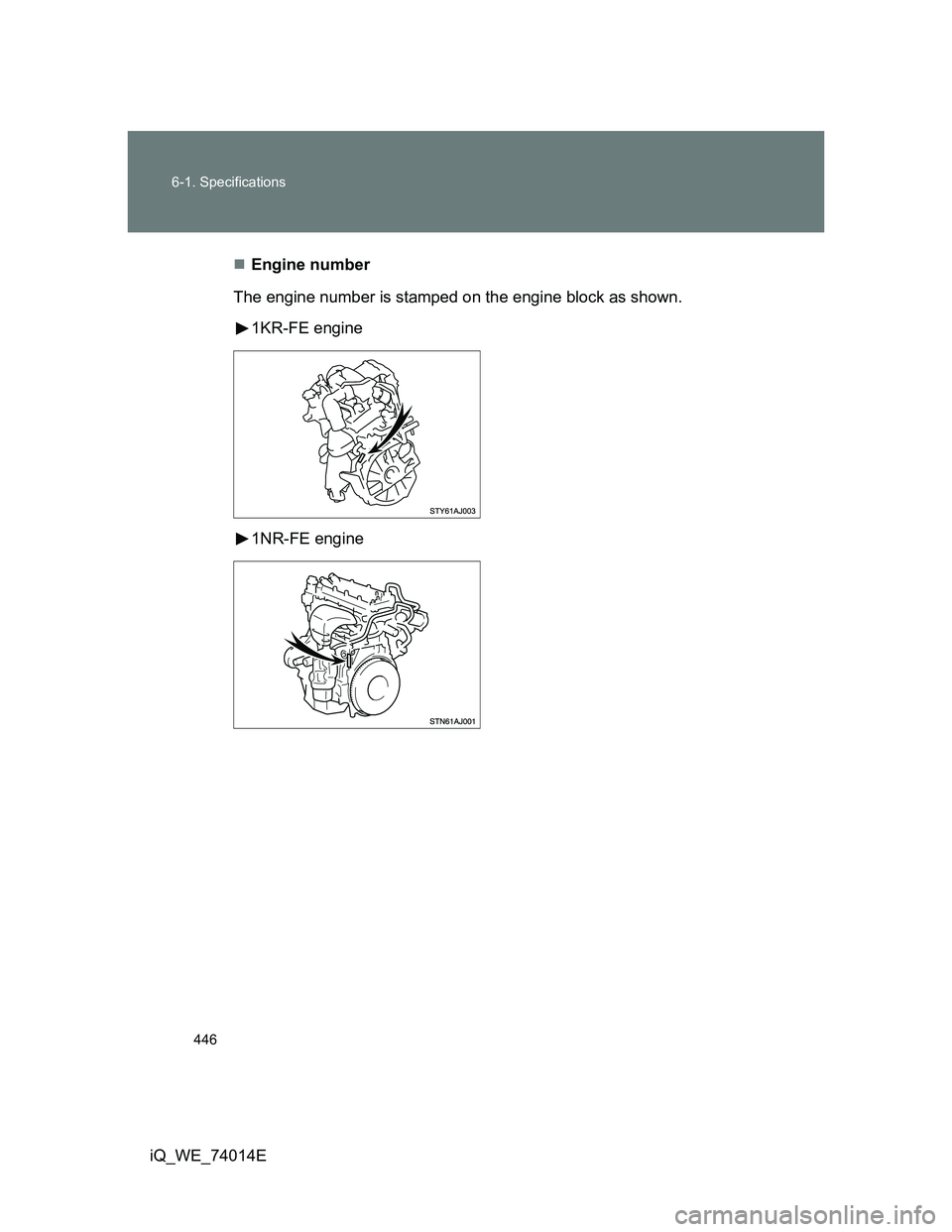
iQ_WE_74014EEngine number
The engine number is stamped on the engine block as shown.
1KR-FE engine
1NR-FE engine
Page 447 of 476
447 6-1. Specifications
6
Vehicle specifications
iQ_WE_74014E
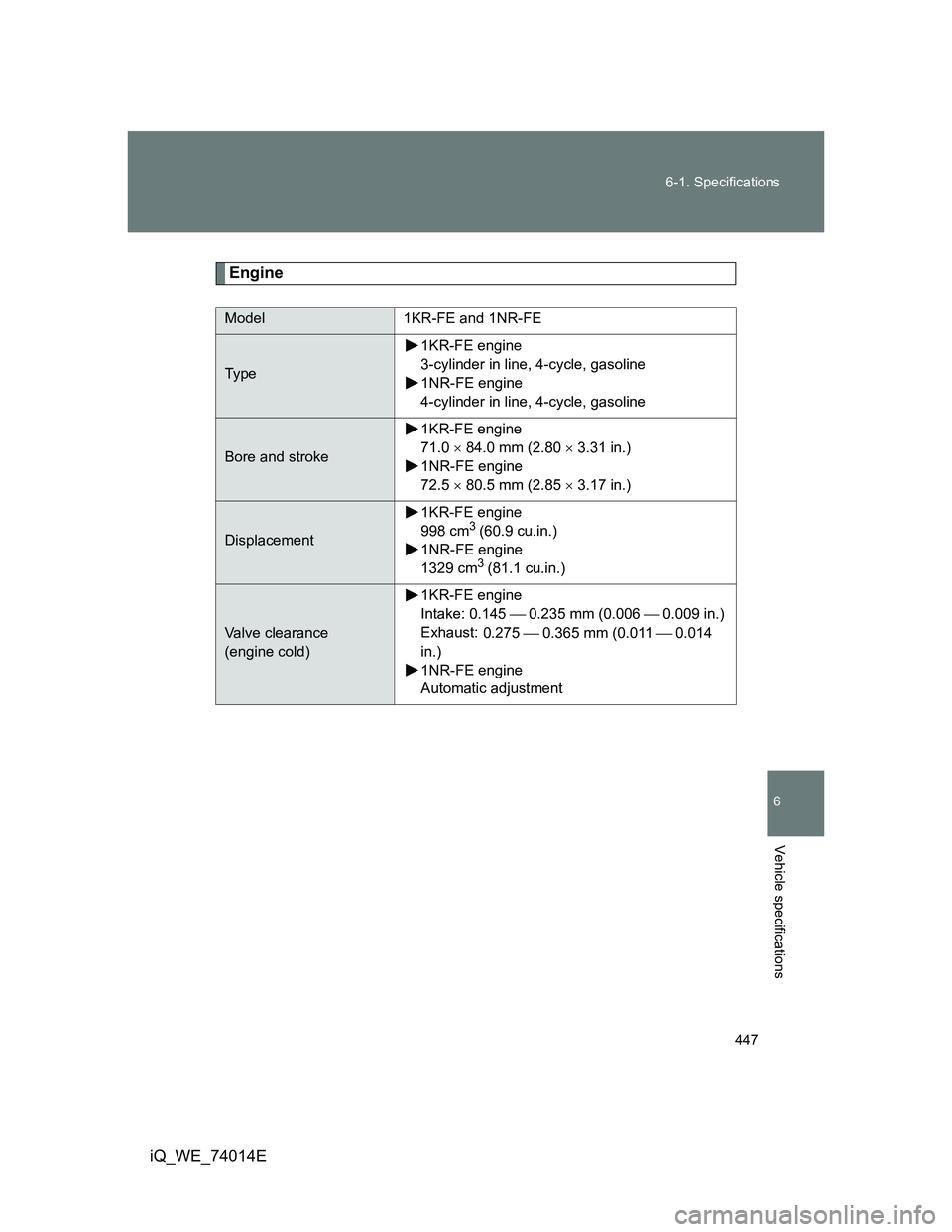
Engine
Model 1KR-FE and 1NR-FE
Ty p e1KR-FE engine
3-cylinder in line, 4-cycle, gasoline
1NR-FE engine
4-cylinder in line, 4-cycle, gasoline
Bore and stroke1KR-FE engine
71.0 84.0 mm (2.80 3.31 in.)
1NR-FE engine
72.5 80.5 mm (2.85 3.17 in.)
Displacement1KR-FE engine
998 cm3 (60.9 cu.in.)
1NR-FE engine
1329 cm
3 (81.1 cu.in.)
Valve clearance
(engine cold)1KR-FE engine
Intake: 0.145 0.235 mm (0.006 0.009 in.)
Exhaust: 0.275 0.365 mm (0.011 0.014
in.)
1NR-FE engine
Automatic adjustment
Page 448 of 476
448 6-1. Specifications
iQ_WE_74014E
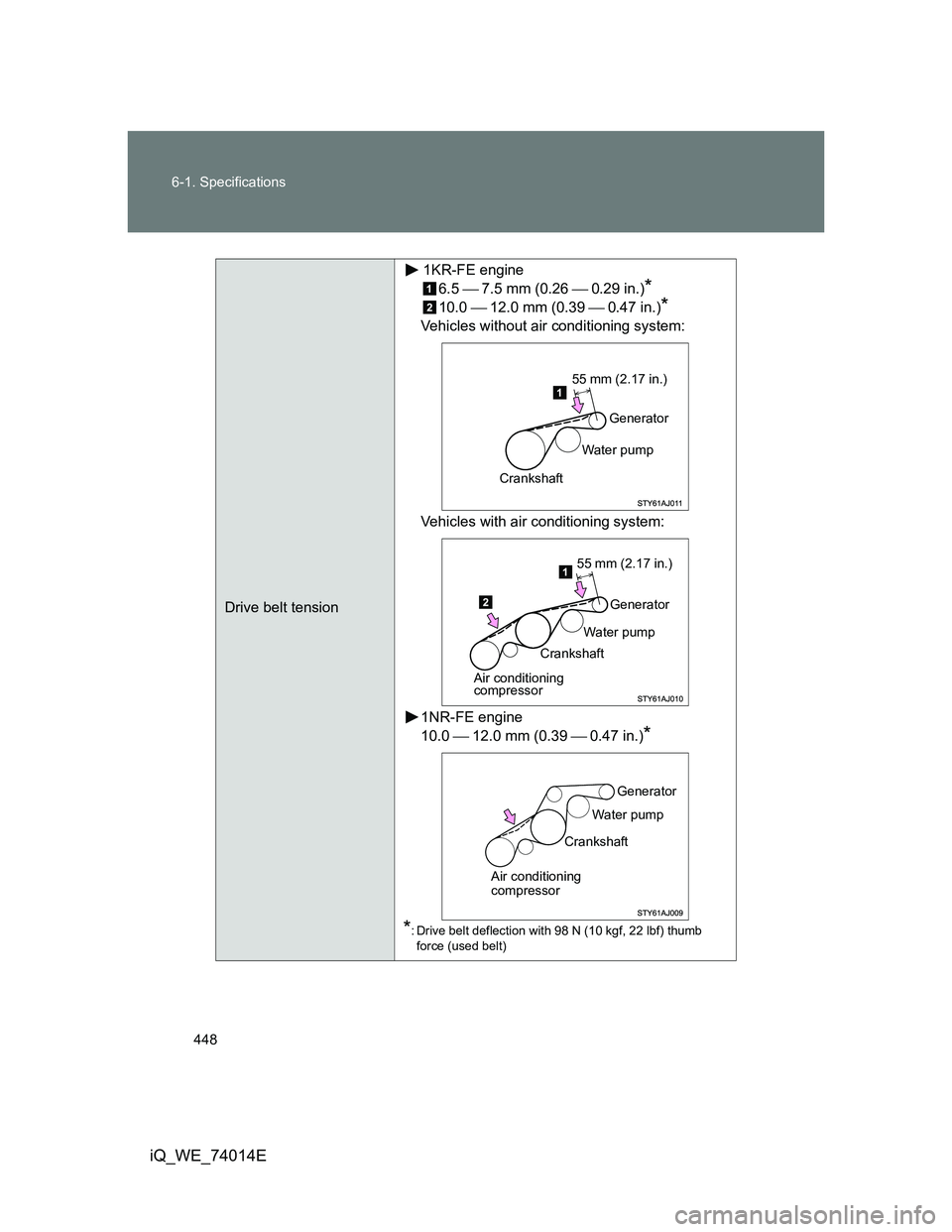
Drive belt tension1KR-FE engine
6.5 7.5 mm (0.26 0.29 in.)
*
10.0 12.0 mm (0.39 0.47 in.)*
Vehicles without air conditioning system:
Vehicles with air conditioning system:
1NR-FE engine
10.0 12.0 mm (0.39 0.47 in.)
*
*
: Drive belt deflection with 98 N (10 kgf, 22 lbf) thumb
force (used belt)
Generator
Water pump
Crankshaft55 mm (2.17 in.)
CrankshaftWater pumpGenerator
Air conditioning
compressor55 mm (2.17 in.)
CrankshaftWater pumpGenerator
Air conditioning
compressor
Page 449 of 476
449 6-1. Specifications
6
Vehicle specifications
iQ_WE_74014E
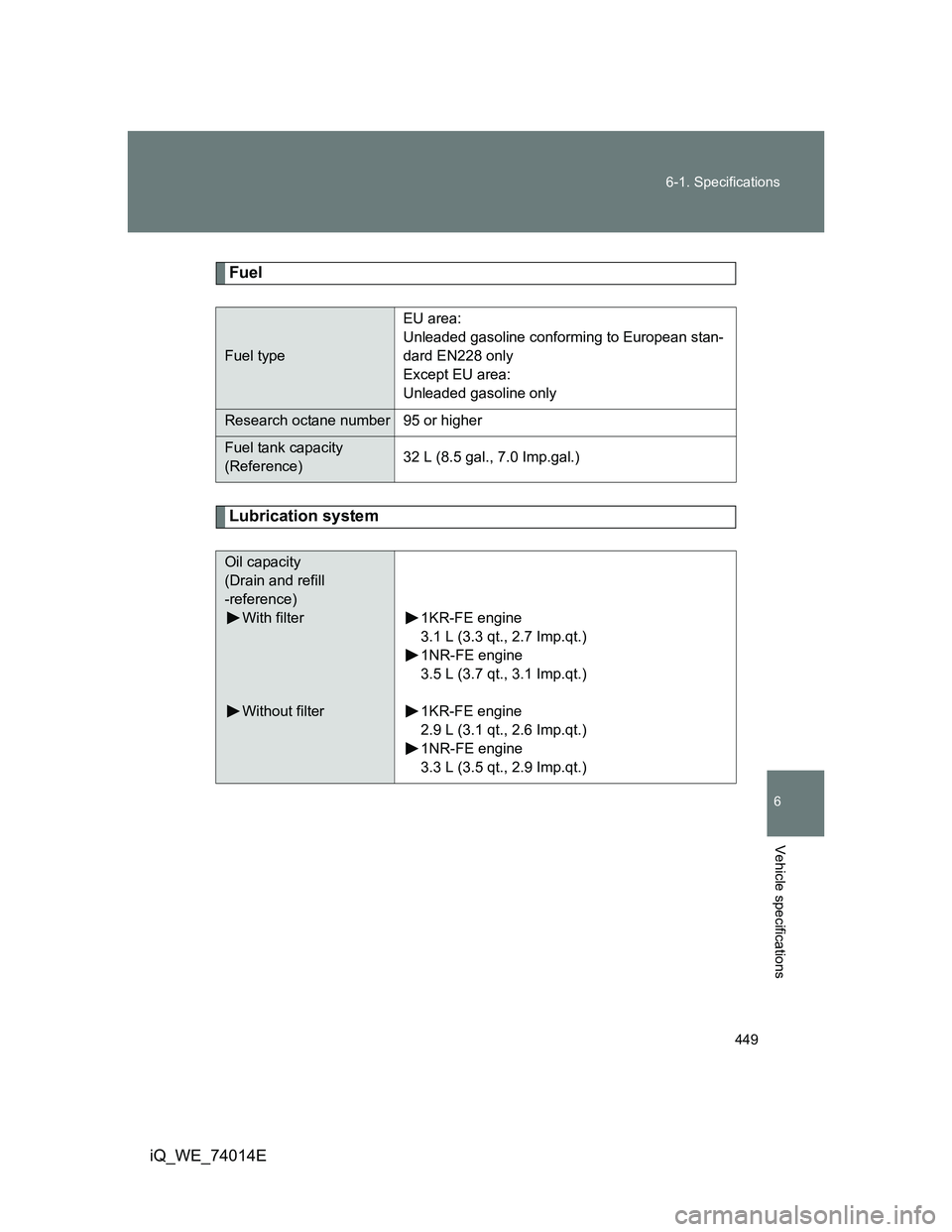
Fuel
Lubrication system
Fuel typeEU area:
Unleaded gasoline conforming to European stan-
dard EN228 only
Except EU area:
Unleaded gasoline only
Research octane number 95 or higher
Fuel tank capacity
(Reference)32 L (8.5 gal., 7.0 Imp.gal.)
Oil capacity
(Drain and refill
-reference)
With filter
Without filter1KR-FE engine
3.1 L (3.3 qt., 2.7 Imp.qt.)
1NR-FE engine
3.5 L (3.7 qt., 3.1 Imp.qt.)
1KR-FE engine
2.9 L (3.1 qt., 2.6 Imp.qt.)
1NR-FE engine
3.3 L (3.5 qt., 2.9 Imp.qt.)
Page 450 of 476
450 6-1. Specifications
iQ_WE_74014EEngine oil selection
“Toyota Genuine Motor Oil” is used in your Toyota vehicle. Toyota rec-
ommends the use of approved “Toyota Genuine Motor Oil”. Another
motor oil of matching quality can also be used.
Oil grade:
0W-20, 5W-20, 5W-30 and 10W-30:
API grade SL “Energy-Conserving”, SM “Energy-Conserving”, SN
“Resource-Conserving” or ILSAC multigrade engine oil
15W-40 and 20W-50:
API grade SL, SM or SN multigrade engine oil
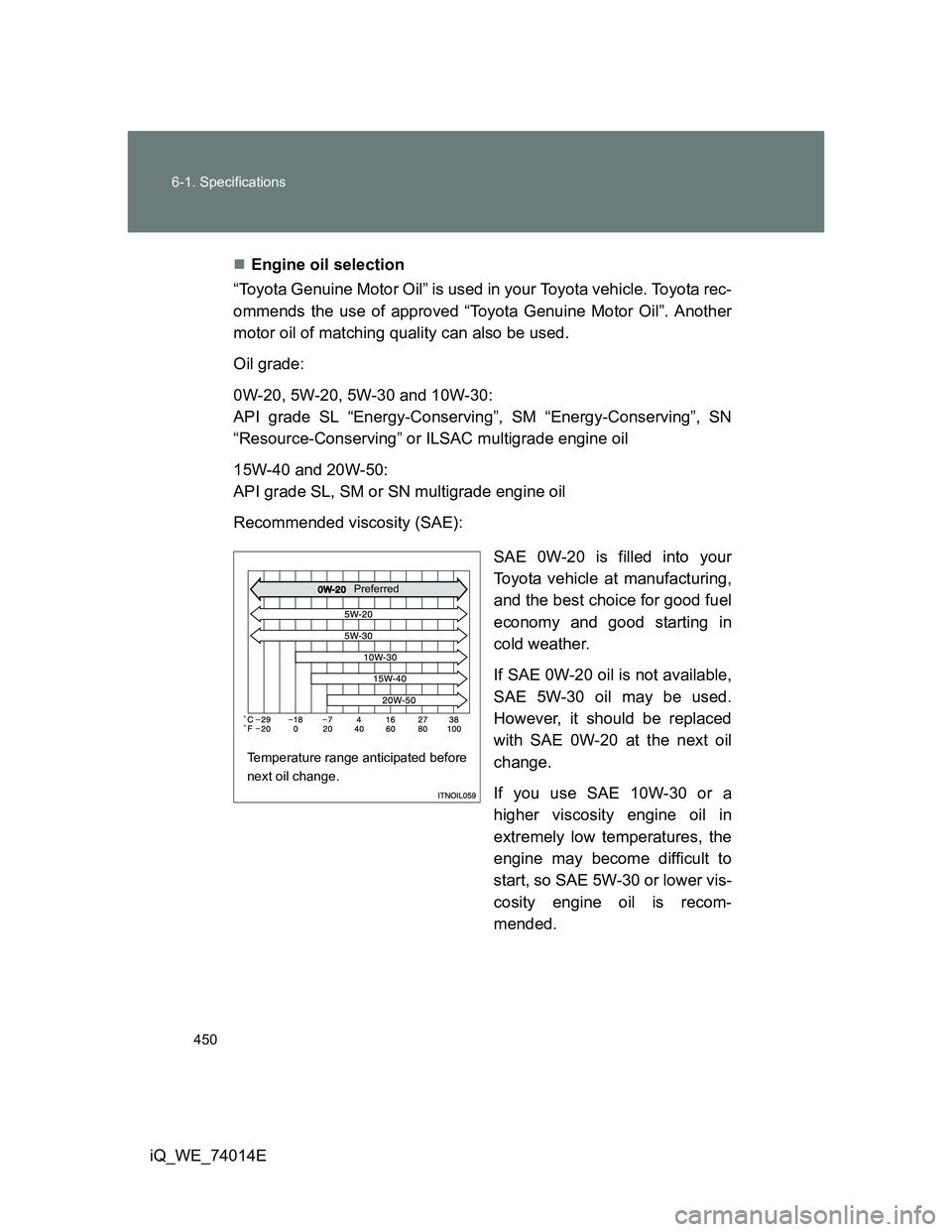
Recommended viscosity (SAE):
SAE 0W-20 is filled into your
Toyota vehicle at manufacturing,
and the best choice for good fuel
economy and good starting in
cold weather.
If SAE 0W-20 oil is not available,
SAE 5W-30 oil may be used.
However, it should be replaced
with SAE 0W-20 at the next oil
change.
If you use SAE 10W-30 or a
higher viscosity engine oil in
extremely low temperatures, the
engine may become difficult to
start, so SAE 5W-30 or lower vis-
cosity engine oil is recom-
mended.
Temperature range anticipated before
next oil change.
Preferred
Page 451 of 476
451 6-1. Specifications
6
Vehicle specifications
iQ_WE_74014E
The 0W portion of the oil viscosity rating indicates the characteristic of the oil
which allows cold startability. Oils with a lower value before the W allow for
easier starting of the engine in cold weather.
The 20 in 0W-20 indicates the oil viscosity when the oil is at its operating
temperature. An oil with a higher viscosity may be better suited if the vehicle
is operated at high speeds, or under extreme load conditions.
How to read oil container labels:
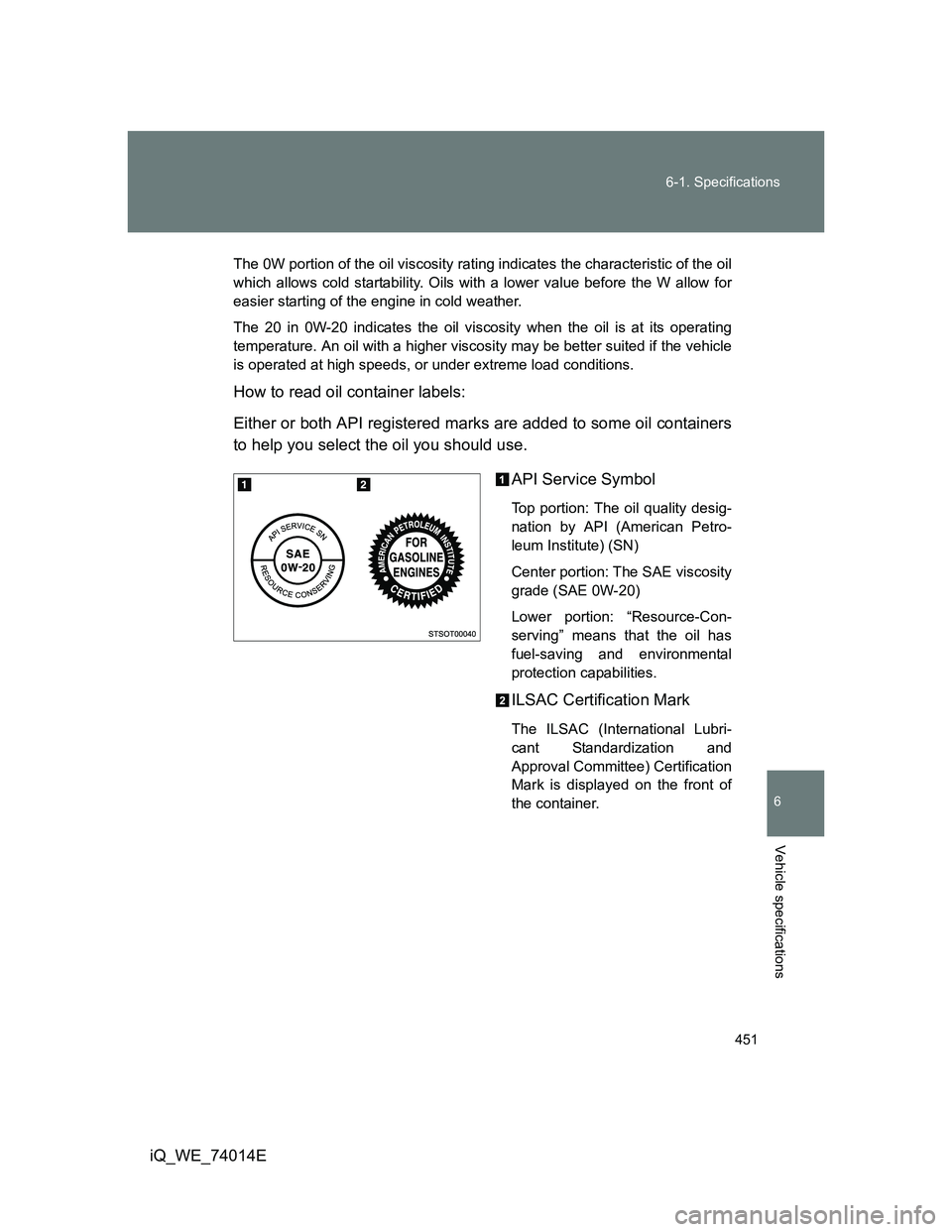
Either or both API registered marks are added to some oil containers
to help you select the oil you should use.
API Service Symbol
Top portion: The oil quality desig-
nation by API (American Petro-
leum Institute) (SN)
Center portion: The SAE viscosity
grade (SAE 0W-20)
Lower portion: “Resource-Con-
serving” means that the oil has
fuel-saving and environmental
protection capabilities.
ILSAC Certification Mark
The ILSAC (International Lubri-
cant Standardization and
Approval Committee) Certification
Mark is displayed on the front of
the container.