airbag TOYOTA IQ 2012 User Guide
[x] Cancel search | Manufacturer: TOYOTA, Model Year: 2012, Model line: IQ, Model: TOYOTA IQ 2012Pages: 476, PDF Size: 23.52 MB
Page 31 of 476
31
iQ_WE_74014E
To y o t a
Installation of a RF-transmitter system
As the installation of an RF-transmitter system in your vehicle could affect
electronic systems such as the multi-port fuel injection system/sequential
multi-port fuel injection system, anti-lock brake system, SRS airbag system
or seat belt pretensioner system, be sure to check with any authorized
Toyota dealer or repairer, or another duly qualified and equipped
professional for precautionary measures or special instructions regarding
installation.
Further information regarding frequency bands, power levels, antenna posi-
tions and installation provisions for the installation of RF-transmitters, is
available on request at any authorized Toyota dealer or repairer, or another
duly qualified and equipped professional.
Scrapping of your Toyota
The SRS airbag and seat belt pretensioner devices in your Toyota contain
explosive chemicals. If the vehicle is scrapped with the airbags and seat belt
pretensioners left as they are, this may cause an accident such as fire. Be
sure to have the systems of the SRS airbag and seat belt pretensioner
removed and disposed of by a qualified service shop or by any authorized
Toyota dealer or repairer, or another duly qualified and equipped profes-
sional, before you scrap your vehicle.
Page 35 of 476
1Before driving
35
iQ_WE_74014E
1-1. Key information
Keys.................................... 36
1-2. Opening, closing and locking
the doors
Smart entry & start
system .............................. 39
Wireless remote control ...... 62
Side doors .......................... 72
Back door ........................... 75
1-3. Adjustable components
(seats, mirrors, steering
wheel)
Front seats.......................... 79
Rear seats .......................... 82
Seat belts............................ 86
Steering wheel .................... 91
Anti-glare inside rear
view mirror ........................ 92
Outside rear view mirrors ... 95
1-4. Opening and closing
the windows
Power windows................. 1001-5. Refueling
Opening the fuel tank
cap .................................. 103
1-6. Theft deterrent system
Engine immobilizer
system ............................ 108
Double locking
system ............................ 117
Alarm ................................ 119
1-7. Safety information
Correct driving posture ..... 122
SRS airbags...................... 124
Child restraint systems ..... 137
Installing child restraints ... 148
Airbag manual on-off
system ............................ 159
Page 122 of 476
122
iQ_WE_74014E
1-7. Safety information
Correct driving posture
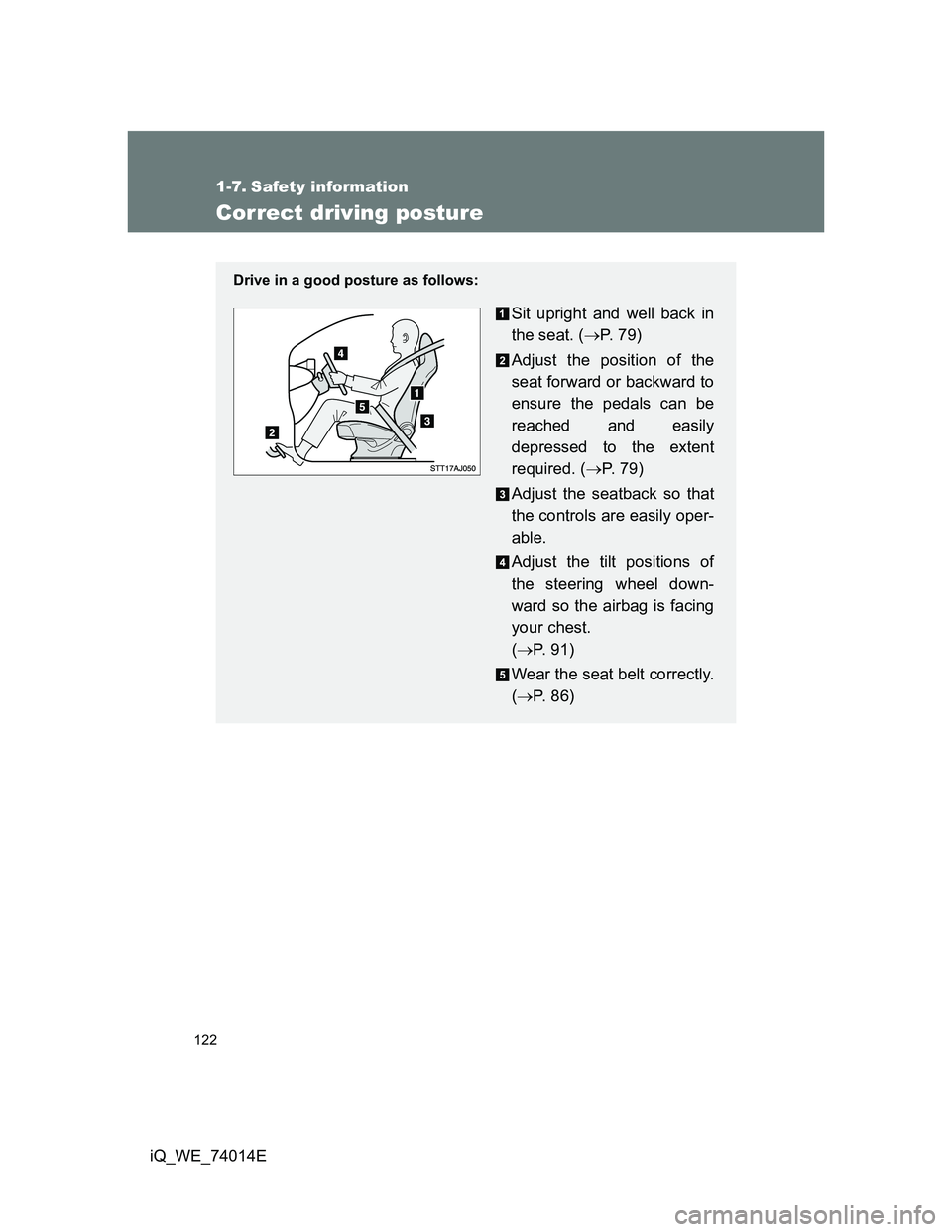
Drive in a good posture as follows:
Sit upright and well back in
the seat. (P. 7 9 )
Adjust the position of the
seat forward or backward to
ensure the pedals can be
reached and easily
depressed to the extent
required. (P. 79)
Adjust the seatback so that
the controls are easily oper-
able.
Adjust the tilt positions of
the steering wheel down-
ward so the airbag is facing
your chest.
(P. 91)
Wear the seat belt correctly.
(P. 86)
Page 124 of 476
124
1-7. Safety information
iQ_WE_74014E
SRS airbags
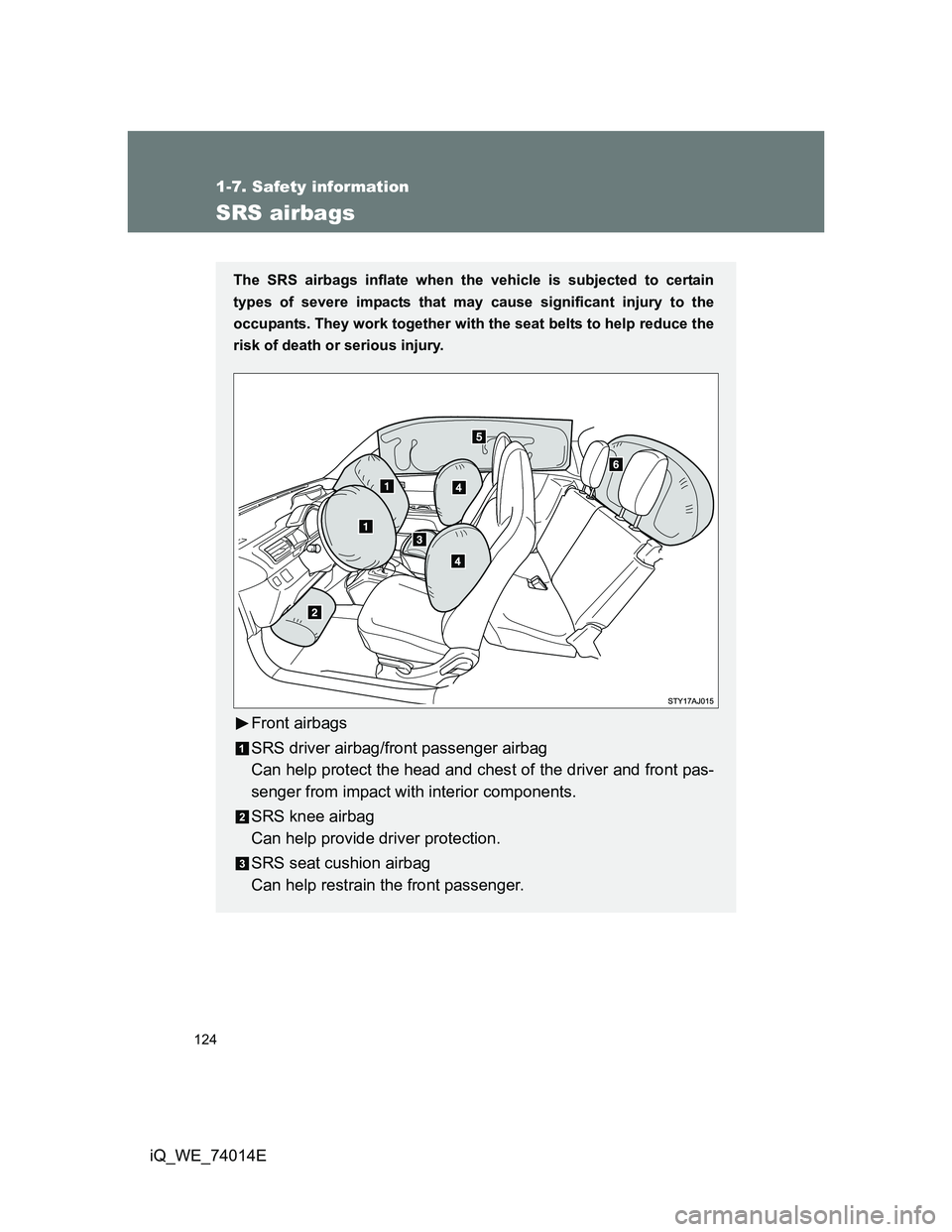
The SRS airbags inflate when the vehicle is subjected to certain
types of severe impacts that may cause significant injury to the
occupants. They work together with the seat belts to help reduce the
risk of death or serious injury.
Front airbags
SRS driver airbag/front passenger airbag
Can help protect the head and chest of the driver and front pas-
senger from impact with interior components.
SRS knee airbag
Can help provide driver protection.
SRS seat cushion airbag
Can help restrain the front passenger.
Page 125 of 476
125 1-7. Safety information
1
Before driving
iQ_WE_74014E
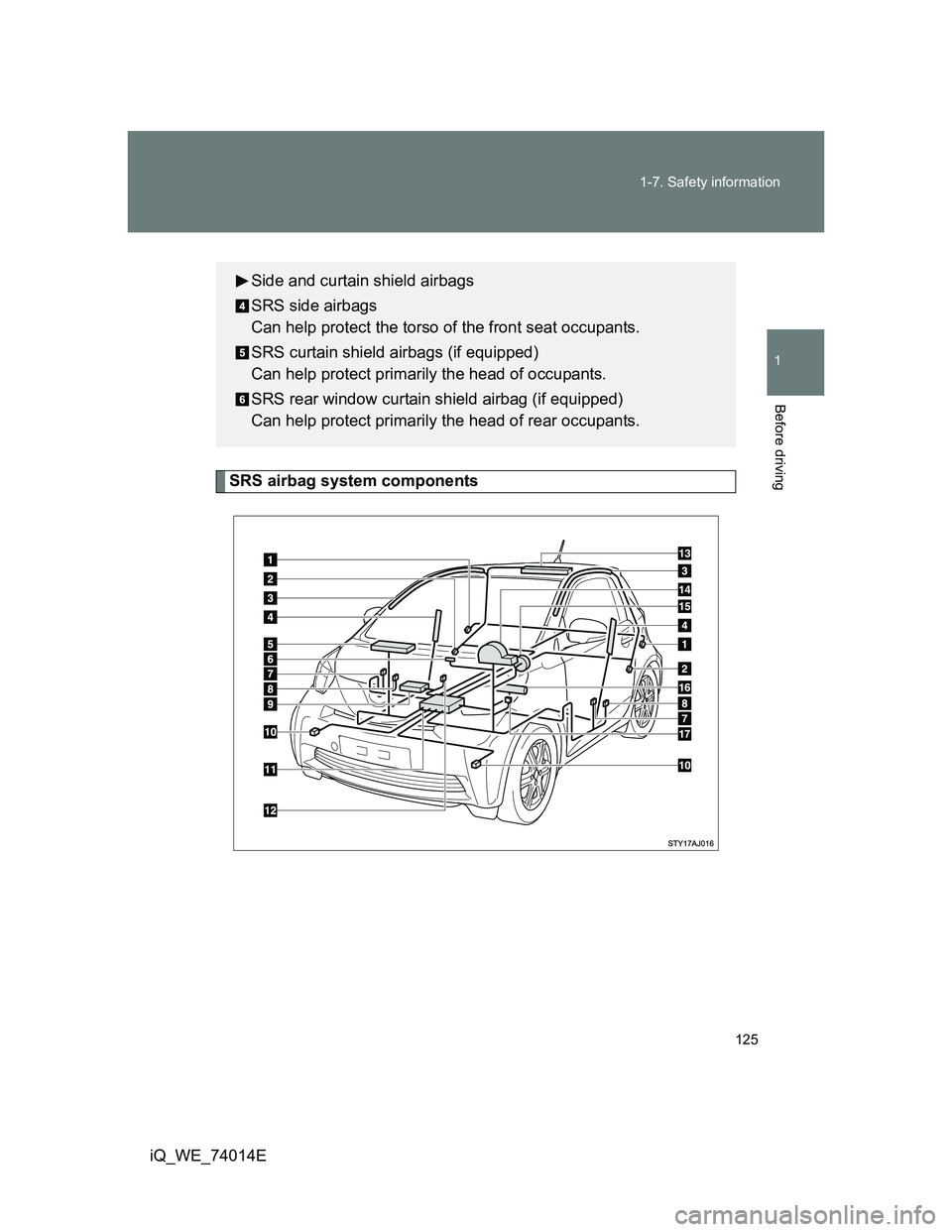
SRS airbag system components
Side and curtain shield airbags
SRS side airbags
Can help protect the torso of the front seat occupants.
SRS curtain shield airbags (if equipped)
Can help protect primarily the head of occupants.
SRS rear window curtain shield airbag (if equipped)
Can help protect primarily the head of rear occupants.
Page 126 of 476
126 1-7. Safety information
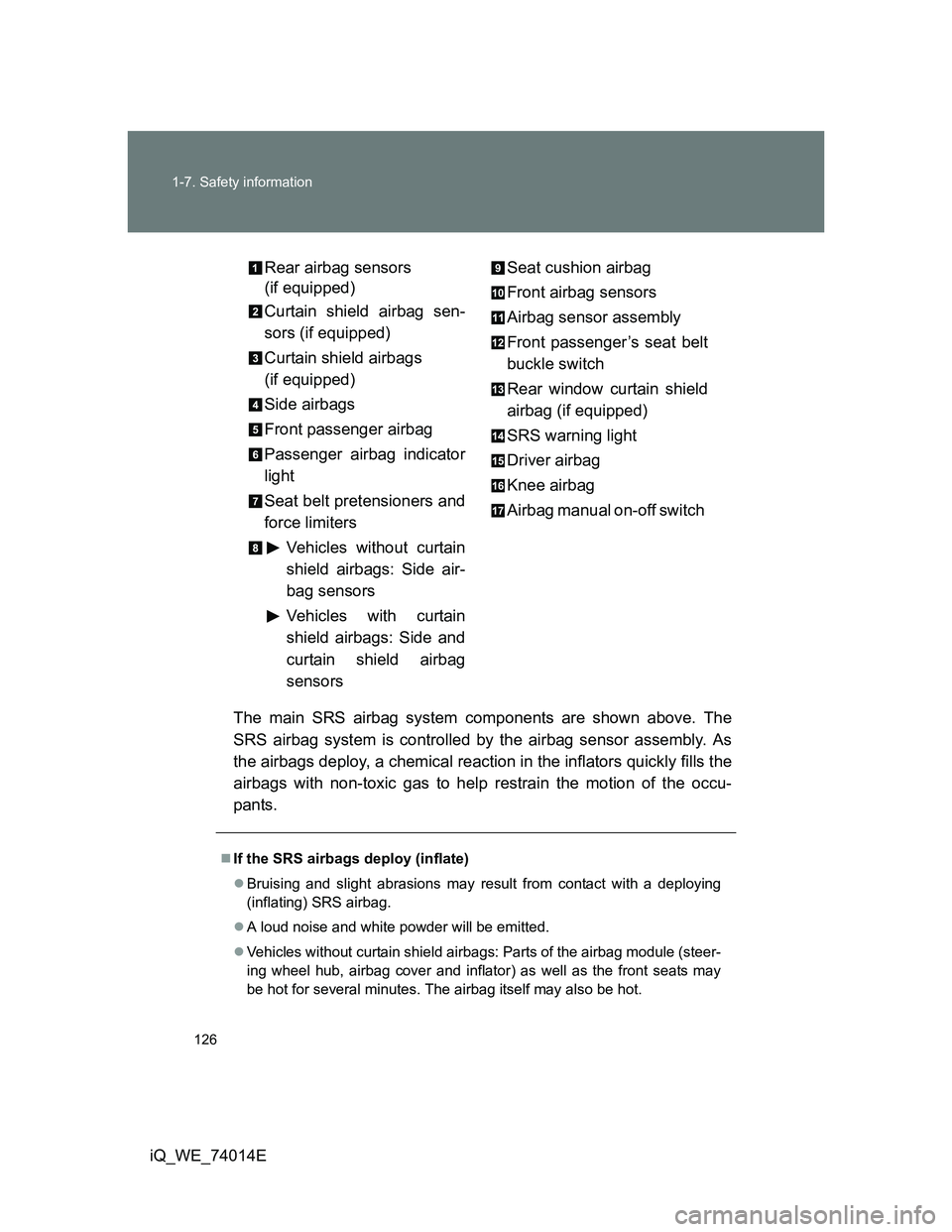
iQ_WE_74014EThe main SRS airbag system components are shown above. The
SRS airbag system is controlled by the airbag sensor assembly. As
the airbags deploy, a chemical reaction in the inflators quickly fills the
airbags with non-toxic gas to help restrain the motion of the occu-
pants.
Rear airbag sensors
(if equipped)
Curtain shield airbag sen-
sors (if equipped)
Curtain shield airbags
(if equipped)
Side airbags
Front passenger airbag
Passenger airbag indicator
light
Seat belt pretensioners and
force limiters
Vehicles without curtain
shield airbags: Side air-
bag sensors
Vehicles with curtain
shield airbags: Side and
curtain shield airbag
sensorsSeat cushion airbag
Front airbag sensors
Airbag sensor assembly
Front passenger’s seat belt
buckle switch
Rear window curtain shield
airbag (if equipped)
SRS warning light
Driver airbag
Knee airbag
Airbag manual on-off switch
If the SRS airbags deploy (inflate)
Bruising and slight abrasions may result from contact with a deploying
(inflating) SRS airbag.
A loud noise and white powder will be emitted.
Vehicles without curtain shield airbags: Parts of the airbag module (steer-
ing wheel hub, airbag cover and inflator) as well as the front seats may
be hot for several minutes. The airbag itself may also be hot.
Page 127 of 476
127 1-7. Safety information
1
Before driving
iQ_WE_74014E
Vehicles with curtain shield airbags: Parts of the airbag module (steering
wheel hub, airbag cover and inflator) as well as the front seats, and parts
of the front and rear pillars, roof side rail and rear roof headlining may be
hot for several minutes. The airbag itself may also be hot.
The front windshield may crack.
Operating conditions (front airbags)
The SRS front airbags will deploy in the event of an impact that exceeds
the set threshold level (the level of force corresponding to an approxi-
mately 20-30 km/h [12-18 mph] frontal collision with a fixed wall that does
not move or deform).
However, this threshold velocity will be considerably higher if the vehicle
strikes an object, such as a parked vehicle or sign pole, which can move or
deform on impact, or if the vehicle is involved in an underride collision (e.g.
a collision in which the front of the vehicle “underrides”, or goes under, the
bed of a truck, etc.).
Depending on the type of collision, it is possible that only the seat belt
pretensioners will activate.
The SRS seat cushion airbag on the front passenger’s seat will not oper-
ate if the occupant is not wearing a seat belt.
Operating conditions (side airbags & curtain shield airbags [if
equipped])
The SRS side airbags & SRS curtain shield airbags will deploy in the event
of an impact that exceeds the set threshold level (the level of force corre-
sponding to the impact force produced by an approximately 1500 kg [3300
lb.] vehicle colliding with the vehicle cabin from a direction perpendicular to
the vehicle orientation at an approximate speed of 20-30 km/h [12-18 mph]).
Operating conditions (rear window curtain shield airbag [if equipped])
The SRS rear window curtain shield airbag is designed to inflate when the
passenger compartment is subjected to a severe impact from the rear or
side.
Page 128 of 476
128 1-7. Safety information
iQ_WE_74014E
Conditions under which the SRS airbags may deploy (inflate), other
than a collision
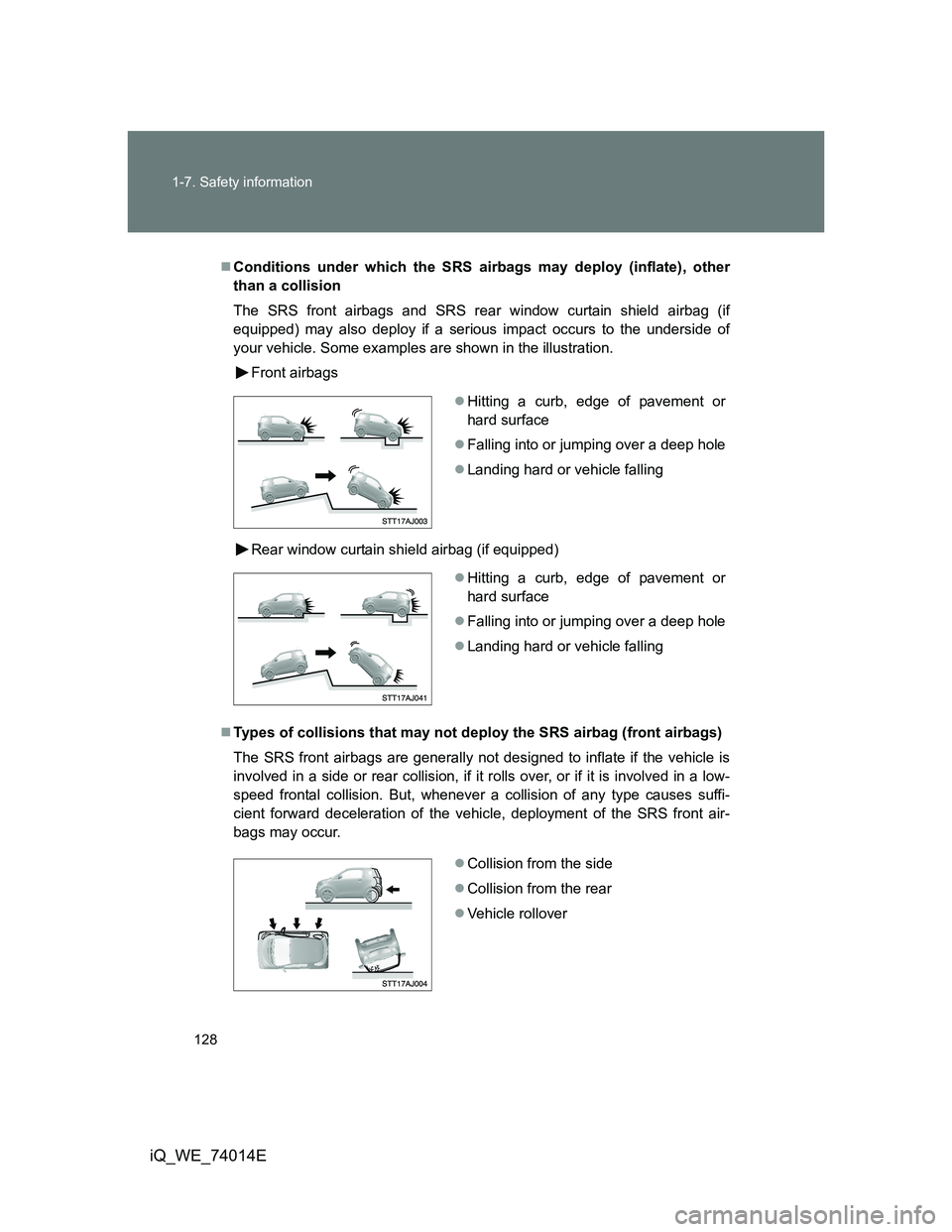
The SRS front airbags and SRS rear window curtain shield airbag (if
equipped) may also deploy if a serious impact occurs to the underside of
your vehicle. Some examples are shown in the illustration.
Front airbags
Rear window curtain shield airbag (if equipped)
Types of collisions that may not deploy the SRS airbag (front airbags)
The SRS front airbags are generally not designed to inflate if the vehicle is
involved in a side or rear collision, if it rolls over, or if it is involved in a low-
speed frontal collision. But, whenever a collision of any type causes suffi-
cient forward deceleration of the vehicle, deployment of the SRS front air-
bags may occur.
Hitting a curb, edge of pavement or
hard surface
Falling into or jumping over a deep hole
Landing hard or vehicle falling
Hitting a curb, edge of pavement or
hard surface
Falling into or jumping over a deep hole
Landing hard or vehicle falling
Collision from the side
Collision from the rear
Vehicle rollover
Page 129 of 476
![TOYOTA IQ 2012 User Guide 129 1-7. Safety information
1
Before driving
iQ_WE_74014E
Types of collisions that may not deploy the SRS airbag
(side airbags and curtain shield airbags [if equipped])
The SRS side airbag and cur](/img/14/60097/w960_60097-128.png "TOYOTA IQ 2012 User Guide 129 1-7. Safety information
1
Before driving
iQ_WE_74014E
Types of collisions that may not deploy the SRS airbag
(side airbags and curtain shield airbags [if equipped])
The SRS side airbag and cur")
129 1-7. Safety information
1
Before driving
iQ_WE_74014E
Types of collisions that may not deploy the SRS airbag
(side airbags and curtain shield airbags [if equipped])
The SRS side airbag and curtain shield airbag (if equipped) system may not
activate if the vehicle is subjected to a collision from the side at certain
angles, or a collision to the side of the vehicle body other than the passenger
compartment.
The SRS side airbags do not generally inflate if the vehicle is involved in a
frontal or rear collision, if it rolls over, or if it is involved in a low-speed side
collision.
Vehicles with SRS curtain shield airbags: The SRS curtain shield airbags do
not generally inflate if the vehicle is involved in a frontal collision, if it rolls
over, or if it is involved in a low-speed side or low speed rear collision.
Collision from the side to the vehicle
body other than the passenger com-
partment
Collision from the side at an angle
Collision from the front
Collision from the rear
Vehicle rollover
Collision from the front
Vehicle rollover
Page 130 of 476
![TOYOTA IQ 2012 User Guide 130 1-7. Safety information
iQ_WE_74014E
Types of collisions that may not deploy the SRS airbag
(rear window curtain shield airbag [if equipped])
The SRS rear window curtain shield airbag is gener](/img/14/60097/w960_60097-129.png "TOYOTA IQ 2012 User Guide 130 1-7. Safety information
iQ_WE_74014E
Types of collisions that may not deploy the SRS airbag
(rear window curtain shield airbag [if equipped])
The SRS rear window curtain shield airbag is gener")
130 1-7. Safety information
iQ_WE_74014E
Types of collisions that may not deploy the SRS airbag
(rear window curtain shield airbag [if equipped])
The SRS rear window curtain shield airbag is generally not designed to
inflate if the vehicle is involved in a front collision, if it rolls over, or if it is
involved in a low-speed rear or low-speed side collision.
When to contact any authorized Toyota dealer or repairer, or another
duly qualified and equipped professional
In the following cases, contact any authorized Toyota dealer or repairer, or
another duly qualified and equipped professional, as soon as possible.
Any of the SRS airbags have been inflated.
Collision from the front
Vehicle rollover
The front of the vehicle is damaged or
deformed, or was involved in an acci-
dent that was not severe enough to
cause the SRS airbags to inflate.
A portion of a door is damaged or
deformed, or the vehicle was involved
in an accident that was not severe
enough to cause the SRS side airbags
and curtain shield airbags (if equipped)
to inflate.