instrument panel TOYOTA IQ 2012 User Guide
[x] Cancel search | Manufacturer: TOYOTA, Model Year: 2012, Model line: IQ, Model: TOYOTA IQ 2012Pages: 476, PDF Size: 23.52 MB
Page 132 of 476
132 1-7. Safety information
iQ_WE_74014E
CAUTION
SRS airbag precautions
Observe the following precautions regarding the airbags.
Failure to do so may cause death or serious injury.
The driver and all passengers in the vehicle must wear their seat belts
properly.
The SRS airbags are supplemental devices to be used with the seat belts.
The SRS driver airbag deploys with considerable force, and can cause
death or serious injury especially if the driver is very close to the airbag.
Since the risk zone for the driver’s airbag is the first 50 - 75 mm (2 - 3 in.) of
inflation, placing yourself 250 mm (10 in.) from your driver airbag provides
you with a clear margin of safety. This distance is measured from the center
of the steering wheel to your breastbone. If you sit less than 250 mm (10 in.)
away now, you can change your driving position in several ways:
• Move your seat to the rear as far as you can while still reaching the
pedals comfortably.
• Slightly recline the back of the seat.
Although vehicle designs vary, many drivers can achieve the 250 mm
(10 in.) distance, even with the driver seat all the way forward, simply
by reclining the back of the seat somewhat. If reclining the back of your
seat makes it hard to see the road, raise yourself by using a firm, non-
slippery cushion, or raise the seat if your vehicle has that feature.
• If your steering wheel is adjustable, tilt it downward. This points the air-
bag toward your chest instead of your head and neck.
The seat should be adjusted as recommended above, while still maintaining
control of the foot pedals, steering wheel, and your view of the instrument
panel controls.
The SRS front passenger airbag also deploys with considerable force, and
can cause death or serious injury especially if the front passenger is very
close to the airbag. The front passenger seat should be as far from the air-
bag as possible with the seatback adjusted, so the front passenger sits
upright.
Page 134 of 476
134 1-7. Safety information
iQ_WE_74014E
CAUTION
SRS airbag precautions
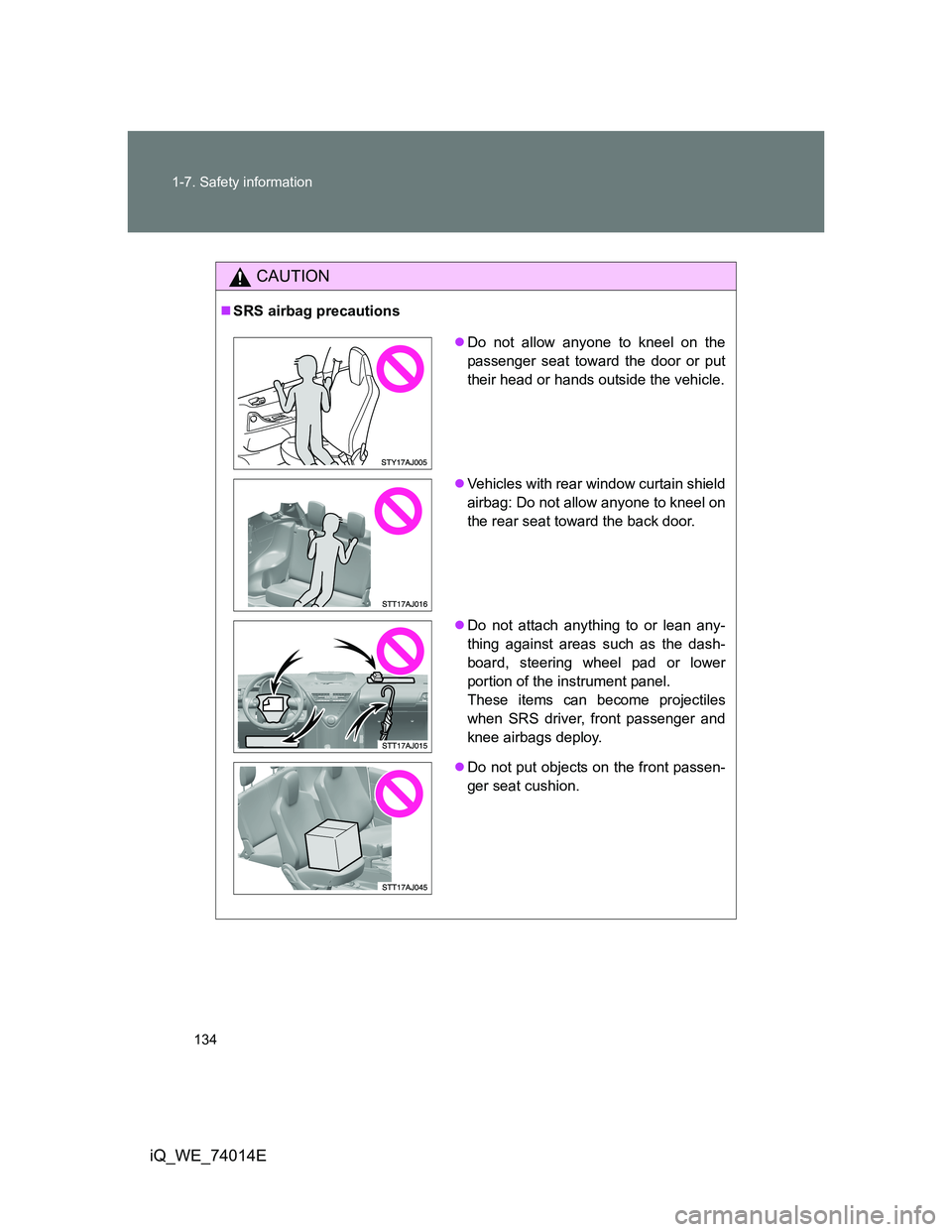
Do not allow anyone to kneel on the
passenger seat toward the door or put
their head or hands outside the vehicle.
Vehicles with rear window curtain shield
airbag: Do not allow anyone to kneel on
the rear seat toward the back door.
Do not attach anything to or lean any-
thing against areas such as the dash-
board, steering wheel pad or lower
portion of the instrument panel.
These items can become projectiles
when SRS driver, front passenger and
knee airbags deploy.
Do not put objects on the front passen-
ger seat cushion.
Page 136 of 476
136 1-7. Safety information
iQ_WE_74014E
CAUTION
SRS airbag precautions
Vehicles without curtain shield airbags: If the areas where the SRS airbags
are stored, such as the steering wheel pad are damaged or cracked, have
them replaced by any authorized Toyota dealer or repairer, or another duly
qualified and equipped professional.
Vehicles with curtain shield airbags: If the areas where the SRS airbags
are stored, such as the steering wheel pad and front and rear pillar
garnishes, are damaged or cracked, have them replaced by any
authorized Toyota dealer or repairer, or another duly qualified and
equipped professional.
Modification and disposal of SRS airbag system components
Do not dispose of your vehicle or perform any of the following modifications
without consulting any authorized Toyota dealer or repairer, or another duly
qualified and equipped professional.
The SRS airbags may malfunction or deploy (inflate) accidentally, causing
death or serious injury.
Installation, removal, disassembly and repair of the SRS airbags.
Repairs, modifications, removal or replacement of the steering wheel,
instrument panel, dashboard, seats or seat upholstery, roof headlining,
front, side and rear pillars, or roof side rail.
Vehicles without curtain shield airbags: Repairs or modifications of the
front fender, front bumper, or side of the occupant compartment.
Vehicles with curtain shield airbags: Repairs or modifications of the front
fender, front and rear bumper, or side and rear of the occupant compart-
ment.
Installation of snow plows, winches, etc. to the front grille (bull bars, kan-
garoo bar etc.).
Vehicles with curtain shield airbags: Installation of racks etc. to the back
door (strap racks, bicycle rack etc.).
Modifications to the vehicle’s suspension system.
Installation of electronic devices such as an RF-transmitter or CD players.
Page 157 of 476
157 1-7. Safety information
1
Before driving
iQ_WE_74014E
CAUTION
When installing a child restraint system
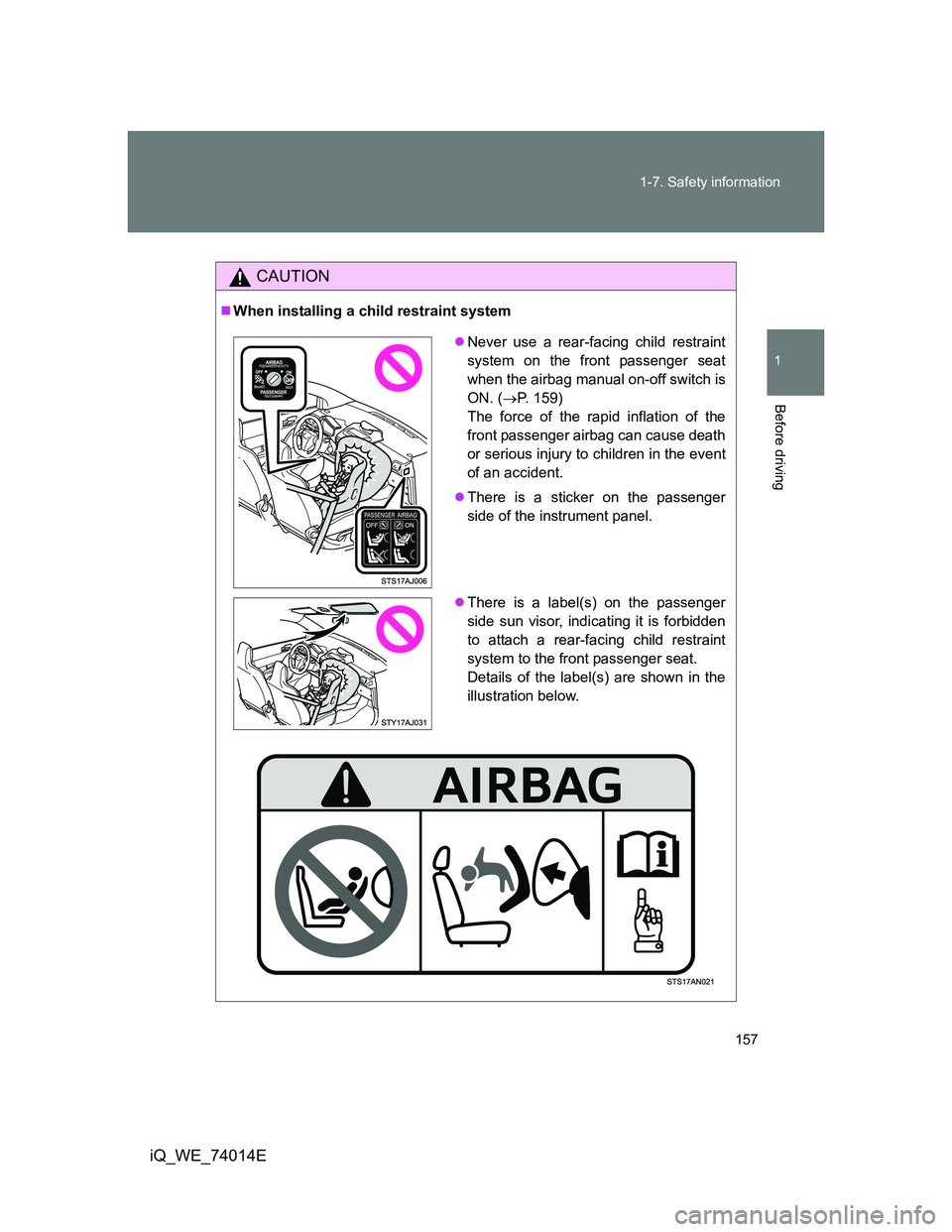
Never use a rear-facing child restraint
system on the front passenger seat
when the airbag manual on-off switch is
ON. (P. 159)
The force of the rapid inflation of the
front passenger airbag can cause death
or serious injury to children in the event
of an accident.
There is a sticker on the passenger
side of the instrument panel.
There is a label(s) on the passenger
side sun visor, indicating it is forbidden
to attach a rear-facing child restraint
system to the front passenger seat.
Details of the label(s) are shown in the
illustration below.
Page 199 of 476
199
2-2. Instrument cluster
2
When driving
iQ_WE_74014E
Indicators and warning lights
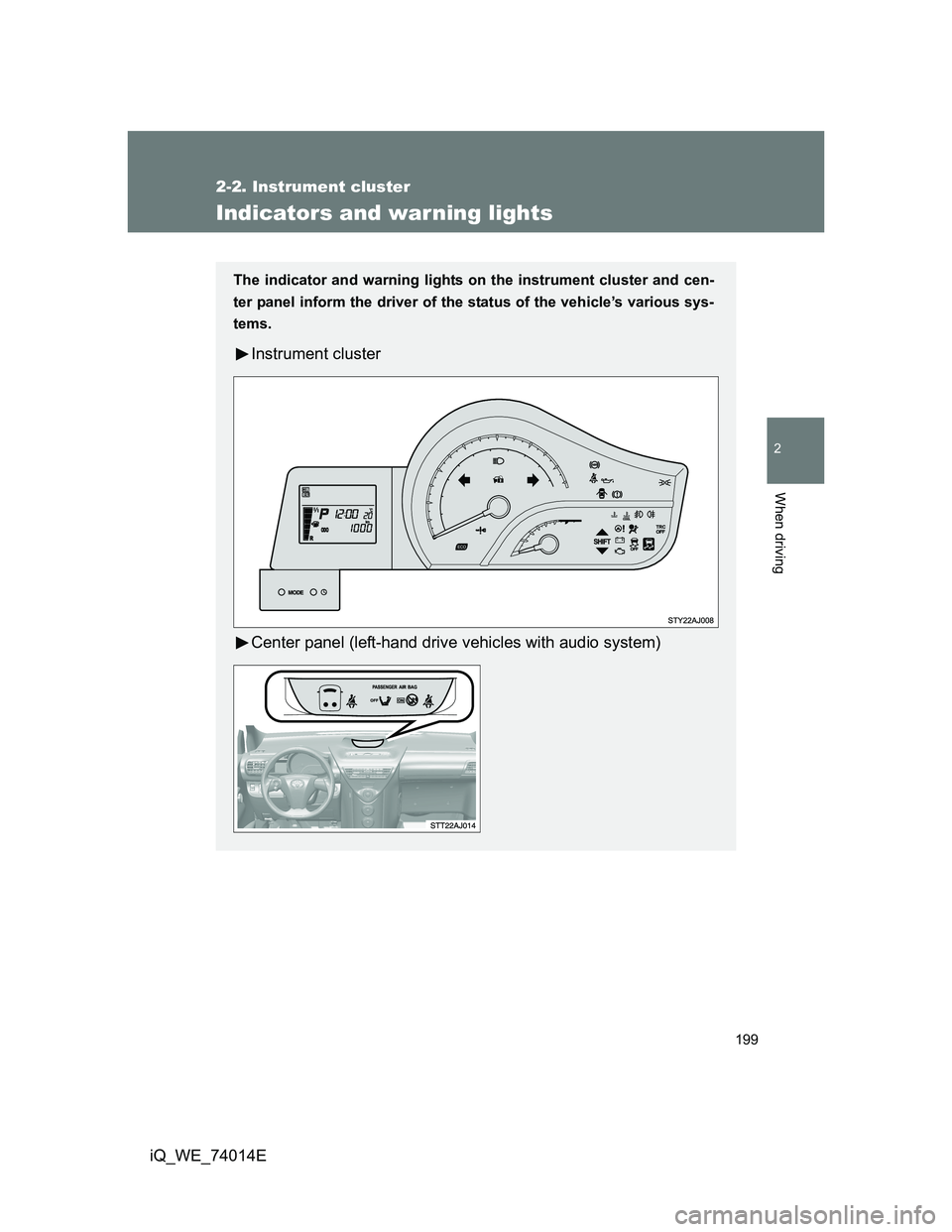
The indicator and warning lights on the instrument cluster and cen-
ter panel inform the driver of the status of the vehicle’s various sys-
tems.
Instrument cluster
Center panel (left-hand drive vehicles with audio system)
Page 200 of 476
200 2-2. Instrument cluster
iQ_WE_74014E
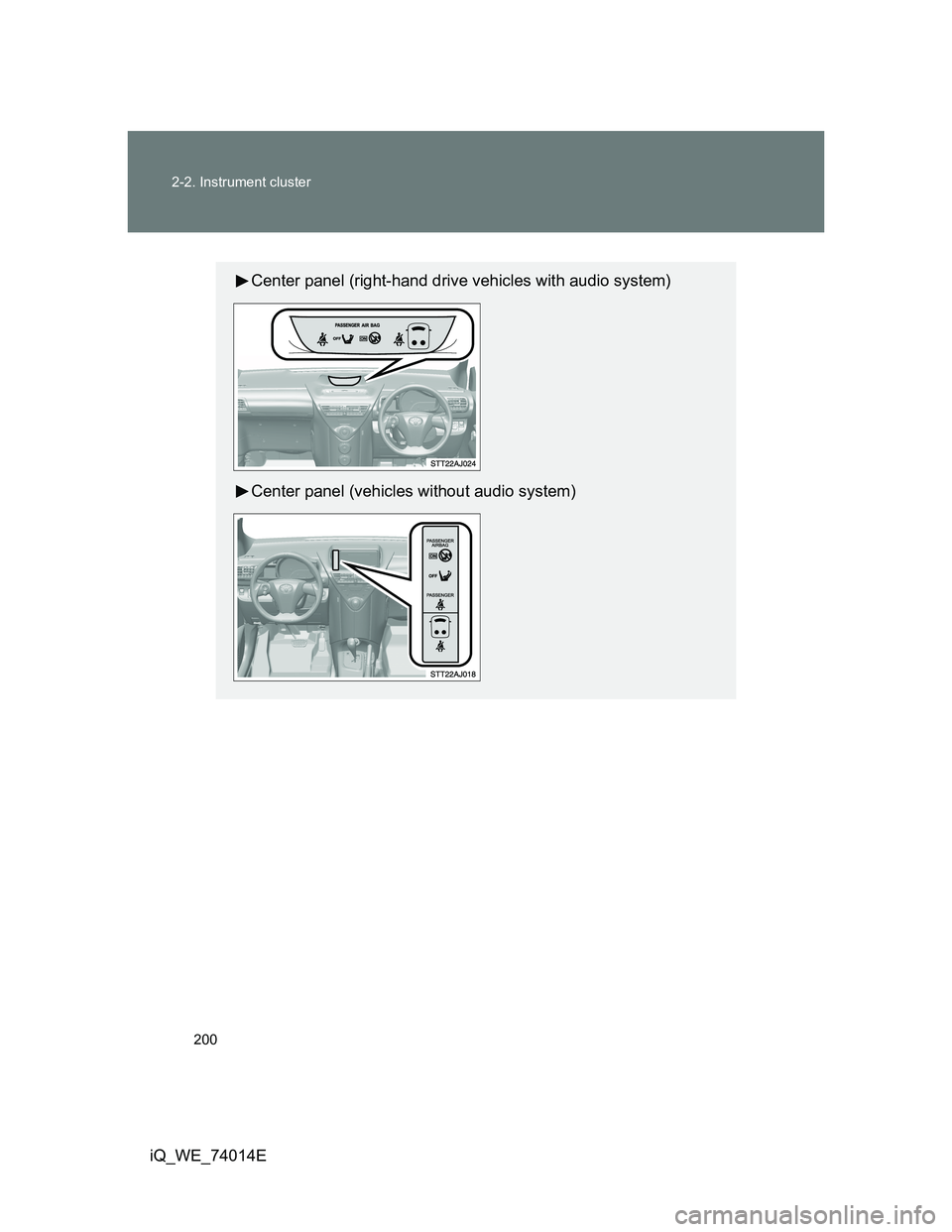
Center panel (right-hand drive vehicles with audio system)
Center panel (vehicles without audio system)
Page 207 of 476
207 2-2. Instrument cluster
2
When driving
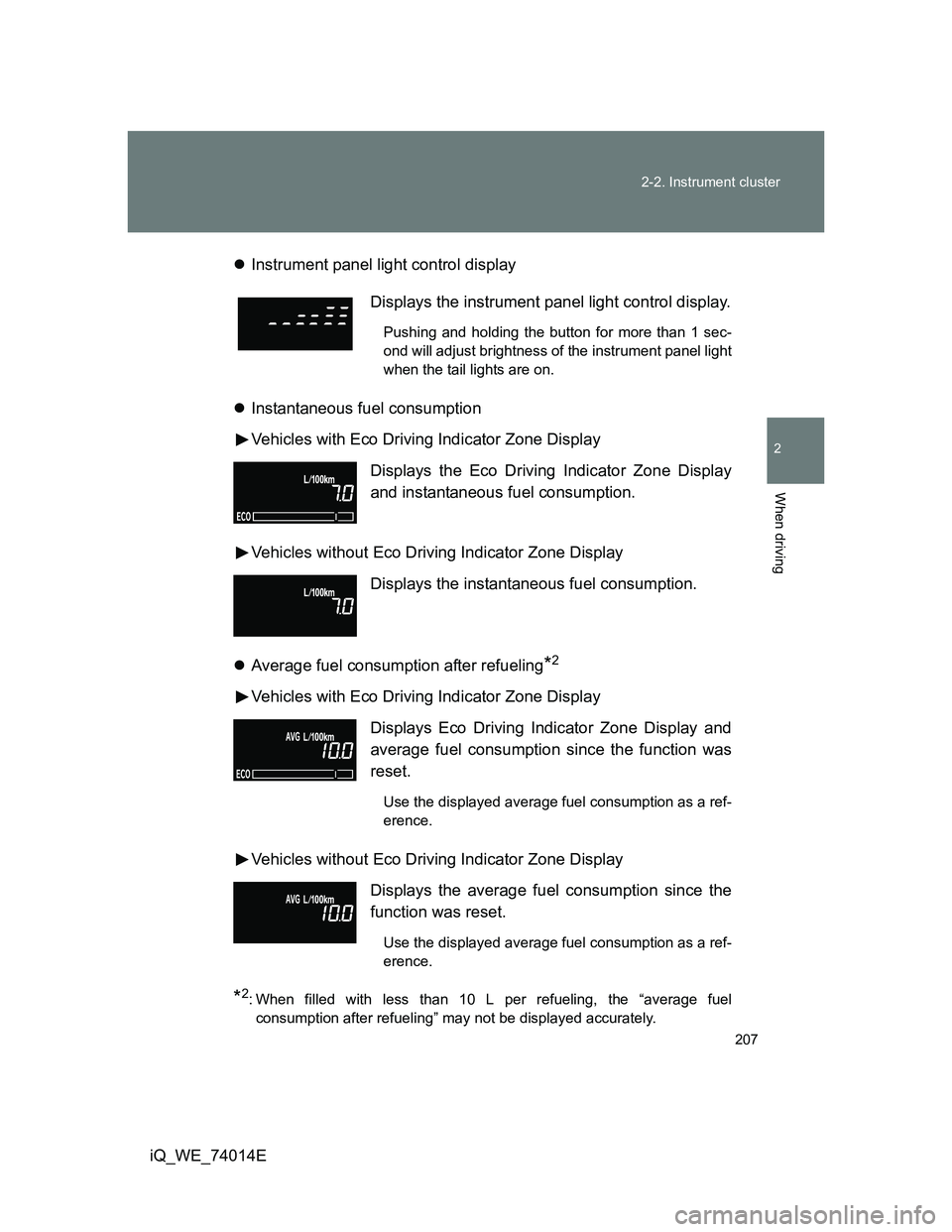
iQ_WE_74014EInstrument panel light control display
Instantaneous fuel consumption
Vehicles with Eco Driving Indicator Zone Display
Vehicles without Eco Driving Indicator Zone Display
Average fuel consumption after refueling
*2
Vehicles with Eco Driving Indicator Zone Display
Vehicles without Eco Driving Indicator Zone Display
*2: When filled with less than 10 L per refueling, the “average fuel
consumption after refueling” may not be displayed accurately.
Displays the instrument panel light control display.
Pushing and holding the button for more than 1 sec-
ond will adjust brightness of the instrument panel light
when the tail lights are on.
Displays the Eco Driving Indicator Zone Display
and instantaneous fuel consumption.
Displays the instantaneous fuel consumption.
Displays Eco Driving Indicator Zone Display and
average fuel consumption since the function was
reset.
Use the displayed average fuel consumption as a ref-
erence.
Displays the average fuel consumption since the
function was reset.
Use the displayed average fuel consumption as a ref-
erence.
Page 211 of 476
211
2
When driving
iQ_WE_74014E
2-3. Operating the lights and wipers
Headlight switch
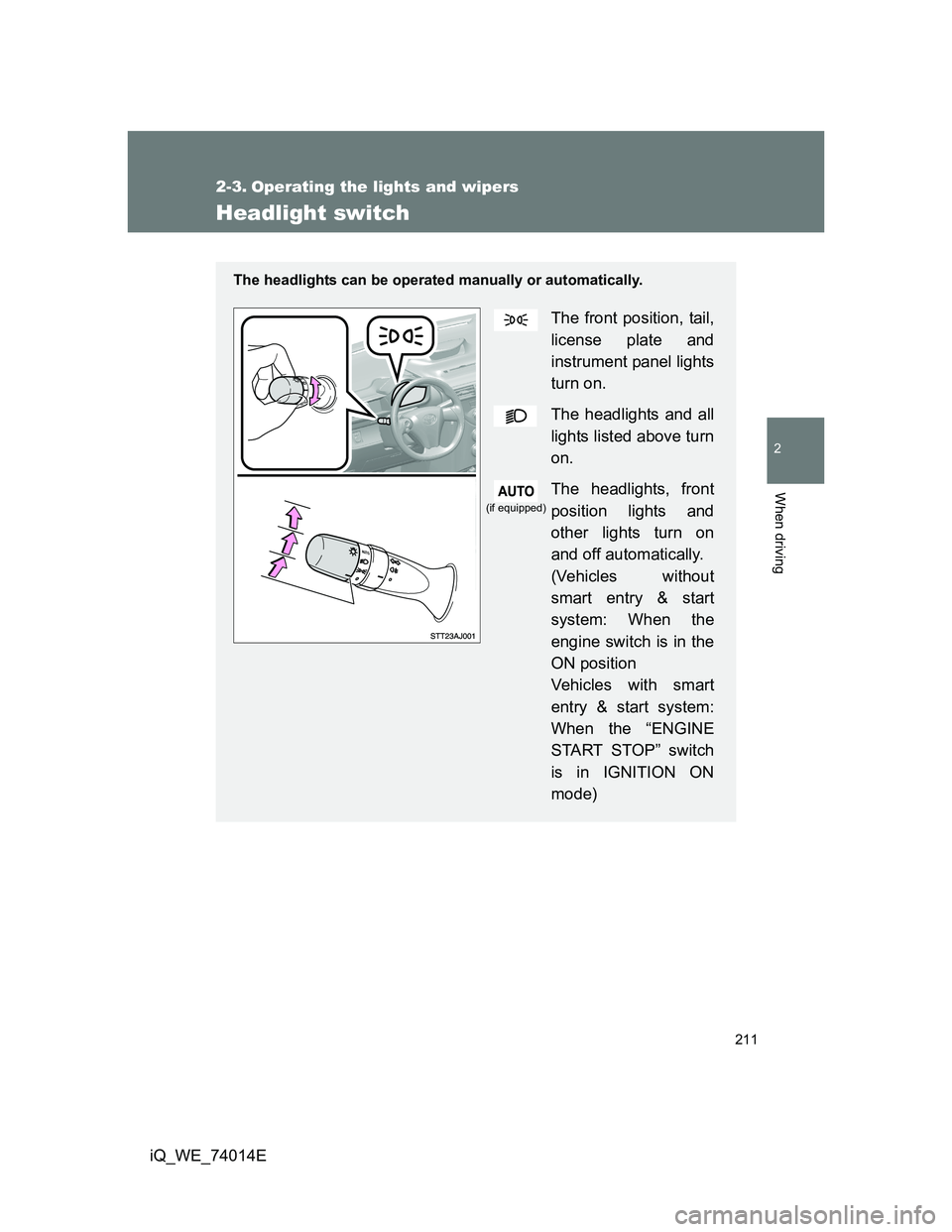
The headlights can be operated manually or automatically.
The front position, tail,
license plate and
instrument panel lights
turn on.
The headlights and all
lights listed above turn
on.
The headlights, front
position lights and
other lights turn on
and off automatically.
(Vehicles without
smart entry & start
system: When the
engine switch is in the
ON position
Vehicles with smart
entry & start system:
When the “ENGINE
START STOP” switch
is in IGNITION ON
mode)
(if equipped)
Page 229 of 476
229
2
When driving
iQ_WE_74014E
2-5. Driving information
Cargo and luggage
CAUTION
Things that must not be carried in the luggage compartment
The following things may cause a fire if loaded in the luggage compartment.
Receptacles containing gasoline
Aerosol cans
Storage precautions
Observe the following precautions.
Failing to do so may result in death or serious injury.
Do not place cargo or luggage in or on the following locations as the item
may get under the brake or accelerator pedal and prevent the pedals from
being depressed properly, block the driver’s vision, or hit the driver or pas-
sengers, causing an accident.
• Driver’s feet
• Front passenger or rear seats (when stacking items)
• Instrument panel
• Dashboard
• Auxiliary box or tray that has no lid
Do not stack anything in the luggage compartment higher than the seat-
backs.
Such items may be thrown about and possibly injure people in the vehicle
during sudden braking or in an accident.
Take notice of the following information about storage precautions,
cargo capacity and load.
Stow cargo and luggage in the luggage compartment whenever
possible.
Be sure all items are secured in place.
Be careful to keep the vehicle level. Placing the weight as far for-
ward as possible helps maintain vehicle balance.
For better fuel economy, do not carry unnecessary weight.
Page 311 of 476
311 4-1. Maintenance and care
4
Maintenance and care
iQ_WE_74014E
Caring for leather areas
Toyota recommends cleaning the interior of the vehicle at least twice a year
to maintain the quality of the vehicle’s interior.
Shampooing the carpets
There are several commercial foaming-type cleaners available. Use a
sponge or brush to apply the foam. Rub in overlapping circles. Do not apply
water. Excellent results are obtained when keeping the carpet as dry as pos-
sible.
Seat belts
Clean with mild soap and lukewarm water using a cloth or sponge. Also
check the belts periodically for excessive wear, fraying or cuts.
CAUTION
Water in the vehicle
Do not splash or spill liquid in the vehicle. Doing so may cause the electri-
cal components etc. to malfunction or catch fire.
Do not get any of the SRS components or wiring in the vehicle interior wet.
(P. 125)
Electrical malfunction may cause the airbags to deploy or not function
properly, resulting in death or severe injury.
Cleaning the interior (especially instrument panel)
Do not use polish wax or polish cleaner. The instrument panel may reflect off
the windshield, obstructing the driver’s view and leading to an accident,
resulting in death or serious injury.