ignition TOYOTA IQ 2012 Owner's Manual
[x] Cancel search | Manufacturer: TOYOTA, Model Year: 2012, Model line: IQ, Model: TOYOTA IQ 2012Pages: 476, PDF Size: 23.52 MB
Page 211 of 476
211
2
When driving
iQ_WE_74014E
2-3. Operating the lights and wipers
Headlight switch
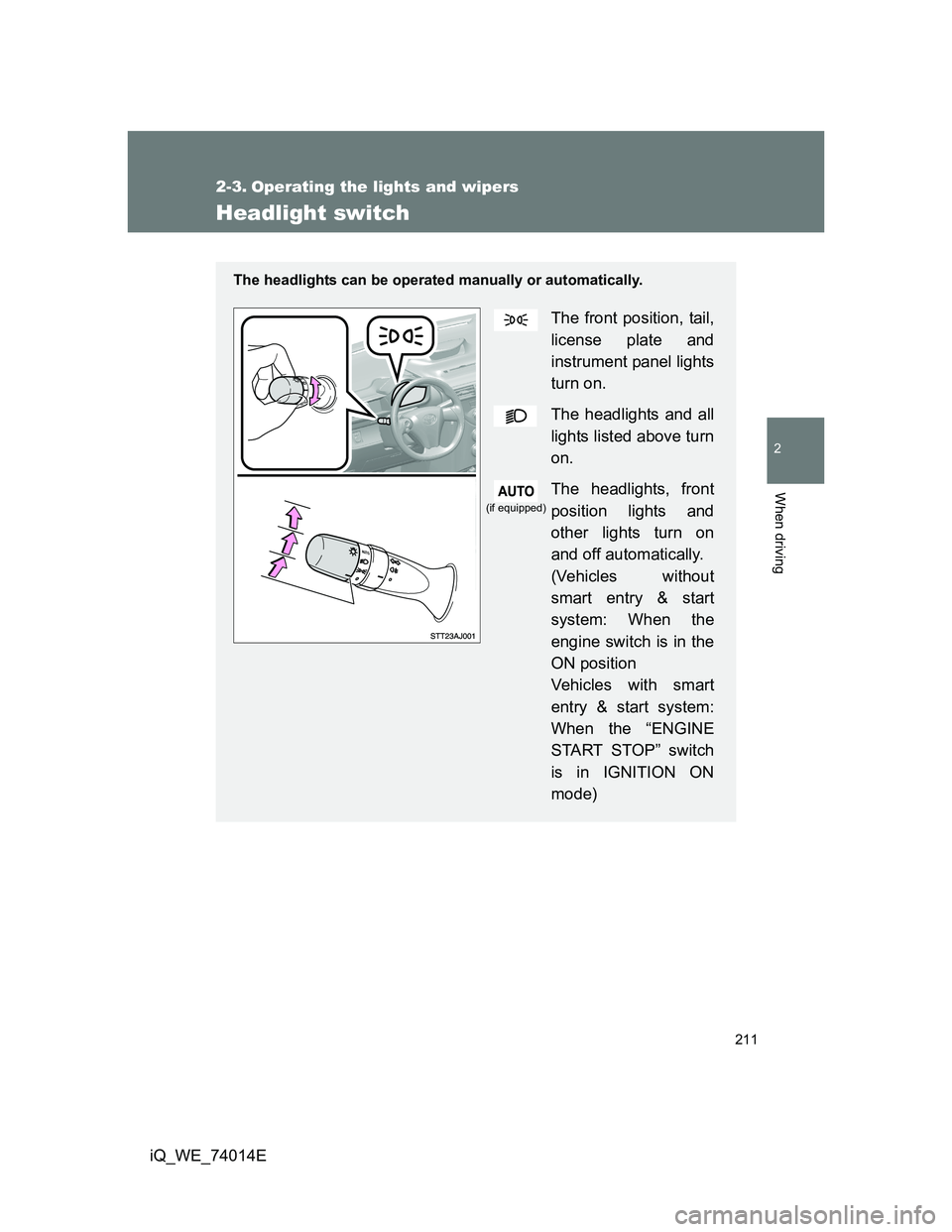
The headlights can be operated manually or automatically.
The front position, tail,
license plate and
instrument panel lights
turn on.
The headlights and all
lights listed above turn
on.
The headlights, front
position lights and
other lights turn on
and off automatically.
(Vehicles without
smart entry & start
system: When the
engine switch is in the
ON position
Vehicles with smart
entry & start system:
When the “ENGINE
START STOP” switch
is in IGNITION ON
mode)
(if equipped)
Page 214 of 476
214 2-3. Operating the lights and wipers
iQ_WE_74014E
Daytime running light system (if equipped)
To make your vehicle more visible to other drivers, the headlights and tail
lights turn on automatically whenever the engine is started. (However, the
daytime running light system will be cancelled when the headlight switch is
operated manually or the automatic headlight system turns on the tail lights.)
Daytime running lights are not designed for use at night.
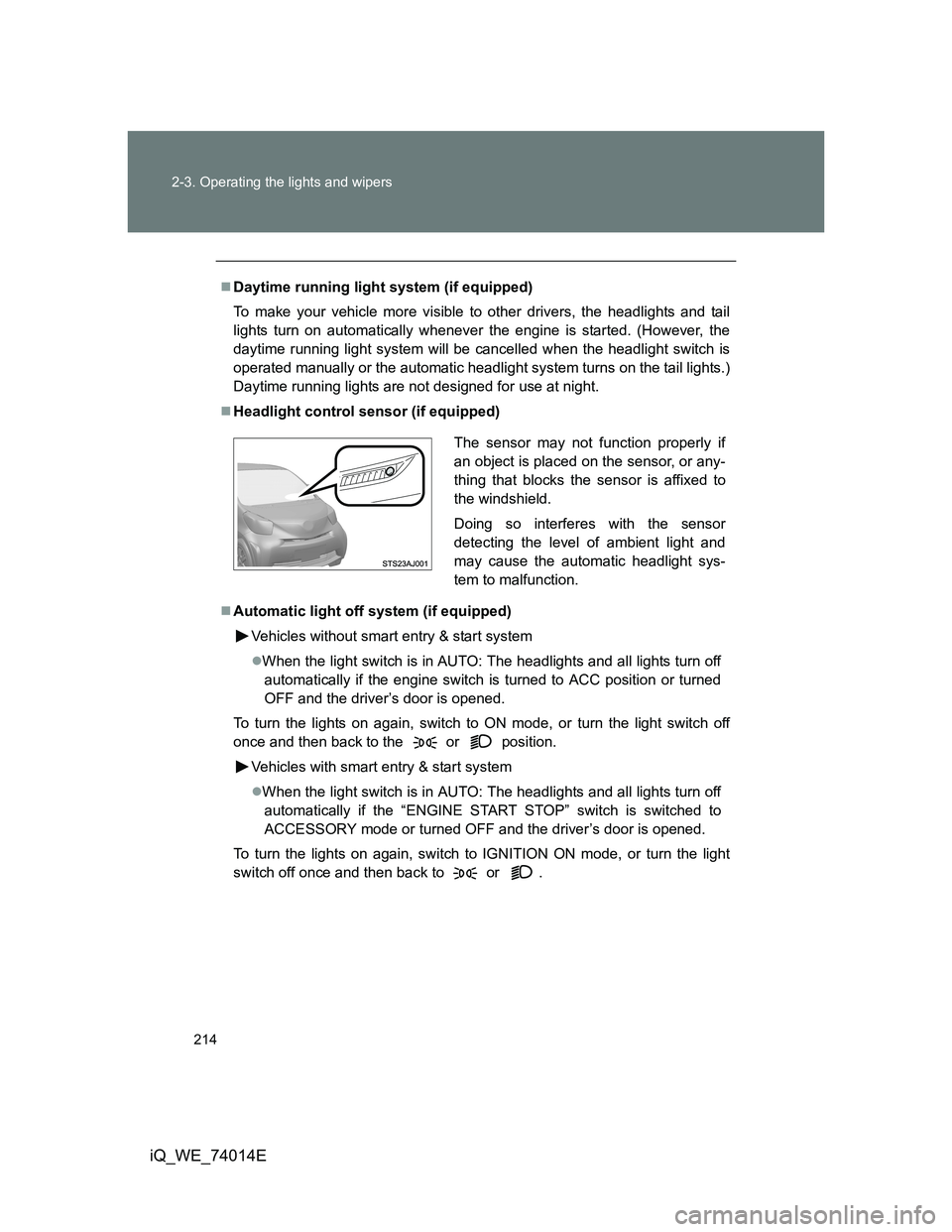
Headlight control sensor (if equipped)
Automatic light off system (if equipped)
Vehicles without smart entry & start system
When the light switch is in
AUTO: The headlights and all lights turn off
automatically if the engine switch is turned to ACC position or turned
OFF and the driver’s door is opened.
To turn the lights on again, switch to ON mode, or turn the light switch off
once and then back to the
or position.
Vehicles with smart entry & start system
When the light switch is in AUTO: The headlights and all lights turn off
automatically if the “ENGINE START STOP” switch is switched to
ACCESSORY mode or turned OFF and the driver’s door is opened.
To turn the lights on again, switch to IGNITION ON mode, or turn the light
switch off once and then back to
or .
The sensor may not function properly if
an object is placed on the sensor, or any-
thing that blocks the sensor is affixed to
the windshield.
Doing so interferes with the sensor
detecting the level of ambient light and
may cause the automatic headlight sys-
tem to malfunction.
Page 220 of 476
220 2-3. Operating the lights and wipers
iQ_WE_74014E
The windshield wiper and washer can be operated when
Vehicles without smart entry & start system
The engine switch is in the ON position.
Vehicles with smart entry & start system
The “ENGINE START STOP” switch is in IGNITION ON mode.
Effects of vehicle speed on wiper operation (vehicles with rain-sensing
windshield wipers)
Even when the wipers are not in AUTO mode, wiper operation varies
depending on vehicle speed when the washer is being used (delay until drop
prevention wiper sweep occurs).
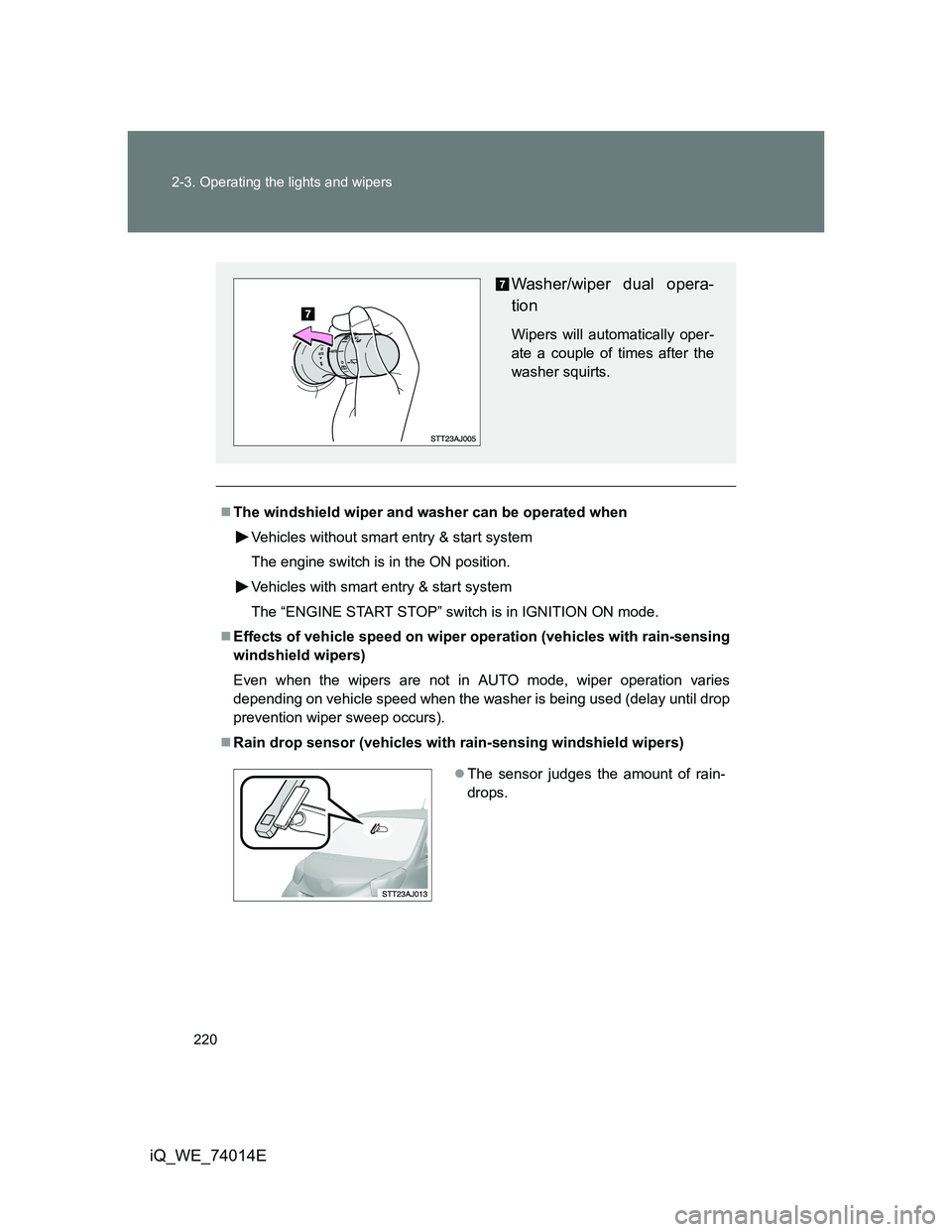
Rain drop sensor (vehicles with rain-sensing windshield wipers)
Washer/wiper dual opera-
tion
Wipers will automatically oper-
ate a couple of times after the
washer squirts.
The sensor judges the amount of rain-
drops.
Page 221 of 476
221 2-3. Operating the lights and wipers
2
When driving
iQ_WE_74014E
Vehicles without smart entry & start system:
If the wiper switch is turned to AUTO position while the engine switch is in
the ON position, the wiper will operate once to show that AUTO mode is
activated.
Vehicles with smart entry & start system:
If the wiper switch is turned to AUTO position while the “ENGINE START
STOP” switch is in IGNITION ON mode, the wiper will operate once to
show that AUTO mode is activated.
If the temperature of the raindrop sensor is 90°C (194°F) or higher, or
-10°C (14°F) or lower, automatic operation may not occur. In this case,
operate the wipers in any mode other than “AUTO”.
If no windshield washer fluid sprays
Check that the washer nozzles are not blocked and that there is washer fluid
in the windshield washer fluid reservoir.
CAUTION
Caution regarding the use of windshield wipers in AUTO mode
(vehicles with rain-sensing windshield wipers)
The windshield wipers may operate unexpectedly if the sensor is touched or
the windshield is subject to vibration in AUTO mode. Take care that your fin-
gers or anything else does not become caught in the windshield wipers.
NOTICE
When the windshield is dry
Do not use the wipers, as they may damage the windshield.
When there is no washer fluid spray from the nozzle
Damage to the washer fluid pump may be caused if the lever is pulled
toward you and held continually.
When a nozzle becomes blocked
Do not try to clear it with a pin or other object. The nozzle will be damaged.
Page 223 of 476
223 2-3. Operating the lights and wipers
2
When driving
iQ_WE_74014E
The rear window wiper and washer can be operated when
Vehicles without smart entry & start system
The engine switch is in the ON position.
Vehicles with smart entry & start system
The “ENGINE START STOP” switch is in IGNITION ON mode.
NOTICE
When the rear window is dry
Do not use the wipers, as they may damage the rear window.
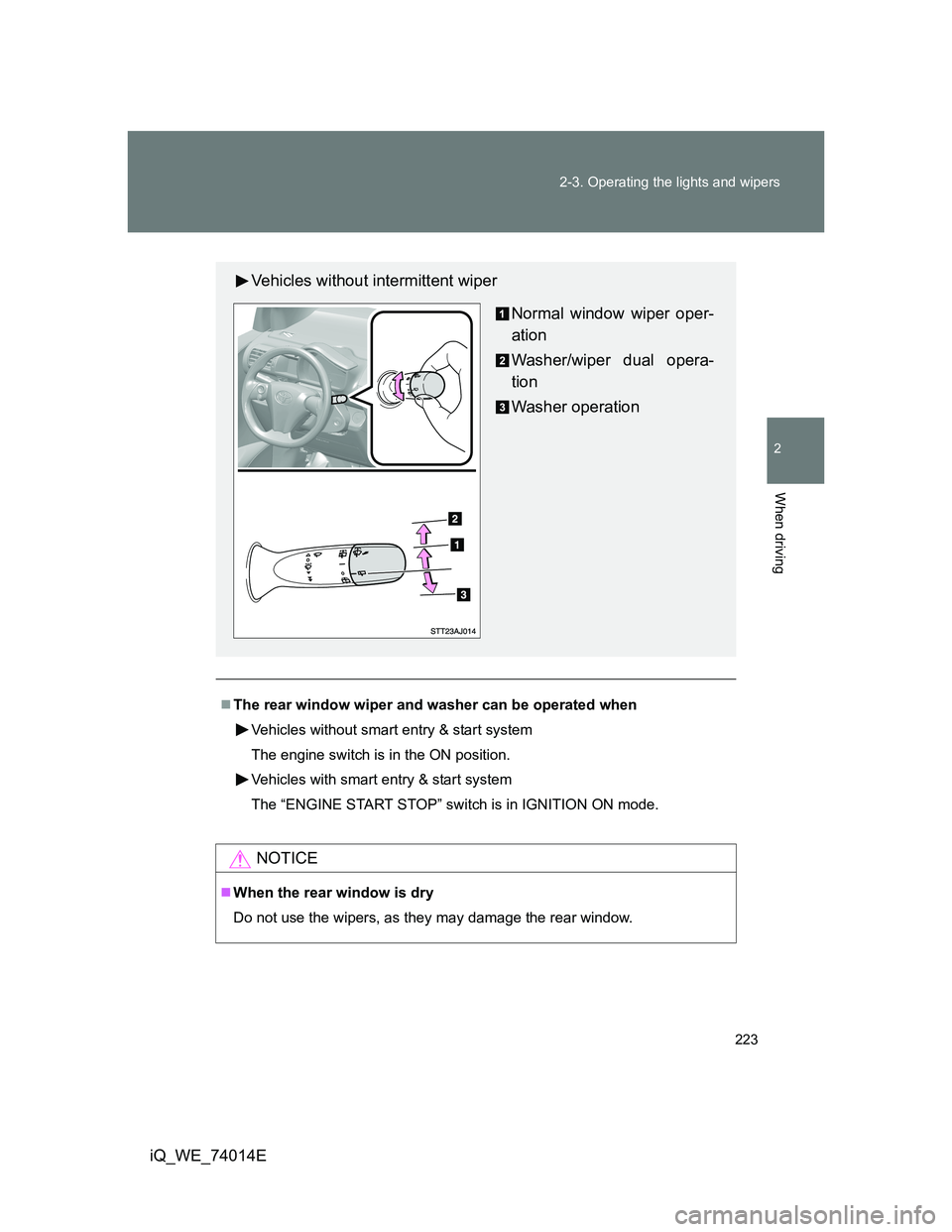
Vehicles without intermittent wiper
Normal window wiper oper-
ation
Washer/wiper dual opera-
tion
Washer operation
Page 253 of 476
253 3-1. Using the air conditioning system and defogger
3
Interior features
iQ_WE_74014E
The rear window defogger can be operated when
Vehicles without smart entry & start system
The engine switch is in the ON position.
Vehicles with smart entry & start system
The “ENGINE START STOP” switch is in IGNITION ON mode.
NOTICE
To prevent battery discharge
Do not leave the rear window defogger on longer than necessary when the
engine is stopped.
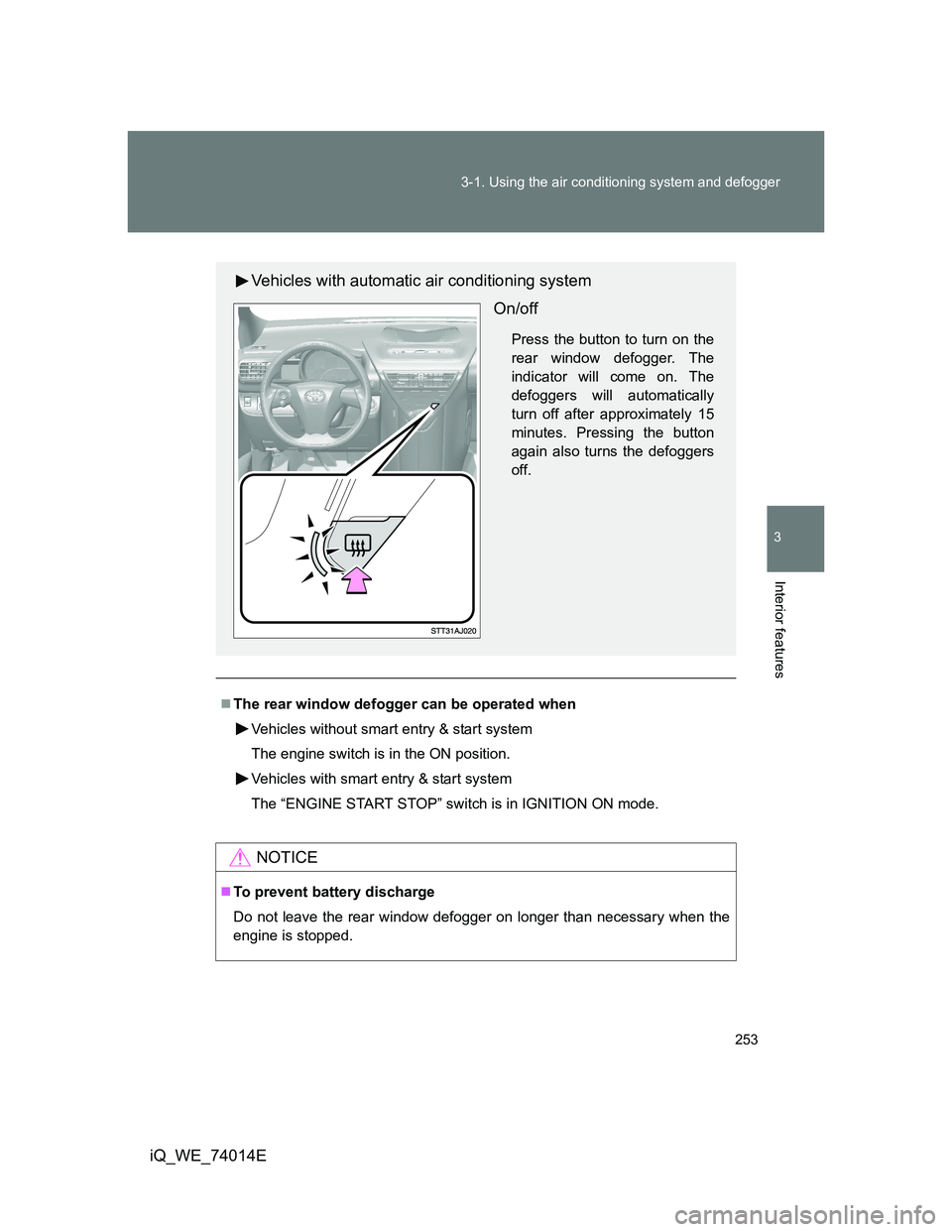
Vehicles with automatic air conditioning system
On/off
Press the button to turn on the
rear window defogger. The
indicator will come on. The
defoggers will automatically
turn off after approximately 15
minutes. Pressing the button
again also turns the defoggers
off.
Page 255 of 476
255 3-1. Using the air conditioning system and defogger
3
Interior features
iQ_WE_74014E
The rear window and outside rear view mirror defoggers can be oper-
ated when
Vehicles without smart entry & start system
The engine switch is in the ON position.
Vehicles with smart entry & start system
The “ENGINE START STOP” switch is in IGNITION ON mode.
CAUTION
When the outside rear view mirror defoggers are on
Do not touch the rear view mirror surfaces, as they can become very hot and
burn you.
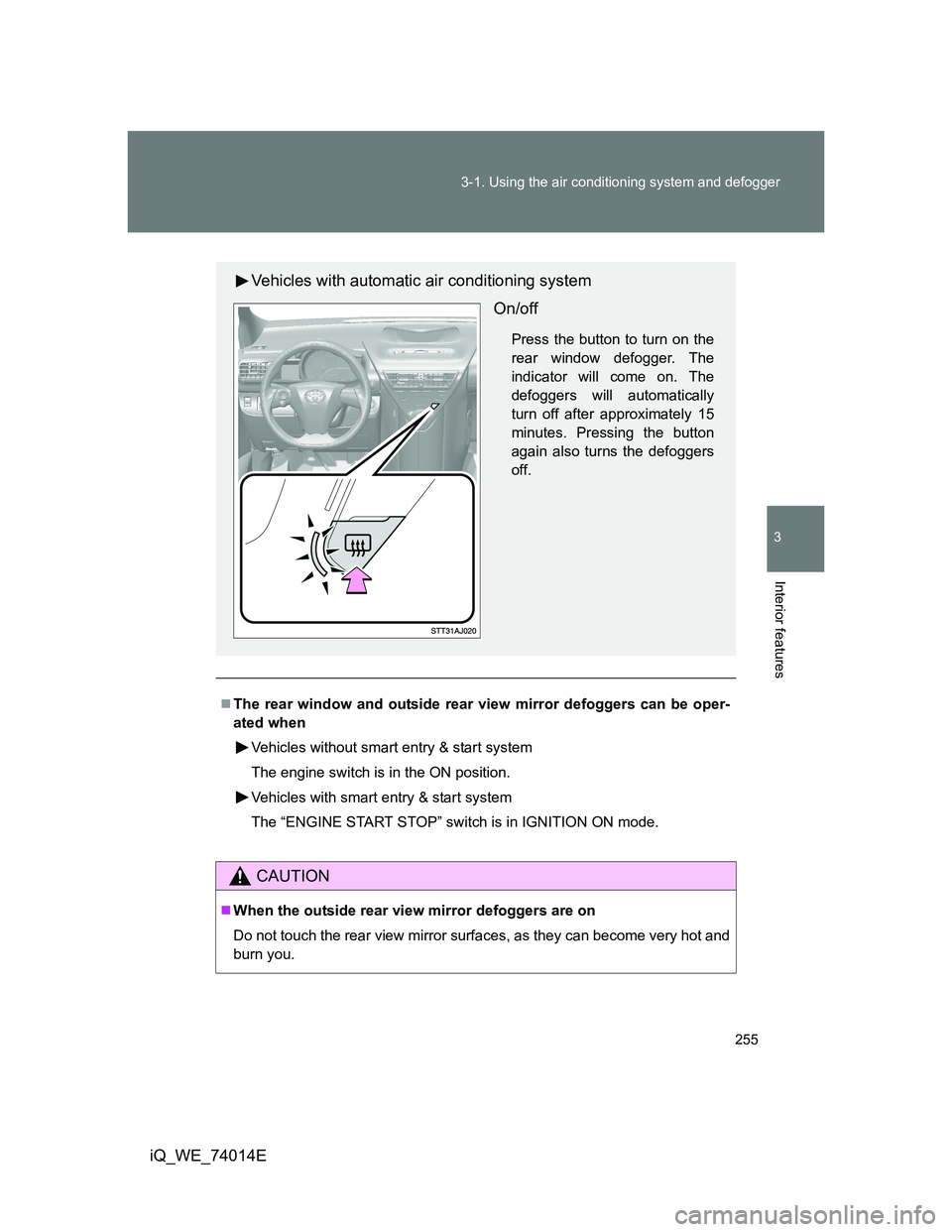
Vehicles with automatic air conditioning system
On/off
Press the button to turn on the
rear window defogger. The
indicator will come on. The
defoggers will automatically
turn off after approximately 15
minutes. Pressing the button
again also turns the defoggers
off.
Page 295 of 476
295
3-5. Other interior features
3
Interior features
iQ_WE_74014E
Power outlet
The power outlet can be used when
Vehicles without smart entry & start system
The engine switch is in the ACC or ON position.
Vehicles with smart entry & start system
The “ENGINE START STOP” switch is in ACCESSORY or IGNITION ON
mode.
NOTICE
To avoid damaging the power outlet
Close the power outlet lid when the power outlet is not in use.
Foreign objects or liquids that enter the power outlet may cause a short cir-
cuit.
To prevent the fuse from being blown
Do not use an accessory that uses more than 12 V 10 A.
To prevent battery discharge
Do not use the power outlet longer than necessary when the engine is not
running.
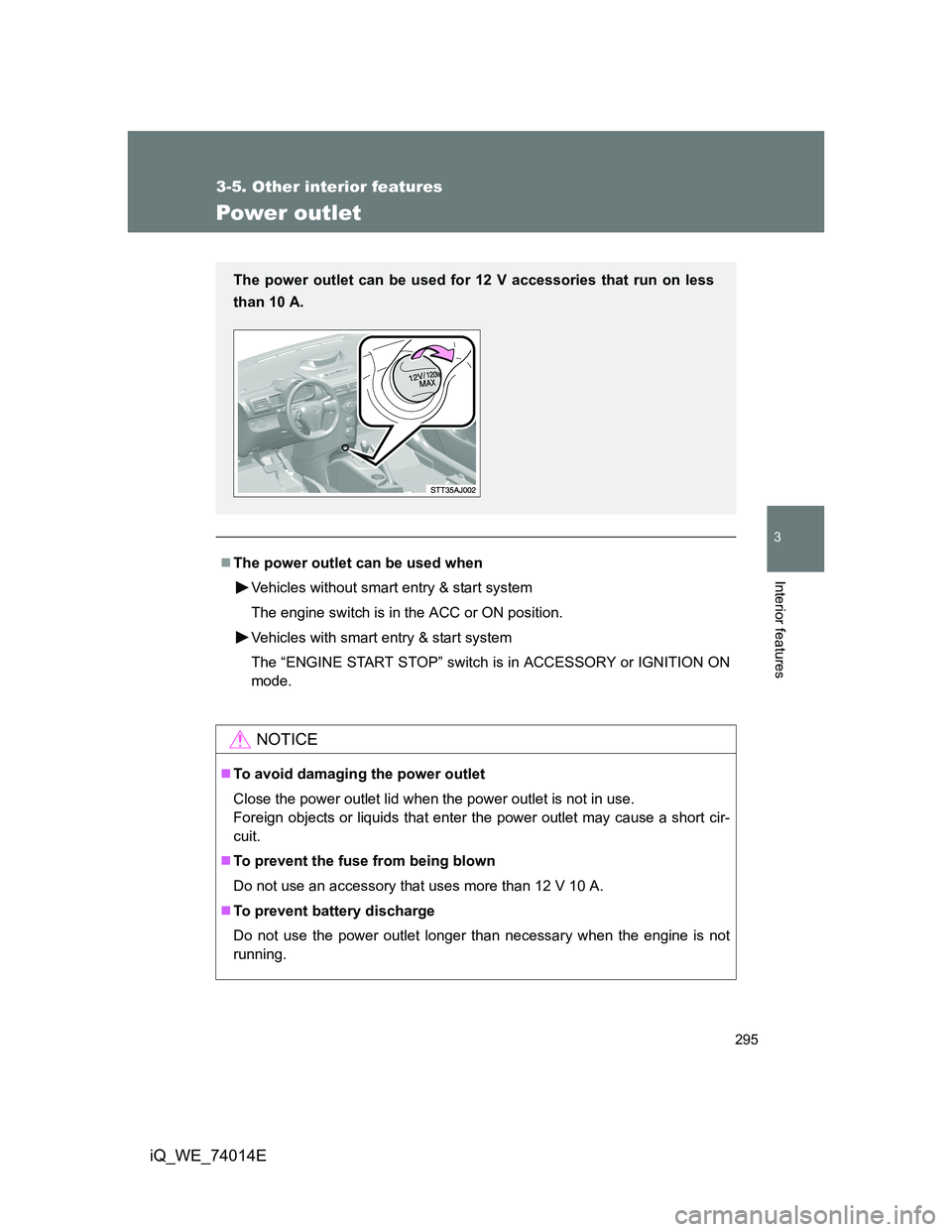
The power outlet can be used for 12 V accessories that run on less
than 10 A.
Page 296 of 476
296
3-5. Other interior features
iQ_WE_74014E
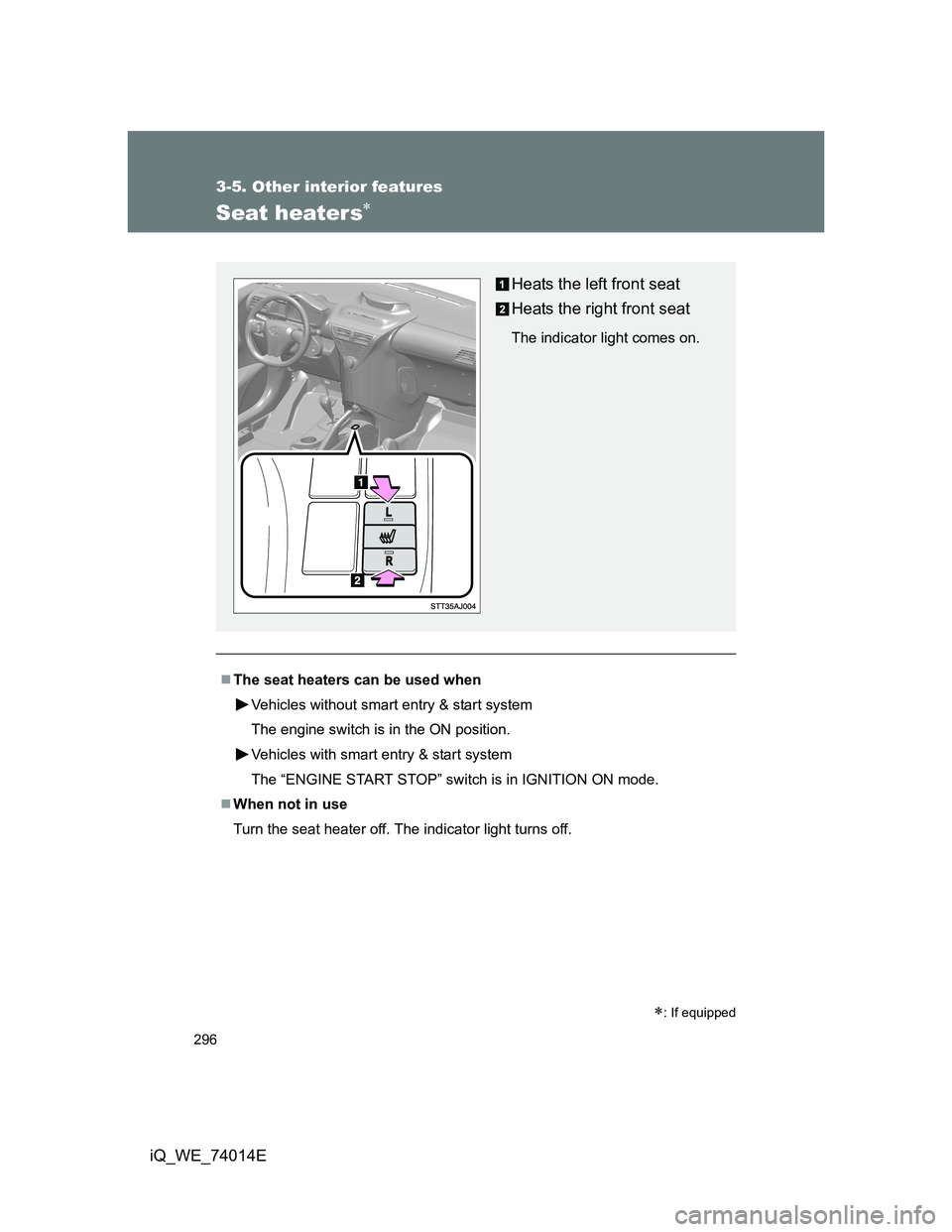
Seat heaters
: If equipped
The seat heaters can be used when
Vehicles without smart entry & start system
The engine switch is in the ON position.
Vehicles with smart entry & start system
The “ENGINE START STOP” switch is in IGNITION ON mode.
When not in use
Turn the seat heater off. The indicator light turns off.
Heats the left front seat
Heats the right front seat
The indicator light comes on.
Page 317 of 476
317 4-3. Do-it-yourself maintenance
4
Maintenance and care
iQ_WE_74014E
CAUTION
The engine compartment contains many mechanisms and fluids that may
move suddenly, become hot, or become electrically energized. To avoid death
or serious injury, observe the following precautions.
When working on the engine compartment
Keep hands, clothing, and tools away from the moving fan and engine
drive belt.
Be careful not to touch the engine, radiator, exhaust manifold, etc. right
after driving as they may be hot. Oil and other fluids may also be hot.
Do not leave anything that may burn easily, such as paper or rags, in the
engine compartment.
Do not smoke, cause sparks or expose an open flame to fuel or the bat-
tery. Fuel and battery fumes are flammable.
Be extremely cautious when working on the battery. It contains poisonous
and corrosive sulfuric acid.
Take care because brake fluid can harm your hands or eyes and damage
painted surfaces.
If fluid gets on your hands or in your eyes, flush the affected area with
clean water immediately.
If you still experience discomfort, see a doctor.
When working near the electric cooling fan or radiator grille
Vehicles without smart entry & start system:
Be sure the engine switch is in the LOCK position.
With the engine switch in the ON position, the electric cooling fan may
automatically start to run if the air conditioning system is on and/or the
coolant temperature is high. (P. 342)
Vehicles with smart entry & start system:
Be sure the “ENGINE START STOP” switch is in the OFF.
With the “ENGINE START STOP” switch in the IGNITION ON mode, the
electric cooling fan may automatically start to run if the air conditioning
system is on and/or the coolant temperature is high. (P. 342)
Safety glasses
Wear safety glasses to prevent flying or falling material, fluid spray, etc. from
getting in the eyes.