tow TOYOTA IQ 2012 Owner's Manual
[x] Cancel search | Manufacturer: TOYOTA, Model Year: 2012, Model line: IQ, Model: TOYOTA IQ 2012Pages: 476, PDF Size: 23.52 MB
Page 385 of 476
5When trouble arises
385
iQ_WE_74014E
5-1. Essential information
Emergency flashers .......... 386
If your vehicle needs
to be towed ..................... 388
If you think something
is wrong .......................... 395
Fuel pump shut off
system ............................ 3965-2. Steps to take
in an emergency
If a warning light turns on
or a warning buzzer
sounds... ......................... 397
If you have a flat tire ......... 405
If the engine will
not start........................... 423
If the shift lever cannot
be shifted from P
(vehicles with
a Multidrive) .................... 425
If you lose your keys ......... 426
If the electronic key does
not operate properly
(vehicles with smart
entry & start system)....... 427
If the vehicle battery is
discharged ...................... 430
If your vehicle
overheats ........................ 435
If the vehicle becomes
stuck ............................... 438
If your vehicle has
to be stopped
in an emergency ............. 440
Page 388 of 476
388
5-1. Essential information
iQ_WE_74014E
If your vehicle needs to be towed
Before towing
The following may indicate a problem with your transmission. Contact
any authorized Toyota dealer or repairer, or another duly qualified
and equipped professional, before towing.
The engine is running, but the vehicle will not move.
The vehicle makes an abnormal sound.
If towing is necessary, we recommend having your vehicle towed by
any authorized Toyota dealer or repairer, or another duly qualified
and equipped professional, such as or a commercial towing service,
using a lift-type truck or a flat bed truck.
Use a safety chain system for all towing, and abide by all state/pro-
vincial and local laws.
If towing from the front, the vehicle’s rear wheels and axles must be
in good condition. (P. 392)
If they are damaged, use a towing dolly or flat bed truck.
Page 389 of 476
5
389 5-1. Essential information
When trouble arises
iQ_WE_74014E
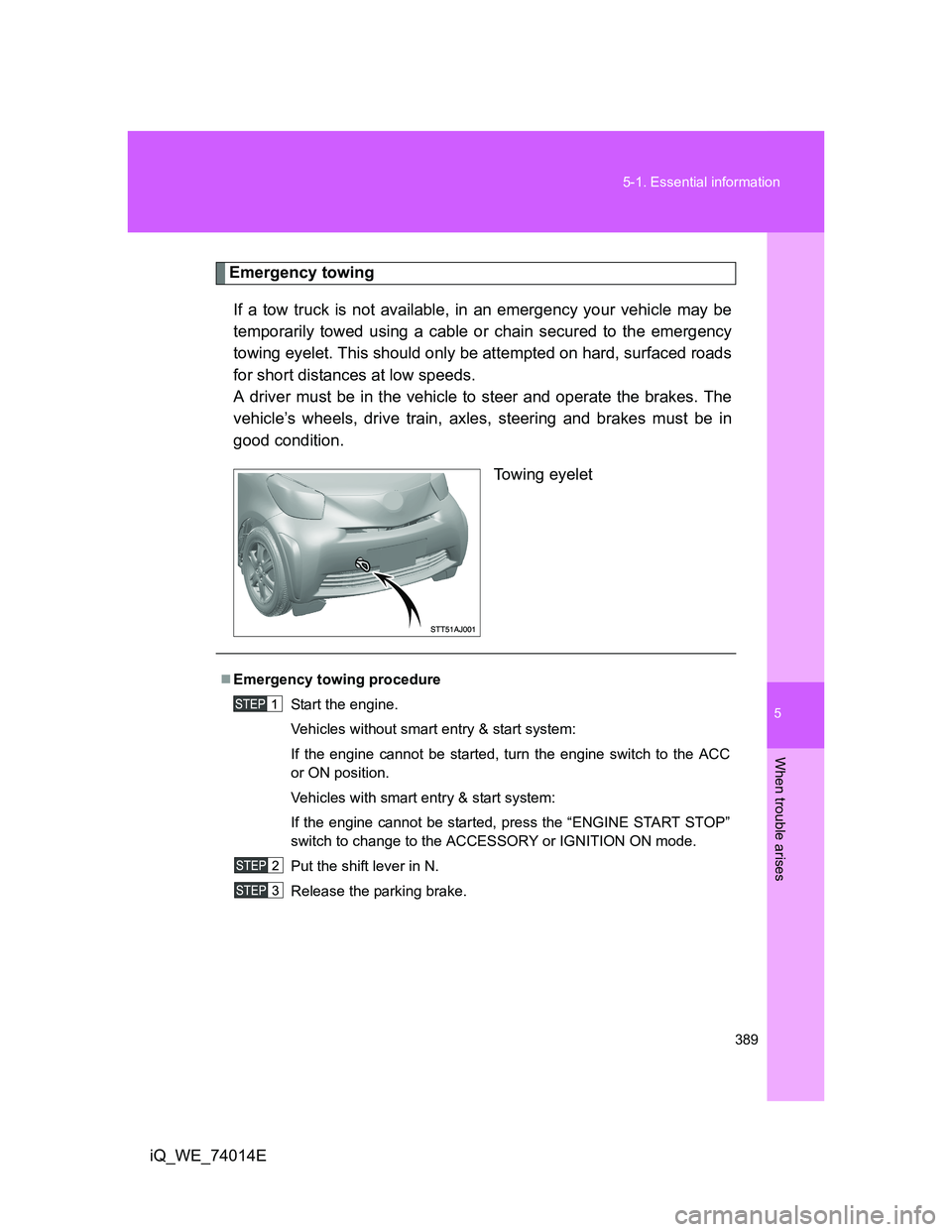
Emergency towing
If a tow truck is not available, in an emergency your vehicle may be
temporarily towed using a cable or chain secured to the emergency
towing eyelet. This should only be attempted on hard, surfaced roads
for short distances at low speeds.
A driver must be in the vehicle to steer and operate the brakes. The
vehicle’s wheels, drive train, axles, steering and brakes must be in
good condition.
Towing eyelet
Emergency towing procedure
Start the engine.
Vehicles without smart entry & start system:
If the engine cannot be started, turn the engine switch to the ACC
or ON position.
Vehicles with smart entry & start system:
If the engine cannot be started, press the “ENGINE START STOP”
switch to change to the ACCESSORY or IGNITION ON mode.
Put the shift lever in N.
Release the parking brake.
Page 390 of 476
390 5-1. Essential information
iQ_WE_74014E
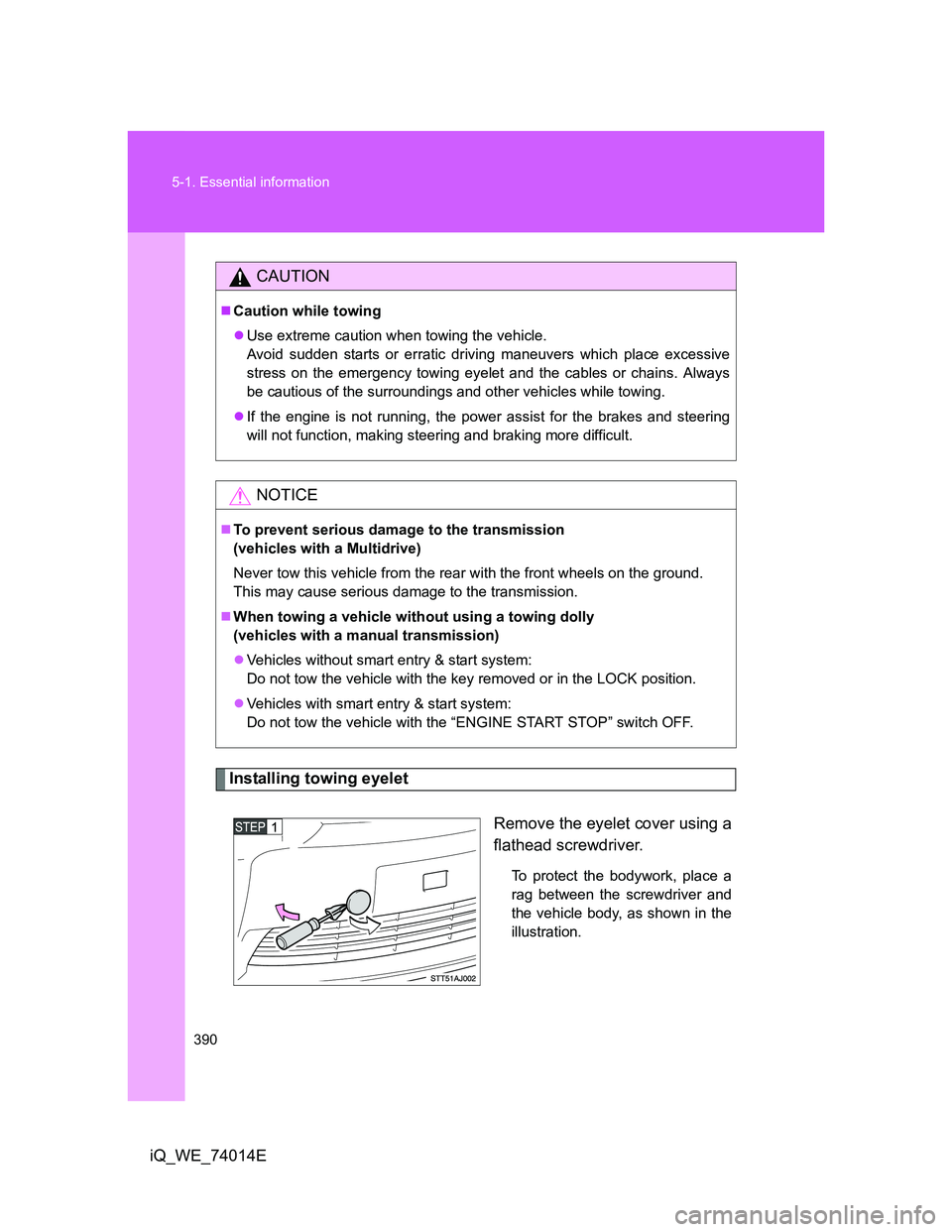
Installing towing eyelet
Remove the eyelet cover using a
flathead screwdriver.
To protect the bodywork, place a
rag between the screwdriver and
the vehicle body, as shown in the
illustration.
CAUTION
Caution while towing
Use extreme caution when towing the vehicle.
Avoid sudden starts or erratic driving maneuvers which place excessive
stress on the emergency towing eyelet and the cables or chains. Always
be cautious of the surroundings and other vehicles while towing.
If the engine is not running, the power assist for the brakes and steering
will not function, making steering and braking more difficult.
NOTICE
To prevent serious damage to the transmission
(vehicles with a Multidrive)
Never tow this vehicle from the rear with the front wheels on the ground.
This may cause serious damage to the transmission.
When towing a vehicle without using a towing dolly
(vehicles with a manual transmission)
Vehicles without smart entry & start system:
Do not tow the vehicle with the key removed or in the LOCK position.
Vehicles with smart entry & start system:
Do not tow the vehicle with the “ENGINE START STOP” switch OFF.
Page 391 of 476

5
391 5-1. Essential information
When trouble arises
iQ_WE_74014EInsert the towing eyelet into the
hole and tighten partially by
hand.
Tighten down the towing eyelet
securely using a wheel nut
wrench.
Location of the emergency towing eyelet
P. 324
CAUTION
Installing towing eyelet to the vehicle
Make sure that the towing eyelet is installed securely.
If not securely installed, towing eyelet may come loose during towing. This
may lead to accidents that cause serious injury or even death.
Page 392 of 476
392 5-1. Essential information
iQ_WE_74014E
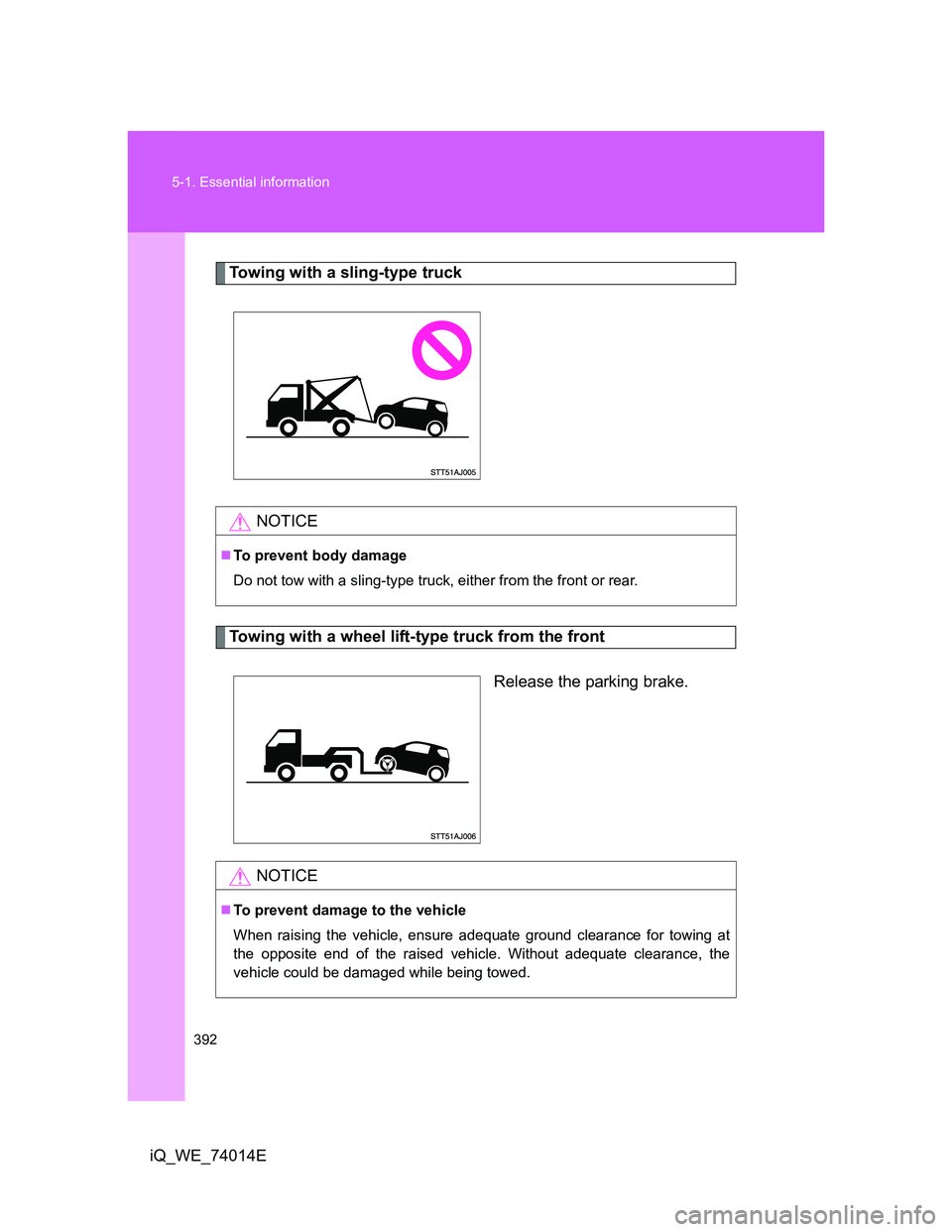
Towing with a sling-type truck
Towing with a wheel lift-type truck from the front
Release the parking brake.
NOTICE
To prevent body damage
Do not tow with a sling-type truck, either from the front or rear.
NOTICE
To prevent damage to the vehicle
When raising the vehicle, ensure adequate ground clearance for towing at
the opposite end of the raised vehicle. Without adequate clearance, the
vehicle could be damaged while being towed.
Page 393 of 476

5
393 5-1. Essential information
When trouble arises
iQ_WE_74014E
Towing with a wheel lift-type truck from the rear
Vehicles with a Multidrive: Use a
towing dolly under the front
wheels.
Vehicles with a manual transmis-
sion: We recommend the use of
a towing dolly under the front
wheels.
Vehicles without smart entry &
start system: When not using a
towing dolly, turn the engine
switch to the ACC position and
shift the shift lever to N.
Vehicles with smart entry & start
system: When not using a towing
dolly, turn the “ENGINE START
STOP” switch to the ACCES-
SORY or IGNITION ON mode
and shift the shift lever to N.
NOTICE
To prevent serious damage to the transmission
(vehicles with a Multidrive)
Never tow this vehicle from the rear with the front wheels on the ground.
Page 394 of 476
394 5-1. Essential information
iQ_WE_74014E
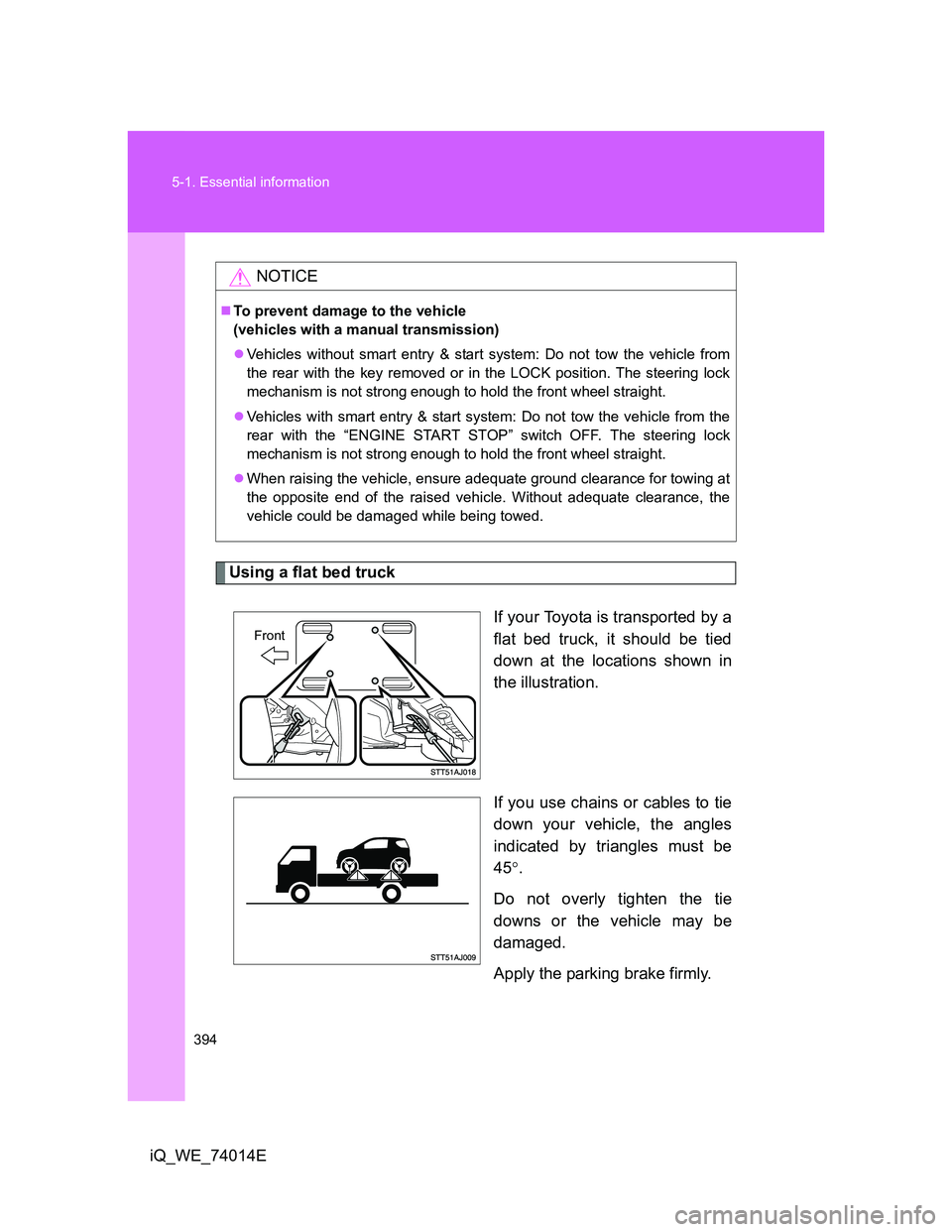
Using a flat bed truck
If your Toyota is transported by a
flat bed truck, it should be tied
down at the locations shown in
the illustration.
If you use chains or cables to tie
down your vehicle, the angles
indicated by triangles must be
45.
Do not overly tighten the tie
downs or the vehicle may be
damaged.
Apply the parking brake firmly.
NOTICE
To prevent damage to the vehicle
(vehicles with a manual transmission)
Vehicles without smart entry & start system: Do not tow the vehicle from
the rear with the key removed or in the LOCK position. The steering lock
mechanism is not strong enough to hold the front wheel straight.
Vehicles with smart entry & start system: Do not tow the vehicle from the
rear with the “ENGINE START STOP” switch OFF. The steering lock
mechanism is not strong enough to hold the front wheel straight.
When raising the vehicle, ensure adequate ground clearance for towing at
the opposite end of the raised vehicle. Without adequate clearance, the
vehicle could be damaged while being towed.
Front
Page 438 of 476

438
5-2. Steps to take in an emergency
iQ_WE_74014E
If the vehicle becomes stuck
Emergency hook
Carry out the following procedures if the tires spin or the vehicle
becomes stuck in mud, dirt, or snow.
Stop the engine. Set the parking brake and put the shift
lever in P (Multidrive) or N (manual transmission).
Remove the mud, snow, or sand from around the stuck tire.
Place wood, stones or some other material to help provide
traction under the tires.
Restart the engine.
Shift the shift lever to D or R (Multidrive) or 1 or R (manual
transmission) and carefully apply the accelerator to free the
vehicle.
Turn off the TRC and/or VSC systems if it is difficult to get out
because of TRC and/or VSC operation. (P. 225)
When your vehicle becomes stuck and
cannot move, the emergency hook is
used for another vehicle to pull your vehi-
cle out in an emergency.
Your vehicle is not designed to tow
another vehicle.
Page 439 of 476
5
439 5-2. Steps to take in an emergency
When trouble arises
iQ_WE_74014E
CAUTION
When attempting to free a stuck vehicle
If you choose to rock the vehicle back and forth to free it, make sure the sur-
rounding area is clear, to avoid striking other vehicles, objects or persons.
The vehicle may also lunge forward or lunge back suddenly as it becomes
free. Use extreme caution.
When shifting the shift lever (vehicles with a Multidrive)
Be careful not to shift the shift lever with the accelerator pedal depressed.
This may lead to unexpected rapid acceleration of the vehicle that may
cause an accident and result in death or serious injury.
NOTICE
To avoid damaging the transmission and other components
Avoid spinning the wheels and do not rev the engine.
If the vehicle remains stuck after trying these procedures, the vehicle may
require towing to be freed.