steering TOYOTA IQ 2012 Workshop Manual
[x] Cancel search | Manufacturer: TOYOTA, Model Year: 2012, Model line: IQ, Model: TOYOTA IQ 2012Pages: 476, PDF Size: 23.52 MB
Page 285 of 476
285 3-2. Using the audio system
3
Interior features
iQ_WE_74014E
Selecting a radio station
Press several times until FM or AM mode is displayed.
Press “” or “” on to select a preset station.
To scan for receivable stations, press and hold the switch until you
hear a beep.
Selecting a track/file
Press several times until “CD”, “MP3” or “WMA” is dis-
played.
Press “” or “” on to select the desired track/file.
Selecting a folder
Press several times until “MP3” or “WMA” is displayed.
Press and hold “” or “” on until you hear a beep.
CAUTION
To reduce the risk of an accident
Exercise care when operating the audio switches on the steering wheel.
Page 368 of 476
368 4-3. Do-it-yourself maintenance
iQ_WE_74014E
*1: Vehicles without daytime running light system and automatic light off sys-
tem
*2: Vehicles with daytime running light system or automatic light off system13 H-LP HI
*27.5 A Headlight (high beam)
14 (STRG LOCK) 20 A Steering lock system
15 H-LP RH
*110 A Right-hand headlight
16 DOME 15 A Interior light, audio system
17 ECU-B NO.1 7.5 AMain body ECU, power door lock
system, smart entry & start system
18 (MIR HTR) 7.5 A Outside rear view mirror defoggers
19 WIP-S 7.5 A Power management ECU
20 DEFOGGER 30 A Rear window defogger
21 EPS 50 A Electric power steering
22 RDI 30 A RDI FAN
23 ABS NO.1 50 A Vehicle stability control system
24 HTR-B 40 A HTR, BLR
25 ABS NO.2 30 A Vehicle stability control system
26 HORN 10 A Horn
27 EFI-MAIN 20 AMultiport fuel injection system/
sequential multiport fuel injection
system, EFI NO.1, Fuel pump
28 IGN 15 A Injection, igniter
29 IG2 10 ASmart entry & start system, SRS
airbag system, meter
30 EFI NO.1 10 AMultiport fuel injection system/
sequential multiport fuel injection
system
FuseAmpereCircuit
Page 370 of 476
370 4-3. Do-it-yourself maintenance
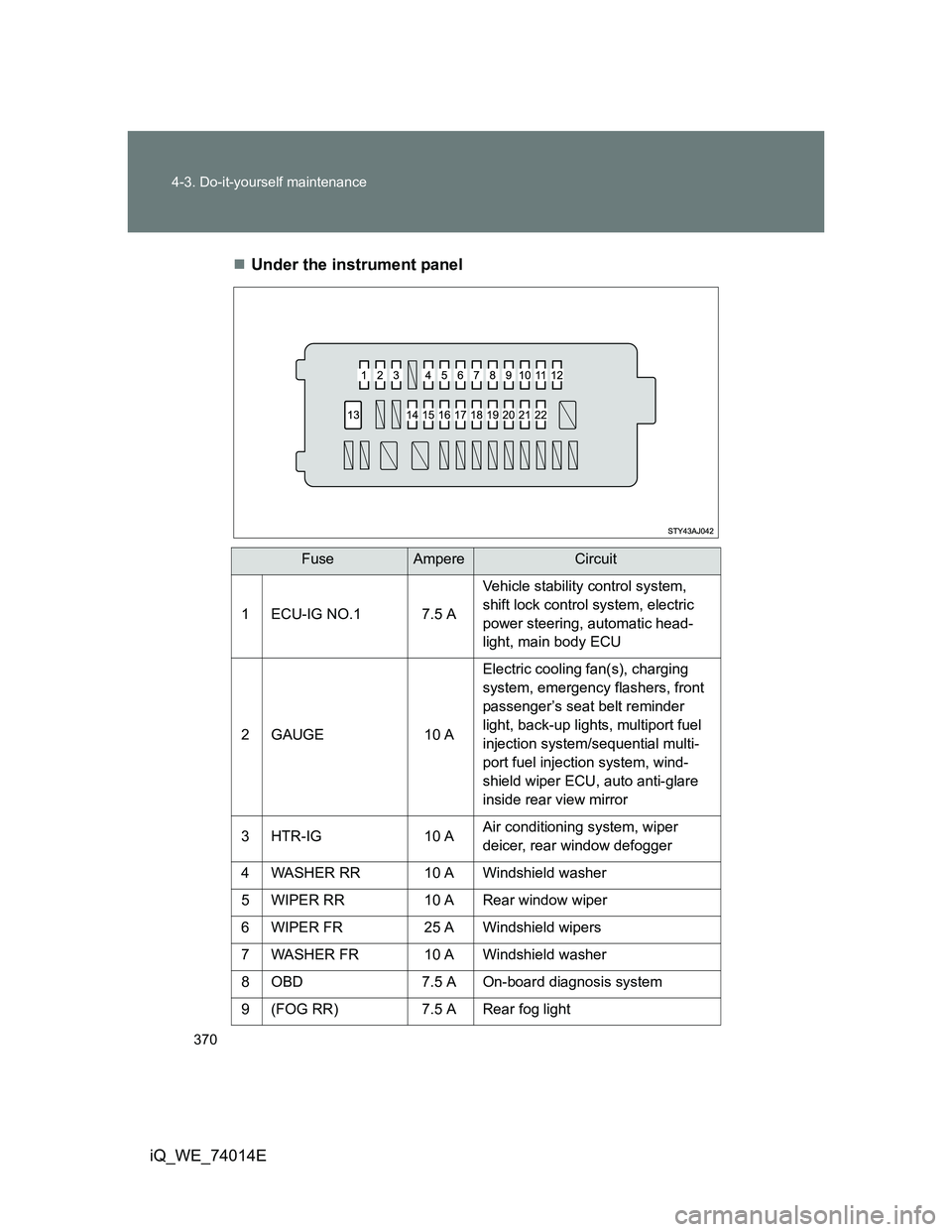
iQ_WE_74014EUnder the instrument panel
FuseAmpereCircuit
1 ECU-IG NO.1 7.5 AVehicle stability control system,
shift lock control system, electric
power steering, automatic head-
light, main body ECU
2 GAUGE 10 AElectric cooling fan(s), charging
system, emergency flashers, front
passenger’s seat belt reminder
light, back-up lights, multiport fuel
injection system/sequential multi-
port fuel injection system, wind-
shield wiper ECU, auto anti-glare
inside rear view mirror
3 HTR-IG 10 AAir conditioning system, wiper
deicer, rear window defogger
4 WASHER RR 10 A Windshield washer
5 WIPER RR 10 A Rear window wiper
6 WIPER FR 25 A Windshield wipers
7 WASHER FR 10 A Windshield washer
8 OBD 7.5 A On-board diagnosis system
9 (FOG RR) 7.5 A Rear fog light
Page 389 of 476
5
389 5-1. Essential information
When trouble arises
iQ_WE_74014E
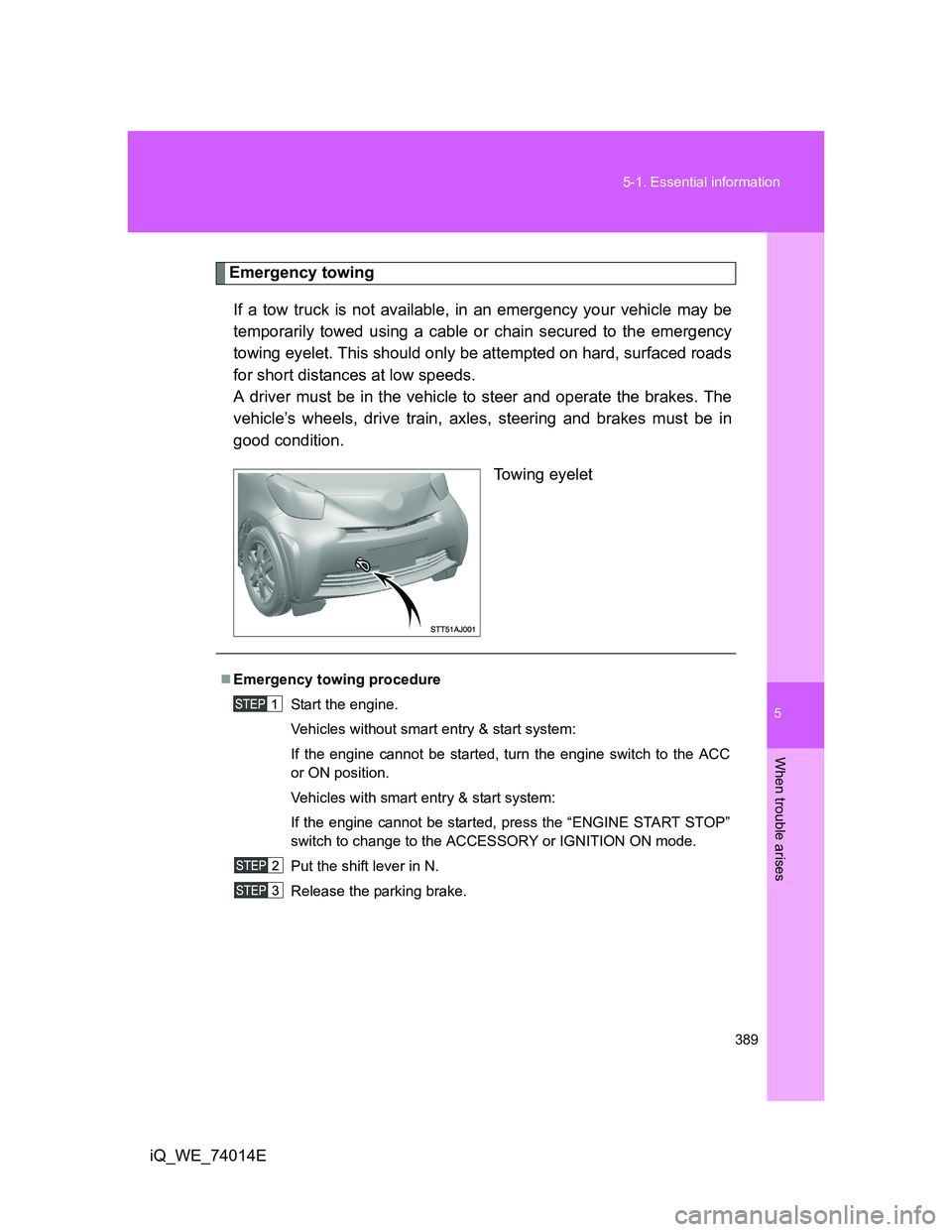
Emergency towing
If a tow truck is not available, in an emergency your vehicle may be
temporarily towed using a cable or chain secured to the emergency
towing eyelet. This should only be attempted on hard, surfaced roads
for short distances at low speeds.
A driver must be in the vehicle to steer and operate the brakes. The
vehicle’s wheels, drive train, axles, steering and brakes must be in
good condition.
Towing eyelet
Emergency towing procedure
Start the engine.
Vehicles without smart entry & start system:
If the engine cannot be started, turn the engine switch to the ACC
or ON position.
Vehicles with smart entry & start system:
If the engine cannot be started, press the “ENGINE START STOP”
switch to change to the ACCESSORY or IGNITION ON mode.
Put the shift lever in N.
Release the parking brake.
Page 390 of 476
390 5-1. Essential information
iQ_WE_74014E
Installing towing eyelet
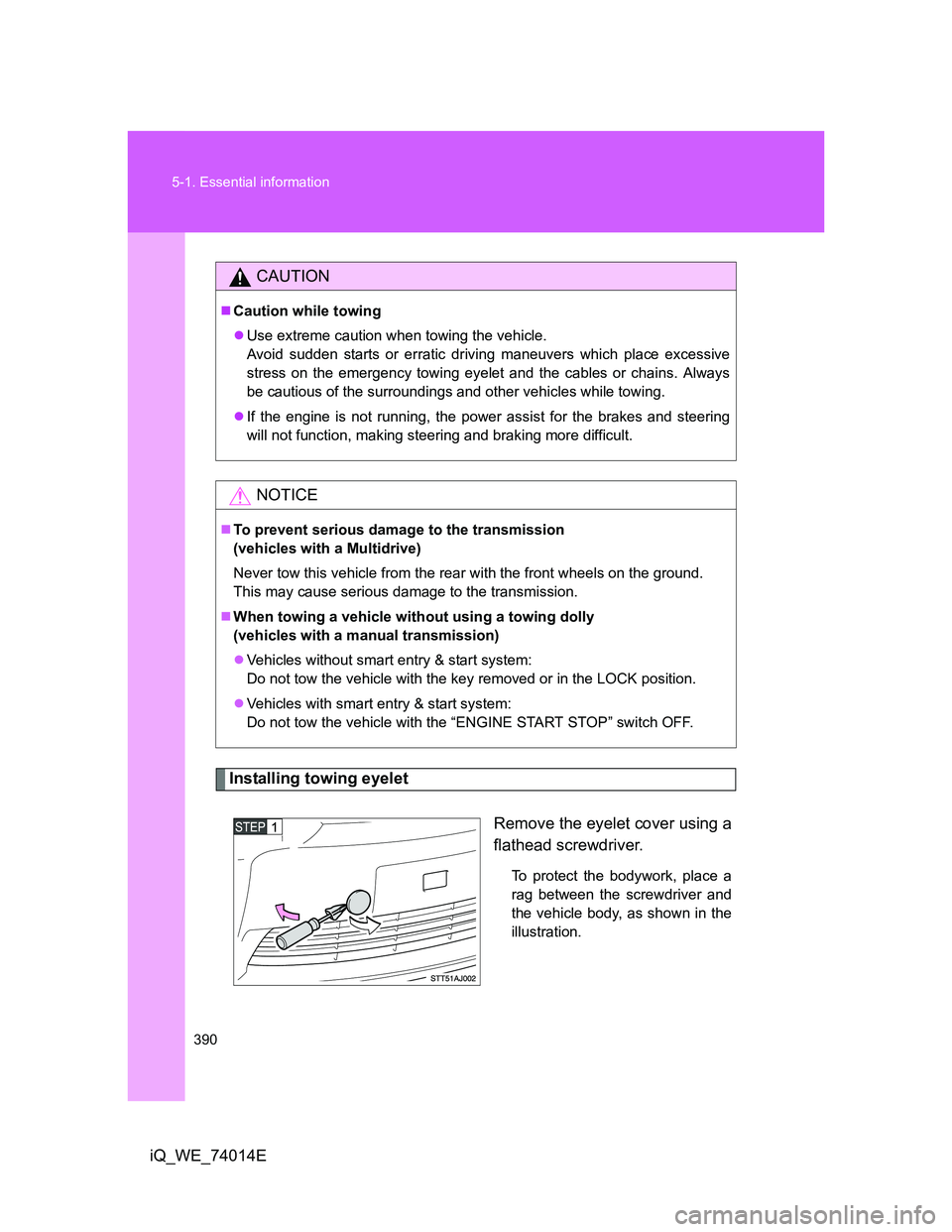
Remove the eyelet cover using a
flathead screwdriver.
To protect the bodywork, place a
rag between the screwdriver and
the vehicle body, as shown in the
illustration.
CAUTION
Caution while towing
Use extreme caution when towing the vehicle.
Avoid sudden starts or erratic driving maneuvers which place excessive
stress on the emergency towing eyelet and the cables or chains. Always
be cautious of the surroundings and other vehicles while towing.
If the engine is not running, the power assist for the brakes and steering
will not function, making steering and braking more difficult.
NOTICE
To prevent serious damage to the transmission
(vehicles with a Multidrive)
Never tow this vehicle from the rear with the front wheels on the ground.
This may cause serious damage to the transmission.
When towing a vehicle without using a towing dolly
(vehicles with a manual transmission)
Vehicles without smart entry & start system:
Do not tow the vehicle with the key removed or in the LOCK position.
Vehicles with smart entry & start system:
Do not tow the vehicle with the “ENGINE START STOP” switch OFF.
Page 394 of 476
394 5-1. Essential information
iQ_WE_74014E
Using a flat bed truck
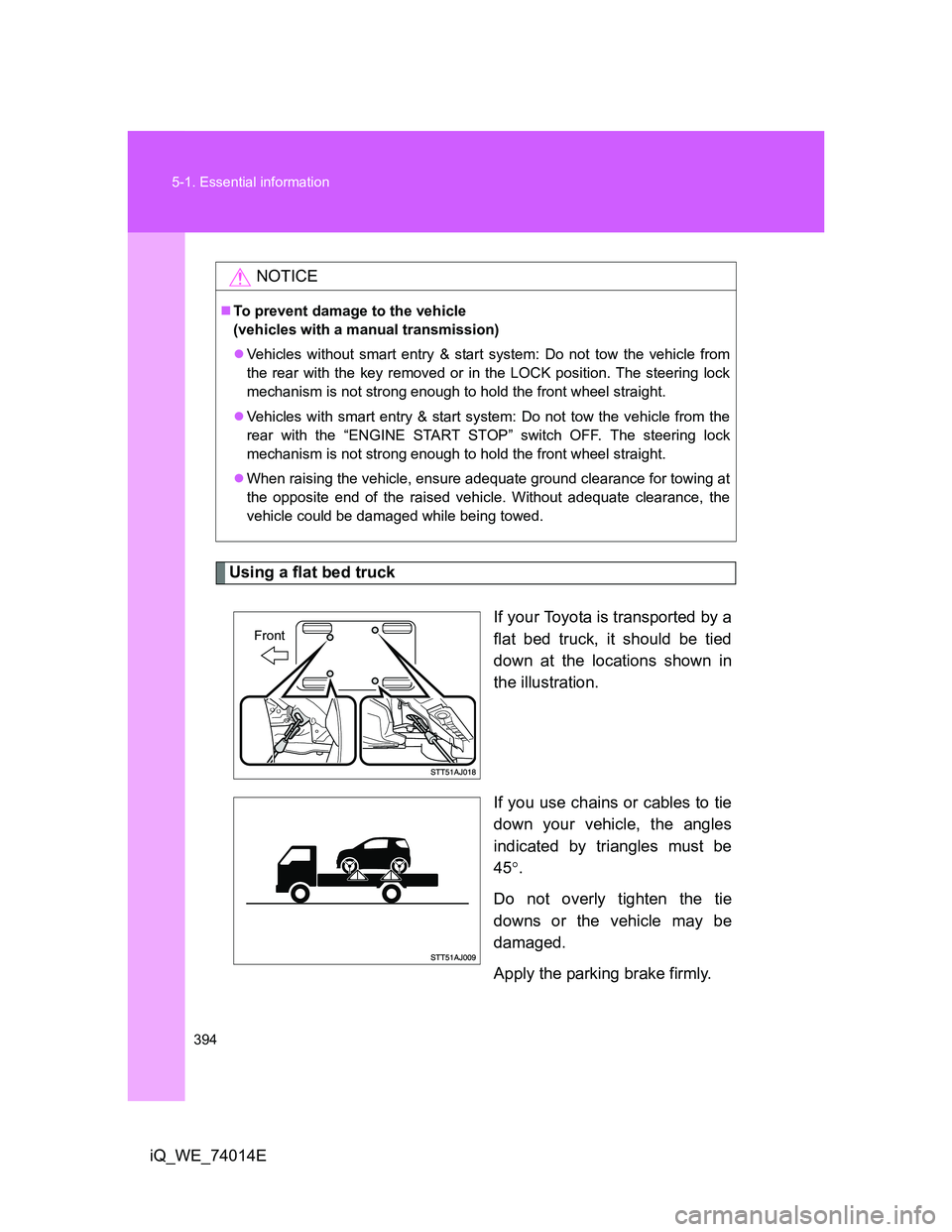
If your Toyota is transported by a
flat bed truck, it should be tied
down at the locations shown in
the illustration.
If you use chains or cables to tie
down your vehicle, the angles
indicated by triangles must be
45.
Do not overly tighten the tie
downs or the vehicle may be
damaged.
Apply the parking brake firmly.
NOTICE
To prevent damage to the vehicle
(vehicles with a manual transmission)
Vehicles without smart entry & start system: Do not tow the vehicle from
the rear with the key removed or in the LOCK position. The steering lock
mechanism is not strong enough to hold the front wheel straight.
Vehicles with smart entry & start system: Do not tow the vehicle from the
rear with the “ENGINE START STOP” switch OFF. The steering lock
mechanism is not strong enough to hold the front wheel straight.
When raising the vehicle, ensure adequate ground clearance for towing at
the opposite end of the raised vehicle. Without adequate clearance, the
vehicle could be damaged while being towed.
Front
Page 399 of 476
5
399 5-2. Steps to take in an emergency
When trouble arises
iQ_WE_74014E
Follow the correction procedures.
After taking the specified steps to correct the suspected problem,
check that the warning light turns off.
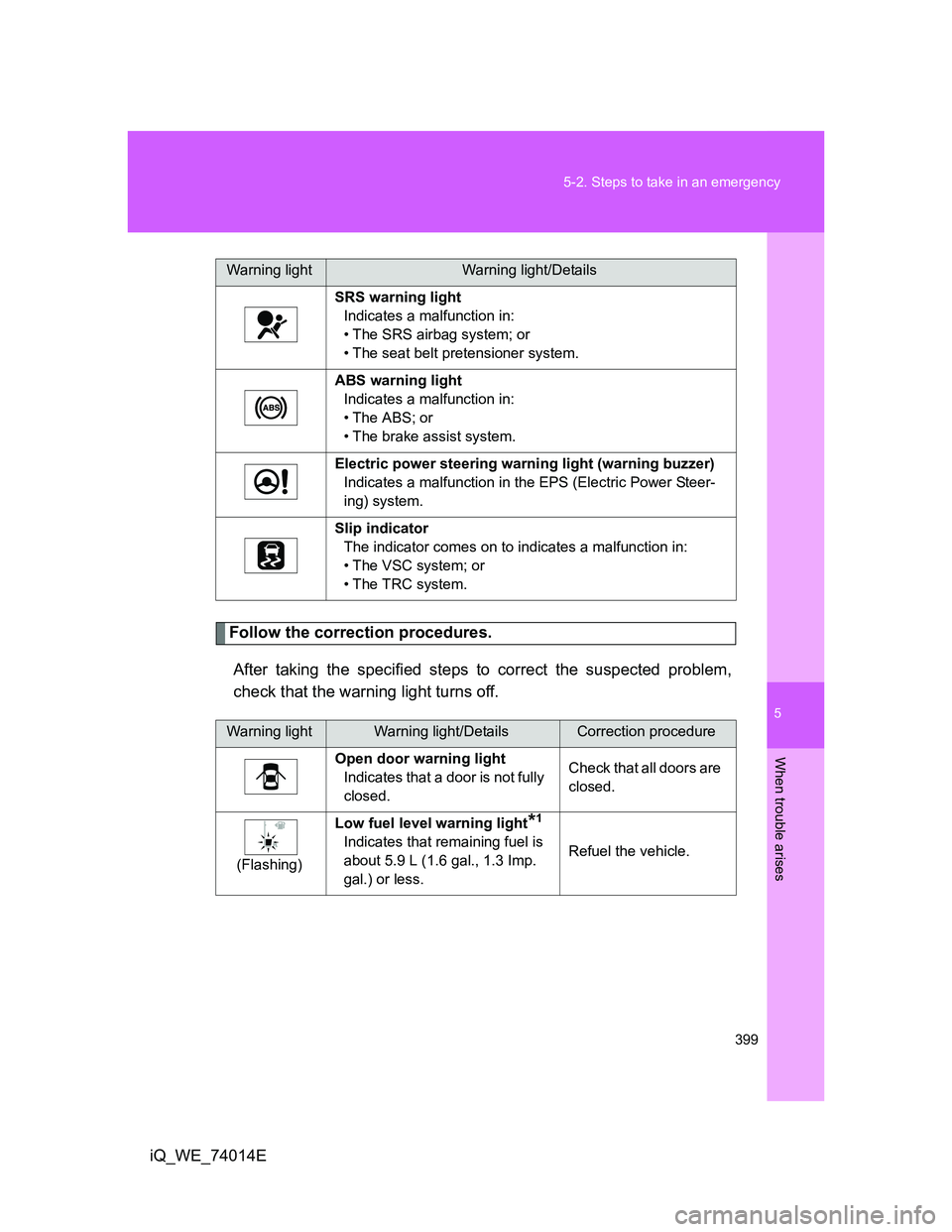
SRS warning light
Indicates a malfunction in:
• The SRS airbag system; or
• The seat belt pretensioner system.
ABS warning light
Indicates a malfunction in:
• The ABS; or
• The brake assist system.
Electric power steering warning light (warning buzzer)
Indicates a malfunction in the EPS (Electric Power Steer-
ing) system.
Slip indicator
The indicator comes on to indicates a malfunction in:
• The VSC system; or
• The TRC system.
Warning lightWarning light/DetailsCorrection procedure
Open door warning light
Indicates that a door is not fully
closed.Check that all doors are
closed.
(Flashing)Low fuel level warning light
*1
Indicates that remaining fuel is
about 5.9 L (1.6 gal., 1.3 Imp.
gal.) or less.Refuel the vehicle.
Warning lightWarning light/Details
Page 404 of 476
404 5-2. Steps to take in an emergency
iQ_WE_74014E
If the malfunction indicator lamp comes on while driving
The malfunction indicator lamp will come on if the fuel tank becomes com-
pletely empty. If the fuel tank is empty, refuel the vehicle immediately. The
malfunction indicator lamp will go off after several trips.
If the malfunction indicator lamp does not go off, contact any authorized
Toyota dealer or repairer, or another duly qualified and equipped
professional as soon as possible.
Front passenger detection sensor and passenger seat belt reminder
If luggage is placed on the front passenger seat, the front passenger
detection sensor may cause the warning light to flash, even if a passen-
ger is not sitting in the seat.
If a cushion is placed on the seat, the sensor may not detect a passen-
ger, and the warning light may not operate properly.
Electric power steering system warning light (warning buzzer)
When the battery charge becomes insufficient or the voltage temporarily
drops, the electric power steering system warning light may come on and
warning buzzer may sound.
Customization that can be configured at any authorized Toyota dealer
or repairer, or another duly qualified and equipped professional
The vehicle speed linked seat belt reminder buzzer can be disabled.
(Customizable features P. 459)
CAUTION
When the electric power steering system warning light comes on
The steering wheel may become extremely heavy.
If the steering wheel becomes heavier than usual when operating, hold
firmly and operate using more force than usual.
Page 421 of 476
5
421 5-2. Steps to take in an emergency
When trouble arises
iQ_WE_74014E
CAUTION
When fixing the flat tire
If the hose comes off the valve while inflating the tire, there is a risk that
the hose will move abruptly due to air pressure.
After inflation of the tire has completed, the sealant may splatter when the
hose is disconnected or some air is let out of the tire.
Follow the operation procedure to repair the tire. If the procedures not fol-
lowed, the sealant may spray out.
Keep back from the tire while it is being repaired, as there is a chance of it
bursting while the repair operation is being performed. If you notice any
cracks or deformation of the tire, turn off the compressor switch and stop
the repair operation immediately.
The repair kit may overheat if operated for a long period of time. Do not
operate the repair kit continuously for more than 60 minutes.
Parts of the repair kit become hot during operation. Be careful handling the
repair kit during and after operation. Do not touch the metal part connect-
ing the bottle and the compressor. It will be extremely hot.
Do not attach the vehicle speed warning sticker to an area other than the
one indicated. If the sticker is attached to an area where an SRS airbag is
located, such as the pad of the steering wheel, it may prevent the SRS air-
bag from operating properly.
Driving to spread the liquid sealant evenly
Observe the following precautions to reduce the risk of accidents.
Failing to do so may result in a loss of vehicle control and cause death or
serious injury.
Drive the vehicle carefully at a low speed. Be especially careful when turn-
ing and cornering.
If the vehicle does not drive straight or you feel a pull through the steering
wheel, stop the vehicle and check the following.
• Tire condition. The tire may have separated from the wheel.
• Tire inflation pressure. If the tire inflation pressure is 130 kPa (1.3
kgf/cm
2 or bar, 19 psi) or less, the tire may be severely damaged.
Page 423 of 476
5
423
5-2. Steps to take in an emergency
When trouble arises
iQ_WE_74014E
If the engine will not start
If the engine still does not start after following the correct starting
procedure (P. 176, 179) or releasing the steering lock (P. 177,
182), confirm the following points.
The engine will not start even when the starter motor oper-
ates normally.
One of the following may be the cause of the problem.
There may not be sufficient fuel in the vehicle’s tank.
Refuel the vehicle.
The engine may be flooded.
Try to restart the engine once more following correct starting
procedures. (P. 176, 179)
There may be a malfunction in the engine immobilizer system.
(P. 108)
The starter motor turns over slowly, the interior lights and
headlights are dim, or the horn does not sound or sounds at
a low volume.
One of the following may be the cause of the problem.
The battery may be discharged. (P. 430)
The battery terminal connections may be loose or corroded.
The starter motor does not turn over. (vehicles with smart
entry & start system)
The engine starting system may be malfunctioning due to an
electrical problem such as an open circuit or a blown fuse. How-
ever, an interim measure is available to start the engine.
(P. 424)