service TOYOTA IQ 2013 User Guide
[x] Cancel search | Manufacturer: TOYOTA, Model Year: 2013, Model line: IQ, Model: TOYOTA IQ 2013Pages: 372, PDF Size: 7.77 MB
Page 300 of 372

300 5-2. Steps to take in an emergency
NOTICE
■When performing an emergency repair
●A tire should only be repaired with the emergency tire puncture repair
kit if the damage is caused by a sharp object such as nail or screw
passing through the tire tread.
Do not remove the sharp object from the tire. Removing the object may
widen the opening and disenable emergency repair with the repair kit.
●The repair kit is not waterproof. Make sure that the repair kit is not
exposed to water, such as when it is being used in the rain.
●Do not put the repair kit directly onto dusty ground such as sand at the
side of the road. If the repair kit vacuums up dust etc., a malfunction
may occur.
■Precautions for the emergency tire puncture repair kit
●The repair kit power source should be 12 V DC suitable for vehicle
use. Do not connect the repair kit to any other source.
●If gasoline splatters on the repair kit, the repair kit may deteriorate.
Take care not to allow gasoline to contact it.
●Place the repair kit in a storage to prevent it from being exposed to dirt
or water.
●Store the repair kit in the luggage room out of reach of children.
●Do not disassemble or modify the repair kit. Do not subject parts such
as the air pressure indicator to impacts. This may cause a malfunction.
■To avoid damage to the tire pressure warning valves and transmit-
ters
When a tire is repaired with liquid se alants, the tire pressure warning
valve and transmitter may not operate properly. If a liquid sealant is
used, contact your Scion dealer or other qualified service shop as soon
as possible. Make sure to replace the tire pressure warning valve and
transmitter when replacing the tire. ( P. 221)
Page 326 of 372
326 6-1. Specifications
■Recommendation of the use of cleaner burning gasoline
Cleaner burning gasoline, including reformulated gasoline that contains oxy-
genates such as ethanol or MTBE (Methyl Tertiary Butyl Ether) is available in
many areas.
Scion recommends the use of cleaner burning gasoline and appropriately
blended reformulated gasoline. These types of gasoline provide excellent
vehicle performance, reduce vehicle emissions and improve air quality.
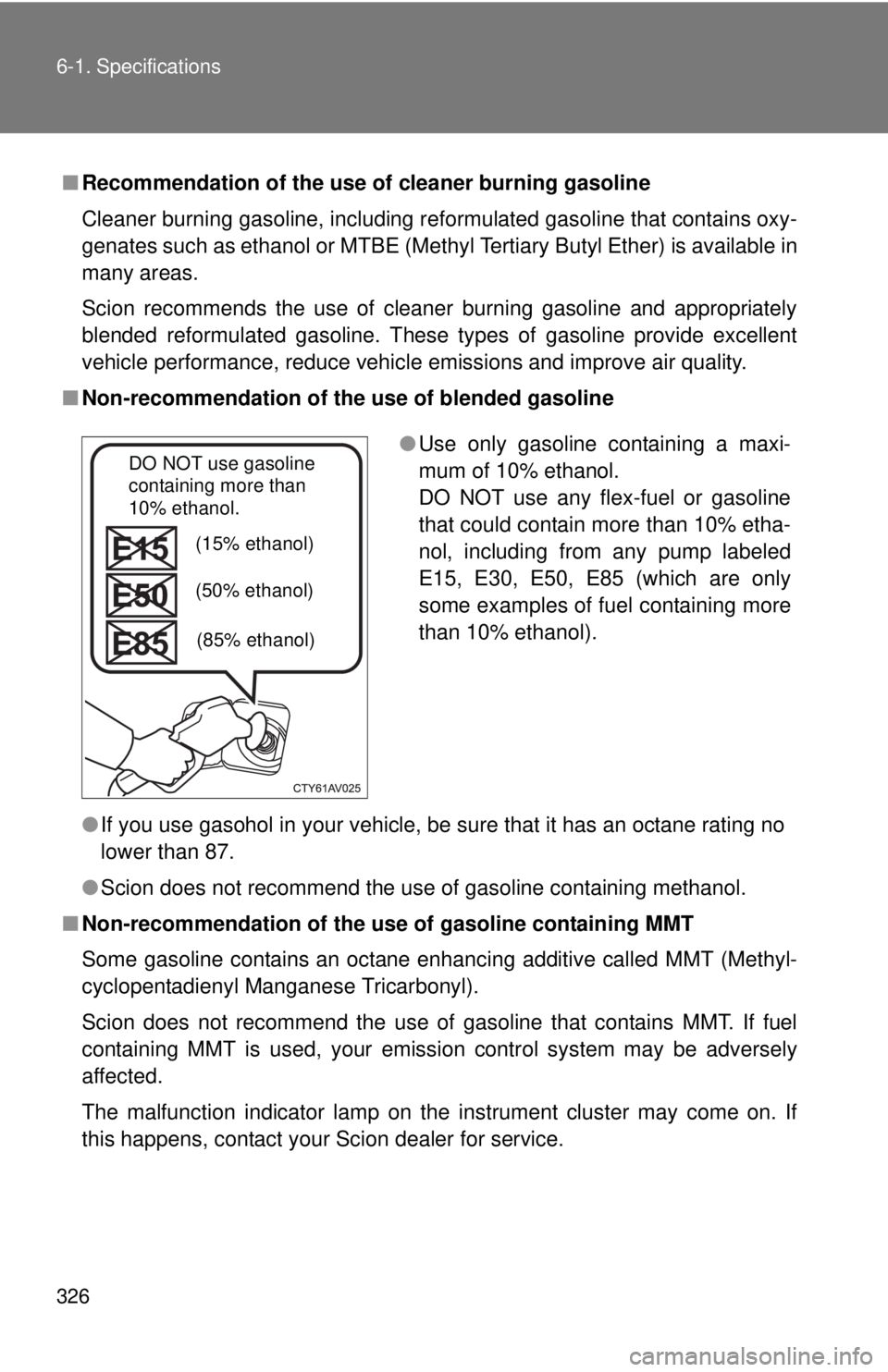
■ Non-recommendation of the use of blended gasoline
●If you use gasohol in your vehicle, be sure that it has an octane rating no
lower than 87.
● Scion does not recommend the use of gasoline containing methanol.
■ Non-recommendation of the use of gasoline containing MMT
Some gasoline contains an octane enhancing additive called MMT (Methyl-
cyclopentadienyl Manganese Tricarbonyl).
Scion does not recommend the use of gasoline that contains MMT. If fuel
containing MMT is used, your emission control system may be adversely
affected.
The malfunction indicator lamp on the instrument cluster may come on. If
this happens, contact your Scion dealer for service.
●Use only gasoline containing a maxi-
mum of 10% ethanol.
DO NOT use any flex-fuel or gasoline
that could contain more than 10% etha-
nol, including from any pump labeled
E15, E30, E50, E85 (which are only
some examples of fuel containing more
than 10% ethanol).DO NOT use gasoline
containing more than
10% ethanol.
(15% ethanol)
(50% ethanol)
(85% ethanol)
Page 332 of 372

332 6-1. Specifications
■Treadwear
The treadwear grade is a comparative rating based on the wear
rate of the tire when tested under controlled conditions on a speci-
fied government test course.
For example, a tire graded 150 would wear one and a half (1 - 1/2)
times as well on the government course as a tire graded 100.
The relative performance of tires depends upon the actual conditions
of their use. Performance may diff er significantly from the norm due
to variations in driving habits, service practices and differences in
road characteristics and climate.
■ Traction AA, A, B, C
The traction grades, from highest to lowest, are AA, A, B and C,
and they represent the tire’s ab ility to stop on wet pavement as
measured under controlled cond itions on specified government
test surfaces of asphalt and concrete.
A tire marked C may have poor traction performance.
Warning: The traction grade assigned to this tire is based on braking
(straight ahead) traction tests and does not include cornering (turn-
ing) traction.
■ Temperature A, B, C
The temperature grades are A (the highest), B, and C, represent-
ing the tire’s resistance to the generation of heat and its ability to
dissipate heat when tested under controlled conditions on a speci-
fied indoor laboratory test wheel.
Sustained high temperature can cause the material of the tire to
degenerate and reduce tire life, and excessive temperature can lead
to sudden tire failure.
Grade C corresponds to a level of performance which all passenger
car tires must meet under the Federal Motor Vehicle Safety Standard
No. 109.
Grades B and A represent higher levels of performance on the labo-
ratory test wheel than the minimum required by law.
Page 364 of 372

364 Alphabetical index
Radiator .................................... 214
Rear seatFolding down ...........................38
Rear side marker lights Replacing light bulbs ............. 251
Switch.................................... 130
Wattage ................................. 324
Rear turn signal lights
Indicator ................................ 122
Lever ..................................... 115
Replacing light bulbs ............. 251
Switch.................................... 115
Wattage ................................. 324
Rear window defogger ............ 162
Rear window wiper .................. 137
Replacing Key battery ............................ 238
Fuses .................................... 240
Light bulbs ............................. 251
Tires .............................. 202, 220
Reporting safety defects for U.S. owners ...................... 344
Seat belts ALR .........................................43
Automatic Locking Retractor ...43
Child restraint system installation .......................85, 90
Cleaning and maintaining...... 186
ELR .........................................43
Emergency Locking Retractor .............................. 43
How to wear your seat belt......41
How your child should wear the seat belt ..........................44
Pregnant women, proper seat belt use .........................44
Reminder light ....................... 276
Seat belt extenders .................44
Seat belt pretensioners ...........43 Seats
Adjustment .............................. 35
Adjustment precautions .......... 37
Child seats/child restraint system installation .......... 85, 90
Cleaning ................................ 185
Front seat adjustment ............. 35
Front seat adjustment precautions ........................... 37
Properly sitting in the seat....... 63
Service reminder
indicators .............................. 121
Shift lever Automatic transmission ......... 114
If the shift lever cannot be
shifted from P ..................... 303
Shift lock system ..................... 303
Side airbags ............................... 65
Side marker lights Replacing light bulbs ............. 251
Switch ................................... 130
Wattage................................. 324
Side mirror
Adjusting ................................. 50
Defogger ............................... 163
Folding .................................... 51
Spark plug ................................ 321
Specifications .......................... 316
Speedometer ............................ 119
Steering wheel Adjustment .............................. 47
Column lock release ............. 112
Electric power steering.......... 139
EPS ....................................... 139
Specification.......................... 323
Warning light ......................... 275R
S