Seat d TOYOTA IQ 2013 Owner's Manual
[x] Cancel search | Manufacturer: TOYOTA, Model Year: 2013, Model line: IQ, Model: TOYOTA IQ 2013Pages: 372, PDF Size: 7.77 MB
Page 46 of 372
46 1-3. Adjustable components (seats, mirrors, steering wheel)
CAUTION
■Seat belt damage and wear
●Do not damage the seat belts by allowing the belt, plate, or buckle to be
jammed in the door.
● Inspect the seat belt system periodically. Check for cuts, fraying, and loose
parts. Do not use a damaged seat belt until it is replaced. Damaged seat
belt cannot protect an occupant from death or serious injury.
● Ensure that the belt and tab are locked and the belt is not twisted.
If the seat belt does not function correctly, immediately contact your Scion
dealer.
● Replace the seat assembly, including the belts, if your vehicle has been
involved in a serious accident, even if there is no obvious damage.
● Do not attempt to install, remove, modify, disassemble or dispose of the
seat belts. Have any necessary repairs carried out by your Scion dealer.
Inappropriate handling of the pretensioner may prevent it from operating
properly resulting in death or serious injury.
■ Using a seat belt extender
●Do not wear the seat belt extender, if you can fasten the seat belt without
the extender.
● Do not use the seat belt extender when installing a child restraint system,
because the belt will not securely hold the child restraint system, increas-
ing the risk of death or serious injury in the event of an accident.
● The personalized extender may not be safe on another vehicle, when
used by another person, or at a different seating position other than the
one originally intended.
NOTICE
■When using a seat belt extender
When releasing the seat belt, press on the buckle release button on the
extender, not on the seat belt.
This helps prevent damage to the vehicle interior and the extender itself.
Page 47 of 372
47
1
1-3. Adjustable components (seats, mirrors, steering wheel)
Before driving
Steering wheel
CAUTION
■Caution while driving
Do not adjust the steering wheel while driving.
Doing so may cause the driver to mishandle the vehicle and an accident
may occur resulting in death or serious injury.
■ After adjusting the steering wheel
Make sure that the steering wheel is securely locked.
Otherwise, the steering wheel may move suddenly, possibly causing an
accident and resulting in death or serious injury.
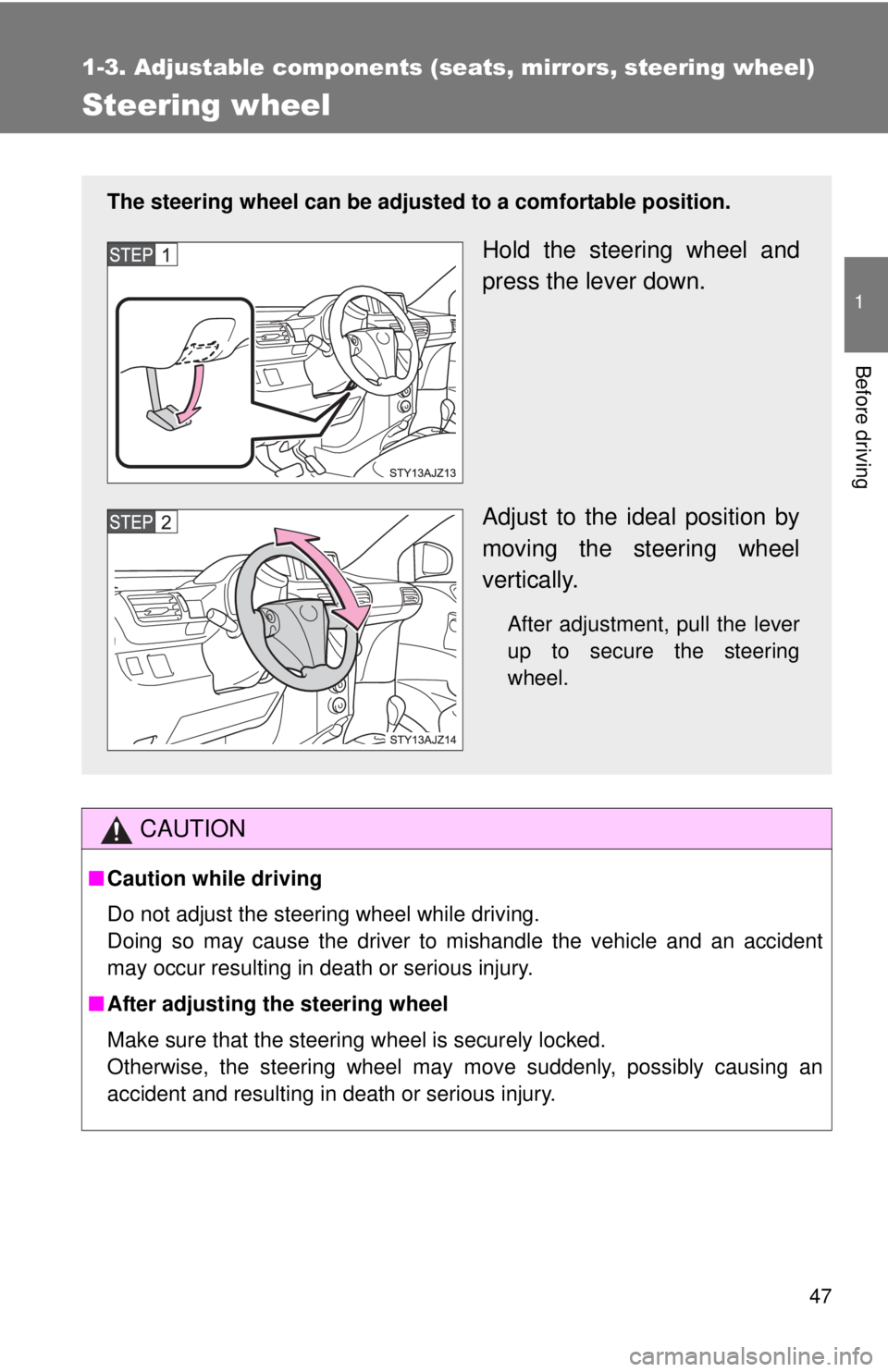
The steering wheel can be adjust ed to a comfortable position.
Hold the steering wheel and
press the lever down.
Adjust to the ideal position by
moving the steering wheel
vertically.
After adjustment, pull the lever
up to secure the steering
wheel.
Page 48 of 372
48
1-3. Adjustable components (seats, mirrors, steering wheel)
Anti-glare inside rear view mirror
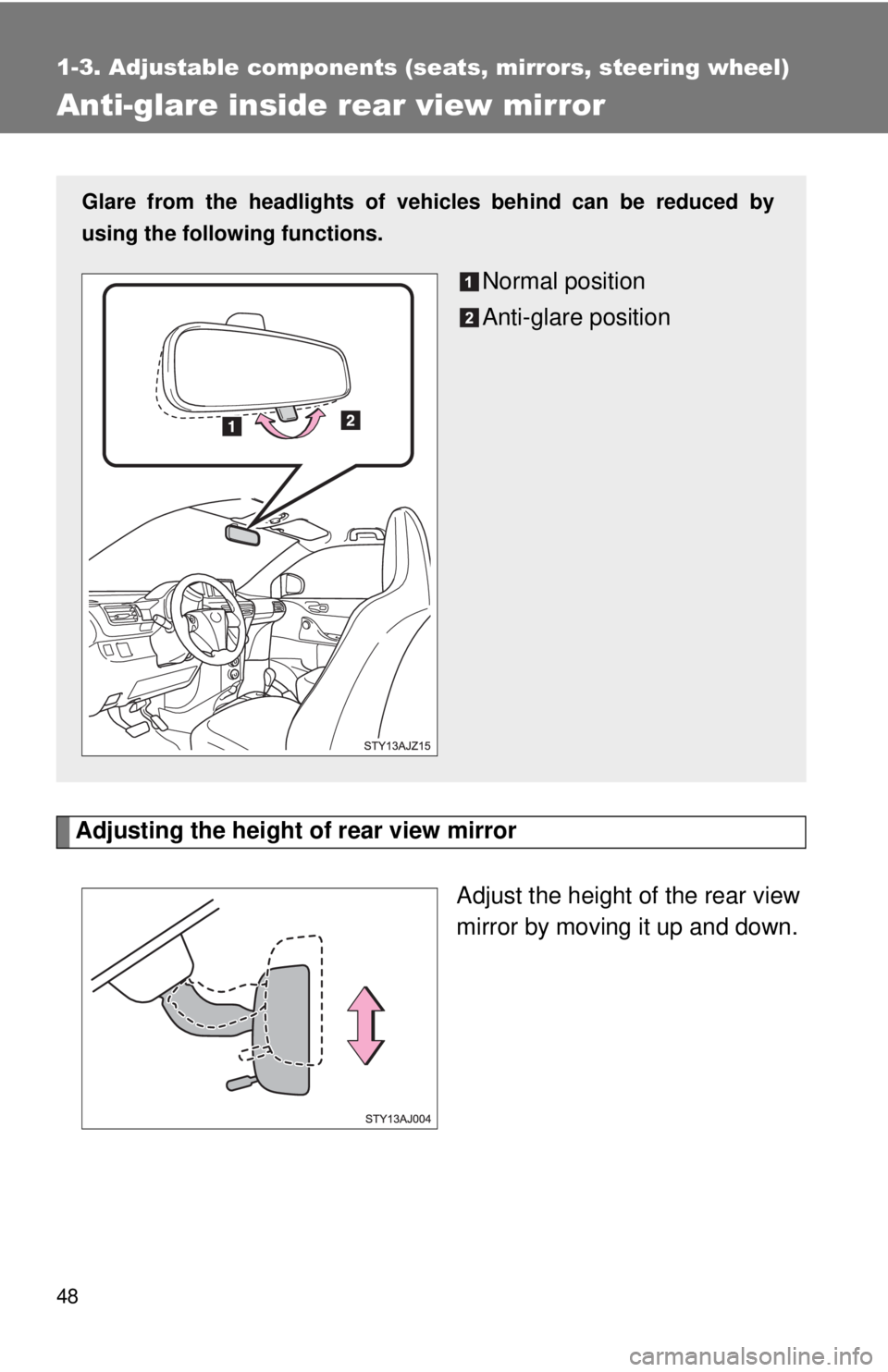
Adjusting the height of rear view mirrorAdjust the height of the rear view
mirror by moving it up and down.
Glare from the headlights of vehicles behind can be reduced by
using the following functions.
Normal position
Anti-glare position
Page 50 of 372
50
1-3. Adjustable components (seats, mirrors, steering wheel)
Outside rear view mirrors
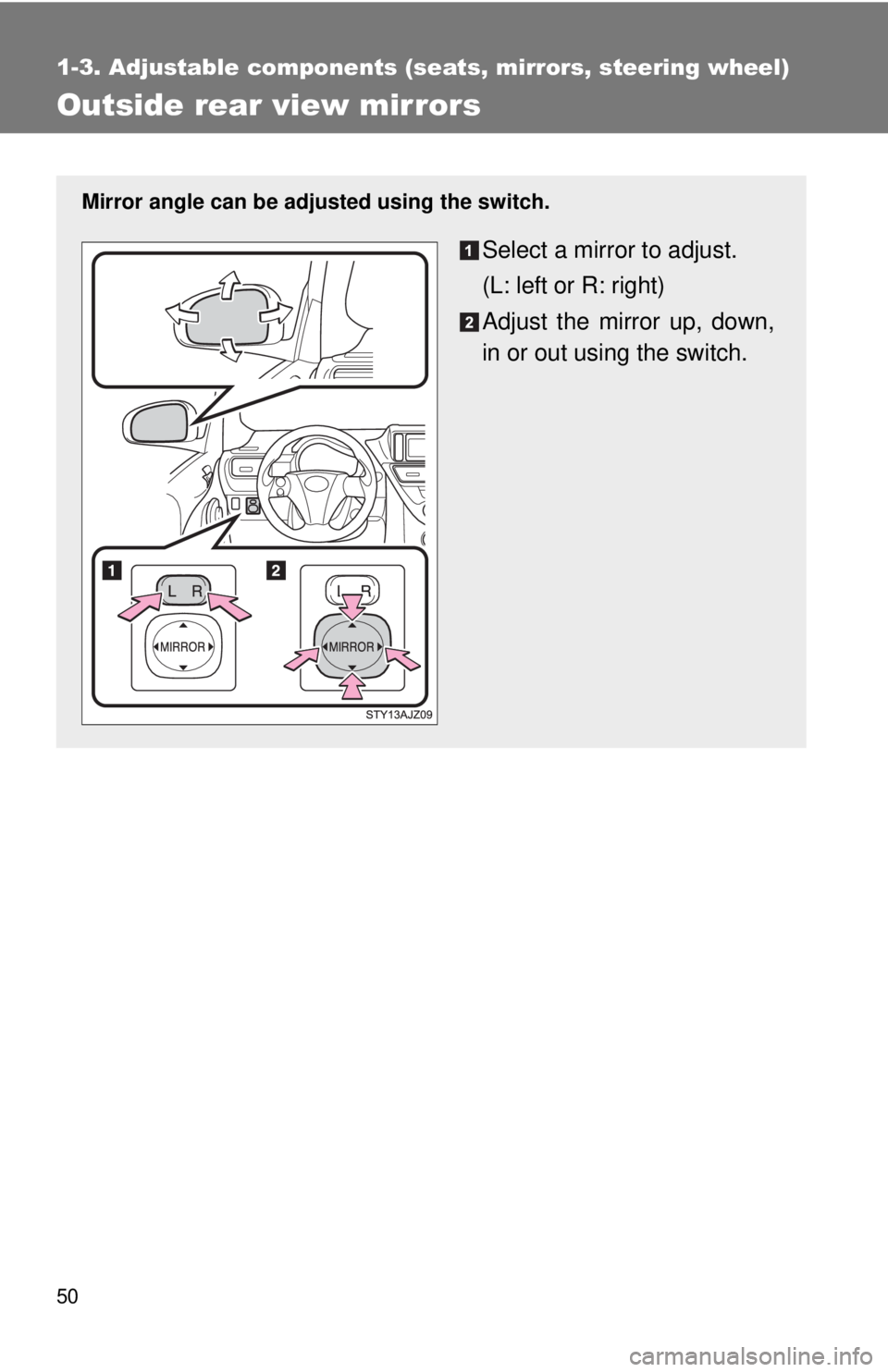
Mirror angle can be adjusted using the switch.
Select a mirror to adjust.
(L: left or R: right)
Adjust the mirror up, down,
in or out using the switch.
Page 52 of 372

52 1-3. Adjustable components (seats, mirrors, steering wheel)
CAUTION
■When driving the vehicle
Observe the following precautions while driving.
Failing to do so may result in loss of control of the vehicle and cause an acci-
dent, resulting in death or serious injury.
●Do not adjust the mirrors while driving.
● Do not drive with the mirrors folded back.
● Both the driver and passenger side mirrors must be extended and properly
adjusted before driving.
■ When the mirror defoggers are operating (vehicles with outside rear
view mirror defoggers)
Do not touch the rear view mirror surfaces, as they can become very hot and
burn you.
NOTICE
■If ice should jam the mirror
Do not operate the control or scrape the mirror face. Use a spray de-icer to
free the mirror.
Page 63 of 372
63
1
Before driving
1-7. Safety information
Correct driving posture
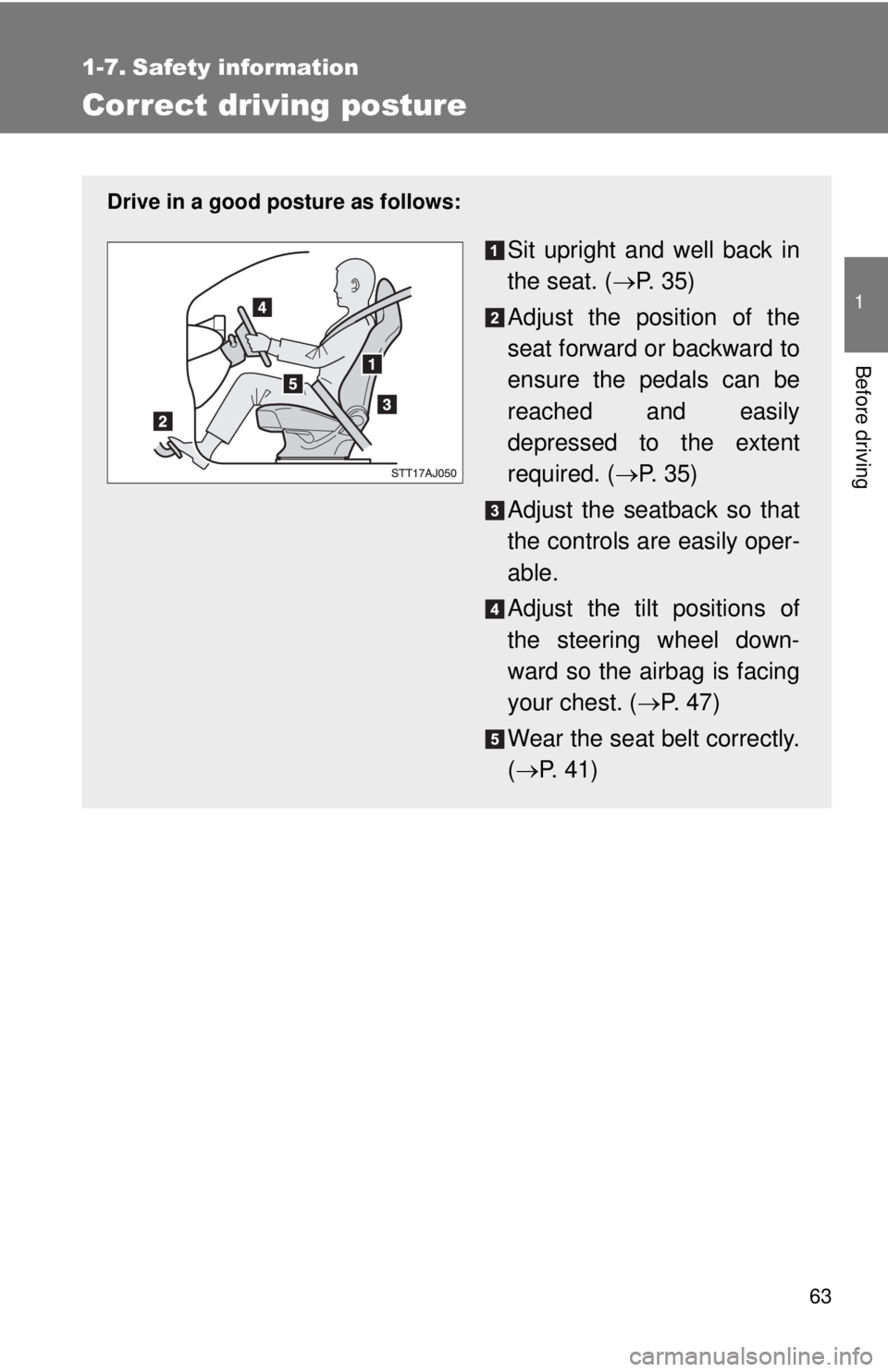
Drive in a good posture as follows:
Sit upright and well back in
the seat. (P. 3 5 )
Adjust the position of the
seat forward or backward to
ensure the pedals can be
reached and easily
depressed to the extent
required. ( P. 35)
Adjust the seatback so that
the controls are easily oper-
able.
Adjust the tilt positions of
the steering wheel down-
ward so the airbag is facing
your chest. ( P. 4 7 )
Wear the seat belt correctly.
( P. 41)
Page 64 of 372

64 1-7. Safety information
CAUTION
■While driving
●Do not adjust the position of the driver's seat while driving.
Doing so could cause the driver to lose control of the vehicle.
● Do not place a cushion between the driver or passenger and the seatback.
A cushion may prevent correct posture from being achieved, and reduce
the effectiveness of the seat belt and head restraint, increasing the risk of
death or serious injury to the driver or passenger.
● Do not place anything under the front seats.
Objects placed under the front seats may become jammed in the seat
tracks and stop the seat from locking in place. This may lead to an acci-
dent. The adjustment mechanism may also be damaged.
■ Adjusting the seat position
●Take care when adjusting the seat position to ensure that other passen-
gers are not injured by the moving seat.
● Do not put your hands under the seat or near the moving parts to avoid
injury.
Fingers or hands may become jammed in the seat mechanism.
Page 65 of 372
65
1
1-7. Safety information
Before driving
SRS airbags
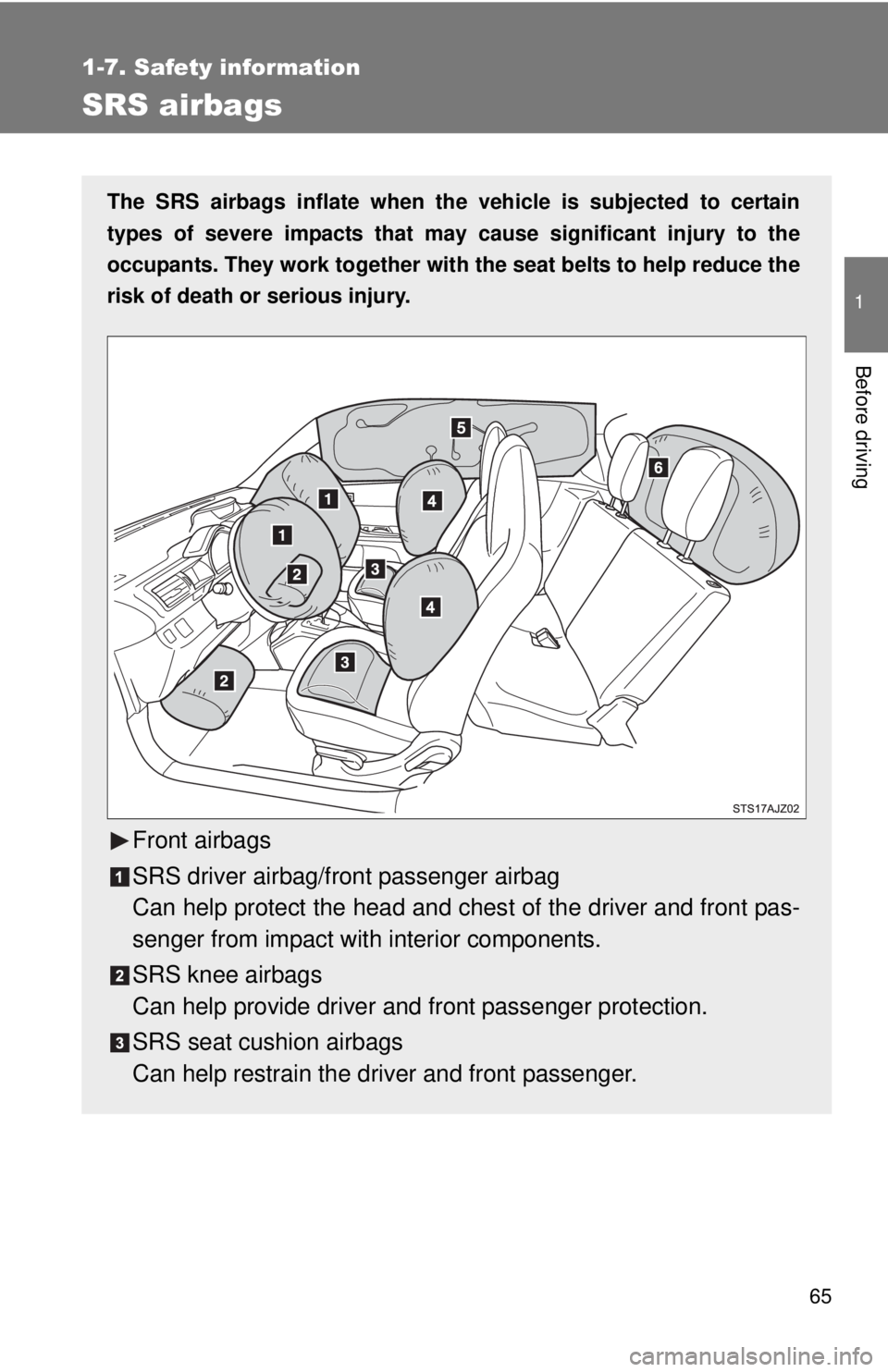
The SRS airbags inflate when the vehicle is subjected to certain
types of severe impacts that may cause significant injury to the
occupants. They work together with the seat belts to help reduce the
risk of death or serious injury.
Front airbags
SRS driver airbag/front passenger airbag
Can help protect the head and ches t of the driver and front pas-
senger from impact with interior components.
SRS knee airbags
Can help provide driver and front passenger protection.
SRS seat cushion airbags
Can help restrain the driver and front passenger.
Page 66 of 372
66 1-7. Safety information
Side and curtain shield airbags
SRS side airbags
Can help protect the torso of the front seat occupants.
SRS curtain shield airbags
Can help protect primarily the head of occupants.
SRS rear window curtain shield airbag
Can help protect primarily the head of rear occupants.
Page 67 of 372
67
1-7. Safety information
1
Before driving
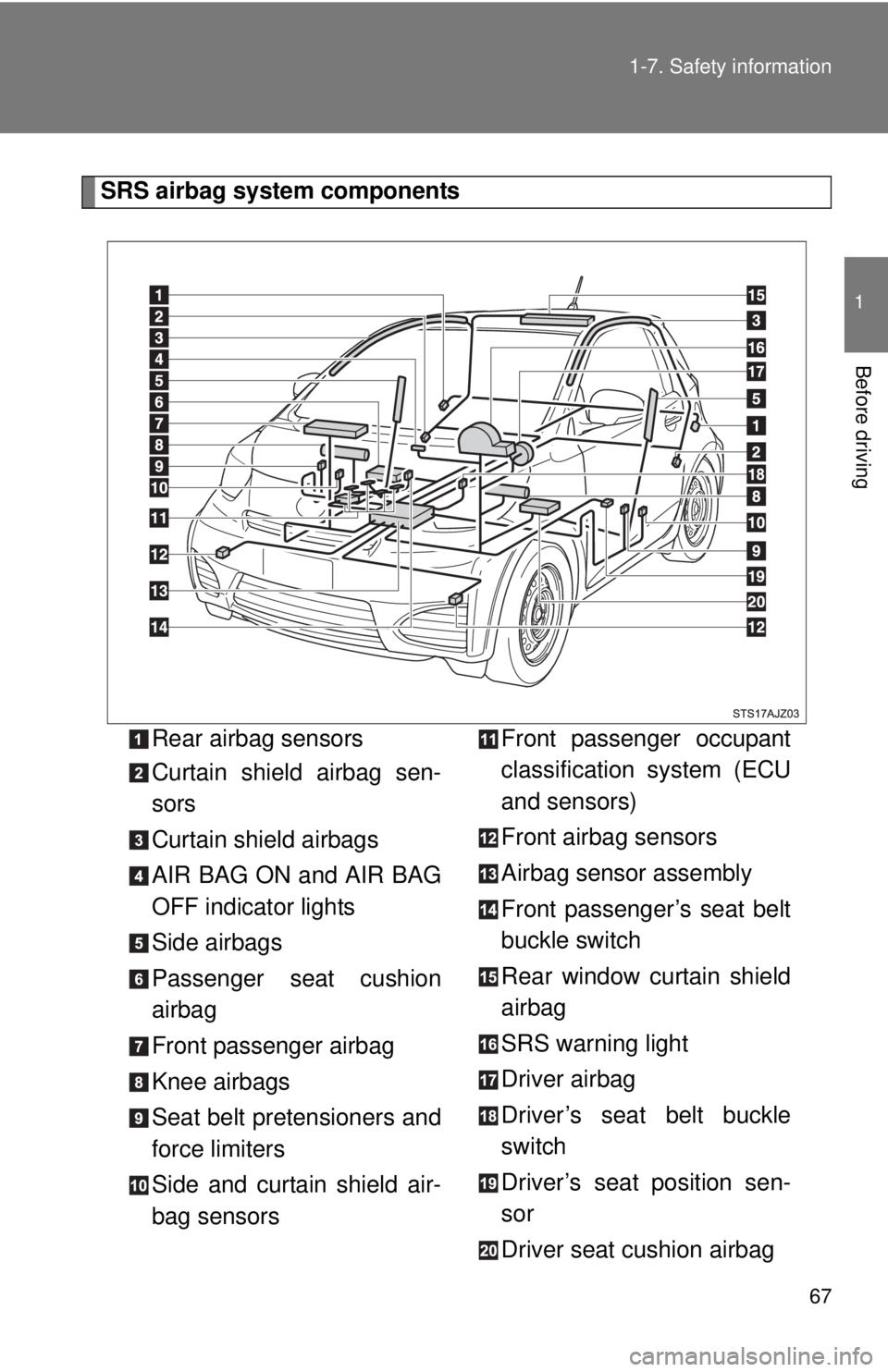
SRS airbag system components
Rear airbag sensors
Curtain shield airbag sen-
sors
Curtain shield airbags
AIR BAG ON and AIR BAG
OFF indicator lights
Side airbags
Passenger seat cushion
airbag
Front passenger airbag
Knee airbags
Seat belt pretensioners and
force limiters
Side and curtain shield air-
bag sensors Front passenger occupant
classification system (ECU
and sensors)
Front airbag sensors
Airbag sensor assembly
Front passenger’s seat belt
buckle switch
Rear window curtain shield
airbag
SRS warning light
Driver airbag
Driver’s seat belt buckle
switch
Driver’s seat position sen-
sor
Driver seat cushion airbag