steering TOYOTA IQ 2013 Service Manual
[x] Cancel search | Manufacturer: TOYOTA, Model Year: 2013, Model line: IQ, Model: TOYOTA IQ 2013Pages: 372, PDF Size: 7.77 MB
Page 141 of 372
141
2-4. Using other
driving systems
2
When driving
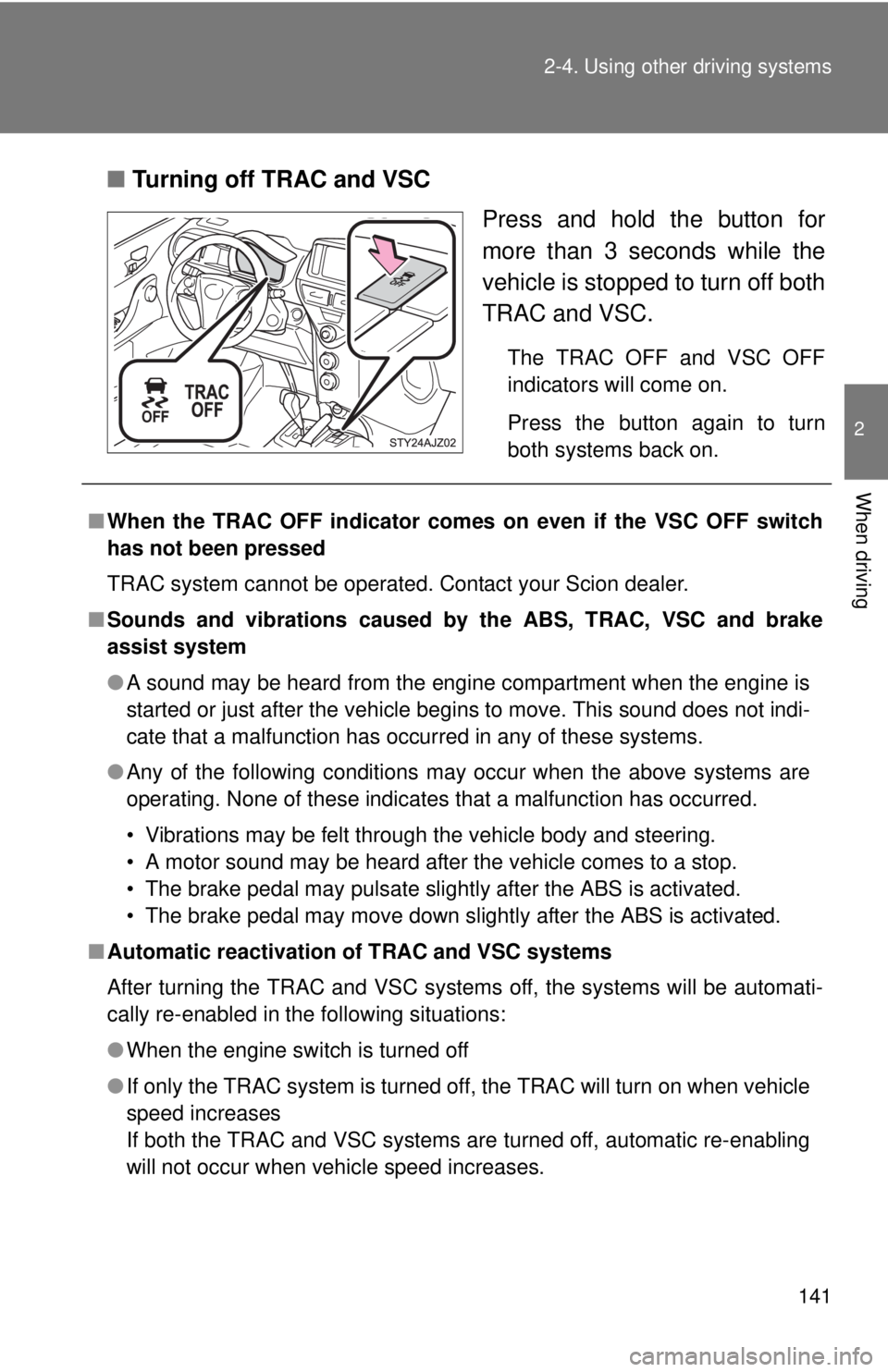
■Turning off TRAC and VSC
Press and hold the button for
more than 3 seconds while the
vehicle is stopped to turn off both
TRAC and VSC.
The TRAC OFF and VSC OFF
indicators will come on.
Press the button again to turn
both systems back on.
■When the TRAC OFF indicator com es on even if the VSC OFF switch
has not been pressed
TRAC system cannot be operated. Contact your Scion dealer.
■ Sounds and vibrations caused by the ABS, TRAC, VSC and brake
assist system
●A sound may be heard from the engine compartment when the engine is
started or just after the vehicle begins to move. This sound does not indi-
cate that a malfunction has occurred in any of these systems.
● Any of the following conditions may occur when the above systems are
operating. None of these indicates that a malfunction has occurred.
• Vibrations may be felt through the vehicle body and steering.
• A motor sound may be heard after the vehicle comes to a stop.
• The brake pedal may pulsate slightly after the ABS is activated.
• The brake pedal may move down slightly after the ABS is activated.
■ Automatic reactivation of TRAC and VSC systems
After turning the TRAC and VSC systems off, the systems will be automati-
cally re-enabled in the following situations:
●When the engine switch is turned off
● If only the TRAC system is turned off, the TRAC will turn on when vehicle
speed increases
If both the TRAC and VSC systems are turned off, automatic re-enabling
will not occur when vehicle speed increases.
Page 142 of 372
142 2-4. Using other driving systems
■If the slip indicator comes on
There is a malfunction in the TRAC and VSC systems. Contact your Scion
dealer and have your Scion inspected.
■ EPS operation sound
When the steering wheel is operated, a motor sound (whirring sound) may
be heard. This does not indicate a malfunction.
■ Reduced effectiveness of the EPS system
The effectiveness of the EPS system is reduced to prevent the system from
overheating when there is frequent steering input over an extended period of
time. The steering wheel may feel heavy as a result. Should this occur,
refrain from excessive steering input or stop the vehicle and turn the engine
off. The EPS system should return to normal within 10 minutes.
CAUTION
■The ABS does not operate effectively when
●The limits of tire gripping performance have been exceeded (such as
excessively worn tires on a snow covered road).
● The vehicle hydroplanes while driving at high speed on the wet or slick
road.
■ Stopping distance when the ABS is operating may exceed that of nor-
mal conditions
The ABS is not designed to shorten the vehicle’s stopping distance. Always
maintain a safe distance from the vehicle in front of you, especially in the fol-
lowing situations.
● When driving on dirt, gravel or snow-covered roads
● When driving with tire chains
● When driving over bumps in the road
● When driving over roads with potholes or uneven roads
■ When VSC is activated
The slip indicator flashes. Always drive carefully. Reckless driving may
cause an accident. Exercise particular care when the indicator flashes.
Page 148 of 372
148
2-5. Driving information
Vehicle load limits
■Total load capacity and seating capacity
These details are also described on the tire and loading information
label. (P. 228)
CAUTION
■Overloading the vehicle
Do not overload the vehicle.
It may not only cause damage to the ti res, but also degrade steering and
braking ability, resulting in an accident.
Vehicle load limits include total load capacity, seating capacity,
towing capacity and cargo capacity.
■ Total load capacity (vehicle capacity weight): ( P. 316)
Total load capacity means the combined weight of occupants,
cargo and luggage.
■ Seating capacity: 4 occupants (Front 2, Rear 2)
Seating capacity means the ma ximum number of occupants
whose estimated average weight is 150 lb. (68 kg) per person.
Even if the number of occupants are within the seating capacity,
do not exceed the total load capacity.
■ Towing capacity
Scion does not recommend towing a trailer with your vehicle.
■ Cargo capacity
Cargo capacity may increase or decrease depending on the
weight and the number of occupants.
Page 155 of 372
Interior features3
155
3-1. Using the air conditioning system and defogger
Air conditioning system .... 156
Rear window defogger ..... 162
Rear window and outside rear view mirror
defoggers ....................... 163
3-2. Using the audio system Using the AUX port/USB port ........................ 165
Using the steering wheel audio switches ............... 166
3-3. Using the interior lights Interior lights list ............... 167
• Interior light .................... 168
3-4. Using the storage features List of storage features .... 169
• Cup holder ..................... 170
• Bottle holders ................. 171
• Auxiliary box .................. 172 3-5. Other interior features
Sun visors ........................ 173
Vanity mirrors ................... 174
Power outlet ..................... 175
Assist grips....................... 176
Floor mat .......................... 177
Luggage compartment features .......................... 179
Page 166 of 372
166
3-2. Using the audio system
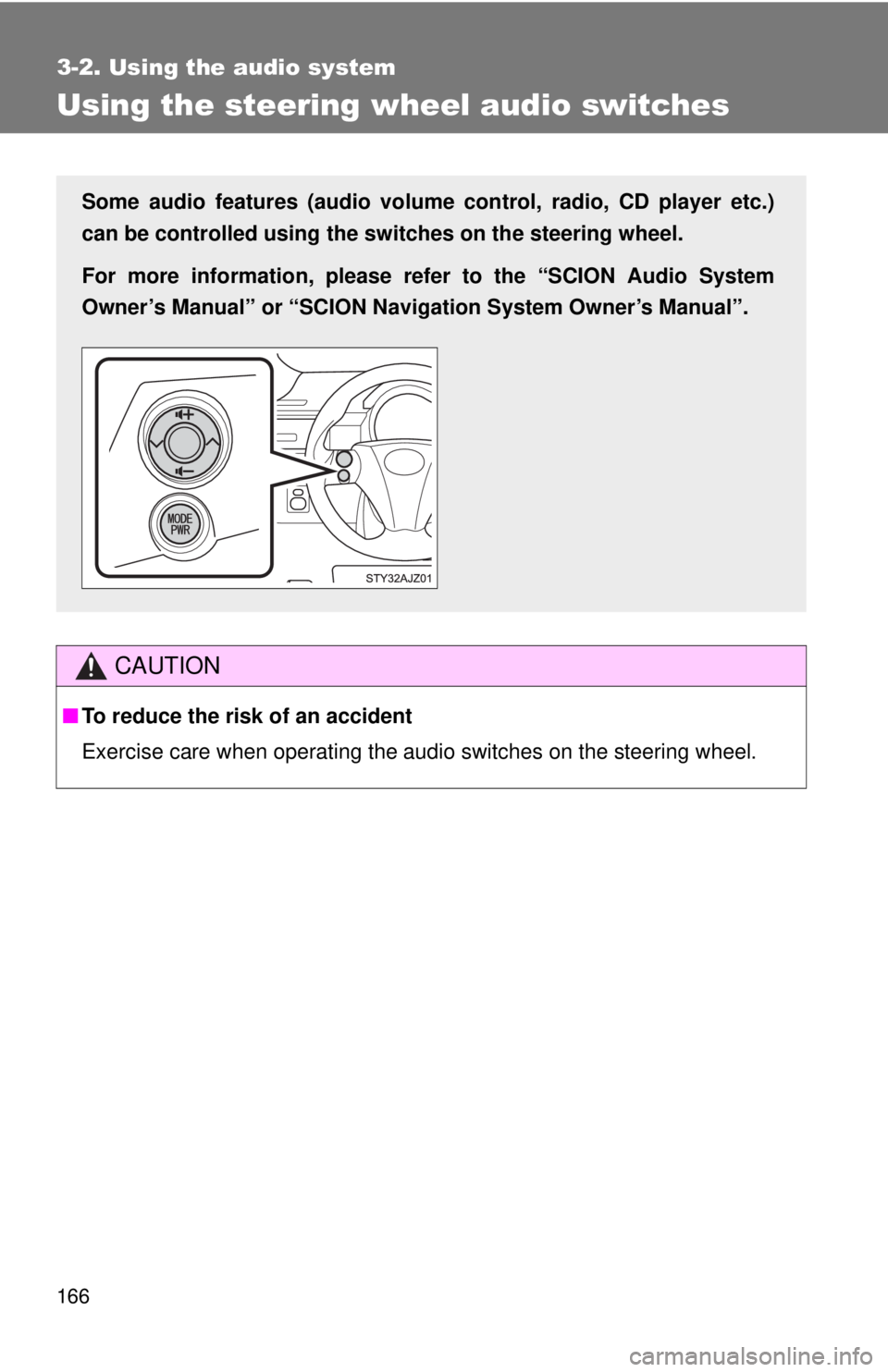
Using the steering wheel audio switches
CAUTION
■To reduce the risk of an accident
Exercise care when operating the audio switches on the steering wheel.
Some audio features (aud io volume control, radio, CD player etc.)
can be controlled using the switches on the steering wheel.
For more information, please re fer to the “SCION Audio System
Owner’s Manual” or “SCION Navigation System Owner’s Manual”.
Page 191 of 372
191
4-2. Maintenance
4
Maintenance and care
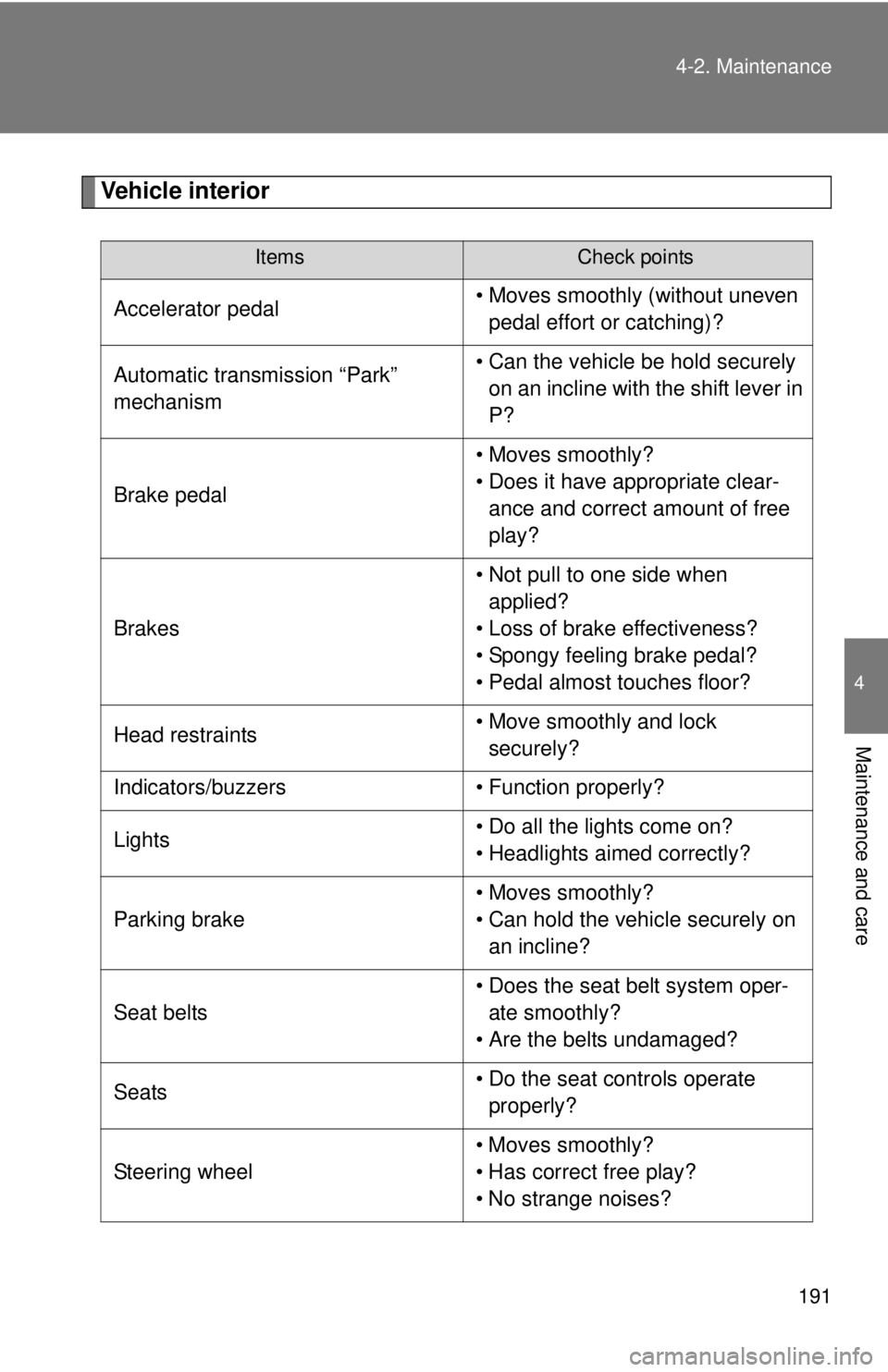
Vehicle interior
ItemsCheck points
Accelerator pedal
• Moves smoothly (without uneven
pedal effort or catching)?
Automatic transmission “Park”
mechanism • Can the vehicle be hold securely
on an incline with the shift lever in
P?
Brake pedal • Moves smoothly?
• Does it have appropriate clear-
ance and correct amount of free
play?
Brakes • Not pull to one side when
applied?
• Loss of brake effectiveness?
• Spongy feeling brake pedal?
• Pedal almost touches floor?
Head restraints • Move smoothly and lock
securely?
Indicators/buzzers • Function properly?
Lights • Do all the lights come on?
• Headlights aimed correctly?
Parking brake • Moves smoothly?
• Can hold the vehicle securely on
an incline?
Seat belts • Does the seat belt system oper-
ate smoothly?
• Are the belts undamaged?
Seats • Do the seat controls operate
properly?
Steering wheel • Moves smoothly?
• Has correct free play?
• No strange noises?
Page 246 of 372

246 4-3. Do-it-yourself maintenance
*1: Vehicles with daytime running light system
*2: Vehicles without daytime running light system14 MIR HTR 7.5 A Outside rear view mirror defoggers
15 DEFOGGER 30 A Rear window defogger
16 EPS 50 A Electric power steering
17 RDI 30 A RDI FAN
18 ABS NO.1 50 A Anti-lock brake system
19 HTR-B 40 A HTR, BLR
20 ABS NO.2 30 A Anti-lock brake system
21 HORN 10 A Horn
22 EFI-MAIN 20 A
Multiport fuel injection system/
sequential multiport fuel injection
system, EFI NO.1, Fuel pump
23 ALT-S 7.5 A Charging system
24 IGN 15 A Injection, igniter
25 IG2 10 A SRS airbag system, meter
26 EFI NO.1 10 AMultiport fuel injection system/
sequential multiport fuel injection
system
FuseAmpereCircuit
Page 248 of 372
248 4-3. Do-it-yourself maintenance
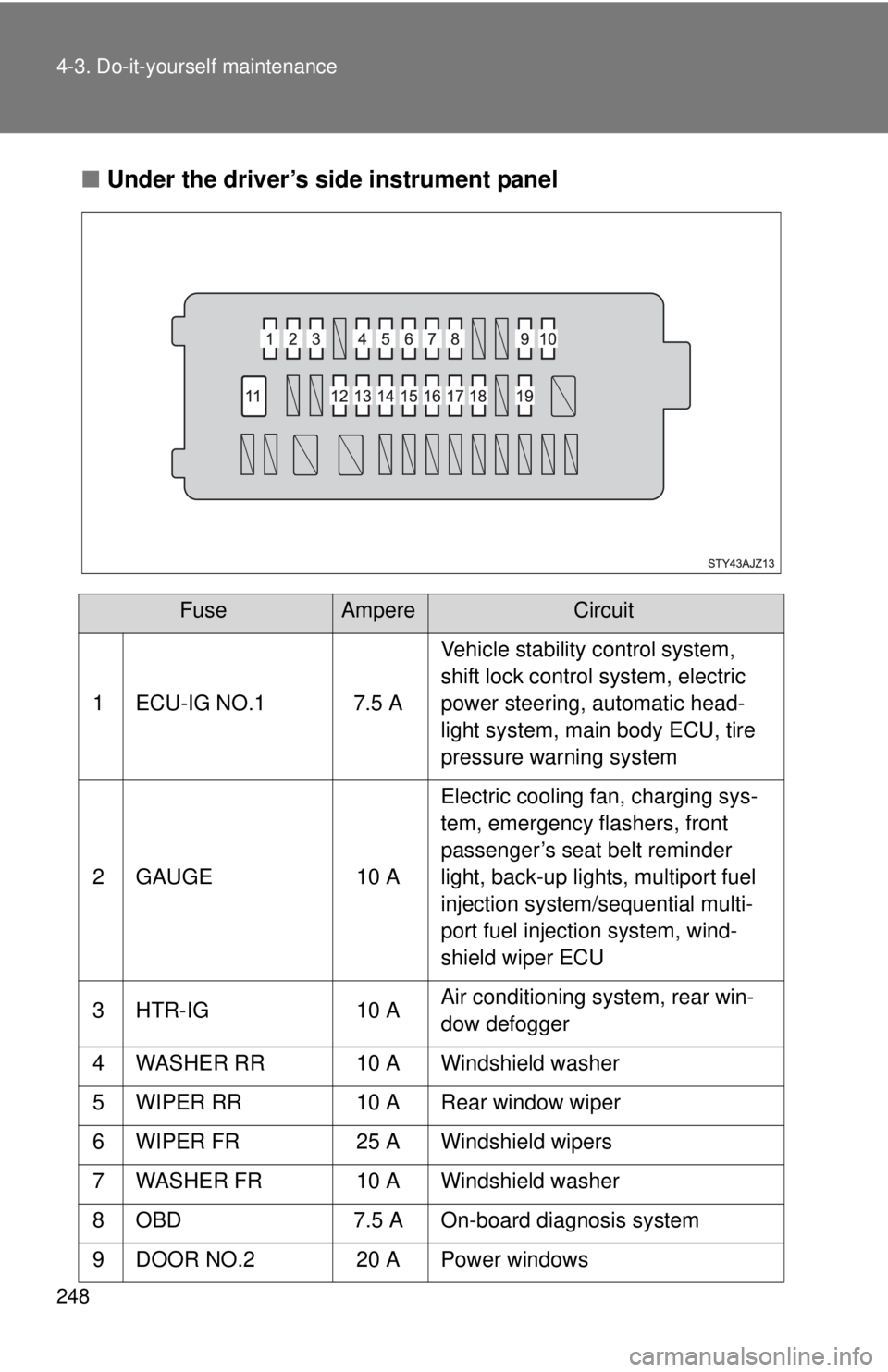
■Under the driver’s side instrument panel
FuseAmpereCircuit
1 ECU-IG NO.1 7.5 A Vehicle stability control system,
shift lock control system, electric
power steering, automatic head-
light system, main body ECU, tire
pressure warning system
2 GAUGE 10 A Electric cooling fan, charging sys-
tem, emergency flashers, front
passenger’s seat belt reminder
light, back-up lights, multiport fuel
injection system/sequential multi-
port fuel injection system, wind-
shield wiper ECU
3 HTR-IG 10 A Air conditioning system, rear win-
dow defogger
4 WASHER RR 10 A Windshield washer
5 WIPER RR 10 A Rear window wiper
6 WIPER FR 25 A Windshield wipers
7 WASHER FR 10 A Windshield washer
8 OBD 7.5 A On-board diagnosis system
9 DOOR NO.2 20 A Power windows
Page 265 of 372
5
When trouble arises
265
5-1. Essential information
If your vehicle needs to be towed
Before towingThe following may indicate a problem with your transmission. Contact
your Scion dealer before towing.
● The engine is running, but the vehicle will not move.
● The vehicle makes an abnormal sound.
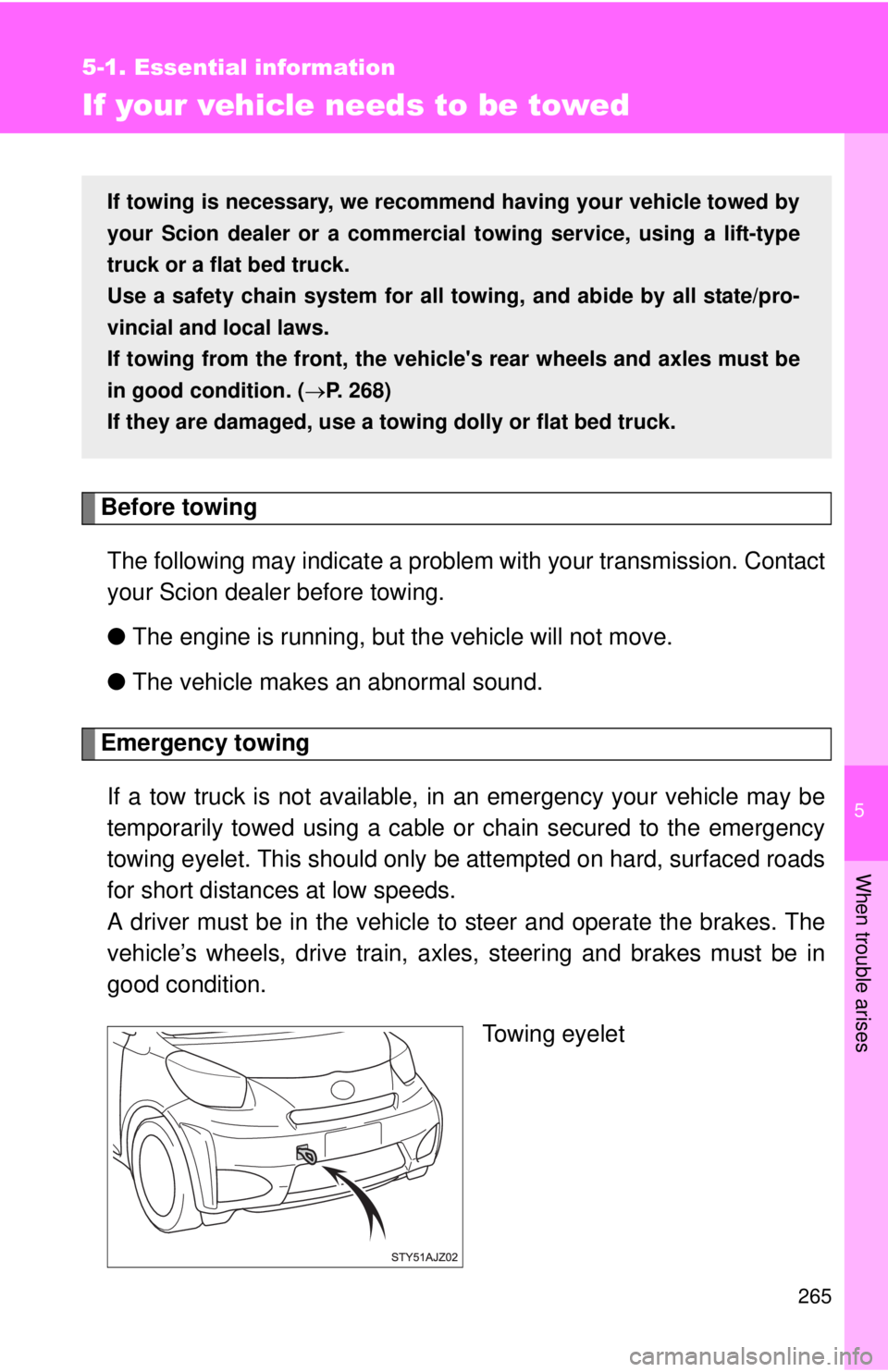
Emergency towing
If a tow truck is not available, in an emergency your vehicle may be
temporarily towed using a cable or chain secured to the emergency
towing eyelet. This should only be attempted on hard, surfaced roads
for short distances at low speeds.
A driver must be in the vehicle to steer and operate the brakes. The
vehicle’s wheels, drive train, axles, steering and brakes must be in
good condition.
Towing eyelet
If towing is necessary, we recommend having your vehicle towed by
your Scion dealer or a commercial towing service, using a lift-type
truck or a flat bed truck.
Use a safety chain system for all to wing, and abide by all state/pro-
vincial and local laws.
If towing from the front, the vehic le's rear wheels and axles must be
in good condition. (P. 268)
If they are damaged, use a towing dolly or flat bed truck.
Page 266 of 372
266 5-1. Essential information
■Emergency towin g procedure
Start the engine.
If the engine cannot be started, turn the engine switch to the ACC
or ON position.
Put the shift lever in N.
Release the parking brake.
CAUTION
■ Caution while towing
●Use extreme caution when towing the vehicle.
Avoid sudden starts or erratic driving maneuvers which place excessive
stress on the emergency towing eyelet and the cables or chains. Always
be cautious of the surroundings and other vehicles while towing.
● If the engine is not running, the power assist for the brakes and steering
will not function, making steering and braking more difficult.
NOTICE
■To prevent serious damage to the transmission
Never tow this vehicle from the rear with the front wheels on the ground.
This may cause serious damage to the transmission.