wheel TOYOTA IQ 2013 Manual PDF
[x] Cancel search | Manufacturer: TOYOTA, Model Year: 2013, Model line: IQ, Model: TOYOTA IQ 2013Pages: 372, PDF Size: 7.77 MB
Page 280 of 372

280 5-2. Steps to take in an emergency
■Front passenger detect ion sensor and passenger seat belt reminder
● If luggage or other load is placed on the front passenger seat, depending
on its weight, the reminder light to flash and buzzer to sound.
● If a cushion is placed on the seat, the sensor may not detect a passen-
ger, and the warning light may not operate properly.
■
When the tire pressure warning light comes on
Check the tire inflation pressure and adjust to the appropriate level.
Pushing the tire pressure warning reset switch does not turn off the tire
pressure warning light.
■The tire pressure warning light ma y turn on due to natural causes
The tire pressure warning light may turn on due to natural causes such
as natural air leaks or tire inflation pressure changes caused by temper-
ature. In this case, adjusting the ti re inflation pressure will turn off the
warning light (after a few minutes).
■If the tire pressure warning system is inoperative
The tire pressure warning system will be disabled in the following condi-
tions:
(When the condition becomes normal, the system will work properly.)
●If tires not equipped with tire pressure warning valves and transmit-
ters are used.
●If the ID code on the tire pressure warning valves and transmitters is
not registered in the tire pressure warning computer.
●If the tire inflation pressure is 73 psi (500 kPa, 5.1 kgf/cm2 or bar) or
higher.
The tire pressure warning system may be disabled in the following condi-
tions:
(When the condition becomes normal, the system will work properly.)
●If electronic devices or facilities using similar radio wave frequencies
are nearby.
●If a radio set at similar frequencies is in use in the vehicle.
●If a window tint that affects the radio wave signals is installed.
●If there is a lot of snow or ice on the vehicle, in particular around the
wheels or wheel housings.
Page 281 of 372
5
When trouble arises
281
5-2. Steps to take in an emergency
●If non-genuine Scion wheels are used. (Even if you use Scion
wheels, the tire pressu
re warning system may not work properly with
some types of tires.)
●If tire chains are used.
●If emergency tire puncture repair kit is used.
■If the tire pressure warning light frequently comes on after blinking
for 1 minute
If the tire pressure warning light frequently comes on after blinking for 1
minute when the engine switch is turned to the ON position, have it
checked by your Scion dealer.
■ Customization that can be configured at Scion dealer
The vehicle speed linked seat belt reminder buzzer can be disabled.
(Customizable features P. 339)
CAUTION
■When the electric power steering system warning light comes on
The steering wheel may become extremely heavy.
If the steering wheel becomes heavier than usual when operating, hold
firmly and operate using more force than usual.
■If the tire pressure warning light comes on
Be sure to observe the following precautions. Failure to do so could
cause loss of vehicle control and result in death or serious injury.
●Stop your vehicle in a safe place as soon as possible. Adjust the tire
inflation pressure immediately.
●If the tire pressure warning light comes on even after tire inflation pres-
sure adjustment, it is pr obable that you have a flat tire. Check the tires.
If the tire is flat, temporary repair it with liquid sealants and have the
flat tire repaired or replaced by the nearest Scion dealer as soon as
possible.
●Avoid abrupt maneuvering and braking. If the vehicle tires deteriorate,
you could lose control of the steering wheel or the brakes.
■If a blowout or sudden air leakage should occur
The tire pressure warning syste m may not activate immediately.
Page 283 of 372

5
When trouble arises
283
5-2. Steps to take in an emergency
CAUTION
TPMS (tire pressure warning system) malfunctions may occur for a vari-
ety of reasons, including the installati
on of replacement or alternate tires
or wheels on the vehicle that prevent the TPMS (tire pressure warning
system) from functioning properly. Always check the TPMS (tire pres-
sure warning system) malfunction te lltale after replacing one or more
tires or wheels on your vehicle to ensure that the replacement or alter-
nate tires and wheels allow the TPMS (tire pressure warning system) to
continue to function properly.
NOTICE
■Precaution when installing a different tire
When a tire of a different specification or maker is installed, the tire pres-
sure warning system may not operate properly.
Page 288 of 372
288 5-2. Steps to take in an emergency
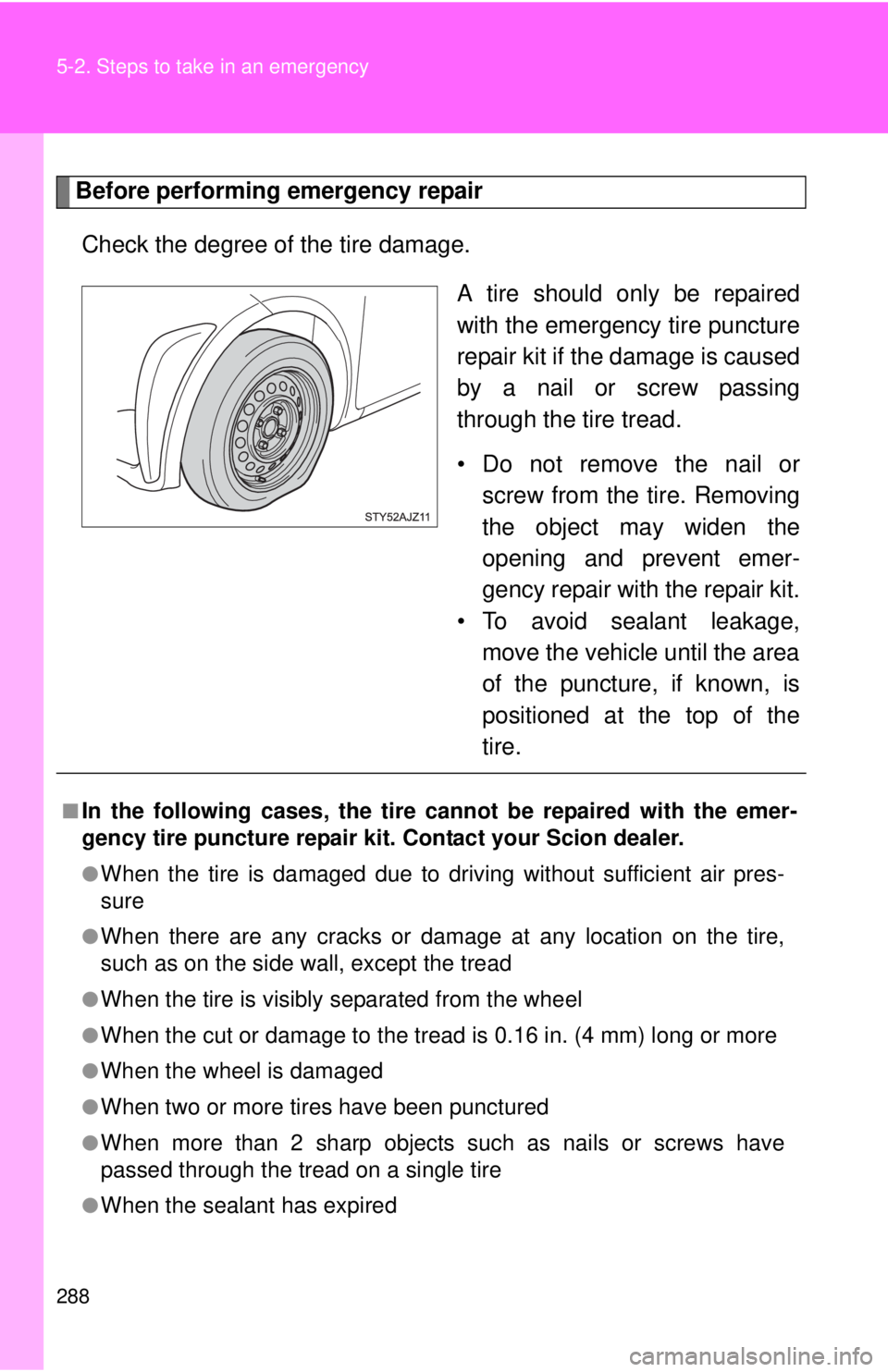
Before performing emergency repairCheck the degree of the tire damage. A tire should only be repaired
with the emergency tire puncture
repair kit if the damage is caused
by a nail or screw passing
through the tire tread.
• Do not remove the nail orscrew from the tire. Removing
the object may widen the
opening and prevent emer-
gency repair with the repair kit.
• To avoid sealant leakage, move the vehicle until the area
of the puncture, if known, is
positioned at the top of the
tire.
■In the following cases, the tire cannot be repaired with the emer-
gency tire puncture repair kit. Contact your Scion dealer.
●When the tire is damaged due to dr iving without sufficient air pres-
sure
●When there are any cracks or damage at any location on the tire,
such as on the side wall, except the tread
●When the tire is visibly separated from the wheel
●When the cut or damage to the trea d is 0.16 in. (4 mm) long or more
●When the wheel is damaged
●When two or more tires have been punctured
●When more than 2 sharp objects such as nails or screws have
passed through the tread on a single tire
●When the sealant has expired
Page 291 of 372
5
When trouble arises
291
5-2. Steps to take in an emergency
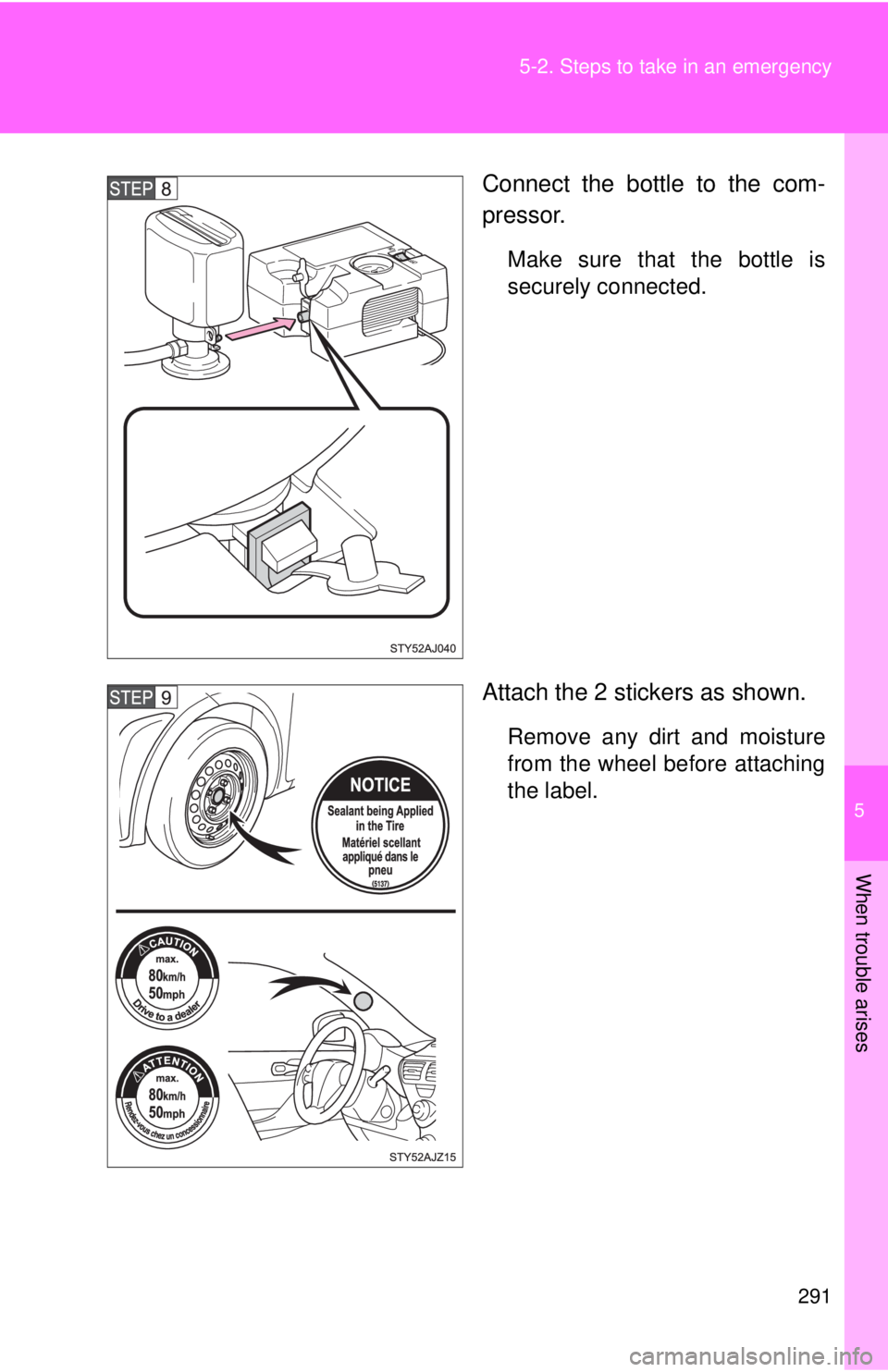
Connect the bottle to the com-
pressor.
Make sure that the bottle is
securely connected.
Attach the 2 stickers as shown.
Remove any dirt and moisture
from the wheel before attaching
the label.
Page 296 of 372

296 5-2. Steps to take in an emergency
■Emergency tire puncture repair kit
●The sealant stored in the emergency tire puncture repair kit can be
used only once to temporarily repair a single tire. If the sealant has
been used and needs to be replaced, contact your Scion dealer.
●The sealant can be used when the outside temperature is from -40°F
(-40°C) to 140°F (60°C).
●The repair kit is exclusively designed for size and type of tires origi-
nally installed on your vehicle. Do not use it for tires that a different
size than the original ones, or for any other purposes.
●The sealant has a limited lifespan. The expiration date is shown on
the bottle. The sealant should be re placed before the expiration date.
Contact your Scion dealer.
●If the sealant gets on your clothes, it may stain.
●If the sealant adheres to a wheel or the surface of the vehicle body,
the stain may not be removable if it is not cleaned at once. Immedi-
ately wipe away the sealant with a wet cloth.
●During operation of the repair kit, a loud operation noise is produced.
This does not indicate a malfunction.
●Do not use to check or to adjust the tire pressure.
Page 298 of 372

298 5-2. Steps to take in an emergency
CAUTION
■Do not drive the vehicle with a flat tire
Do not continue driving with a flat tire.
Driving even a short distance with a flat tire can damage the tire and the
wheel beyond repair.
Driving with a flat tire may cause a circumferential groove on the side
wall. In such a case, the tire may explode when using a repair kit.
■Caution while driving
●Store the repair kit in the luggage room.
Otherwise, the repair kit may fly out and break in events such as sud-
den braking, and may cause an accident.
●The repair kit is exclusively only for your vehicle.
Do not use repair kit on other vehicles, which could lead to an accident
causing death or serious injury.
●Do not use repair kit for tires that are different size than the original
ones, or for any other purpose. If the tires have not been completely
repaired, it could lead to an accident causing death or serious injury.
■Precautions for use of the sealant
●Ingesting the sealant is hazardous to your health. If you ingest sealant,
consume as much water as possible, and then immediately consult a
doctor.
●If sealant gets in eyes or adheres to skin, immediately wash it off with
water. If discomfort persists, consult a doctor.
■When fixing the flat tire
●Stop your vehicle in a safe and flat area.
●Do not touch the wheels or the ar ea around the brakes immediately
after the vehicle has been driven.
After the vehicle has been driven, the wheels and the area around the
brakes may be extremely hot. Touching these areas with hands, feet or
other body parts may result in burns.
●Connect the valve and hose securely with the tire installed on the vehi-
cle. If the hose is not properly con nected to the valve, air leakage may
occur as sealant may be sprayed out.
Page 299 of 372

5
When trouble arises
299
5-2. Steps to take in an emergency
CAUTION
■When fixing the flat tire
●If the hose comes off the valve while inflating the tire, there is a risk
that the hose will
move abruptly due to air pressure.
●After inflation of the tire has comp leted, the sealant may splatter when
the hose is disconnected or so me air is let out of the tire.
●Follow the operation procedure to repair the tire. If the procedures not
followed, the sealant may spray out.
●Keep back from the tire while it is being repaired, as there is a chance
of it bursting while the repair ope ration is being performed. If you
notice any cracks or deformation of the tire, turn off the compressor
switch and stop the repair operation immediately.
●The repair kit may overheat if operated for a long period of time. Do not
operate the repair kit continuously for more than 60 minutes.
●Parts of the repair kit become hot during operation. Be careful handling
the repair kit during and after operation. Do not touch the metal part
connecting the bottle and the co mpressor. It will be extremely hot.
●Do not attach the vehicle speed warning sticker to an area other than
the one indicated. If the sticker is attached to an area where an SRS
airbag is located, such as the pad of the steering wheel, it may prevent
the SRS airbag from operating properly.
■Driving to spread the liquid sealant evenly
Observe the following precautions to reduce the risk of accidents.
Failing to do so may result in a loss of vehicle control and cause death or
serious injury.
●Drive the vehicle carefully at a lo w speed. Be especially careful when
turning and cornering.
●If the vehicle does not drive straight or you feel a pull through the
steering wheel, stop the vehicle and check the following.
• Tire condition. The tire may have separated from the wheel.
• Tire inflation pressure. If the tire inflation pressure is 19 psi (130 kPa, 1.3 kgf/cm
2 or bar) or less, the tire may be severely damaged.
Page 312 of 372

312 5-2. Steps to take in an emergency
CAUTION
■When attempting to free a stuck vehicle
If you choose to rock the vehicle back and forth to free it, make sure the sur-
rounding area is clear, to avoid striking other vehicles, objects or persons.
The vehicle may also lunge forward or lunge back suddenly as it becomes
free. Use extreme caution.
■ When shifting the shift lever
Be careful not to shift the shift lever with the accelerator pedal depressed.
This may lead to unexpected rapid acceleration of the vehicle that may
cause an accident and result in death or serious injury.
NOTICE
■To avoid damaging the transmission and other components
●Avoid spinning the wheels and do not rev the engine.
● If the vehicle remains stuck after trying these procedures, the vehicle may
require towing to be freed.
Page 314 of 372

314 5-2. Steps to take in an emergency
CAUTION
■If the engine has to be turned off while driving
●Power assist for the brakes and steering wheel will be lost, making the
brake pedal harder to depress and the steering wheel heavier to turn.
Decelerate as much as possible before turning off the engine.
● Never attempt to remove the key, as doing so will lock the steering wheel.