air condition TOYOTA IQ 2013 Owners Manual
[x] Cancel search | Manufacturer: TOYOTA, Model Year: 2013, Model line: IQ, Model: TOYOTA IQ 2013Pages: 372, PDF Size: 7.77 MB
Page 1 of 372

TABLE OF CONTENTS
1
1Before drivingAdjusting and operating features such as door locks,
mirrors, and steering column.
2When drivingDriving, stopping and safe-driving information.
3Interior
featuresAir conditioning and audio systems, as well as other in-
terior features for a comfortable driving experience.
4Maintenance
and careCleaning and protecting your vehicle, performing do-it-
yourself maintenance, and maintenance information.
5When trouble
arisesWhat to do if the vehicle needs to be towed, gets a flat
tire, or is involved in an accident.
6Vehicle
specificationsDetailed vehicle information.
7For ownersReporting safety defects for U.S. owners, and seat belt
and SRS airbag instructions for Canadian owners
IndexAlphabetical listing of information contained in this
manual.
Page 3 of 372

1
2
3
4
5
6
7
3
2-5. Driving informationCargo and luggage ............. 144
Vehicle load limits ............... 148
Winter driving tips ............... 149
Trailer towing ...................... 153
Dinghy towing ..................... 154
3-1. Using the air conditioning system and defogger
Air conditioning system ....... 156
Rear window defogger ........ 162
Rear window and outside rear view mirror
defoggers .......................... 163
3-2. Using the audio system Using the AUX port/USB port ........................... 165
Using the steering wheel audio switches .................. 166
3-3. Using the interior lights Interior lights list .................. 167
• Interior light ....................... 168
3-4. Using the storage features List of storage features ....... 169
• Cup holder ........................ 170
• Bottle holders .................... 171
• Auxiliary box ..................... 172 3-5. Other interior features
Sun visors........................... 173
Vanity mirrors ..................... 174
Power outlet ....................... 175
Assist grips ......................... 176
Floor mat ............................ 177
Luggage compartment features ............................ 179
4-1. Maintenance and care Cleaning and protecting the vehicle exterior ........... 182
Cleaning and protecting the vehicle interior ............ 185
4-2. Maintenance Maintenance requirements .................... 188
General maintenance ......... 190
Emission inspection and maintenance (I/M)
programs .......................... 193
3Interior features
4Maintenance and care
Page 4 of 372

TABLE OF CONTENTSIndex
4
4-3. Do-it-yourself maintenanceDo-it-yourself service precautions ...................... 194
Hood................................... 197
Positioning a floor jack ....... 199
Replacing the tire ............... 202
Engine compartment .......... 208
Tires ................................... 220
Tire inflation pressure......... 228
Wheels ............................... 232
Air conditioning filter ........... 234
Key battery ......................... 238
Checking and replacing fuses ................................ 240
Light bulbs .......................... 251
5-1. Essential information Emergency flashers ........... 264
If your vehicle needs to be towed .......................... 265
If you think something is wrong ............................... 271
Fuel pump shut off system .............................. 272 5-2. Steps to take in an emergency
If a warning light turns on or a warning buzzer
sounds... ........................... 273
If you have a flat tire ........... 284
If the engine will not start .... 301
If the shift lever cannot be shifted from P .............. 303
If you lose your keys ........... 304
If the vehicle battery is discharged ........................ 305
If your vehicle overheats..... 308
If the vehicle becomes stuck ................................. 311
If your vehicle has to be stopped in
an emergency................... 313
6-1. Specifications Maintenance data (fuel, oil level, etc.) ........... 316
Fuel information .................. 325
Tire information................... 328
6-2. Customization Customizable features ........ 339
Items to initialize ................. 341
5When trouble arises
6Vehicle specifications
Page 13 of 372
13
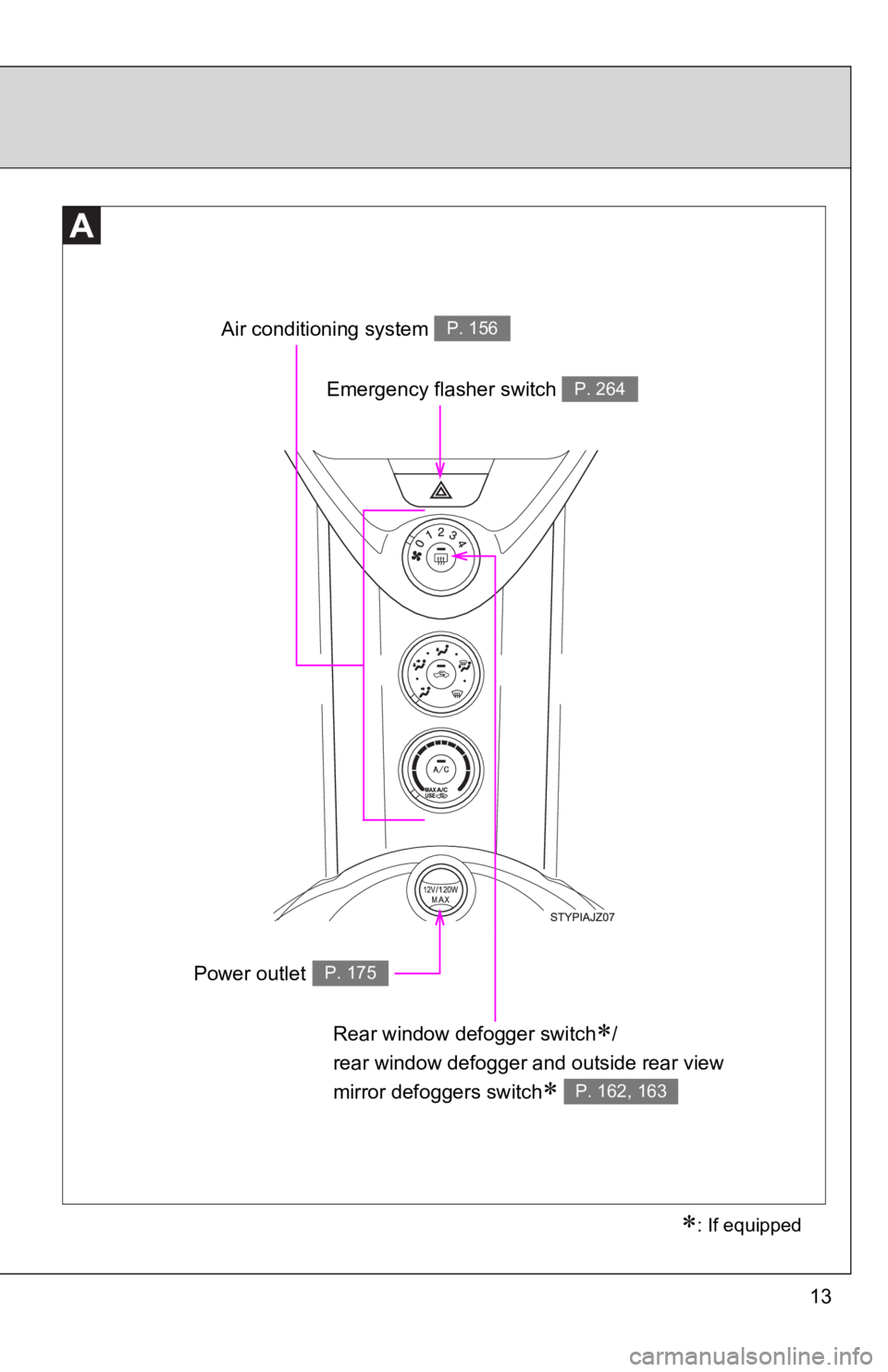
Emergency flasher switch P. 264
: If equipped
Rear window defogger switch/
rear window defogger and outside rear view
mirror defoggers switch
P. 162, 163
Air conditioning system P. 156
Power outletP. 175
Page 27 of 372

27
1-2. Opening, closing and locking the doors
1
Before driving
■
Conditions affecting operation
The wireless remote control function may not operate normally in the follow-
ing situations.
●Near a TV tower, radio station, elec tric power plant, airport, gas station or
other facility that generates strong radio waves
● When carrying a portable radio, cell ular phone or other wireless commu-
nication device
● When multiple wireless keys are in the vicinity
● When the wireless key has come into contact with, or is covered by a
metallic object
● When a wireless key (that emits radio waves) is being used nearby
● When the wireless key has been left near an electrical appliance such as
a personal computer
■ Customization that can be configured at Scion dealer
Settings (e.g. wireless remote control system) can be changed.
(Customizable features P. 339)
■Certification for wireless remote control
For vehicles sold in U.S.A.
FCC ID: MOZB21RG
FCC ID: MOZB23RG
FCC ID: MOZB41TG
This device complies with part 15 of the FCC Rules. Operation is subject to
the following two conditions: (1) This device may not cause harmful interfer-
ence, and (2) this device must accept any interference received, including
interference that may cause undesired operation.
FCC WARNING:
Changes or modifications not expressly approved by the party responsible
for compliance could void the user's authority to operate the equipment. For vehicles sold in Canada
This device complies with RSS-210 of Industry Canada.
Operation is subject to the following two conditions: (1) this device may not
cause interference, and (2) this device must accept any interference, includ-
ing interference that may cause undesired operation of the device.
Page 68 of 372

68 1-7. Safety information
Your vehicle is equipped with ADVANCED AIRBAGS designed based
on the US motor vehicle safety standards (FMVSS208). The airbag
sensor assembly (ECU) controls ai rbag deployment based on infor-
mation obtained from the sensors etc. shown in the system compo-
nents diagram above. This inform ation includes crash severity and
occupant information. As the air bags deploy, a chemical reaction in
the inflators quickly fills the airbag s with non-toxic gas to help restrain
the motion of the occupants.
■ If the SRS airbags deploy (inflate)
●Bruising and slight abrasions may result from contact with a deploying
(inflating) SRS airbag.
● A loud noise and white powder will be emitted.
● Parts of the airbag module (steering wheel hub, airbag cover and inflator)
as well as the front seats, and parts of the front and rear pillars, roof side
rail and rear roof headlining may be hot for several minutes. The airbag
itself may also be hot.
● The front windshield may crack.
■ Operating conditions (SRS front airbags)
●The SRS front airbags and SRS seat cushion airbags will deploy in the
event of an impact that exceeds the set threshold level (the level of force
corresponding to an approximately 12-18 mph [20-30 km/h] frontal colli-
sion with a fixed wall that does not move or deform).
However, this threshold velocity will be considerably higher if the vehicle
strikes an object, such as a parked vehicle or sign pole, which can move or
deform on impact, or if the vehicle is involved in an underride collision (e.g.
a collision in which the front of the vehicle “underrides”, or goes under, the
bed of a truck, etc.).
● Depending on the type of collision, it is possible that only the seat belt
pretensioners will activate.
● The SRS front airbags and seat cushion airbag for the front passenger
will not activate if there is no passenger sitting in the front passenger
seat. However, the SRS front airbags and seat cushion airbag for the
front passenger may deploy if luggage is put in the seat, even if the seat
is unoccupied. ( P. 79)
Page 69 of 372
69
1-7. Safety information
1
Before driving
●
The SRS seat cushion airbags on the front seats will not operate if the
occupant is not wearing a seat belt.
■ Operating conditions (SRS side ai rbags and SRS curtain shield air-
bags)
● The SRS side airbags and SRS curtain shield airbags will deploy in the
event of an impact that exceeds the set threshold level (the level of force
corresponding to the impact force produced by an approximately 3300 lb.
[1500 kg] vehicle colliding with the vehicle cabin from a direction perpen-
dicular to the vehicle orientation at an approximate speed of 12-18 mph
[20-30 km/h]).
● The SRS curtain shield airbags may also deploy in the event of a severe
frontal collision.
■ Operating conditions (SRS rear window curtain shield airbag)
The SRS rear window curtain shield airbag is designed to inflate when the
passenger compartment is subjected to a severe impact from the rear or
side.
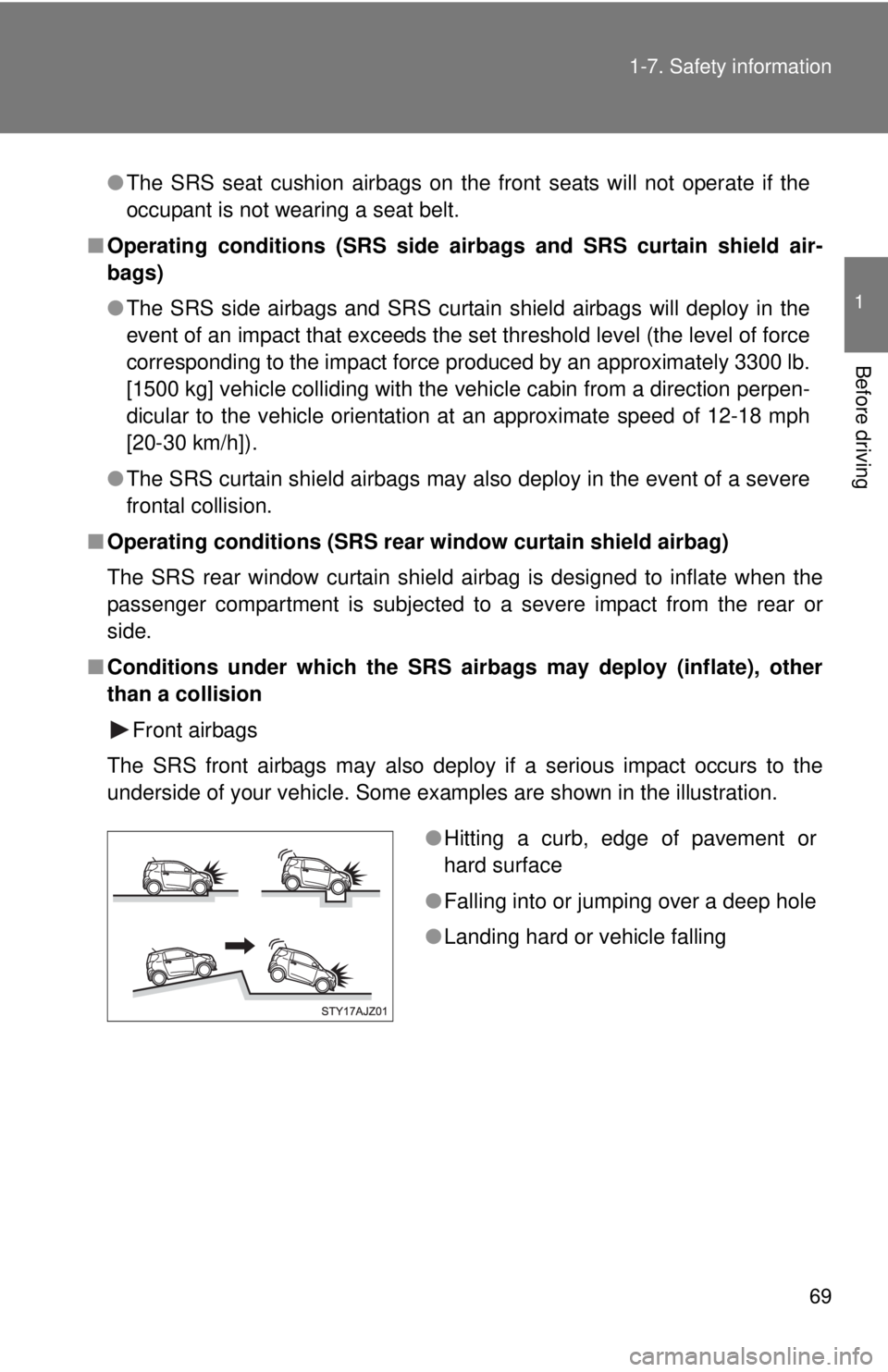
■ Conditions under which the SRS airbags may deploy (inflate), other
than a collision
Front airbags
The SRS front airbags may also deploy if a serious impact occurs to the
underside of your vehicle. Some examples are shown in the illustration.
● Hitting a curb, edge of pavement or
hard surface
● Falling into or jumping over a deep hole
● Landing hard or vehicle falling
Page 71 of 372
71
1-7. Safety information
1
Before driving
■
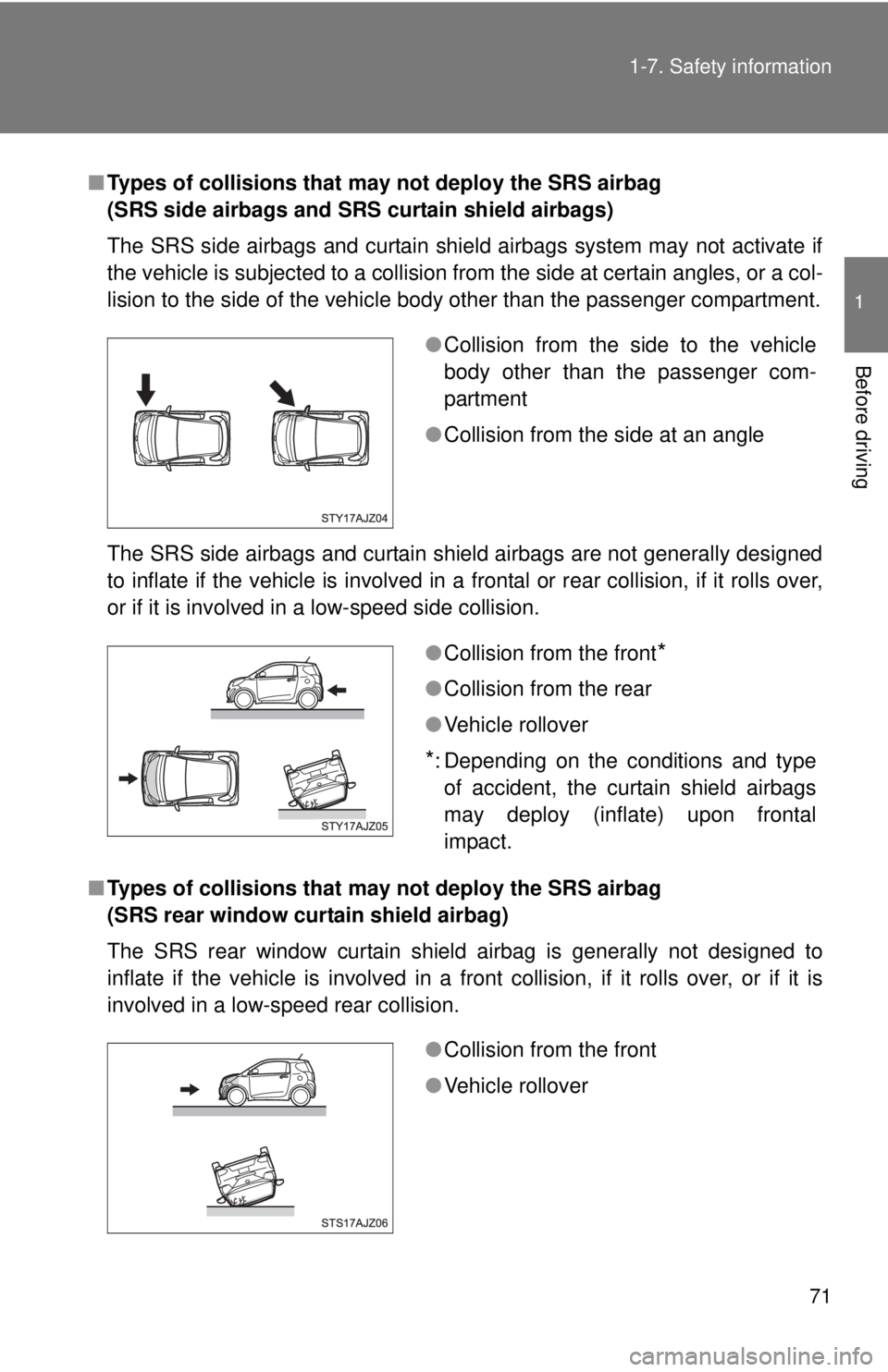
Types of collisions that may not deploy the SRS airbag
(SRS side airbags and SRS curtain shield airbags)
The SRS side airbags and curtain shield airbags system may not activate if
the vehicle is subjected to a collision from the side at certain angles, or a col-
lision to the side of the vehicle body other than the passenger compartment.
The SRS side airbags and curtain shield airbags are not generally designed
to inflate if the vehicle is involved in a frontal or rear collision, if it rolls over,
or if it is involved in a low-speed side collision.
■ Types of collisions that may not deploy the SRS airbag
(SRS rear window curtain shield airbag)
The SRS rear window curtain shield airbag is generally not designed to
inflate if the vehicle is involved in a front collision, if it rolls over, or if it is
involved in a low-speed rear collision.
● Collision from the side to the vehicle
body other than the passenger com-
partment
● Collision from the side at an angle
●Collision from the front*
●Collision from the rear
● Vehicle rollover
*: Depending on the conditions and type
of accident, the curtain shield airbags
may deploy (inflate) upon frontal
impact.
● Collision from the front
● Vehicle rollover
Page 79 of 372
79
1
1-7. Safety information
Before driving
Front passenger occupant classification system
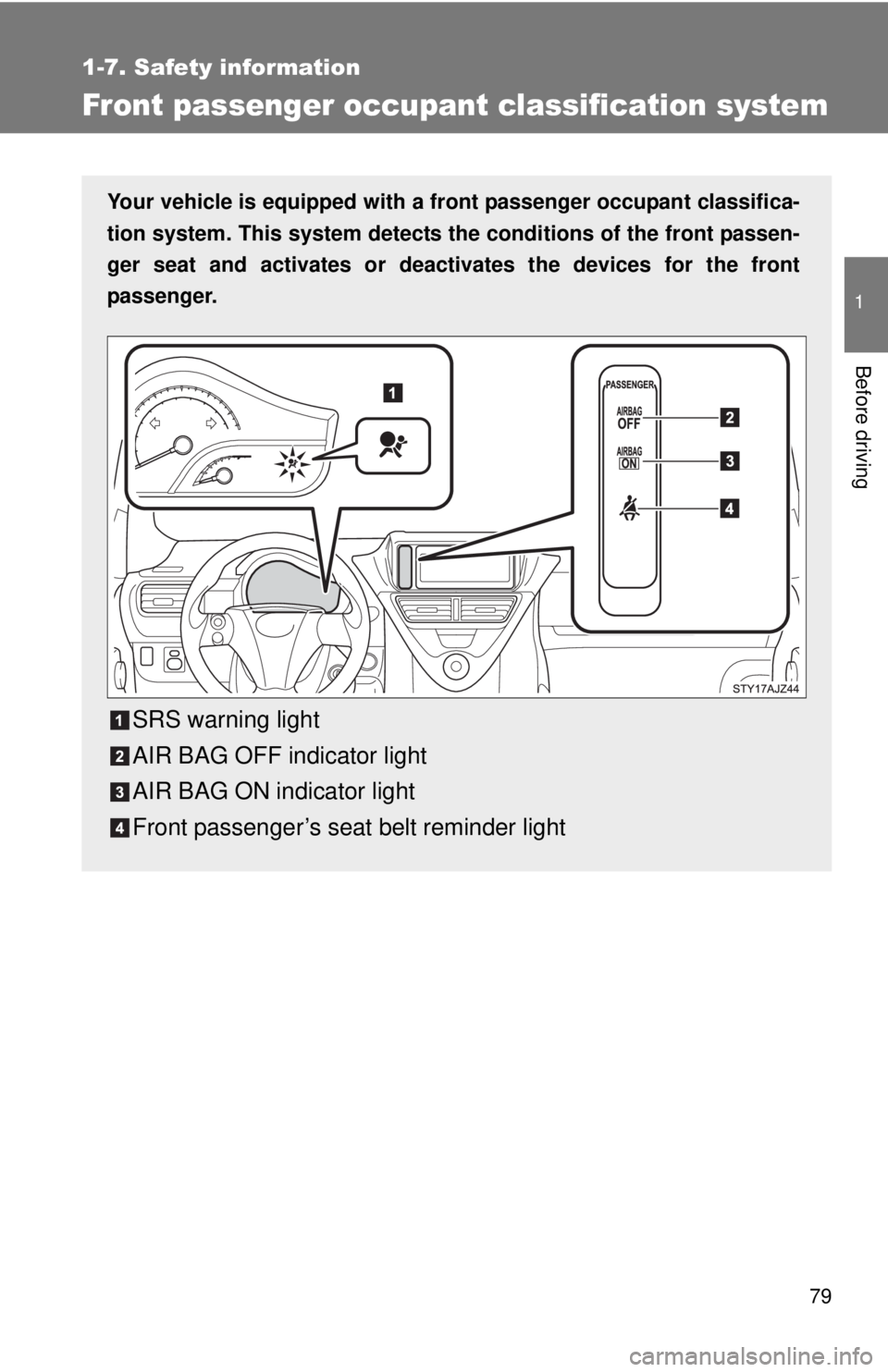
Your vehicle is equipped with a front passenger occupant classifica-
tion system. This system detects the conditions of the front passen-
ger seat and activates or deactiv ates the devices for the front
passenger.
SRS warning light
AIR BAG OFF indicator light
AIR BAG ON indicator light
Front passenger’s seat belt reminder light
Page 80 of 372

80 1-7. Safety information
Condition and operation in the front passenger occupant classification system
■Adult*1
■Child*4 or child restraint system*5
Indicator/
warning light AIR BAG ON and AIR BAG OFF indicator
lights AIR BAG ON
SRS warning light Off
Front passenger’s seat belt reminder light Off*2
or
flashing
*3
Devices Front passenger airbag
Activated
Side airbag on the front passenger seat
Curtain shield airbag in the front passenger side
Front passenger knee airbag
Seat cushion airbag in the front passenger side Activated
*2
or
deactivated
*3
Front passenger’s seat belt pretensioner Activated
Indicator/
warning light AIR BAG ON and AIR BAG OFF indicator
lights AIR BAG
OFF
*6
SRS warning light Off
Front passenger’s seat belt reminder light Off
*2
or
flashing
*3
Devices Front passenger airbag Deactivated
Side airbag on the front passenger seat Activated
Curtain shield airbag in the front passenger
side
Front passenger knee airbag Deactivated
Seat cushion airbag in the front passenger
side
Front passenger’s seat belt pretensioner Activated