ESP TOYOTA IQ 2014 Owner's Manual
[x] Cancel search | Manufacturer: TOYOTA, Model Year: 2014, Model line: IQ, Model: TOYOTA IQ 2014Pages: 376, PDF Size: 7.76 MB
Page 286 of 376

286 5-2. Steps to take in an emergency
CAUTION
■Maintenance of the tire
Each tire, including the spare (if provided), should be checked monthly
when cold and inflated to the inflation pressure recommended by the
vehicle manufacturer on the vehicle placard or tire inflation pressure
label (tire and load information label). (If your vehicle has tires of a differ-
ent size than the size indicated on the vehicle placard or tire inflation
pressure label [tire and load information label], you should determine the
proper tire inflation pr essure for those tires.)
As an added safety feature, your vehicle has been equipped with a tire
pressure monitoring system (TPMS-ti re pressure warning system) that
illuminates a low tire pressure telltal e (tire pressure warning light) when
one or more of your tires is significantly under-inflated. Accordingly,
when the low tire pressu re telltale (tire pressure warning light) illumi-
nates, you should stop and check your tires as soon as possible, and
inflate them to the proper pressure. Driving on a significantly under-
inflated tire causes the tire to overheat and can lead to tire failure.
Under-inflation also reduces fuel effi ciency and tire tread life, and may
affect the vehicle’s handling and stopping ability.
Please note that the TPMS (tire pressure warning system) is not a sub-
stitute for proper tire main tenance, and it is the driver’s responsibility to
maintain correct tire pressure, even if under-inflation has not reached the
level to trigger illu mination of the TPMS low tire pressure telltale (tire
pressure warning light).
Your vehicle has also been equipped with a TPMS (tire pressure warning
system) malfunction indicator to indi cate when the system is not operat-
ing properly. The TPMS (tire pressure warning system) malfunction indi-
cator is combined with the low tire pressure telltale (tire pressure
warning light). When the system det ects a malfunction, the telltale will
flash for approximately one minute an d then remain continuously illumi-
nated. This sequence will continue upon subsequent vehicle start-ups as
long as the malfunction exists. When the malfunction indi cator is illumi-
nated, the system may not be able to detect or signal low tire pressure
as intended.
Page 300 of 376

300 5-2. Steps to take in an emergency
■Emergency tire puncture repair kit
●The sealant stored in the emergency tire puncture repair kit can be
used only once to temporarily repair a single tire. If the sealant has
been used and needs to be replaced, contact your Scion dealer.
●The sealant can be used when the outside temperature is from -40°F
(-40°C) to 140°F (60°C).
●The repair kit is exclusively designed for size and type of tires origi-
nally installed on your vehicle. Do not use it for tires that a different
size than the original ones, or for any other purposes.
●The sealant has a limited lifespan. The expiration date is shown on
the bottle. The sealant should be re placed before the expiration date.
Contact your Scion dealer.
●If the sealant gets on your clothes, it may stain.
●If the sealant adheres to a wheel or the surface of the vehicle body,
the stain may not be removable if it is not cleaned at once. Immedi-
ately wipe away the sealant with a wet cloth.
●During operation of the repair kit, a loud operation noise is produced.
This does not indicate a malfunction.
●Do not use to check or to adjust the tire pressure.
Page 303 of 376

5
When trouble arises
303
5-2. Steps to take in an emergency
CAUTION
■When fixing the flat tire
●If the hose comes off the valve while inflating the tire, there is a risk
that the hose will
move abruptly due to air pressure.
●After inflation of the tire has comp leted, the sealant may splatter when
the hose is disconnected or so me air is let out of the tire.
●Follow the operation procedure to repair the tire. If the procedures not
followed, the sealant may spray out.
●Keep back from the tire while it is being repaired, as there is a chance
of it bursting while the repair ope ration is being performed. If you
notice any cracks or deformation of the tire, turn off the compressor
switch and stop the repair operation immediately.
●The repair kit may overheat if operated for a long period of time. Do not
operate the repair kit continuously for more than 60 minutes.
●Parts of the repair kit become hot during operation. Be careful handling
the repair kit during and after operation. Do not touch the metal part
connecting the bottle and the co mpressor. It will be extremely hot.
●Do not attach the vehicle speed warning sticker to an area other than
the one indicated. If the sticker is attached to an area where an SRS
airbag is located, such as the pad of the steering wheel, it may prevent
the SRS airbag from operating properly.
■Driving to spread the liquid sealant evenly
Observe the following precautions to reduce the risk of accidents.
Failing to do so may result in a loss of vehicle control and cause death or
serious injury.
●Drive the vehicle carefully at a lo w speed. Be especially careful when
turning and cornering.
●If the vehicle does not drive straight or you feel a pull through the
steering wheel, stop the vehicle and check the following.
• Tire condition. The tire may have separated from the wheel.
• Tire inflation pressure. If the tire inflation pressure is 19 psi (130 kPa, 1.3 kgf/cm
2 or bar) or less, the tire may be severely damaged.
Page 313 of 376
5
When trouble arises
313
5-2. Steps to take in an emergency
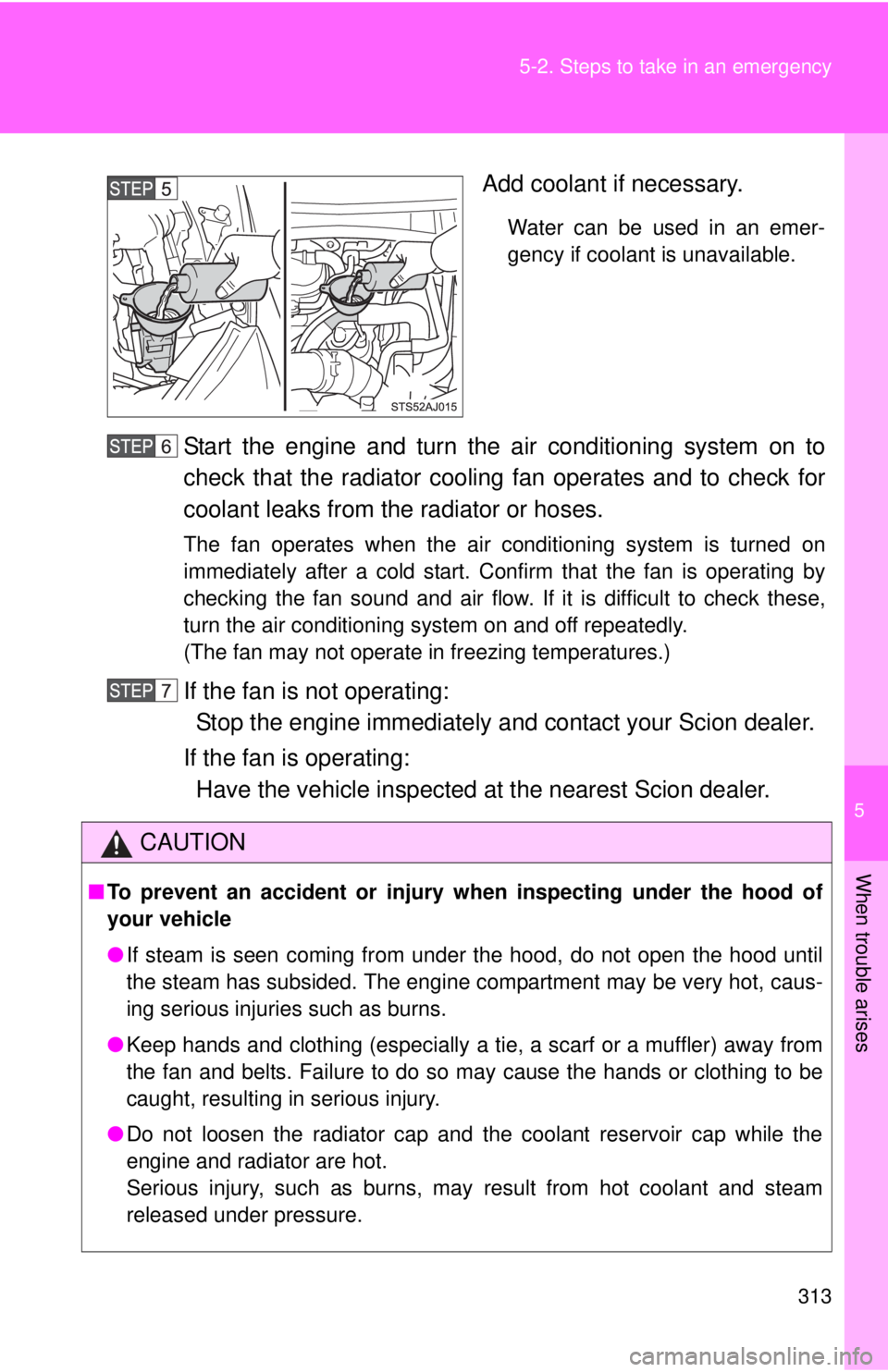
Add coolant if necessary.
Water can be used in an emer-
gency if coolant is unavailable.
Start the engine and turn the
air conditioning system on to
check that the radiator cooling fan operates and to check for
coolant leaks from the radiator or hoses.
The fan operates when the air conditioning system is turned on
immediately after a cold start. Confirm that the fan is operating by
checking the fan sound and air flow. If it is difficult to check these,
turn the air conditioning system on and off repeatedly.
(The fan may not operate in freezing temperatures.)
If the fan is not operating: Stop the engine immediately a nd contact your Scion dealer.
If the fan is operating: Have the vehicle inspected at the nearest Scion dealer.
CAUTION
■ To prevent an accident or injury when inspecting under the hood of
your vehicle
●If steam is seen coming from under the hood, do not open the hood until
the steam has subsided. The engine compartment may be very hot, caus-
ing serious injuries such as burns.
● Keep hands and clothing (especially a tie, a scarf or a muffler) away from
the fan and belts. Failure to do so may cause the hands or clothing to be
caught, resulting in serious injury.
● Do not loosen the radiator cap and the coolant reservoir cap while the
engine and radiator are hot.
Serious injury, such as burns, may result from hot coolant and steam
released under pressure.
Page 336 of 376

336 6-1. Specifications
■Treadwear
The treadwear grade is a comparative rating based on the wear
rate of the tire when tested under controlled conditions on a speci-
fied government test course.
For example, a tire graded 150 would wear one and a half (1 - 1/2)
times as well on the government course as a tire graded 100.
The relative performance of tires depends upon the actual conditions
of their use. Performance may diff er significantly from the norm due
to variations in driving habits, service practices and differences in
road characteristics and climate.
■ Traction AA, A, B, C
The traction grades, from highest to lowest, are AA, A, B and C,
and they represent the tire’s ab ility to stop on wet pavement as
measured under controlled cond itions on specified government
test surfaces of asphalt and concrete.
A tire marked C may have poor traction performance.
Warning: The traction grade assigned to this tire is based on braking
(straight ahead) traction tests and does not include cornering (turn-
ing) traction.
■ Temperature A, B, C
The temperature grades are A (the highest), B, and C, represent-
ing the tire’s resistance to the generation of heat and its ability to
dissipate heat when tested under controlled conditions on a speci-
fied indoor laboratory test wheel.
Sustained high temperature can cause the material of the tire to
degenerate and reduce tire life, and excessive temperature can lead
to sudden tire failure.
Grade C corresponds to a level of performance which all passenger
car tires must meet under the Federal Motor Vehicle Safety Standard
No. 109.
Grades B and A represent higher levels of performance on the labo-
ratory test wheel than the minimum required by law.
Page 372 of 376
372
What to do if...
What to do if...
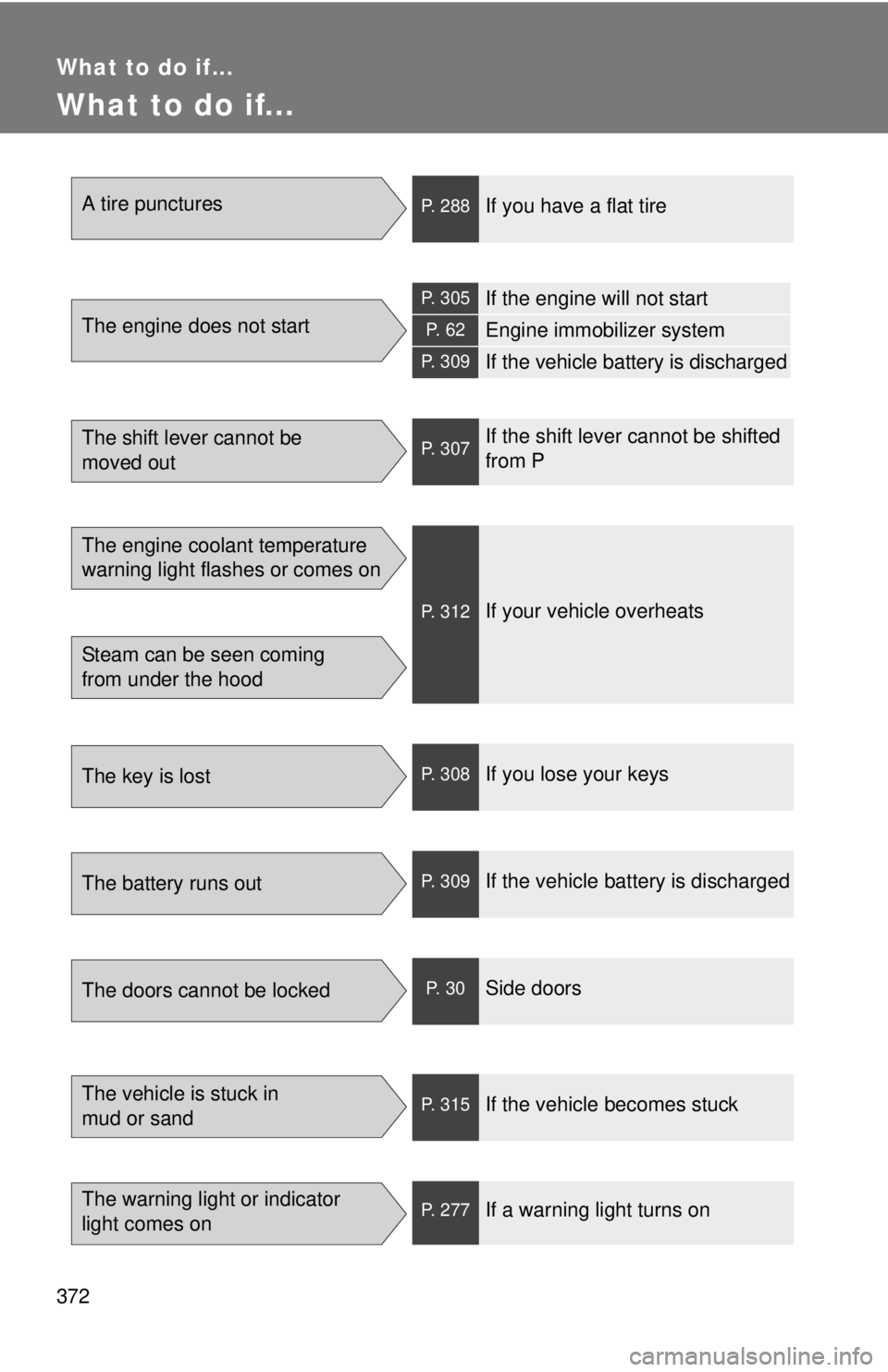
A tire puncturesP. 288If you have a flat tire
The engine does not start
P. 305If the engine will not start
P. 6 2Engine immobilizer system
P. 309If the vehicle battery is discharged
The shift lever cannot be
moved outP. 307If the shift lever cannot be shifted
from P
The engine coolant temperature
warning light flashes or comes on
Steam can be seen coming
from under the hood
P. 312If your vehicle overheats
The key is lostP. 308If you lose your keys
The battery runs outP. 309If the vehicle battery is discharged
The doors cannot be lockedP. 3 0Side doors
The vehicle is stuck in
mud or sandP. 315If the vehicle becomes stuck
The warning light or indicator
light comes onP. 277If a warning light turns on