brake TOYOTA IQ 2014 Owner's Guide
[x] Cancel search | Manufacturer: TOYOTA, Model Year: 2014, Model line: IQ, Model: TOYOTA IQ 2014Pages: 376, PDF Size: 7.76 MB
Page 204 of 376
204
4-3. Do-it-yourself maintenance
Replacing the tire
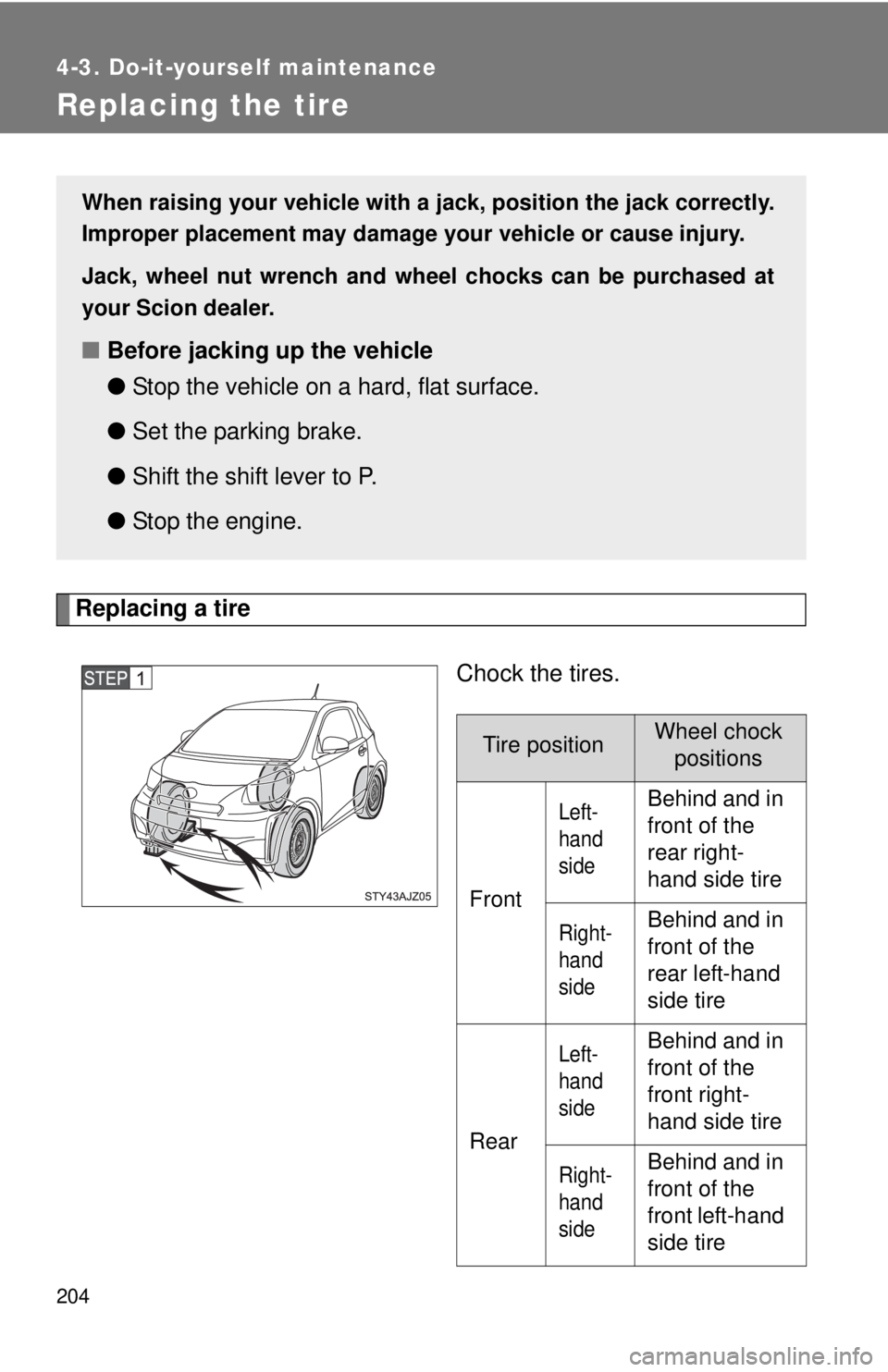
Replacing a tireChock the tires.
When raising your vehicle with a jack, position the jack correctly.
Improper placement may damage your vehicle or cause injury.
Jack, wheel nut wrench and wheel chocks can be purchased at
your Scion dealer.
■Before jacking up the vehicle
●Stop the vehicle on a hard, flat surface.
● Set the parking brake.
● Shift the shift lever to P.
● Stop the engine.
Tire positionWheel chock
positions
Front
Left-
hand
sideBehind and in
front of the
rear right-
hand side tire
Right-
hand
sideBehind and in
front of the
rear left-hand
side tire
Rear
Left-
hand
sideBehind and in
front of the
front right-
hand side tire
Right-
hand
sideBehind and in
front of the
front left-hand
side tire
Page 210 of 376
210
4-3. Do-it-yourself maintenance
Engine compar tment
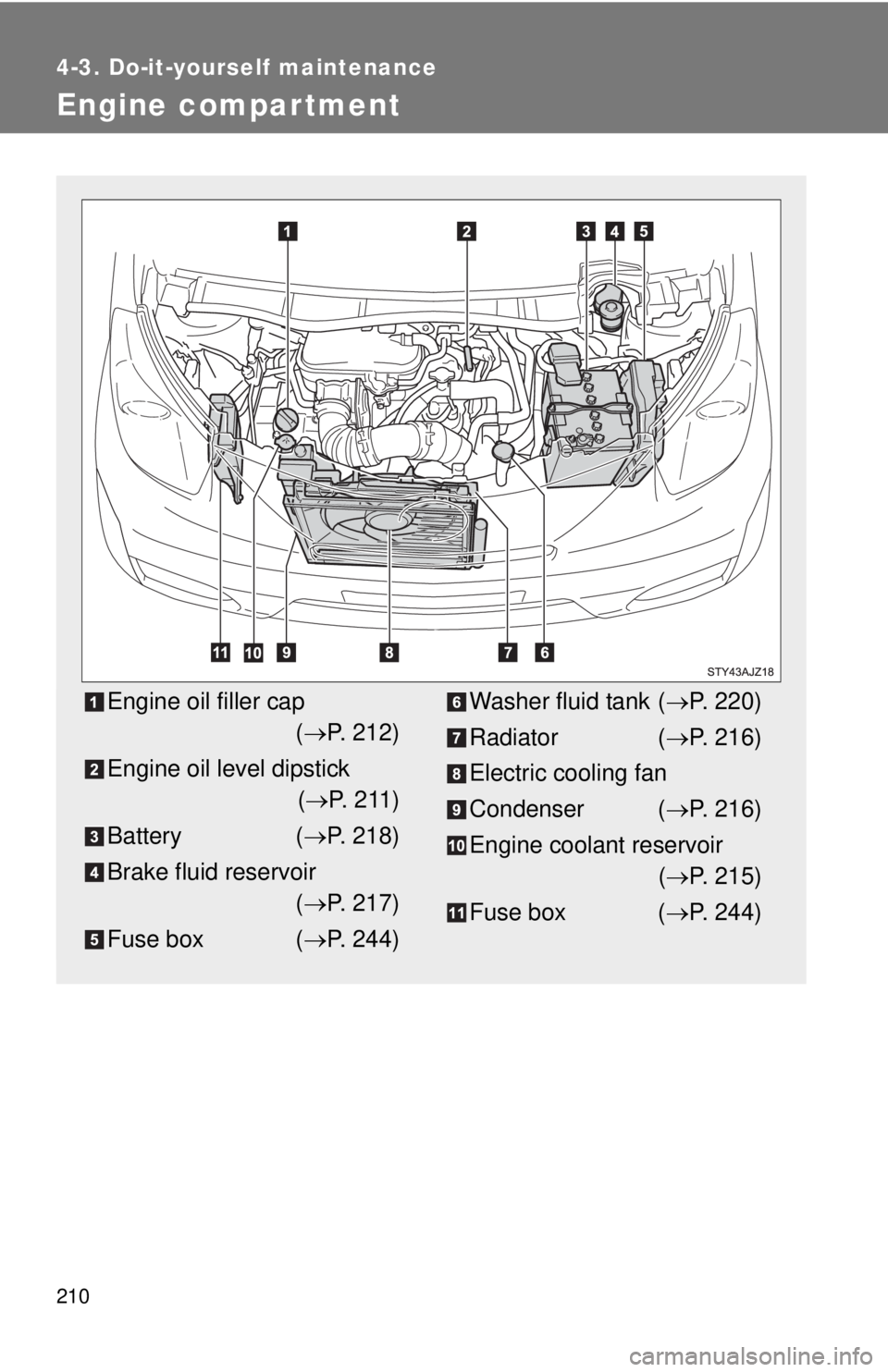
Engine oil filler cap ( P. 212)
Engine oil level dipstick ( P. 2 11 )
Battery ( P. 218)
Brake fluid reservoir ( P. 217)
Fuse box ( P. 244)Washer fluid tank ( P. 220)
Radiator ( P. 216)
Electric cooling fan
Condenser ( P. 216)
Engine coolant reservoir ( P. 215)
Fuse box ( P. 244)
Page 217 of 376
217
4-3. Do-it-yourself maintenance
4
Maintenance and care
Brake fluid
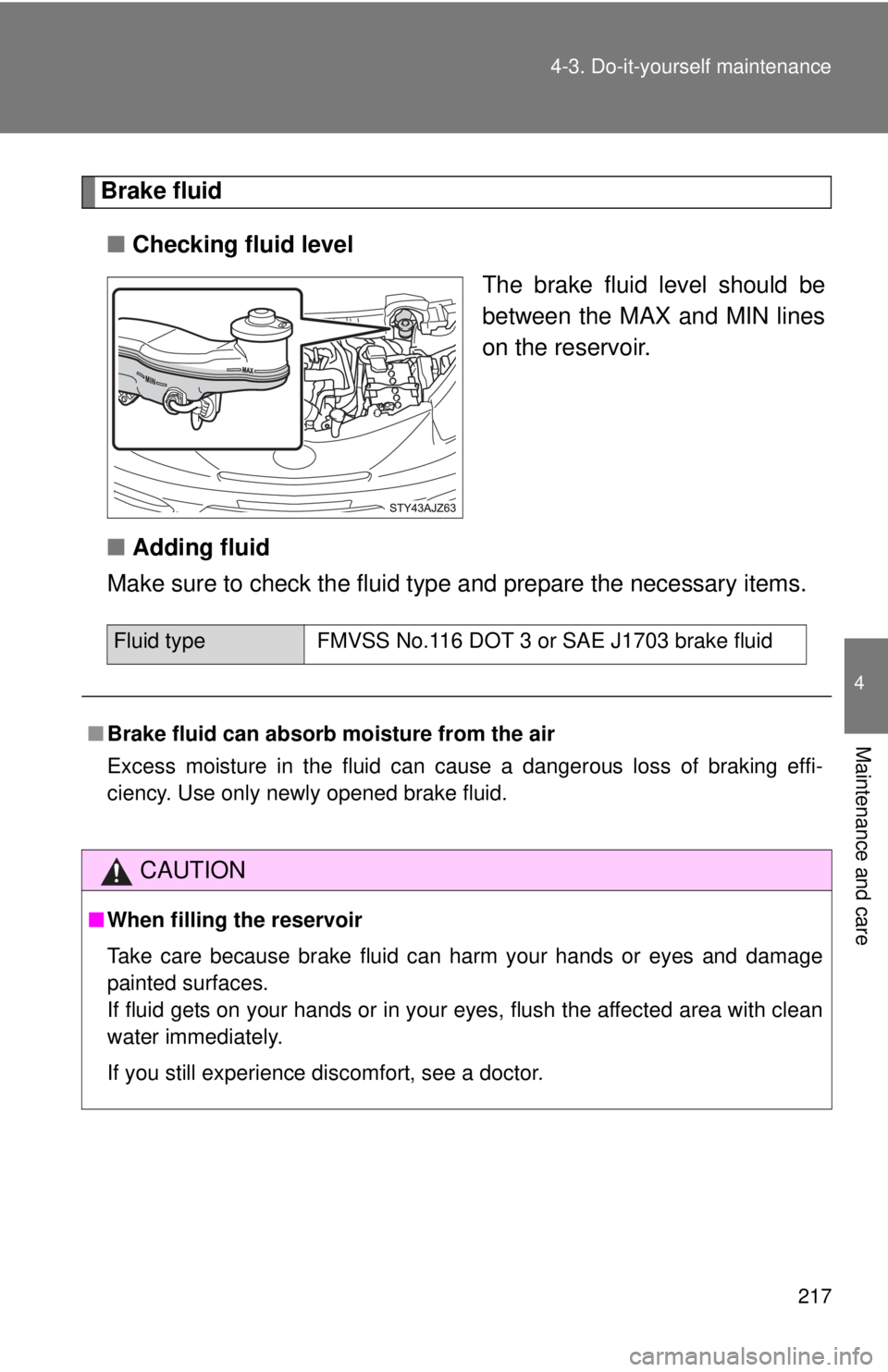
■ Checking fluid level
The brake fluid level should be
between the MAX and MIN lines
on the reservoir.
■ Adding fluid
Make sure to check the fluid type and prepare the necessary items.
Fluid type FMVSS No.116 DOT 3 or SAE J1703 brake fluid
■ Brake fluid can absorb moisture from the air
Excess moisture in the fluid can cause a dangerous loss of braking effi-
ciency. Use only newly opened brake fluid.
CAUTION
■When filling the reservoir
Take care because brake fluid can harm your hands or eyes and damage
painted surfaces.
If fluid gets on your hands or in your eyes, flush the affected area with clean
water immediately.
If you still experience discomfort, see a doctor.
Page 218 of 376
218 4-3. Do-it-yourself maintenance
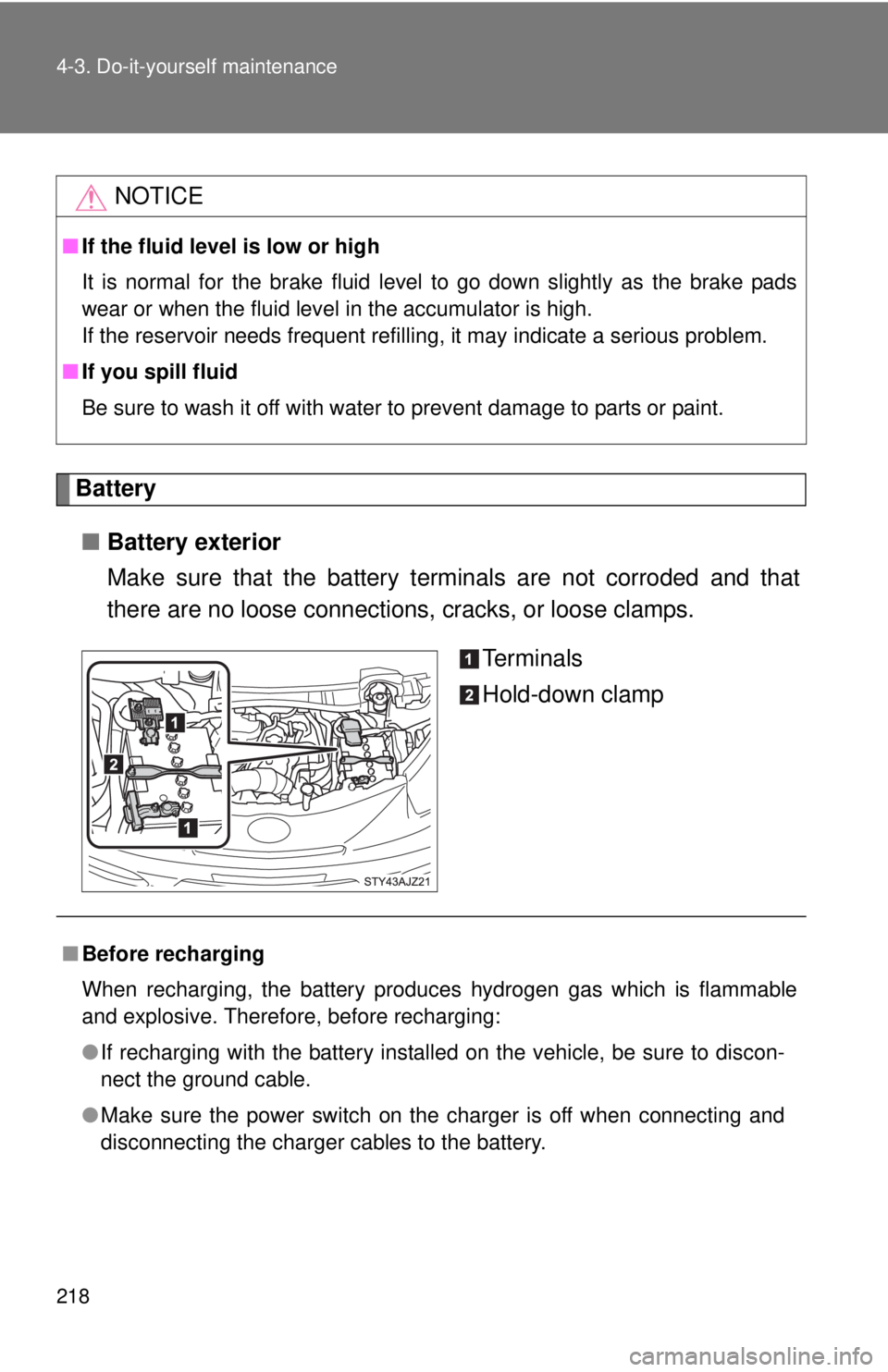
Battery■ Battery exterior
Make sure that the battery terminals are not corroded and that
there are no loose connections, cracks, or loose clamps.
Te r m i n a l s
Hold-down clamp
NOTICE
■If the fluid level is low or high
It is normal for the brake fluid level to go down slightly as the brake pads
wear or when the fluid level in the accumulator is high.
If the reservoir needs frequent refilling, it may indicate a serious pro\
blem.
■ If you spill fluid
Be sure to wash it off with water to prevent damage to parts or paint.
■Before recharging
When recharging, the battery produces hydrogen gas which is flammable
and explosive. Therefore, before recharging:
●If recharging with the battery installed on the vehicle, be sure to discon-
nect the ground cable.
● Make sure the power switch on the charger is off when connecting and
disconnecting the charger cables to the battery.
Page 269 of 376
5
When trouble arises
269
5-1. Essential information
If your vehicle needs to be towed
Before towingThe following may indicate a problem with your transmission. Contact
your Scion dealer before towing.
● The engine is running, but the vehicle will not move.
● The vehicle makes an abnormal sound.
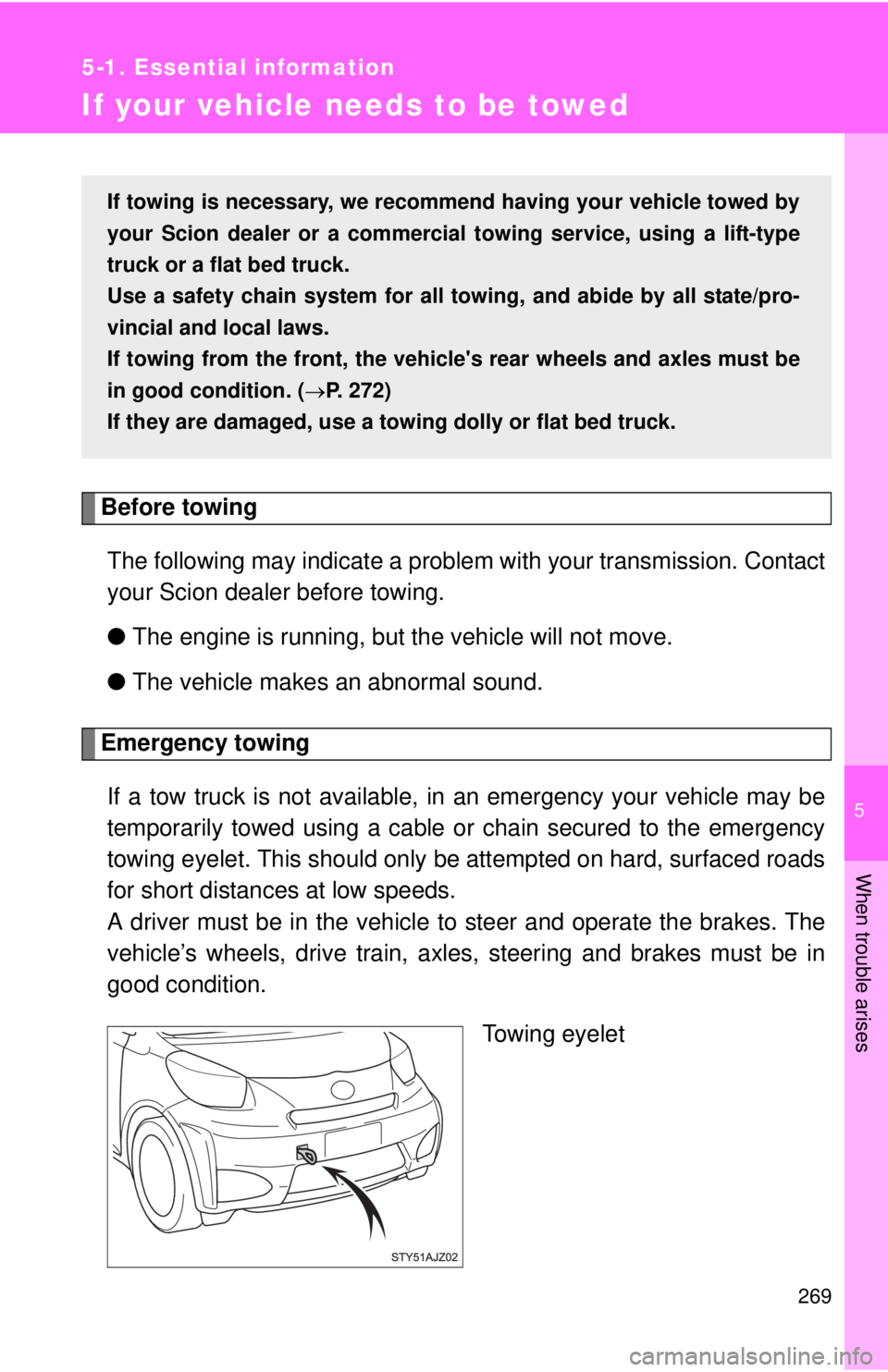
Emergency towing
If a tow truck is not available, in an emergency your vehicle may be
temporarily towed using a cable or chain secured to the emergency
towing eyelet. This should only be attempted on hard, surfaced roads
for short distances at low speeds.
A driver must be in the vehicle to steer and operate the brakes. The
vehicle’s wheels, drive train, axles, steering and brakes must be in
good condition.
Towing eyelet
If towing is necessary, we recommend having your vehicle towed by
your Scion dealer or a commercial towing service, using a lift-type
truck or a flat bed truck.
Use a safety chain system for all to wing, and abide by all state/pro-
vincial and local laws.
If towing from the front, the vehic le's rear wheels and axles must be
in good condition. (P. 272)
If they are damaged, use a towing dolly or flat bed truck.
Page 270 of 376
270 5-1. Essential information
■Emergency towin g procedure
Start the engine.
If the engine cannot be started, turn the engine switch to the ACC
or ON position.
Put the shift lever in N.
Release the parking brake.
CAUTION
■ Caution while towing
●Use extreme caution when towing the vehicle.
Avoid sudden starts or erratic driving maneuvers which place excessive
stress on the emergency towing eyelet and the cables or chains. Always
be cautious of the surroundings and other vehicles while towing.
● If the engine is not running, the power assist for the brakes and steering
will not function, making steering and braking more difficult.
NOTICE
■To prevent serious damage to the transmission
Never tow this vehicle from the rear with the front wheels on the ground.
This may cause serious damage to the transmission.
Page 272 of 376
272 5-1. Essential information
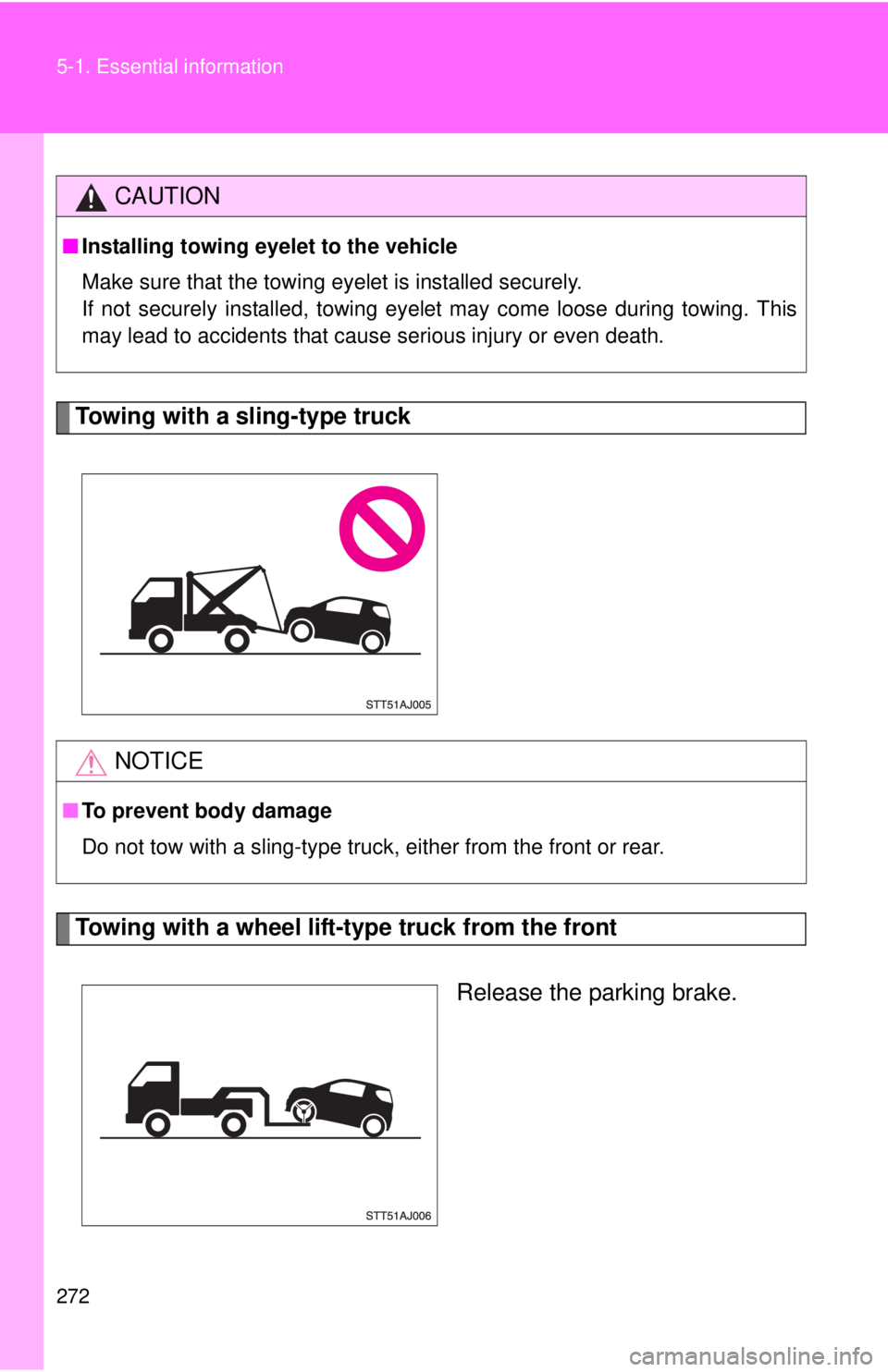
Towing with a sling-type truck
Towing with a wheel lift-type truck from the frontRelease the parking brake.
CAUTION
■Installing towing eyelet to the vehicle
Make sure that the towing eyelet is installed securely.
If not securely installed, towing eyelet may come loose during towing. This
may lead to accidents that cause serious injury or even death.
NOTICE
■To prevent body damage
Do not tow with a sling-type truck, either from the front or rear.
Page 274 of 376
274 5-1. Essential information
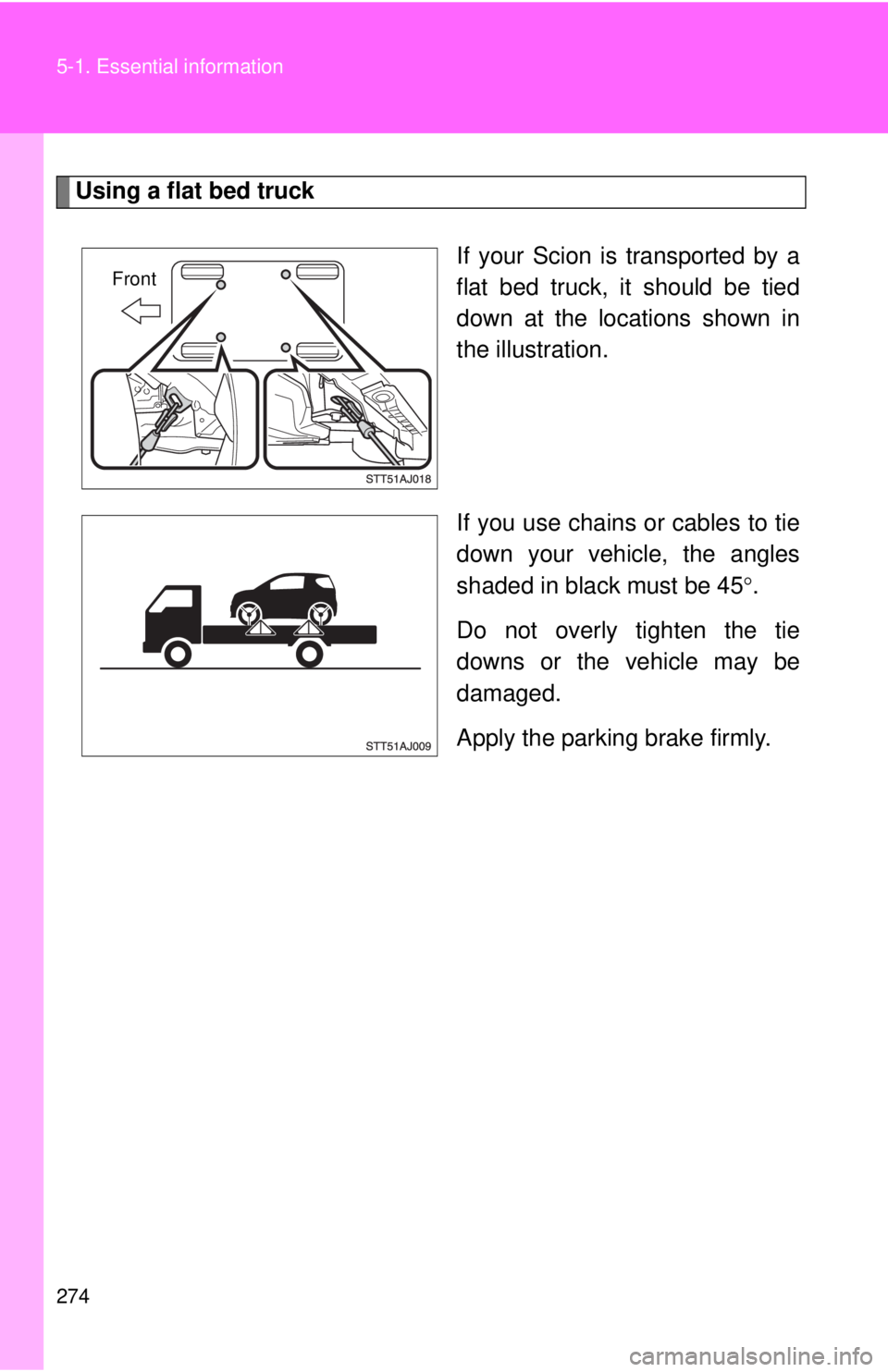
Using a flat bed truckIf your Scion is transported by a
flat bed truck, it should be tied
down at the locations shown in
the illustration.
If you use chains or cables to tie
down your vehicle, the angles
shaded in black must be 45.
Do not overly tighten the tie
downs or the vehicle may be
damaged.
Apply the parking brake firmly.
Front
Page 275 of 376
5
When trouble arises
275
5-1. Essential information
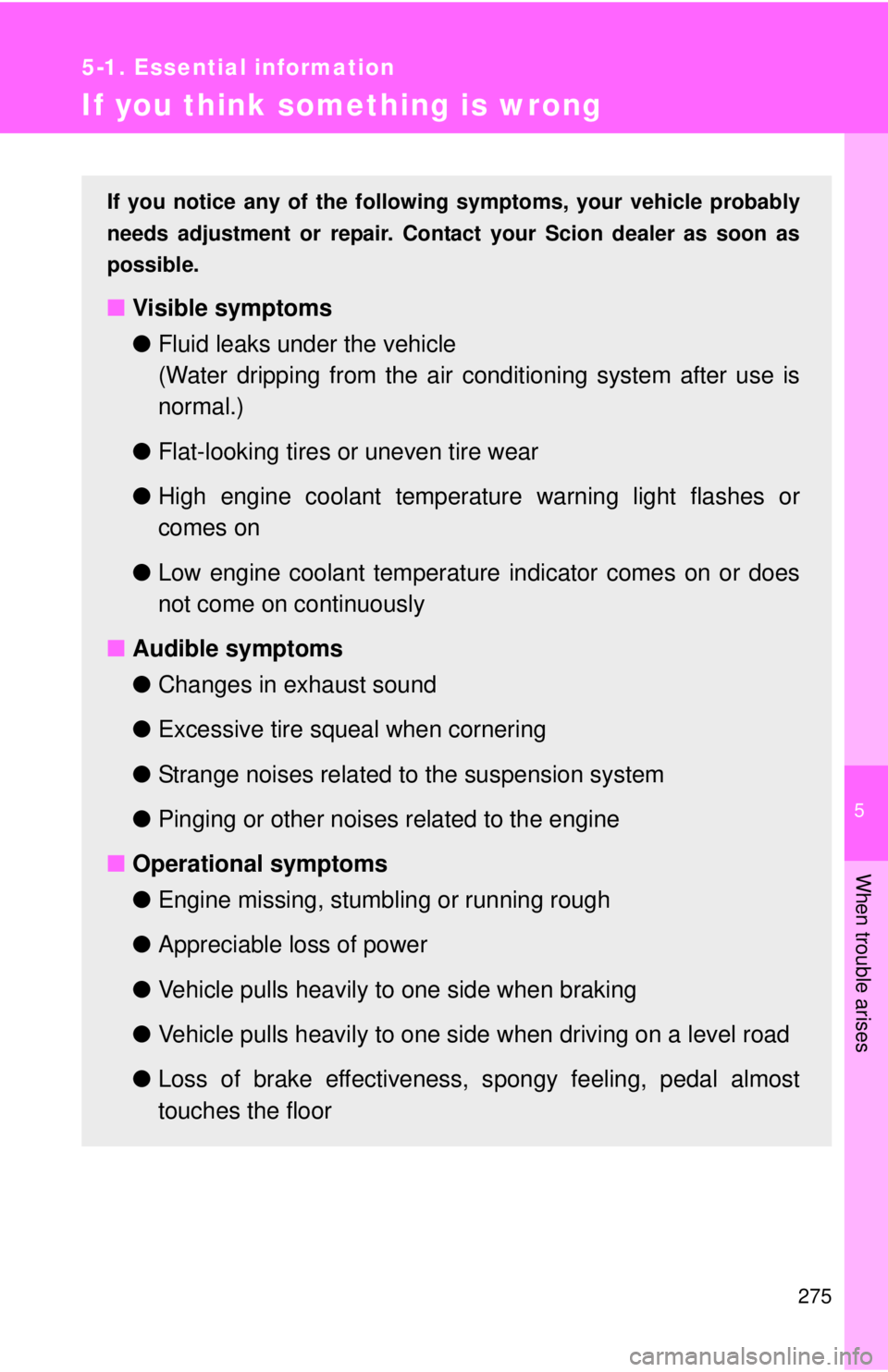
If you think something is wrong
If you notice any of the following symptoms, your vehicle probably
needs adjustment or repair. Cont act your Scion dealer as soon as
possible.
■ Visible symptoms
●Fluid leaks under the vehicle
(Water dripping from the air c onditioning system after use is
normal.)
● Flat-looking tires or uneven tire wear
● High engine coolant temperatur e warning light flashes or
comes on
● Low engine coolant temperature indicator comes on or does
not come on continuously
■ Audible symptoms
●Changes in exhaust sound
● Excessive tire squeal when cornering
● Strange noises related to the suspension system
● Pinging or other noises related to the engine
■ Operational symptoms
●Engine missing, stumbling or running rough
● Appreciable loss of power
● Vehicle pulls heavily to one side when braking
● Vehicle pulls heavily to one side when driving on a level road
● Loss of brake effectiveness, s pongy feeling, pedal almost
touches the floor
Page 277 of 376
5
When trouble arises
277
5-2. Steps to take in an emergency
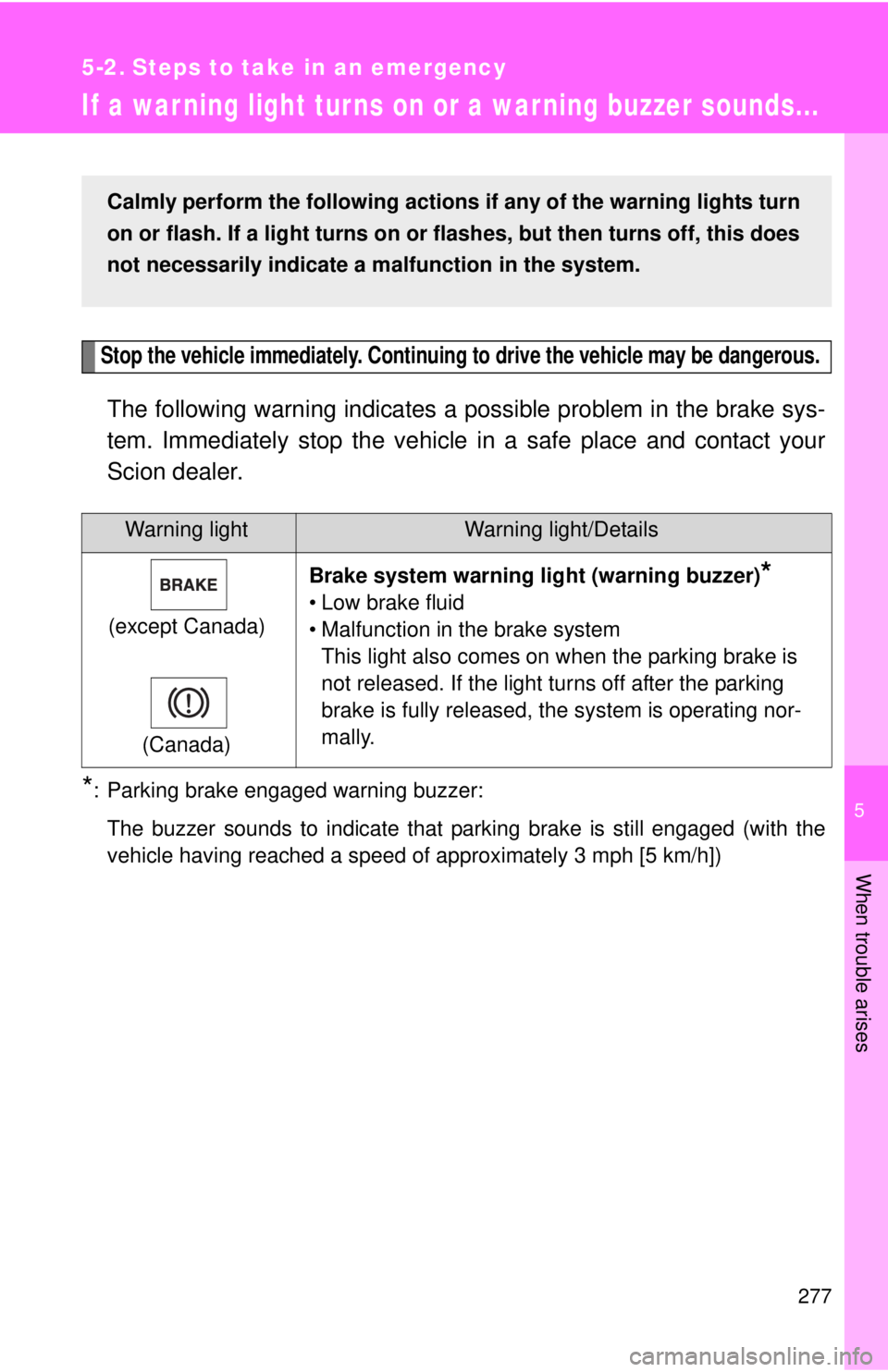
If a war ning light turns on or a war ning buzzer sounds...
Stop the vehicle immediately. Continuing to drive the vehicle may be dangerous.
The following warning indicates a possible problem in the brake sys-
tem. Immediately stop the vehicle in a safe place and contact your
Scion dealer.
*: Parking brake engaged warning buzzer:
The buzzer sounds to indicate that parking brake is still engaged (with the
vehicle having reached a speed of approximately 3 mph [5 km/h])
Warning lightWarning light/Details
(except Canada)
(Canada) Brake system warning light (warning buzzer)
*
• Low brake fluid
• Malfunction in the brake system
This light also comes on when the parking brake is
not released. If the light turns off after the parking
brake is fully released, the system is operating nor-
mally.
Calmly perform the following actions if any of the warning lights turn
on or flash. If a light turns on or flashes, but then turns off, this does
not necessarily indicate a malfunction in the system.