flat tire TOYOTA IQ 2014 Owner's Guide
[x] Cancel search | Manufacturer: TOYOTA, Model Year: 2014, Model line: IQ, Model: TOYOTA IQ 2014Pages: 376, PDF Size: 7.76 MB
Page 296 of 376
296 5-2. Steps to take in an emergency
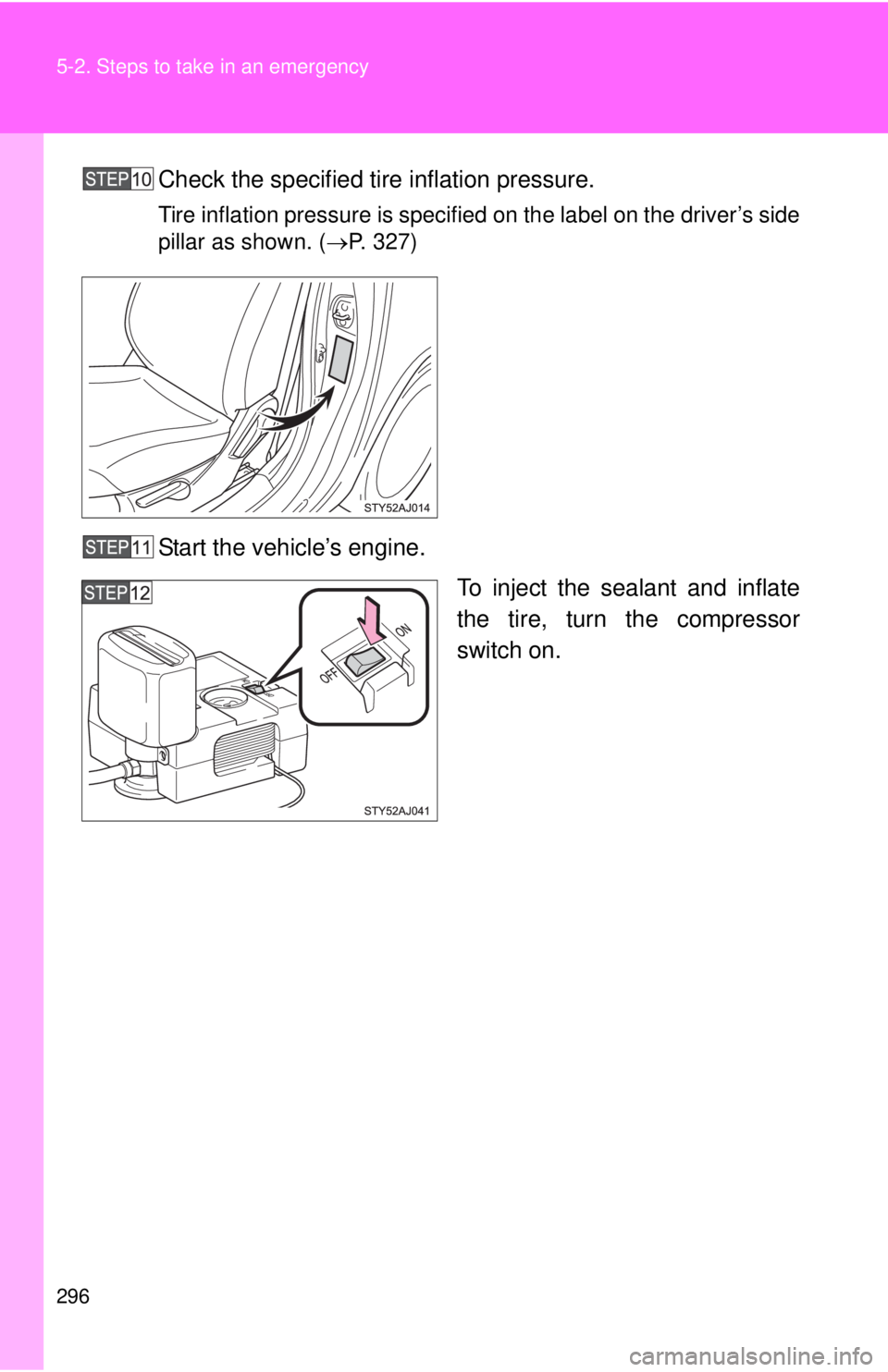
Check the specified tire inflation pressure.
Tire inflation pressure is specified on the label on the driver’s side
pillar as shown. ( P. 327)
Start the vehicle’s engine.
To inject the sealant and inflate
the tire, turn the compressor
switch on.
Page 297 of 376
5
When trouble arises
297
5-2. Steps to take in an emergency
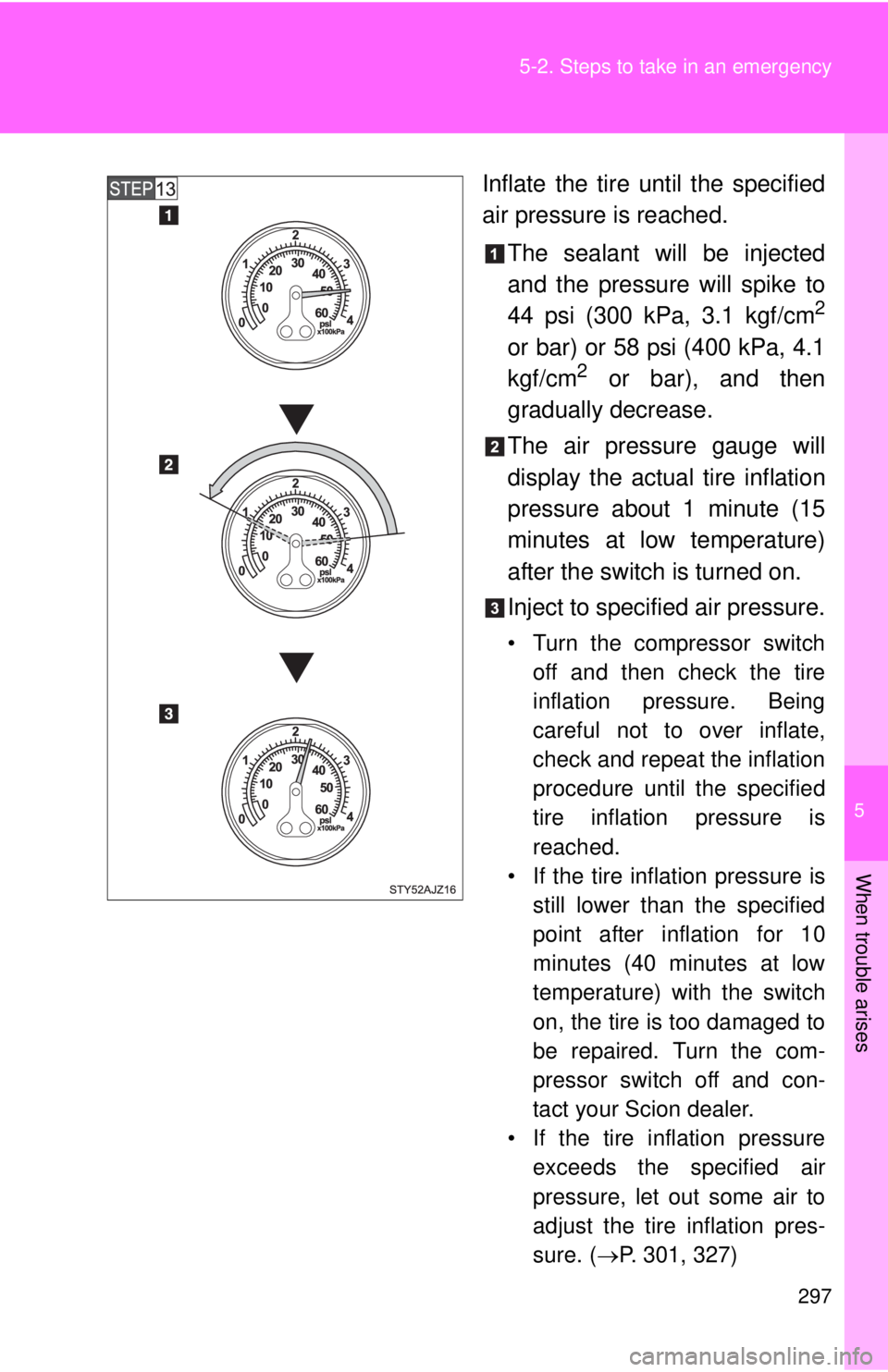
Inflate the tire until the specified
air pressure is reached.
The sealant will be injected
and the pressure will spike to
44 psi (300 kPa, 3.1 kgf/cm
2
or bar) or 58 psi (400 kPa, 4.1
kgf/cm2 or bar), and then
gradually decrease.
The air pressure gauge will
display the actual tire inflation
pressure about 1 minute (15
minutes at low temperature)
after the switch is turned on.
Inject to specified air pressure.
• Turn the compressor switch off and then check the tire
inflation pressure. Being
careful not to over inflate,
check and repeat the inflation
procedure until the specified
tire inflation pressure is
reached.
• If the tire inflation pressure is still lower than the specified
point after inflation for 10
minutes (40 minutes at low
temperature) with the switch
on, the tire is too damaged to
be repaired. Turn the com-
pressor switch off and con-
tact your Scion dealer.
• If the tire inflation pressure exceeds the specified air
pressure, let out some air to
adjust the tire inflation pres-
sure. ( P. 301, 327)
Page 298 of 376
298 5-2. Steps to take in an emergency
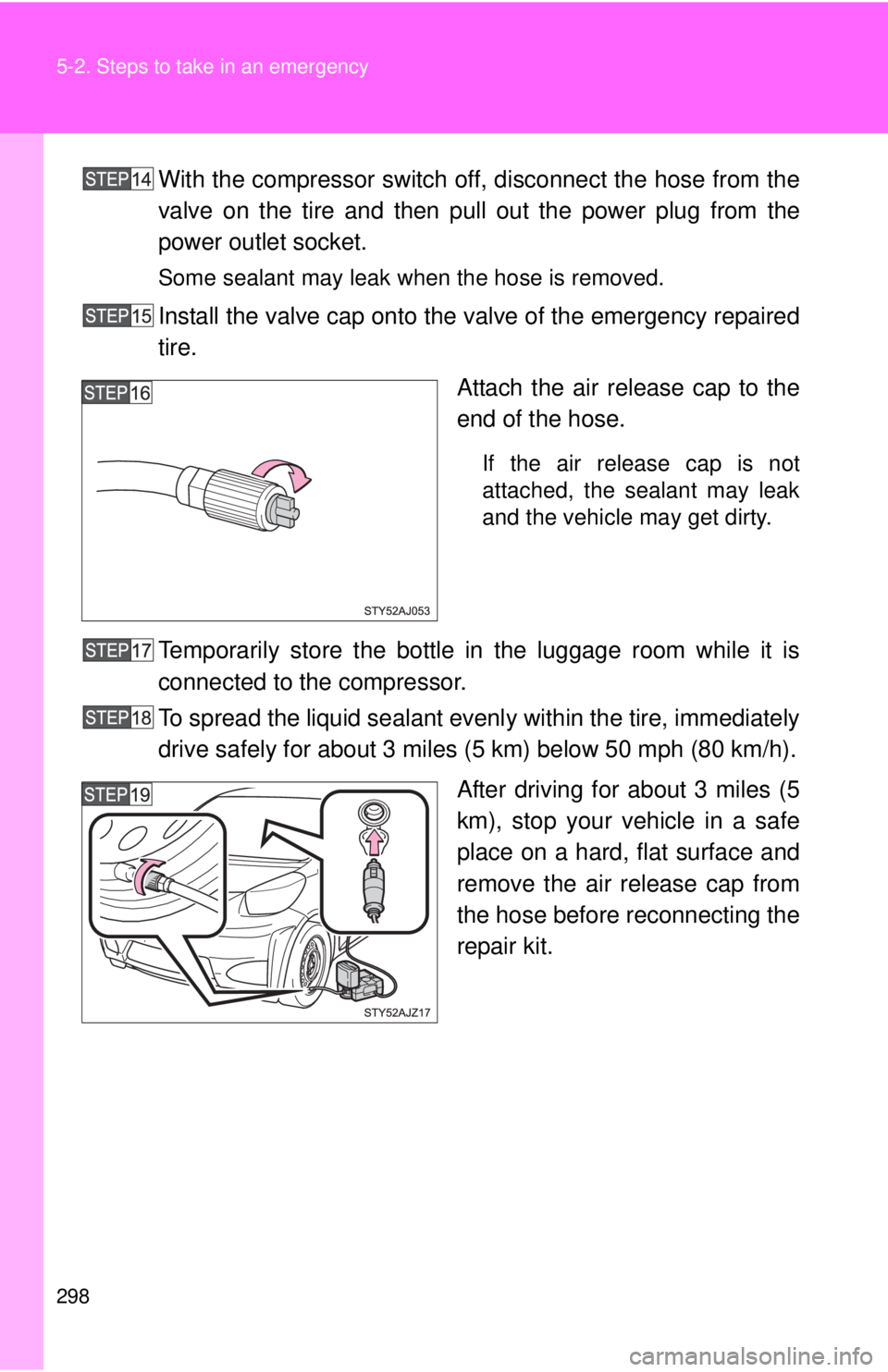
With the compressor switch off, disconnect the hose from the
valve on the tire and then pull out the power plug from the
power outlet socket.
Some sealant may leak when the hose is removed.
Install the valve cap onto the valve of the emergency repaired
tire.Attach the air release cap to the
end of the hose.
If the air release cap is not
attached, the sealant may leak
and the vehicle may get dirty.
Temporarily store the bottle in the luggage room while it is
connected to the compressor.
To spread the liquid sealant evenl y within the tire, immediately
drive safely for about 3 miles (5 km) below 50 mph (80 km/h).
After driving for about 3 miles (5
km), stop your vehicle in a safe
place on a hard, flat surface and
remove the air release cap from
the hose before reconnecting the
repair kit.
Page 299 of 376
5
When trouble arises
299
5-2. Steps to take in an emergency
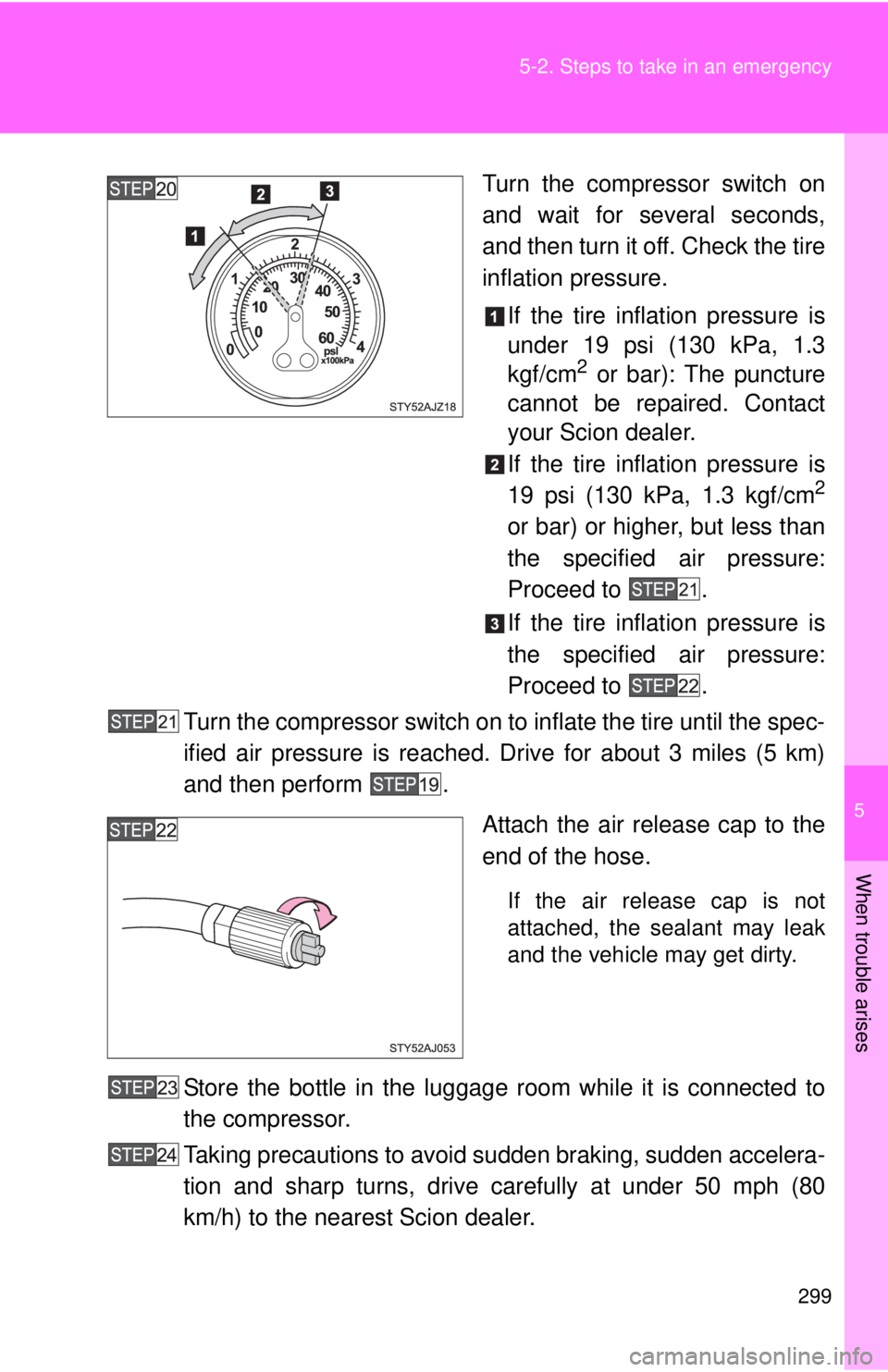
Turn the compressor switch on
and wait for several seconds,
and then turn it off. Check the tire
inflation pressure.
If the tire inflation pressure is
under 19 psi (130 kPa, 1.3
kgf/cm
2 or bar): The puncture
cannot be repaired. Contact
your Scion dealer.
If the tire inflation pressure is
19 psi (130 kPa, 1.3 kgf/cm
2
or bar) or higher, but less than
the specified air pressure:
Proceed to .
If the tire inflation pressure is
the specified air pressure:
Proceed to .
Turn the compressor switch on to inflate the tire until the spec-
ified air pressure is reached. Drive for about 3 miles (5 km)
and then perform .
Attach the air release cap to the
end of the hose.
If the air release cap is not
attached, the sealant may leak
and the vehicle may get dirty.
Store the bottle in the luggage room while it is connected to
the compressor.
Taking precautions to avoid s udden braking, sudden accelera-
tion and sharp turns, drive carefully at under 50 mph (80
km/h) to the nearest Scion dealer.
Page 301 of 376
5
When trouble arises
301
5-2. Steps to take in an emergency
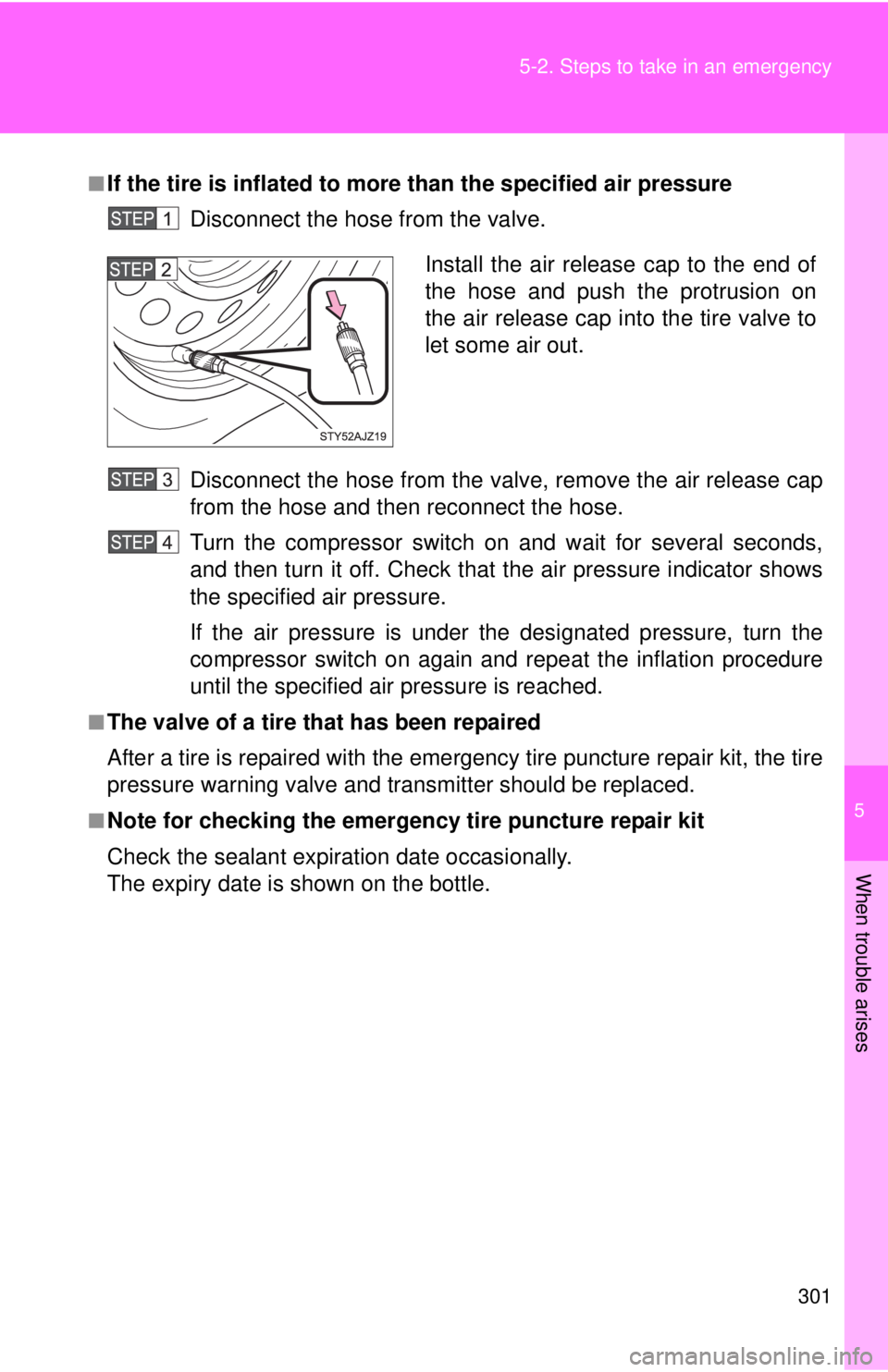
■If the tire is inflated to more than the specified air pressure
Disconnect the hose from the valve.
Disconnect the hose from the valve, remove the air release cap
from the hose and then reconnect the hose.
Turn the compressor switch on and wait for several seconds,
and then turn it off. Check that the air pressure indicator shows
the specified air pressure.
If the air pressure is under the designated pressure, turn the
compressor switch on again and repeat the inflation procedure
until the specified air pressure is reached.
■The valve of a tire that has been repaired
After a tire is repaired with the emergency tire puncture repair kit, the tire
pressure warning valve and transmitter should be replaced.
■Note for checking the emergency tire puncture repair kit
Check the sealant expiration date occasionally.
The expiry date is shown on the bottle.
Install the air release cap to the end of
the hose and push the protrusion on
the air release cap into the tire valve to
let some air out.
Page 302 of 376

302 5-2. Steps to take in an emergency
CAUTION
■Do not drive the vehicle with a flat tire
Do not continue driving with a flat tire.
Driving even a short distance with a flat tire can damage the tire and the
wheel beyond repair.
Driving with a flat tire may cause a circumferential groove on the side
wall. In such a case, the tire may explode when using a repair kit.
■Caution while driving
●Store the repair kit in the luggage room.
Otherwise, the repair kit may fly out and break in events such as sud-
den braking, and may cause an accident.
●The repair kit is exclusively only for your vehicle.
Do not use repair kit on other vehicles, which could lead to an accident
causing death or serious injury.
●Do not use repair kit for tires that are different size than the original
ones, or for any other purpose. If the tires have not been completely
repaired, it could lead to an accident causing death or serious injury.
■Precautions for use of the sealant
●Ingesting the sealant is hazardous to your health. If you ingest sealant,
consume as much water as possible, and then immediately consult a
doctor.
●If sealant gets in eyes or adheres to skin, immediately wash it off with
water. If discomfort persists, consult a doctor.
■When fixing the flat tire
●Stop your vehicle in a safe and flat area.
●Do not touch the wheels or the ar ea around the brakes immediately
after the vehicle has been driven.
After the vehicle has been driven, the wheels and the area around the
brakes may be extremely hot. Touching these areas with hands, feet or
other body parts may result in burns.
●Connect the valve and hose securely with the tire installed on the vehi-
cle. If the hose is not properly con nected to the valve, air leakage may
occur as sealant may be sprayed out.
Page 303 of 376

5
When trouble arises
303
5-2. Steps to take in an emergency
CAUTION
■When fixing the flat tire
●If the hose comes off the valve while inflating the tire, there is a risk
that the hose will
move abruptly due to air pressure.
●After inflation of the tire has comp leted, the sealant may splatter when
the hose is disconnected or so me air is let out of the tire.
●Follow the operation procedure to repair the tire. If the procedures not
followed, the sealant may spray out.
●Keep back from the tire while it is being repaired, as there is a chance
of it bursting while the repair ope ration is being performed. If you
notice any cracks or deformation of the tire, turn off the compressor
switch and stop the repair operation immediately.
●The repair kit may overheat if operated for a long period of time. Do not
operate the repair kit continuously for more than 60 minutes.
●Parts of the repair kit become hot during operation. Be careful handling
the repair kit during and after operation. Do not touch the metal part
connecting the bottle and the co mpressor. It will be extremely hot.
●Do not attach the vehicle speed warning sticker to an area other than
the one indicated. If the sticker is attached to an area where an SRS
airbag is located, such as the pad of the steering wheel, it may prevent
the SRS airbag from operating properly.
■Driving to spread the liquid sealant evenly
Observe the following precautions to reduce the risk of accidents.
Failing to do so may result in a loss of vehicle control and cause death or
serious injury.
●Drive the vehicle carefully at a lo w speed. Be especially careful when
turning and cornering.
●If the vehicle does not drive straight or you feel a pull through the
steering wheel, stop the vehicle and check the following.
• Tire condition. The tire may have separated from the wheel.
• Tire inflation pressure. If the tire inflation pressure is 19 psi (130 kPa, 1.3 kgf/cm
2 or bar) or less, the tire may be severely damaged.
Page 327 of 376
327
6-1. Specifications
6
Vehicle specifications
Steering
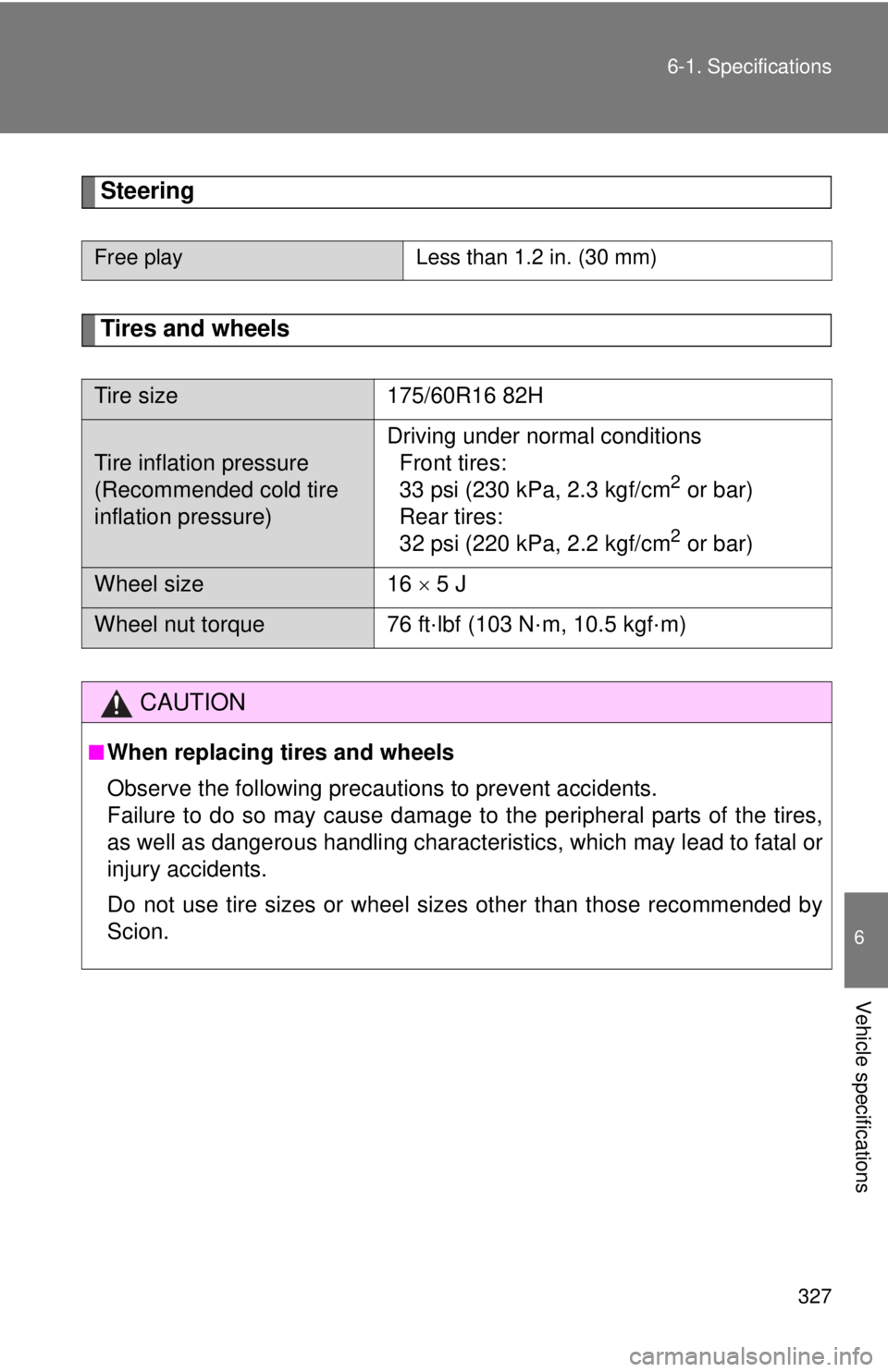
Tires and wheels
Free play
Less than 1.2 in. (30 mm)
Tire size175/60R16 82H
Tire inflation pressure
(Recommended cold tire
inflation pressure)Driving under normal conditions
Front tires:
33 psi (230 kPa, 2.3 kgf/cm2 or bar)
Rear tires:
32 psi (220 kPa, 2.2 kgf/cm
2 or bar)
Wheel size 16 5 J
Wheel nut torque 76 ft·lbf (103 N·m, 10.5 kgf·m)
CAUTION
■When replacing tires and wheels
Observe the following precautions to prevent accidents.
Failure to do so may cause damage to the peripheral parts of the tires,
as well as dangerous handling characteristics, which may lead to fatal or
injury accidents.
Do not use tire sizes or wheel sizes other than those recommended by
Scion.
Page 332 of 376
332
6-1. Specifications
Tire infor mation
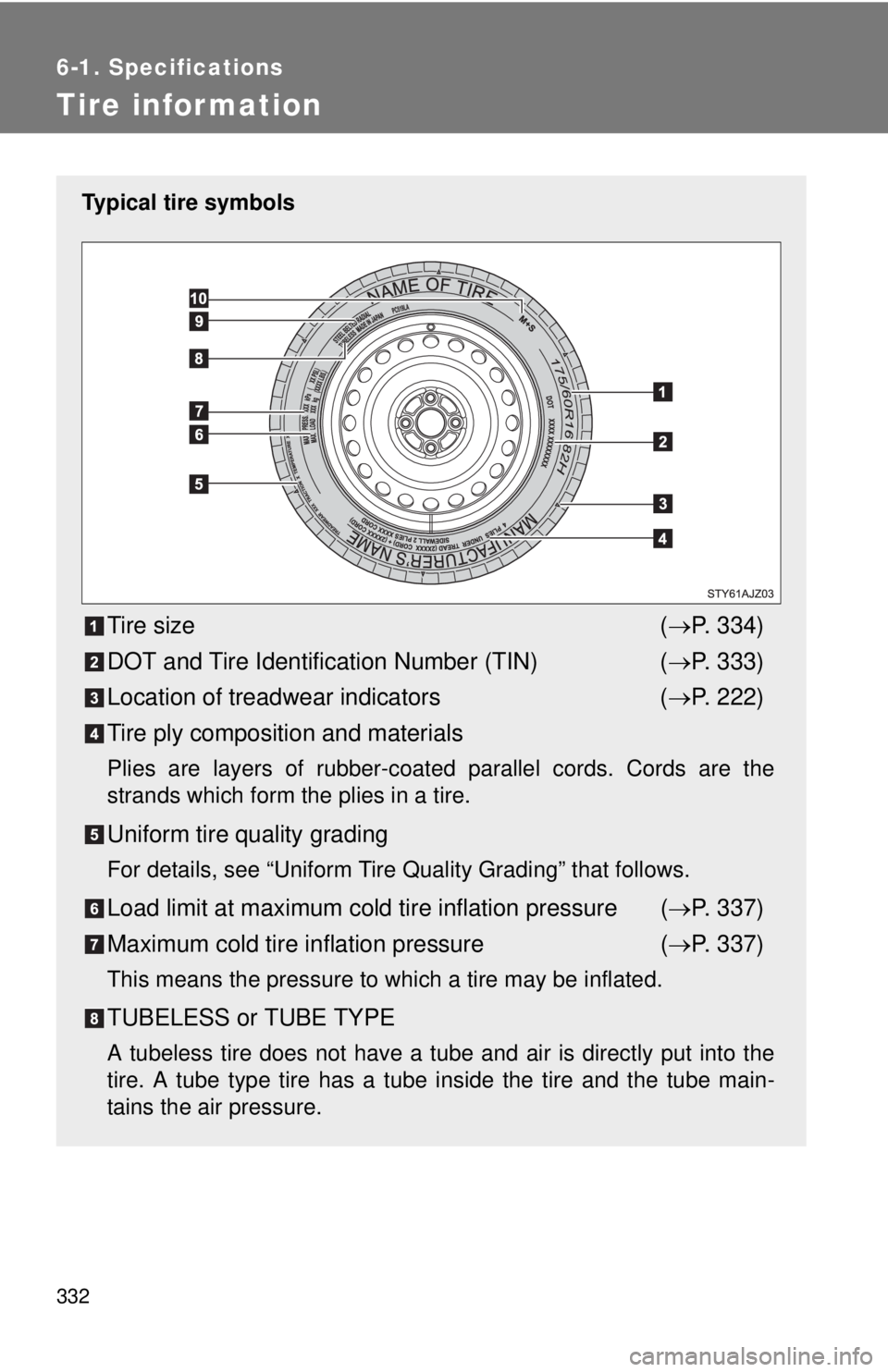
Typical tire symbols
Tire size( P. 334)
DOT and Tire Identification Number (TIN) ( P. 333)
Location of treadwear indicators ( P. 222)
Tire ply composition and materials
Plies are layers of rubber-coated parallel cords. Cords are the
strands which form the plies in a tire.
Uniform tire quality grading
For details, see “Uniform Tire Quality Grading” that follows.
Load limit at maximum cold tire inflation pressure ( P. 337)
Maximum cold tire inflation pressure ( P. 337)
This means the pressure to which a tire may be inflated.
TUBELESS or TUBE TYPE
A tubeless tire does not have a tube and air is directly put into the
tire. A tube type tire has a tube inside the tire and the tube main-
tains the air pressure.
Page 337 of 376
337
6-1. Specifications
6
Vehicle specifications
Warning: The temperature grades of a tire assume that it is properly
inflated and not overloaded.
Excessive speed, underinflation, or
excessive loading, either sepa-
rately or in combination, can caus e heat buildup and possible tire fail-
ure.
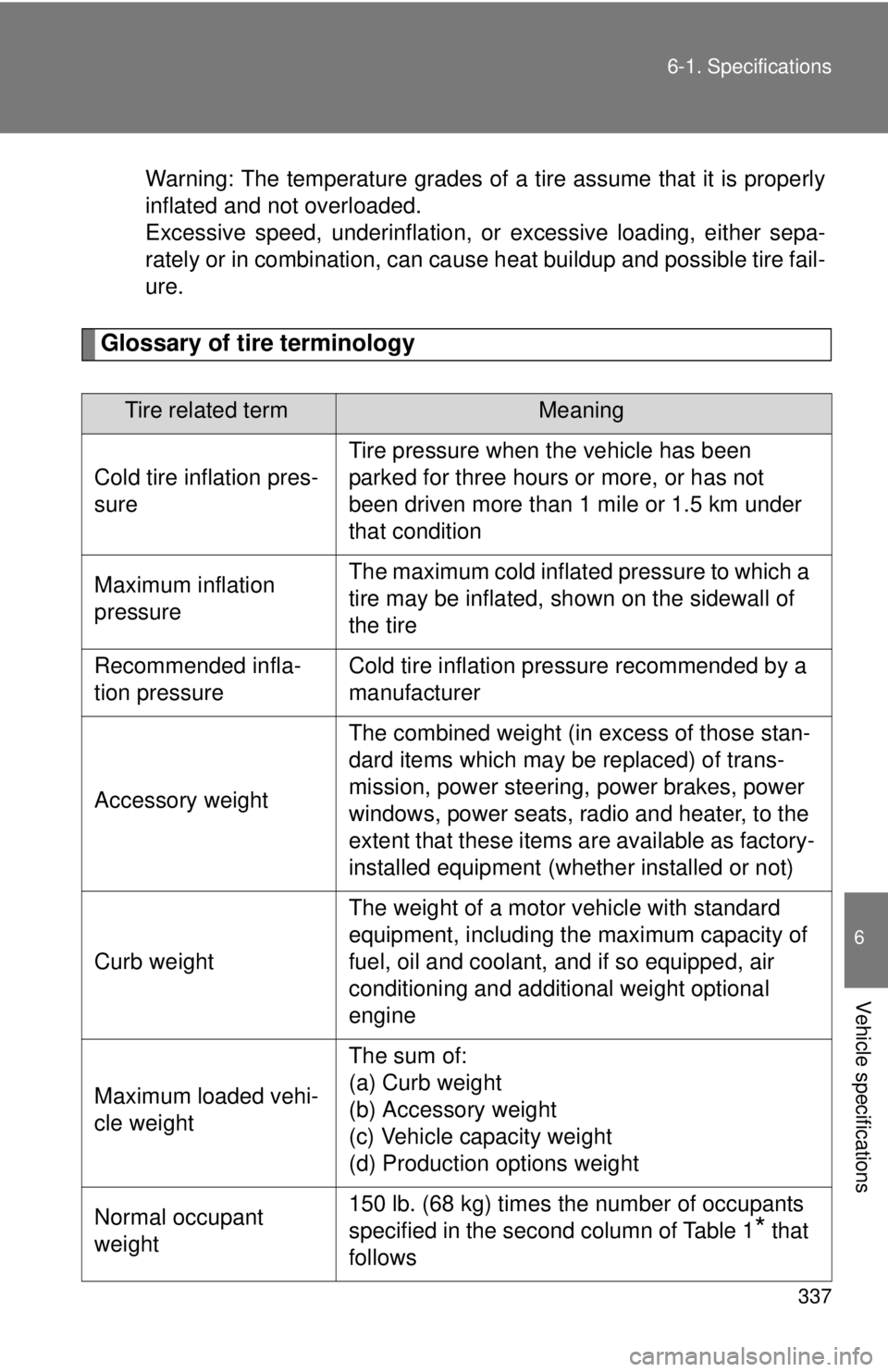
Glossary of tire terminology
Tire related termMeaning
Cold tire inflation pres-
sure
Tire pressure when the vehicle has been
parked for three hours or more, or has not
been driven more than 1 mile or 1.5 km under
that condition
Maximum inflation
pressureThe maximum cold inflated pressure to which a
tire may be inflated, s hown on the sidewall of
the tire
Recommended infla-
tion pressureCold tire inflation pressure recommended by a
manufacturer
Accessory weight
The combined weight (in excess of those stan-
dard items which may be replaced) of trans-
mission, power steering, power brakes, power
windows, power seats, radio and heater, to the
extent that these items are available as factory-
installed equipment (whether installed or not)
Curb weight
The weight of a motor vehicle with standard
equipment, including the maximum capacity of
fuel, oil and coolant, and if so equipped, air
conditioning and additional weight optional
engine
Maximum loaded vehi-
cle weight
The sum of:
(a) Curb weight
(b) Accessory weight
(c) Vehicle capacity weight
(d) Production options weight
Normal occupant
weight150 lb. (68 kg) times the number of occupants
specified in the second column of Table 1
* that
follows