air condition TOYOTA IQ 2014 Owners Manual
[x] Cancel search | Manufacturer: TOYOTA, Model Year: 2014, Model line: IQ, Model: TOYOTA IQ 2014Pages: 376, PDF Size: 7.76 MB
Page 1 of 376

TABLE OF CONTENTS
1
1Before drivingAdjusting and operating features such as door locks,
mirrors, and steering column.
2When drivingDriving, stopping and safe-driving information.
3Interior
featuresAir conditioning and audio systems, as well as other in-
terior features for a comfortable driving experience.
4Maintenance
and careCleaning and protecting your vehicle, performing do-it-
yourself maintenance, and maintenance information.
5When trouble
arisesWhat to do if the vehicle needs to be towed, gets a flat
tire, or is involved in an accident.
6Vehicle
specificationsDetailed vehicle information.
7For ownersReporting safety defects for U.S. owners, and seat belt
and SRS airbag instructions for Canadian owners
IndexAlphabetical listing of information contained in this
manual.
Page 3 of 376

1
2
3
4
5
6
7
3
2-5. Driving informationCargo and luggage ............. 146
Vehicle load limits ............... 150
Winter driving tips ............... 151
Trailer towing ...................... 155
Dinghy towing ..................... 156
3-1. Using the air conditioning system and defogger
Air conditioning system ....... 158
Rear window defogger ........ 164
Rear window and outside rear view mirror
defoggers .......................... 165
3-2. Using the audio system Using the AUX port/USB port ........................... 167
Using the steering wheel audio switches .................. 168
3-3. Using the interior lights Interior lights list .................. 169
• Interior light ....................... 170
3-4. Using the storage features List of storage features ....... 171
• Cup holder ........................ 172
• Bottle holders .................... 173
• Auxiliary box ..................... 174 3-5. Other interior features
Sun visors........................... 175
Vanity mirrors ..................... 176
Power outlet ....................... 177
Assist grips ......................... 178
Floor mat ............................ 179
Luggage compartment features ............................ 181
4-1. Maintenance and care Cleaning and protecting the vehicle exterior ........... 184
Cleaning and protecting the vehicle interior ............ 187
4-2. Maintenance Maintenance requirements .................... 190
General maintenance ......... 192
Emission inspection and maintenance (I/M)
programs .......................... 195
4-3. Do-it-yourself maintenance Do-it-yourself service precautions....................... 196
Hood ................................... 199
Positioning a floor jack ....... 201
Replacing the tire ............... 204
Engine compartment .......... 210
Tires ................................... 222
Tire inflation pressure ......... 230
Wheels ............................... 234
Air conditioning filter ........... 236
3Interior features
4Maintenance and care
Page 13 of 376
13
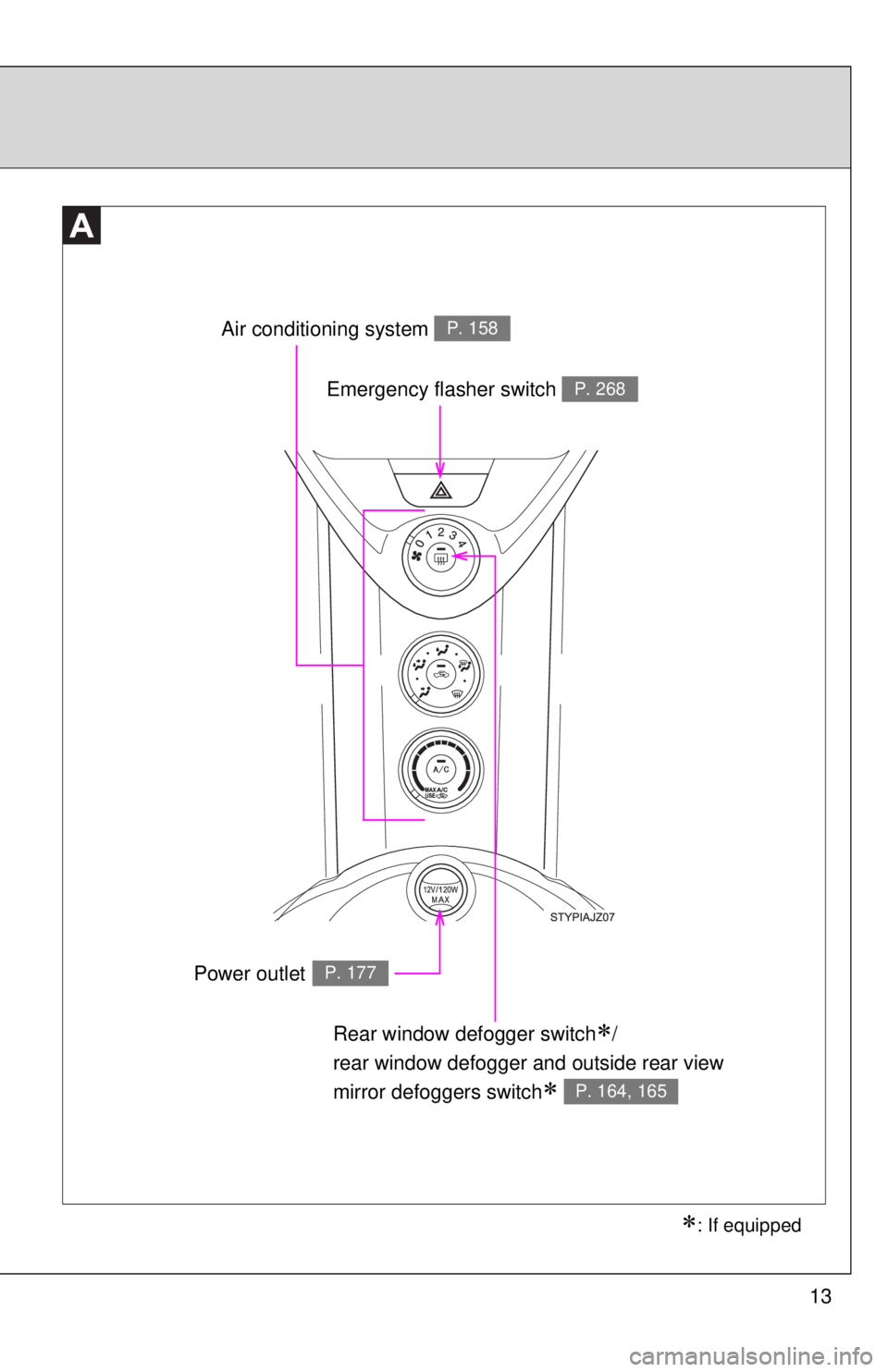
Emergency flasher switch P. 268
: If equipped
Rear window defogger switch/
rear window defogger and outside rear view
mirror defoggers switch
P. 164, 165
Air conditioning system P. 158
Power outletP. 177
Page 27 of 376
27
1-2. Opening, closing and locking the doors
1
Before driving
■
Operation signals
The emergency flashers flash to indicate that the doors have been locked/
unlocked. (Locked: Once; Unlocked: Twice)
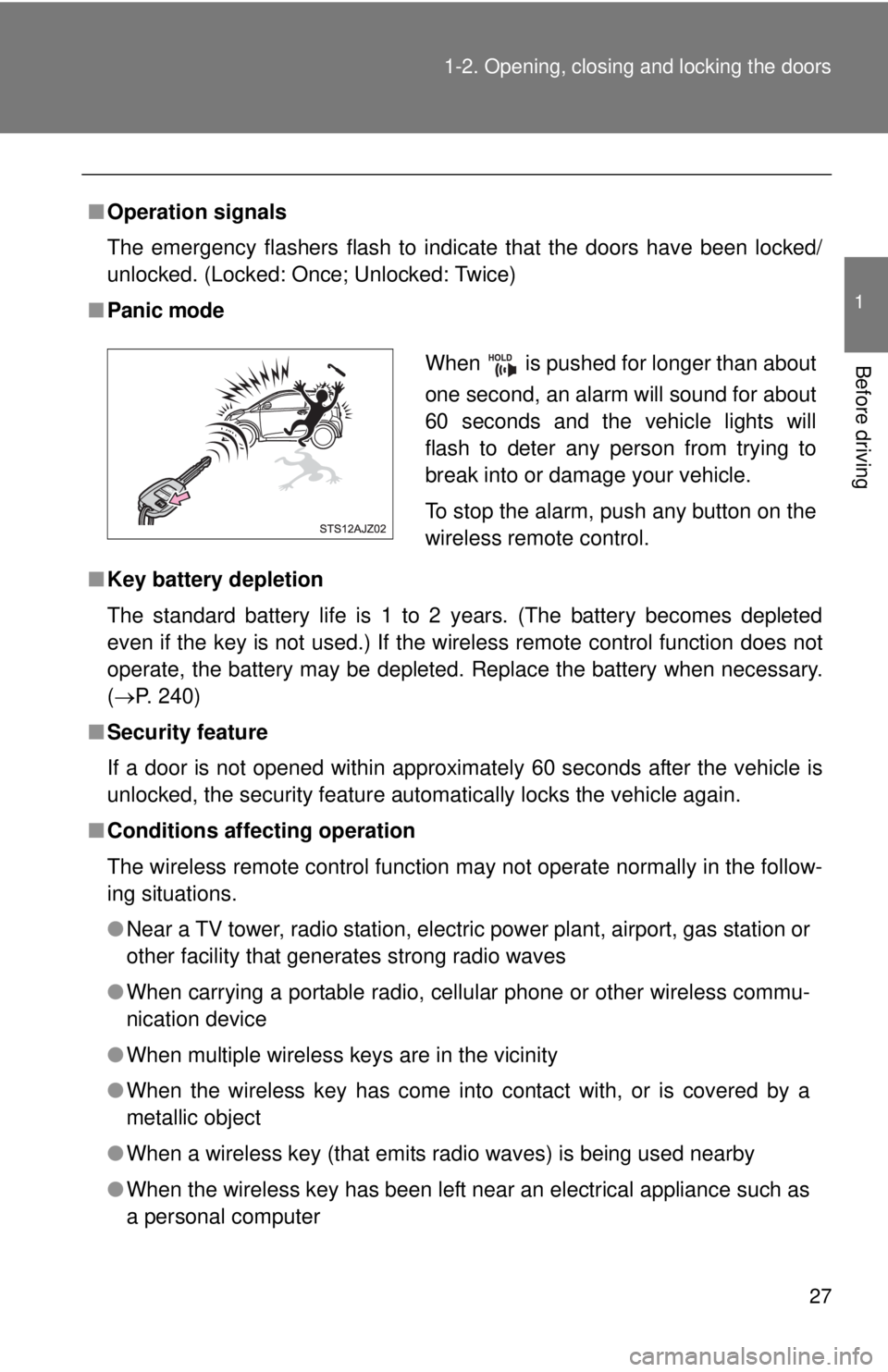
■Panic mode
■Key battery depletion
The standard battery life is 1 to 2 years. (The battery becomes depleted
even if the key is not used.) If the wireless remote control function does not
operate, the battery may be depleted. Replace the battery when necessary.
(P. 240)
■ Security feature
If a door is not opened within approximately 60 seconds after the vehicle is
unlocked, the security feature automatically locks the vehicle again.
■ Conditions affecting operation
The wireless remote control function may not operate normally in the follow-
ing situations.
●Near a TV tower, radio station, elec tric power plant, airport, gas station or
other facility that generates strong radio waves
● When carrying a portable radio, cell ular phone or other wireless commu-
nication device
● When multiple wireless keys are in the vicinity
● When the wireless key has come into contact with, or is covered by a
metallic object
● When a wireless key (that emits radio waves) is being used nearby
● When the wireless key has been left near an electrical appliance such as
a personal computer
When is pushed for longer than about
one second, an alarm will sound for about
60 seconds and the vehicle lights will
flash to deter any person from trying to
break into or damage your vehicle.
To stop the alarm, push any button on the
wireless remote control.
Page 70 of 376

70 1-7. Safety information
Your vehicle is equipped with ADVANCED AIRBAGS designed based
on the US motor vehicle safety standards (FMVSS208). The airbag
sensor assembly (ECU) controls ai rbag deployment based on infor-
mation obtained from the sensors etc. shown in the system compo-
nents diagram above. This inform ation includes crash severity and
occupant information. As the air bags deploy, a chemical reaction in
the inflators quickly fills the airbag s with non-toxic gas to help restrain
the motion of the occupants.
■ If the SRS airbags deploy (inflate)
●Bruising and slight abrasions may result from contact with a deploying
(inflating) SRS airbag.
● A loud noise and white powder will be emitted.
● Parts of the airbag module (steering wheel hub, airbag cover and inflator)
as well as the front seats, and parts of the front and rear pillars, roof side
rail and rear roof headlining may be hot for several minutes. The airbag
itself may also be hot.
● The front windshield may crack.
■ Operating conditions (SRS front airbags)
●The SRS front airbags will deploy in the event of an impact that exceeds
the set threshold level (the level of force corresponding to an approxi-
mately 12-18 mph [20-30 km/h] frontal collision with a fixed wall that does
not move or deform).
However, this threshold velocity will be considerably higher if the vehicle
strikes an object, such as a parked vehicle or sign pole, which can move or
deform on impact, or if the vehicle is involved in an underride collision (e.g.
a collision in which the front of the vehicle “underrides”, or goes under, the
bed of a truck, etc.).
● Depending on the type of collision, it is possible that only the seat belt
pretensioners will activate.
● The SRS front airbags for the front passenger will not activate if there is
no passenger sitting in the front passenger seat. However, the SRS front
airbags for the front passenger may deploy if luggage is put in the seat,
even if the seat is unoccupied. ( P. 81)
Page 71 of 376
71
1-7. Safety information
1
Before driving
●
The SRS seat cushion airbags on the front seats will not operate if the
occupant is not wearing a seat belt.
■ Operating conditions (SRS side ai rbags and SRS curtain shield air-
bags)
● The SRS side airbags and SRS curtain shield airbags will deploy in the
event of an impact that exceeds the set threshold level (the level of force
corresponding to the impact force produced by an approximately 3300 lb.
[1500 kg] vehicle colliding with the vehicle cabin from a direction perpen-
dicular to the vehicle orientation at an approximate speed of 12-18 mph
[20-30 km/h]).
● The SRS side airbags and SRS curtain shield airbags may also deploy in
the event of a severe rear collision.
● The SRS curtain shield airbags may also deploy in the event of a severe
frontal collision.
■ Operating conditions (SRS rear window curtain shield airbag)
The SRS rear window curtain shield airbag is designed to inflate when the
passenger compartment is subjected to a severe impact from the rear or
side.
■ Conditions under which the SRS airbags may deploy (inflate), other
than a collision
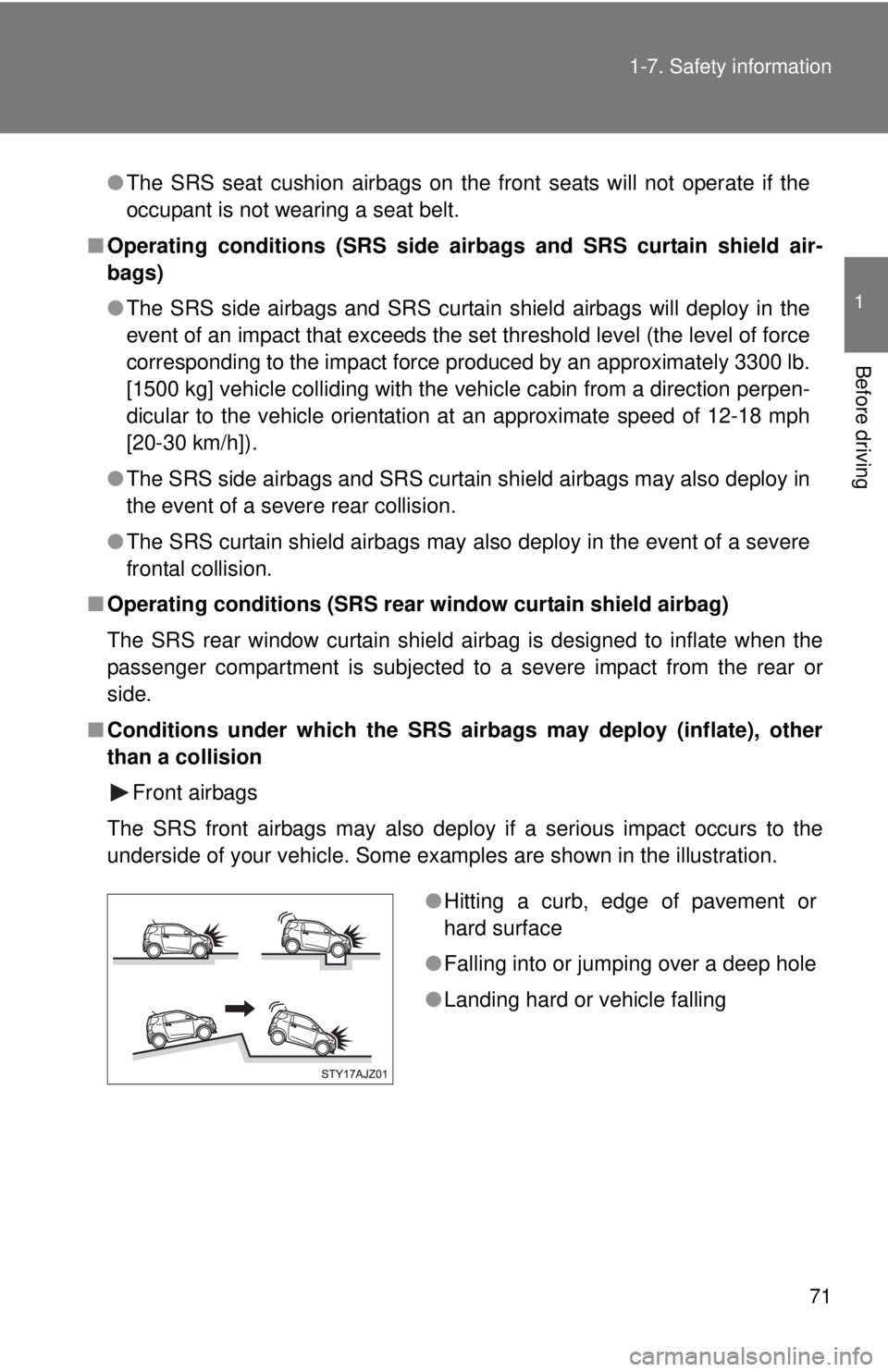
Front airbags
The SRS front airbags may also deploy if a serious impact occurs to the
underside of your vehicle. Some examples are shown in the illustration.
● Hitting a curb, edge of pavement or
hard surface
● Falling into or jumping over a deep hole
● Landing hard or vehicle falling
Page 81 of 376
81
1
1-7. Safety information
Before driving
Front passenger occupant classification system
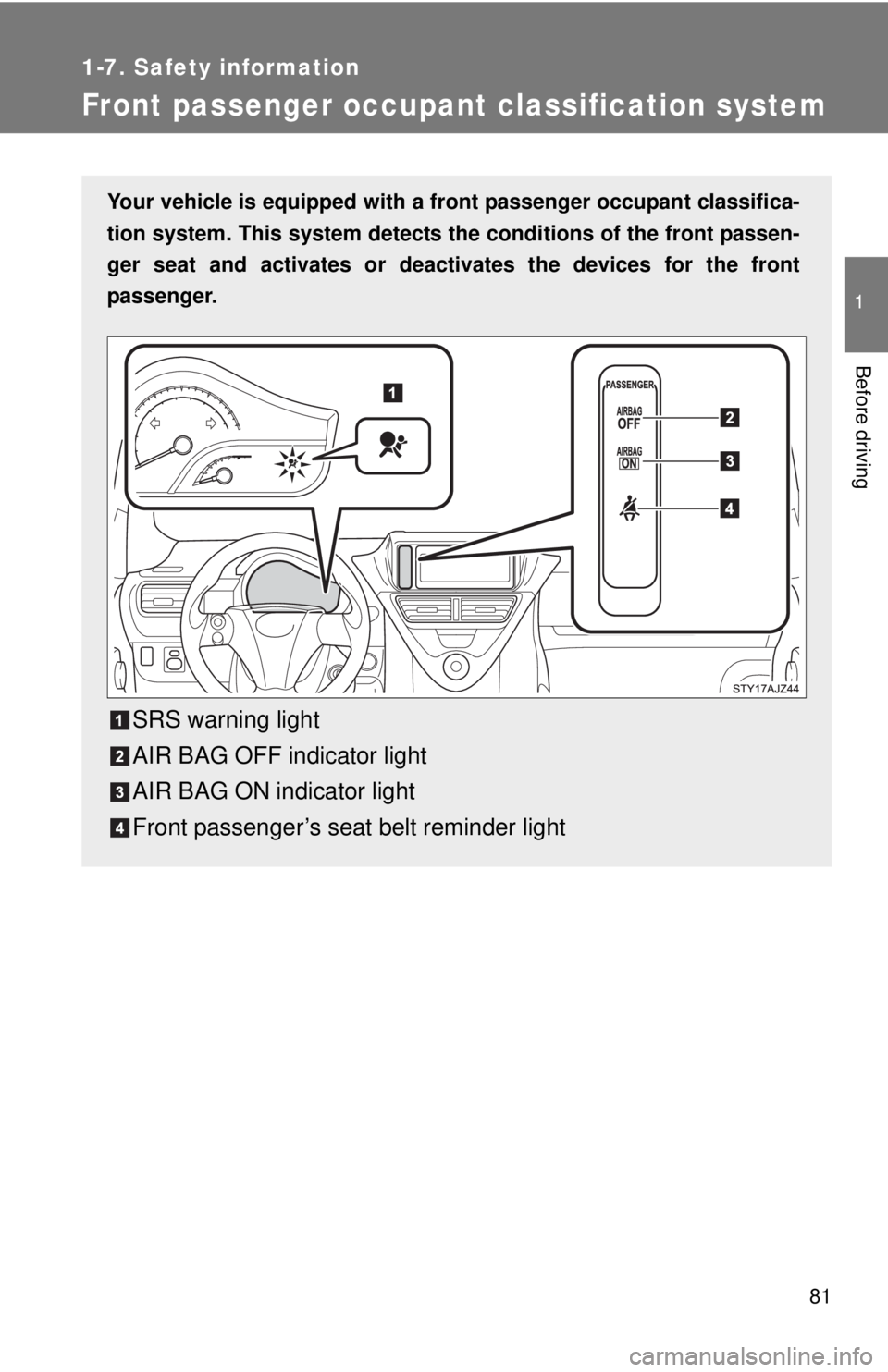
Your vehicle is equipped with a front passenger occupant classifica-
tion system. This system detects the conditions of the front passen-
ger seat and activates or deactiv ates the devices for the front
passenger.
SRS warning light
AIR BAG OFF indicator light
AIR BAG ON indicator light
Front passenger’s seat belt reminder light
Page 82 of 376

82 1-7. Safety information
Condition and operation in the front passenger occupant classification system
■Adult*1
■Child*4 or child restraint system*5
Indicator/
warning light AIR BAG ON and AIR BAG OFF indicator
lights AIR BAG ON
SRS warning light Off
Front passenger’s seat belt reminder light Off
*2
or
flashing
*3
Devices Front passenger airbag
Activated
Side airbag on the front passenger seat
Curtain shield airbag in the front passenger side
Front passenger knee airbag
Seat cushion airbag in the front passenger side
Activated*2
or
deactivated
*3
Front passenger’s seat belt pretensioner Activated
Indicator/
warning light AIR BAG ON and AIR BAG OFF indicator
lights AIR BAG
OFF
*6
SRS warning light Off
Front passenger’s seat belt reminder light Off
*2
or
flashing
*3
Devices Front passenger airbag Deactivated
Side airbag on the front passenger seat Activated
Curtain shield airbag in the front passenger
side
Front passenger knee airbag Deactivated
Seat cushion airbag in the front passenger
side
Front passenger’s seat belt pretensioner Activated
Page 112 of 376

112 2-1. Driving procedures
NOTICE
■If you hear a squealing or scrapin g noise while driving (brake pad wear
limit indicators)
Have the brake pads checked and replaced by your Scion dealer as soon as
possible.
The rotor damage can result if the pads are not replaced when needed.
It is dangerous to drive the vehicle when the wear limits of the brake pads
and/or that of the brake discs are exceeded.
■ If you get a flat tire while driving
A flat or damaged tire may cause the following situations. Hold the steering
wheel firmly and gradually press the brake pedal to slow down the vehicle.
●It may be difficult to control your vehicle.
● The vehicle will make abnormal sounds.
● The vehicle will behave abnormally.
If a tire goes flat, confirm the extent of the damage to the tire.
● If the tire is reparable, complete the emergency repair procedure.
( P. 288)
● If the tire is irreparable, please contact your Scion dealer.
■ When encountering flooded roads
Do not drive on a road that has flooded after heavy rain etc. Doing so may
cause the following serious damage to the vehicle.
●Engine stalling
● Short in electrical components
● Engine damage caused by water immersion
In the event that you drive on a flooded road and the vehicle is flooded, be
sure to have your Scion dealer check the following.
● Brake function
● Changes in quantity and quality of eng ine oil, transmission fluid, etc.
● Lubricant condition for the bearings and suspension joints (where possi-
ble) and the function of all joints, bearings, etc.
Page 151 of 376
151
2-5. Driving information
2
When driving
Winter driving tips
Carry out the necessary preparations and inspections before driving
the vehicle in winter. Always drive the vehicle in a manner appropri-
ate to the prevailing weather conditions.
■ Pre-winter preparations
●Use fluids that are appropriate to the prevailing outside tem-
peratures.
• Engine oil
• Engine coolant
• Washer fluid
● Have the vehicle fitted with four snow tires or purchase a set
of tire chains for the front tires.
Ensure that all tires are the same size and brand, and that chains
match the size of the tires.
■Before driving the vehicle
Perform the following according to the driving conditions.
●Do not try to forcibly open a window, scrape an outside rear
view mirror surface or move a wiper or outside rear view mir-
ror that is frozen. Pour warm water over the frozen area to
melt the ice. Wipe away the water immediately to prevent it
from freezing.
● To ensure proper operation of th e climate control system fan,
remove any snow that has accumulated on the air inlet vents
in front of the windshield.
● Remove any ice that has accumu lated on the vehicle chassis.
● Periodically check for and remove any excess ice or snow
that may have accumulated in the wheel well or on the
brakes.