charging TOYOTA IQ 2014 Owners Manual
[x] Cancel search | Manufacturer: TOYOTA, Model Year: 2014, Model line: IQ, Model: TOYOTA IQ 2014Pages: 376, PDF Size: 7.76 MB
Page 60 of 376
60 1-5. Refueling
CAUTION
■Refueling the vehicle
Observe the following precautions while refueling the vehicle.
Failure to do so may result in death or serious injury.
●Touch the vehicle or some other metal surface to discharge any static
electricity.
Sparks resulting from discharging static electricity may cause the fuel
vapors to ignite.
● Always hold the grips on the fuel tank cap and turn it slowly to remove it.
A whooshing sound may be heard when the fuel tank cap is loosened.
Wait until the sound cannot be heard before fully removing the cap.
In hot weather, pressurized fuel may spray out of the filler neck and cause
injury.
● Do not allow anyone that has not discharged static electricity from their
bodies to come close to an open fuel tank.
● Do not inhale vaporized fuel.
Fuel contains substances that are harmful if inhaled.
● Do not smoke while refueling the vehicle.
Doing so may cause the fuel to ignite and cause a fire.
● Do not return to the vehicle or touch any person or object that is statically
charged.
This may cause static electricity to build up, resulting in a possible ignition
hazard.
■ When replacing the fuel tank cap
Do not use anything but a genuine Scion fuel tank cap designed for your
vehicle. Doing so may cause a fire or other incident which may result in
death or serious injury.
Page 218 of 376
218 4-3. Do-it-yourself maintenance
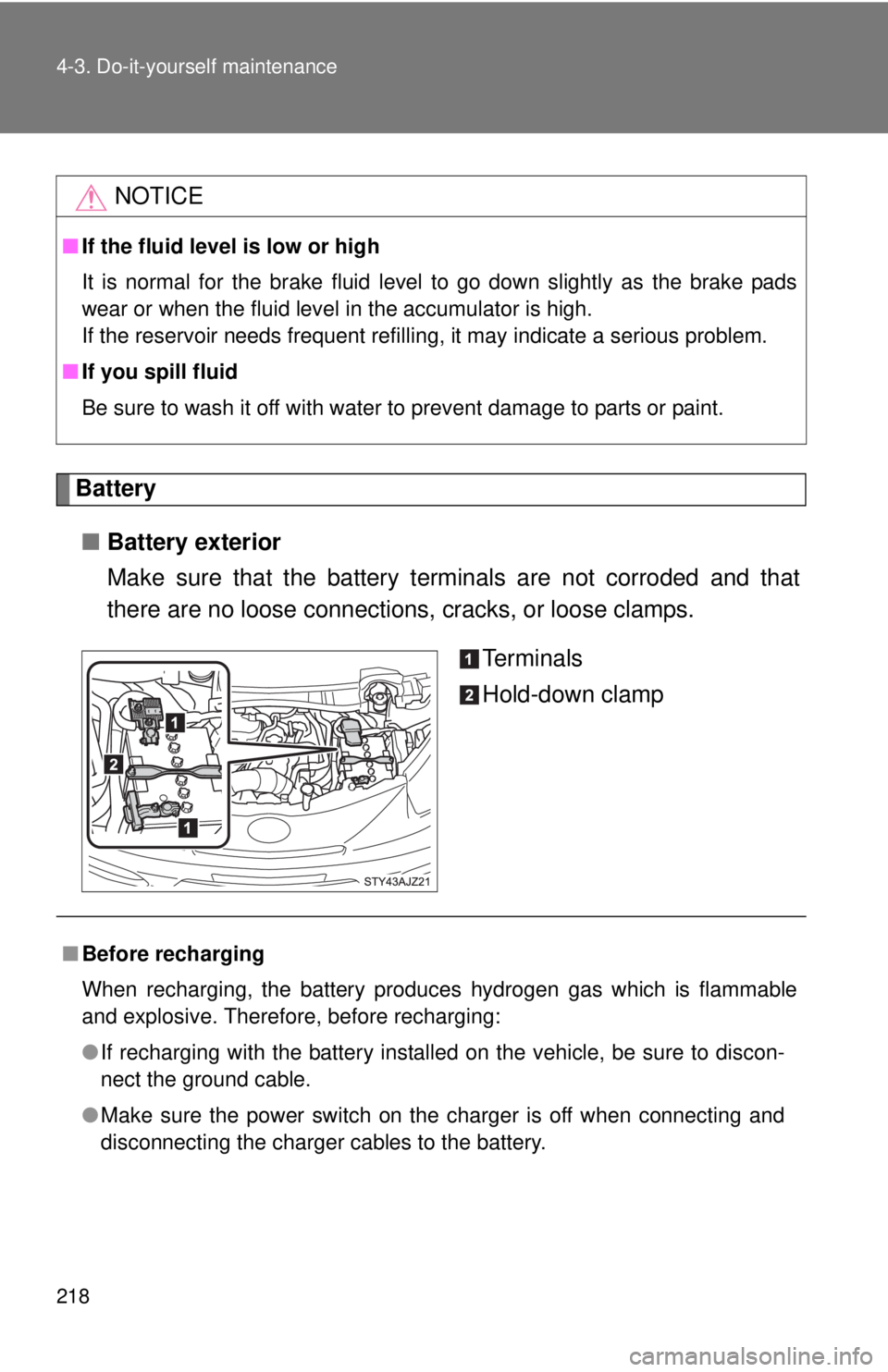
Battery■ Battery exterior
Make sure that the battery terminals are not corroded and that
there are no loose connections, cracks, or loose clamps.
Te r m i n a l s
Hold-down clamp
NOTICE
■If the fluid level is low or high
It is normal for the brake fluid level to go down slightly as the brake pads
wear or when the fluid level in the accumulator is high.
If the reservoir needs frequent refilling, it may indicate a serious pro\
blem.
■ If you spill fluid
Be sure to wash it off with water to prevent damage to parts or paint.
■Before recharging
When recharging, the battery produces hydrogen gas which is flammable
and explosive. Therefore, before recharging:
●If recharging with the battery installed on the vehicle, be sure to discon-
nect the ground cable.
● Make sure the power switch on the charger is off when connecting and
disconnecting the charger cables to the battery.
Page 220 of 376
220 4-3. Do-it-yourself maintenance
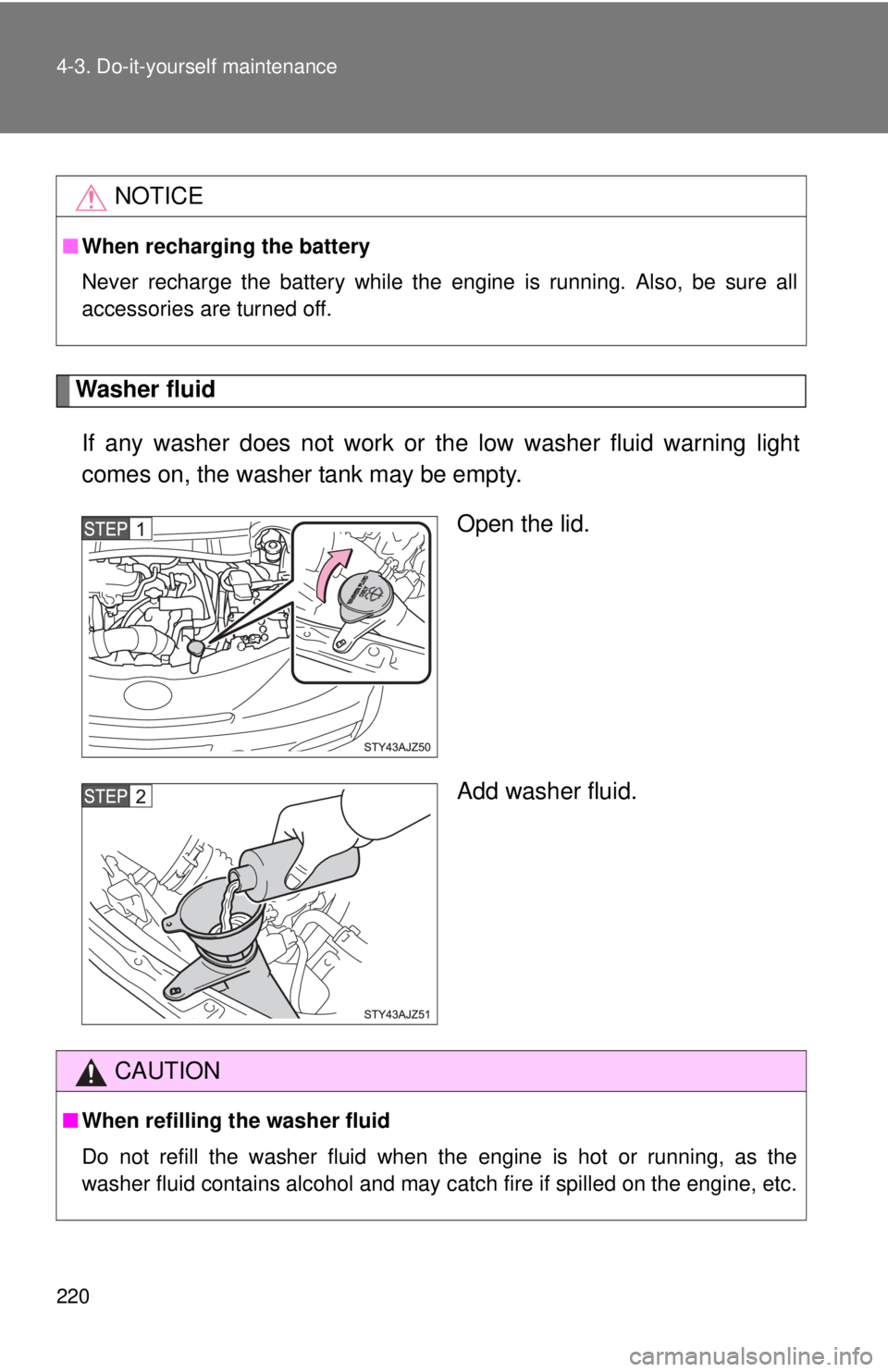
Washer fluidIf any washer does not work or the low washer fluid warning light
comes on, the washer tank may be empty. Open the lid.
Add washer fluid.
NOTICE
■When recharging the battery
Never recharge the battery while the engine is running. Also, be sure all
accessories are turned off.
CAUTION
■When refilling the washer fluid
Do not refill the washer fluid when the engine is hot or running, as the
washer fluid contains alcohol and may catch fire if spilled on the engine, etc.
Page 248 of 376
248 4-3. Do-it-yourself maintenance
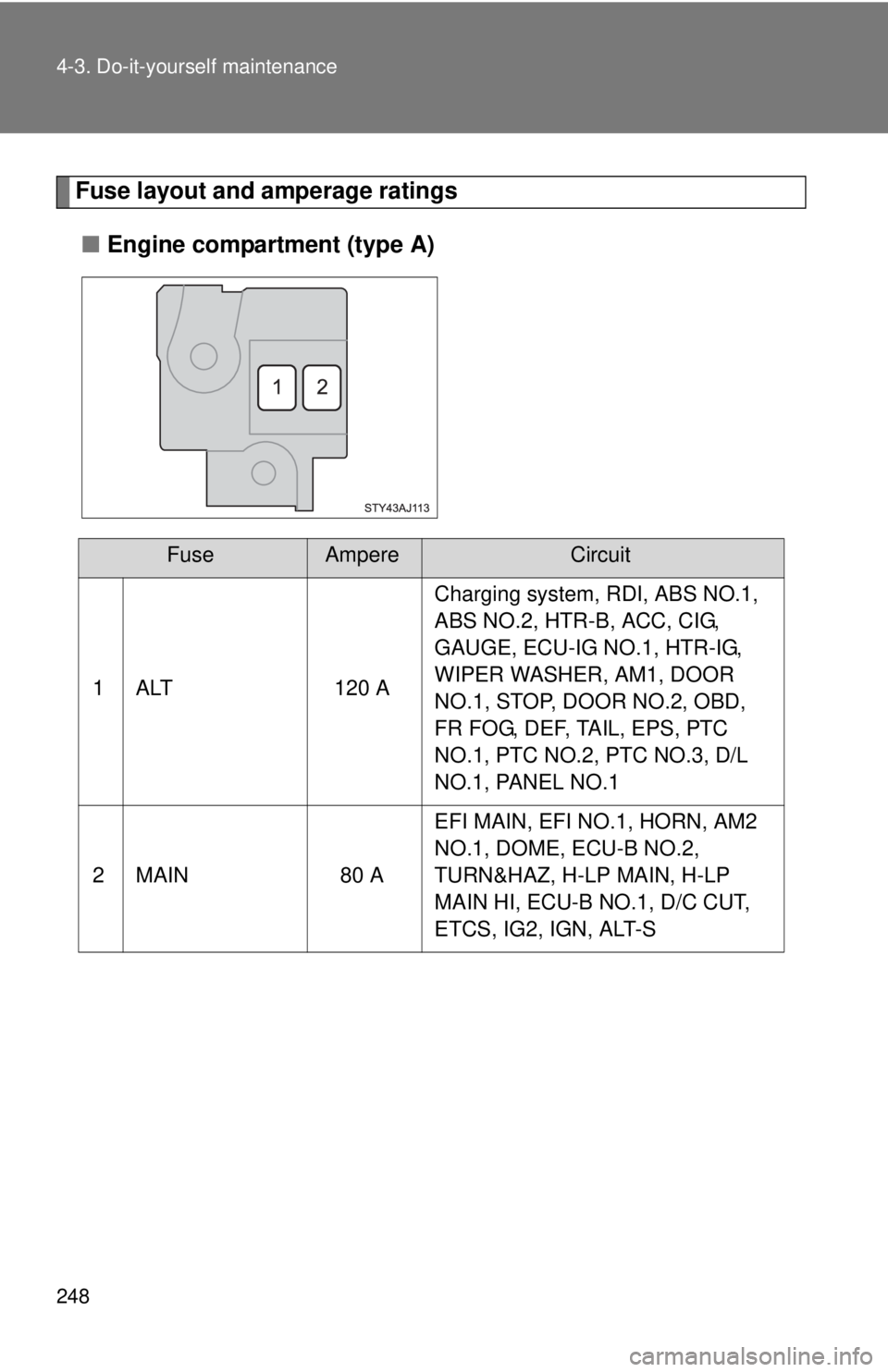
Fuse layout and amperage ratings■ Engine compartment (type A)
FuseAmpereCircuit
1 ALT 120 A Charging system, RDI, ABS NO.1,
ABS NO.2, HTR-B, ACC, CIG,
GAUGE, ECU-IG NO.1, HTR-IG,
WIPER WASHER, AM1, DOOR
NO.1, STOP, DOOR NO.2, OBD,
FR FOG, DEF, TAIL, EPS, PTC
NO.1, PTC NO.2, PTC NO.3, D/L
NO.1, PANEL NO.1
2 MAIN 80 A EFI MAIN, EFI NO.1, HORN, AM2
NO.1, DOME, ECU-B NO.2,
TURN&HAZ, H-LP MAIN, H-LP
MAIN HI, ECU-B NO.1, D/C CUT,
ETCS, IG2, IGN, ALT-S
Page 250 of 376
250 4-3. Do-it-yourself maintenance
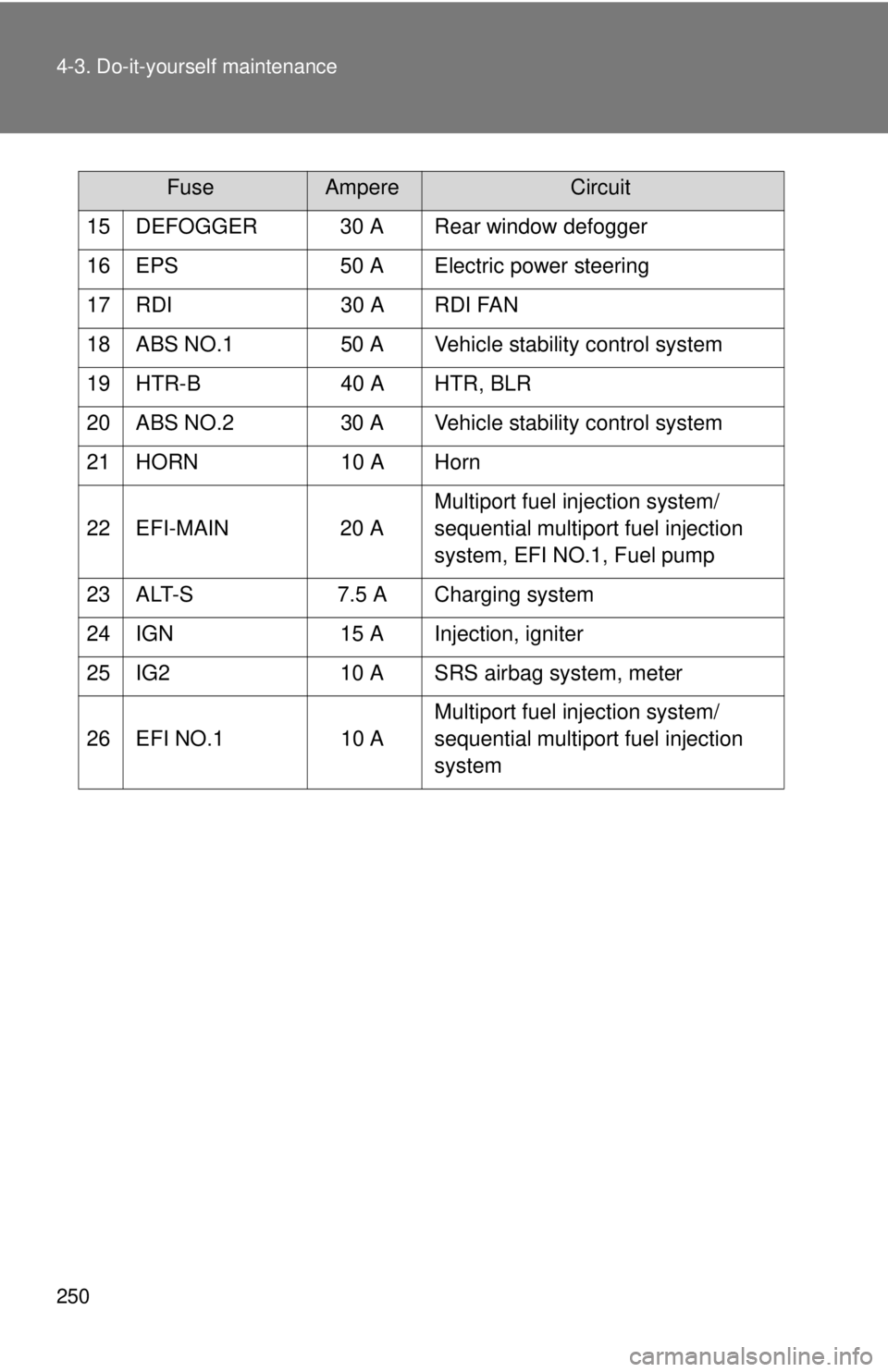
15 DEFOGGER 30 A Rear window defogger
16 EPS 50 A Electric power steering
17 RDI 30 A RDI FAN
18 ABS NO.1 50 A Vehicle stability control system
19 HTR-B 40 A HTR, BLR
20 ABS NO.2 30 A Vehicle stability control system
21 HORN 10 A Horn
22 EFI-MAIN 20 AMultiport fuel injection system/
sequential multiport fuel injection
system, EFI NO.1, Fuel pump
23 ALT-S 7.5 A Charging system
24 IGN 15 A Injection, igniter
25 IG2 10 A SRS airbag system, meter
26 EFI NO.1 10 A Multiport fuel injection system/
sequential multiport fuel injection
system
FuseAmpereCircuit
Page 252 of 376
252 4-3. Do-it-yourself maintenance
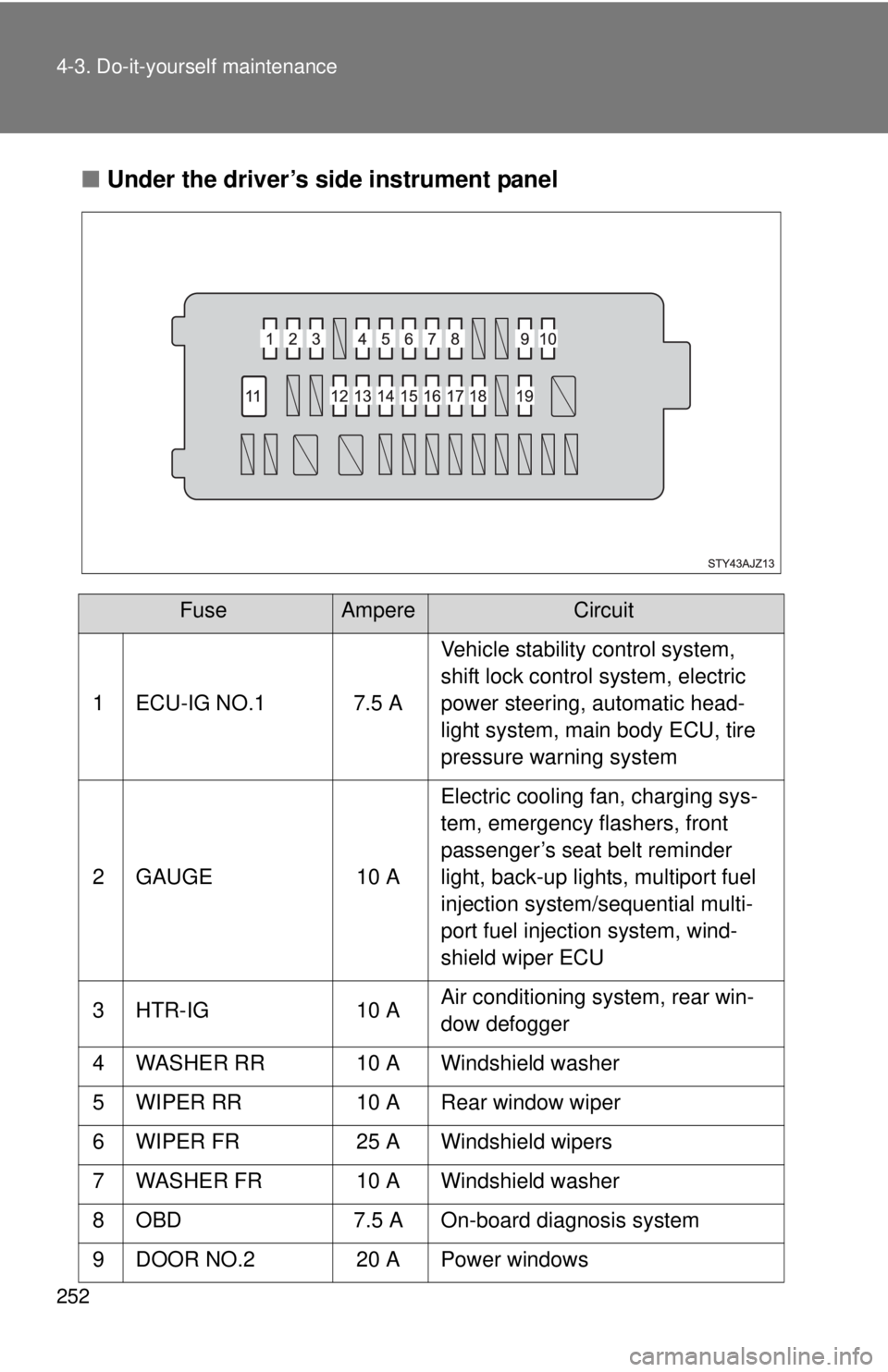
■Under the driver’s side instrument panel
FuseAmpereCircuit
1 ECU-IG NO.1 7.5 A Vehicle stability control system,
shift lock control system, electric
power steering, automatic head-
light system, main body ECU, tire
pressure warning system
2 GAUGE 10 A Electric cooling fan, charging sys-
tem, emergency flashers, front
passenger’s seat belt reminder
light, back-up lights, multiport fuel
injection system/sequential multi-
port fuel injection system, wind-
shield wiper ECU
3 HTR-IG 10 A Air conditioning system, rear win-
dow defogger
4 WASHER RR 10 A Windshield washer
5 WIPER RR 10 A Rear window wiper
6 WIPER FR 25 A Windshield wipers
7 WASHER FR 10 A Windshield washer
8 OBD 7.5 A On-board diagnosis system
9 DOOR NO.2 20 A Power windows
Page 278 of 376
278 5-2. Steps to take in an emergency
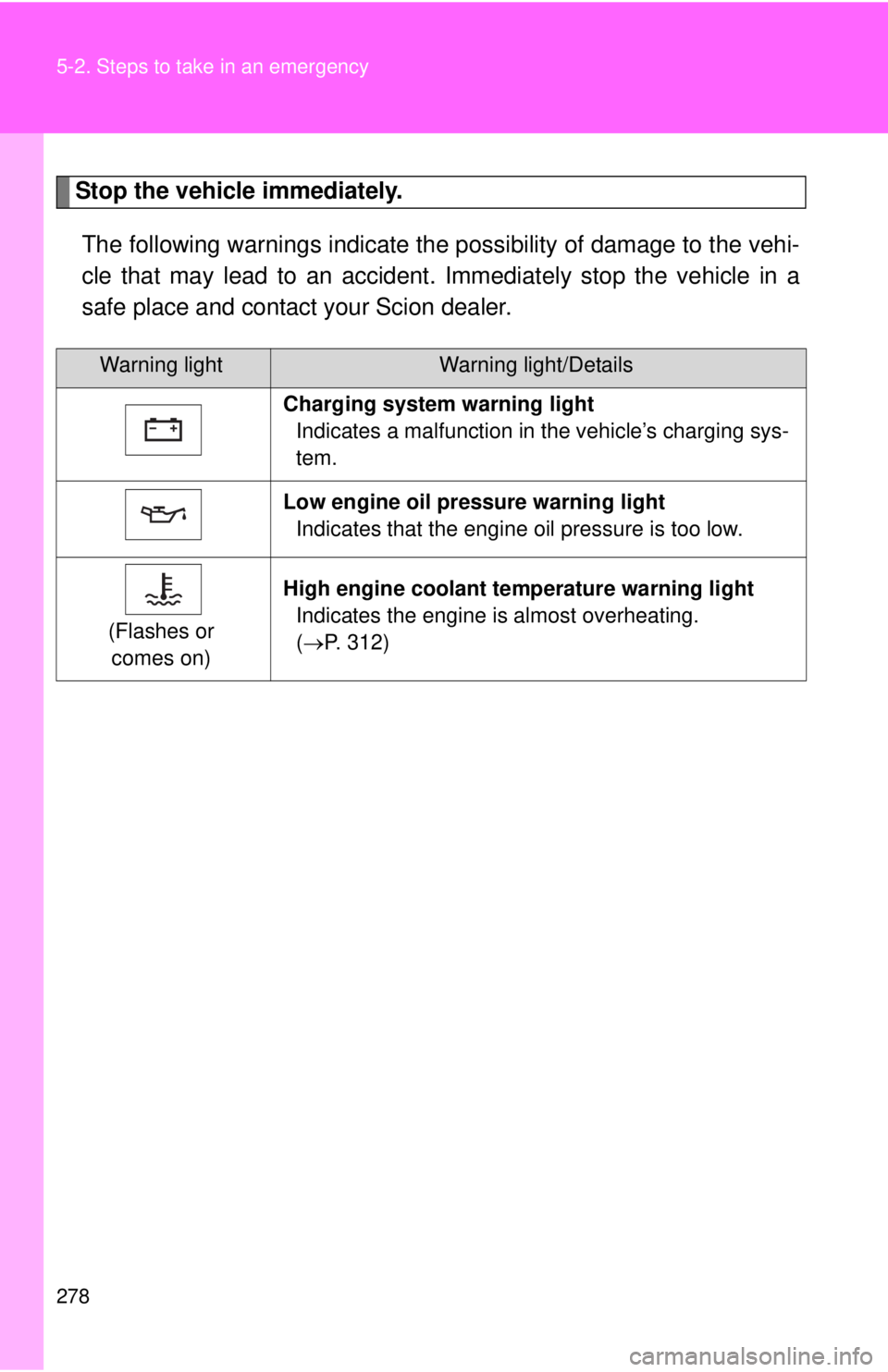
Stop the vehicle immediately.The following warnings indicate the possibility of damage to the vehi-
cle that may lead to an accident. Immediately stop the vehicle in a
safe place and contact your Scion dealer.
Warning lightWarning light/Details
Charging system warning light Indicates a malfunction in the vehicle’s charging sys-
tem.
Low engine oil pressure warning light Indicates that the engine oil pressure is too low.
(Flashes or comes on) High engine coolant temperature warning light
Indicates the engine is almost overheating.
(P. 312)
Page 310 of 376
310 5-2. Steps to take in an emergency
■Starting the engine when the battery is discharged
The engine cannot be started by push-starting.
■ Avoiding a discharged battery
●Turn off the headlights and the audio system while the engine is turned
off.
● Turn off any unnecessary electrical components when the vehicle is run-
ning at a low speed for an extended period, such as in heavy traffic, etc.
■ Charging the battery
The electricity stored in the battery will discharge gradually even when the
vehicle is not in use, due to natural discharge and the draining effects of cer-
tain electrical appliances. If the vehicle is left for a long time, the battery may
discharge, and the engine may be unable to start. (The battery recharges
automatically during driving.)
CAUTION
■Avoiding battery fires or explosions
Observe the following precautions to prevent accidentally igniting the flam-
mable gas that may be emitted from the battery.
●Make sure the jumper cable is connected to the correct terminal and that it
is not unintentionally in contact with any part other than the intended termi-
nal.
● Do not allow the jumper cables to come into contact with the “+” and “-” ter-
minals.
● Do not smoke, use matches, cigarette lighters or allow open flame near
the battery.
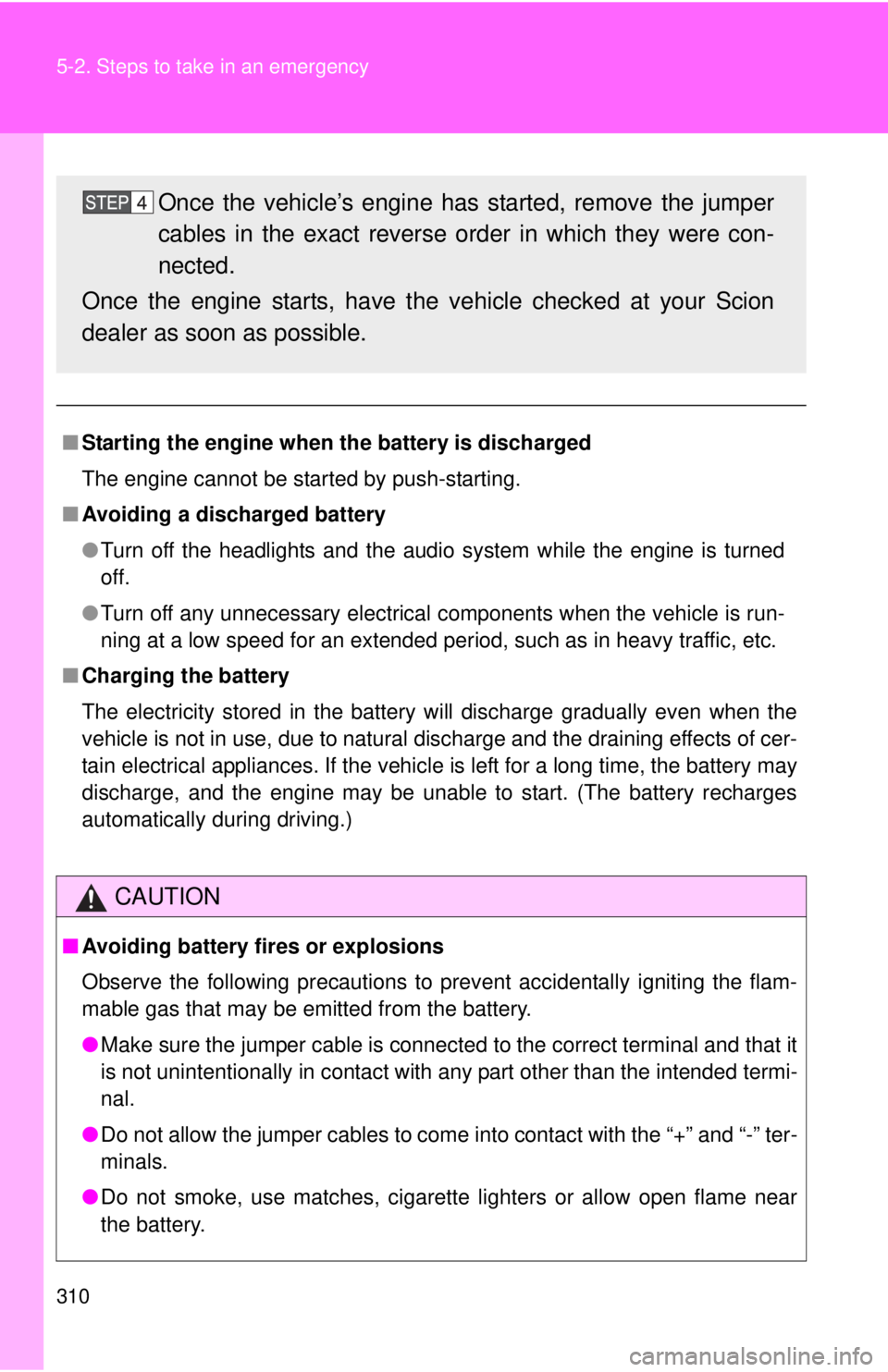
Once the vehicle’s engine has started, remove the jumper
cables in the exact reverse order in which they were con-
nected.
Once the engine starts, have the vehicle checked at your Scion
dealer as soon as possible.
Page 325 of 376
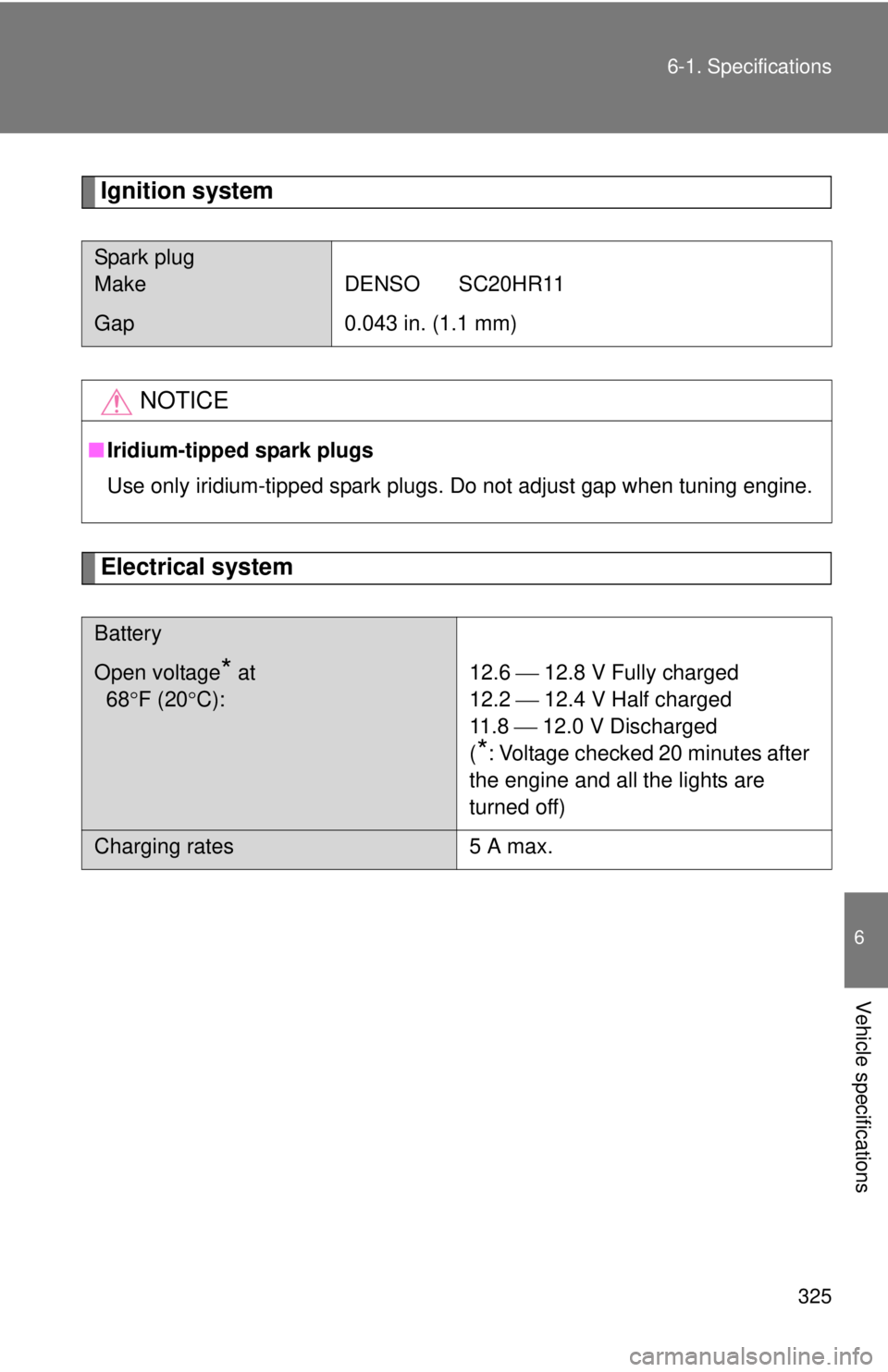
325
6-1. Specifications
6
Vehicle specifications
Ignition system
Electrical system
Spark plug
Make DENSO SC20HR11
Gap
0.043 in. (1.1 mm)
NOTICE
■Iridium-tipped spark plugs
Use only iridium-tipped spark plugs. Do not adjust gap when tuning engine.
Battery
Open voltage* at
68 F (20 C): 12.6 12.8 V Fully charged
12.2 12.4 V Half charged
11 . 8
12.0 V Discharged
(
*: Voltage checked 20 minutes after
the engine and all the lights are
turned off)
Charging rates 5 A max.
Page 370 of 376

370 Alphabetical index
Traction control........................ 141
TRAC ......................................... 141
Trip information ....................... 127
Trip meter ................................. 127
Turn signal lightsIndicator ................................ 124
Lever ..................................... 117
Replacing light bulbs ............. 255
Switch.................................... 117
Wattage ................................. 328
USB port ................................... 167
Vanity mirrors........................... 176
Vehicle data recordings ............18
Vehicle identification number ................................... 321
Vehicle stability control........... 141
VSC............................................ 141
Warning buzzers
Brake system ........................ 277
Seat belt reminder ................. 280
Warning lights ABS ....................................... 279
Airbag system ....................... 279
Anti-lock brake system .......... 279
Brake system ........................ 277
Charging system .... ............... 278
Driver’s seat belt ................... 280
Electric power steering system ................................ 279
Electronic engine control system ................................ 279
Engine oil replacement.......... 280
EPS system........................... 279 Front passenger occupant
classification system ........... 279
Front passenger’s seat belt... 280
High engine coolant temperature ........................ 278
Low brake fluid ...................... 277
Low engine oil pressure ........ 278
Low fuel level ........................ 280
Low tire inflation pressure ..... 280
Low washer fluid ................... 280
Malfunction............................ 279
Open door ............................. 280
Seat belt ................................ 280
Seat belt pretensioner system ................................ 279
SRS....................................... 279
SRS airbag system ............... 279
Tire pressure ......................... 280
Tire pressure warning system ................................ 280
VSC OFF .............................. 279
Washer Checking ............................... 220
Preparing and checking
before winter ....................... 151
Switch ........................... 136, 139
Warning light ......................... 280
Washing and waxing ............... 184
Weight Cargo capacity ...................... 146
Load limits ............................. 150
Weight ................................... 320
Wheels ...................................... 234
Window glasses ............ 55, 164, 184, 187
Window lock switch................... 55
U
V
W