coolant temperature TOYOTA IQ 2014 Owners Manual
[x] Cancel search | Manufacturer: TOYOTA, Model Year: 2014, Model line: IQ, Model: TOYOTA IQ 2014Pages: 376, PDF Size: 7.76 MB
Page 122 of 376
122 2-2. Instrument cluster
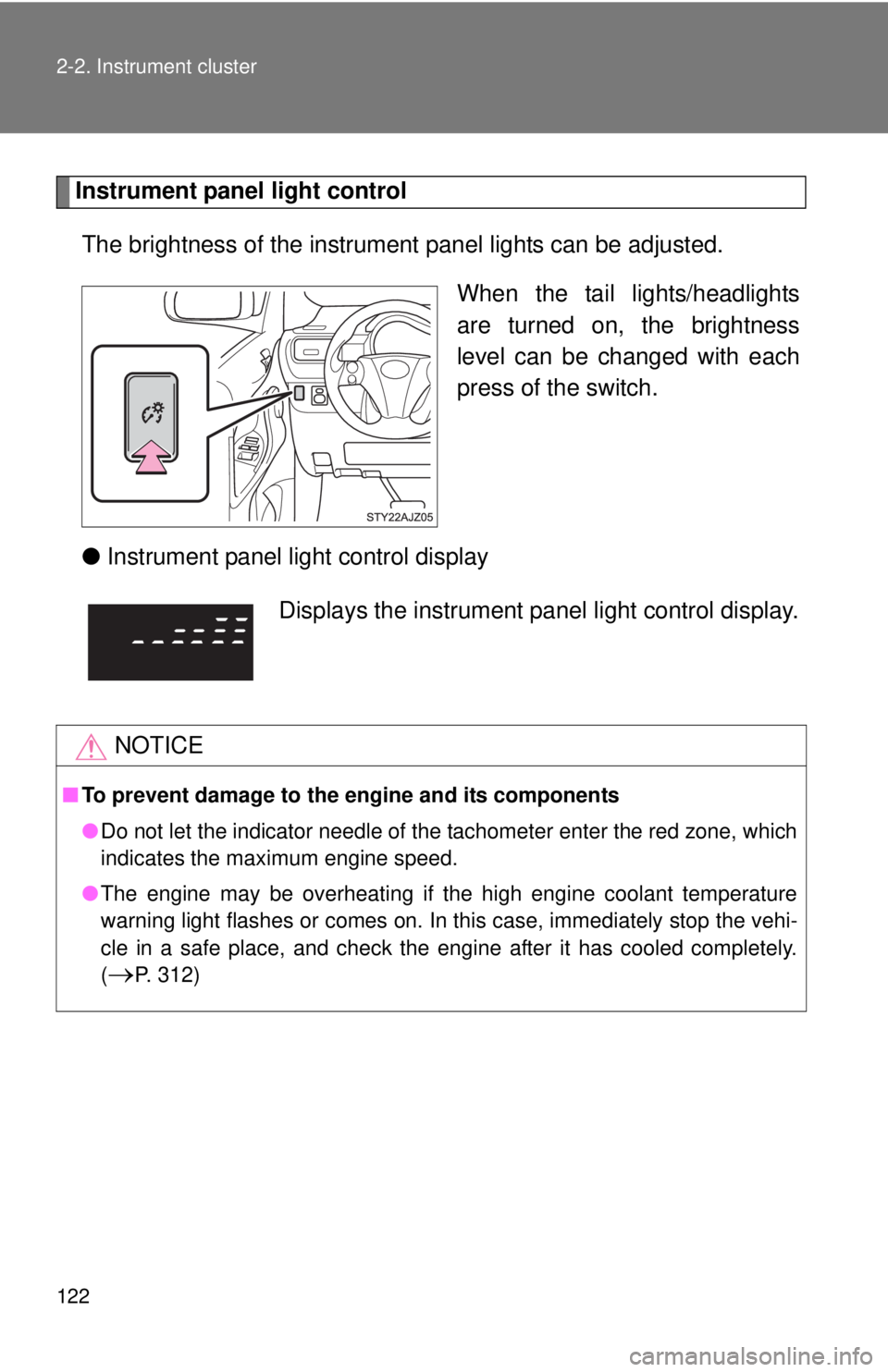
Instrument panel light controlThe brightness of the instrument panel lights can be adjusted.
When the tail lights/headlights
are turned on, the brightness
level can be changed with each
press of the switch.
● Instrument panel light control display
Displays the instrument pa nel light control display.
NOTICE
■To prevent damage to the engine and its components
●Do not let the indicator needle of the tachometer enter the red zone, which
indicates the maximum engine speed.
● The engine may be overheating if the high engine coolant temperature
warning light flashes or comes on. In this case, immediately stop the vehi-
cle in a safe place, and check the engine after it has cooled completely.
(
P. 312)
Page 124 of 376
124 2-2. Instrument cluster
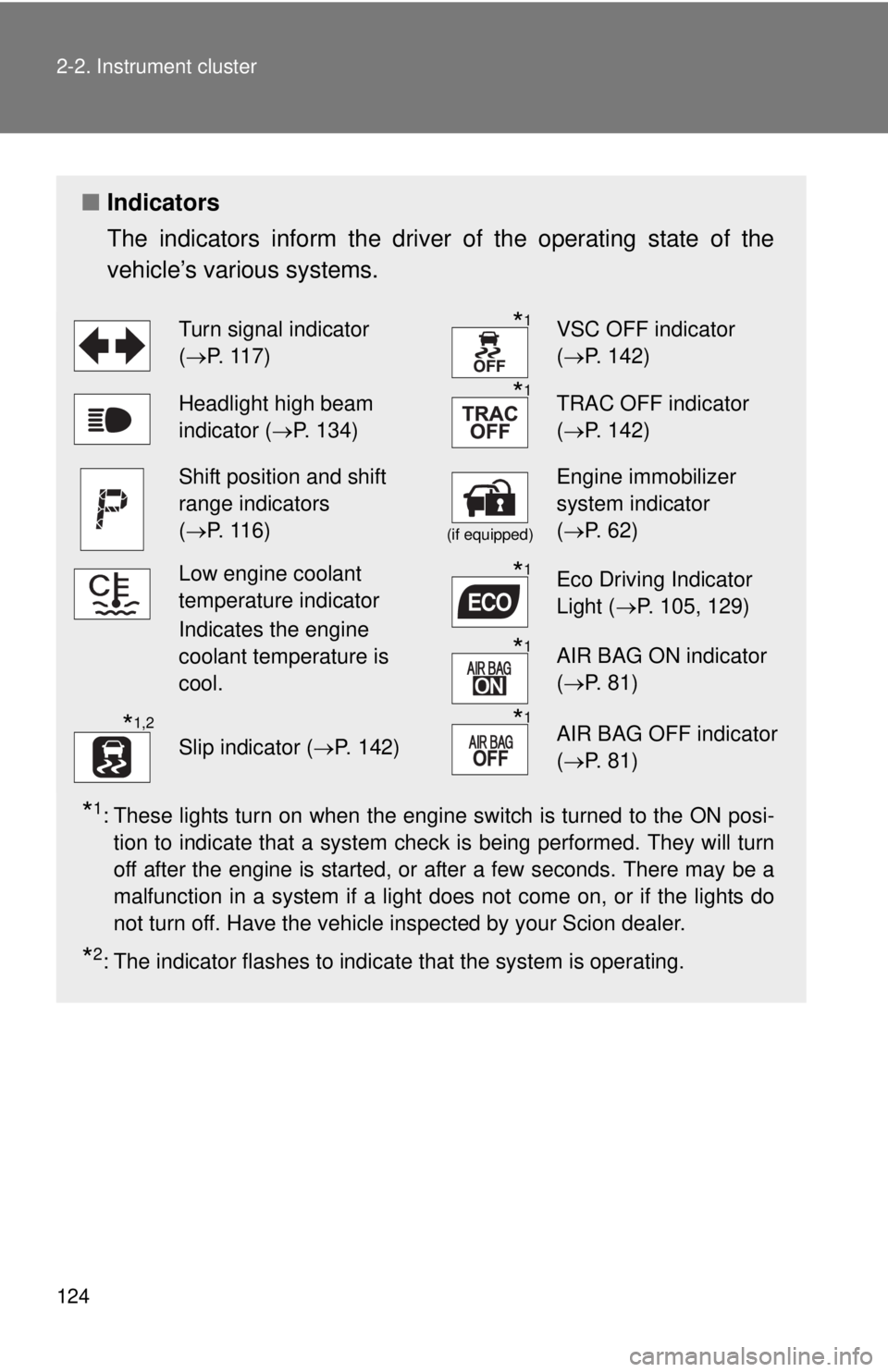
■Indicators
The indicators inform the driver of the operating state of the
vehicle’s various systems.
*1: These lights turn on when the engine switch is turned to the ON posi-
tion to indicate that a system check is being performed. They will turn
off after the engine is started, or after a few seconds. There may be a
malfunction in a system if a light does not come on, or if the lights do
not turn off. Have the vehicle inspected by your Scion dealer.
*2: The indicator flashes to indicate that the system is operating.
Turn signal indicator
(P. 117)*1VSC OFF indicator
( P. 142)
Headlight high beam
indicator ( P. 134)*1TRAC OFF indicator
(P. 142)
Shift position and shift
range indicators
(P. 116)
(if equipped)
Engine immobilizer
system indicator
( P. 62)
Low engine coolant
temperature indicator
Indicates the engine
coolant temperature is
cool.*1Eco Driving Indicator
Light ( P. 105, 129)
*1AIR BAG ON indicator
(P. 81)
*1,2
Slip indicator ( P. 142)
*1AIR BAG OFF indicator
(P. 81)
Page 198 of 376

198 4-3. Do-it-yourself maintenance
CAUTION
■When working on the engine compartment
●Take care because brake fluid can harm your hands or eyes and damage
painted surfaces.
If fluid gets on your hands or in your eyes, flush the affected area with
clean water immediately.
If you still experience discomfort, see a doctor.
■ When working near the electric cooling fan or radiator grille
Be sure the engine switch is in the LOCK position.
With the engine switch in the ON position, the electric cooling fan may \
auto-
matically start to run if the air condi tioning system is on and/or the coolant
temperature is high. ( P. 216)
■ Safety glasses
Wear safety glasses to prevent flying or falling material, fluid spray, etc. from
getting in the eyes.
NOTICE
■If you remove the air cleaner
Driving with the air cleaner removed may cause excessive engine wear due
to dirt in the air.
Page 275 of 376
5
When trouble arises
275
5-1. Essential information
If you think something is wrong
If you notice any of the following symptoms, your vehicle probably
needs adjustment or repair. Cont act your Scion dealer as soon as
possible.
■ Visible symptoms
●Fluid leaks under the vehicle
(Water dripping from the air c onditioning system after use is
normal.)
● Flat-looking tires or uneven tire wear
● High engine coolant temperatur e warning light flashes or
comes on
● Low engine coolant temperature indicator comes on or does
not come on continuously
■ Audible symptoms
●Changes in exhaust sound
● Excessive tire squeal when cornering
● Strange noises related to the suspension system
● Pinging or other noises related to the engine
■ Operational symptoms
●Engine missing, stumbling or running rough
● Appreciable loss of power
● Vehicle pulls heavily to one side when braking
● Vehicle pulls heavily to one side when driving on a level road
● Loss of brake effectiveness, s pongy feeling, pedal almost
touches the floor
Page 278 of 376
278 5-2. Steps to take in an emergency
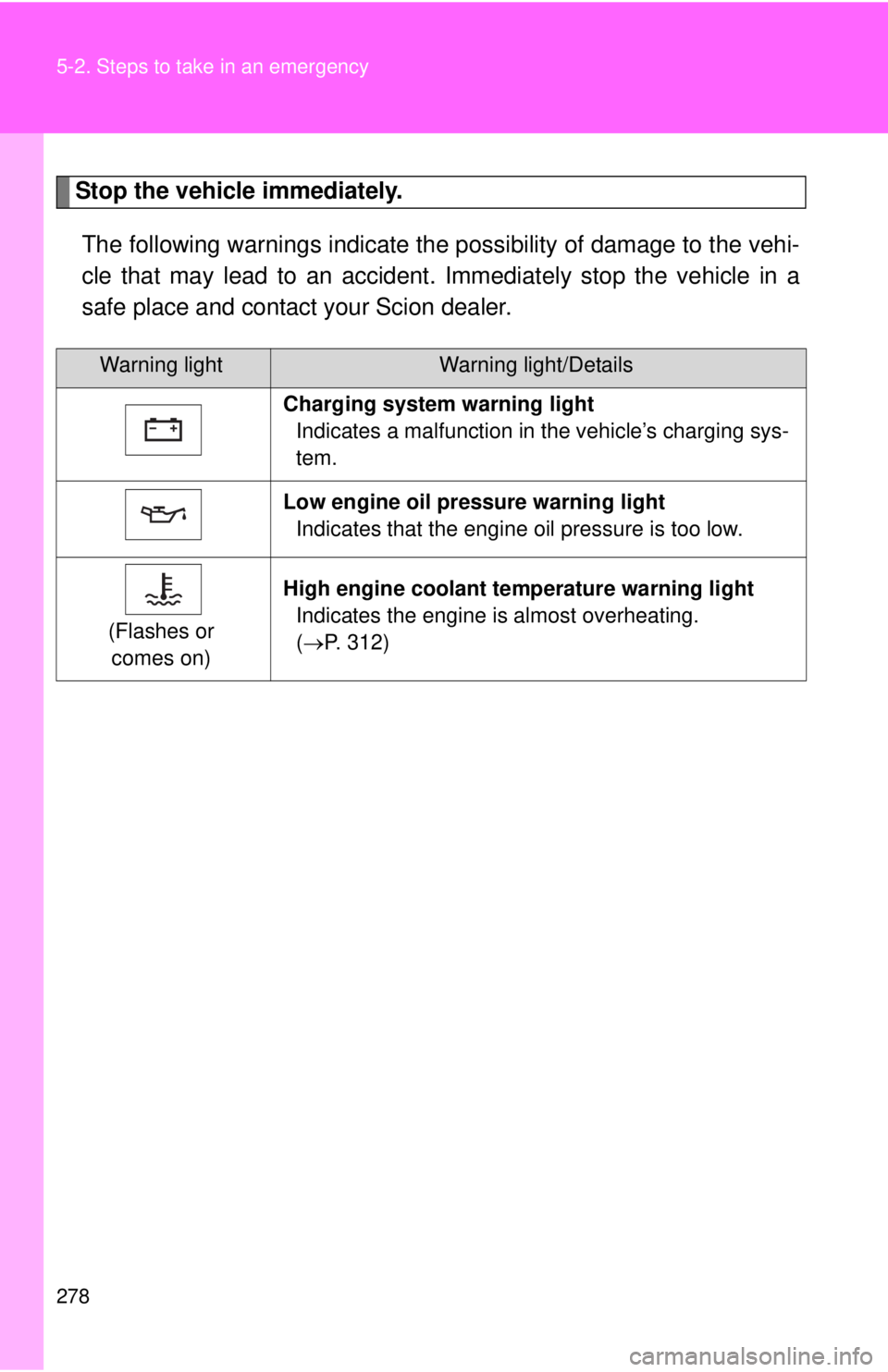
Stop the vehicle immediately.The following warnings indicate the possibility of damage to the vehi-
cle that may lead to an accident. Immediately stop the vehicle in a
safe place and contact your Scion dealer.
Warning lightWarning light/Details
Charging system warning light Indicates a malfunction in the vehicle’s charging sys-
tem.
Low engine oil pressure warning light Indicates that the engine oil pressure is too low.
(Flashes or comes on) High engine coolant temperature warning light
Indicates the engine is almost overheating.
(P. 312)
Page 313 of 376
5
When trouble arises
313
5-2. Steps to take in an emergency
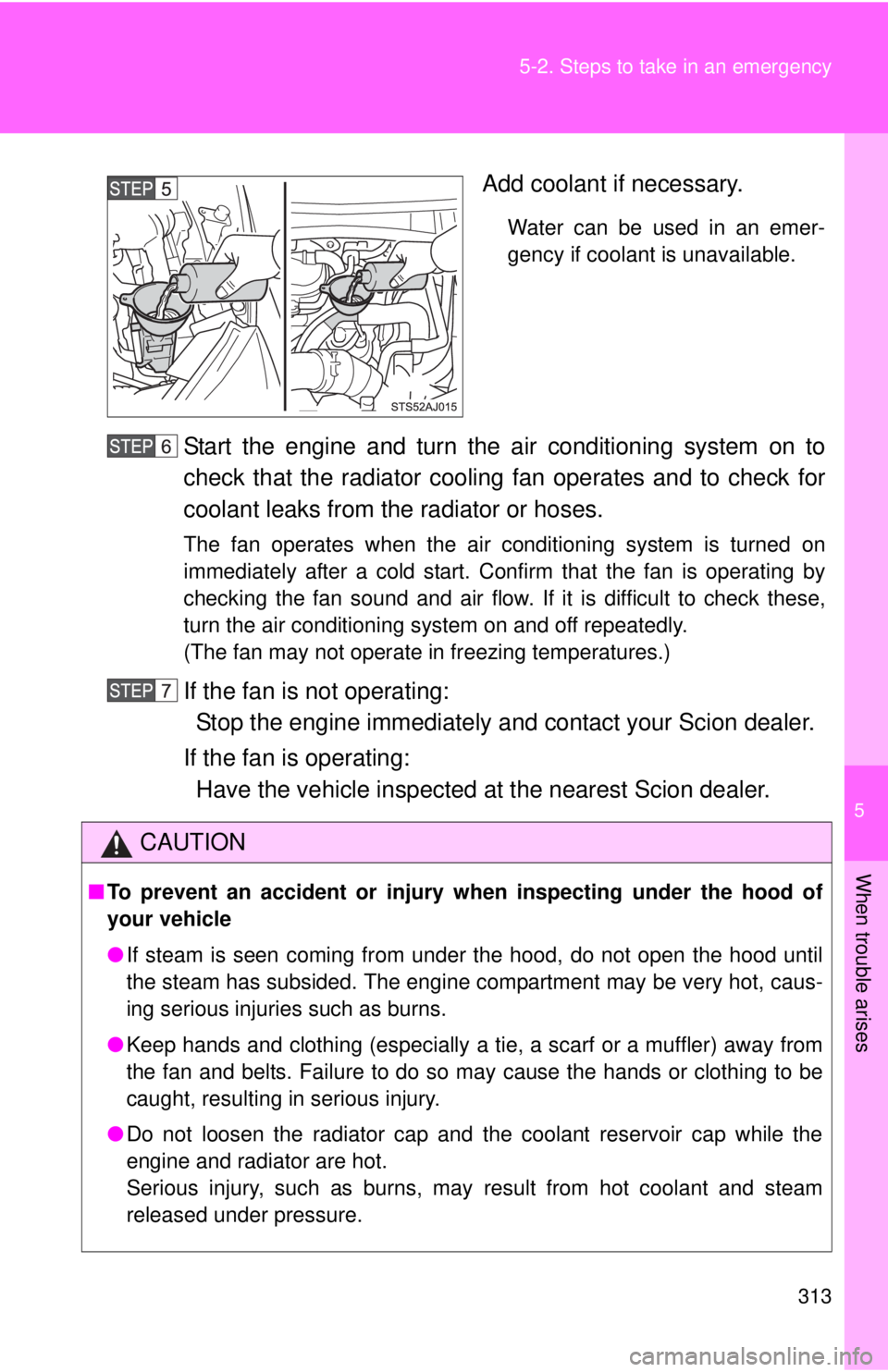
Add coolant if necessary.
Water can be used in an emer-
gency if coolant is unavailable.
Start the engine and turn the
air conditioning system on to
check that the radiator cooling fan operates and to check for
coolant leaks from the radiator or hoses.
The fan operates when the air conditioning system is turned on
immediately after a cold start. Confirm that the fan is operating by
checking the fan sound and air flow. If it is difficult to check these,
turn the air conditioning system on and off repeatedly.
(The fan may not operate in freezing temperatures.)
If the fan is not operating: Stop the engine immediately a nd contact your Scion dealer.
If the fan is operating: Have the vehicle inspected at the nearest Scion dealer.
CAUTION
■ To prevent an accident or injury when inspecting under the hood of
your vehicle
●If steam is seen coming from under the hood, do not open the hood until
the steam has subsided. The engine compartment may be very hot, caus-
ing serious injuries such as burns.
● Keep hands and clothing (especially a tie, a scarf or a muffler) away from
the fan and belts. Failure to do so may cause the hands or clothing to be
caught, resulting in serious injury.
● Do not loosen the radiator cap and the coolant reservoir cap while the
engine and radiator are hot.
Serious injury, such as burns, may result from hot coolant and steam
released under pressure.
Page 324 of 376
324 6-1. Specifications
The 0W portion of the oil viscosity rating indicates the characteristic of the
oil which allows cold startability. Oils with a lower value before the W allow
for easier starting of the engine in cold weather.
The 20 in 0W-20 indicates the oil viscosity when the oil is at its operating
temperature. An oil with a higher viscosity may be better suited if the vehi-
cle is operated at high speeds, or under extreme load conditions.
How to read oil container label:
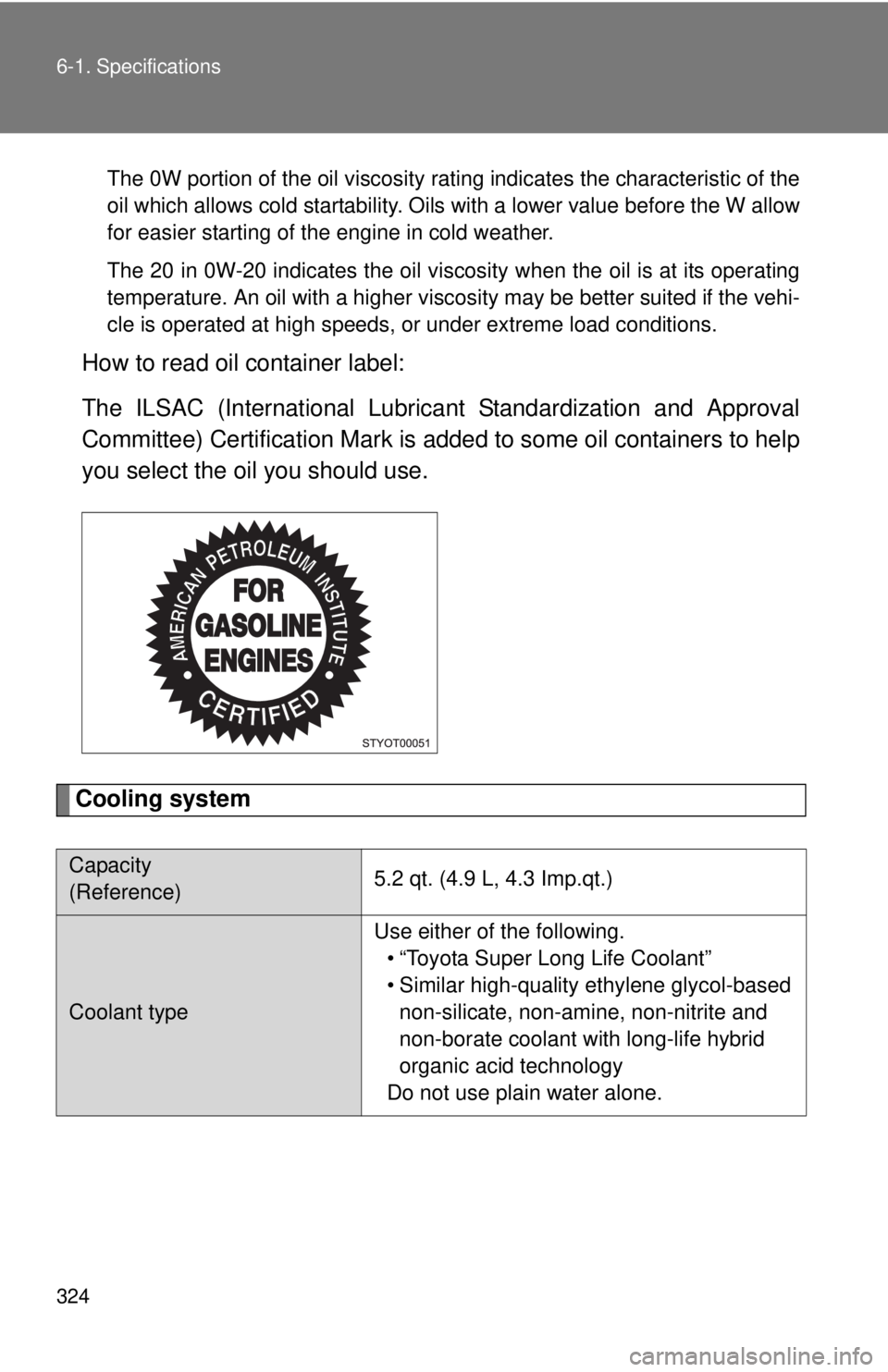
The ILSAC (International Lubricant Standardization and Approval
Committee) Certification Mark is added to some oil containers to help
you select the oil you should use.
Cooling system
Capacity
(Reference) 5.2 qt. (4.9 L, 4.3 Imp.qt.)
Coolant typeUse either of the following.
• “Toyota Super Long Life Coolant”
• Similar high-quality ethylene glycol-based non-silicate, non-amine, non-nitrite and
non-borate coolant with long-life hybrid
organic acid technology
Do not use plain water alone.
Page 337 of 376
337
6-1. Specifications
6
Vehicle specifications
Warning: The temperature grades of a tire assume that it is properly
inflated and not overloaded.
Excessive speed, underinflation, or
excessive loading, either sepa-
rately or in combination, can caus e heat buildup and possible tire fail-
ure.
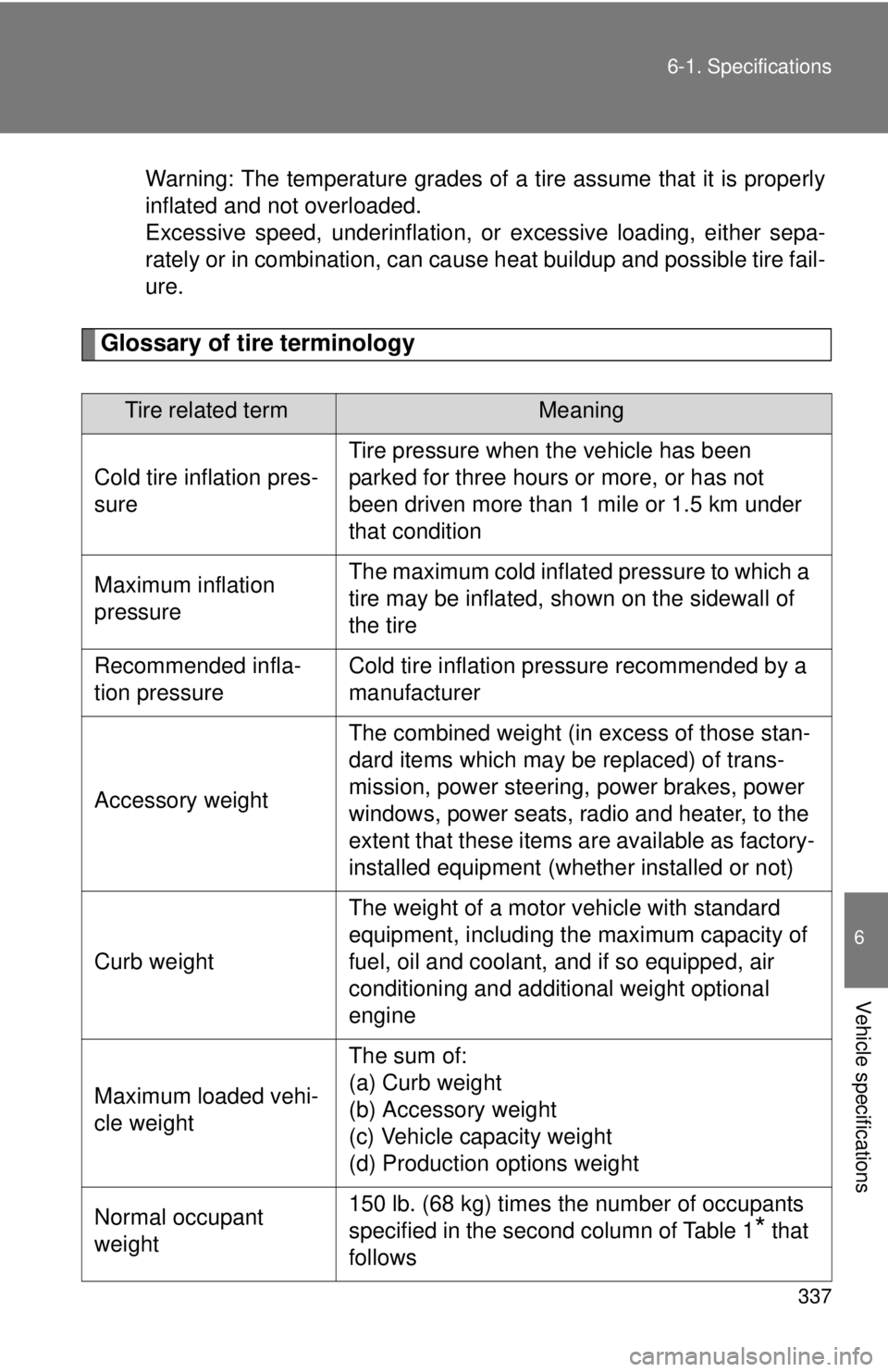
Glossary of tire terminology
Tire related termMeaning
Cold tire inflation pres-
sure
Tire pressure when the vehicle has been
parked for three hours or more, or has not
been driven more than 1 mile or 1.5 km under
that condition
Maximum inflation
pressureThe maximum cold inflated pressure to which a
tire may be inflated, s hown on the sidewall of
the tire
Recommended infla-
tion pressureCold tire inflation pressure recommended by a
manufacturer
Accessory weight
The combined weight (in excess of those stan-
dard items which may be replaced) of trans-
mission, power steering, power brakes, power
windows, power seats, radio and heater, to the
extent that these items are available as factory-
installed equipment (whether installed or not)
Curb weight
The weight of a motor vehicle with standard
equipment, including the maximum capacity of
fuel, oil and coolant, and if so equipped, air
conditioning and additional weight optional
engine
Maximum loaded vehi-
cle weight
The sum of:
(a) Curb weight
(b) Accessory weight
(c) Vehicle capacity weight
(d) Production options weight
Normal occupant
weight150 lb. (68 kg) times the number of occupants
specified in the second column of Table 1
* that
follows
Page 370 of 376

370 Alphabetical index
Traction control........................ 141
TRAC ......................................... 141
Trip information ....................... 127
Trip meter ................................. 127
Turn signal lightsIndicator ................................ 124
Lever ..................................... 117
Replacing light bulbs ............. 255
Switch.................................... 117
Wattage ................................. 328
USB port ................................... 167
Vanity mirrors........................... 176
Vehicle data recordings ............18
Vehicle identification number ................................... 321
Vehicle stability control........... 141
VSC............................................ 141
Warning buzzers
Brake system ........................ 277
Seat belt reminder ................. 280
Warning lights ABS ....................................... 279
Airbag system ....................... 279
Anti-lock brake system .......... 279
Brake system ........................ 277
Charging system .... ............... 278
Driver’s seat belt ................... 280
Electric power steering system ................................ 279
Electronic engine control system ................................ 279
Engine oil replacement.......... 280
EPS system........................... 279 Front passenger occupant
classification system ........... 279
Front passenger’s seat belt... 280
High engine coolant temperature ........................ 278
Low brake fluid ...................... 277
Low engine oil pressure ........ 278
Low fuel level ........................ 280
Low tire inflation pressure ..... 280
Low washer fluid ................... 280
Malfunction............................ 279
Open door ............................. 280
Seat belt ................................ 280
Seat belt pretensioner system ................................ 279
SRS....................................... 279
SRS airbag system ............... 279
Tire pressure ......................... 280
Tire pressure warning system ................................ 280
VSC OFF .............................. 279
Washer Checking ............................... 220
Preparing and checking
before winter ....................... 151
Switch ........................... 136, 139
Warning light ......................... 280
Washing and waxing ............... 184
Weight Cargo capacity ...................... 146
Load limits ............................. 150
Weight ................................... 320
Wheels ...................................... 234
Window glasses ............ 55, 164, 184, 187
Window lock switch................... 55
U
V
W
Page 372 of 376
372
What to do if...
What to do if...
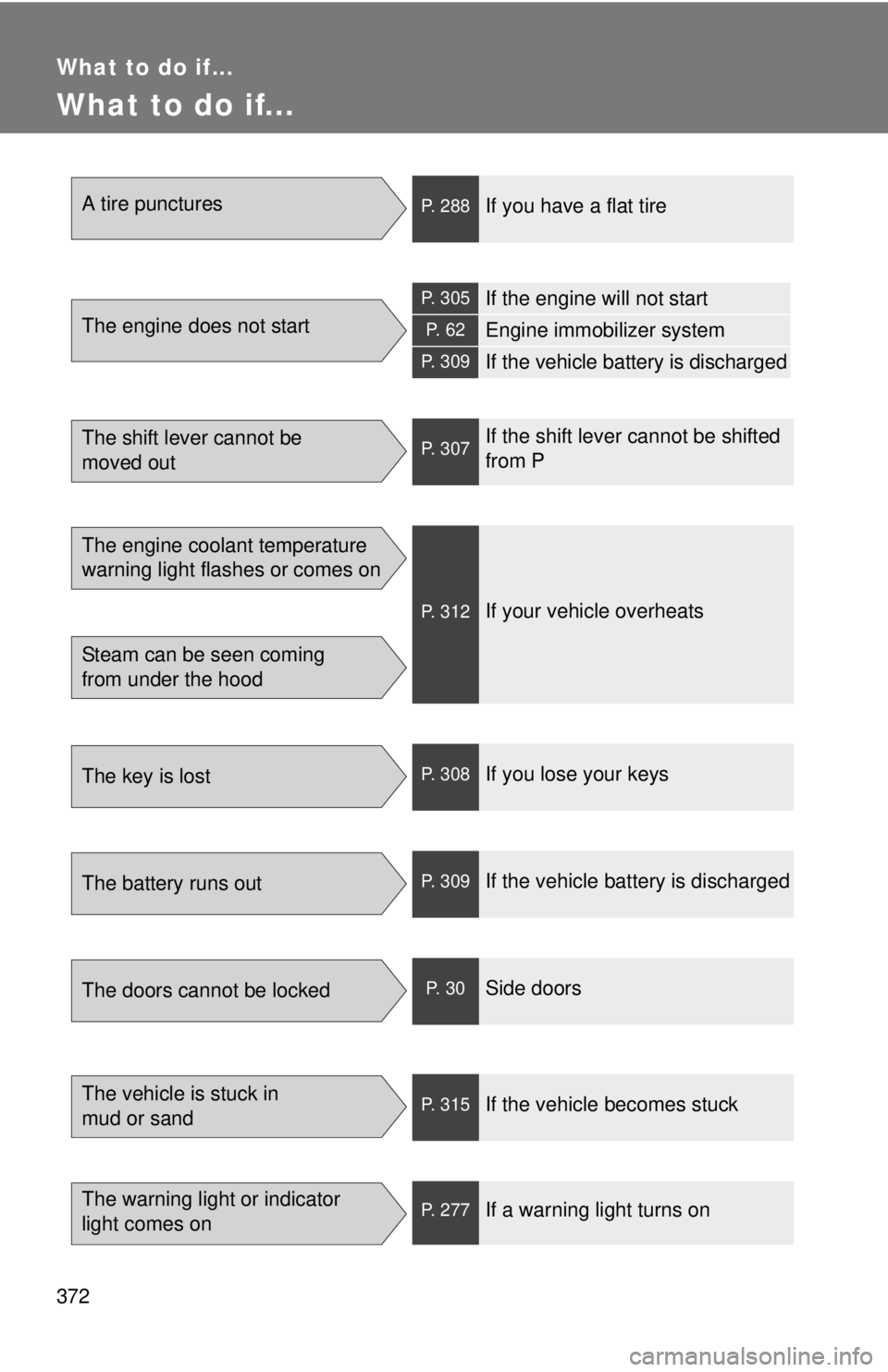
A tire puncturesP. 288If you have a flat tire
The engine does not start
P. 305If the engine will not start
P. 6 2Engine immobilizer system
P. 309If the vehicle battery is discharged
The shift lever cannot be
moved outP. 307If the shift lever cannot be shifted
from P
The engine coolant temperature
warning light flashes or comes on
Steam can be seen coming
from under the hood
P. 312If your vehicle overheats
The key is lostP. 308If you lose your keys
The battery runs outP. 309If the vehicle battery is discharged
The doors cannot be lockedP. 3 0Side doors
The vehicle is stuck in
mud or sandP. 315If the vehicle becomes stuck
The warning light or indicator
light comes onP. 277If a warning light turns on