engine TOYOTA LAND CRUISER 1999 Owner's Guide
[x] Cancel search | Manufacturer: TOYOTA, Model Year: 1999, Model line: LAND CRUISER, Model: TOYOTA LAND CRUISER 1999Pages: 202, PDF Size: 1.92 MB
Page 149 of 202

New L/C100(U)157
FUNCTIONS OF ENGINE OIL
Engine oil has the primary functions of
lubricating and cooling the inside of the
engine, and plays a major role in main-
taining the engine in proper working order.
ENGINE OIL CONSUMPTION
It is normal that an engine should con-
sume some engine oil during normal
engine operation. The causes of oil
consumption in a normal engine are as
follows.
Oil is used to lubricate pistons, piston
rings and cylinders. A thin film of oil
is left on the cylinder wall when a pis-
ton moves downwards in the cylinder.
High negative pressure generated when
the vehicle is decelerating sucks some
of this oil into the combustion chamber.
This oil as well as some part of the oil
film left on the cylinder wall is burned
by the high temperature combustion
gases during the combustion process.
Oil is also used to lubricate the stems
of the intake valves. Some of this oil
is sucked into the combustion chamber
together with the intake air and is
burned along with the fuel. High tem-
perature exhaust gases also burn the
oil used to lubricate the exhaust valve
stems.
The amount of engine oil consumed de-
pends on the viscosity of the oil, the
quality of the oil and the conditions the
vehicle is driven under.
More oil is consumed by high- speed driv-
ing and frequent acceleration and decel-
eration.
A new engine consumes more oil, since
its pistons, piston rings and cylinder walls
have not become conditioned.
When judging the amount of oil con-
sumption, note that the oil may become
diluted and make it difficult to judge
the true level accurately. As an example, if a vehicle is used for
repeated short trips, and consumes a nor-
mal amount of oil, the dipstick may not
show any drop in the oil level at all, even
after 1000 km (600 miles) or more. This
is because the oil is gradually becoming
diluted with fuel or moisture, making it
appear that the oil level has not changed.
The diluting ingredients evaporate out
when the vehicle is then driven at high
speeds, as on an expressway, making it
appear that oil is excessively consumed
after driving at high speeds.
IMPORTANCE OF ENGINE OIL LEVEL CHECK
One of the most important points in prop-
er vehicle maintenance is to keep the en-
gine oil at the optimum level so that oil
function will not be impaired. Therefore, it
is essential that the oil level be checked
regularly. Toyota recommends that the oil
level be checked every time you refuel
the vehicle.
NOTICE
Failure to check the oil level regularly
could lead to serious engine troubledue to insufficient oil.
Facts about engine oil
consumption
Page 150 of 202
New L/C100(U)
158
For detailed information on oil level check,
see ºChecking the engine oil levelº in
Chapter 7- 2.
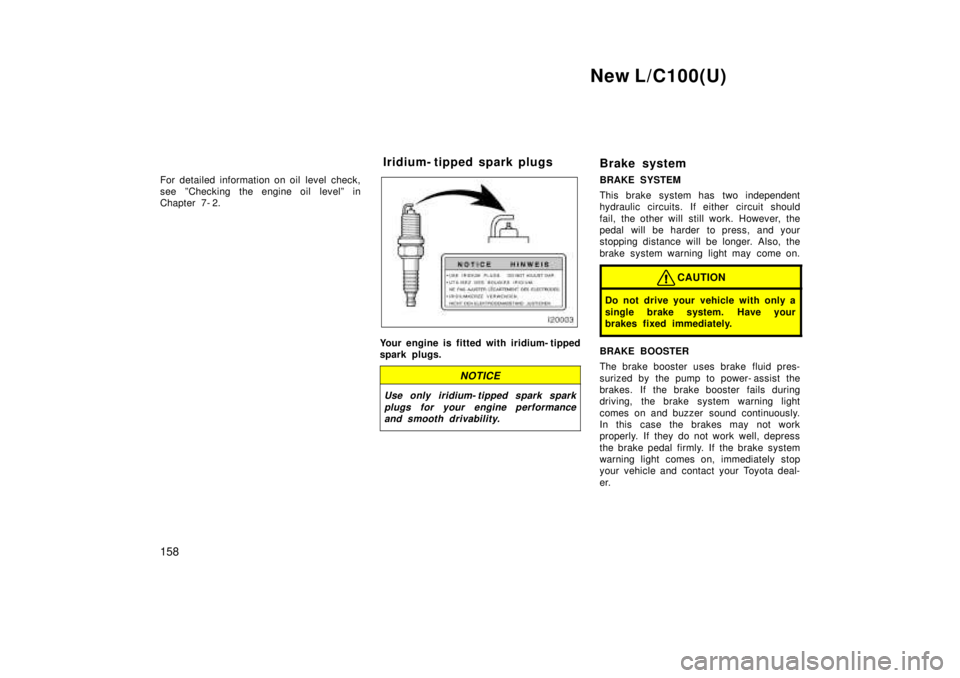
Your engine is fitted with iridium- tipped
spark plugs.
NOTICE
Use only iridium- tipped spark spark
plugs for your engine performanceand smooth drivability.
Brake system
BRAKE SYSTEM
This brake system has two independent
hydraulic circuits. If either circuit should
fail, the other will still work. However, the
pedal will be harder to press, and your
stopping distance will be longer. Also, the
brake system warning light may come on.
CAUTION
Do not drive your vehicle with only a
single brake system. Have your
brakes fixed immediately.
BRAKE BOOSTER
The brake booster uses brake fluid pres-
surized by the pump to power- assist the
brakes. If the brake booster fails during
driving, the brake system warning light
comes on and buzzer sound continuously.
In this case the brakes may not work
properly. If they do not work well, depress
the brake pedal firmly. If the brake system
warning light comes on, immediately stop
your vehicle and contact your Toyota deal-
er.
Iridium- tipped spark plugs
Page 151 of 202
New L/C100(U)159
There may be the case that the brake
system warning light stays on for a
bout
60 seconds after the engine is started. It
is normal if the light goes out after a
while.
Depressing the brake pedal repeatedly
may turn on the brake system warning
light and buzzer. It is normal if the light
goes out and the buzzer stops sounding
after a few seconds.
You may hear a small sound in the engine
compartment after the engine is started or
the brake pedal is depressed repeatedly.
This is a pump pulsating sound of the
brake system, and it is not a malfunction.
CAUTION
Do not pump the brake pedal if the
engine stalls. Each push on the
pedal uses up your brake fluid
pressure reserve.
Even if the power assist is com-
pletely lost, the brakes will still
work. But you will have to push the
pedal hardÐmuch harder than nor-
mal. And your braking distance will
be longer.
ANTI- LOCK BRAKE SYSTEM (with
ºABSº warning light)
The anti-lock brake system is designed to
automatically help prevent lock-up of the
wheels during sudden braking or braking
on slippery road surfaces. This assists in
providing directional stab ility and steering
performance of the vehicle under these
circumstances.
The anti- lock brake system becomes op-
erative after the vehicle has accelerated
to a speed in excess of approximately 10
km/h (6 mph). It stops operating when the
vehicle decelerates to a speed below
approximately 5 km/h (3 mph).
You may hear a sound in the engine
compartment for a few seconds when the
engine is started or just after the vehicle
is started. This means that the anti- lock
brake system is in the self check mode,
and does not indicate a malfunction.
Effective way to press the ºABSº brake
pedal: When the anti- lock brake system
function is in action, you may feel the
brake pedal pulsating and hear a noise.
In this situation, to let the anti- lock
brake system work for you, just hold the
brake pedal down more firmly. Do not
pump the brake in a panic stop. Pump-
ing the brake pedal makes the stopping
distance longer.
The brake pedal pulsation caused by the
anti- lock brake system may indicate haz-
ardous road surface conditions. Although
the anti- lock brake system assists in pro-
viding vehicle control, it is still important
to drive with all due care, because the
anti- lock brake system cannot overcome
the laws of physics that act on your ve-
hicle: Braking capab ility is dependent on tire
friction with the road surface.
Even though the anti- lock brake sys-
tem is operating, a driver cannot main-
tain full control on certain slippery road
surfaces, when cornering at high
speeds, or in violent maneuvers.
Page 152 of 202
New L/C100(U)
160
Avoid high speeds on wet roads. The
anti- lock brake system cannot elimi-
nate the risk of hydroplaning and loss
of tire friction.
Always maintain a safe distance from the
vehicle in front of you. Compared with
vehicles not fitted with an anti- lock brake
system, your vehicle may r equire a longer
stopping distance in the following cases:
Driving on rough, gravel or snow- cov-
ered roads.
Driving with tire chains installed.
Driving on roads where the road sur-
face is pitted or has other differences
in surface height.
CAUTION
Do not use tires other than the
manufacturer 's designated tires, and
do not mix tires or wheels of differ-
ent sizes. You may prevent the anti-
lock brake system from operating at
full effectiveness.
Vehicles with rear differential lock sys-
tem 'The anti- lock brake system does not
operate when the rear differential is
locked. It is normal operation for the
ºABSº warning light to be on at this time.
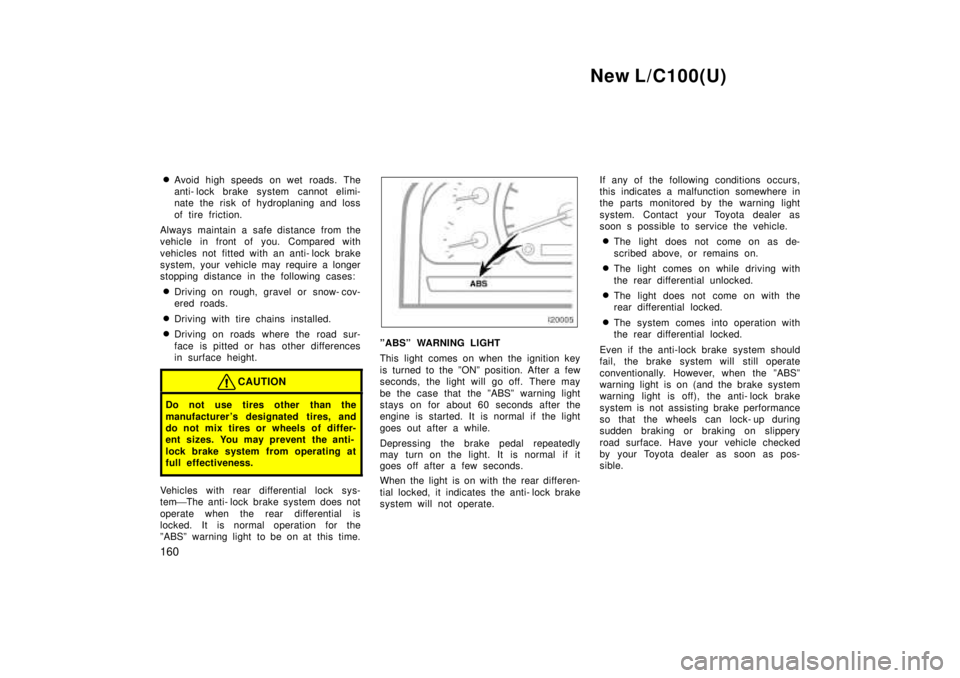
ºABSº WARNING LIGHT
This light comes on when the ignition key
is turned to the ºONº position. After a few
seconds, the light will go off. There may
be the case that the ºABSº warning light
stays on for about 60 seconds after the
engine is started. It is normal if the light
goes out after a while.
Depressing the brake pedal repeatedly
may turn on the light. It is normal if it
goes off after a few seconds.
When the light is on with the rear differen-
tial locked, it indicates the anti- lock brake
system will not operate. If any of the following conditions occurs,
this indicates a malfunction somewhere in
the parts monitored by the warning light
system. Contact your Toyota dealer as
soon s possible to service the vehicle.
The light does not come on as de-
scribed above, or remains on.
The light comes on while driving with
the rear differential unlocked.
The light does not come on with the
rear differential locked.
The system comes into operation with
the rear differential locked.
Even if the anti-lock brake system should
fail, the brake system will still operate
conventionally. However, when the ºABSº
warning light is on (and the brake system
warning light is off), the anti- lock brake
system is not assisting brake performance
so that the wheels can lock- up during
sudden braking or braking on slippery
road surface. Have your vehicle checked
by your Toyota dealer as soon as pos-
sible.
Page 155 of 202
New L/C100(U)163
Limited- slip differential
Some Toyotas are equipped with a lim-
ited- slip differential. If one rear wheel be-
gins to spin, the limited- slip differential is
designed to aid traction by automatically
transmitting driving force to the other rear
wheel. If you are not sure whether your
vehicle is equipped with one, you can ask
your Toyota dealer.
CAUTION
Do not start or run the engine while
your vehicle is supported by a jack.
The vehicle could be driven off the
jack and could pose a danger or re-
sult in serious injury.
NOTICE
Use only a spare tire of the same
size, construction and load capacityas the original tires on your Toyotabecause damage to the limited- slip
differential could possibly occur withanother tire type.
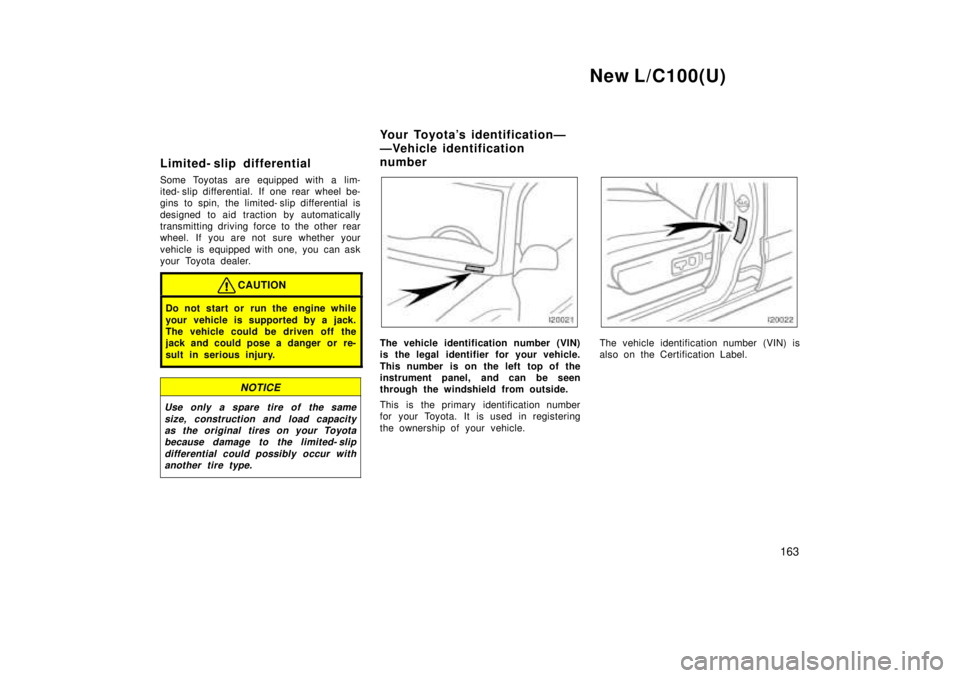
The vehicle identification number (VIN)
is the legal identifier for your vehicle.
This number is on the left top of the
instrument panel, and can be seen
through the windshield from outside.
This is the primary identification number
for your Toyota. It is used in registering
the ownership of your vehicle.The vehicle identification number (VIN) is
also on the Certification Label.
Your Toyota's identificationÐ
ÐVehicle identification
number
Page 156 of 202
New L/C100(U)
164
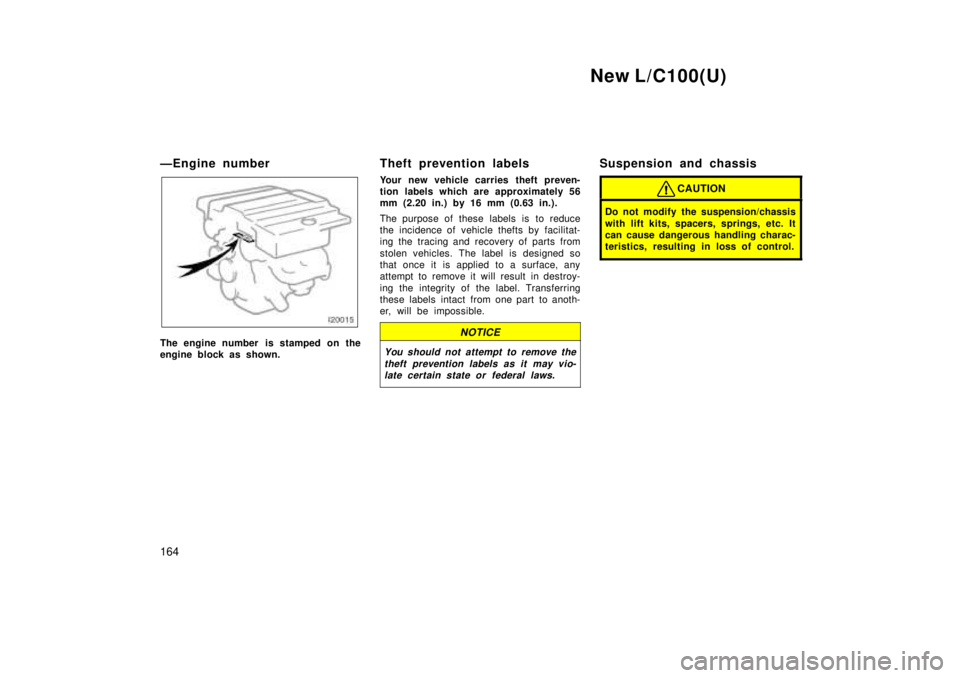
ÐEngine number
The engine number is stamped on the
engine block as shown.
Theft prevention labels
Your new vehicle carries theft preven-
tion labels which are approximately 56
mm (2.20 in.) by 16 mm (0.63 in.).
The purpose of these labels is to reduce
the incidence of vehicle thefts by fac
ilitat-
ing the tracing and recovery of parts from
stolen vehicles. The label is designed so
that once it is applied to a surface, any
attempt to remove it will result in destroy-
ing the integrity of the label. Transferring
these labels intact from one part to anoth-
er, will be impossible.NOTICE
You should not attempt to remove the
theft prevention labels as it may vio-late certain state or federal laws.
Suspension and chassis
CAUTION
Do not modify the suspension/chassis
with lift kits, spacers, springs, etc. It
can cause dangerous handling charac-
teristics, resulting in loss of control.
Page 159 of 202

New L/C100(U)167
Part 3
STARTING AND DRIV-
ING
Before starting the engine
How to start the engine
Tips for driving in various
conditions
Off- road driving precautions
Winter driving tips
Tr ailer towing
How to save fuel and make your
vehicle last longer, too
Before starting the engine
1. Check the area around the vehicle be- fore entering it.
2. Adjust seat position, seatback angle, head restraint height and steering
wheel angle.
3. Adjust inside and outside rear view mirrors.
4. Lock all doors.
5. Fasten seat belts. 1. Apply the parking brake firmly.
2. Turn off unnecessary lights and acces-
sories.
3. Put the selector lever in ºPº. If you need to restart the engine while the
vehicle is moving, put the selector le-
ver in ºNº. A starter safety device will
prevent the starter from operating if the
selector lever is in any drive position.
4. Depress the brake pedal and hold it to the floor until driving off.
How to start the engine±
(a) Before cranking
Page 160 of 202

New L/C100(U)
168
(b) Starting the engine
Before starting the engine, be sure to fol-
low the instructions in º(a) Before crank-
ingº.
Normal starting procedure
The multiport fuel injection system/sequen-
tial multiport fuel injection system in your
engine automatically controls the proper
air- fuel mixture for starting. You can start
a cold or hot engine as follows:
1. With your foot off the accelerator ped- al, crank the engine by turning the key
to ºSTARTº. Release it when the en-
gine starts.
2. After the engine runs for about 10 se- conds, you are ready to drive.
If the weather is below freezing, let the
engine warm up for a few minutes be-
fore driving.
If the engine stalls...
Simply restart it, using the correct proce-
dure given in normal starting.
If the engine will not start...
See ºIf your vehicle will not startº in Part 4.
NOTICE
Do not crank for more than 30 se- conds at a time. This may overheatthe starter and wiring systems.
Do not race a cold engine.
If the engine becomes difficult tostart or stalls frequently, have the
engine checked immediately.
Always slow down in gusty crosswinds.
This will allow you much better control.
Drive slowly onto curbs and, if pos-
sible, at a right angle. Avoid driving
onto high, sharp- edged objects and
other road hazards. Failure to do so
can lead to severe tire damage result-
ing in tire bursts.
When parking on a hill, turn the front
wheels until they touch the curb so
that the vehicle will not roll. Apply the
parking brake, and place the transmis-
sion in ºPº. If necessary, block the
wheels.
Washing your vehicle or driving through
deep water may get the brakes wet. To
see whether they are wet, check that
there is no traffic near you, and then
press the pedal lightly. If you do not
feel a normal braking force, the brakes
are probably wet. To dry them, drive
the vehicle cautiously while lightly
pressing the brake pedal with the park-
ing brake pulled. If they still do not
work safely, pull to the side of the road
and call a Toyota dealer for assistance.
Tips for driving
in various conditions
Page 161 of 202
New L/C100(U)169
CAUTION
Before driving off, make sure the
parking brake is fully released and
the parking brake reminder light is
off.
Do not leave your vehicle unat-
tended while the engine is running.
Do not rest your foot on the brake
pedal while driving. It can cause
dangerous overheating, needless
wear, and poor fuel economy.
To drive down a long or steep hill,
reduce your speed and downshift.
Remember, if you ride the brakes
excessively, they may overheat and
not work properly.
Be careful when accelerating, up-
shifting, downshifting or braking on
a slippery surface. Sudden accelera-
tion or engine braking could cause
the vehicle to spin or skid.
Do not drive in excess of the speed
limit. Even if the legal speed limit
permits it, do not drive over 140
km/h (85 mph) unless your vehicle
has high- speed capability tires.
Driving over 140 km/h (85 mph) may
result in tire failure, loss of control
and possible injury. Be sure to con-
sult a tire dealer to determine
whether the tires on your vehicle
are high- speed capability tires or
not before driving at such speeds.
Do not continue normal driving
when the brakes are wet. If they are
wet, your vehicle will require a
longer stopping distance, and it
may pull to one side when the
brakes are applied. Also, the park-
ing brake will not hold the vehicle
securely.
Off- road driving precautions
When driving your vehicle off- road, please
observe the following precautions to en-
sure your driving enjoyment and to help
prevent the closure of areas to off- road
vehicles.
a. Drive your vehicle only in areas where
off- road vehicles are permitted to trav-
el.
b. Respect private property. Get owner 's permission before entering private prop-
erty.
c. Do not enter areas that are closed. Honor gates, barriers and signs that
restrict travel.
d. Stay on established roads. When condi- tions are wet, driving techniques should
be changed or travel delayed to pre-
vent damage to roads.
For owners in U.S. mainland, Hawaii and
Puerto Rico:
To obtain additional information pertaining
to driving your vehicle off- road, consult
the following organizations.
State and Local Parks and Recreation
Departments
State Motor Vehicle Bureau
Recreational Vehicle Clubs
U.S. Forest Service and Bureau of
Land Management
Page 162 of 202
New L/C100(U)
170
CAUTION
Always observe the following precau-
tions to minimize the risk of serious
personal injury or damage to your ve-
hicle: Drive carefully when off the road.
Do not take unnecessary risks by
driving in dangerous places.
Do not grip the steering wheel
spokes when driving off- road. A
bad bump could jerk the wheel and
injure your hands. Keep both hands
and especially your thumbs on the
outside of the rim.
Always check your brakes for effec-
tiveness immediately after driving in
sand, mud, water or snow.
After driving through tall grass,
mud, rock, sand, rivers, etc., check
that there is no grass, bush, paper,
rags, stone, sand, etc. adhering or
trapped on the underbody. Clear off
any such matter from the under-
body. If the vehicle is used with
these materials trapped or adhering
to the underbody, a breakdown or
fire could occur.
The driver and all passengers
should fasten their seat belts when-
ever the vehicle is moving.
NOTICE
If driving through water, such as
when crossing shallow streams,first check the depth of the water
and the bottom of the river bed for
firmness. Drive slowly and avoiddeep water.
Take all necessary safety measures
to ensure that water damage to theengine or other components doesnot occur.
Water entering the engine air intakewill cause severe engine damage.
Water can wash the grease fromwheel bearings, causing rusting and
premature failure, and may also en-ter the differentials, transmissionand transfer case, reducing the gear
oil's lubricating qualities.
Sand and mud that has accumulatedin brake drums and around brakediscs may affect braking efficiencyand may damage brake system com-
ponents.
Always perform a maintenanceinspection after each day of
off- road driving that has taken youthrough rough terrain, sand, mud, or water. For scheduled mainte-
nance information, refer to theseparate ºScheduled Maintenance Guideº or ºOwner 's Manual Supple-
mentº.