check engine TOYOTA LAND CRUISER 2008 J200 Owner's Manual
[x] Cancel search | Manufacturer: TOYOTA, Model Year: 2008, Model line: LAND CRUISER, Model: TOYOTA LAND CRUISER 2008 J200Pages: 531, PDF Size: 5.6 MB
Page 372 of 531
377
4−3. Do−it−yourself maintenance
4
Maintenance and care
Engine oil
With the engine at operating temperature and turned off, check the oil
level on the dipstick.
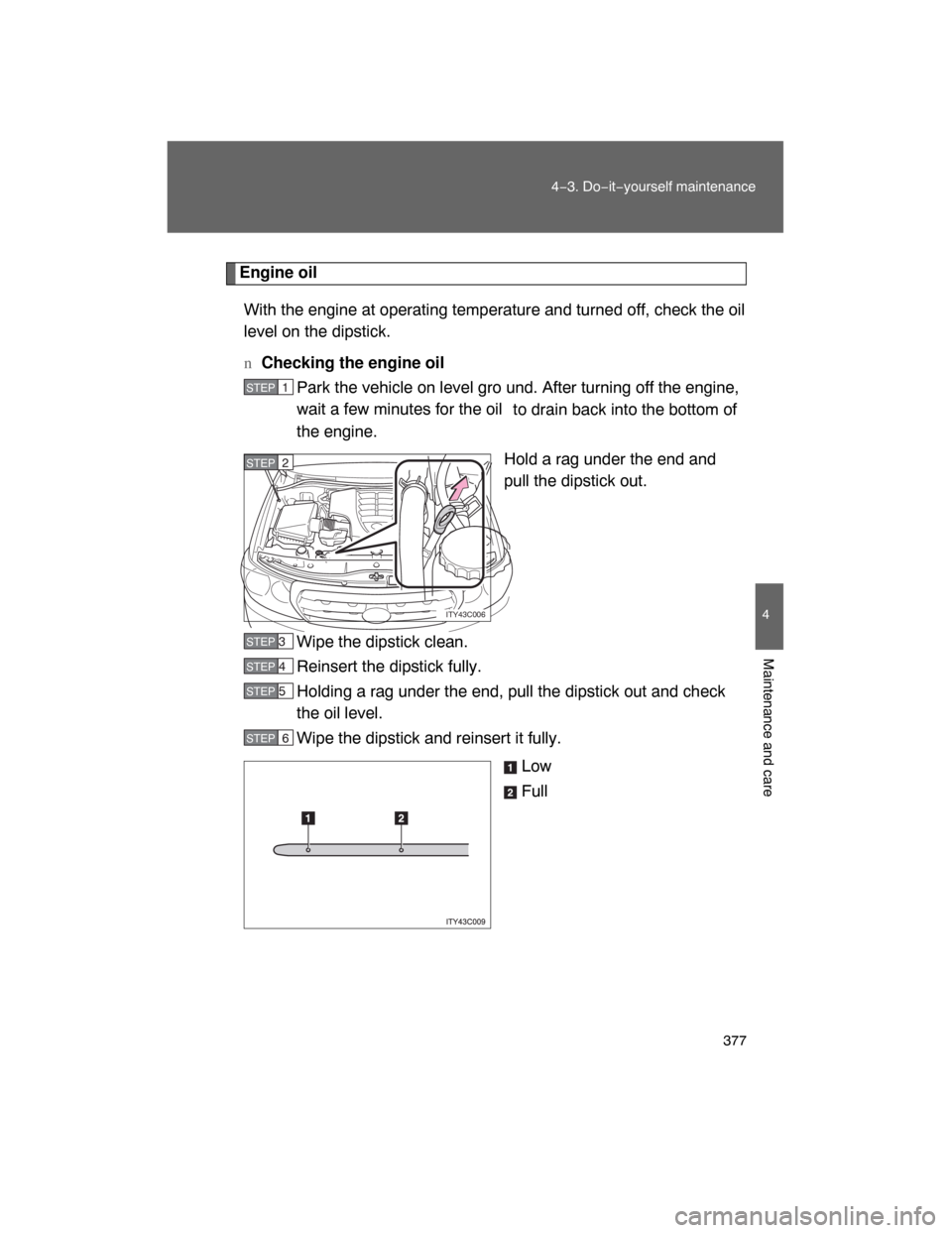
nChecking the engine oil
Park the vehicle on level gro und. After turning off the engine,
wait a few minutes for the oil
to drain back into the bottom of
the engine.
Hold a rag under the end and
pull the dipstick out.
Wipe the dipstick clean.
Reinsert the dipstick fully.
Holding a rag under the end, pull the dipstick out and check
the oil level.
Wipe the dipstick and reinsert it fully.
Low
Full
STEP1
ITY43C006
STEP2
STEP 3
STEP 4
STEP 5
STEP6
Page 373 of 531
378 4−3. Do−it−yourself maintenance
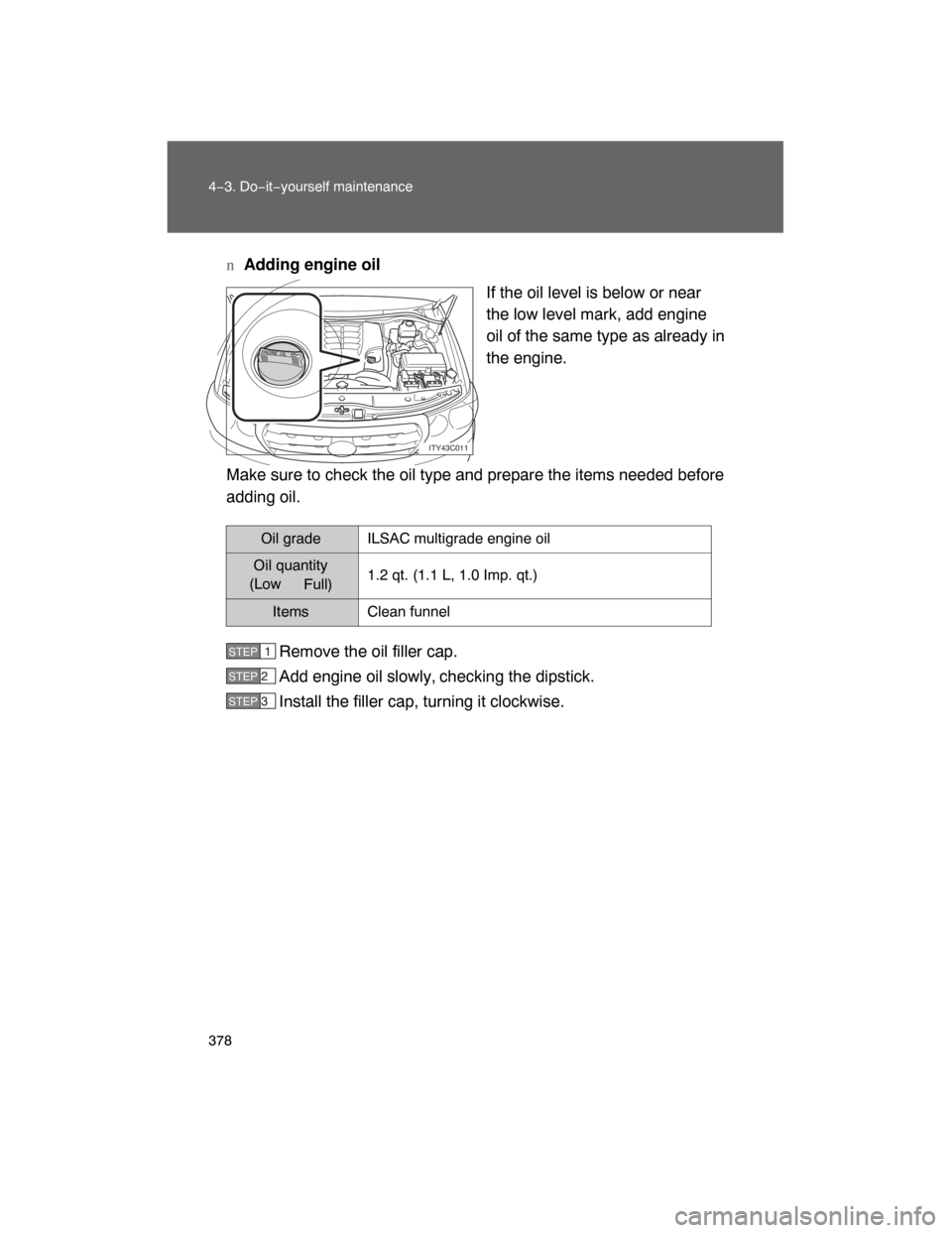
nAdding engine oil
If the oil level is below or near
the low level mark, add engine
oil of the same type as already in
the engine.
Make sure to check the oil type and prepare the items needed before
adding oil.
Remove the oil filler cap.
Add engine oil slowly,
checking the dipstick.
Install the filler cap, turning it clockwise.
ITY43C011
Oil gradeILSAC multigrade engine oil
Oil quantity
(Low
Full)
1.2 qt. (1.1 L, 1.0 Imp. qt.)
Items
Clean funnel
STEP1
STEP 2
STEP 3
Page 376 of 531
381
4−3. Do−it−yourself maintenance
4
Maintenance and care
CAUTION
nUsed engine oil
lUsed engine oil contains potentially harmful contaminants which may
cause skin disorders such as inflammation or skin cancer, so care should
be taken to avoid prolonged and repeated contact. To remove used engine
oil from your skin, wash thoroughly with soap and water.
lDispose of used oil and filters only in a safe and acceptable manner. Do
not dispose of used oil and filters in household trash, in sewers or onto the
ground.
Call your Toyota dealer, service station or auto parts store for information
concerning recycling or disposal.
lDo not leave used engine oil within the reach of children.
NOTICE
nTo prevent serious engine damage
Check the oil level on regular basis.
nWhen replacing the engine oil
lBe careful not to spill engine oil on the vehicle components.
lAvoid overfilling, or the engine could be damaged.
lCheck the oil level on the dipstick every time you refill the vehicle.
l
Be sure the engine oil filler cap is properly retightened.
Page 377 of 531
382 4−3. Do−it−yourself maintenance
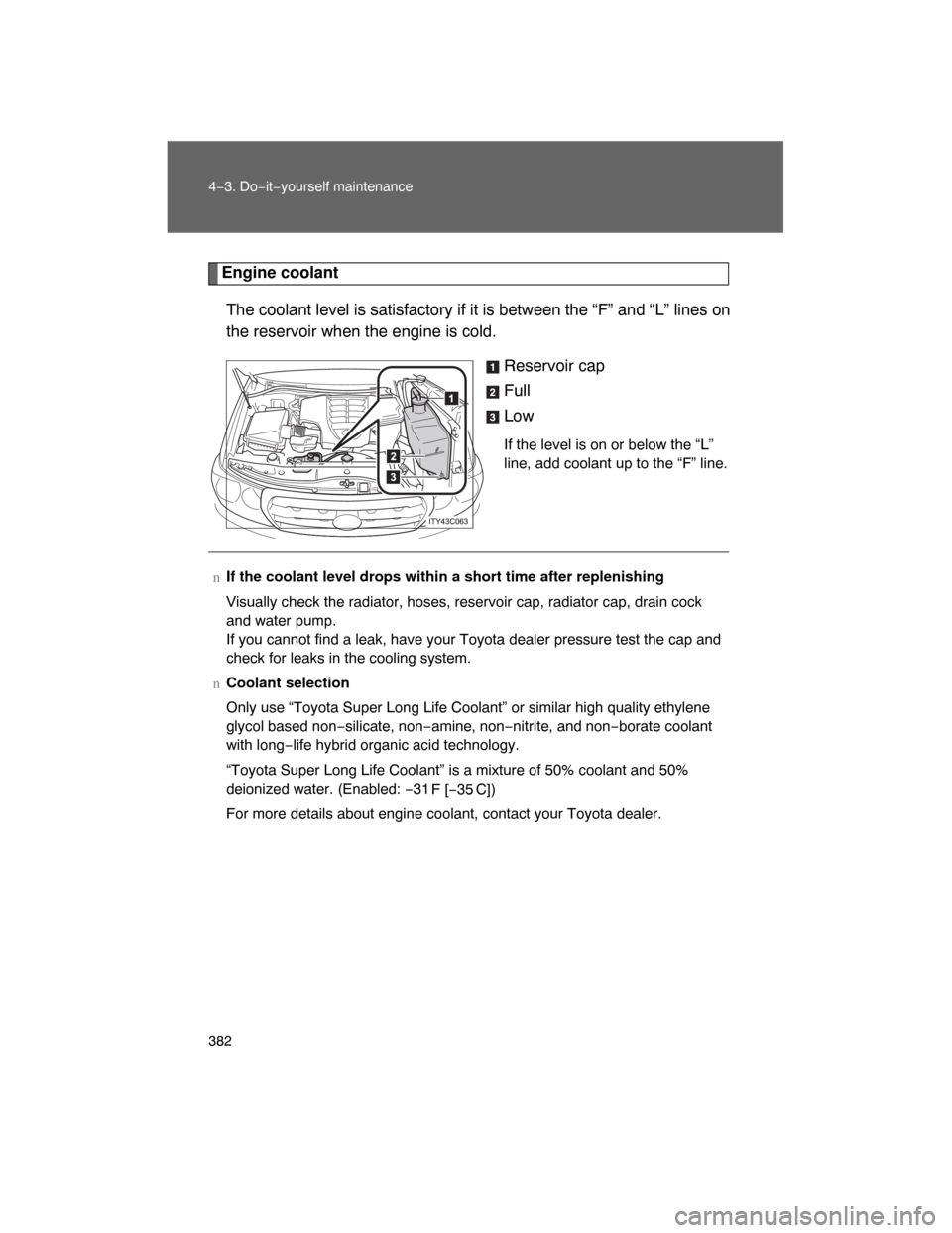
Engine coolant
The coolant level is satisfactory if it is between the “F” and “L” lines on
the reservoir when the engine is cold.
Reservoir cap
Full
Low
If the level is on or below the “L”
line, add coolant up to the “F” line.
nIf the coolant level drops within a short time after replenishing
Visually check the radiator, hoses, reservoir cap, radiator cap, drain cock
and water pump.
If you cannot find a leak, have your Toyota dealer pressure test the cap and
check for leaks in the cooling system.
nCoolant selection
Only use “Toyota Super Long Life Coolant” or similar high quality ethylene
glycol based non−silicate, non−amine, non−nitrite, and non−borate coolant
with long−life hybrid organic acid technology.
“Toyota Super Long Life Coolant” is a mixture of 50% coolant and 50%
deionized water. (Enabled: −31
F [−35 C])
For more details about engine coolant, contact your Toyota dealer.
Page 378 of 531
383
4−3. Do−it−yourself maintenance
4
Maintenance and care
Radiator and condenser
Check the radiator and condenser and clear any foreign objects.
If either of the above parts are extremely dirty or you are not sure of
their condition, have your vehicle checked by your Toyota dealer.
CAUTION
nWhen the engine is hot
Do not remove the radiator cap.
The cooling system may be under pressure and may spray hot coolant if the
cap is removed, causing burns or other injuries.
NOTICE
nWhen adding the engine coolant
Coolant is neither plain water nor stra
ight antifreeze. The correct mixture of
water and antifreeze must be used to provide proper lubrication, corrosion
protection and cooling. Be sure to read the antifreeze or coolant label.
n
If you spill coolant
Be sure to wash it off with water to prevent it damage to parts or paint.
CAUTION
nWhen the engine is hot
Do not touch the radiator or condenser as they may be hot and you may be
burned.
Page 379 of 531
384 4−3. Do−it−yourself maintenance
Brake fluid
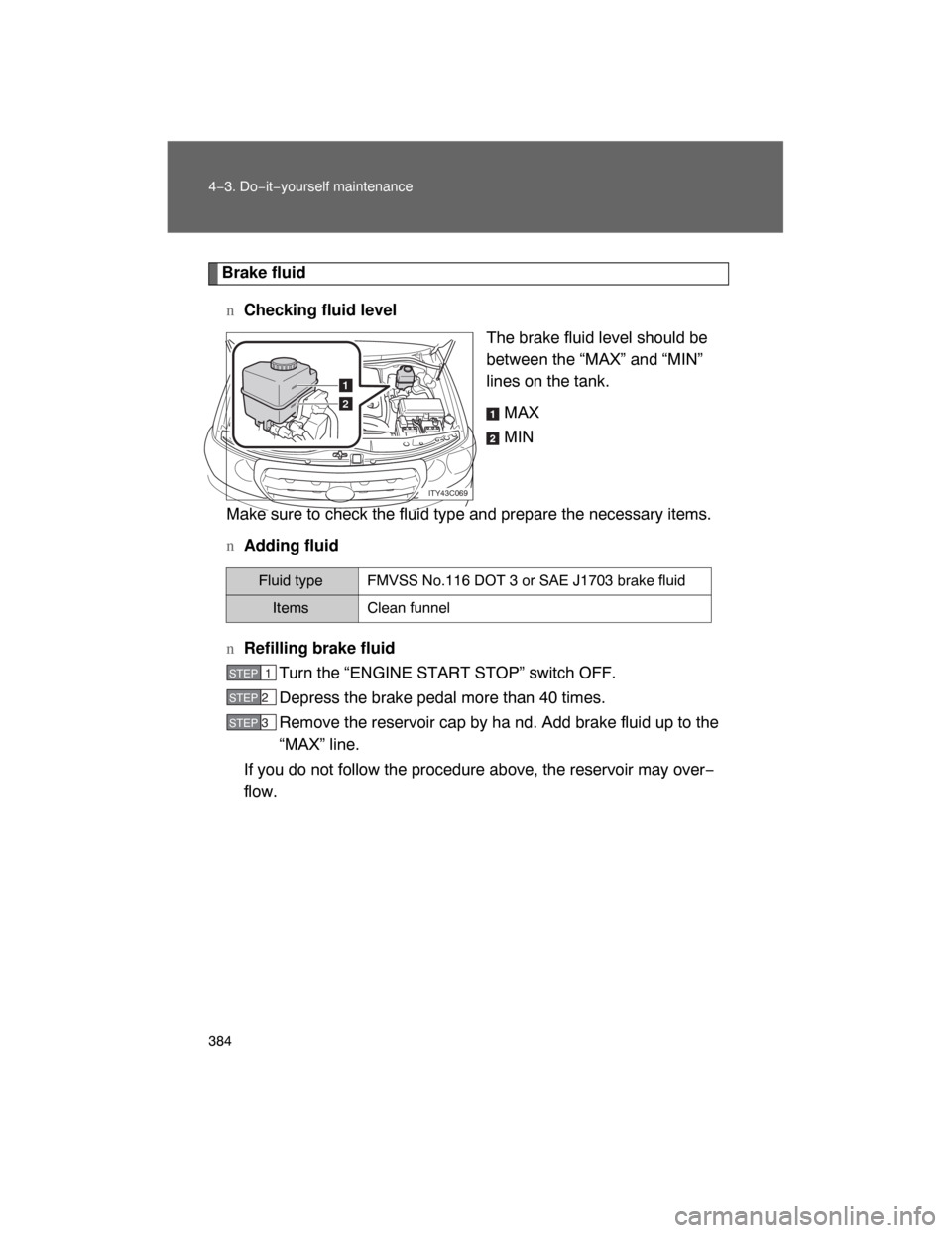
nChecking fluid level
The brake fluid level should be
between the “MAX” and “MIN”
lines on the tank.
MAX
MIN
Make sure to check the fluid type and prepare the necessary items.
n
Adding fluid
nRefilling brake fluid
Turn the “ENGINE START STOP” switch OFF.
Depress the brake pedal more than 40 times.
Remove the reservoir cap by ha nd. Add brake fluid up to the
“MAX” line.
If you do not follow the procedure above, the reservoir may over−
flow.
1
2
ITY43C069
Fluid typeFMVSS No.116 DOT 3 or SAE J1703 brake fluid
Items
Clean funnel
STEP1
STEP 2
STEP 3
Page 381 of 531
386 4−3. Do−it−yourself maintenance
Power steering fluid
nFluid level
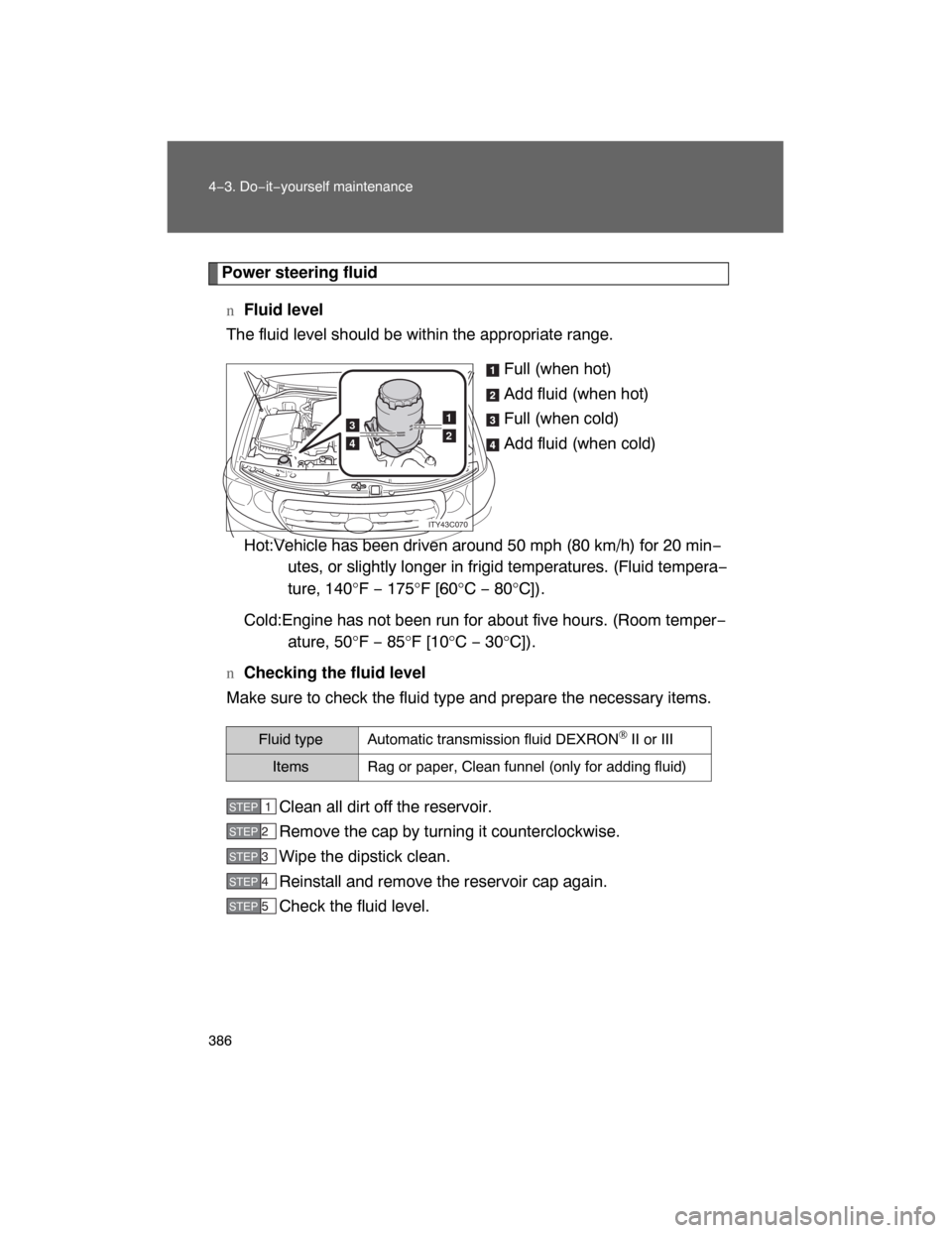
The fluid level should be within the appropriate range.
Full (when hot)
Add fluid (when hot)
Full (when cold)
Add fluid (when cold)
Hot:Vehicle has been driven around 50 mph (80 km/h) for 20 min−
utes, or slightly longer in frigid temperatures. (Fluid tempera−
ture, 140°F − 175°F [60°C − 80°C]).
Cold:Engine has not been run for about five hours. (Room temper−
ature, 50°F − 85°F [10°C − 30°C]).
n
Checking the fluid level
Make sure to check the fluid type and prepare the necessary items.
Clean all dirt off the reservoir.
Remove the cap by turning it counterclockwise.
Wipe the dipstick clean.
Reinstall and remove the reservoir cap again.
Check the fluid level.
1
23
4
ITY43C070
Fluid type Automatic transmission fluid DEXRON® II or III
Items
Rag or paper, Clean funnel (only for adding fluid)
STEP1
STEP 2
STEP 3
STEP 4
STEP 5
Page 383 of 531
388 4−3. Do−it−yourself maintenance
nChecking battery condition
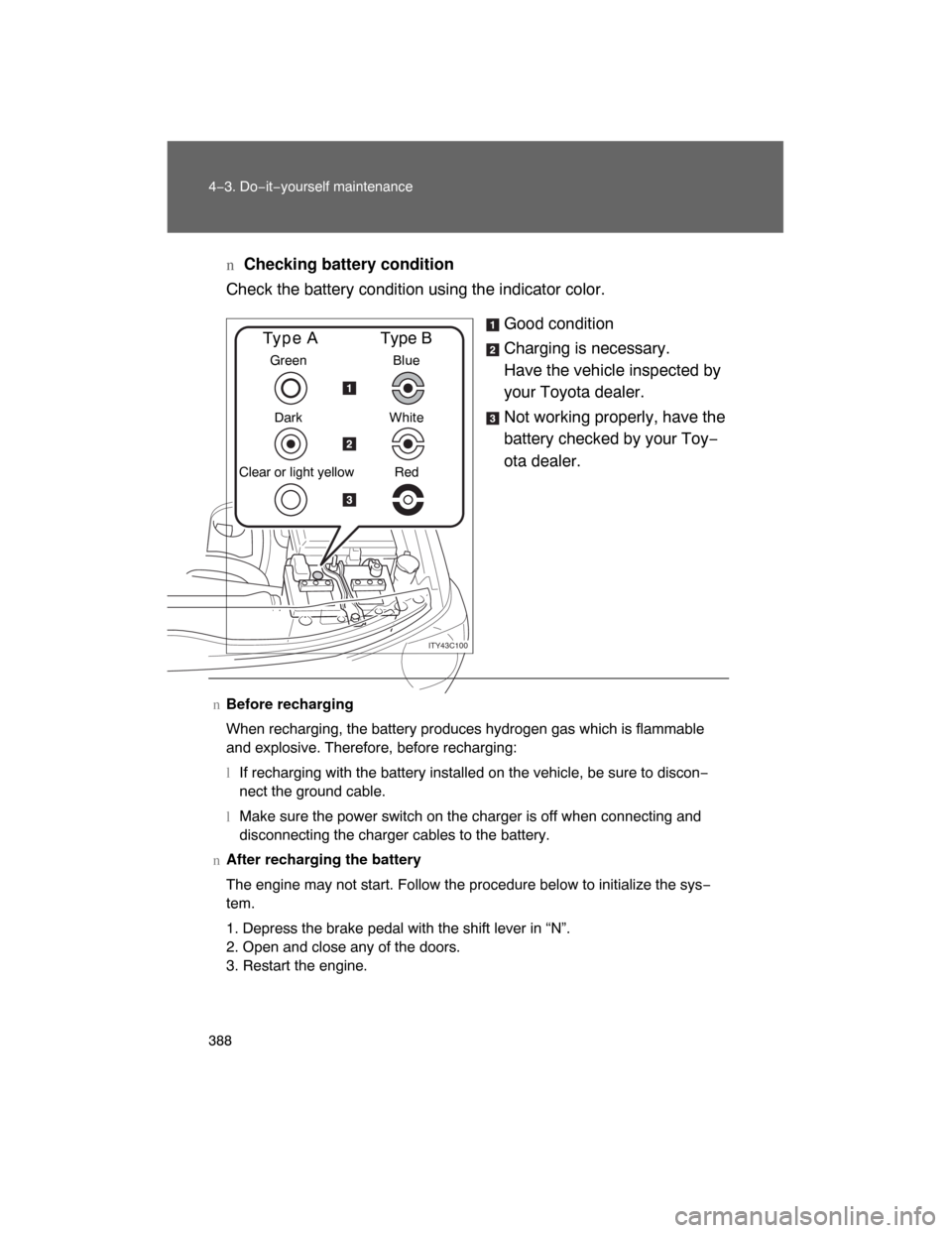
Check the battery condition using the indicator color.
Good condition
Charging is necessary.
Have the vehicle inspected by
your Toyota dealer.
Not working properly, have the
battery checked by your Toy−
ota dealer.
ITY43C100
Green
Dark
Clear or light yellow
Type A
Blue
White
Red
Type B
nBefore recharging
When recharging, the battery produces hydrogen gas which is flammable
and explosive. Therefore, before recharging:
lIf recharging with the battery installed on the vehicle, be sure to discon−
nect the ground cable.
lMake sure the power switch on the charger is off when connecting and
disconnecting the charger cables to the battery.
nAfter recharging the battery
The engine may not start. Follow the procedure below to initialize the sys−
tem.
1. Depress the brake pedal with the shift lever in “N”.
2. Open and close any of the doors.
3. Restart the engine.
Page 408 of 531
413
4−3. Do−it−yourself maintenance
4
Maintenance and care
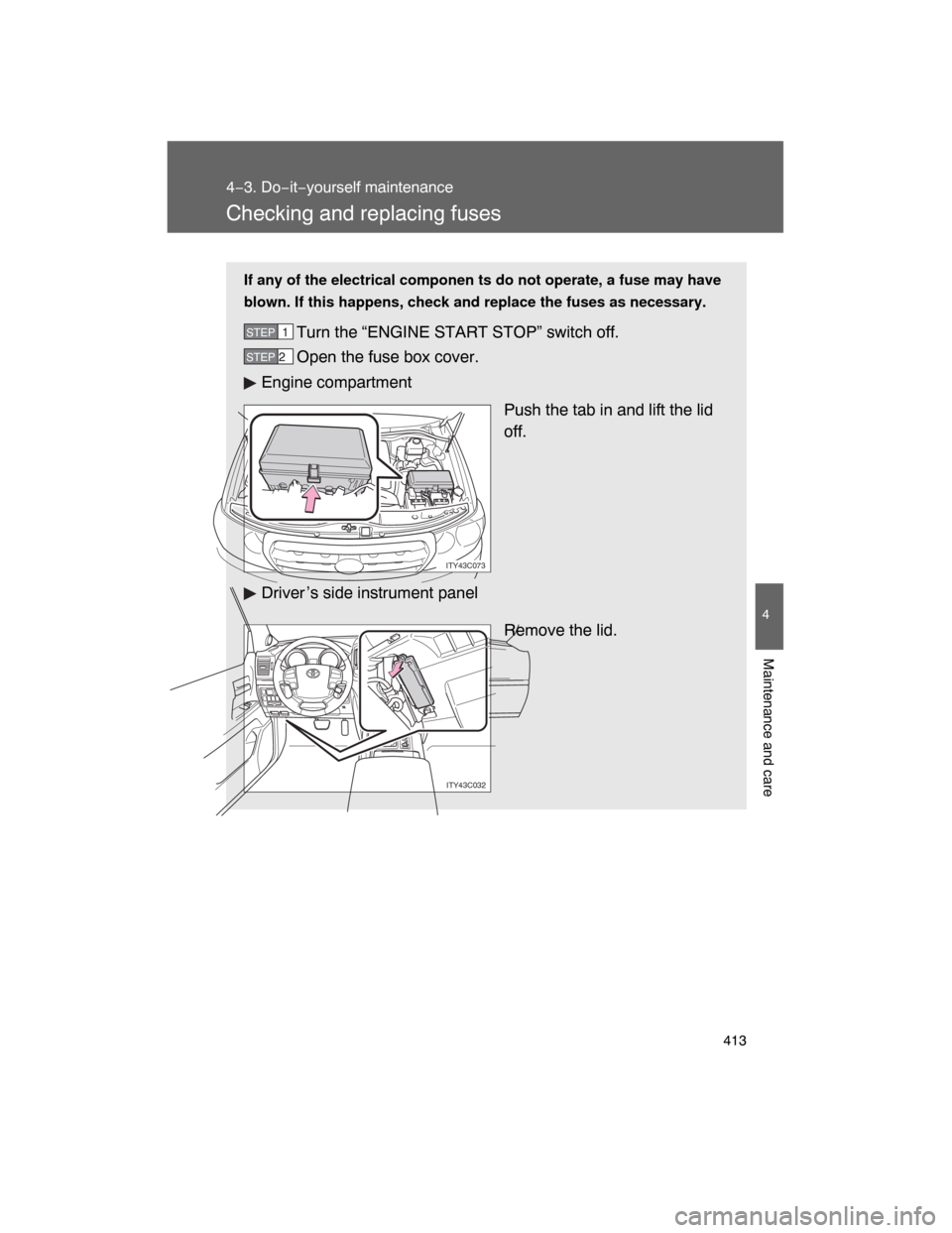
Checking and replacing fuses
If any of the electrical componen ts do not operate, a fuse may have
blown. If this happens, check and replace the fuses as necessary.
Turn the “ENGINE START STOP” switch off.
Open the fuse box cover.
Engine compartment
Push the tab in and lift the lid
off.
Driver ’s side instrument panel
Remove the lid.
STEP1
STEP 2
ITY43C073
ITY43C032
Page 450 of 531
456 5−2. Steps to take in an emergency
nIf the tire pressure warning system is inoperative
The tire pressure warning system
will become inoperati ve in the follow−
ing conditions:
(When the condition becomes normal, the system will work properly.)
lIf tires not equipped with tire pressure warning valves and transmit−
ters are used.
lIf the ID code on the tire pressure warning valves and transmitters is
not registered in the tire pressure warning computer.
lIf the tire inflation pressure is more than 73 psi (500 kPa, 5.1 kgf/cm2
or bar).
The tire pressure warning system may become inoperative in the follow−
ing conditions:
(When the condition becomes normal, the system will work properly.)
lIf electronic devices or facilities us ing similar radio wave frequencies
are nearby.
lIf a radio set at similar frequencies is in use in the vehicle.
lIf a window tint that affects the radio wave signals is installed.
lIf there is a lot of snow or ice on the vehicle, in particular around the
wheels or wheel housings.
lIf non−genuine Toyota wheels are used. (Even if you use Toyota
wheels, the tire pressu re warning system may not work properly with
some types of tires.)
lIf tire chains are used.
lIf the spare tire is in a location subject to poor radio wave signal
reception.
lIf a large metallic object which caninterfere with sign al reception is
put in the luggage compartment.
nIf the tire pressure warning light comes on after blinking for 1
minute frequently
If the tire pressure warning light comes on after blinking 1 minute fre−
quently when the “ENGINE START STOP” switch is turned to IGNITION
ON mode, have it checked by Toyota dealer.