fuel TOYOTA LAND CRUISER 2010 J200 Owner's Manual
[x] Cancel search | Manufacturer: TOYOTA, Model Year: 2010, Model line: LAND CRUISER, Model: TOYOTA LAND CRUISER 2010 J200Pages: 592, PDF Size: 7.98 MB
Page 412 of 592
412
L/C200_U
4-1. Maintenance and care
Cleaning and protecting the vehicle exterior
■Automatic car washes
● Fold the mirrors back and retract the antenna before washing the vehicle.
● Brushes used in automatic car washes may scratch the vehicle surface
and harm your vehicle’s paint.
■ High pressure car washes
● Do not allow the nozzles of the car wash to come within close proximity
of the windows.
● Before car wash, check that the fuel filler door is closed.
■ Aluminum wheels
Remove any dirt immediately by using a neutral detergent. Do not use har\
d
brushes or abrasive cleaners. Do not use strong or harsh chemical cleaners.
Use the same mild detergent and wax as used on the paint.
■ Bumpers and side moldings
Do not scrub with abrasive cleaners.
Perform the following to protect the vehicle and maintain it in prime
condition.
● Working from top to bottom, liber ally apply water to the vehicle
body, wheel wells and underside of the vehicle to remove any
dirt and dust.
Wash the vehicle body using a sponge or soft cloth, such as a cham-
ois.
● For hard-to-remove marks, use car wash soap and rinse thor-
oughly with water.
● Wipe away any water.
● Wax the vehicle when the waterproof coating deteriorates.
If water does not bead on a clean surface, apply wax when the vehicle
body is cool.
Page 419 of 592
419
4-2. Maintenance
4
Maintenance and care
L/C200_U
■
Allow inspection and repairs to be performed by a Toyota dealer
● Toyota technicians are well-trained specialists and are kept up to date
with the latest service information. They are well informed about the
operations of all systems on your vehicle.
● Keep a copy of the repair order. It proves that the maintenance that has
been performed is under warranty coverage. If any problem should arise
while your vehicle is under warranty, your Toyota dealer will promptly
take care of it.
CAUTION
■Warning in handling of battery, oils, fuels, and fluids
● Engine exhaust, some of its constituents, and a wide variety of automobile
components contain or emit chemicals known to the State of California to
cause cancer and birth defects and other reproductive harm. Work in a
well ventilated area.
● Oils, fuels and fluids contained in vehicles as well as waste produced by
component wear contain or emit chemicals known to the State of Califor-
nia to cause cancer and birth defects or other reproductive harm. Avoid
exposure and wash any affected area immediately.
● Battery posts, terminals and related accessories contain lead and lead
compounds which are known to cause brain damage. Wash your hands
after handling. ( P. 439)
Page 423 of 592
423
4-2. Maintenance
4
Maintenance and care
L/C200_U
Emission inspection and maintenance (I/M) programs
Some states have vehicle emission inspection programs which
include OBD (On Board Diagnostics) checks. The OBD system moni-
tors the operation of the emission control system.
■If the malfunction indicator lamp comes on
The OBD system determines that a problem exists somewhere
in the emission control system. Your vehicle may not pass the I/
M test and may need to be repaired. Contact your Toyota dealer
to service the vehicle.
■ Your vehicle may not pass the I/M test:
●When the battery is disconnected or discharged
Readiness codes that are se t during ordinary driving are
erased.
Also, depending on your driving habits, the readiness codes
may not be completely set.
● When the fuel tank cap is loose
The malfunction indicator lamp comes on as a temporary mal-
function and your vehicle may not pass the I/M test.
■ When the malfunction indicator lamp goes off after several
driving trips
The error code in the OBD system will not be cleared unless the
vehicle is driven 40 or more times.
■ If your vehicle does not pass the I/M test
Contact your Toyota dealer to prepare the vehicle for re-testing.
Page 426 of 592
426 4-3. Do-it-yourself maintenance
L/C200_U
CAUTION
The engine compartment contains many mechanisms and fluids that may
move suddenly, become hot, or become electrically energized. To avoid death
or serious injury.
■When working on the engine compartment
● Keep hands, clothing, and tools away from the moving fan and engine
drive belt.
● Be careful not to touch the engine, inverter, radiator, exhaust manifold, etc.
right after driving as they may be hot. Oil and other fluids may also be hot.
● Do not leave anything that may burn easily, such as paper or rags, in the
engine compartment.
● Do not smoke, cause sparks or expose an open flame to fuel or the bat-
tery. Fuel and battery fumes are flammable.
● Be extremely cautious when working on the battery. It contains poisonous
and corrosive sulfuric acid.
■ When working near the electric cooling fan or radiator grille
Be sure the “ENGINE START STOP” switch is OFF.
With the “ENGINE START STOP” switch in IGNITION ON mode, the electric
cooling fan may automatically start to run if the air conditioning is on and/or if
the coolant temperature is high. ( P. 435)
■ When working on or under the vehicle
● Do not get under the vehicle with just the jack supporting it.
Always use automotive jack stands or other solid supports.
● Use eye protection to prevent flying or falling material, fluid spray, etc. from
getting in your eyes.
NOTICE
■If you remove the air cleaner filter
Driving with the air cleaner filter removed may cause excessive engine wear
due to dirt in the air. Also a backfire could cause a fire in the engine compart-
ment.
Page 454 of 592
454 4-3. Do-it-yourself maintenance
L/C200_U
■Effects of incorrect tire inflation pressure
Driving with incorrect tire inflation pressure ma y result in the following:
●Reduced fuel efficiency
●Reduced driving comfort and tire life
●Reduced safety
●Damage to the drive train
If a tire needs frequent re filling, have it checked by your Toyota dealer.
■Instructions for checking tire inflation pressure
When checking tire inflation pressure, observe the following:
●Check only when the tires are cold.
If your vehicle has been parked for at least 3 hours and has not been
driven for more than 1 mile or 1.5 km, you will get an accurate cold
tire inflation pressure reading.
●Always use a tire pressure gauge.
The appearance of the tire can be mi sleading. In addition, tire infla-
tion pressures that are even just a few pounds off can degrade ride
and handling.
●Do not bleed or reduce tire inflation pressure after driving. It is normal
for the tire inflation pressure to be higher after driving.
●Never exceed the vehicle capacity weight.
Passengers and luggage weight should be placed so that the vehicle
is balanced.
Page 470 of 592
470 4-3. Do-it-yourself maintenance
L/C200_U
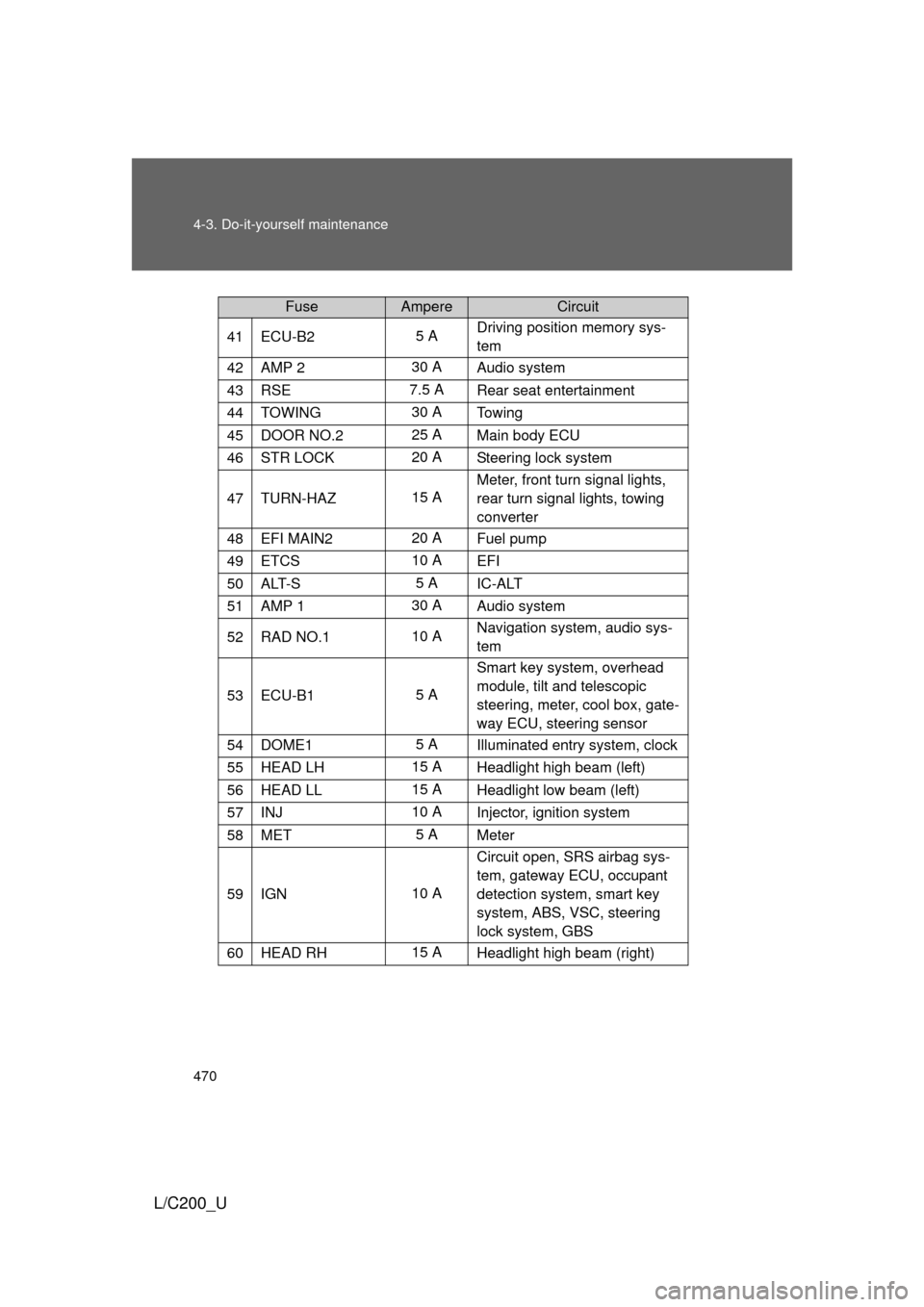
41ECU-B25 ADriving position memory sys-
tem
42AMP 230 A
Audio system
43RSE7.5 A Rear seat entertainment
44TOWING30 ATo w i n g
45DOOR NO.225 A
Main body ECU
46STR LOCK20 ASteering lock system
47TURN-HAZ15 AMeter, front turn signal lights,
rear turn signal lights, towing
converter
48EFI MAIN220 A
Fuel pump
49ETCS10 A
EFI
50ALT-S5 AIC-ALT
51AMP 130 A Audio system
52RAD NO.110 ANavigation system, audio sys-
tem
53ECU-B15 ASmart key system, overhead
module, tilt and telescopic
steering, meter, cool box, gate-
way ECU, steering sensor
54DOME15 A
Illuminated entry system, clock
55HEAD LH15 A Headlight high beam (left)
56HEAD LL15 AHeadlight low beam (left)
57INJ10 A
Injector, ignition system
58MET5 AMeter
59IGN10 A Circuit open, SRS airbag sys-
tem, gateway ECU, occupant
detection system, smart key
system, ABS, VSC, steering
lock system, GBS
60HEAD RH15 A
Headlight high beam (right)
FuseAmpereCircuit
Page 489 of 592
When trouble arises5
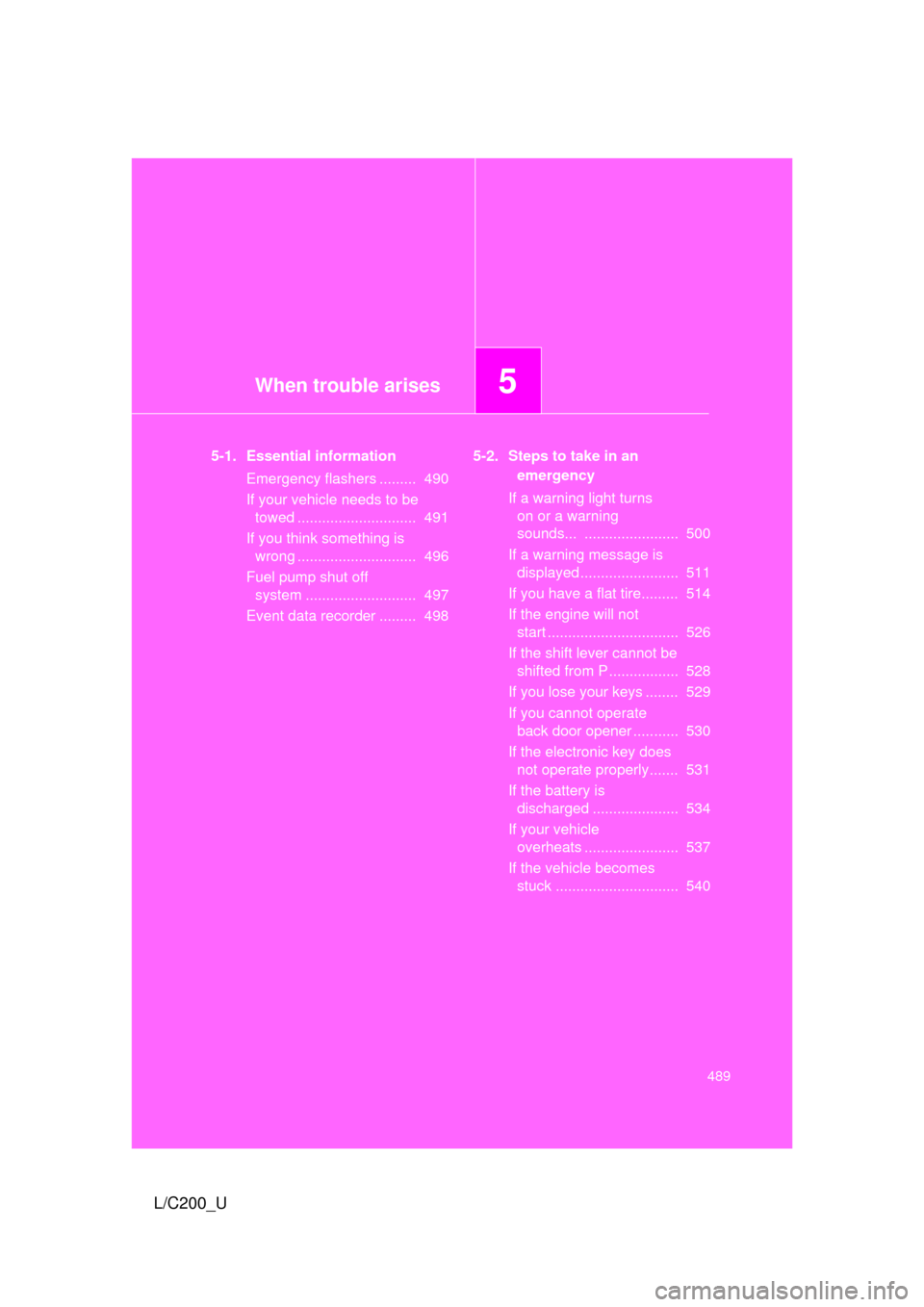
489
L/C200_U
5-1. Essential informationEmergency flashers ......... 490
If your vehicle needs to be towed ............................. 491
If you think something is wrong ............................. 496
Fuel pump shut off system ........................... 497
Event data recorder ......... 498 5-2. Steps to take in an
emergency
If a warning light turns on or a warning
sounds... ....................... 500
If a warning message is displayed ........................ 511
If you have a flat tire......... 514
If the engine will not start ................................ 526
If the shift lever cannot be shifted from P ................. 528
If you lose your keys ........ 529
If you cannot operate back door opener ........... 530
If the electronic key does not operate properly....... 531
If the battery is discharged ..................... 534
If your vehicle overheats ....................... 537
If the vehicle becomes stuck .............................. 540
Page 497 of 592
5
When trouble arises
497
5-1. Essential information
L/C200_U
Fuel pump shut off system
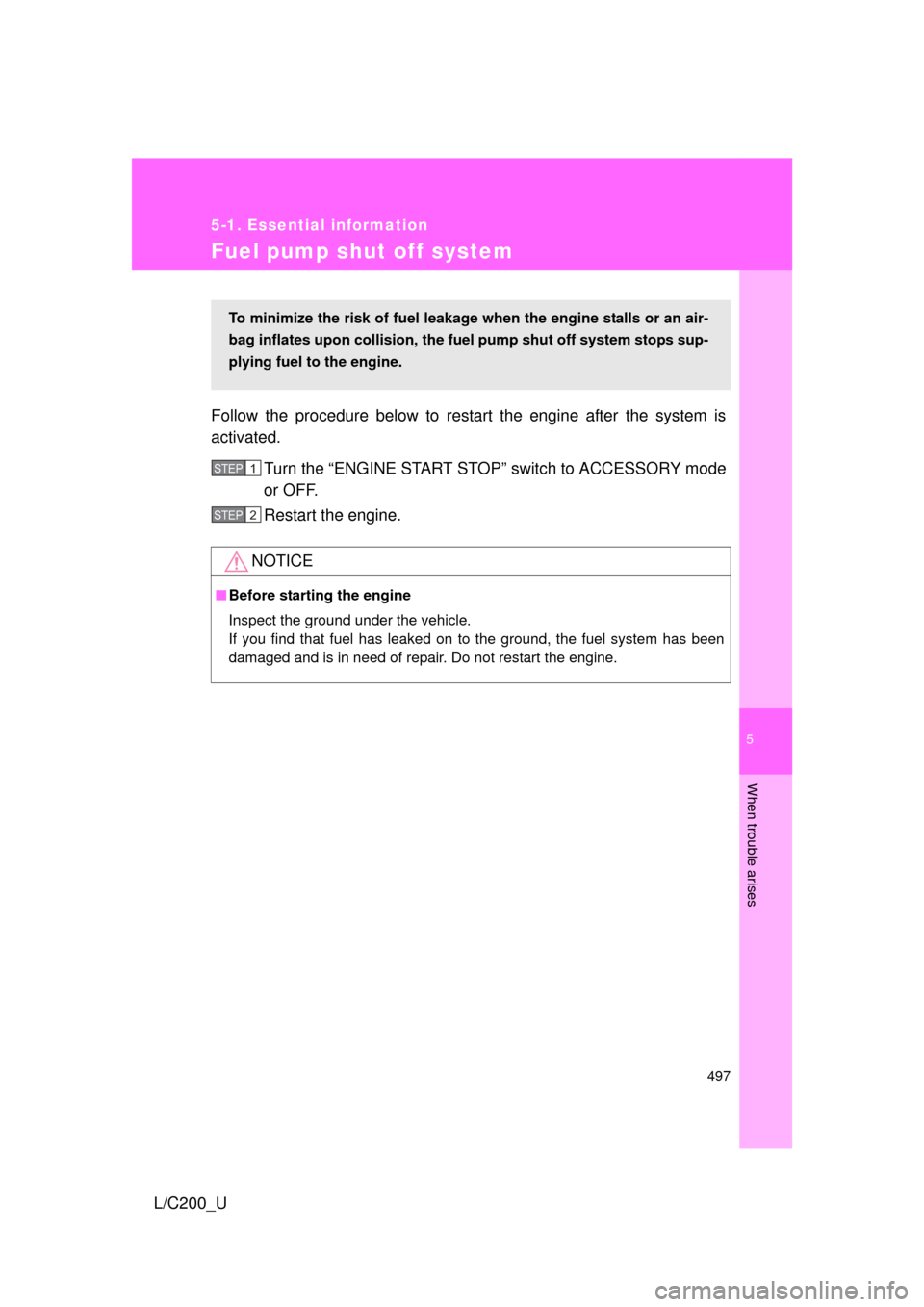
Follow the procedure below to restart the engine after the system is
activated.Turn the “ENGINE START STOP” switch to ACCESSORY mode
or OFF.
Restart the engine.
NOTICE
■Before starting the engine
Inspect the ground under the vehicle.
If you find that fuel has leaked on to the ground, the fuel system has been
damaged and is in need of repair. Do not restart the engine.
To minimize the risk of fuel leakage when the engine stalls or an air-
bag inflates upon collision, the fu el pump shut off system stops sup-
plying fuel to the engine.
STEP1
STEP2
Page 504 of 592
504 5-2. Steps to take in an emergency
L/C200_U
*1: Open door warning buzzer:
The open door warning buzzer sounds to alert one or more of the doors is
not fully closed (with the vehicle having reached a speed of 3 mph [5 km/h]).
*2: Driver’s and front passenger’s seat belt reminder buzzer:
The driver’s and front passenger’s seat belts reminder sounds to alert the
driver and front passenger that
his/her seat belt is not fastened. The buzzer
sounds intermittently for 10 seconds after the vehicle had reached a speed
of at least 12 mph (20 km/h). Then, if the seat belt is still unfastened, the
buzzer will sound in a different tone for 20 more seconds.
*3: Vehicles with navigation system
*4: Vehicles without navigation system
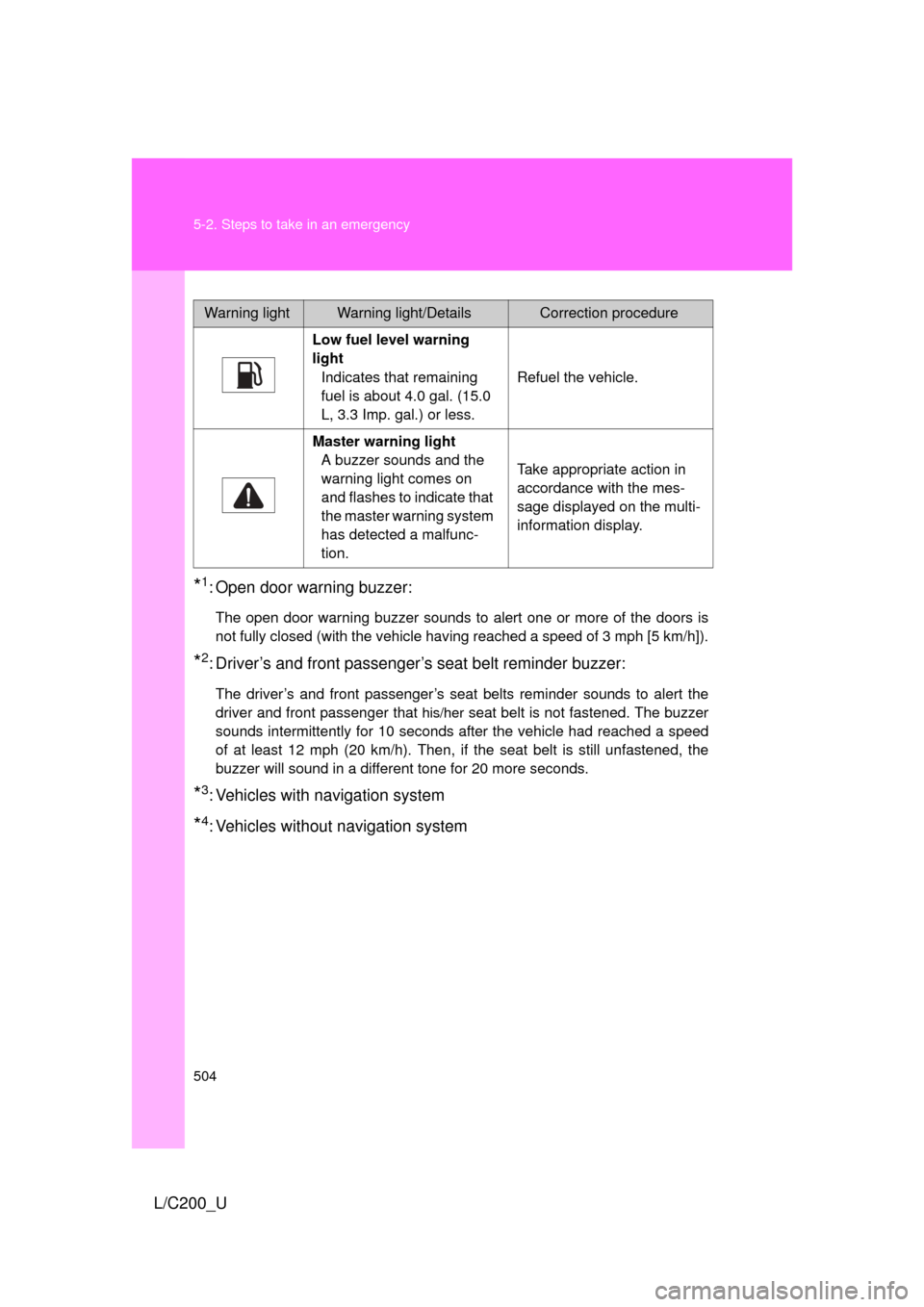
Warning lightWarning light/DetailsCorrection procedure
Low fuel level warning
light Indicates that remaining
fuel is about 4.0 gal. (15.0
L, 3.3 Imp. gal.) or less. Refuel the vehicle.
Master warning light A buzzer sounds and the
warning light comes on
and flashes to indicate that
the master warning system
has detected a malfunc-
tion. Take appropriate action in
accordance with the mes-
sage displayed on the multi-
information display.
Page 505 of 592
5
When trouble arises
505
5-2. Steps to take in an emergency
L/C200_U
■
If the malfunction indicator lamp comes on while driving
First check the following:
● Is the fuel empty?
If it is, fill the fuel tank immediately.
● Is the fuel tank cap loose?
If it is, tighten it securely.
The malfunction indicator lamp will go off after taking several driving trips. If
the malfunction indicator lamp does not go off even after several trips, con-
tact your Toyota dealer as soon as possible.
■ If the low speed four-wheel drive in dicator light or the center differen-
tial lock indicator light blinks
Take the specified steps. ( P. 200)
If the brake system warning light or the malfunction indicator light also
comes on, or the low speed four-wheel drive indicator light or the center dif-
ferential lock indicator light continues to blink after taking the specified steps,
there may be a malfunction in the engine, the brake system or the four-
wheel drive system. In this case, you may not be able to transfer between
“H4” and “L4” modes, and the center differential lock may not be able to be
locked or unlocked. Have the vehicle inspected by your Toyota dealer imme-
diately.
■ Front passenger detection sensor and passenger seat belt reminder
● If luggage is placed on the front passenger seat, the front passenger
detection sensor may cause the warning light to flash, even if a passen-
ger is not sitting in the seat.
● If a cushion is placed on the seat, the sensor may not detect a passen-
ger, and the warning light may not operate properly.