automatic transmission TOYOTA LAND CRUISER 2010 J200 Owners Manual
[x] Cancel search | Manufacturer: TOYOTA, Model Year: 2010, Model line: LAND CRUISER, Model: TOYOTA LAND CRUISER 2010 J200Pages: 592, PDF Size: 7.98 MB
Page 2 of 592

TABLE OF CONTENTSIndex
2
L/C200_U
1-1. Key informationKeys ..................................... 24
1-2. Opening, closing and locking the doors
Smart key system................. 26
Wireless remote control ....... 39
Side doors ............................ 42
Back door ............................. 47
1-3. Adjustable components (seats, mirrors,
steering wheel)
Front seats ........................... 52
Rear seats ............................ 54
Driving position memory system ................................ 63
Head restraints ..................... 67
Seat belts ............................. 71
Steering wheel ..................... 80
Inside rear view mirror.......... 82
Outside rear view mirrors ..... 83
1-4. Opening and closing the windows and moon roof
Power windows .................... 86
Moon roof ............................. 89
1-5. Refueling Opening the fuel tank cap .... 92 1-6. Theft deterrent system
Engine immobilizer system ................................ 96
Alarm .................................... 98
1-7. Safety information Correct driving posture ....... 101
SRS airbags ....................... 103
Front passenger occupant classification system ......... 118
Child restraint systems ....... 124
Installing child restraints ..... 128
2-1. Driving procedures Driving the vehicle .............. 142
Engine (ignition) switch....... 152
Automatic transmission ...... 156
Turn signal lever ................. 161
Parking brake ..................... 162
Horn .................................... 163
2-2. Instrument cluster Gauges and meters ............ 164
Indicators and warning lights ................................. 167
Multi-information display ..... 170
2-3. Operating the lights and wipers
Headlight switch ................. 174
Fog light switch ................... 176
1Before driving
2When driving
Page 141 of 592
When driving2
141
L/C200_U
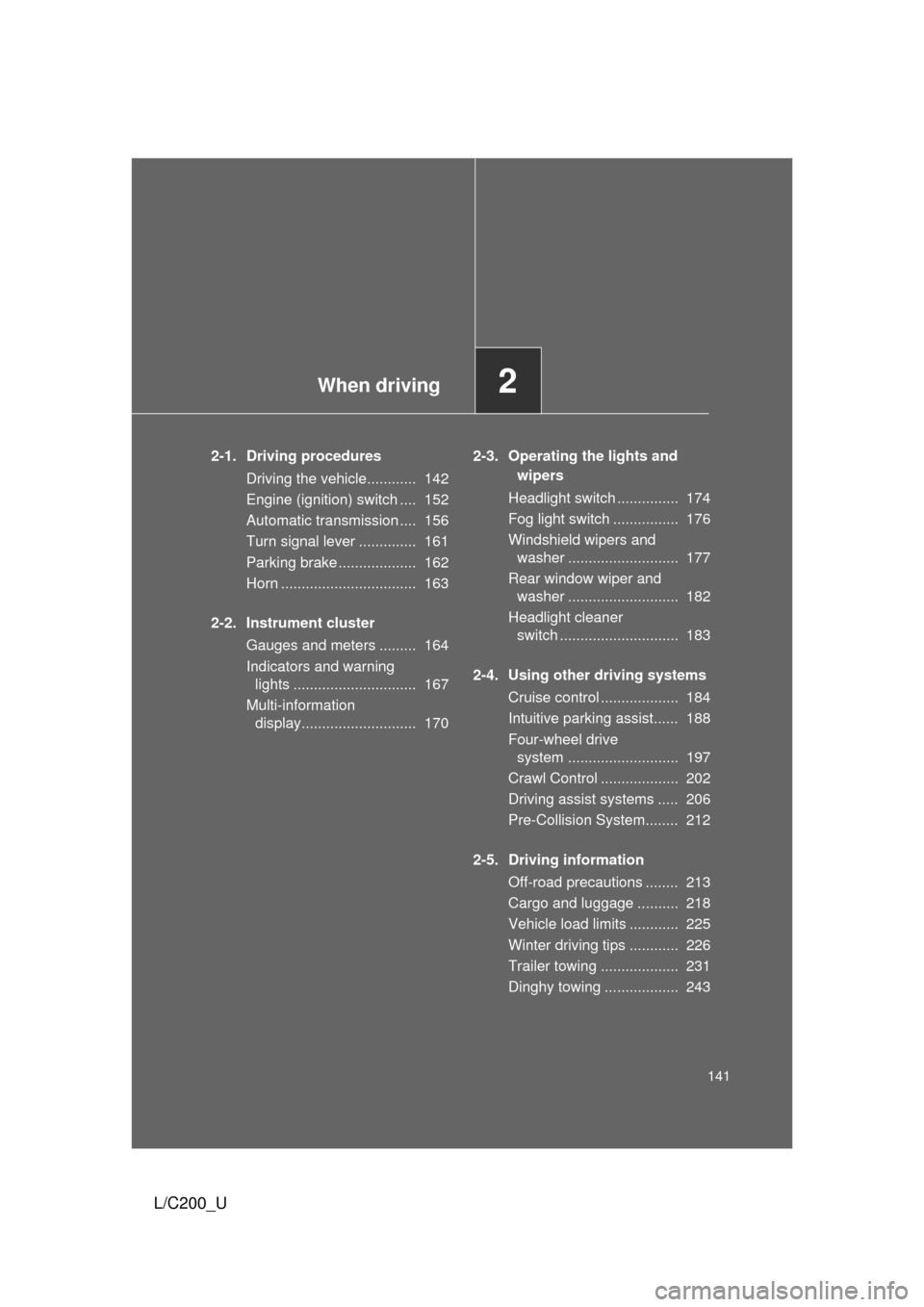
2-1. Driving proceduresDriving the vehicle............ 142
Engine (ignition) switch .... 152
Automatic transmission .... 156
Turn signal lever .............. 161
Parking brake ................... 162
Horn ................................. 163
2-2. Instrument cluster Gauges and meters ......... 164
Indicators and warning lights .............................. 167
Multi-information display............................ 170 2-3. Operating the lights and
wipers
Headlight switch ............... 174
Fog light switch ................ 176
Windshield wipers and washer ........................... 177
Rear window wiper and washer ........................... 182
Headlight cleaner switch ............................. 183
2-4. Using other driving systems Cruise control ................... 184
Intuitive parking assist...... 188
Four-wheel drive system ........................... 197
Crawl Control ................... 202
Driving assist systems ..... 206
Pre-Collision System........ 212
2-5. Driving information Off-road precautions ........ 213
Cargo and luggage .......... 218
Vehicle load limits ............ 225
Winter driving tips ............ 226
Trailer towing ................... 231
Dinghy towing .................. 243
Page 147 of 592
147
2-1. Driving procedures
2
When driving
L/C200_U
CAUTION
■
When the vehicle is parked
● Do not leave glasses, cigarette lighters, spray cans, or soft drink cans in
the vehicle when it is in the sun.
Failure to do so may result in the following:
• Gas may leak from a cigarette lighter or spray can, and may lead to a
fire.
• The temperature inside the vehicle may cause the plastic lenses and plastic material of eye glasses to deform or crack.
• Soft drink cans may fracture, causing the contents to spray over the interior of the vehicle, and may also cause a short circuit in the vehi-
cle’s electrical components.
● Always apply the parking brake, shift the shift lever to “P”, stop the engine
and lock the vehicle.
Do not leave the vehicle unattended while the engine is running.
● If the shift lever is moved before the low speed four-wheel drive indicator
turns on/off, the transfer mode may not be shifted completely. The transfer
mode disengages both the front and rear driveshafts from the powertrain
and allows the vehicle to move regardless of the shift position. (At this
time, the indicator blinks and the buzzer sounds.)
Therefore, the vehicle is free to roll even if the automatic transmission is in
“P”. You or someone else could be seriously injured. You must complete
the shifting of the transfer mode. ( P. 197)
● Do not touch the exhaust pipe while the engine is running or immediately
after turning the engine off.
Doing so may cause burns.
● Do not leave the engine running in an area with snow build-up, or where it
is snowing. If snowbanks build up around the vehicle while the engine is
running, exhaust gases may collect and enter the vehicle. This may lead
to death or a serious health hazard.
Page 156 of 592
156
2-1. Driving procedures
L/C200_U
Automatic transmission
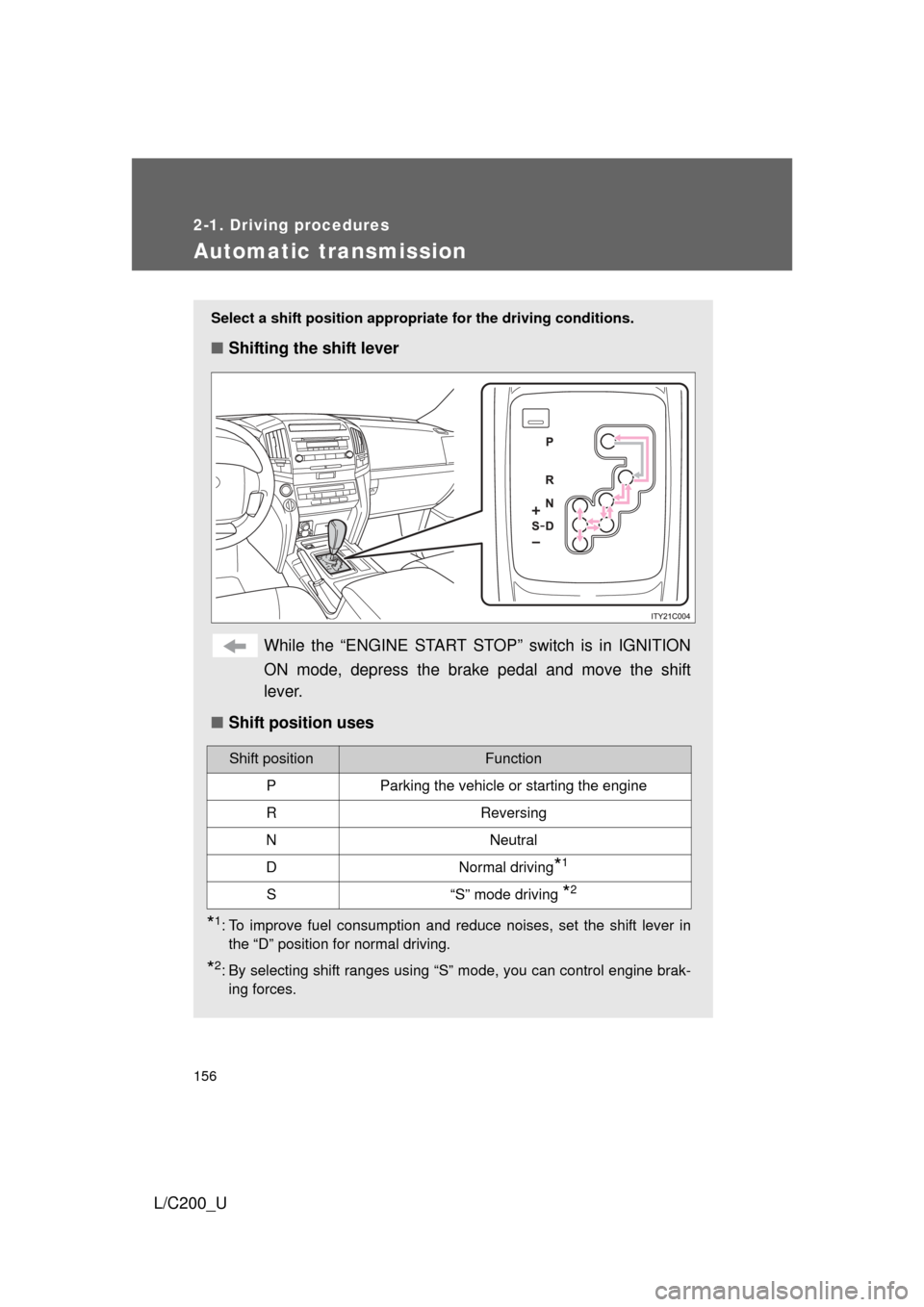
Select a shift position appropriate for the driving conditions.
■Shifting the shift lever
While the “ENGINE START STOP” switch is in IGNITION
ON mode, depress the brake pedal and move the shift
lever.
■ Shift position uses
*1: To improve fuel consumption and reduce noises, set the shift lever in
the “D” position for normal driving.
*2: By selecting shift ranges using “S” mode, you can control engine brak-ing forces.
Shift positionFunction
PParking the vehicle or starting the engine
RReversing
NNeutral
DNormal driving*1
S“S” mode driving *2
Page 160 of 592

160 2-1. Driving procedures
L/C200_U
■“S” mode
When the shift range is “5” or lower, holding the shift lever toward “+” sets
the shift range to “6”.
■ Downshifting restrictions warning buzzer (in the “S” mode)
To help ensure safety and driving performance, downshifting operation may
sometimes be restricted. In some circumstances, downshifting may not be
possible even when the shift lever is operated. (The warning buzzer will
sound twice.)
■ When driving with the cruise control system
The engine brake will not operate in t he “S” mode, even when downshifting
to “5” or “4”. ( P. 184)
■ Second start mode au tomatic deactivation
Second start mode is automatically deactivated if the engine is turned off
after driving in second start mode.
■ If the shift lever cannot be shifted from “P”
P. 5 2 8
■If the “S” indicator does not come on even after shifting the shift lever
to “S”
This may indicate a malfunction in the automatic transmission system. Have
the vehicle inspected by your Toyota dealer immediately.
(In this situation, the vehicle will operate as if the shift lever is in “D”.)
■ AI-SHIFT
The AI-SHIFT automatically shifts the gear to the optimal position according
to the driver performance and driving conditions.
The AI-SHIFT automatically operates when the shift lever is in the “D” posi-
tion. (Shifting the shift lever to the “S” position cancels the function.)
Page 168 of 592
168 2-2. Instrument cluster
L/C200_U
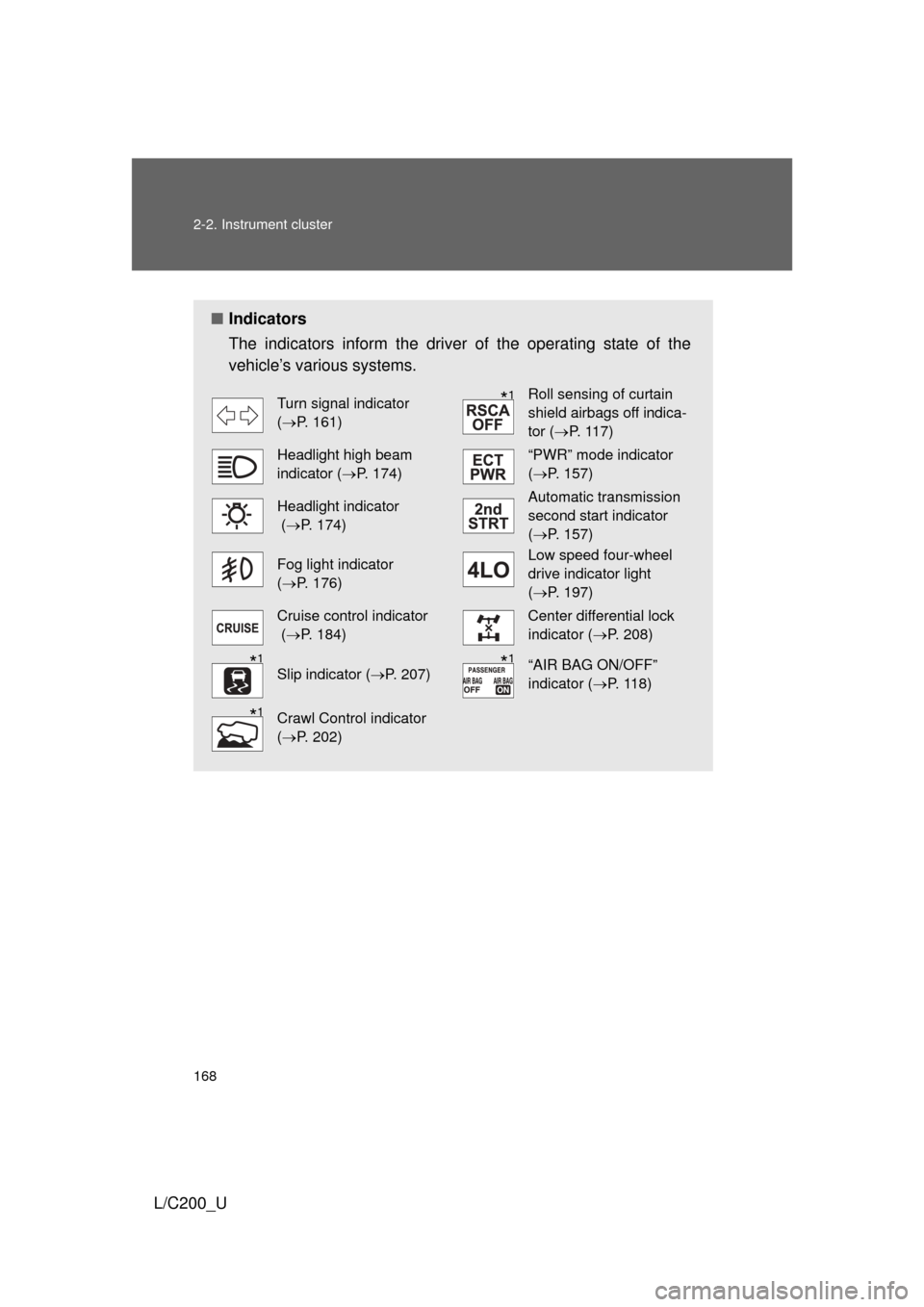
■Indicators
The indicators inform the driver of the operating state of the
vehicle’s various systems.
Turn signal indicator
(P. 161)Roll sensing of curtain
shield airbags off indica-
tor ( P. 117)
Headlight high beam
indicator ( P. 174)“PWR” mode indicator
(P. 157)
Headlight indicator
( P. 174)Automatic transmission
second start indicator
(P. 157)
Fog light indicator
(P. 176) Low speed four-wheel
drive indicator light
(P. 197)
Cruise control indicator
( P. 184)Center differential lock
indicator ( P. 208)
Slip indicator ( P. 207)“AIR BAG ON/OFF”
indicator (P. 118)
Crawl Control indicator
(P. 202)
*1
*1*1
*1
Page 201 of 592
201
2-4. Using other
driving systems
2
When driving
L/C200_U
CAUTION
■While driving
Never move the four-wheel drive control switch if the wheels have lost trac-
tion. Doing so may cause an accident resulting in death or serious injury.
■ If the low speed four-wheel drive in dicator light or the center differen-
tial lock indicator light blinks
If the shift lever is moved before the low speed four-wheel drive indicator
turns on/off, the transfer mode may not be shifted completely. The transfer
mode disengages both the front and rear driveshafts from the powertrain
and allows the vehicle to move regardless of the shift position. (At this time,
the indicator blinks and the buzzer sounds.)
Therefore, the vehicle is free to roll even if the automatic transmission is in
“P”. You or someone else could be seriously injured. You must complete the
shifting of the transfer mode. ( P. 197)
NOTICE
■To prevent damage to the center differential
● For normal driving on dry and hard surface roads, unlock the center differ-
ential.
● Unlock the center differential after the wheels are out of the ditch or off the
slippery or bumpy surface.
● Do not push the center differential lock/unlock button when the vehicle is
turning or when its wheels are spinning freely off the ground.
Page 204 of 592

204 2-4. Using other driving systems
L/C200_U
■Function limitations
● In the following situations, brake control can be used to drive downhill at
a constant speed. However, engine control is not available when driving
uphill at a constant speed.
• When switched to second start mode
• When the vehicle speed exceeds approximately 6 mph (10 km/h).
● In the following situation, engine control and brake control will be tempo-
rarily canceled.
• When the vehicle speed exceeds approximately 15 mph (25 km/h).
■ If the brake system overheats
The system will cease operation and a buzzer will sound to alert the driver.
Stop the vehicle in a safe place. (There is no problem with continuing normal
driving.)
■ If the automatic transmission system overheats
The system will cease operation, a buzzer will sound and a warning mes-
sage will be displayed to alert the driver. Stop the vehicle in a safe place until
the warning message turns off.
■ Sounds and vibrations caused by the Crawl Control system
● A sound may be heard from the engine compartment when the engine is
started or just after the vehicle begins to move. This sound does not indi-
cate that a malfunction has occurred in Crawl Control system.
● Either of the following conditions may occur when the Crawl Control sys-
tem is operating. None of these are indicators that a malfunction has
occurred.
• Vibrations may be felt through the vehicle body and steering.
• A motor sound may be heard after the vehicle comes to a stop.
Page 217 of 592
217
2-5. Driving information
2
When driving
L/C200_U
NOTICE
■
To prevent the water damage
Take all necessary safety measures to ensure that water damage to the
engine or other components does not occur.
● Water entering the engine air intake will cause severe engine damage.
● Water entering the automatic transmission will cause deterioration in shift
quality, locking up of your transmission accompanied by vibration, and ulti-
mately damage.
● Water can wash the grease from wheel bearings, causing rusting and pre-
mature failure, and may also enter the differentials, transmission and
transfer case, reducing the gear oil’s lubricating qualities.
■ When you drive through water
If driving through water, such as when crossing shallow streams, first check
the depth of the water and the bottom of the river bed for firmness. Drive
slowly and avoid deep water.
■ Inspection after off-road driving
● Sand and mud that has accumulat ed in brake drums and around brake
discs may affect braking efficiency and may damage brake system compo-
nents.
● Always perform a maintenance inspection after each day of off-road driv-
ing that has taken you through rough terrain, sand, mud, or water. For
scheduled maintenance information, refer to the “Scheduled Maintenance
Guide” or “Owner’s Manual Supplement”.
Page 421 of 592

421
4-2. Maintenance
4
Maintenance and care
L/C200_U
Vehicle interior
ItemsCheck points
Accelerator pedal • Moves smoothly (without uneven
pedal effort or catching)?
Automatic transmission “Park”
mechanism • Can the vehicle be hold securely
on an incline with the shift lever in
“P”?
Brake pedal • Moves smoothly?
• Does it have appropriate clear-
ance and correct amount of free
play?
Brakes • Pulls to one side when applied?
• Loss of brake effectiveness?
• Spongy feeling brake pedal?
• Pedal almost touches floor?
Head restraints • Move smoothly and lock
securely?
Indicators/buzzers • Function properly?
Lights • Do all the lights come on?
• Headlights aimed correctly?
Parking brake • Moves smoothly?
• Can hold the vehicle securely on
an incline?
Seat belts • Does the seat belt system oper-
ate smoothly?
• Are the belts undamaged?
Seats • Do the seat controls operate
properly?
Steering wheel • Moves smoothly?
• Has correct free play?
• No strange noises?