lights TOYOTA LAND CRUISER 2014 J200 Repair Manual
[x] Cancel search | Manufacturer: TOYOTA, Model Year: 2014, Model line: LAND CRUISER, Model: TOYOTA LAND CRUISER 2014 J200Pages: 724, PDF Size: 11 MB
Page 595 of 724
595
4-3. Do-it-yourself maintenance
4
Maintenance and care
LC200_OM_OM60L09U_(U)
■
Bulbs other than the above
If any of the bulbs listed below has burnt out, have your Toyota
dealer replace it.
● Headlight low beam
● Parking light
● Side turn signal light
● Stop/tail lights
● Tail lights
● High mounted stoplight
● Rear side marker lights
■Discharge headlights
If voltage to the discharge bulbs is insufficient, the bulbs may not come on,
or may go out temporarily. The discharge bulbs will come on when normal
power is restored.
■ Condensation build-up on th e inside of the lens
Temporary condensation build-up on the inside of the headlight lens does
not indicate a malfunction. Contact your Toyota dealer for more information
in the following situations:
● Large drops of water are built up on the inside of the lens.
● Water has built up inside the headlight.
■ LED lights
The parking light, side turn signal light, stop/tail lights, tail lights, high
mounted stoplight and rear side marker lights consist of a number of LEDs. If
any LEDs burn out, take your vehicle to your Toyota dealer to have the light
replaced.
Page 596 of 724
596 4-3. Do-it-yourself maintenance
LC200_OM_OM60L09U_(U)
CAUTION
■Replacing light bulbs
●Turn off the headlights. Do not attempt to replace the bulb immediately
after turning off the headlights.
The bulbs become very hot and may cause burns.
● Do not touch the glass portion of the light bulb with bare hands. When i\
t is
unavoidable to hold the glass portion, use and hold with a clean dry cloth
to avoid getting moisture and oils on the bulb.
Also, if the bulb is scratched or dropped, it may blow out or crack.
● Fully install light bulbs and any parts used to secure them. Failing to do so
may result in heat damage, fire, or water entering the headlight unit. This
may damage the headlights or cause condensation to build up on the lens.
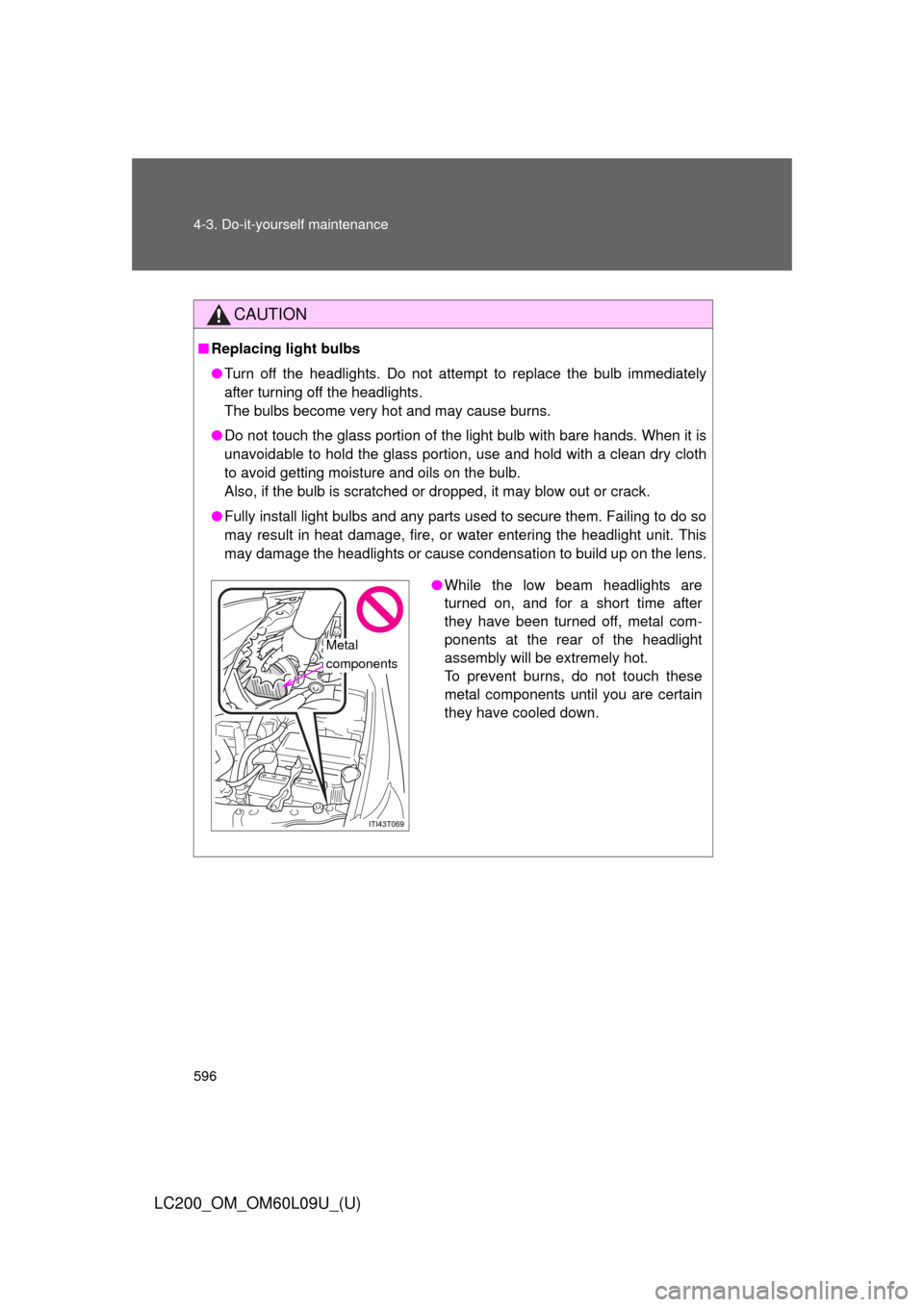
●While the low beam headlights are
turned on, and for a short time after
they have been turned off, metal com-
ponents at the rear of the headlight
assembly will be extremely hot.
To prevent burns, do not touch these
metal components until you are certain
they have cooled down.
Metal
components
Page 597 of 724
597
4-3. Do-it-yourself maintenance
4
Maintenance and care
LC200_OM_OM60L09U_(U)
CAUTION
■
Discharge headlights
●Contact your Toyota dealer before replacing high-intensity discharge
headlights (including light bulbs).
● Do not touch the high-intensity discharge headlight’s high voltage socket
when the headlights are turned on.
An extremely high voltage of 30000 V will be discharged and could result
in serious injury or death by electric shock.
● Do not attempt to take apart or repair the low beam discharge headlight
bulbs, connectors, power supply circuits, or related components.
Doing so could result in electric shock and serious injury or death.
■ To prevent damage or fire
Make sure bulbs are fully seated and locked.
Page 600 of 724
600
LC200_OM_OM60L09U_(U)
5-1. Essential information
Emergency flashers
■Emergency flashers
If the emergency flashers are used for a long time while the engine is not
operation, the battery may discharge.
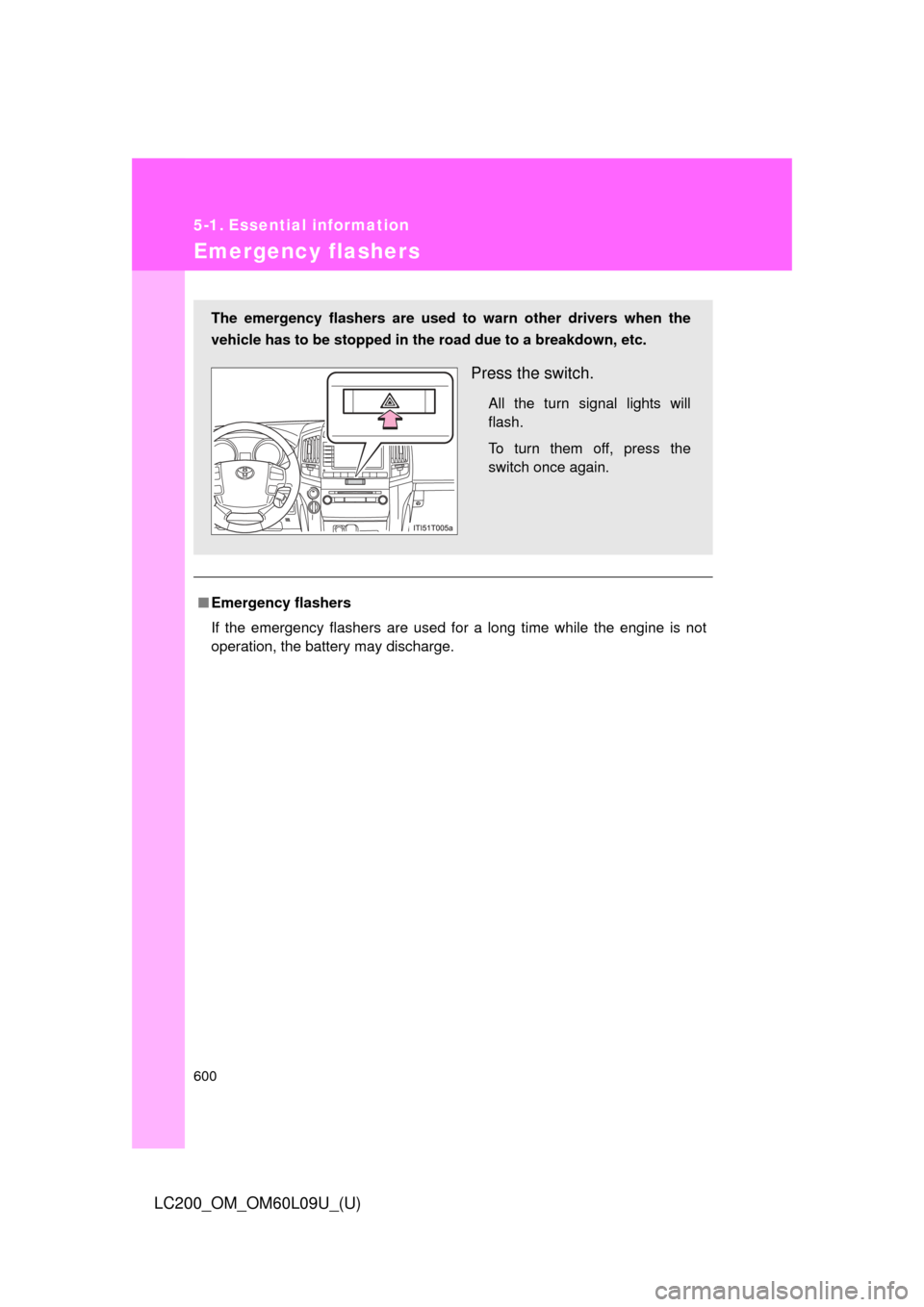
The emergency flashers are used to warn other drivers when the
vehicle has to be stopped in the road due to a breakdown, etc.
Press the switch.
All the turn signal lights will
flash.
To turn them off, press the
switch once again.
Page 608 of 724
608
LC200_OM_OM60L09U_(U)
5-2. Steps to take in an emergency
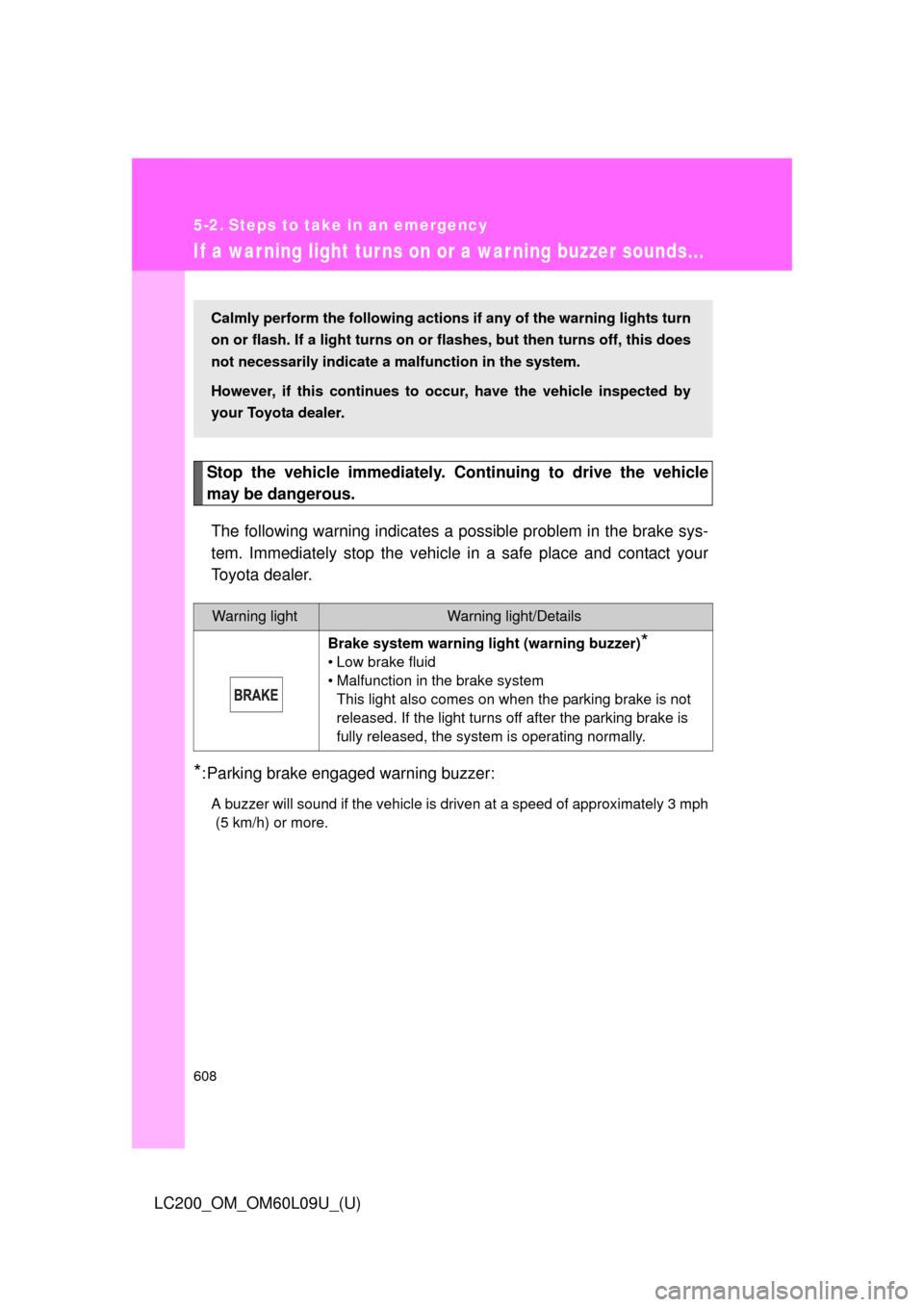
If a war ning light tur ns on or a war ning buzzer sounds...
Stop the vehicle immediately. Continuing to drive the vehicle
may be dangerous.The following warning indicates a possible problem in the brake sys-
tem. Immediately stop the vehicle in a safe place and contact your
Toyota dealer.
*: Parking brake engaged warning buzzer:
A buzzer will sound if the vehicle is driven at a speed of approximately 3 mph (5 km/h) or more.
Warning lightWarning light/Details
Brake system warning light (warning buzzer)
*
• Low brake fluid
• Malfunction in the brake system This light also comes on when the parking brake is not
released. If the light turns off after the parking brake is
fully released, the system is operating normally.
Calmly perform the following actions if any of the warning lights turn
on or flash. If a light turns on or flashes, but then turns off, this does
not necessarily indicate a malfunction in the system.
However, if this continues to o ccur, have the vehicle inspected by
your Toyota dealer.
Page 614 of 724
614 5-2. Steps to take in an emergency
LC200_OM_OM60L09U_(U)
■SRS warning light
This warning light system monitors the following:
●The airbag sensor assembly
● Front impact sensors
● Side impact sensors (rear)
● Side impact sensors (front door)
● Safing sensor (rear)
● The driver’s seat belt buckle switch
● The driver’s seat position sensor
● Front passenger’s seat belt buckle switch
● The airbags
● The interconnecting wiring and power sources
● The front passenger occupant classification system
● “AIR BAG ON” and “AIR BA G OFF” indicator lights
● The seat belt pretensioners
● The “RSCA OFF” indicator light
■ Changing the engine oil
Make sure to reset oil change system
■
When the tire pressure warning light comes on
Check the tire inflation pressure and adjust to the appropriate level.
Pushing the tire pressure warning reset switch does not turn off the tire
pressure warning light.
■The tire pressure warning light ma y turn on due to natural causes
The tire pressure warning light may turn on due to natural causes such
as natural air leaks or tire inflation pressure changes caused by temper-
ature. In this case, adjusting the ti re inflation pressure will turn off the
warning light (after a few minutes).
Page 649 of 724
5
When trouble arises
649
5-2. Steps to take in an emergency
LC200_OM_OM60L09U_(U)
If the engine will not star t
If the engine still does not start after following the correct starting
procedure ( P. 166) or releasing the steering lock (P. 168), confirm
the following points.
■ The engine will not start when the starter motor operates
normally
One of the following may be the cause of the problem.
●There may not be sufficient fuel in the vehicle’s tank.
Refuel the vehicle.
● The engine may be flooded.
Try to restart the engine once more following correct starting
procedures. ( P. 166)
● There may be a malfunction in the engine immobilizer system.
( P. 105)
■ The starter motor turn over slowly, the interior lights and
headlights are dim, or the horn does not sound or sounds at
a low volume
One of the following may be the cause of the problem.
●The battery may be discharged. ( P. 656)
● The battery terminal connec tions may be loose or corroded.
■ The starter motor does not turn over
The engine starting system may be malfunctioning due to an
electrical problem such as an open circuit or a blown fuse. How-
ever, an interim measure is available to start the engine.
(
P. 650)
Page 650 of 724
650 5-2. Steps to take in an emergency
LC200_OM_OM60L09U_(U)
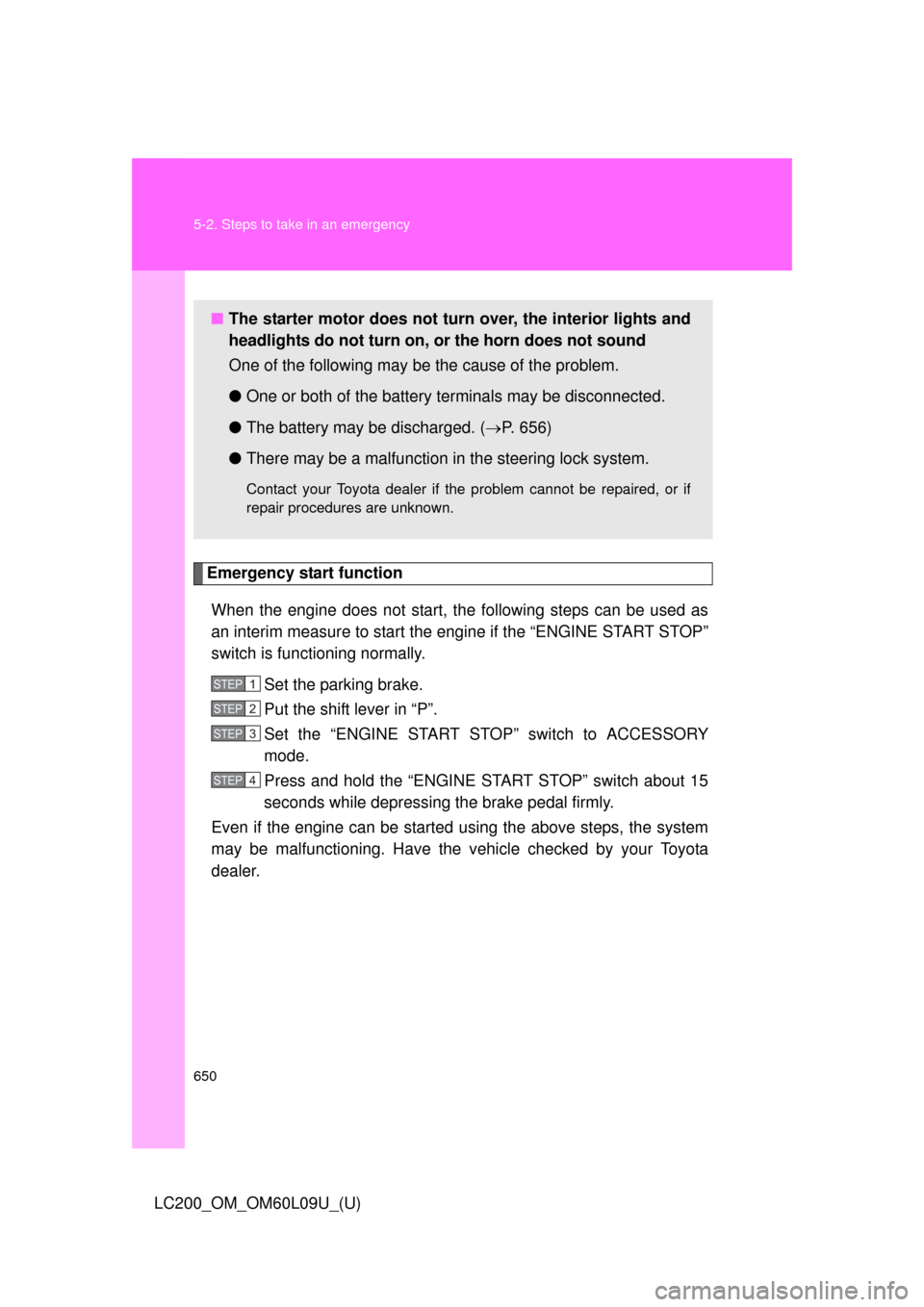
Emergency start functionWhen the engine does not start, the following steps can be used as
an interim measure to start the engine if the “ENGINE START STOP”
switch is functioning normally. Set the parking brake.
Put the shift lever in “P”.
Set the “ENGINE START ST OP” switch to ACCESSORY
mode.
Press and hold the “ENGINE START STOP” switch about 15
seconds while depressing the brake pedal firmly.
Even if the engine can be start ed using the above steps, the system
may be malfunctioning. Have the vehicle checked by your Toyota
dealer.
■ The starter motor does not turn over, the interior lights and
headlights do not turn on, or the horn does not sound
One of the following may be the cause of the problem.
● One or both of the battery terminals may be disconnected.
● The battery may be discharged. ( P. 656)
● There may be a malfunction in the steering lock system.
Contact your Toyota dealer if the problem cannot be repaired, or if
repair procedures are unknown.
STEP1
STEP2
STEP3
STEP4
Page 657 of 724
5
When trouble arises
657
5-2. Steps to take in an emergency
LC200_OM_OM60L09U_(U)
■
Starting the engine when the battery is discharged
The engine cannot be started by push-starting.
■ Avoiding a discharged battery
●Turn off the headlights and the audio system while the engine is off.
● Turn off any unnecessary electrical components when the vehicle is run-
ning at a low speed for an extended period, such as in heavy traffic, etc.
■ Charging the battery
The electricity stored in the battery will discharge gradually even when the
vehicle is not in use, due to natural discharge and the draining effects of cer-
tain electrical appliances. If the vehicle is left for a long time, the battery may
discharge, and the engine may be unable to start. (The battery recharges
automatically during driving.)
■ When the battery is removed or discharged
Make sure the key is not inside the vehicle when recharging or replacing the
battery. The key may be locked in the vehicle if the alarm is activated.
(P. 109)
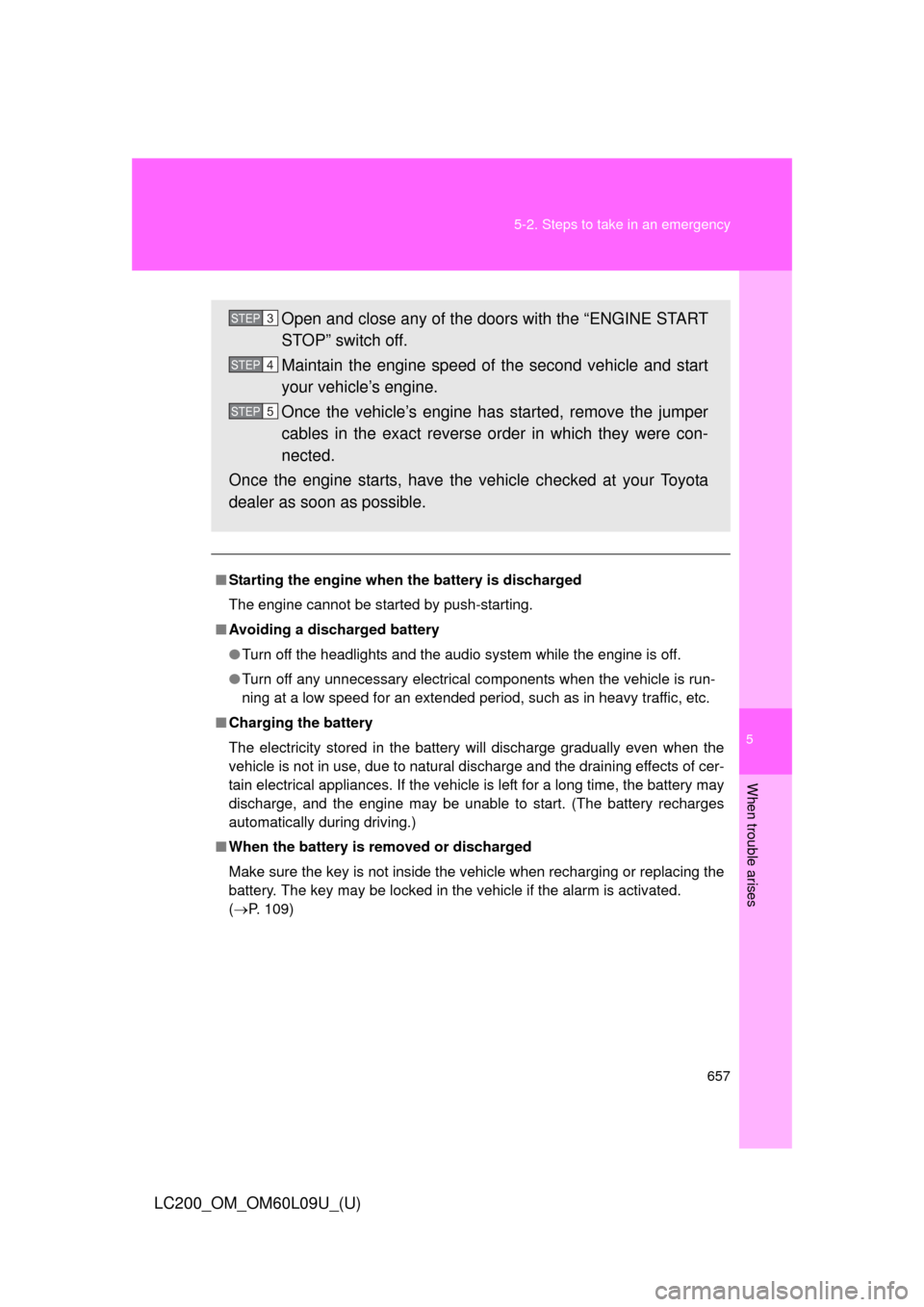
Open and close any of the doors with the “ENGINE START
STOP” switch off.
Maintain the engine speed of the second vehicle and start
your vehicle’s engine.
Once the vehicle’s engine has started, remove the jumper
cables in the exact reverse order in which they were con-
nected.
Once the engine starts, have the vehicle checked at your Toyota
dealer as soon as possible.STEP3
STEP4
STEP5
Page 673 of 724
673
6-1. Specifications
6
Vehicle specifications
LC200_OM_OM60L09U_(U)
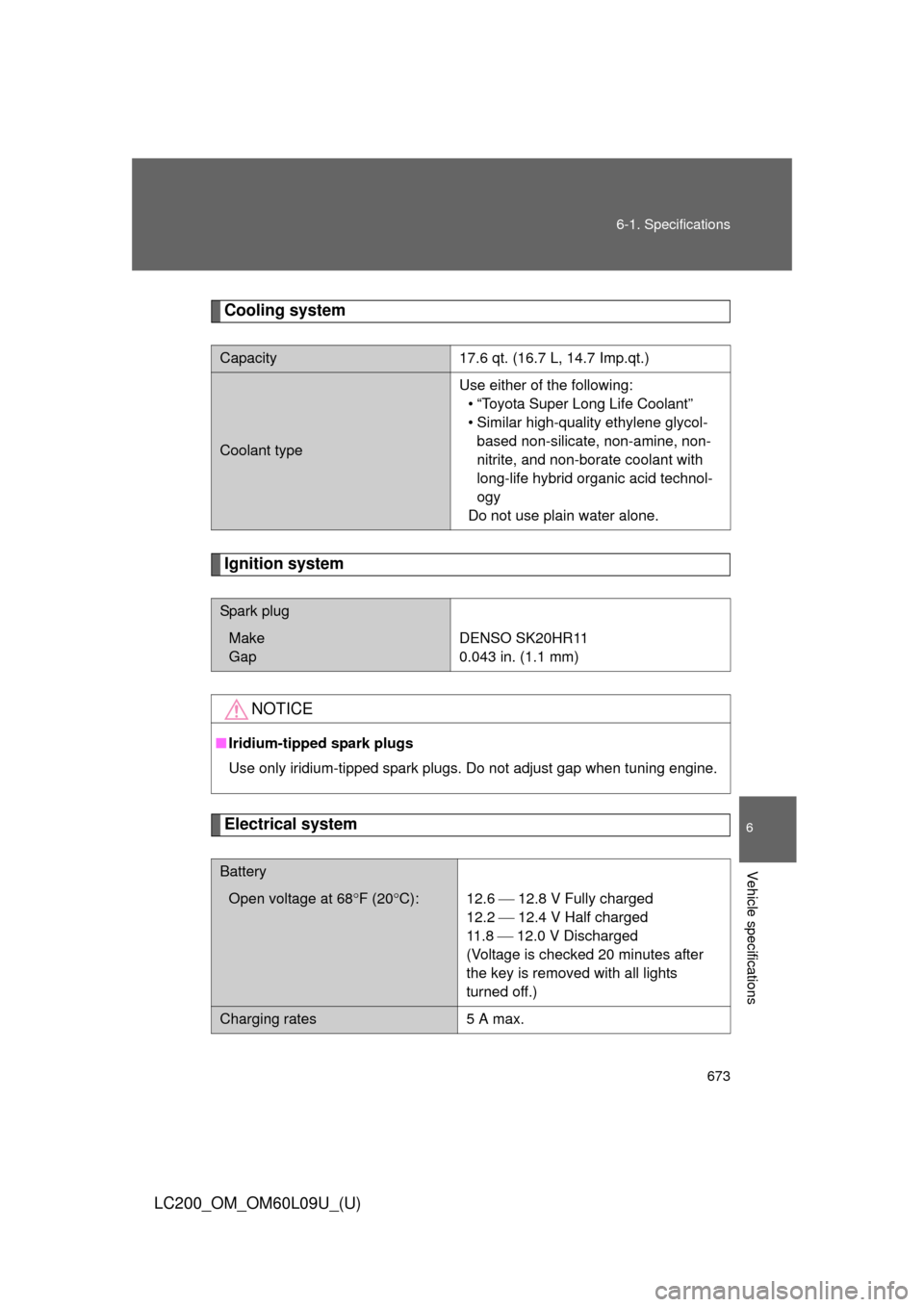
Cooling system
Ignition system
Electrical system
Capacity17.6 qt. (16.7 L, 14.7 Imp.qt.)
Coolant type
Use either of the following:
• “Toyota Super Long Life Coolant”
• Similar high-quality ethylene glycol- based non-silicate, non-amine, non-
nitrite, and non-borate coolant with
long-life hybrid organic acid technol-
ogy
Do not use plain water alone.
Spark plug
Make
GapDENSO SK20HR11
0.043 in. (1.1 mm)
NOTICE
■ Iridium-tipped spark plugs
Use only iridium-tipped spark plugs. Do not adjust gap when tuning engine.
Battery
Open voltage at 68 F (20 C):12.6 12.8 V Fully charged
12.2 12.4 V Half charged
11 . 8 12.0 V Discharged
(Voltage is checked 20 minutes after
the key is removed with all lights
turned off.)
Charging rates5 A max.