light TOYOTA MATRIX 2009 E140 / 2.G User Guide
[x] Cancel search | Manufacturer: TOYOTA, Model Year: 2009, Model line: MATRIX, Model: TOYOTA MATRIX 2009 E140 / 2.GPages: 440, PDF Size: 9.39 MB
Page 25 of 440

25 1-1. Key information
1
Before driving
NOTICE
■To prevent key damage
●Do not subject the keys to strong shocks, expose them to high tempera-
tures by placing them in direct sunlight, or get them wet.
●Do not expose the keys to electromagnetic materials or attach any mate-
rial that blocks electromagnetic waves to the key surface.
●Do not disassemble the key.
Page 26 of 440
26
1-2. Opening, closing and locking the doors
Wireless remote control (if equipped)
■Operation signals
A buzzer sounds and the emergency flashers flash to indicate that the doors
have been locked/unlocked. (Locked: Once; Unlocked: Twice)
■Door lock buzzer
If a door is not fully closed, a buzzer sounds continuously for 10 seconds if
an attempt to lock the door is made. Fully close the door to stop the buzzer,
and lock the vehicle once more.
■Panic mode
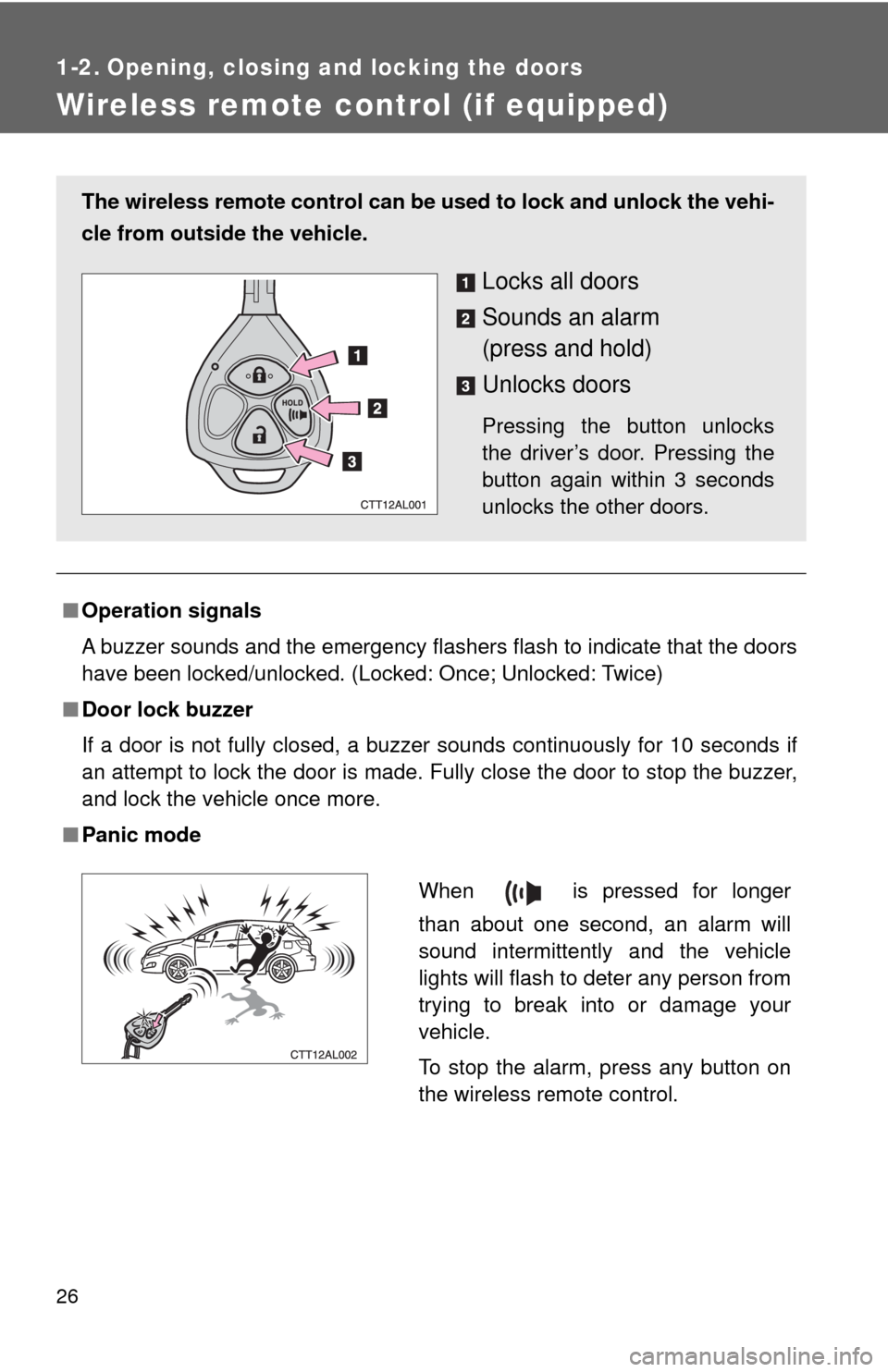
The wireless remote control can be used to lock and unlock the vehi-
cle from outside the vehicle.
Locks all doors
Sounds an alarm
(press and hold)
Unlocks doors
Pressing the button unlocks
the driver’s door. Pressing the
button again within 3 seconds
unlocks the other doors.
When is pressed for longer
than about one second, an alarm will
sound intermittently and the vehicle
lights will flash to deter any person from
trying to break into or damage your
vehicle.
To stop the alarm, press any button on
the wireless remote control.
Page 36 of 440
36 1-3. Adjustable components (seats, mirrors, steering wheel)
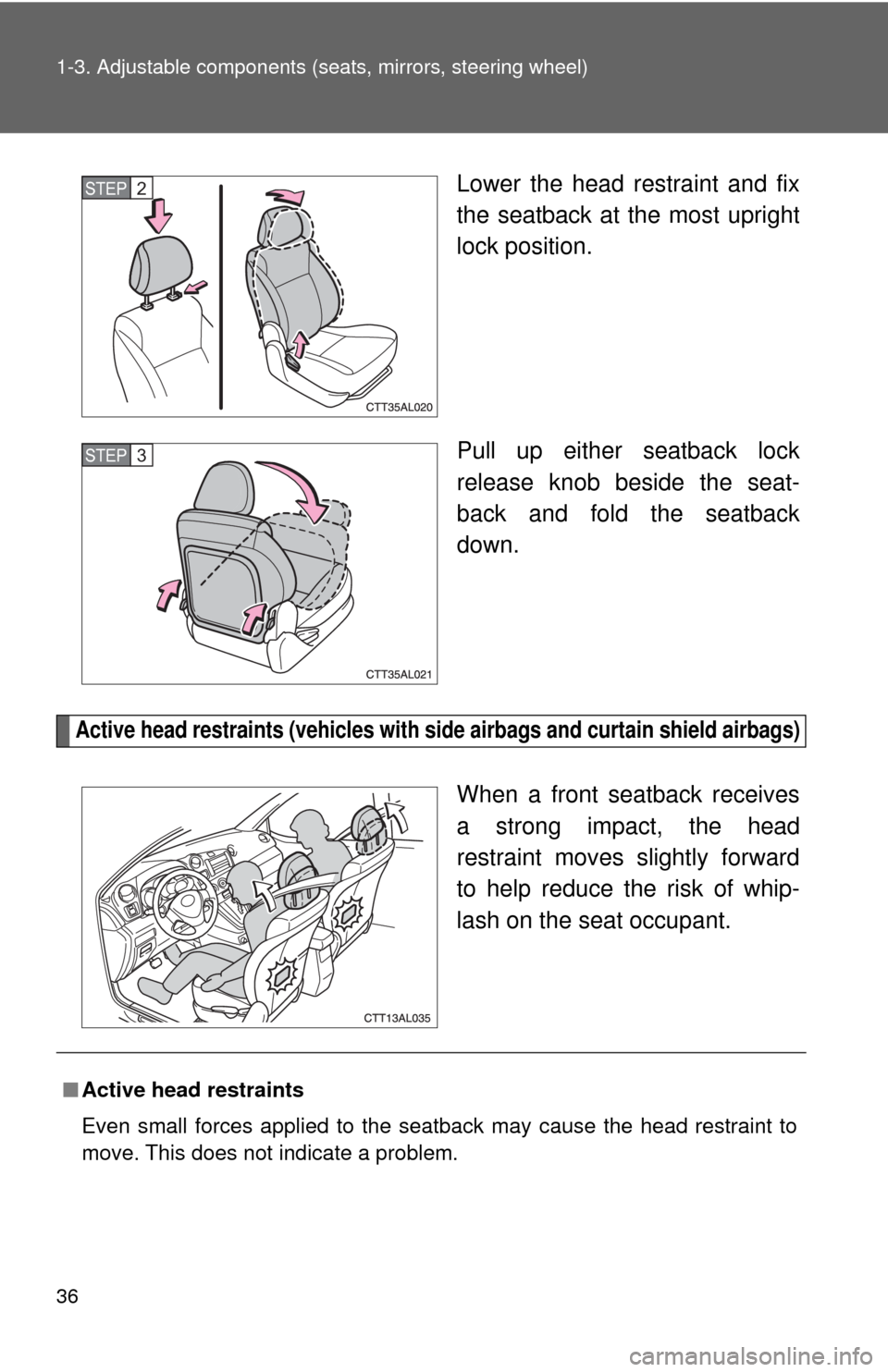
Lower the head restraint and fix
the seatback at the most upright
lock position.
Pull up either seatback lock
release knob beside the seat-
back and fold the seatback
down.
Active head restraints (vehicles with side airbags and curtain shield airbags)
When a front seatback receives
a strong impact, the head
restraint moves slightly forward
to help reduce the risk of whip-
lash on the seat occupant.
STEP2
STEP3
■Active head restraints
Even small forces applied to the seatback may cause the head restraint to
move. This does not indicate a problem.
Page 39 of 440
39 1-3. Adjustable components (seats, mirrors, steering wheel)
1
Before driving
CAUTION
■After returning the seatback to the upright position
Observe the following precautions. Failure to do so may result in death or
serious injury.
●Check that the seat belts are not twisted or caught in the seatback.
■Caution while driving
Do not sit on the folded seatback.
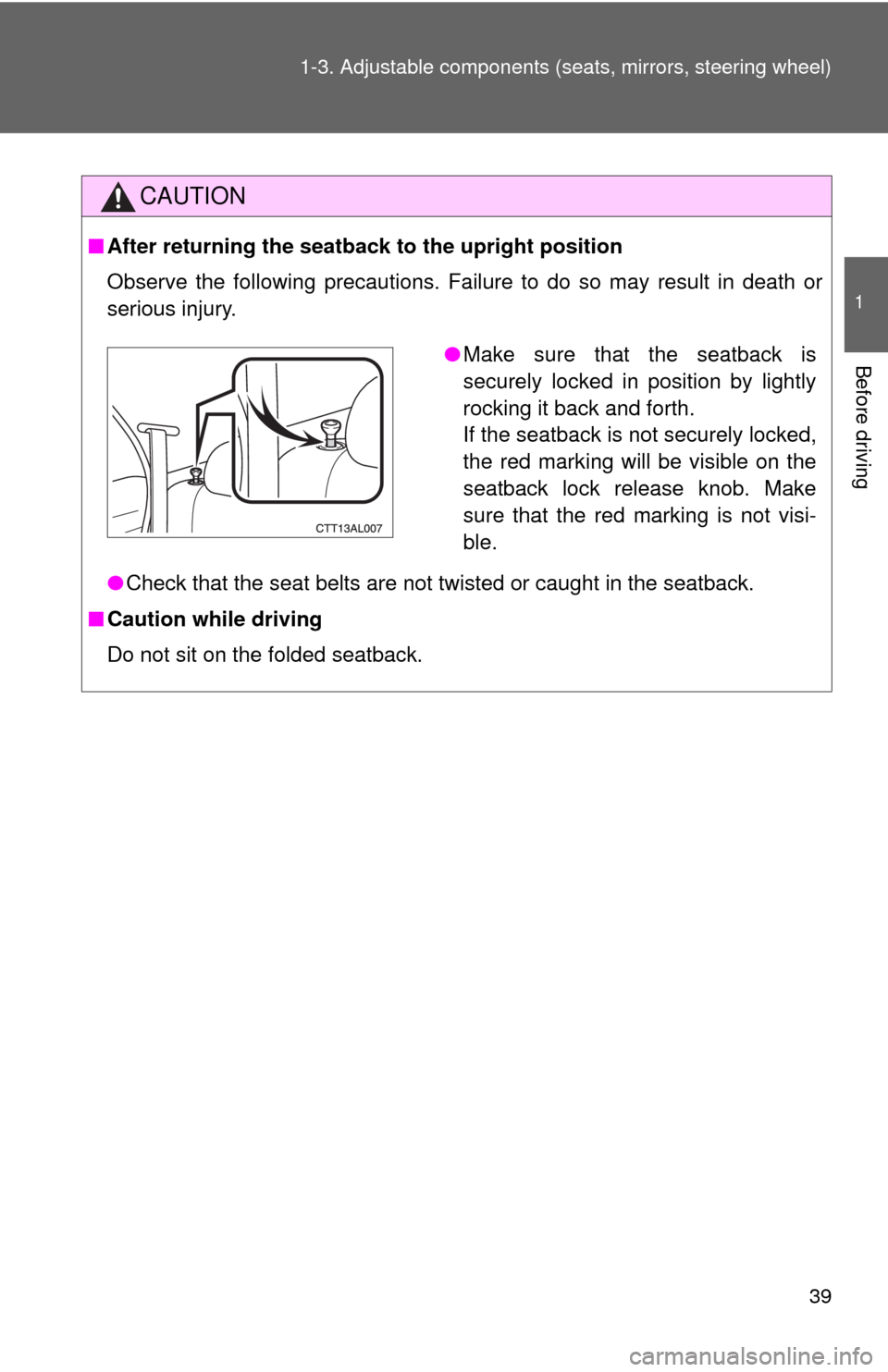
●Make sure that the seatback is
securely locked in position by lightly
rocking it back and forth.
If the seatback is not securely locked,
the red marking will be visible on the
seatback lock release knob. Make
sure that the red marking is not visi-
ble.
Page 42 of 440
42 1-3. Adjustable components (seats, mirrors, steering wheel)
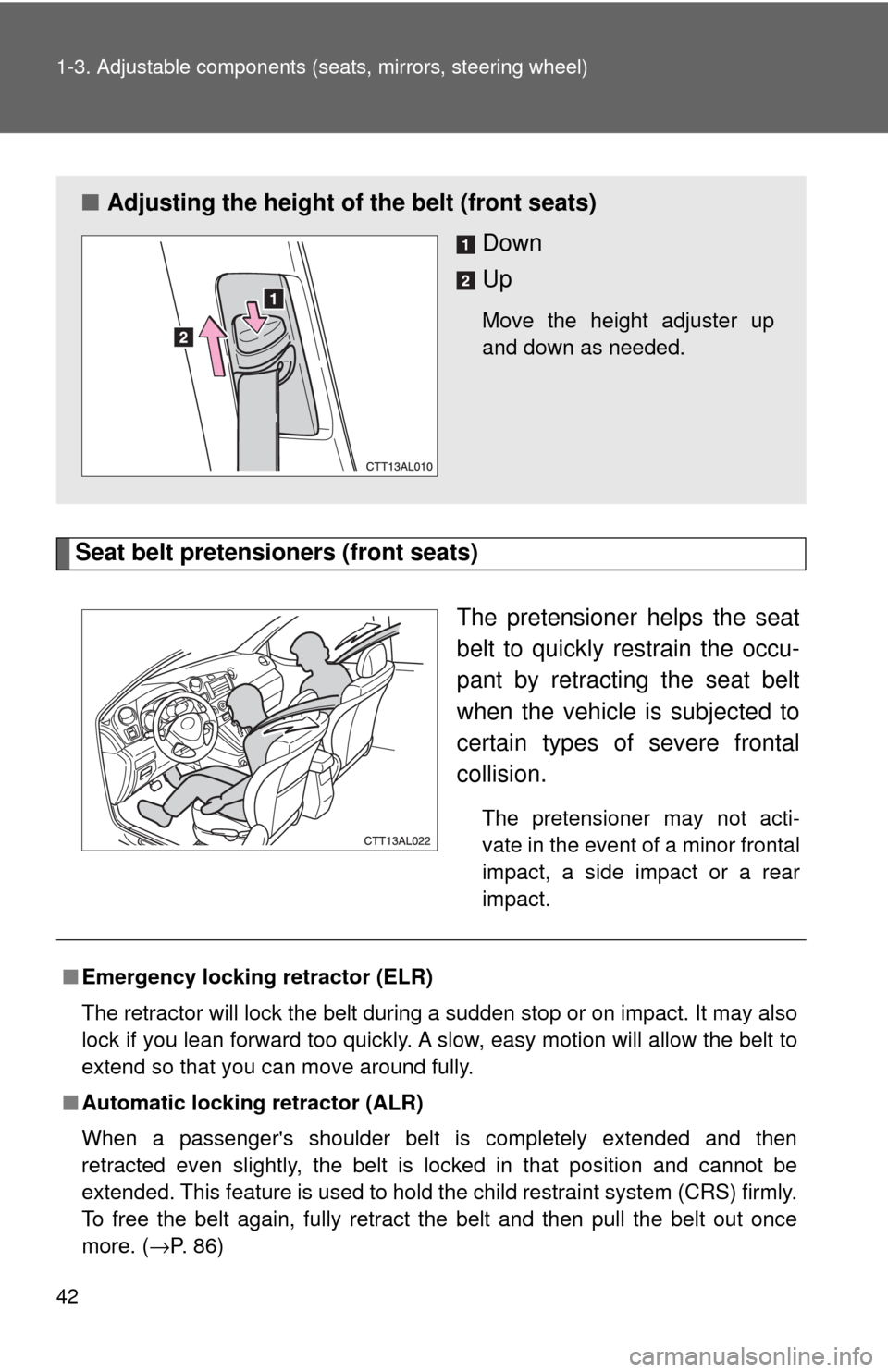
Seat belt pretensioners (front seats)
The pretensioner helps the seat
belt to quickly restrain the occu-
pant by retracting the seat belt
when the vehicle is subjected to
certain types of severe frontal
collision.
The pretensioner may not acti-
vate in the event of a minor frontal
impact, a side impact or a rear
impact.
■Adjusting the height of the belt (front seats)
Down
Up
Move the height adjuster up
and down as needed.
■Emergency locking retractor (ELR)
The retractor will lock the belt during a sudden stop or on impact. It may also
lock if you lean forward too quickly. A slow, easy motion will allow the belt to
extend so that you can move around fully.
■Automatic locking retractor (ALR)
When a passenger's shoulder belt is completely extended and then
retracted even slightly, the belt is locked in that position and cannot be
extended. This feature is used to hold the child restraint system (CRS) firmly.
To free the belt again, fully retract the belt and then pull the belt out once
more. (→P. 86)
Page 47 of 440
47
1
1-3. Adjustable components (seats, mirrors, steering wheel)
Before driving
Anti-glare inside rear view mirror
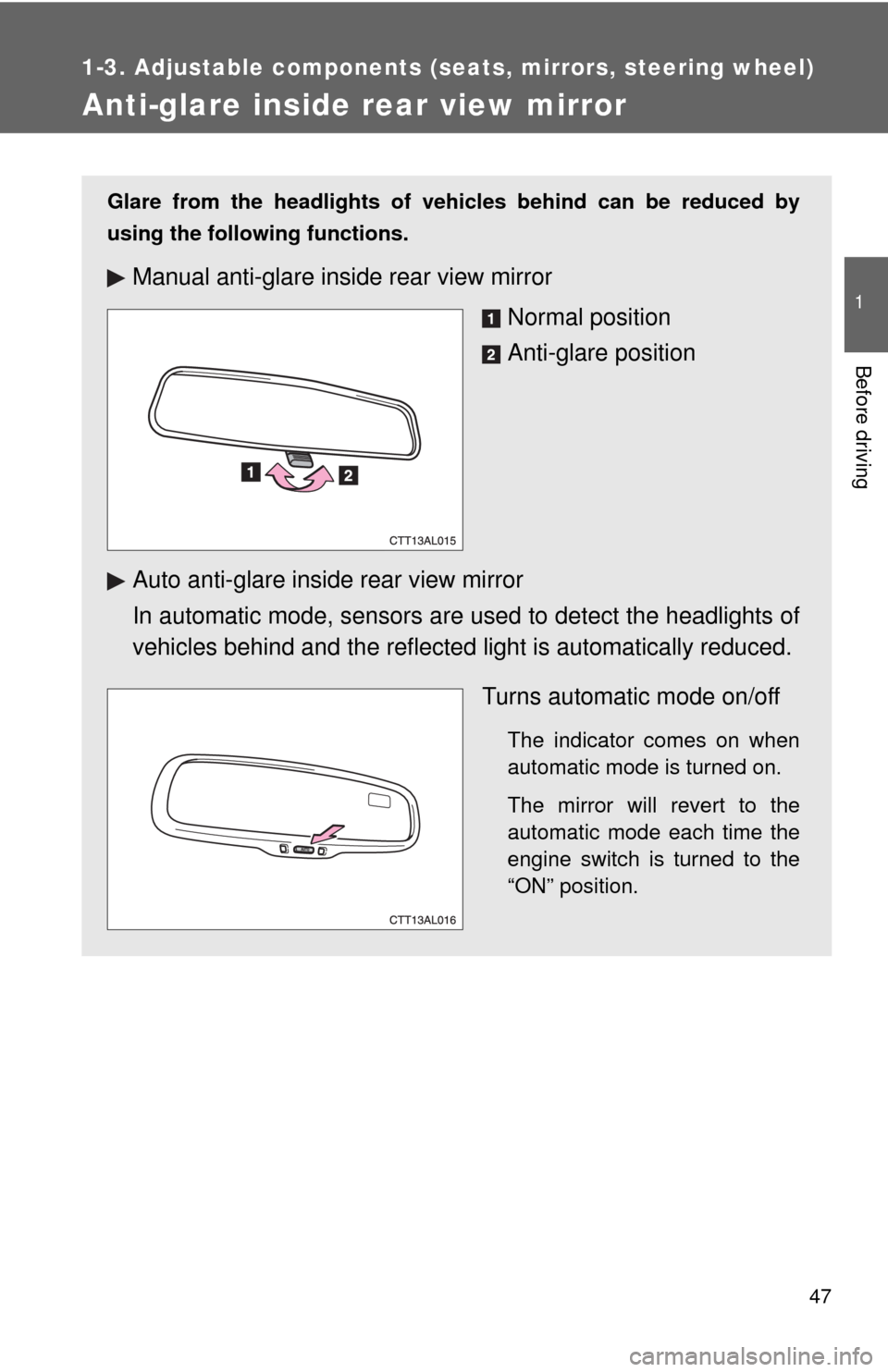
Glare from the headlights of vehicles behind can be reduced by
using the following functions.
Manual anti-glare inside rear view mirror
Normal position
Anti-glare position
Auto anti-glare inside rear view mirror
In automatic mode, sensors are used to detect the headlights of
vehicles behind and the reflected light is automatically reduced.
Turns automatic mode on/off
The indicator comes on when
automatic mode is turned on.
The mirror will revert to the
automatic mode each time the
engine switch is turned to the
“ON” position.
Page 53 of 440
53
1
1-4. Opening and closing the windows
Before driving
Moon roof (if equipped)
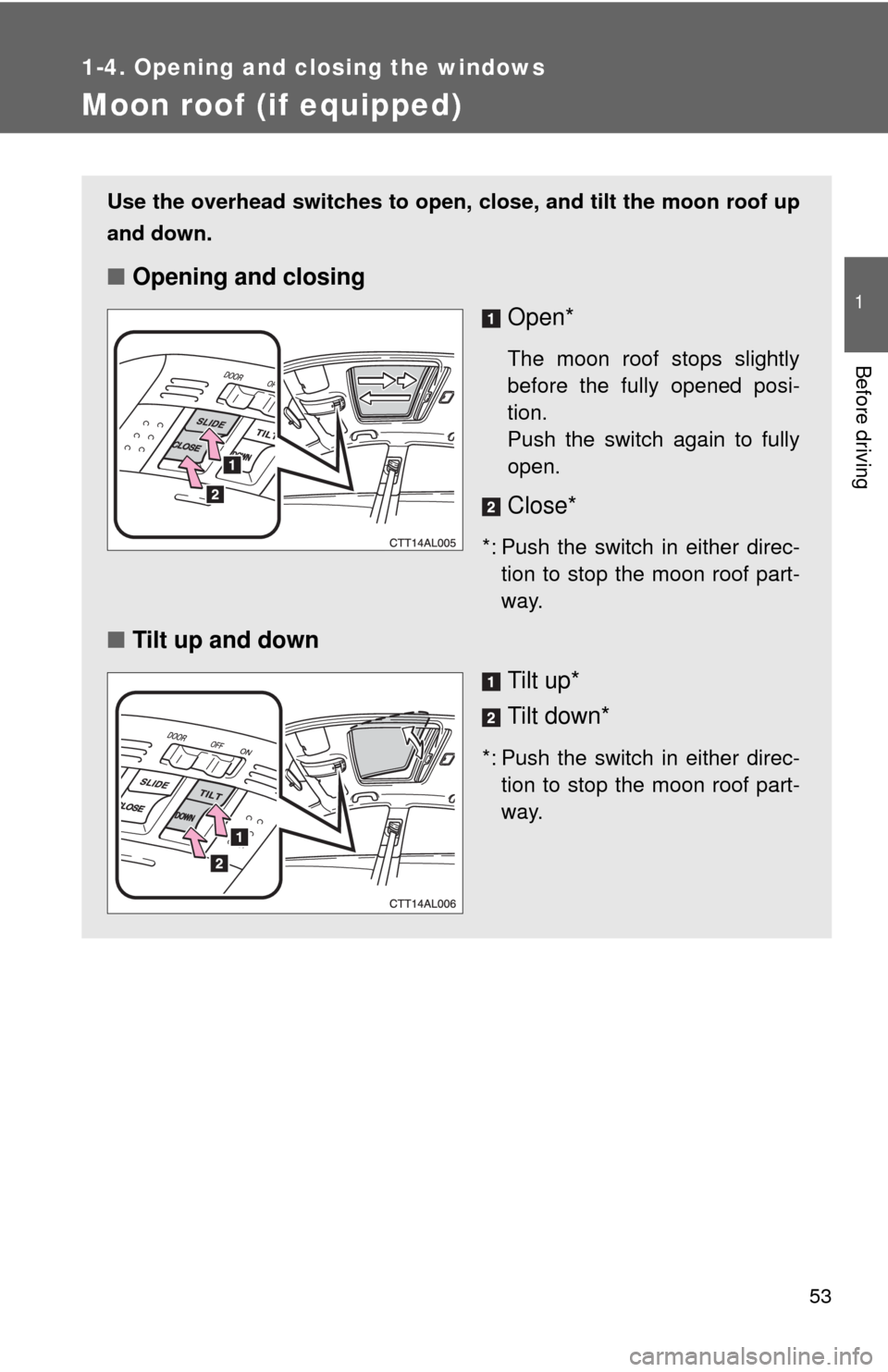
Use the overhead switches to open, close, and tilt the moon roof up
and down.
■Opening and closing
Open*
The moon roof stops slightly
before the fully opened posi-
tion.
Push the switch again to fully
open.
Close*
*: Push the switch in either direc-
tion to stop the moon roof part-
way.
■Tilt up and down
Tilt up*
Tilt down*
*: Push the switch in either direc-
tion to stop the moon roof part-
way.
Page 54 of 440

54 1-4. Opening and closing the windows
■The moon roof can be operated when
The engine switch is in the “ON” position.
■Operating the moon roof after turning the engine OFF
The moon roof can be operated for approximately 45 seconds after the
engine switch is turned to the “ACC” or “LOCK” position. It cannot, however,
be operated once either front door is opened.
■Jam protection function
If an object is detected between the moon roof and the frame while closing
or tilting down, travel is stopped and the moon roof opens slightly.
■To reduce wind noise
Drive with the moon roof opened to slightly before the fully open position as
driving with the moon roof opened fully will cause wind noise.
■Sunshade
The sunshade can be opened and closed manually. However, the sunshade
will open automatically when the moon roof is opened.
Page 57 of 440
57 1-5. Refueling
1
Before driving
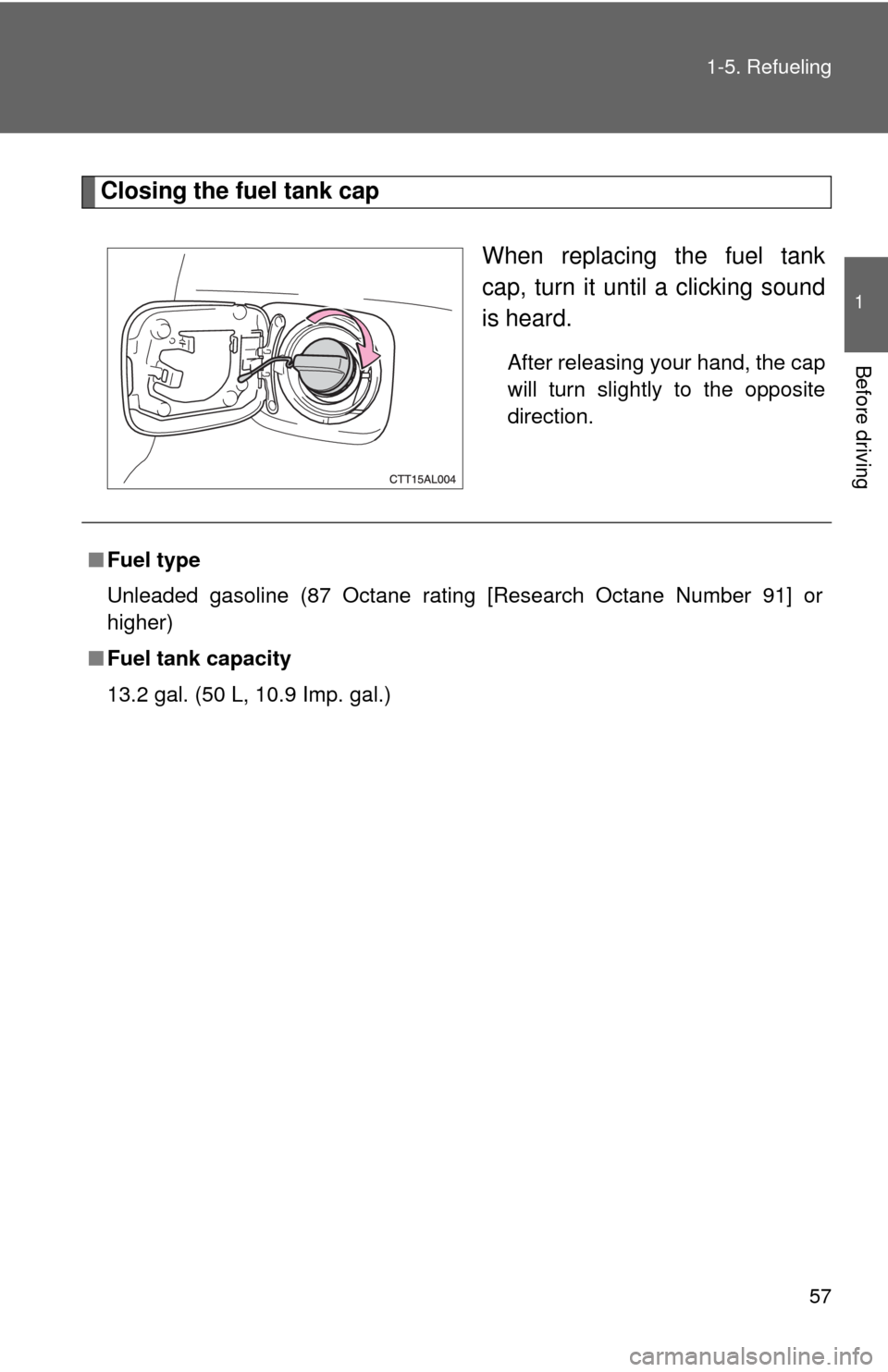
Closing the fuel tank cap
When replacing the fuel tank
cap, turn it until a clicking sound
is heard.
After releasing your hand, the cap
will turn slightly to the opposite
direction.
■Fuel type
Unleaded gasoline (87 Octane rating [Research Octane Number 91] or
higher)
■Fuel tank capacity
13.2 gal. (50 L, 10.9 Imp. gal.)
Page 60 of 440
60
1-6. Theft deterrent system
Engine immobilizer system
■System maintenance
The vehicle has a maintenance-free type of engine immobilizer system.
■Conditions that may cause the system to malfunction
●If the key is in contact with a metallic object
●If the key is in close proximity to or touching a key to the security system
(key with a built-in transponder chip) of another vehicle
■Certifications for the engine immobilizer system (for vehicles sold in
U.S.A.)
FCC ID: MOZRI-21BTY
This device complies with Part 15 of the FCC Rules. Operation is subject to
the following two conditions: (1) this device may not cause harmful interfer-
ence, and (2) this device must accept any interference received, including
interference that may cause undesired operation.
■Certifications for the engine immobilizer system (for vehicles sold in
Canada)
This device complies with RSS-210 of Industry Canada.
Operation is subject to the following two conditions: (1) this device may not
cause interference, and (2) this device must accept any interference, includ-
ing interference that may cause undesired operation of the device.
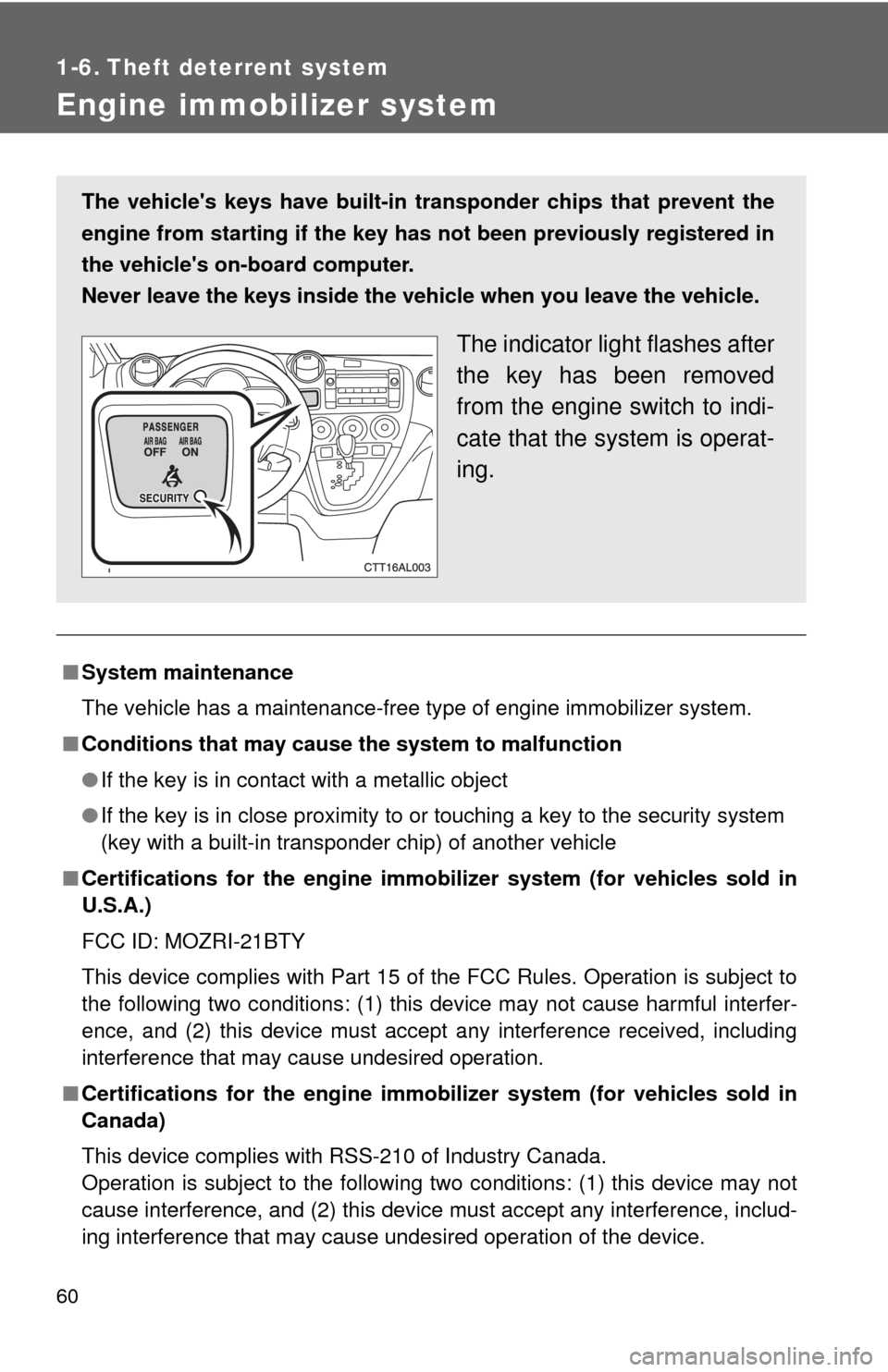
The vehicle's keys have built-in transponder chips that prevent the
engine from starting if the key has not been previously registered in
the vehicle's on-board computer.
Never leave the keys inside the vehicle when you leave the vehicle.
The indicator light flashes after
the key has been removed
from the engine switch to indi-
cate that the system is operat-
ing.