mirror TOYOTA MATRIX 2009 E140 / 2.G Owner's Manual
[x] Cancel search | Manufacturer: TOYOTA, Model Year: 2009, Model line: MATRIX, Model: TOYOTA MATRIX 2009 E140 / 2.GPages: 440, PDF Size: 9.39 MB
Page 46 of 440
46
1-3. Adjustable components (seats, mirrors, steering wheel)
Steering wheel
CAUTION
■Caution while driving
Do not adjust the steering wheel while driving.
Doing so may cause the driver to mishandle the vehicle and cause an acci-
dent, resulting in death or serious injury.
■After adjusting the steering wheel
Make sure that the steering wheel is securely locked.
Otherwise, the steering wheel may move suddenly, possibly causing an
accident and resulting in death or serious injury.
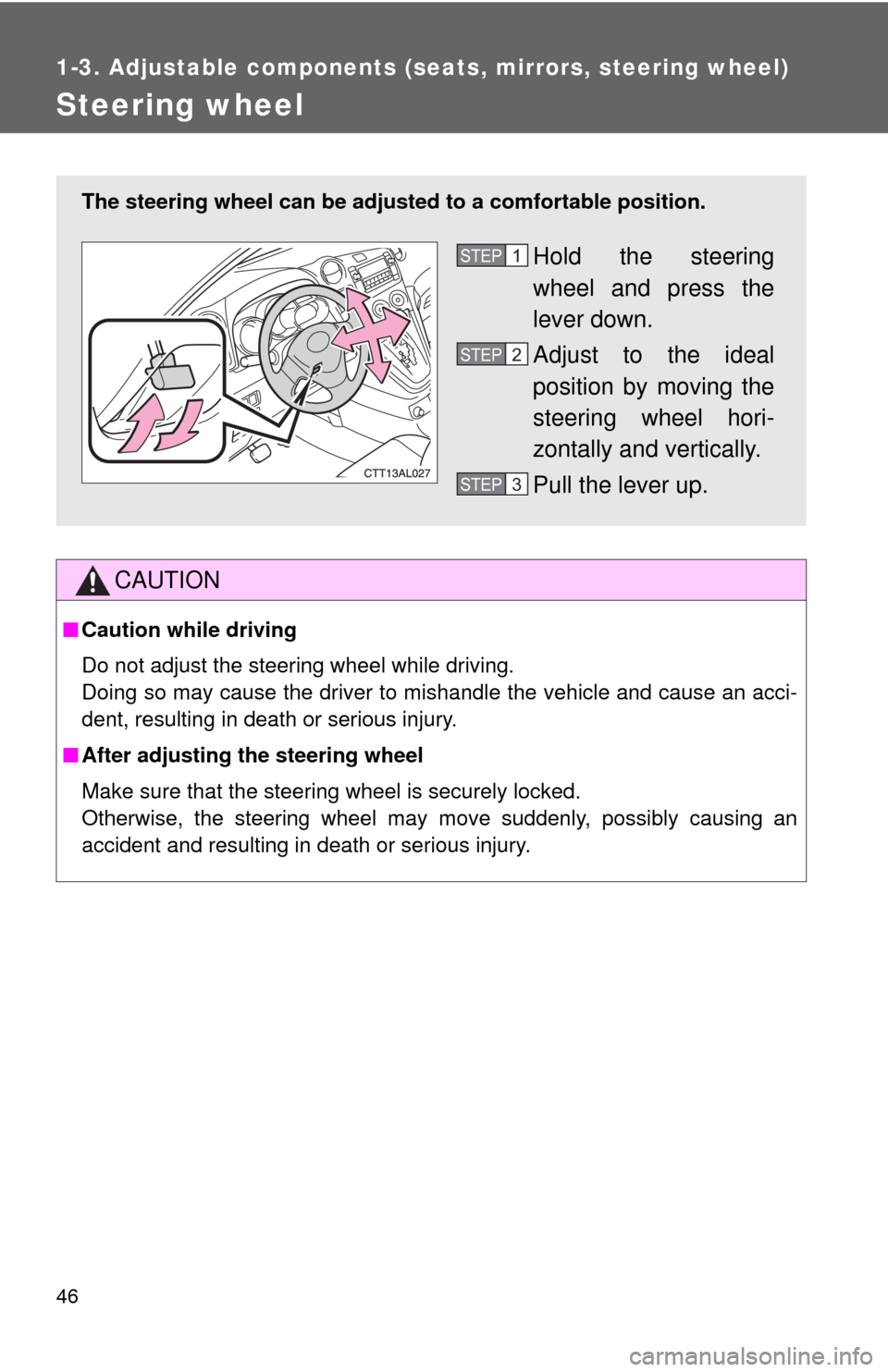
The steering wheel can be adjusted to a comfortable position.
Hold the steering
wheel and press the
lever down.
Adjust to the ideal
position by moving the
steering wheel hori-
zontally and vertically.
Pull the lever up.STEP1
STEP2
STEP3
Page 47 of 440
47
1
1-3. Adjustable components (seats, mirrors, steering wheel)
Before driving
Anti-glare inside rear view mirror
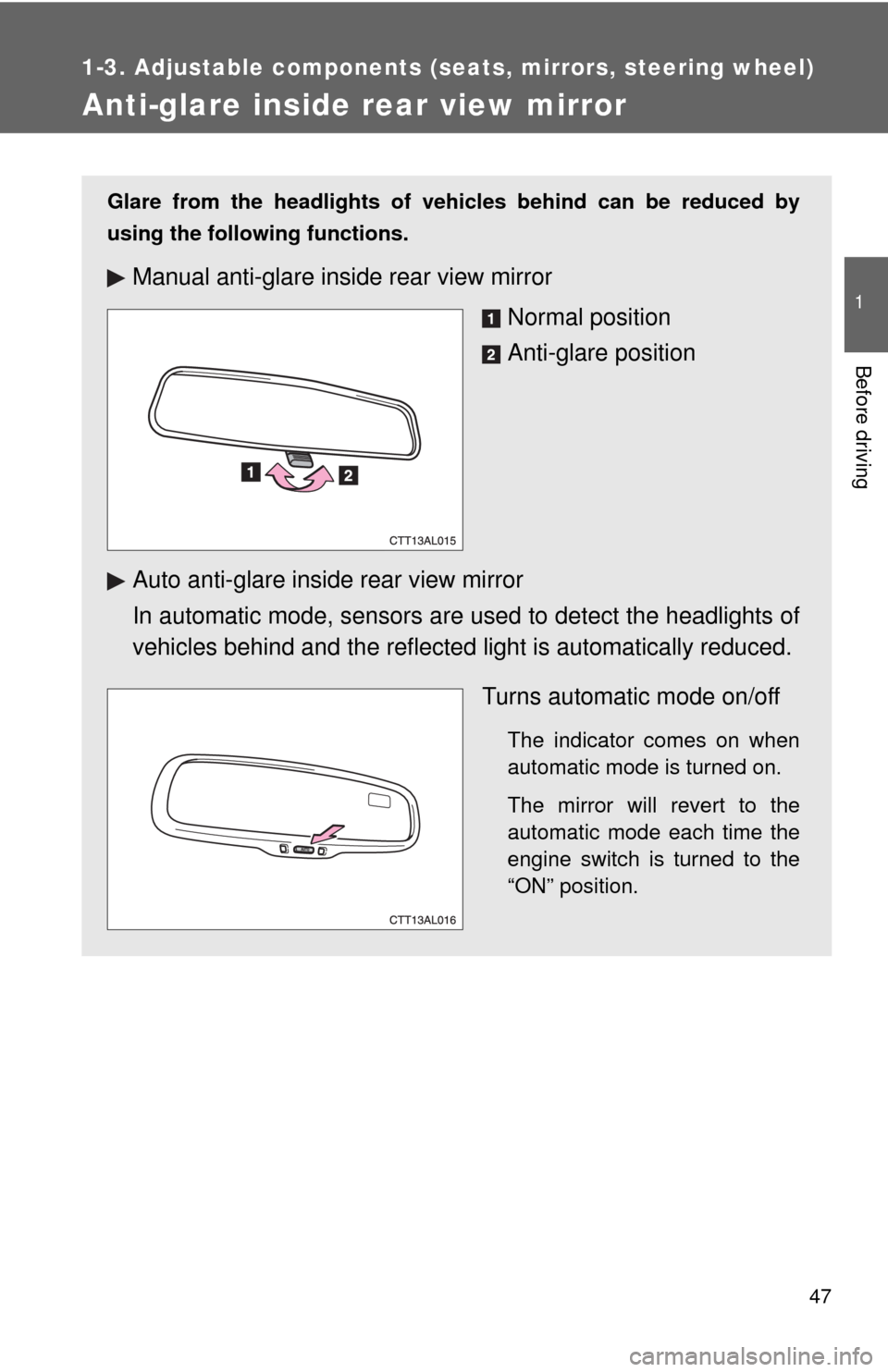
Glare from the headlights of vehicles behind can be reduced by
using the following functions.
Manual anti-glare inside rear view mirror
Normal position
Anti-glare position
Auto anti-glare inside rear view mirror
In automatic mode, sensors are used to detect the headlights of
vehicles behind and the reflected light is automatically reduced.
Turns automatic mode on/off
The indicator comes on when
automatic mode is turned on.
The mirror will revert to the
automatic mode each time the
engine switch is turned to the
“ON” position.
Page 48 of 440
48 1-3. Adjustable components (seats, mirrors, steering wheel)
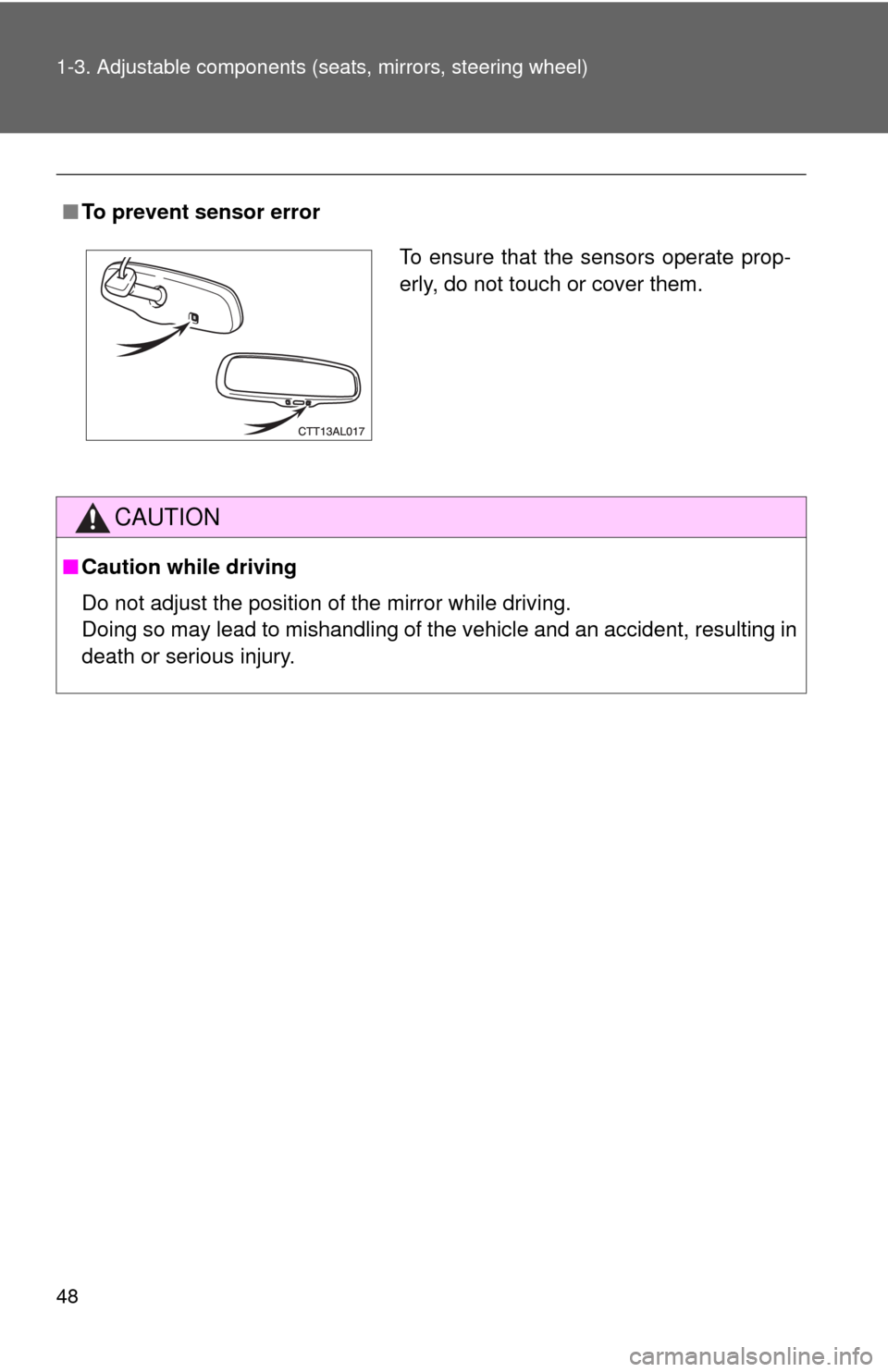
■To prevent sensor error
CAUTION
■Caution while driving
Do not adjust the position of the mirror while driving.
Doing so may lead to mishandling of the vehicle and an accident, resulting in
death or serious injury.
To ensure that the sensors operate prop-
erly, do not touch or cover them.
Page 49 of 440
49
1
1-3. Adjustable components (seats, mirrors, steering wheel)
Before driving
Outside rear view mirrors
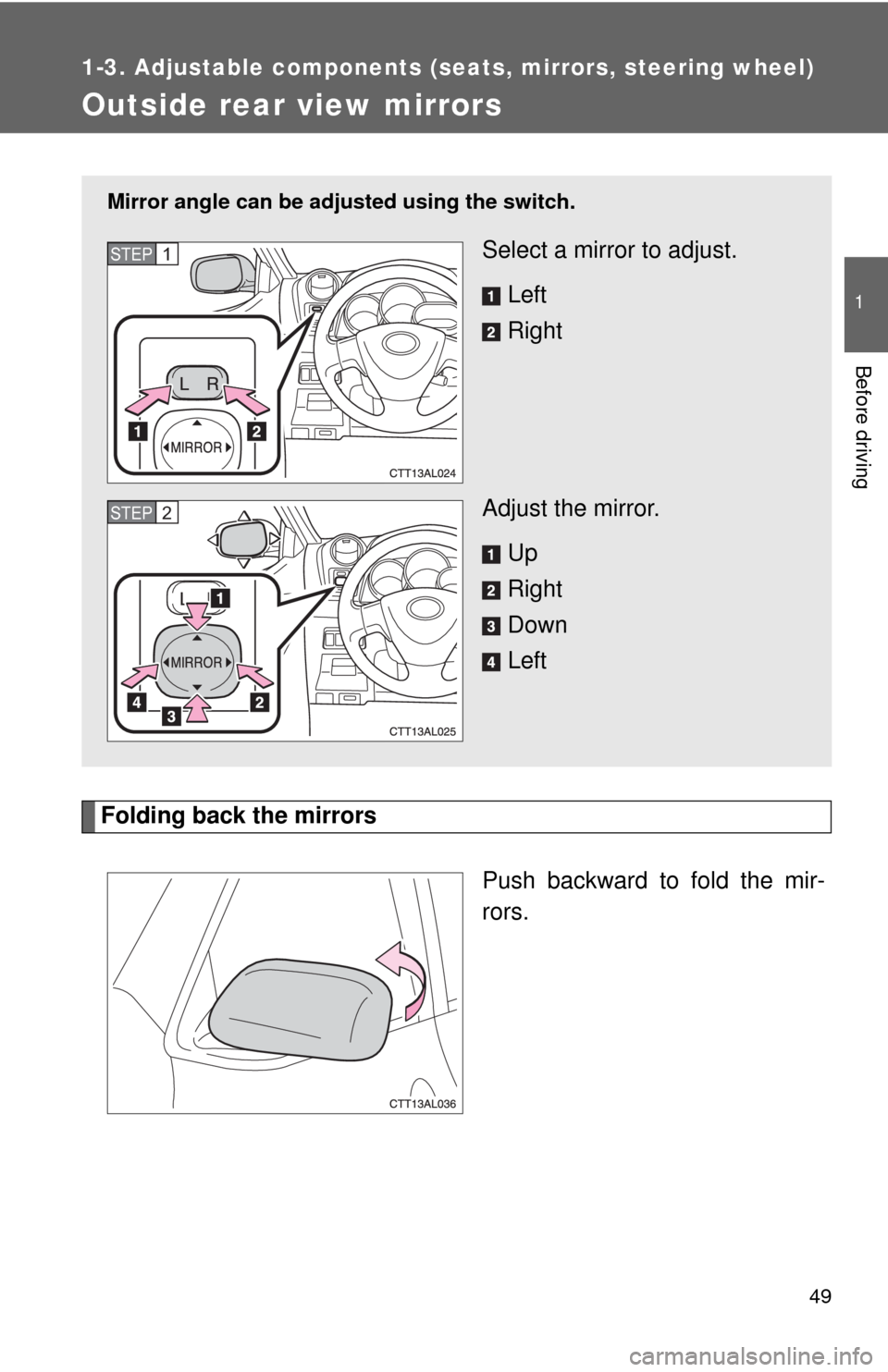
Folding back the mirrors
Push backward to fold the mir-
rors.
Mirror angle can be adjusted using the switch.
Select a mirror to adjust.
Left
Right
Adjust the mirror.
Up
Right
Down
LeftSTEP1
STEP2
Page 50 of 440

50 1-3. Adjustable components (seats, mirrors, steering wheel)
■Mirror angle can be adjusted when
The engine switch is in the “ACC” or “ON” position.
■When the mirrors are fogged up (vehicles with outside rear view mirror
defoggers)
Turn on the mirror defoggers to defog the mirrors. (→P. 168)
CAUTION
■When driving the vehicle
Observe the following precautions while driving.
Failing to do so may result in loss of control of the vehicle and cause an acci-
dent, resulting in death or serious injury.
●Do not adjust the mirrors while driving.
●Do not drive with the mirrors folded back.
●Both the driver and passenger side mirrors must be extended and properly
adjusted before driving.
■When the mirror defoggers are operating (vehicles with outside rear
view mirror defoggers)
Do not touch the surface of the mirror, as it may be hot.
Page 100 of 440
100 2-1. Driving procedures
CAUTION
●Do not drive the vehicle over or stop the vehicle near flammable materials.
The exhaust system and exhaust gases can be extremely hot. This may
cause a fire if there is any flammable material nearby.
●Vehicles with an automatic transmission: Do not let the vehicle roll back-
wards while the shift lever is in a driving position, or roll forward while the
shift lever is in R. Doing so may cause the engine to stall or lead to poor
brake and steering performance, resulting in an accident or damage to the
vehicle.
●If the smell of exhaust is noticed inside the vehicle, open the windows and
check that the back door is closed. Large amounts of exhaust in the vehi-
cle can cause driver drowsiness and an accident, resulting in death or a
serious health hazard. Have the vehicle inspected by your Toyota dealer
immediately.
●Do not under any circumstances shift the shift lever to P (vehicles with an
automatic transmission) or R while the vehicle is moving. Doing so can
cause significant damage to the transmission system and may result in a
loss of vehicle control.
●Do not shift the shift lever to N while the vehicle is moving. Doing so may
cause insufficient engine braking and lead to an accident.
●Do not turn the engine off while driving. The power steering and brake
booster systems will not operate properly if the engine is not running.
●Use engine braking (downshift) to maintain a safe speed when driving
down a steep hill. Using the brakes continuously may cause the brakes to
overheat and lose effectiveness. (→P. 1 1 1 )
●When stopped on an inclined surface, use the brake pedal and parking
brake to prevent the vehicle from rolling backward or forward and causing
an accident.
●Do not adjust the position of the steering wheel, the seat, or the inside or
outside rear view mirrors while driving. Doing so may result in a loss of
vehicle control that can cause accidents that may result in death or serious
injury.
●Always check that all passengers' arms, heads or other parts of their bod-
ies are not outside the vehicle, as this may result in death or serious injury.
Page 150 of 440

150 2-5. Driving information
■Before towing
●Ensure that your vehicle’s tires are properly inflated. (→P. 312)
●Trailer tires should be inflated according to the trailer manufacturer's rec-
ommendation.
●All trailer lights must work in order to be legal.
●Confirm all lights work each time you connect them.
●Check that your vehicle remains level when a loaded or unloaded trailer
is hitched. Do not drive if the vehicle is not level, and check for improper
tongue load, overloading, worn suspension, or other possible causes.
●Make sure the trailer cargo is securely loaded.
●Check that your rear view mirrors conform to any federal, state/provincial
or local regulations. If they do not, install rear view mirrors appropriate for
towing purposes.
■Break-in schedule
Toyota recommends that you do not use a new vehicle or a vehicle with any
new power train components (engine, transmission, differential, wheel bear-
ings, etc.) to tow a trailer for the first 500 miles (800 km) of driving.
■Maintenance
●If you tow a trailer, your vehicle will require more frequent maintenance
due to the additional load. (See “Scheduled Maintenance Guide” or
“Owner's Manual Supplement”.)
●Retighten the fixing bolts of the towing ball and bracket after approxi-
mately 600 miles (1000 km) of trailer towing.
Page 160 of 440
160
3-1. Using the air conditioning
system and defogger ... 162
Air conditioning system .... 162
Rear window and outside
rear view mirror
defoggers ....................... 168
3-2. Using the audio
system .......................... 169
Audio system types .......... 169
Using the radio ................. 172
Using the CD player ......... 178
Playing MP3 and
WMA discs ..................... 185
Optimal use of the audio
system ........................... 193
Using the AUX adapter .... 196
Using the steering wheel
audio switches ............... 197
Page 161 of 440
Interior features3
161
3-3. Using the hands-free
phone system
(for cellular phone) ...... 200
Hands-free phone system
(for cellular phone)
features .......................... 200
Using the hands-free
phone system
(for cellular phone) ......... 203
Making a phone call ......... 212
Setting a cellular phone ... 216
Security and system
setup .............................. 221
Using the phone book ...... 225
3-4. Using the interior
lights ............................. 232
Interior lights list ............... 232
• Interior light .................... 233
• Personal/interior lights ... 234
• Personal lights ............... 2353-5. Using the storage
features ......................... 236
List of storage features .... 236
• Glove box....................... 237
• Console box ................... 237
• Cup holders ................... 239
• Bottle holders ................. 241
• Auxiliary boxes ............... 242
3-6. Other interior
features ......................... 244
Sun visors ........................ 244
Vanity mirrors ................... 245
Clock ................................ 246
Ashtrays ........................... 247
Cigarette lighter................ 248
Power outlet ..................... 249
Grocery bag hook ............ 251
Seatback table ................. 253
Floor mat .......................... 254
Luggage compartment
feature............................ 255
Compass .......................... 262
Page 168 of 440
168
3-1. Using the air conditioning system and defogger
Rear window and outside rear view mirror defoggers
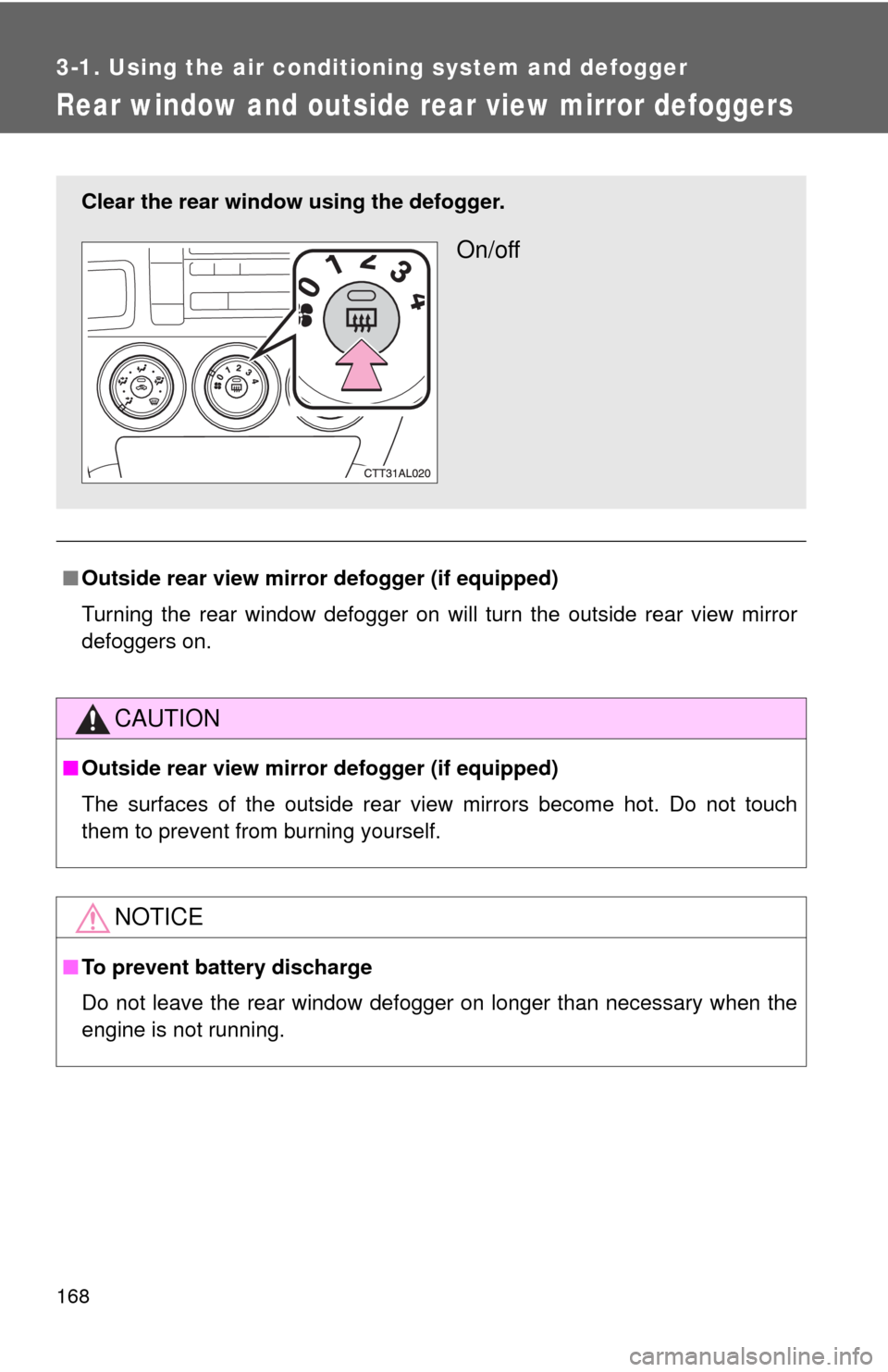
■Outside rear view mirror defogger (if equipped)
Turning the rear window defogger on will turn the outside rear view mirror
defoggers on.
CAUTION
■Outside rear view mirror defogger (if equipped)
The surfaces of the outside rear view mirrors become hot. Do not touch
them to prevent from burning yourself.
NOTICE
■To prevent battery discharge
Do not leave the rear window defogger on longer than necessary when the
engine is not running.
Clear the rear window using the defogger.
On/off