tire pressure TOYOTA MATRIX 2009 E140 / 2.G Owner's Guide
[x] Cancel search | Manufacturer: TOYOTA, Model Year: 2009, Model line: MATRIX, Model: TOYOTA MATRIX 2009 E140 / 2.GPages: 440, PDF Size: 9.39 MB
Page 371 of 440
5
When trouble arises
371 5-2. Steps to take in an emergency
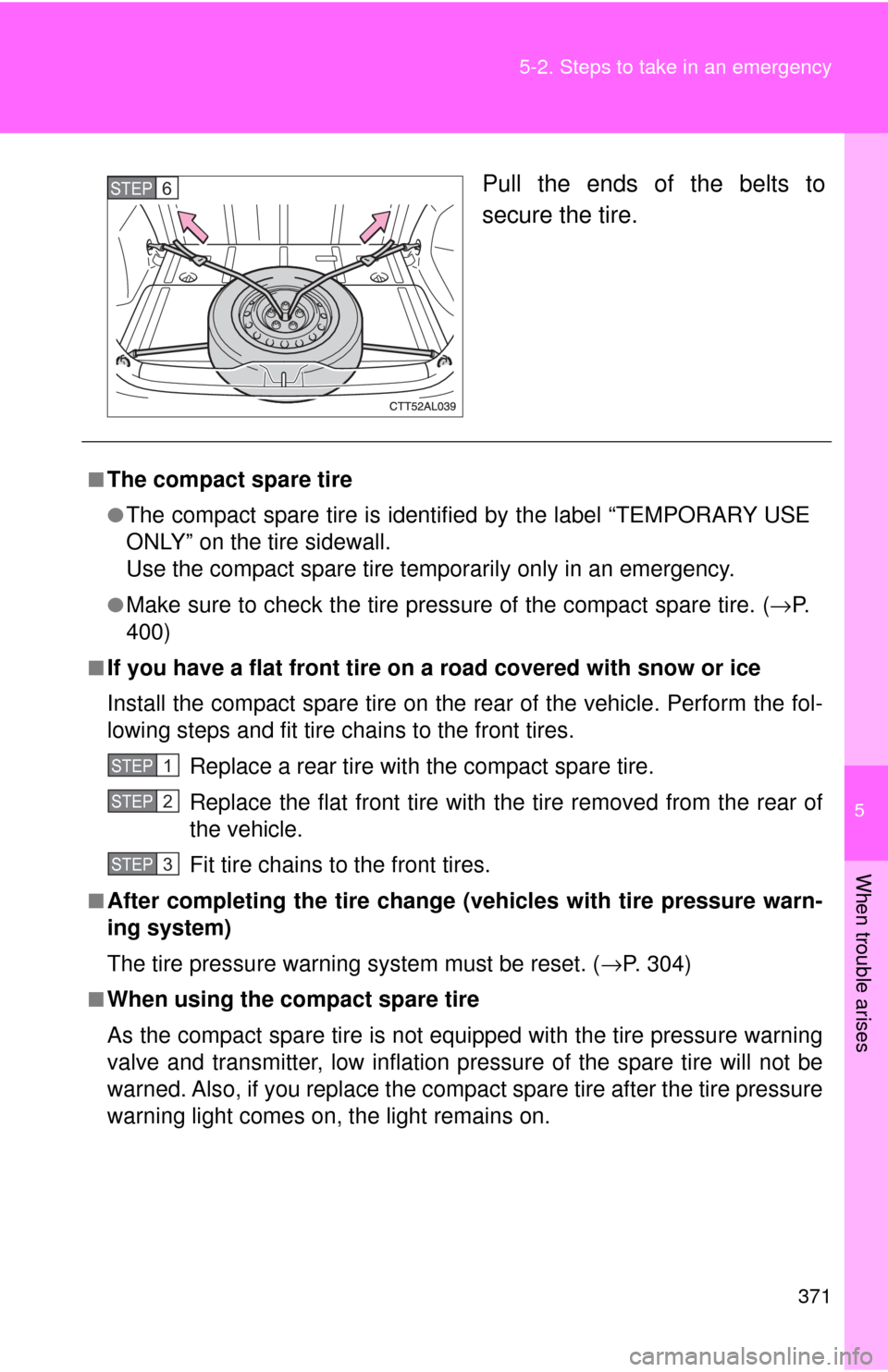
Pull the ends of the belts to
secure the tire.STEP6
■The compact spare tire
●The compact spare tire is identified by the label “TEMPORARY USE
ONLY” on the tire sidewall.
Use the compact spare tire temporarily only in an emergency.
●Make sure to check the tire pressure of the compact spare tire. (→P.
400)
■If you have a flat front tire on a road covered with snow or ice
Install the compact spare tire on the rear of the vehicle. Perform the fol-
lowing steps and fit tire chains to the front tires.
Replace a rear tire with the compact spare tire.
Replace the flat front tire with the tire removed from the rear of
the vehicle.
Fit tire chains to the front tires.
■After completing the tire change (vehicles with tire pressure warn-
ing system)
The tire pressure warning system must be reset. (→P. 304)
■When using the compact spare tire
As the compact spare tire is not equipped with the tire pressure warning
valve and transmitter, low inflation pressure of the spare tire will not be
warned. Also, if you replace the compact spare tire after the tire pressure
warning light comes on, the light remains on.
STEP1
STEP2
STEP3
Page 375 of 440
5
When trouble arises
375 5-2. Steps to take in an emergency
NOTICE
■Do not drive the vehicle with a flat tire
Do not continue driving with a flat tire.
Driving even a short distance with a flat tire can damage the tire and the
wheel beyond repair.
■Be careful when driving over bumps with the compact spare tire
installed on the vehicle
The vehicle becomes lower when driving with the compact spare tire
compared to when driving with standard tires. Be careful when driving
over uneven road surfaces.
■Driving with tire chains and the compact spare tire
Do not fit tire chains to the compact spare tire.
Tire chains may damage the vehicle body and adversely affect driving
performance.
■When replacing the tires
When removing or fitting the wheels, tires or the tire pressure warning
valve and transmitter, contact your Toyota dealer as the tire pressure
warning valve and transmitter may be damaged if not handled correctly.
■To avoid damaging the tire pressure warning valves and transmit-
ters
Do not use liquid sealants on flat tires.
Page 382 of 440
382 5-2. Steps to take in an emergency
■Avoiding a discharged battery
●Turn off the headlights and the audio system while the engine is turned
off.
●Turn off any unnecessary electrical components when the vehicle is run-
ning at a low speed for an extended period, such as in heavy traffic, etc.
■When the battery is removed or discharged
The tire pressure warning system must be initialized.
(→P. 304)
Once the vehicle’s engine has started, remove the jumper
cables in the exact reverse order in which they were con-
nected.
Once the engine starts, have the vehicle checked at your Toyota
dealer as soon as possible.STEP4
Page 400 of 440

400 6-1. Specifications
Steering
Tires and wheels
Type A
Type B
Free play Less than 1.2 in. (30 mm)
Tire size P205/55R16 89H, T135/70R16 100M
Tire inflation pressure
(Recommended cold tire
inflation pressure)Front: 32 psi (220 kPa, 2.2 kgf/cm2 or bar)
Rear: 32 psi (220 kPa, 2.2 kgf/cm2 or bar)
Spare: 60 psi (420 kPa, 4.2 kgf/cm2 or bar)
Wheel size 16 × 6 1/2 J, 16 × 4T (compact spare)
Wheel nut torque 76 ft•lbf (103 N•m, 10.5 kgf•m)
Tire size P205/55R16 89H, T135/80R16 101M
Tire inflation pressure
(Recommended cold tire
inflation pressure)Front: 32 psi (220 kPa, 2.2 kgf/cm2 or bar)
Rear: 32 psi (220 kPa, 2.2 kgf/cm2 or bar)
Spare: 60 psi (420 kPa, 4.2 kgf/cm2 or bar)
Wheel size 16 × 6 1/2 J, 16 × 4T (compact spare)
Wheel nut torque 76 ft•lbf (103 N•m, 10.5 kgf•m)
Page 401 of 440

401 6-1. Specifications
6
Vehicle specifications
Type C
Type D
Tire size P205/55R16 89H, T135/70R17 102M
Tire inflation pressure
(Recommended cold tire
inflation pressure)2WD models
Front: 32 psi (220 kPa, 2.2 kgf/cm
2 or
bar)
Rear: 32 psi (220 kPa, 2.2 kgf/cm
2 or
bar)
Spare: 60 psi (420 kPa, 4.2 kgf/cm
2 or
bar)
AWD models
Front: 35 psi (240 kPa, 2.4 kgf/cm
2 or
bar)
Rear: 32 psi (220 kPa, 2.2 kgf/cm
2 or
bar)
Spare: 60 psi (420 kPa, 4.2 kgf/cm
2 or
bar)
Wheel size 16 × 6 1/2 J, 17 × 4T (compact spare)
Wheel nut torque 76 ft•lbf (103 N•m, 10.5 kgf•m)
Tire size P215/45R17 87W, T135/70R16 100M
Tire inflation pressure
(Recommended cold tire
inflation pressure)Front: 32 psi (220 kPa, 2.2 kgf/cm2 or bar)
Rear: 32 psi (220 kPa, 2.2 kgf/cm2 or bar)
Spare: 60 psi (420 kPa, 4.2 kgf/cm2 or bar)
Wheel size 17 × 7J, 16 × 4T (compact spare)
Wheel nut torque 76 ft•lbf (103 N•m, 10.5 kgf•m)
Page 402 of 440

402 6-1. Specifications
Type E
Type F
Tire size P215/45R17 87W, T135/80R16 101M
Tire inflation pressure
(Recommended cold tire
inflation pressure)Front: 32 psi (220 kPa, 2.2 kgf/cm2 or bar)
Rear: 32 psi (220 kPa, 2.2 kgf/cm2 or bar)
Spare: 60 psi (420 kPa, 4.2 kgf/cm2 or bar)
Wheel size 17 × 7 J, 16 × 4T (compact spare)
Wheel nut torque 76 ft•lbf (103 N•m, 10.5 kgf•m)
Tire size P215/45R17 87W, T135/70R17 102M
Tire inflation pressure
(Recommended cold tire
inflation pressure)2WD models
Front: 32 psi (220 kPa, 2.2 kgf/cm
2 or
bar)
Rear: 32 psi (220 kPa, 2.2 kgf/cm
2 or
bar)
Spare: 60 psi (420 kPa, 4.2 kgf/cm
2 or
bar)
AWD models
Front: 35 psi (240 kPa, 2.4 kgf/cm
2 or
bar)
Rear: 32 psi (220 kPa, 2.2 kgf/cm
2 or
bar)
Spare: 60 psi (420 kPa, 4.2 kgf/cm
2 or
bar)
Wheel size 17 × 7 J, 17× 4T (compact spare)
Wheel nut torque 76 ft•lbf (103 N•m, 10.5 kgf•m)
Page 403 of 440

403 6-1. Specifications
6
Vehicle specifications
Type G
Tire size P215/45R18 89W, T135/70R17 102M
Tire inflation pressure
(Recommended cold tire
inflation pressure)Front: 32 psi (220 kPa, 2.2 kgf/cm2 or bar)
Rear: 32 psi (220 kPa, 2.2 kgf/cm2 or bar)
Spare: 60 psi (420 kPa, 4.2 kgf/cm2 or bar)
Wheel size 18 × 7 J, 17 × 4T (compact spare)
Wheel nut torque 76 ft•lbf (103 N•m, 10.5 kgf•m)
Page 409 of 440

409 6-1. Specifications
6
Vehicle specifications
Tire ply composition and materials
Plies are layers of rubber-coated parallel cords. Cords are the
strands which form the plies in a tire.
Radial tires or bias-ply tires
A radial tire has “RADIAL” on the sidewall. A tire not marked
“RADIAL” is a bias-ply tire.
TUBELESS or TUBE TYPE
A tubeless tire does not have a tube and air is directly filled in the
tire. A tube type tire has a tube inside the tire and the tube main-
tains the air pressure.
Load limit at maximum cold tire inflation pressure (→P. 307)
Maximum cold tire inflation pressure (→P. 400)
This means the pressure to which a tire may be inflated.
Summer tires or all season tires (→P. 308)
An all season tire has “M+S” on the sidewall. A tire not marked
“M+S” is a summer tire.
“TEMPORARY USE ONLY” (→P. 371)
A compact spare tire is identified by the phrase “TEMPORARY USE
ONLY” molded into its sidewall. This tire is designed for temporary
emergency use only.
Page 414 of 440
414 6-1. Specifications
Warning: The temperature grades for this tire are established for a
tire that is properly inflated and not overloaded.
Excessive speed, underinflation, or excessive loading, either sepa-
rately or in combination, can cause heat buildup and possible tire fail-
ure.
Glossary of tire terminology
Tire related termMeaning
Cold tire inflation pres-
sureTire pressure when the vehicle has been
parked for three hours or more, or has not
been driven more than 1 mile or 1.5 km under
that condition
Maximum inflation
pressureThe maximum cold inflated pressure to which a
tire may be inflated, shown on the sidewall of
the tire
Recommended infla-
tion pressureCold tire inflation pressure recommended by a
manufacturer
Accessory weightThe combined weight (in excess of those stan-
dard items which may be replaced) of auto-
matic transmission, power steering, power
brakes, power windows, power seats, radio
and heater, to the extent that these items are
available as factory-installed equipment
(whether installed or not)
Curb weightThe weight of a motor vehicle with standard
equipment, including the maximum capacity of
fuel, oil and coolant, and if so equipped, air
conditioning and additional weight optional
engine
Maximum loaded vehi-
cle weightThe sum of:
(a) Curb weight
(b) Accessory weight
(c) Vehicle capacity weight
(d) Production options weight
Page 416 of 440

416 6-1. Specifications
Tire related termMeaning
Weather sideThe surface area of the rim not covered by the
inflated tire
BeadThe part of the tire that is made of steel wires,
wrapped or reinforced by ply cords and that is
shaped to fit the rim
Bead separationA breakdown of the bond between components
in the bead
Bias ply tireA pneumatic tire in which the ply cords that
extend to the beads are laid at alternate angles
substantially less than 90 degrees to the cen-
terline of the tread
CarcassThe tire structure, except tread and sidewall
rubber which, when inflated, bears the load
ChunkingThe breaking away of pieces of the tread or
sidewall
Cord The strands forming the plies in the tire
Cord separationThe parting of cords from adjacent rubber com-
pounds
CrackingAny parting within the tread, sidewall, or inner-
liner of the tire extending to cord material
CTA pneumatic tire with an inverted flange tire
and rim system in which the rim is designed
with rim flanges pointed radially inward and the
tire is designed to fit on the underside of the
rim in a manner that encloses the rim flanges
inside the air cavity of the tire
Extra load tireA tire designed to operate at higher loads and
at higher inflation pressures than the corre-
sponding standard tire
Groove The space between two adjacent tread ribs
InnerlinerThe layer(s) forming the inside surface of a
tubeless tire that contains the inflating medium
within the tire