towing TOYOTA MATRIX 2010 E140 / 2.G User Guide
[x] Cancel search | Manufacturer: TOYOTA, Model Year: 2010, Model line: MATRIX, Model: TOYOTA MATRIX 2010 E140 / 2.GPages: 448, PDF Size: 9.74 MB
Page 160 of 448

160 2-5. Driving information
●Reversing with a trailer attached is difficult and requires practice.
Grip the bottom of the steering wheel and move your hand to the
left to move the trailer to the left. Move your hand to the right to
move the trailer to right. (This is generally opposite to reversing
without a trailer attached.) Avoid sharp or prolonged turning. Have
someone guide you when reversing to reduce the risk of an acci-
dent.
●As stopping distance is increased when towing a trailer, vehicle-to-
vehicle distance should be increased. For each 10 mph (16 km/h)
of speed, allow at least one vehicle and trailer length.
●Avoid sudden braking as you may skid, resulting in jackknifing and
loss of control. This is especially true on wet or slippery surfaces.
●Avoid jerky starts or sudden acceleration.
●Avoid jerky steering and sharp turns, and slow down before mak-
ing turns.
●Note that when making a turn, the trailer wheels will be closer than
the vehicle wheels to the inside of the turn. Compensate by making
a larger than normal turning radius.
●Crosswinds and rough roads will adversely affect handling of your
vehicle and trailer, causing sway. Periodically check the rear to
prepare for being passed by large trucks or buses, which may
cause your vehicle and trailer to sway. If swaying occurs, firmly grip
the steering wheel, reduce speed immediately but gradually, and
steer straight ahead. Never increase speed. If you make no
extreme correction with the steering or brakes, your vehicle and
trailer will stabilize.
●Take care when passing other vehicles. Passing requires consider-
able distance. After passing a vehicle, do not forget the length of
your trailer, and be sure you have plenty of room before changing
lanes.
Page 162 of 448

162 2-5. Driving information
CAUTION
■To avoid an accident
●Do not exceed 45 mph (72 km/h) or posted towing speed limit, whichever
is lower. As instability (swaying) of the towing vehicle-trailer combination
increases as speed increases, exceeding 45 mph (72 km/h) may cause
loss of control.
●Slow down and downshift before descending steep or long downhill
grades. Do not make sudden downshifts.
●Avoid holding the brake pedal down too long or applying the brakes too
frequently. This could cause the brakes to overheat and result in reduced
braking efficiency.
Page 163 of 448
163
2-5. Driving information
2
When driving
Dinghy towing (automatic transmission)
NOTICE
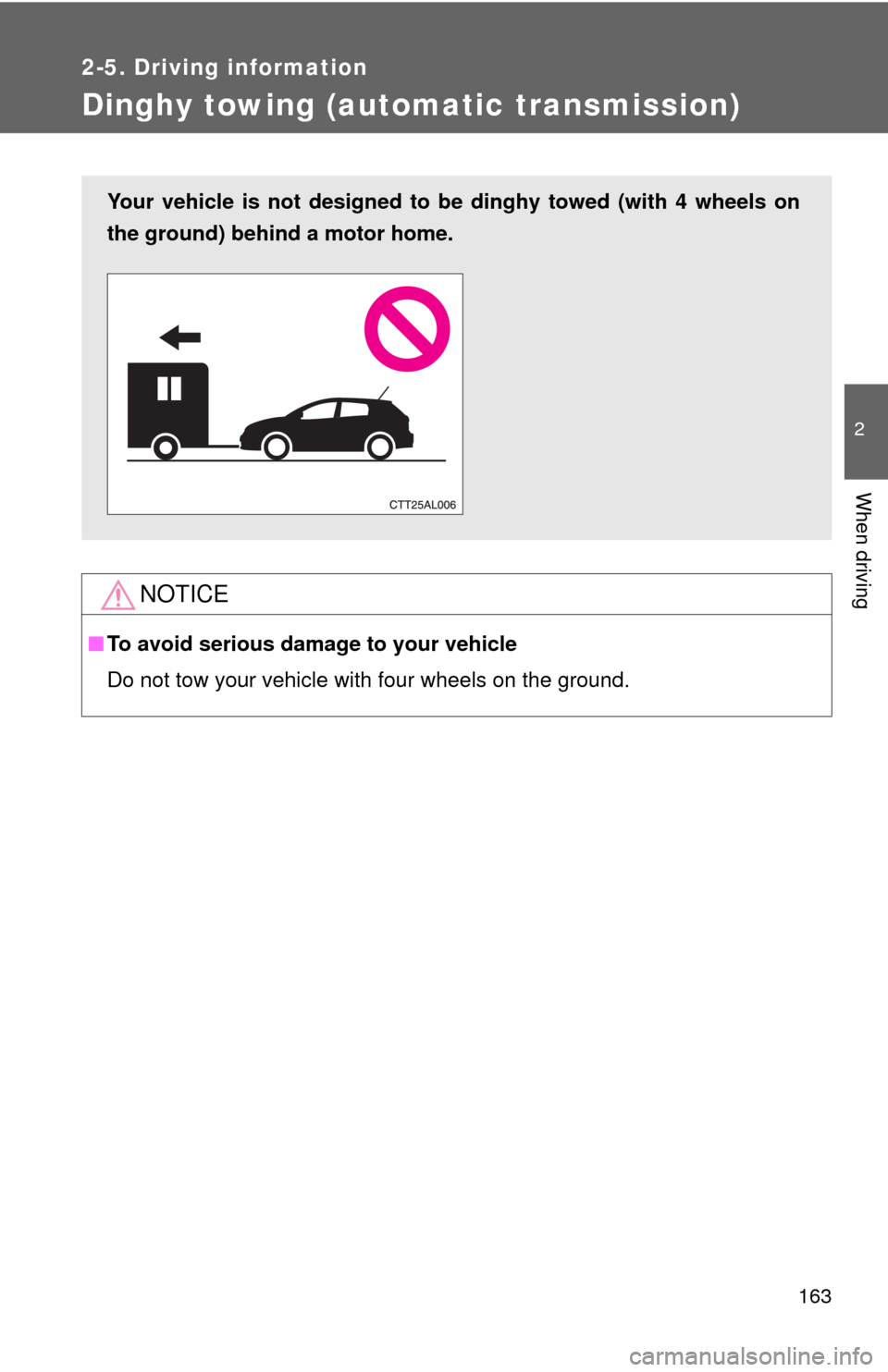
■To avoid serious damage to your vehicle
Do not tow your vehicle with four wheels on the ground.
Your vehicle is not designed to be dinghy towed (with 4 wheels on
the ground) behind a motor home.
Page 164 of 448
164
2-5. Driving information
Dinghy towing (manual transmission)
Towing your vehicle with 4 wheels on the ground
To prevent damage to your vehicle, perform the following procedures
before towing.
Shift the shift lever to N.
Switch to the “ACC” position. (P. 112)
Ensure that the audio system and other powered devices have been
turned off.
Release the parking brake.
After towing, leave the engine in idle for at least 3 minutes before
driving the vehicle.
■Necessary equipment and accessories
Specialized equipment and accessories are required for dinghy towing. Con-
tact the service branch of the motor home manufacturer regarding recom-
mended equipment.
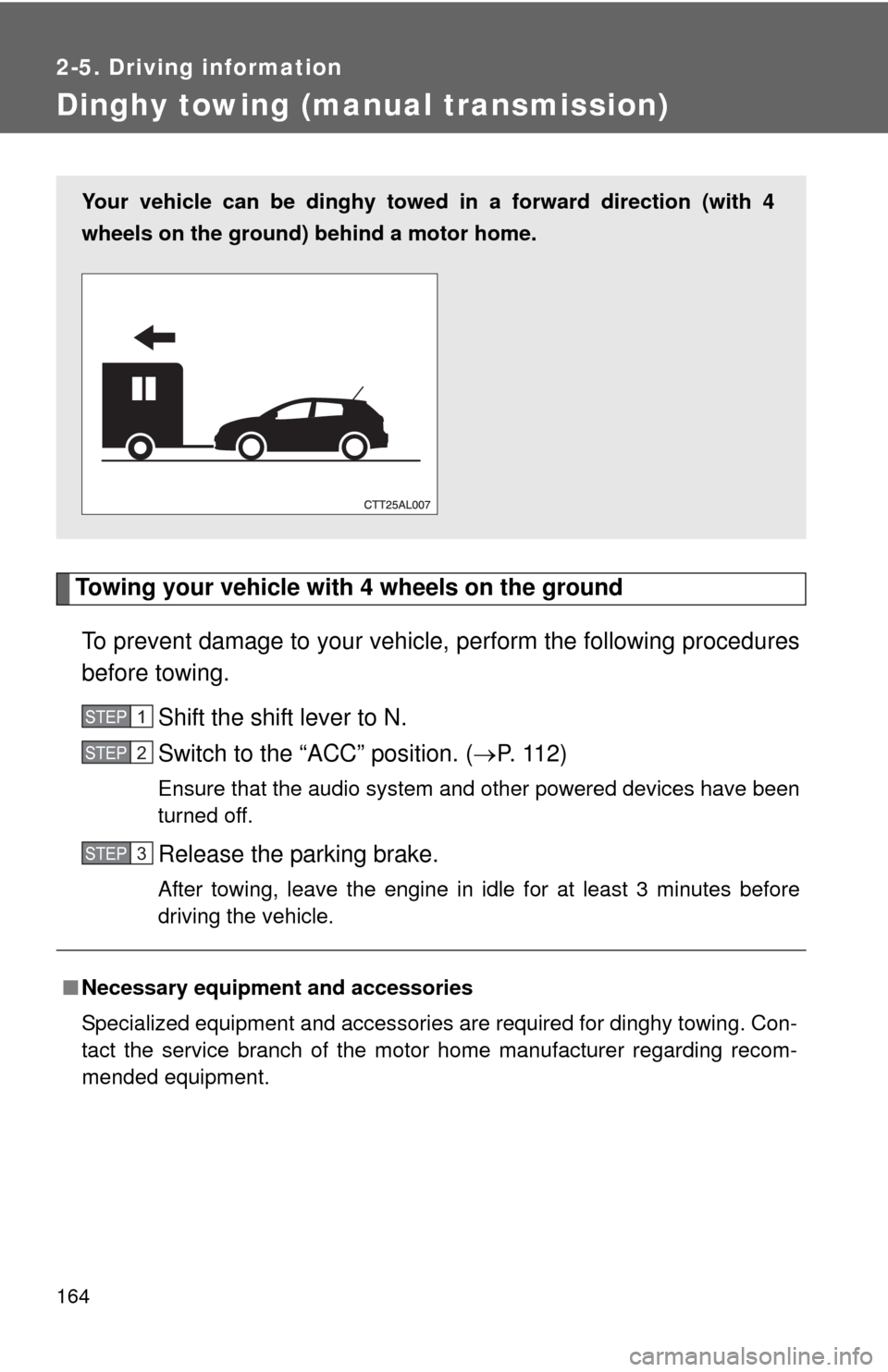
Your vehicle can be dinghy towed in a forward direction (with 4
wheels on the ground) behind a motor home.
STEP1
STEP2
STEP3
Page 165 of 448
165 2-5. Driving information
2
When driving
NOTICE
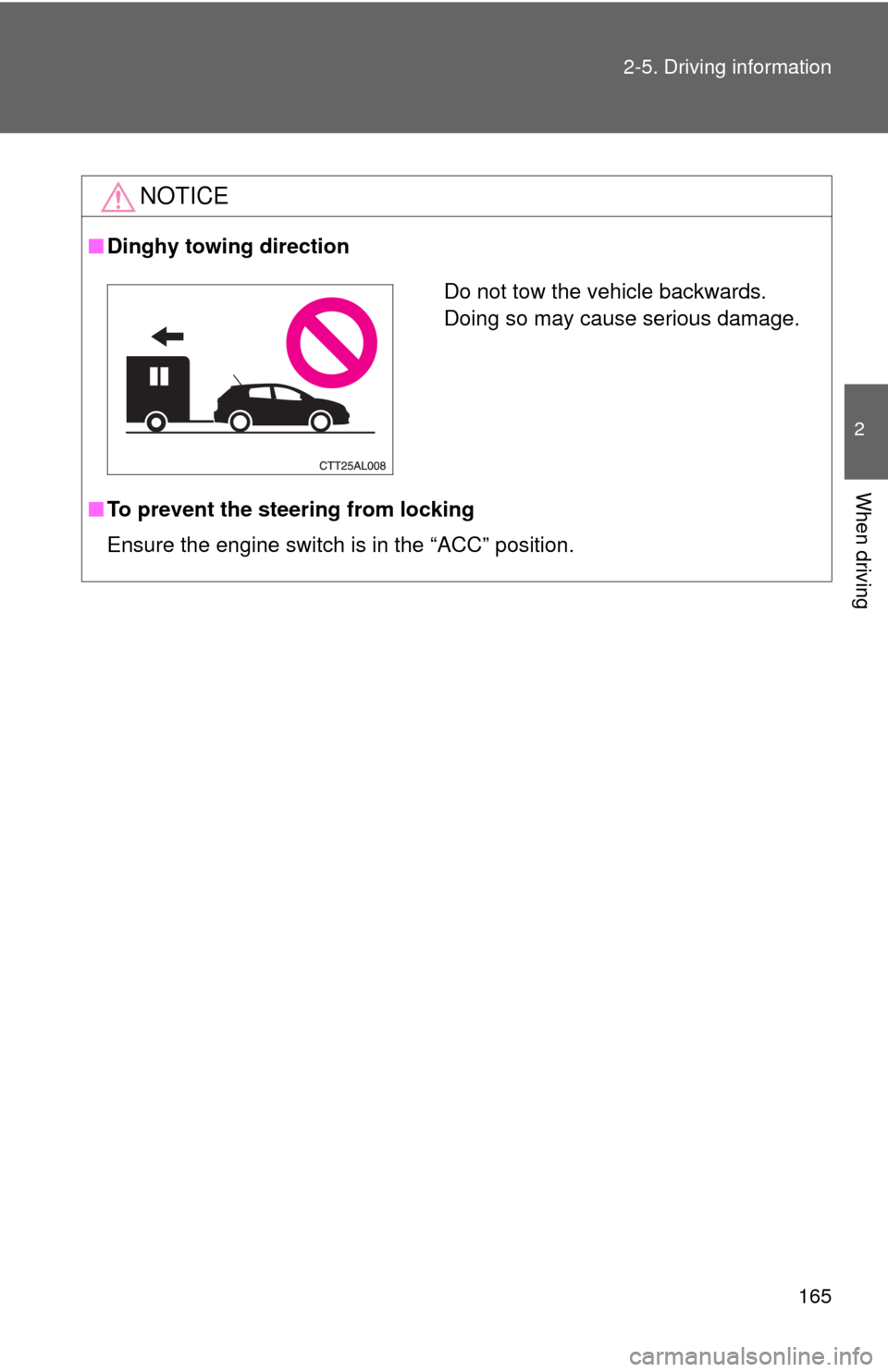
■Dinghy towing direction
■To prevent the steering from locking
Ensure the engine switch is in the “ACC” position.
Do not tow the vehicle backwards.
Doing so may cause serious damage.
Page 349 of 448
5
When trouble arises
349
5-1. Essential information
If your vehicle needs to be towed
Before towing
The following may indicate a problem with your transmission. Contact
your Toyota dealer before towing.
●The engine is running, but the vehicle will not move.
●The vehicle makes an abnormal sound.
If towing is necessary, we recommend having your vehicle towed by
your Toyota dealer or a commercial towing service, using a lift-type
truck or a flat bed truck.
Use a safety chain system for all towing, and abide by all state/pro-
vincial and local laws.
If towing from the front, the vehicle's rear wheels and axles must be
in good condition. (P. 352)
If they are damaged, use a towing dolly or flat bed truck.
Page 350 of 448
350 5-1. Essential information
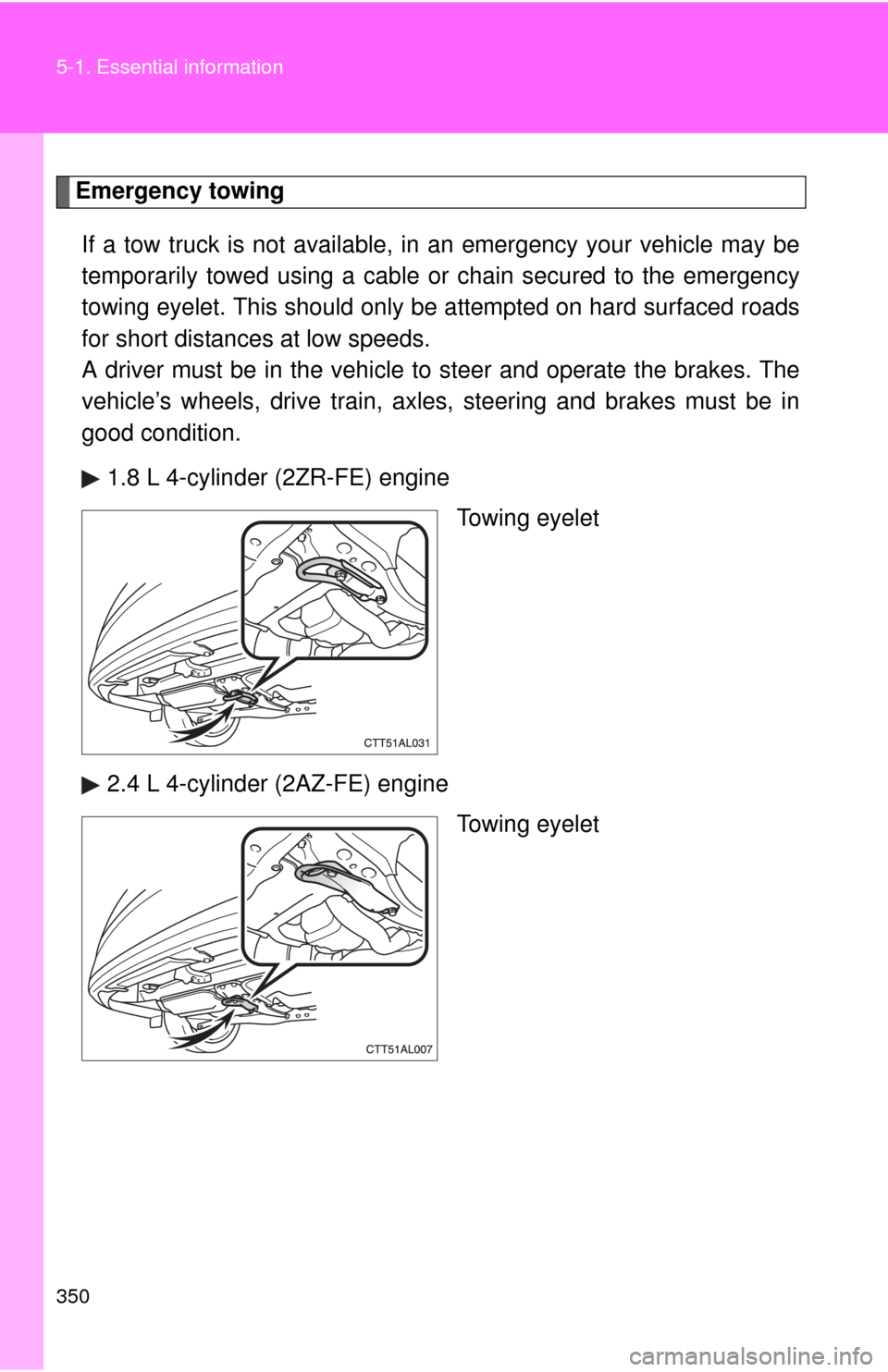
Emergency towing
If a tow truck is not available, in an emergency your vehicle may be
temporarily towed using a cable or chain secured to the emergency
towing eyelet. This should only be attempted on hard surfaced roads
for short distances at low speeds.
A driver must be in the vehicle to steer and operate the brakes. The
vehicle’s wheels, drive train, axles, steering and brakes must be in
good condition.
1.8 L 4-cylinder (2ZR-FE) engine
Towing eyelet
2.4 L 4-cylinder (2AZ-FE) engine
Towing eyelet
Page 351 of 448
5
When trouble arises
351 5-1. Essential information
■Emergency towing procedure
Release the parking brake.
Shift the shift lever to N.
Turn the engine switch to the “ACC” (engine off) or “ON” (engine
running) position.
CAUTION
■Caution while towing
●Use extreme caution when towing the vehicle.
Avoid sudden starts or erratic driving maneuvers which place excessive
stress on the emergency towing eyelets and the cables or chains.
●If the engine is not running, the power assist for the brakes and steering
will not function, making steering and braking more difficult.
STEP1
STEP2
STEP3
Page 352 of 448
352 5-1. Essential information
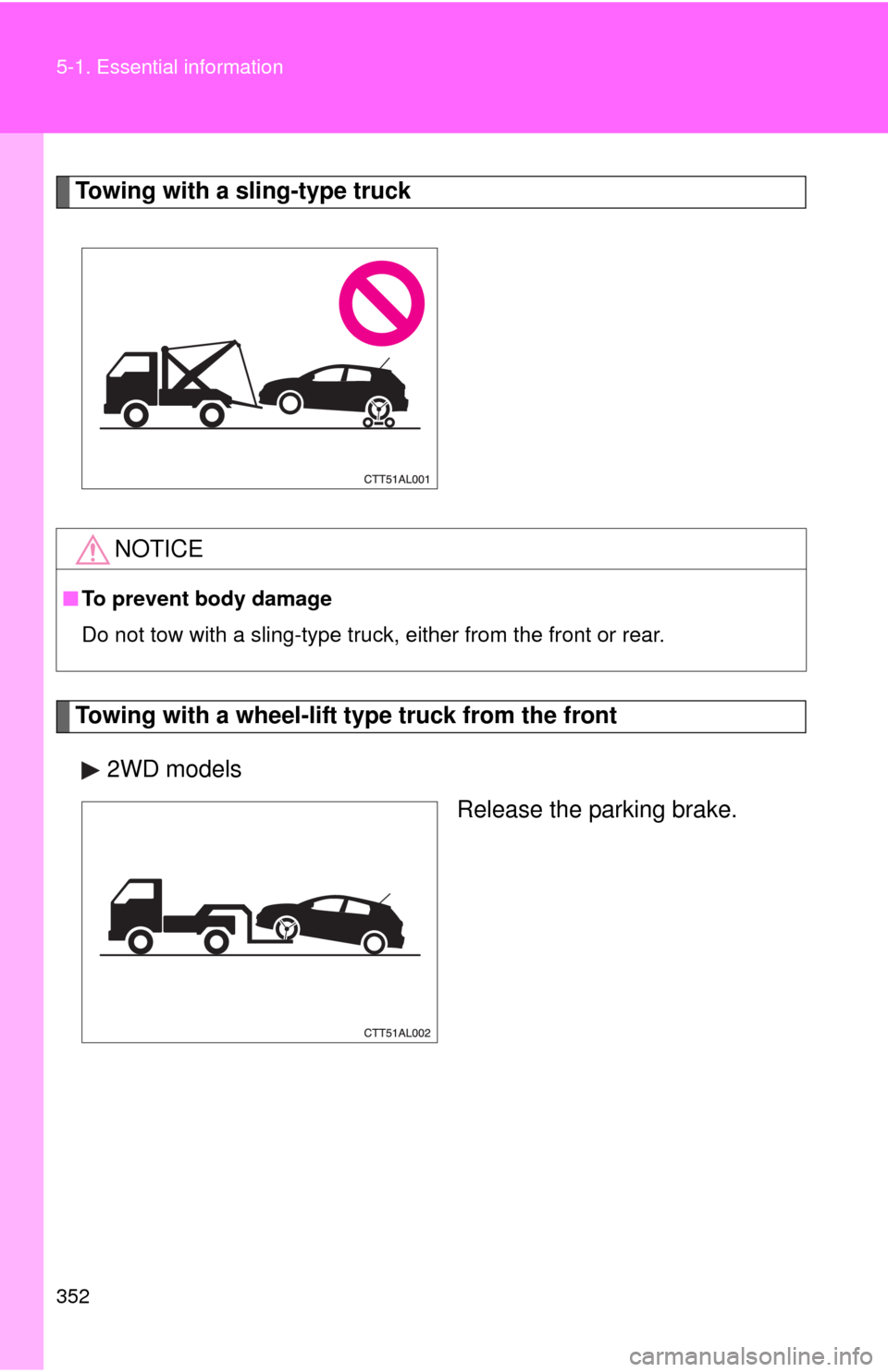
Towing with a sling-type truck
Towing with a wheel-lift type truck from the front
2WD models
Release the parking brake.
NOTICE
■To prevent body damage
Do not tow with a sling-type truck, either from the front or rear.
Page 353 of 448
5
When trouble arises
353 5-1. Essential information
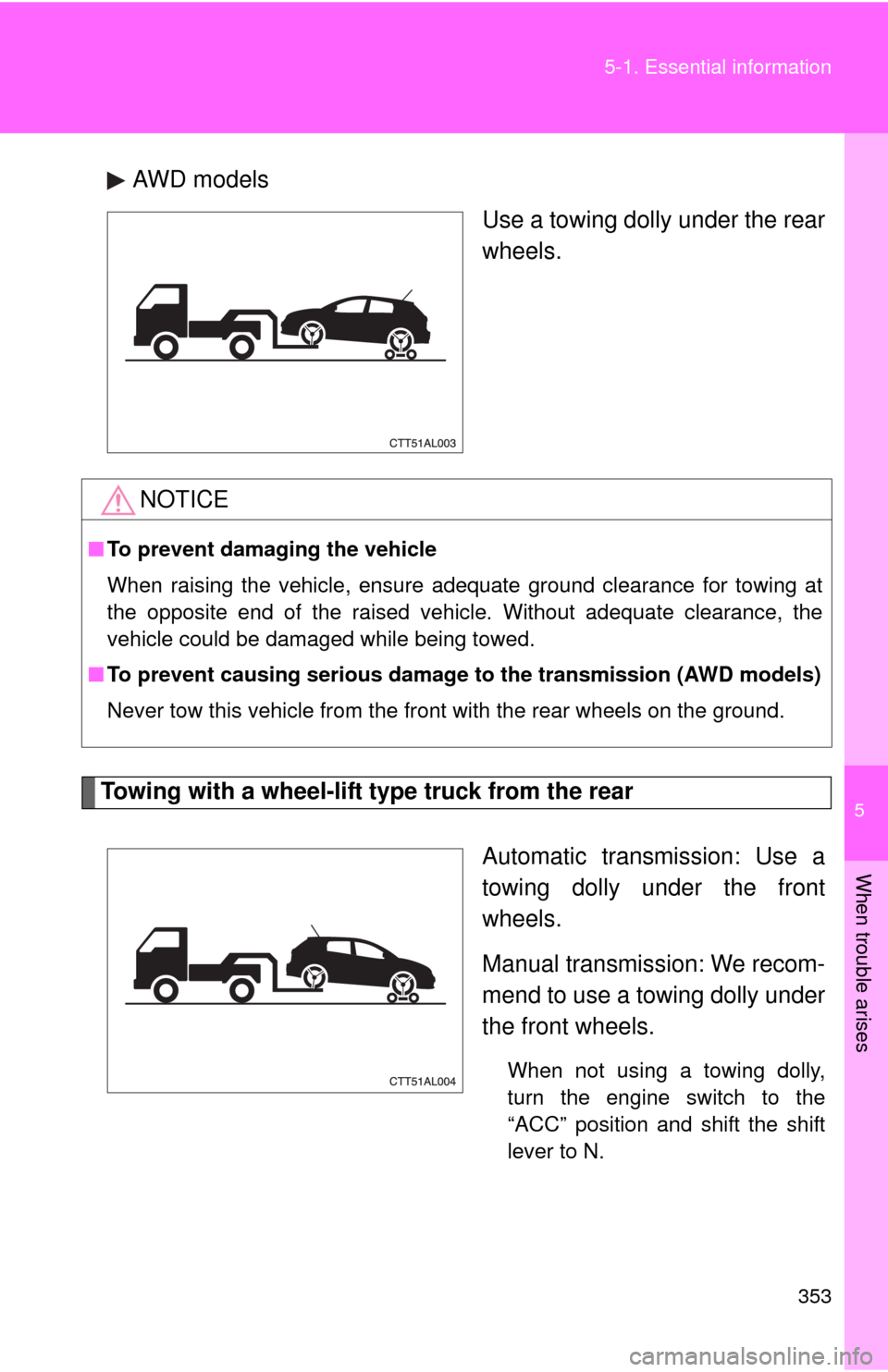
AWD models
Use a towing dolly under the rear
wheels.
Towing with a wheel-lift type truck from the rear
Automatic transmission: Use a
towing dolly under the front
wheels.
Manual transmission: We recom-
mend to use a towing dolly under
the front wheels.
When not using a towing dolly,
turn the engine switch to the
“ACC” position and shift the shift
lever to N.
NOTICE
■To prevent damaging the vehicle
When raising the vehicle, ensure adequate ground clearance for towing at
the opposite end of the raised vehicle. Without adequate clearance, the
vehicle could be damaged while being towed.
■To prevent causing serious damage to the transmission (AWD models)
Never tow this vehicle from the front with the rear wheels on the ground.