engine oil TOYOTA MATRIX 2013 E140 / 2.G User Guide
[x] Cancel search | Manufacturer: TOYOTA, Model Year: 2013, Model line: MATRIX, Model: TOYOTA MATRIX 2013 E140 / 2.GPages: 500, PDF Size: 14.83 MB
Page 339 of 500
339 4-3. Do-it-yourself maintenance
4
Maintenance and care
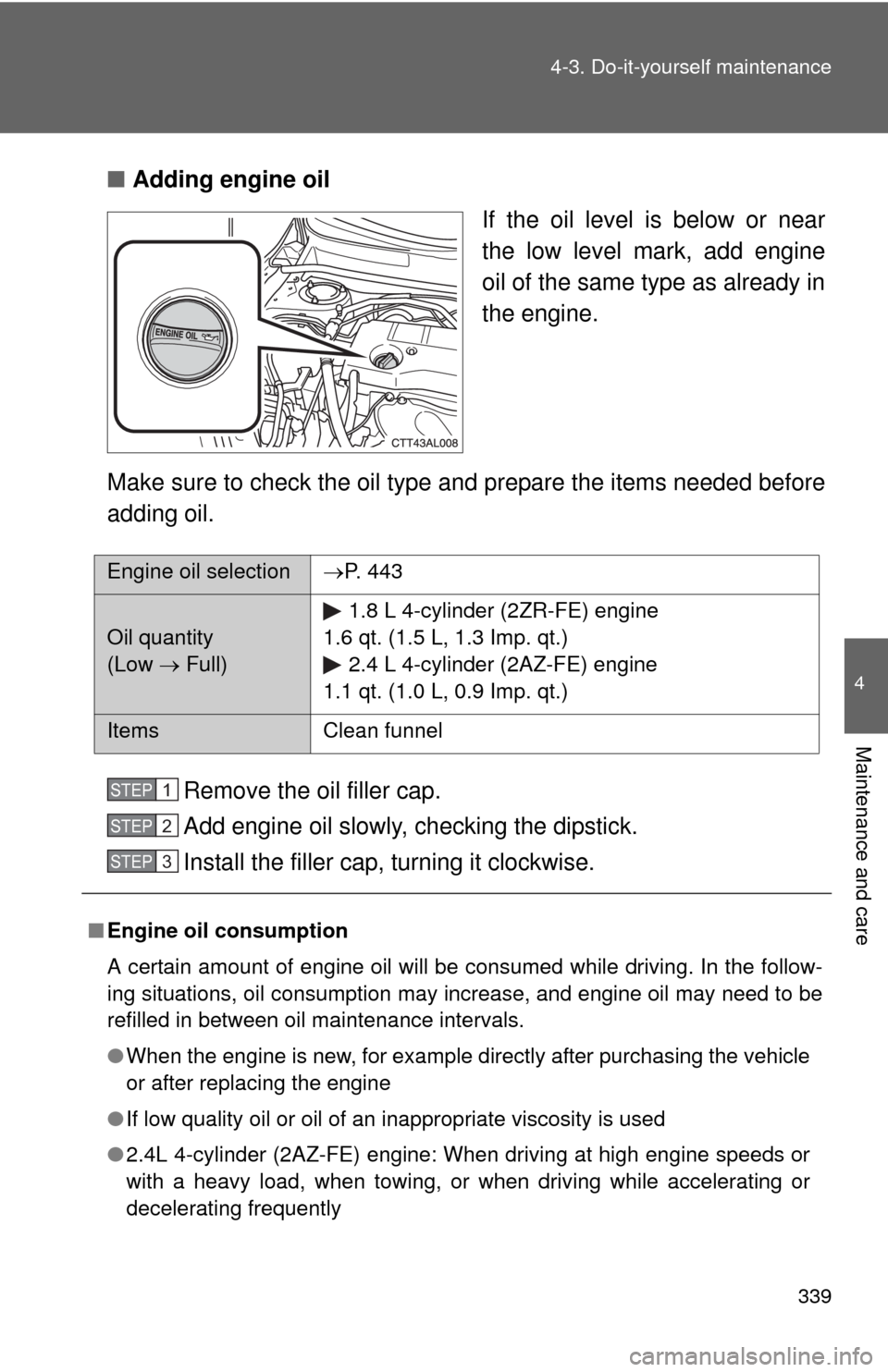
■Adding engine oil
If the oil level is below or near
the low level mark, add engine
oil of the same type as already in
the engine.
Make sure to check the oil type and prepare the items needed before
adding oil.
Remove the oil filler cap.
Add engine oil slowly, checking the dipstick.
Install the filler cap, turning it clockwise.
Engine oil selectionP. 443
Oil quantity
(Low Full)1.8 L 4-cylinder (2ZR-FE) engine
1.6 qt. (1.5 L, 1.3 Imp. qt.)
2.4 L 4-cylinder (2AZ-FE) engine
1.1 qt. (1.0 L, 0.9 Imp. qt.)
Items Clean funnel
■Engine oil consumption
A certain amount of engine oil will be consumed while driving. In the follow-
ing situations, oil consumption may increase, and engine oil may need to be
refilled in between oil maintenance intervals.
●When the engine is new, for example directly after purchasing the vehicle
or after replacing the engine
●If low quality oil or oil of an inappropriate viscosity is used
●2.4L 4-cylinder (2AZ-FE) engine: When driving at high engine speeds or
with a heavy load, when towing, or when driving while accelerating or
decelerating frequently
STEP1
STEP2
STEP3
Page 340 of 500
340 4-3. Do-it-yourself maintenance
●1.8L 4-cylinder (2ZR-FE) engine: When driving at high engine speeds or
with a heavy load, or when driving while accelerating or decelerating fre-
quently
●When leaving the engine idling for a long time, or when driving frequently
through heavy traffic
CAUTION
■Used engine oil
●Used engine oil contains potentially harmful contaminants which may
cause skin disorders such as inflammation or skin cancer, so care should
be taken to avoid prolonged and repeated contact. To remove used engine
oil from your skin, wash thoroughly with soap and water.
●Dispose of used oil and filters only in a safe and acceptable manner. Do
not dispose of used oil and filters in household trash, in sewers or onto the
ground. Call your Toyota dealer, service station or auto parts store for
information concerning recycling or disposal.
●Do not leave used engine oil within the reach of children.
NOTICE
■To prevent serious engine damage
Check the oil level on a regular basis.
■When replacing the engine oil
●Be careful not to spill engine oil on the vehicle components.
●Avoid overfilling, as the engine could be damaged.
●Check the oil level on the dipstick every time you refill the vehicle.
●Be sure the engine oil filler cap is properly tightened.
Page 398 of 500
398 5-2. Steps to take in an emergency
Stop the vehicle immediately.
The following warning indicates the possibility of damage to the vehi-
cle that may lead to an accident. Immediately stop the vehicle in a
safe place and contact your Toyota dealer.
Have the vehicle inspected immediately.
Failing to investigate the cause of the following warnings may lead to
the system operating abnormally and possibly cause an accident.
Have the vehicle inspected by your Toyota dealer immediately.
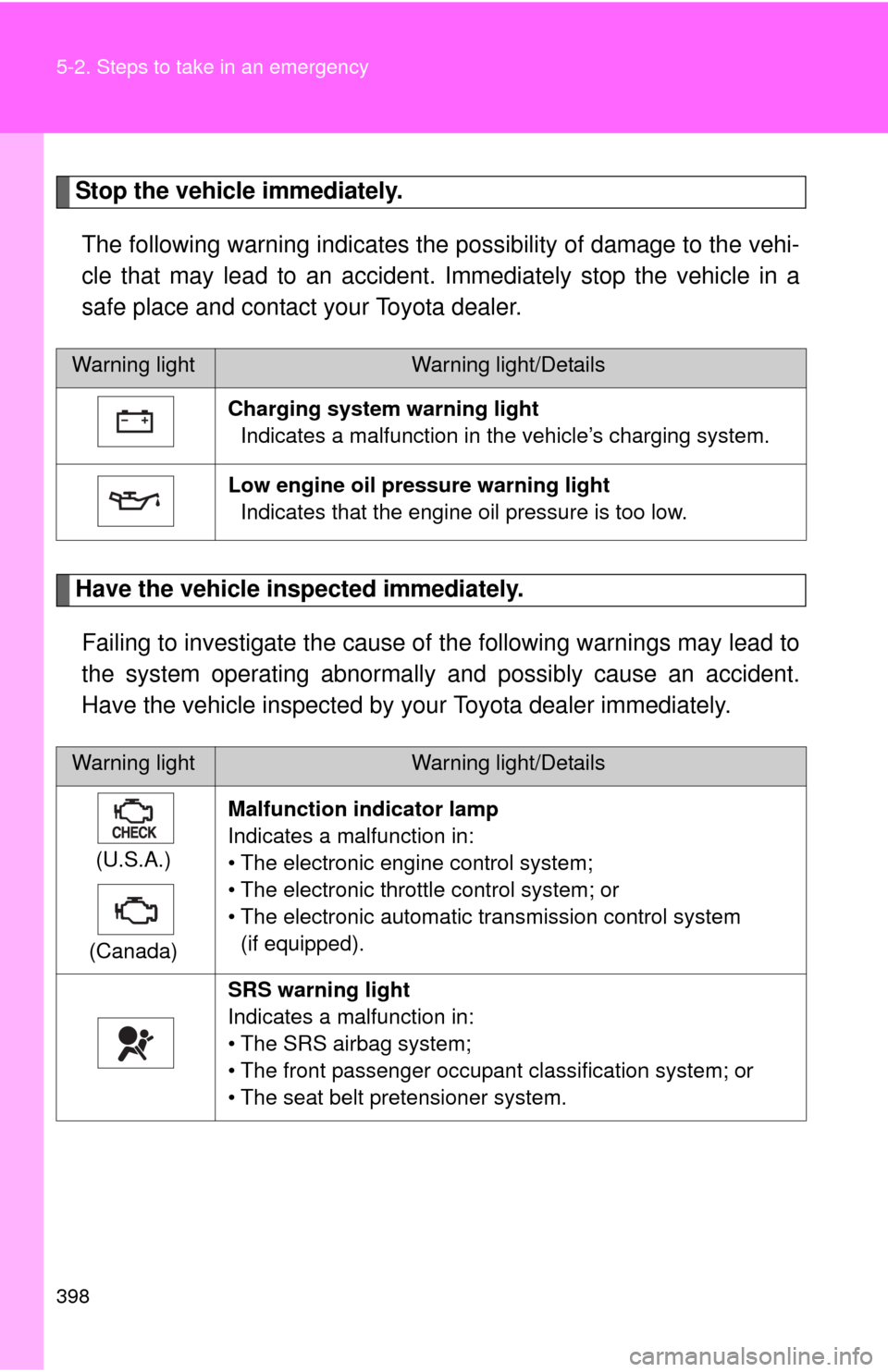
Warning lightWarning light/Details
Charging system warning light
Indicates a malfunction in the vehicle’s charging system.
Low engine oil pressure warning light
Indicates that the engine oil pressure is too low.
Warning lightWarning light/Details
(U.S.A.)
(Canada)Malfunction indicator lamp
Indicates a malfunction in:
• The electronic engine control system;
• The electronic throttle control system; or
• The electronic automatic transmission control system
(if equipped).
SRS warning light
Indicates a malfunction in:
• The SRS airbag system;
• The front passenger occupant classification system; or
• The seat belt pretensioner system.
Page 438 of 500
438
6-1. Specifications
Maintenance data (fuel, oil level, etc.)
Dimensions and weights
*1: Except S or XRS grade models
*2: S or XRS grade models
*3: Unladen vehicle
*4: Vehicles without double wishbone rear suspension
*5: Vehicles with double wishbone rear suspension
*6: 2.4 L 4-cylinder (2AZ-FE) engine only
Overall length171.9 in. (4365 mm)*1
173.0 in. (4395 mm)*2
Overall width 69.5 in. (1765 mm)
Overall height*361.0 in. (1550 mm)*4
61.4 in. (1560 mm)*5
Wheelbase 102.4 in. (2600 mm)
TreadFront 59.8 in. (1519 mm)
Rear 59.9 in. (1522 mm)
Vehicle capacity weight
(Occupants + luggage)850 lb. (385 kg)
Trailer weight rating*6
(Trailer weight + cargo weight)1500 lb. (680 kg)
Page 443 of 500
443 6-1. Specifications
6
Vehicle specifications
Lubrication system
■Engine oil selection
“Toyota Genuine Motor Oil” is used in your Toyota vehicle. Use
Toyota approved “Toyota Genuine Motor Oil” or equivalent to satisfy
the following grade and viscosity.
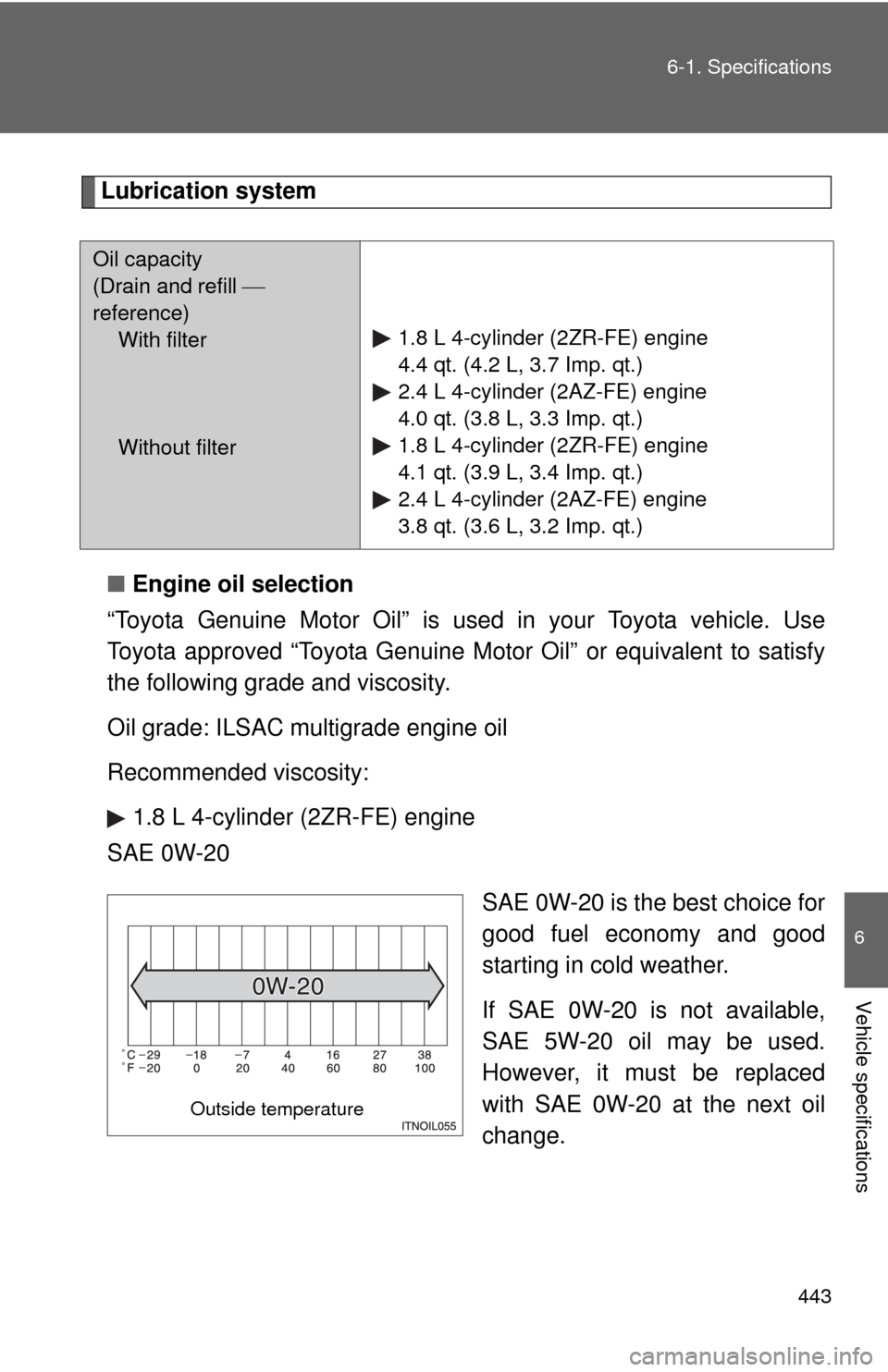
Oil grade: ILSAC multigrade engine oil
Recommended viscosity:
1.8 L 4-cylinder (2ZR-FE) engine
SAE 0W-20
SAE 0W-20 is the best choice for
good fuel economy and good
starting in cold weather.
If SAE 0W-20 is not available,
SAE 5W-20 oil may be used.
However, it must be replaced
with SAE 0W-20 at the next oil
change.
Oil capacity
(Drain and refill
reference)
With filter
Without filter1.8 L 4-cylinder (2ZR-FE) engine
4.4 qt. (4.2 L, 3.7 Imp. qt.)
2.4 L 4-cylinder (2AZ-FE) engine
4.0 qt. (3.8 L, 3.3 Imp. qt.)
1.8 L 4-cylinder (2ZR-FE) engine
4.1 qt. (3.9 L, 3.4 Imp. qt.)
2.4 L 4-cylinder (2AZ-FE) engine
3.8 qt. (3.6 L, 3.2 Imp. qt.)
Outside temperature
Page 444 of 500
444 6-1. Specifications
Oil viscosity (0W-20 is explained here as an example):
●The 0W in 0W-20 indicates the characteristic of the oil which allows
cold startability. Oils with a lower value before the W allow for easier
starting of the engine in cold weather.
●The 20 in 0W-20 indicates the viscosity characteristic of the oil when
the oil is at high temperature. An oil with a higher viscosity (one with a
higher value) may be better suited if the vehicle is operated at high
speeds, or under extreme load conditions.
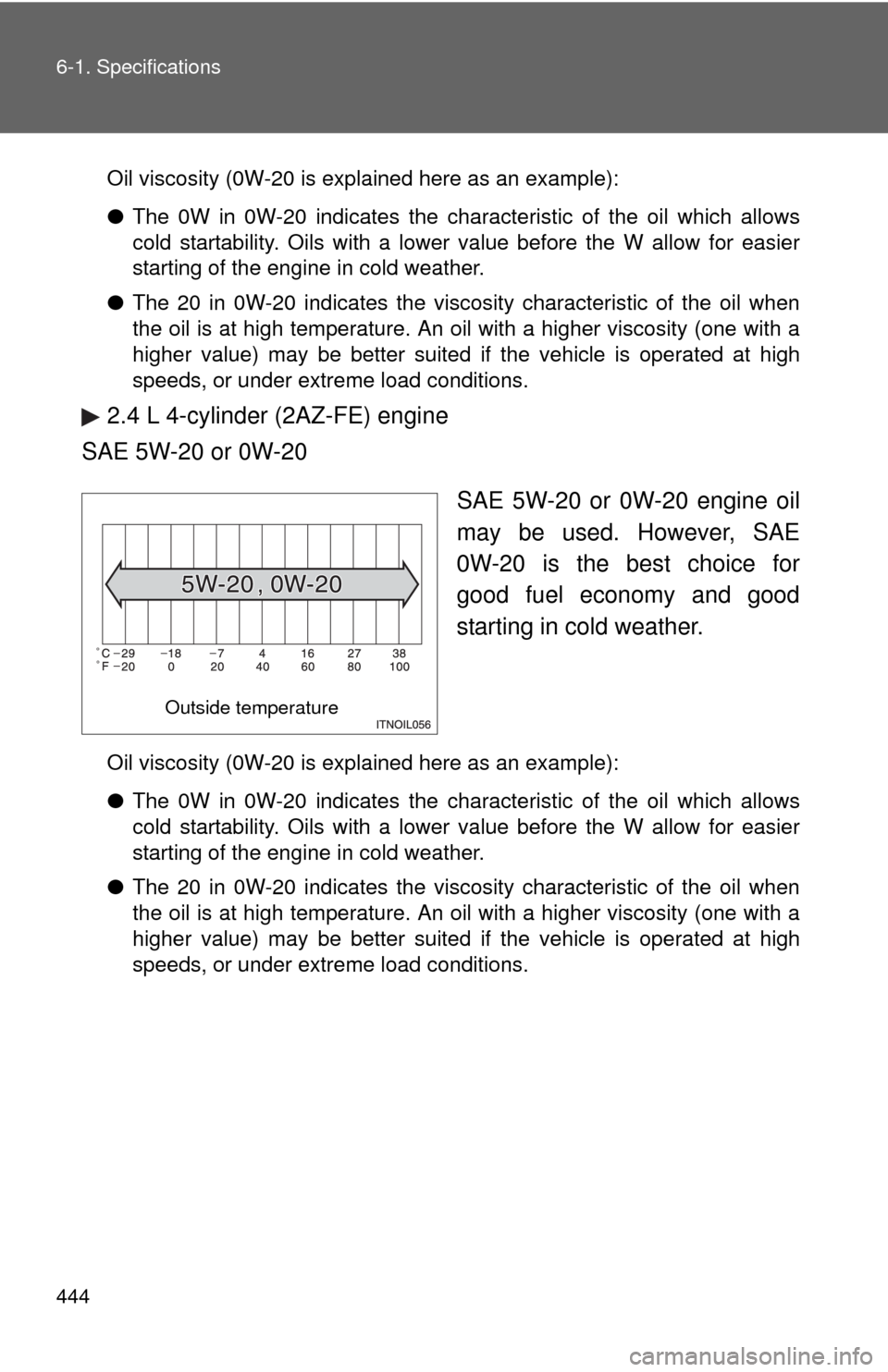
2.4 L 4-cylinder (2AZ-FE) engine
SAE 5W-20 or 0W-20
SAE 5W-20 or 0W-20 engine oil
may be used. However, SAE
0W-20 is the best choice for
good fuel economy and good
starting in cold weather.
Oil viscosity (0W-20 is explained here as an example):
●The 0W in 0W-20 indicates the characteristic of the oil which allows
cold startability. Oils with a lower value before the W allow for easier
starting of the engine in cold weather.
●The 20 in 0W-20 indicates the viscosity characteristic of the oil when
the oil is at high temperature. An oil with a higher viscosity (one with a
higher value) may be better suited if the vehicle is operated at high
speeds, or under extreme load conditions.
Outside temperature
Page 445 of 500
445 6-1. Specifications
6
Vehicle specifications
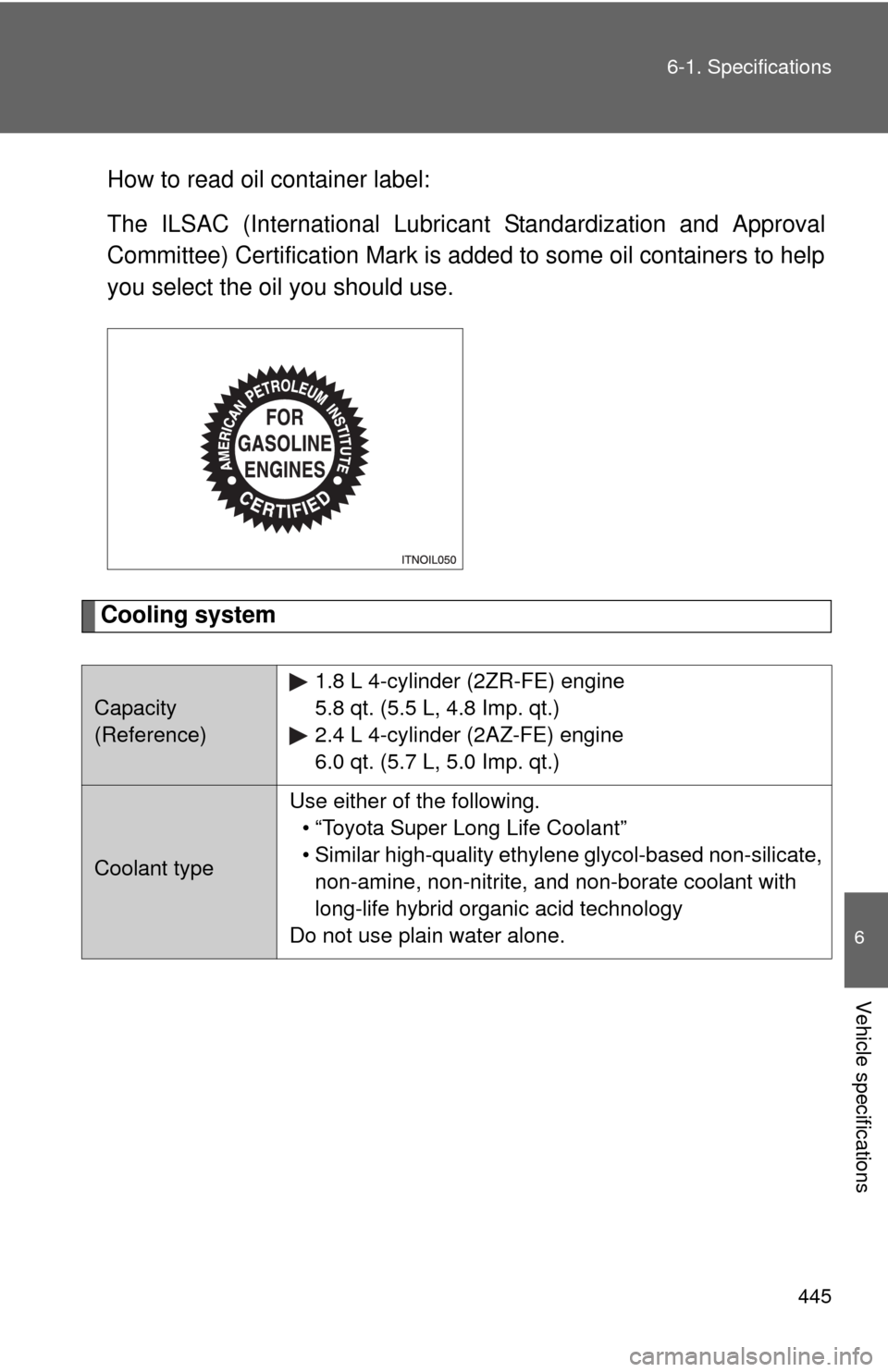
How to read oil container label:
The ILSAC (International Lubricant Standardization and Approval
Committee) Certification Mark is added to some oil containers to help
you select the oil you should use.
Cooling system
Capacity
(Reference)1.8 L 4-cylinder (2ZR-FE) engine
5.8 qt. (5.5 L, 4.8 Imp. qt.)
2.4 L 4-cylinder (2AZ-FE) engine
6.0 qt. (5.7 L, 5.0 Imp. qt.)
Coolant typeUse either of the following.
• “Toyota Super Long Life Coolant”
• Similar high-quality ethylene glycol-based non-silicate,
non-amine, non-nitrite, and non-borate coolant with
long-life hybrid organic acid technology
Do not use plain water alone.
Page 447 of 500
447 6-1. Specifications
6
Vehicle specifications
Manual transmission
Gear oil capacity (Reference)1.8 L 4-cylinder (2ZR-FE) engine
2.0 qt. (1.9 L, 1.7 Imp. qt.)
2.4 L 4-cylinder (2AZ-FE) engine
2.6 qt. (2.5 L, 2.2 Imp. qt.)
Gear oil typeUse either of the following:
• “TOYOTA Genuine Manual Transmission
Gear Oil LV”
• Other gear oil that meets API GL-4 and
SAE 75W specifications
NOTICE
■Manual transmission gear oil
Please be aware that depending on the particular characteristics of the gear
oil used or the operating conditions, idle sound, shift feeling and/or fuel effi-
ciency may be different or affected. Toyota recommends to use “TOYOTA
Genuine Manual Transmission Gear Oil LV” to achieve optimal performance.
Page 463 of 500
463 6-1. Specifications
6
Vehicle specifications
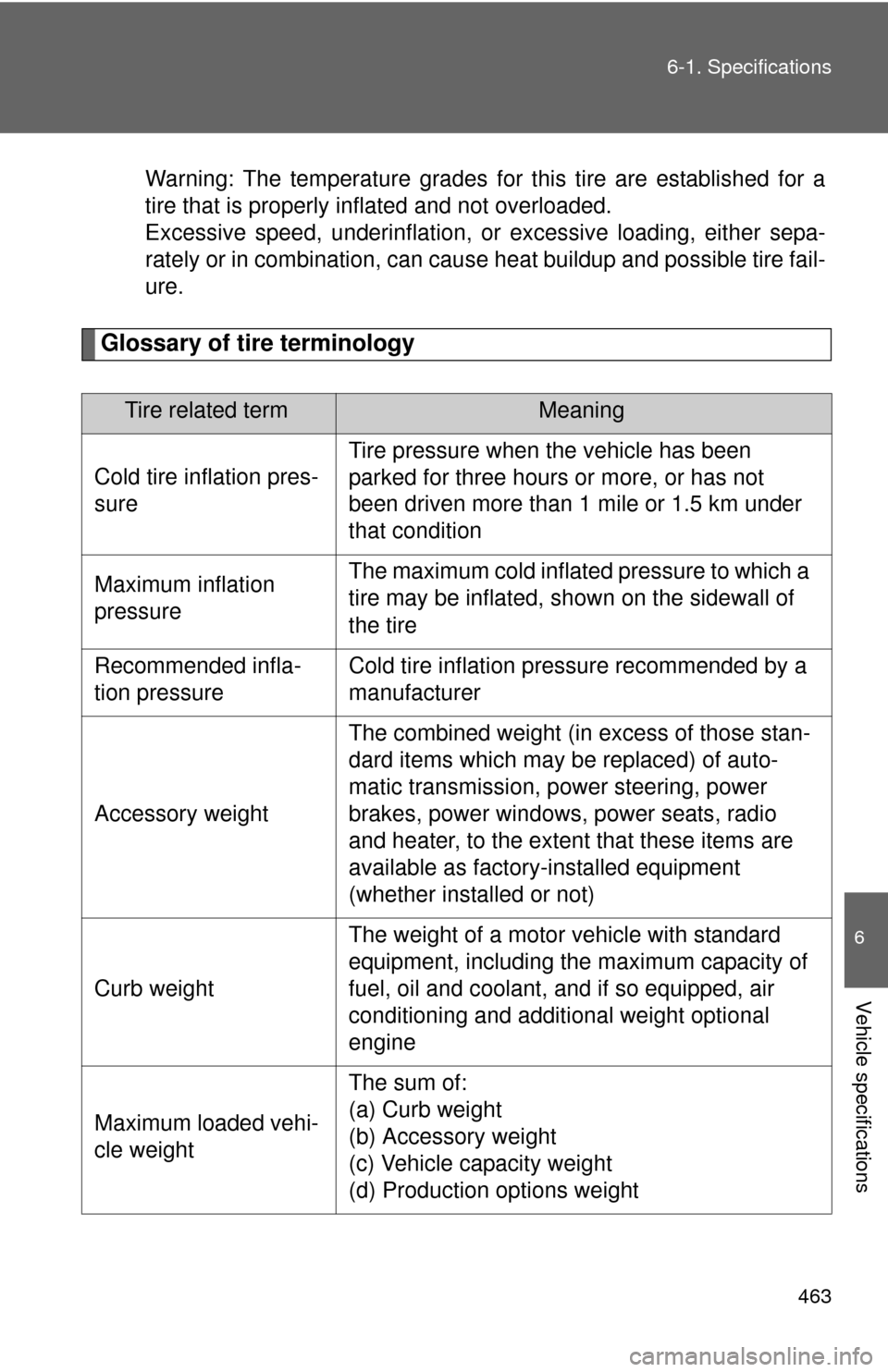
Warning: The temperature grades for this tire are established for a
tire that is properly inflated and not overloaded.
Excessive speed, underinflation, or excessive loading, either sepa-
rately or in combination, can cause heat buildup and possible tire fail-
ure.
Glossary of tire terminology
Tire related termMeaning
Cold tire inflation pres-
sureTire pressure when the vehicle has been
parked for three hours or more, or has not
been driven more than 1 mile or 1.5 km under
that condition
Maximum inflation
pressureThe maximum cold inflated pressure to which a
tire may be inflated, shown on the sidewall of
the tire
Recommended infla-
tion pressureCold tire inflation pressure recommended by a
manufacturer
Accessory weightThe combined weight (in excess of those stan-
dard items which may be replaced) of auto-
matic transmission, power steering, power
brakes, power windows, power seats, radio
and heater, to the extent that these items are
available as factory-installed equipment
(whether installed or not)
Curb weightThe weight of a motor vehicle with standard
equipment, including the maximum capacity of
fuel, oil and coolant, and if so equipped, air
conditioning and additional weight optional
engine
Maximum loaded vehi-
cle weightThe sum of:
(a) Curb weight
(b) Accessory weight
(c) Vehicle capacity weight
(d) Production options weight
Page 491 of 500

491 Alphabetical index
Electric power steering........... 152
Emergency flashers
Switch ................................... 388
Emergency, in case of
If a warning light turns on ..... 397
If the engine will not start...... 422
If the shift lever cannot be
shifted from P ..................... 423
If the vehicle has a
discharged battery ............. 425
If the warning buzzer
sounds ............................... 397
If you have a flat tire ............ 408
If you lose your keys............. 424
If you think something is
wrong ................................. 395
If your vehicle becomes
stuck................................... 433
If your vehicle has to be
stopped in an emergency... 435
If your vehicle needs to be
towed ................................. 389
If your vehicle overheats ...... 430Engine
Compartment ........................335
Engine switch ........................118
Hood......................................330
How to start the
engine .................................118
Identification number .............439
If the engine will not start ......422
Ignition switch........................118
Overheating...........................430
Engine coolant
Capacity ................................445
Checking ...............................341
Preparing and checking
before winter .......................162
Engine coolant temperature
gauge ......................................132
Engine immobilizer system.......68
Engine oil
Capacity ................................443
Checking ...............................337
Preparing and checking
before winter .......................162
EPS ............................................152
Event data recorder ...................19E