airbag off TOYOTA MATRIX 2013 E140 / 2.G Owners Manual
[x] Cancel search | Manufacturer: TOYOTA, Model Year: 2013, Model line: MATRIX, Model: TOYOTA MATRIX 2013 E140 / 2.GPages: 500, PDF Size: 14.83 MB
Page 5 of 500

1
2
3
4
5
6
7
5
5-1. Essential information
Emergency flashers ............ 388
If your vehicle needs to be
towed ................................ 389
If you think something is
wrong ................................ 395
Fuel pump shut off
system .............................. 396
5-2. Steps to take in an
emergency
If a warning light turns
on or a warning buzzer
sounds... .......................... 397
If you have a flat tire............ 408
If the engine will not start .... 422
If the shift lever cannot be
shifted from P.................... 423
If you lose your keys ........... 424
If the battery is
discharged ........................ 425
If your vehicle overheats ..... 430
If the vehicle becomes
stuck ................................. 433
If your vehicle has to
be stopped in an
emergency ........................ 4356-1. Specifications
Maintenance data
(fuel, oil level, etc.) ........... 438
Fuel information.................. 454
Tire information .................. 457
6-2. Customization
Customizable features........ 469
6-3. Initialization
Items to initialize ................. 471
Reporting safety defects
for U.S. owners ................ 474
Seat belt instructions
for Canadian owners
(in French) ........................ 475
SRS airbag instructions
for Canadian owners
(in French) ........................ 477
Abbreviation list ........................ 486
Alphabetical index .................... 488
What to do if... .......................... 498
5When trouble arises6Vehicle specifications
7For owners
Index
Page 19 of 500

19
Installation of a mobile two-way radio system
As the installation of a mobile two-way radio system in your vehicle may
affect electronic systems such as the multi-port fuel injection system/sequen-
tial multi-port fuel injection system, cruise control system, anti-lock brake
system, SRS airbag system or seat belt pretensioner system, be sure to
check with your Toyota dealer for precautionary measures or special instruc-
tions regarding installation.
Vehicle data recordings
Your Toyota is equipped with several sophisticated computers that will record
certain data, such as:
• Engine speed
• Accelerator status
• Brake status
• Vehicle speed
• Shift position (vehicles with an automatic transmission)
The recorded data varies according to the vehicle grade level and options
with which it is equipped. Furthermore, these computers do not record con-
versations, sounds or pictures.
●Data usage
Toyota may use the data recorded in these computers to diagnose malfunc-
tions, conduct research and development, and improve quality.
Toyota will not disclose the recorded data to a third party except:
• With the consent of the vehicle owner or with the consent of the lessee if
the vehicle is leased
• In response to an official request by the police, a court of law or a govern-
ment agency
• For use by Toyota in a lawsuit
• For research purposes where the data is not tied to a specific vehicle or
vehicle owner
Page 21 of 500

21
●Disclosure of the EDR data
Toyota will not disclose the data recorded in an EDR to a third party except
when:
• An agreement from the vehicle’s owner (or the lessee for a leased vehicle)
is obtained
• In response to an official request by the police, a court of law or a govern-
ment agency
• For use by Toyota in a lawsuit
However, if necessary, Toyota may:
• Use the data for research on vehicle safety performance
• Disclose the data to a third party for research purposes without disclosing
information about the specific vehicle or vehicle owner
Scrapping of your Toyota
The SRS airbag and seat belt pretensioner devices in your Toyota contain
explosive chemicals. If the vehicle is scrapped with the airbags and seat belt
pretensioners left as they are, this may cause an accident such as fire. Be
sure to have the systems of the SRS airbag and seat belt pretensioner
removed and disposed of by a qualified service shop or by your Toyota
dealer before you scrap your vehicle.
Perchlorate Material
Special handling may apply, See www.dtsc.ca.gov/hazardouswaste/perchlorate.
Your vehicle has components that may contain perchlorate. These compo-
nents may include airbags, seat belt pretensioners, and wireless remote con-
trol batteries.
Page 74 of 500
74 1-7. Safety information
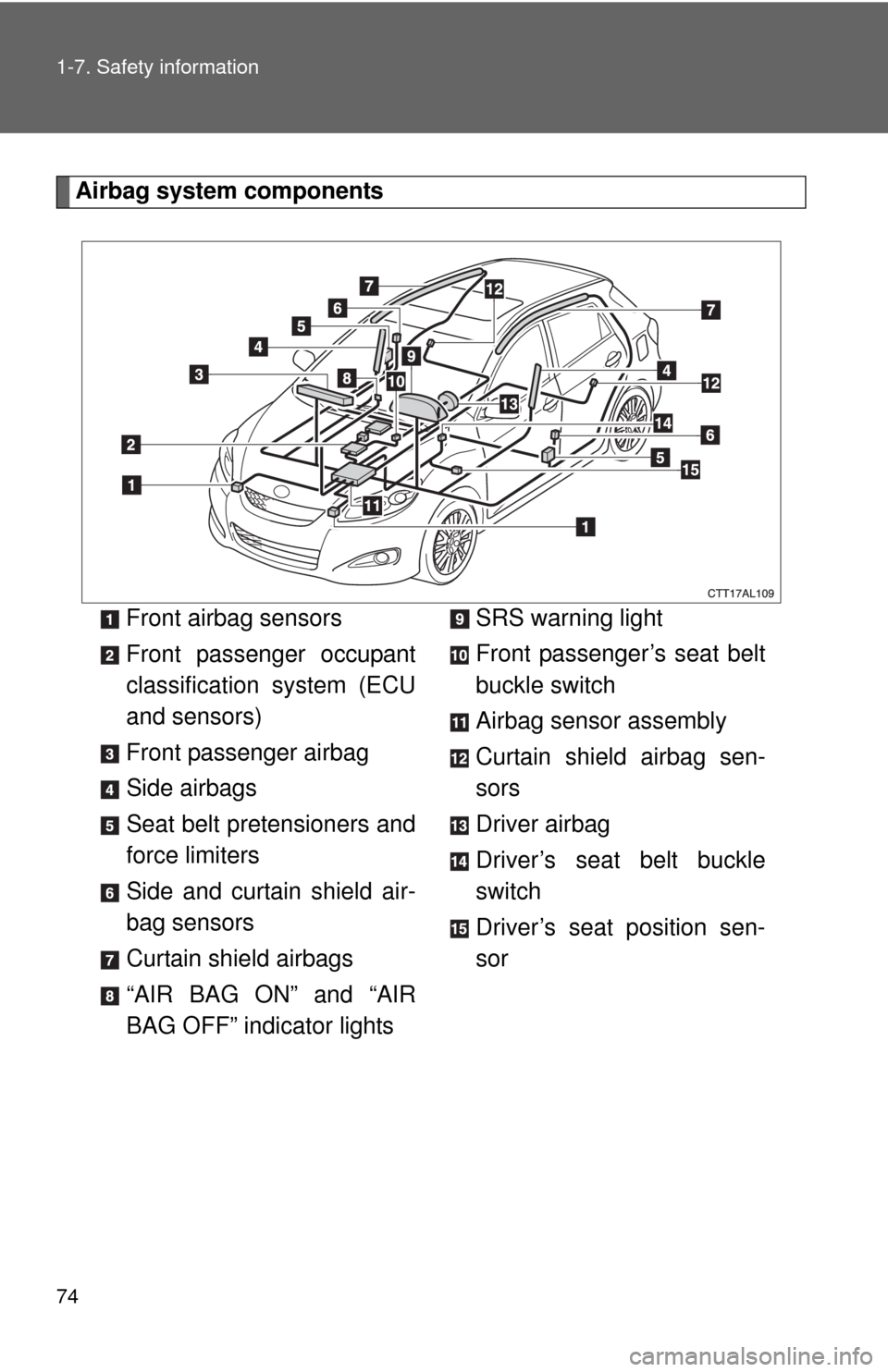
Airbag system components
Front airbag sensors
Front passenger occupant
classification system (ECU
and sensors)
Front passenger airbag
Side airbags
Seat belt pretensioners and
force limiters
Side and curtain shield air-
bag sensors
Curtain shield airbags
“AIR BAG ON” and “AIR
BAG OFF” indicator lightsSRS warning light
Front passenger’s seat belt
buckle switch
Airbag sensor assembly
Curtain shield airbag sen-
sors
Driver airbag
Driver’s seat belt buckle
switch
Driver’s seat position sen-
sor
Page 84 of 500
84 1-7. Safety information
CAUTION
■SRS airbag precautions
●If breathing becomes difficult after the SRS airbag has deployed, open a
door or window to allow fresh air in, or leave the vehicle if it is safe to do
so. Wash off any residue as soon as possible to prevent skin irritation.
●If the areas where the SRS airbags are stored, such as the steering wheel
pad and front and rear pillar garnishes, are damaged or cracked, have
them replaced by your Toyota dealer.
■Modification and disposal of SRS airbag system components
Do not dispose of your vehicle or perform any of the following modifications
without consulting your Toyota dealer.
The SRS airbags may malfunction or deploy (inflate) accidentally, causing
death or serious injury.
●Installation, removal, disassembly and repair of the SRS airbags.
●Repairs, modifications, removal or replacement of the steering wheel,
instrument panel, dashboard, seats or seat upholstery, front, side and rear
pillars or roof side rail.
●Repairs or modifications of the front fender, front bumper, or side of the
occupant compartment.
●Installation of snow plows, winches, etc. to the front grille (bull bars, kan-
garoo bar etc.).
●Modifications to the vehicle's suspension system.
●Installation of electronic devices such as mobile two-way radios or CD
players.
●Modifications to your vehicle for a person with a physical disability.
Page 86 of 500

86 1-7. Safety information
Conditions and operation of the front passenger occupant classification system
■Adult*1
■Child*3 or child restraint system*4
Indicator/
warning light
“AIR BAG ON” and “AIR BAG OFF” indicator
lights“AIR BAG
ON”
SRS warning light Off
Front passenger’s seat belt reminder light Flashing
*2
DevicesFront passenger airbag
Activated Side airbag on the front
passenger seats
Curtain shield airbag in the front
passenger side
Front passenger’s seat belt pretensioner
Indicator/
warning light
“AIR BAG ON” and “AIR BAG OFF” indicator
lights“AIR BAG
OFF”*5
SRS warning light Off
Front passenger’s seat belt reminder light Flashing
*2
DevicesFront passenger airbag Deactivated
Side airbag on the front
passenger seats
Activated Curtain shield airbag in the front
passenger side
Front passenger’s seat belt pretensioner
Page 87 of 500

87 1-7. Safety information
1
Before driving
■Unoccupied
■There is a malfunction in the system
*1: The system judges a person of adult size as an adult. When a
smaller adult sits in the front passenger seat, the system may rec-
ognize him/her as a child depending on his/her physique and pos-
ture.
*2: In the event the front passenger does not wear a seat belt.
*3: When a larger child who has outgrown a child restraint system
sits in the front passenger seat, the system may recognize him/
her as an adult depending on his/her physique or posture.
Indicator/
warning light
“AIR BAG ON” and “AIR BAG OFF” indicator
lightsNot illuminated
SRS warning light
Off
Front passenger’s seat belt reminder light
DevicesFront passenger airbag Deactivated
Side airbag on the front
passenger seats
Activated
Curtain shield airbag in the front
passenger side
Front passenger’s seat belt pretensioner Deactivated
Indicator/
warning light
“AIR BAG ON” and “AIR BAG OFF” indicator
lights“AIR BAG
OFF”
SRS warning light On
Front passenger’s seat belt reminder light Off
DevicesFront passenger airbag Deactivated
Side airbag on the front
passenger seats
Activated Curtain shield airbag in the front
passenger side
Front passenger’s seat belt pretensioner
Page 88 of 500
88 1-7. Safety information
*4: Never install a rear-facing child restraint system on the front pas-
senger seat. A forward-facing child restraint system should only
be installed on the front passenger seat when it is unavoidable.
(P. 90)
*5: In case the indicator is not illuminated, consult this manual as for
installing the child restraint system properly. (P. 94)
CAUTION
■Front passenger occupant classification system precautions
Observe the following precautions regarding the front passenger occupant
classification system.
Failure to do so may cause death or serious injury.
●Wear the seat belt properly.
●Make sure the front passenger’s seat belt tab has not been left inserted
into the buckle before someone sits in the front passenger seat.
●Make sure the “AIR BAG OFF” indicator light is not illuminated when using
the seat belt extender for the front passenger seat. If the “AIR BAG OFF”
indicator light is illuminated, disconnect the extender tongue from the seat
belt buckle, then reconnect the seat belt. Reconnect the seat belt extender
after making sure the “AIR BAG ON” indicator light is illuminated. If you
use the seat belt extender while the “AIR BAG OFF” indicator light is illumi-
nated, the SRS airbags for the passenger may not activate correctly,
which could cause death or serious injury in the event of a collision.
●Do not apply a heavy load to the front passenger seat.
●Do not put weight on the front passenger seat by putting your hands or
feet on the front passenger seat seatback from the rear passenger seat.
●Do not let a rear passenger lift the front passenger seat with their feet or
press on the seatback with their legs.
●Do not put objects under the front passenger seat.
Page 89 of 500
89 1-7. Safety information
1
Before driving
CAUTION
■Front passenger occupant classification system precautions
●Do not recline the front passenger seatback so far that it touches a rear
seat. This may cause the “AIR BAG OFF” indicator light to be illuminated,
which indicates that the passenger’s airbags will not deploy in the event of
a severe accident. If the seatback touches the rear seat, return the seat-
back to a position where it does not touch the rear seat. Keep the front
passenger seatback as upright as possible when the vehicle is moving.
Reclining the seatback excessively may lessen the effectiveness of the
seat belt system.
●If an adult sits in the front passenger seat, the “AIR BAG ON” indicator
light is illuminated. If the “AIR BAG OFF” indicator is illuminated, ask the
passenger to sit up straight, well back in the seat, feet on the floor, and
with the seat belt worn correctly. If the “AIR BAG OFF” indicator still
remains illuminated, either ask the passenger to move to the rear seat, or
if that is not possible, move the front passenger seat fully rearward.
●When it is unavoidable to install the forward-facing child restraint system
on the front passenger seat, install the child restraint system on the front
passenger seat in the proper order. (P. 94)
●Do not modify or remove the front seats.
●Do not kick the front passenger seat or subject it to severe impact. Other-
wise, the SRS warning light may come on to indicate a malfunction of the
detection system. In this case, contact your Toyota dealer immediately.
●Child restraint systems installed on the rear seat should not contact the
front seatbacks.
●Do not use a seat accessory, such as a cushion or seat cover, that covers
the seat cushion surface.
●Do not modify or replace the upholstery of the front seat.
Page 92 of 500
92 1-7. Safety information
■Selecting an appropriate child restraint system
●Use a child restraint system appropriate for the child until the child
becomes large enough to properly wear the vehicle’s seat belt.
●If a child is too large for a child restraint system, sit the child on a rear
seat and use the vehicle's seat belt. (P. 48)
CAUTION
■Child restraint precautions
●For effective protection in automobile accidents and sudden stops, a child
must be properly restrained, using a seat belt or child restraint system
depending on the age and size of the child. Holding a child in your arms is
not a substitute for a child restraint system. In an accident, the child can be
crushed against the windshield, or between you and the vehicle's interior.
●Toyota strongly urges the use of a proper child restraint system that con-
forms to the size of the child, installed on the rear seat. According to acci-
dent statistics, the child is safer when properly restrained in the rear seat
than in the front seat.
●Never install a rear-facing child restraint system on the front passenger
seat even if the “AIR BAG OFF” indicator light is illuminated. In the event
of an accident, the force of the rapid inflation of the front passenger airbag
can cause death or serious injury to the child if the rear-facing child
restraint system is installed on the front passenger seat.
●A forward-facing child restraint system may be allowed to be installed on
the front passenger seat only when it is unavoidable. A child restraint sys-
tem that requires a top tether strap should not be used in the front passen-
ger seat since there is no top tether strap anchor for the front passenger
seat. Adjust the seatback as uprights as possible and always move the
seat as far back as possible even if the “AIR BAG OFF” indicator light is
illuminated, because the front passenger airbag could inflate with consid-
erable speed and force. Otherwise, the child may be killed or seriously
injured.