tow TOYOTA MATRIX 2014 E140 / 2.G User Guide
[x] Cancel search | Manufacturer: TOYOTA, Model Year: 2014, Model line: MATRIX, Model: TOYOTA MATRIX 2014 E140 / 2.GPages: 500, PDF Size: 7.02 MB
Page 124 of 500
124 2-1. Driving procedures
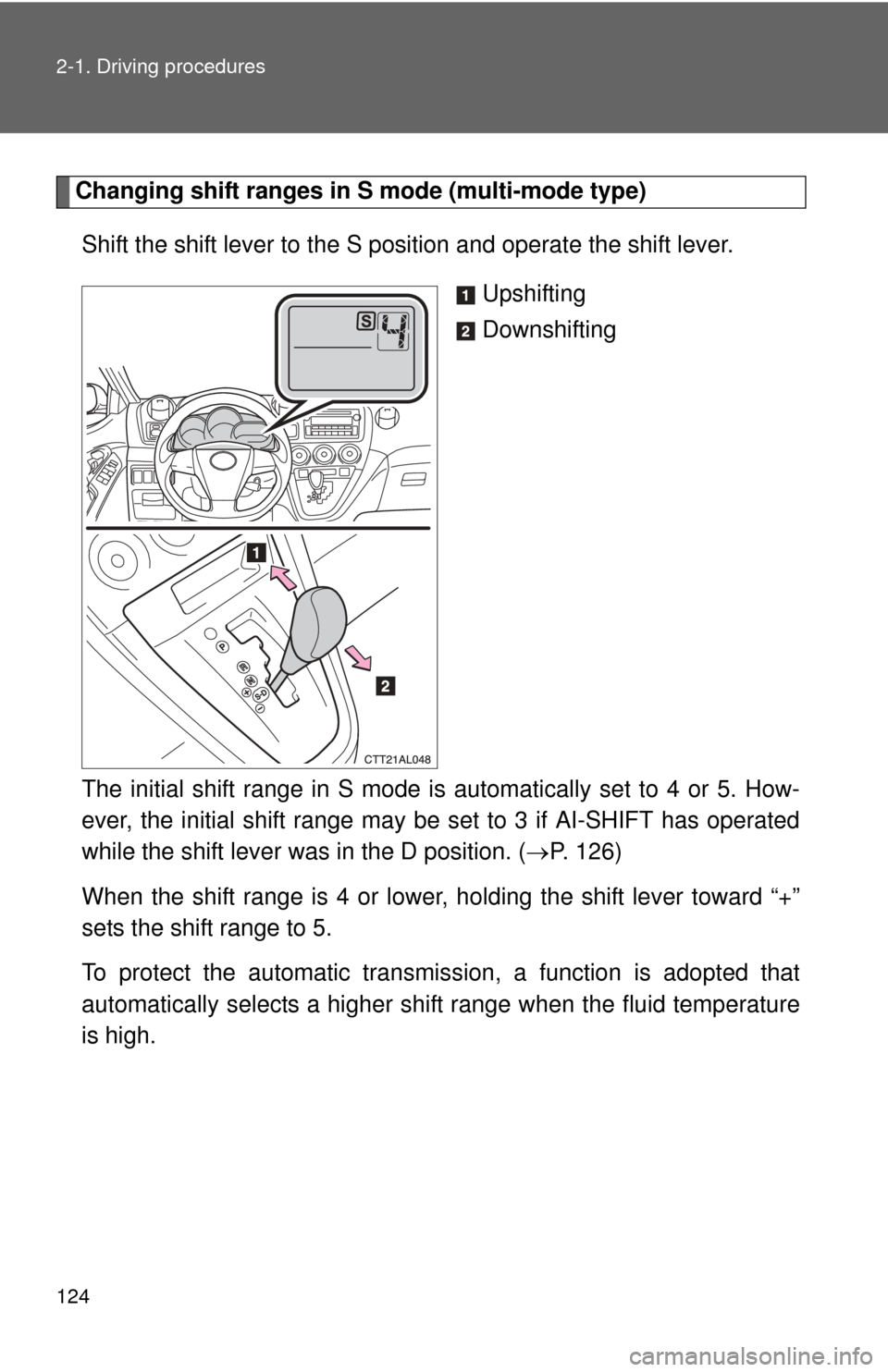
Changing shift ranges in S mode (multi-mode type)Shift the shift lever to the S position and operate the shift lever. Upshifting
Downshifting
The initial shift range in S mode is automatically set to 4 or 5. How-
ever, the initial shift range may be set to 3 if AI-SHIFT has operated
while the shift lever was in the D position. ( P. 126)
When the shift range is 4 or lower, holding the shift lever toward “+”
sets the shift range to 5.
To protect the automatic transmis sion, a function is adopted that
automatically selects a higher shift range when the fluid temperature
is high.
Page 139 of 500
139
2-3. Operating the lights and wipers
2
When driving
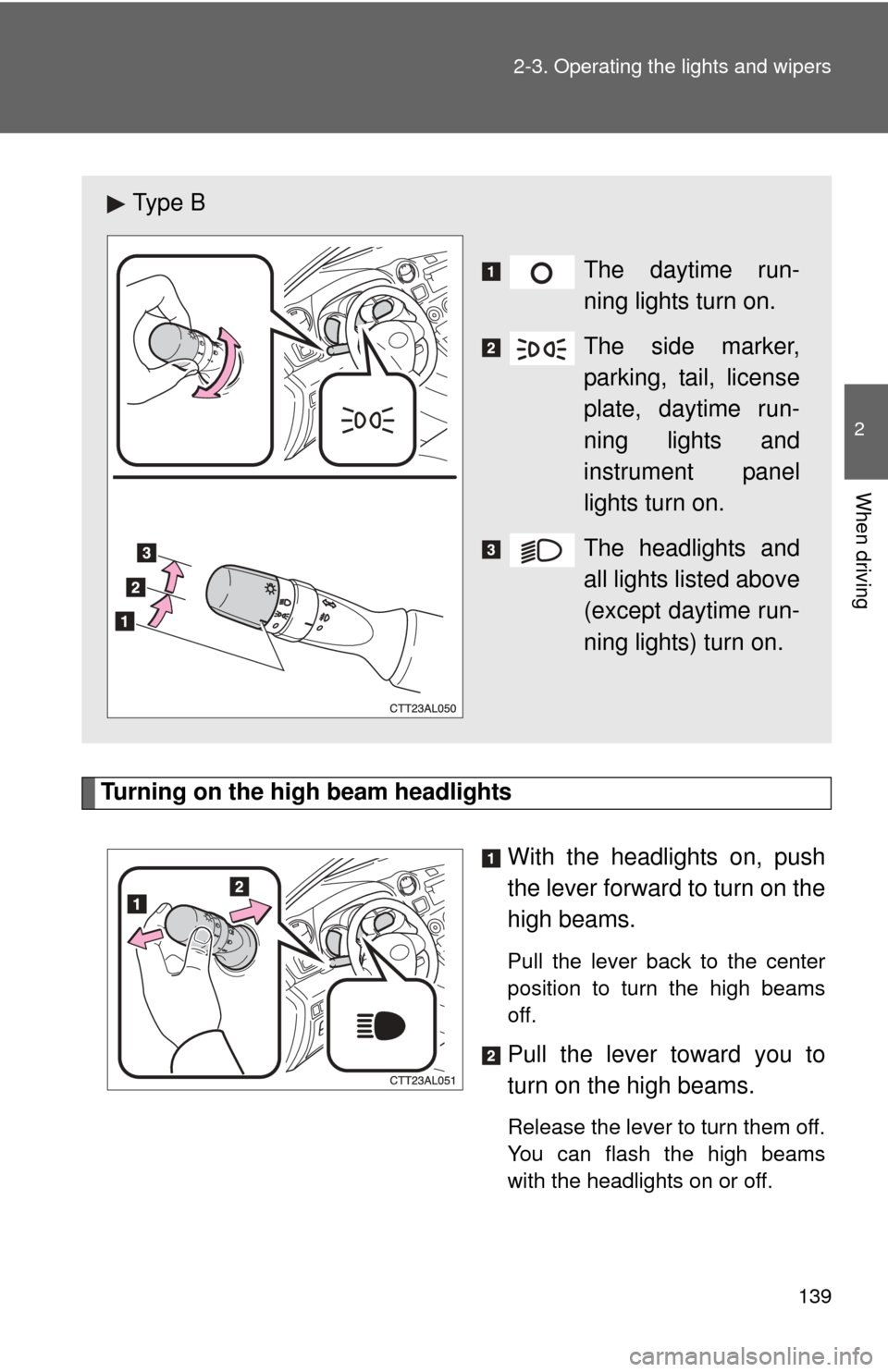
Turning on the high beam headlights
With the headlights on, push
the lever forward to turn on the
high beams.
Pull the lever back to the center
position to turn the high beams
off.
Pull the lever toward you to
turn on the high beams.
Release the lever to turn them off.
You can flash the high beams
with the headlights on or off.
Ty p e B
The daytime run-
ning lights turn on.
The side marker,
parking, tail, license
plate, daytime run-
ning lights and
instrument panel
lights turn on.
The headlights and
all lights listed above
(except daytime run-
ning lights) turn on.
Page 145 of 500
145
2-3. Operating the lights and wipers
2
When driving
■
The windshield wipers and w ashers can be operated when
The engine switch is in the “ON” position.
■ If no windshield washer fluid sprays
Check that the washer nozzles are not blocked and if there is washer fluid in
the windshield washer fluid reservoir.
NOTICE
■When the windshield is dry
Do not use the wipers, as they may damage the windshield.
■ When there is no washer fluid spray from the nozzle
Damage to the washer fluid pump may be caused if the lever is pulled
toward you and held continually.
■ When a nozzle becomes blocked
Do not try to clear it with a pin or other object. The nozzle will be damaged.
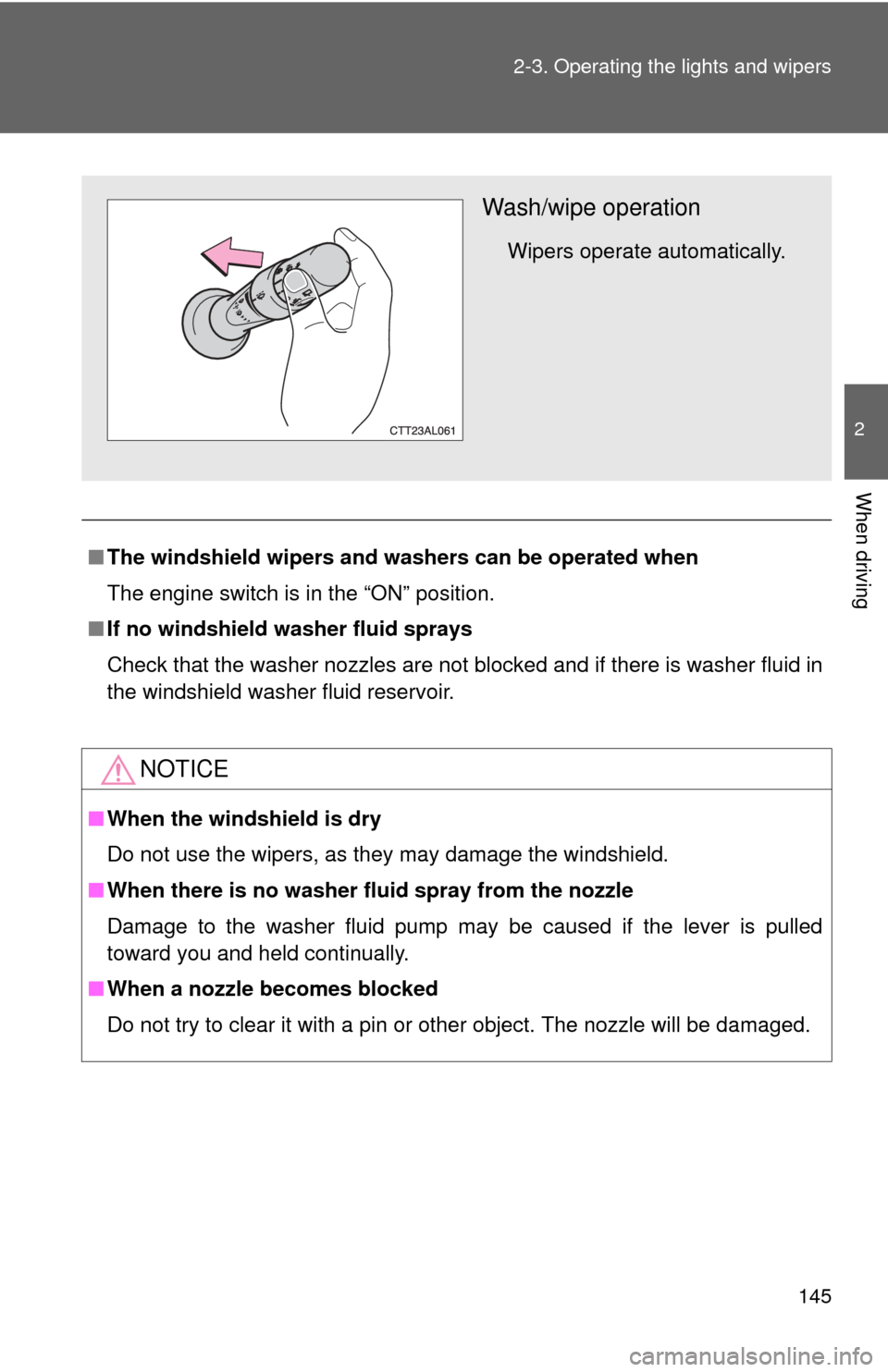
Wash/wipe operation
Wipers operate automatically.
Page 147 of 500
147
2-3. Operating the lights and wipers
2
When driving
■
The rear window wiper and washer can be operated when
The engine switch is in “ON”.
NOTICE
■When the rear window is dry
Do not use the wipers, as they may damage the rear window.
■ When there is no washer fluid spray from the nozzle
Damage to the washer fluid pump may be caused if the lever is pulled
toward you and held continually.
■ When a nozzle becomes blocked
Do not try to clear it with a pin or other object. The nozzle will be damaged.
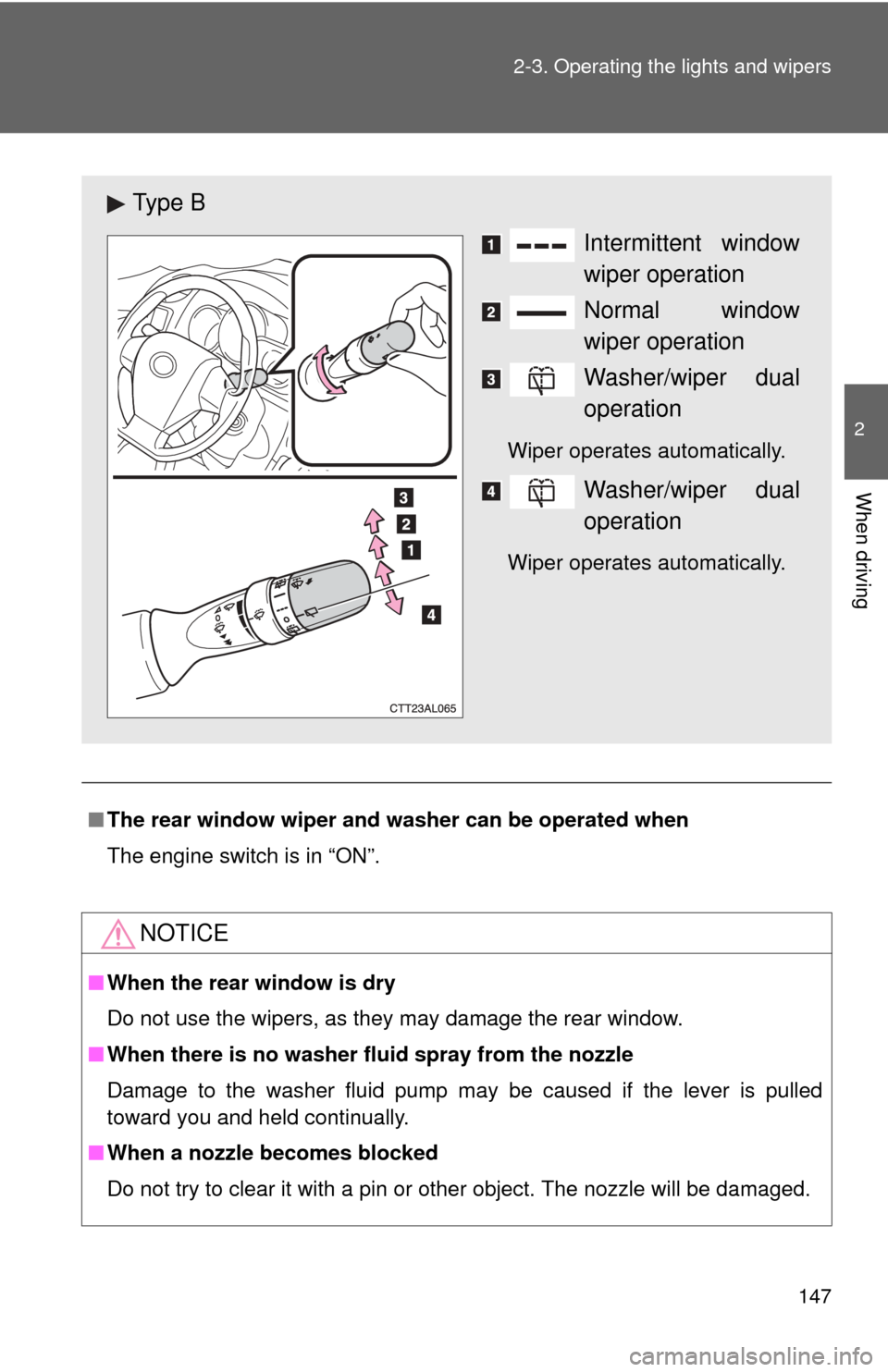
Ty p e B
Intermittent window
wiper operation
Normal window
wiper operation
Washer/wiper dual
operation
Wiper operates automatically.
Washer/wiper dual
operation
Wiper operates automatically.
Page 150 of 500
150 2-4. Using other driving systems
■Cruise control can be set when
●Automatic transmission:
The shift lever is in the D or range 3 (standard type), or in the D or range
4 or higher of S has been selected (multi-mode type).
● Vehicle speed is above approximately 25 mph (40 km/h).
■ Accelerating
The vehicle can be accelerated normally. After acceleration, the set speed
resumes.
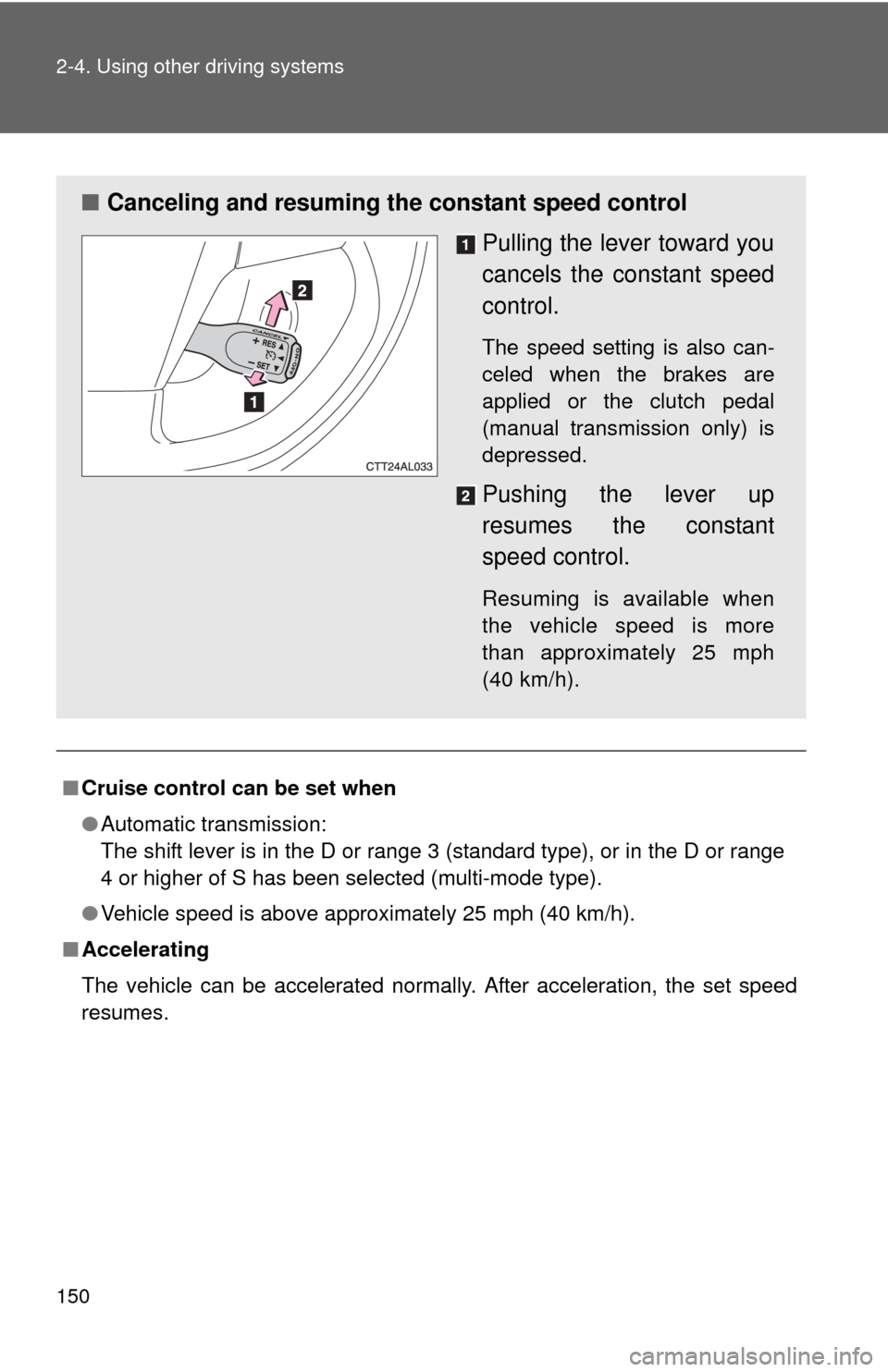
■ Canceling and resuming the constant speed control
Pulling the lever toward you
cancels the constant speed
control.
The speed setting is also can-
celed when the brakes are
applied or the clutch pedal
(manual transmission only) is
depressed.
Pushing the lever up
resumes the constant
speed control.
Resuming is available when
the vehicle speed is more
than approximately 25 mph
(40 km/h).
Page 151 of 500
151
2-4. Using other
driving systems
2
When driving
■Automatic cruise control cancelation
Cruise control will stop maintaining the vehicle speed in any of the following
situations.
●Actual vehicle speed falls more than approximately 10 mph (16 km/h)
below the preset vehicle speed.
At this time, the memorized set speed is not retained.
● Actual vehicle speed is below approximately 25 mph (40 km/h).
● VSC is activated.
■ If the cruise control indicator light flashes
Press the “ON-OFF” button once to deactivate the system, and then press
the button again to reactivate the system.
If the cruise control speed cannot be set or if the cruise control cancels
immediately after being activated, there may be a malfunction in the cruise
control system. Have the vehicle inspected by your Toyota dealer.
CAUTION
■ To avoid operating the cruise control by mistake
Switch the cruise control off using the “ON-OFF” button when not in use.
■ Situations unsuitable for cruise control
Do not use cruise control in any of the following situations.
Doing so may result in loss of control and could cause an accident resulting
in death or serious injury.
●In heavy traffic
● On roads with sharp bends
● On winding roads
● On slippery roads, such as those covered with rain, ice or snow
● On steep hills
Vehicle speed may exceed the set speed when driving down a steep hill.
● When your vehicle is towing a trailer or during emergency towing
Page 157 of 500
157
2
When driving
2-5. Driving information
Cargo and luggage
Capacity and distributionCargo capacity depends on the total weight of the occupants.
(Cargo capacity) = (Total load capacity) - (Total weight of occupants)
Steps for Determining Correct Load Limit
(1)Locate the statement “The co mbined weight of occupants and
cargo should never exceed XXX kg or XXX lbs.” on your vehicle's
placard.
(2)Determine the combined weight of the driver and passengers that
will be riding in your vehicle.
(3)Subtract the combined weight of the driver and passengers from XXX kg or XXX lbs.
(4)The resulting figure equals the av ailable amount of cargo and lug-
gage load capacity.
For example, if the “XXX” amount equals 1400 lbs. and there will
be five 150 lb passengers in your vehicle, the amount of available
cargo and luggage load capacity is 650 lbs. (1400 - 750 (5 150) =
650 lbs.)
(5)Determine the combined weight of luggage and cargo being loaded on the vehicle. That weight may not safely exceed the avail-
able cargo and luggage load capacity calculated in Step 4.
Take notice of the following information about storage precau-
tions, cargo capacity and load.
● Stow cargo and luggage in the luggage compartment whenever
possible. Be sure all items are secured in place.
● Be careful to keep the vehicle level. Placing the weight as far for-
ward as possible helps maintain vehicle balance.
● For better fuel economy, do no t carry unnecessary weight.
Page 158 of 500
158 2-5. Driving information
(6)If your vehicle will be towing a trailer, load from your trailer will be
transferred to your vehicle. Cons ult this manual to determine how
this reduces the available cargo and luggage load capacity of your
vehicle.
( P. 167)
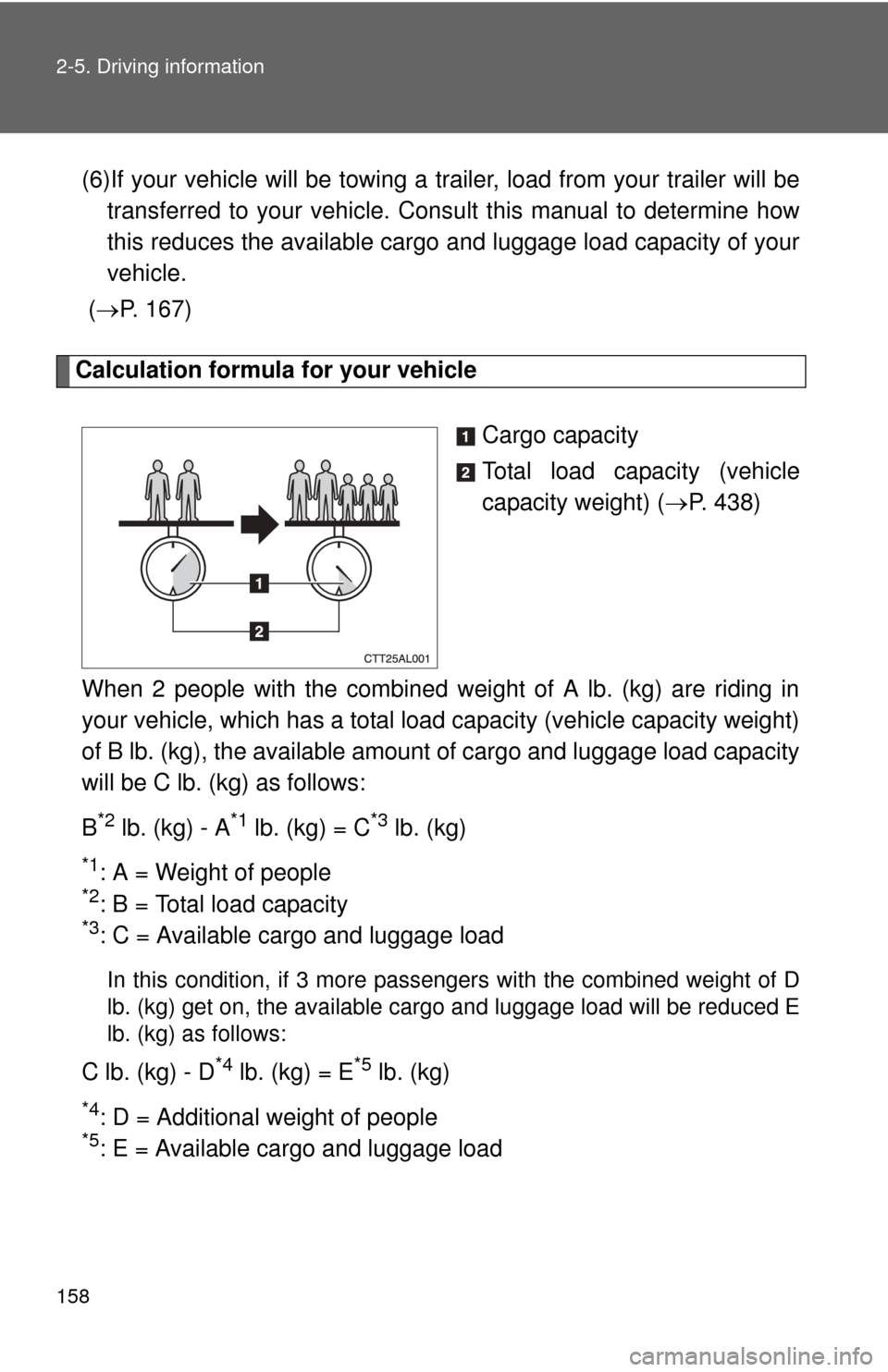
Calculation formula for your vehicle
Cargo capacity
Total load capacity (vehicle
capacity weight) (P. 438)
When 2 people with the combined weight of A lb. (kg) are riding in
your vehicle, which has a total load capacity (vehicle capacity weight)
of B lb. (kg), the available amount of cargo and luggage load capacity
will be C lb. (kg) as follows:
B
*2 lb. (kg) - A*1 lb. (kg) = C*3 lb. (kg)
*1: A = Weight of people*2: B = Total load capacity*3: C = Available cargo and luggage load
In this condition, if 3 more passengers with the combined weight of D
lb. (kg) get on, the available carg o and luggage load will be reduced E
lb. (kg) as follows:
C lb. (kg) - D*4 lb. (kg) = E*5 lb. (kg)
*4: D = Additional weight of people*5: E = Available cargo and luggage load
Page 161 of 500
161
2-5. Driving information
2
When driving
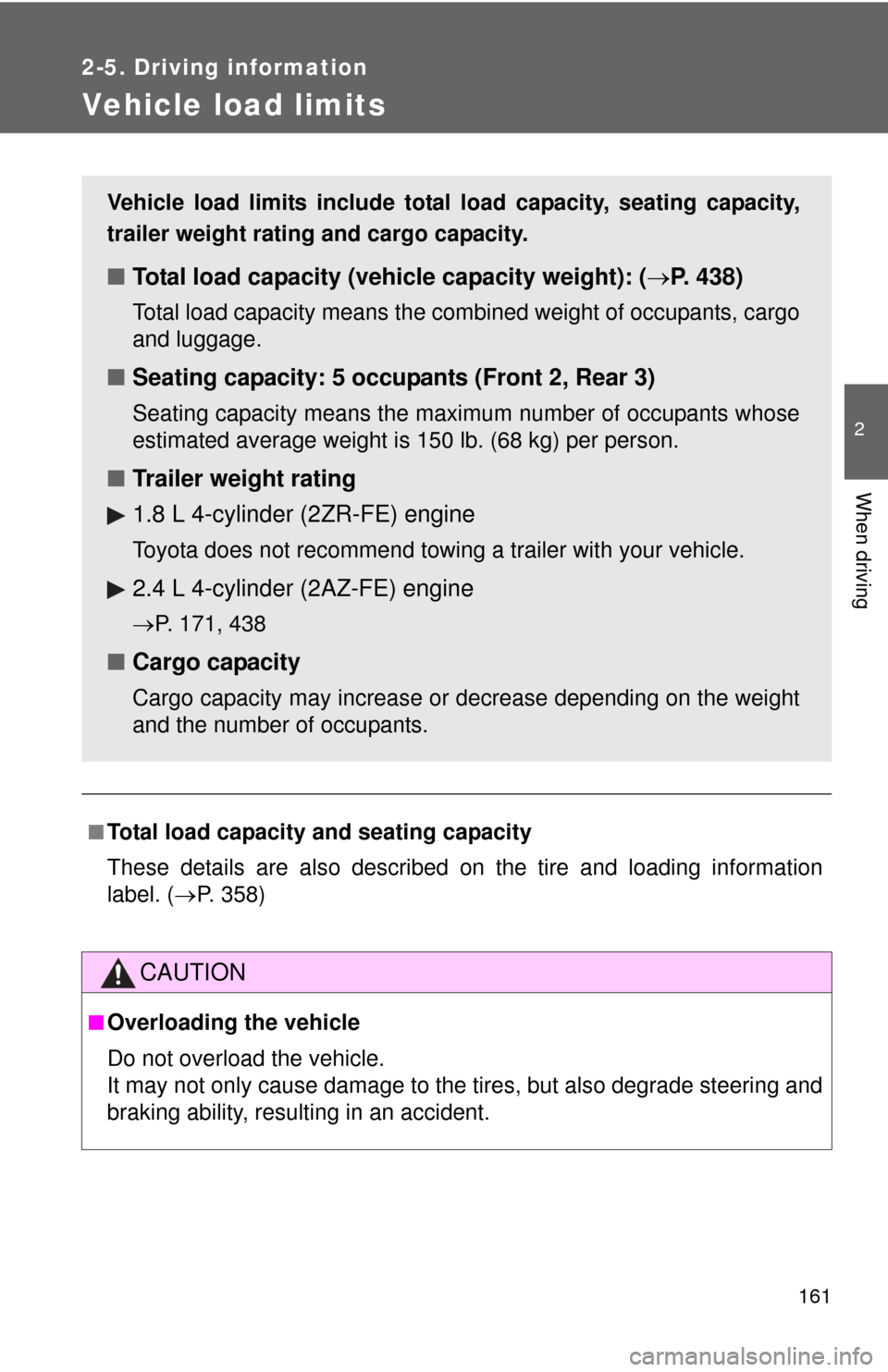
Vehicle load limits
■Total load capacity and seating capacity
These details are also described on the tire and loading information
label. (P. 358)
CAUTION
■Overloading the vehicle
Do not overload the vehicle.
It may not only cause damage to the ti res, but also degrade steering and
braking ability, resulting in an accident.
Vehicle load limits include total load capacity, seating capacity,
trailer weight rating and cargo capacity.
■ Total load capacity (vehicle capacity weight): ( P. 438)
Total load capacity means the combined weight of occupants, cargo
and luggage.
■ Seating capacity: 5 occupants (Front 2, Rear 3)
Seating capacity means the maxi mum number of occupants whose
estimated average weight is 150 lb. (68 kg) per person.
■ Trailer weight rating
1.8 L 4-cylinder (2ZR-FE) engine
Toyota does not recommend towing a trailer with your vehicle.
2.4 L 4-cylinder (2AZ-FE) engine
P. 171, 438
■ Cargo capacity
Cargo capacity may increase or decrease depending on the weight
and the number of occupants.
Page 166 of 500
![TOYOTA MATRIX 2014 E140 / 2.G User Guide 166
2-5. Driving information
Trailer towing (1.8 L 4-cylinder [2ZR-FE] engine)
Toyota does not recommend towing a trailer with your vehicle.
Toyota also does not recommend the installation of a tow hi](/img/14/6547/w960_6547-165.png "TOYOTA MATRIX 2014 E140 / 2.G User Guide 166
2-5. Driving information
Trailer towing (1.8 L 4-cylinder [2ZR-FE] engine)
Toyota does not recommend towing a trailer with your vehicle.
Toyota also does not recommend the installation of a tow hi")
166
2-5. Driving information
Trailer towing (1.8 L 4-cylinder [2ZR-FE] engine)
Toyota does not recommend towing a trailer with your vehicle.
Toyota also does not recommend the installation of a tow hitch or
the use of a tow hitch carrier for a wheelchair, scooter, bicycle, etc.
Your Toyota is not designed for tr ailer towing or for the use of tow
hitch mounted carriers.