light TOYOTA MIRAI 2016 1.G Owner's Manual
[x] Cancel search | Manufacturer: TOYOTA, Model Year: 2016, Model line: MIRAI, Model: TOYOTA MIRAI 2016 1.GPages: 464, PDF Size: 8.05 MB
Page 52 of 464
521-1. For safe use
MIRAI_OM_USA_OM62004U■
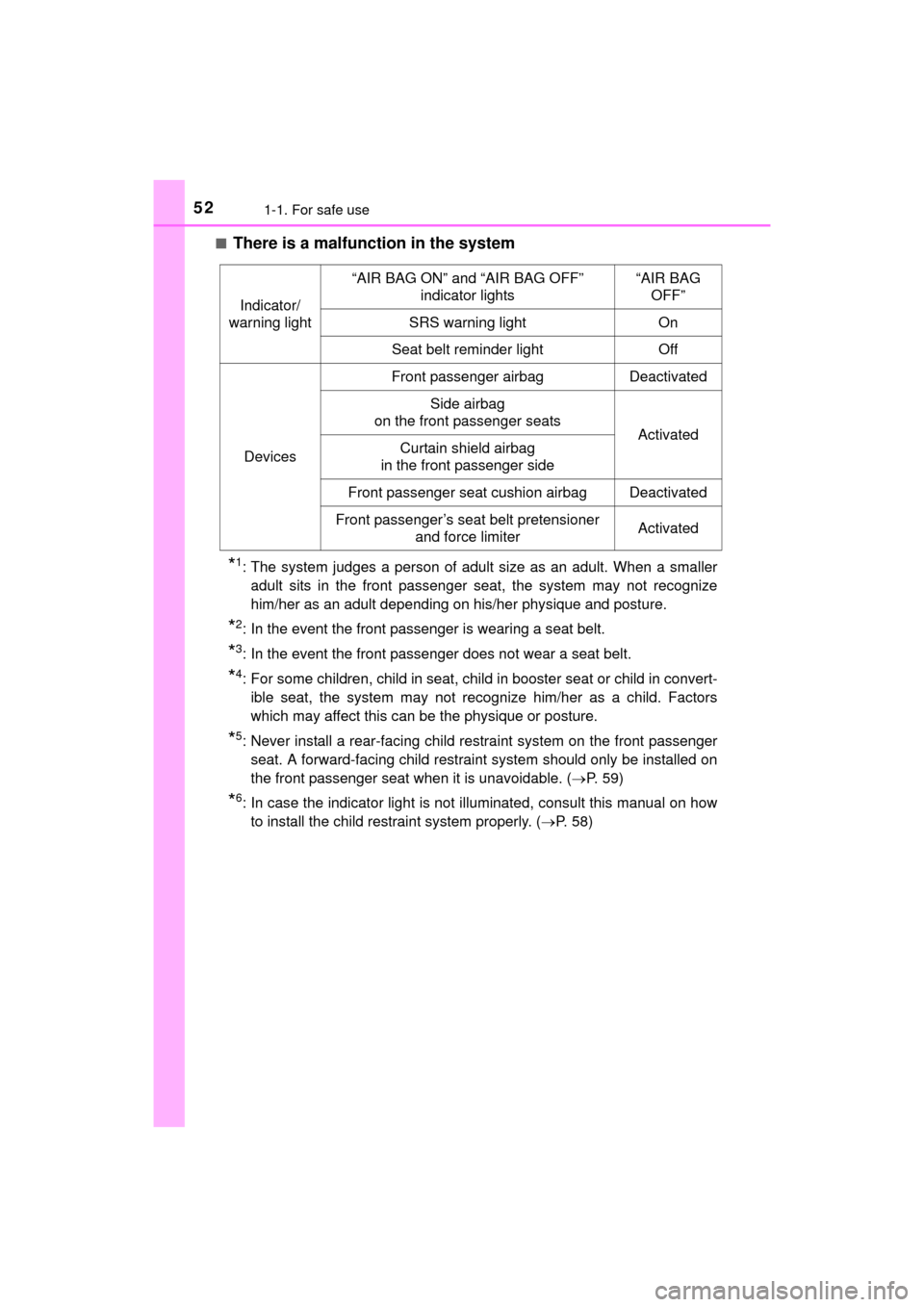
There is a malfunction in the system
*1: The system judges a person of adult size as an adult. When a smaller
adult sits in the front passenger seat, the system may not recognize
him/her as an adult depending on his/her physique and posture.
*2: In the event the front passenger is wearing a seat belt.
*3: In the event the front passenger does not wear a seat belt.
*4: For some children, child in seat, child in booster seat or child in convert-ible seat, the system may not recognize him/her as a child. Factors
which may affect this can be the physique or posture.
*5: Never install a rear-facing child restraint system on the front passengerseat. A forward-facing child restraint system should only be installed on
the front passenger seat when it is unavoidable. ( P. 59)
*6: In case the indicator light is not illuminated, consult this manual on how
to install the child restraint system properly. ( P. 58)
Indicator/
warning light
“AIR BAG ON” and “AIR BAG OFF” indicator lights“AIR BAG OFF”
SRS warning lightOn
Seat belt reminder lightOff
Devices
Front passenger airbagDeactivated
Side airbag
on the front passenger seats
ActivatedCurtain shield airbag
in the front passenger side
Front passenger seat cushion airbagDeactivated
Front passenger’s seat belt pretensioner
and force limiterActivated
Page 53 of 464
531-1. For safe use
1
For safety and security
MIRAI_OM_USA_OM62004U
WARNING
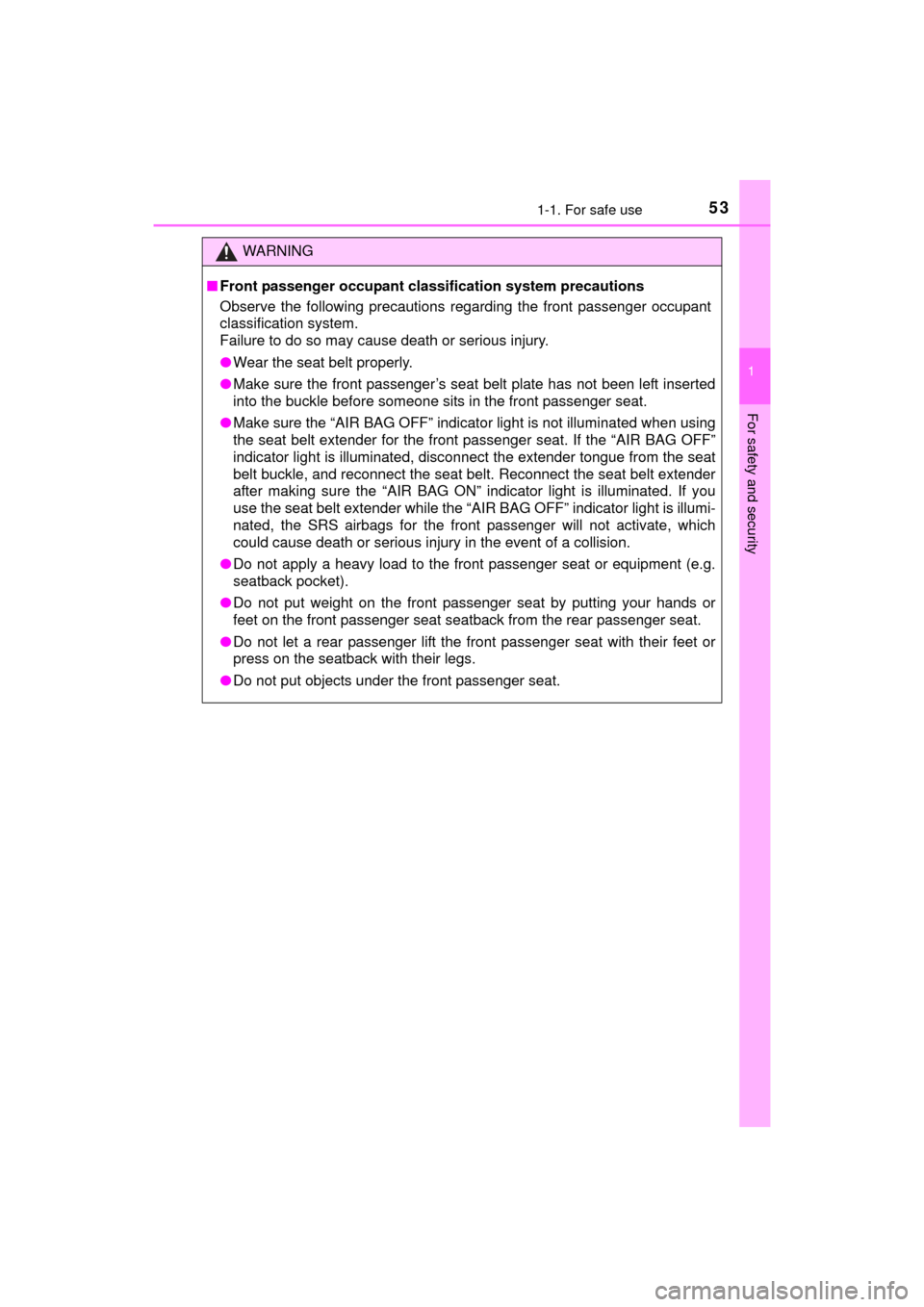
■Front passenger occupant classification system precautions
Observe the following precautions regarding the front passenger occupant
classification system.
Failure to do so may cause death or serious injury.
●Wear the seat belt properly.
● Make sure the front passenger’s seat belt plate has not been left inserted
into the buckle before someone sits in the front passenger seat.
● Make sure the “AIR BAG OFF” indicator light is not illuminated when using
the seat belt extender for the front passenger seat. If the “AIR BAG OFF”
indicator light is illuminated, disconnect the extender tongue from the seat
belt buckle, and reconnect the seat belt. Reconnect the seat belt extender
after making sure the “AIR BAG ON” indicator light is illuminated. If you
use the seat belt extender while the “AIR BAG OFF” indicator light is illumi-
nated, the SRS airbags for the front passenger will not activate, which
could cause death or serious injury in the event of a collision.
● Do not apply a heavy load to the front passenger seat or equipment (e.g.
seatback pocket).
● Do not put weight on the front passenger seat by putting your hands or
feet on the front passenger seat seatback from the rear passenger seat.
● Do not let a rear passenger lift the front passenger seat with their feet or
press on the seatback with their legs.
● Do not put objects under the front passenger seat.
Page 54 of 464
541-1. For safe use
MIRAI_OM_USA_OM62004U
WARNING
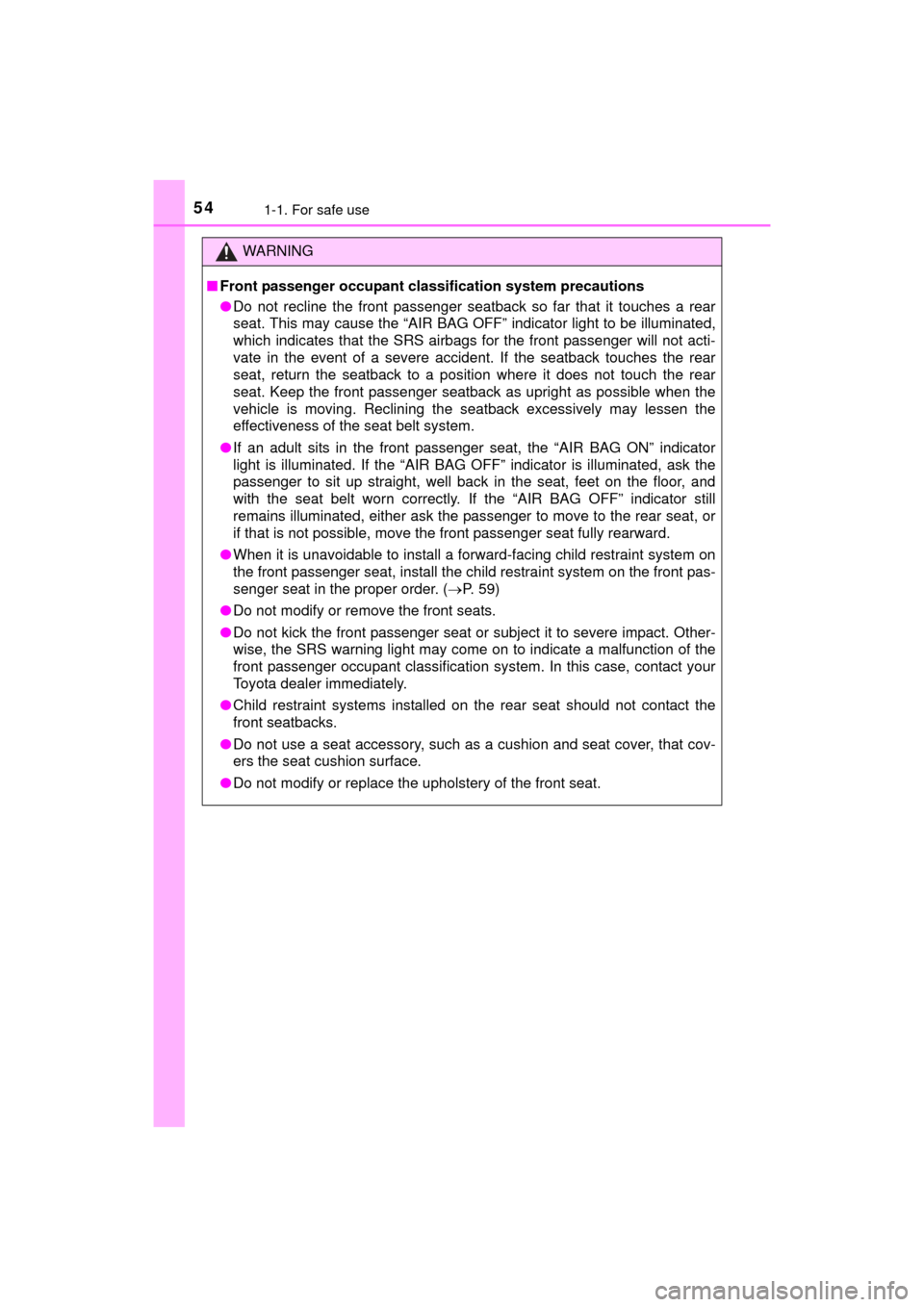
■Front passenger occupant classification system precautions
●Do not recline the front passenger seatback so far that it touches a rear
seat. This may cause the “AIR BAG OFF” indicator light to be illuminated,
which indicates that the SRS airbags for the front passenger will not acti-
vate in the event of a severe accident. If the seatback touches the rear
seat, return the seatback to a position where it does not touch the rear
seat. Keep the front passenger seatback as upright as possible when the
vehicle is moving. Reclining the seatback excessively may lessen the
effectiveness of the seat belt system.
● If an adult sits in the front passenger seat, the “AIR BAG ON” indicator
light is illuminated. If the “AIR BAG OFF” indicator is illuminated, ask the
passenger to sit up straight, well back in the seat, feet on the floor, and
with the seat belt worn correctly. If the “AIR BAG OFF” indicator still
remains illuminated, either ask the passenger to move to the rear seat, or
if that is not possible, move the front passenger seat fully rearward.
● When it is unavoidable to install a forward-facing child restraint system on
the front passenger seat, install the child restraint system on the front pas-
senger seat in the proper order. ( P. 59)
● Do not modify or remove the front seats.
● Do not kick the front passenger seat or subject it to severe impact. Other-
wise, the SRS warning light may come on to indicate a malfunction of the
front passenger occupant classification system. In this case, contact your
Toyota dealer immediately.
● Child restraint systems installed on the rear seat should not contact the
front seatbacks.
● Do not use a seat accessory, such as a cushion and seat cover, that cov-
ers the seat cushion surface.
● Do not modify or replace the upholstery of the front seat.
Page 60 of 464
601-1. For safe use
MIRAI_OM_USA_OM62004U
WARNING
■When installing a child restraint system
Observe the following when installing child restraint system to the front pas-
senger seat if it is unavoidable. The front passenger SRS airbag inflates
with considerable speed and force that if not observed may lead to death or
serious injury to the child.
●Never install a rear-facing child restraint system on the front passenger
seat even if the “AIR BAG OFF” indicator light is illuminated. In the event
of an accident, the force of the rapid inflation of the front passenger airbag
can cause death or serious injury to the child if the rear-facing child
restraint system is installed on the front passenger seat.
● A forward-facing child restraint system may be installed on the front pas-
senger seat only when it is unavoidable. A child restraint system that
requires a top tether strap should not be used in the front passenger seat
since there is no top tether strap anchor for the front passenger seat.
If the head restraint interferes with the child restraint system installation
and the head restraint can be removed, remove the head restraint.
● Do not allow the child to lean his/her head or any part of his/her body
against the door or the area of the seat, front pillars or roof side rails from
which the SRS side airbags or SRS curtain shield airbags deploy even if
the child is seated in the child restraint system. It is dangerous if the SRS
side and curtain shield airbags inflate, and the impact could cause death
or serious injury to the child.
● When a booster seat is installed, always ensure that the shoulder belt is
positioned across the center of the child’s shoulder. The belt should be
kept away from the child’s neck, but not so that it could fall off the child’s
shoulder.
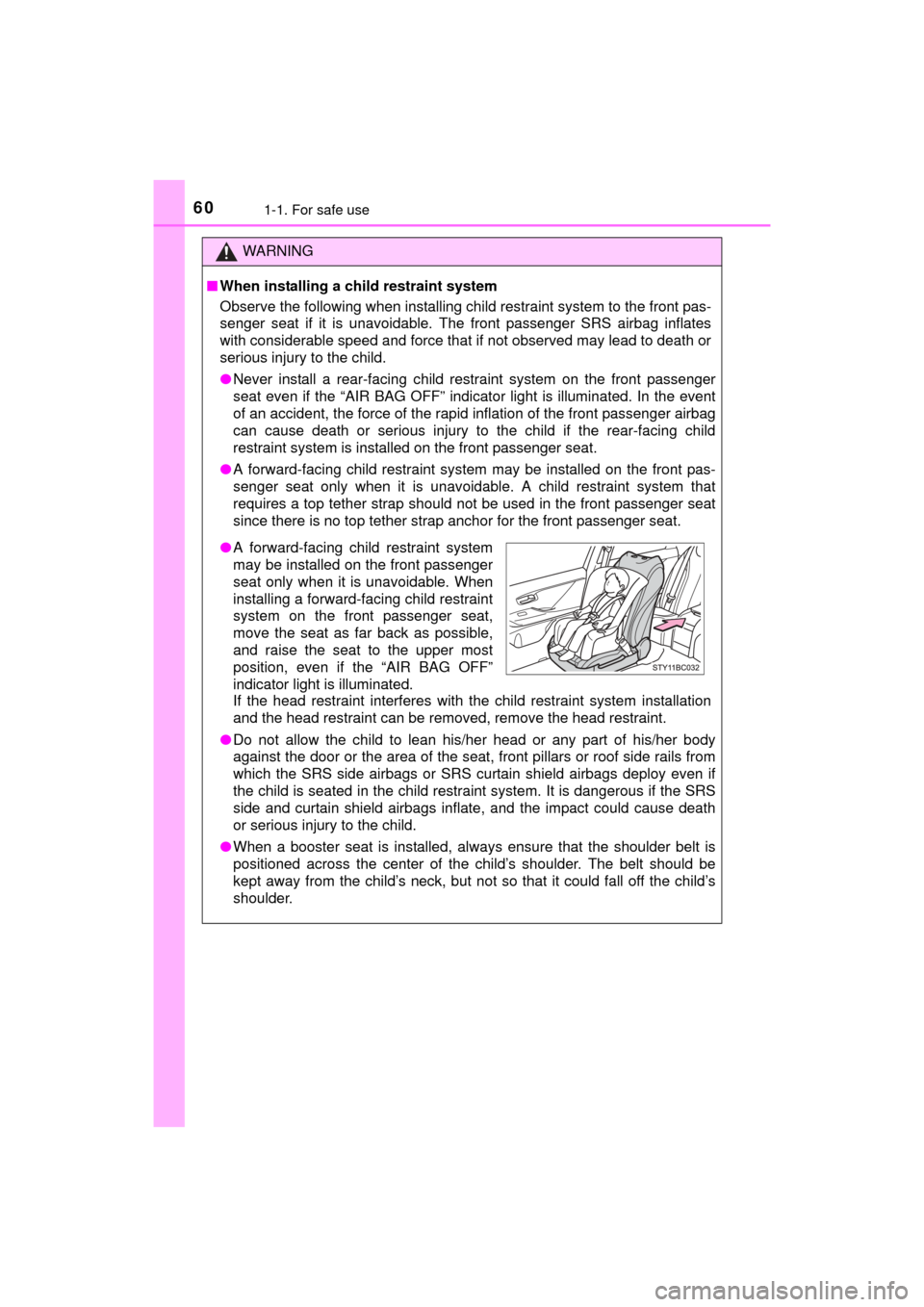
●A forward-facing child restraint system
may be installed on the front passenger
seat only when it is unavoidable. When
installing a forward-facing child restraint
system on the front passenger seat,
move the seat as far back as possible,
and raise the seat to the upper most
position, even if the “AIR BAG OFF”
indicator light is illuminated.
Page 67 of 464
671-1. For safe use
1
For safety and security
MIRAI_OM_USA_OM62004U■
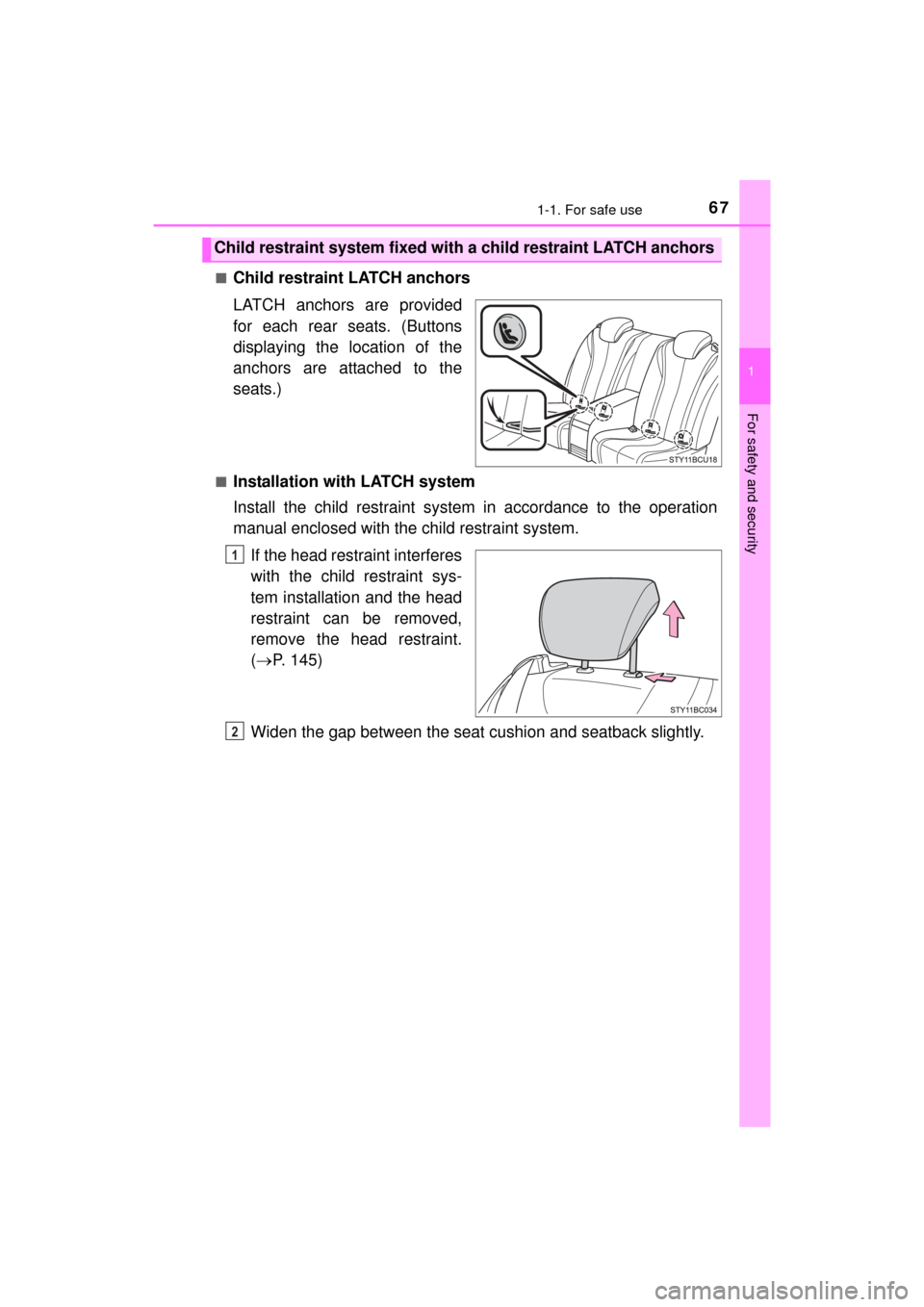
Child restraint LATCH anchors
LATCH anchors are provided
for each rear seats. (Buttons
displaying the location of the
anchors are attached to the
seats.)
■Installation with LATCH system
Install the child restraint system in accordance to the operation
manual enclosed with the child restraint system.
If the head restraint interferes
with the child restraint sys-
tem installation and the head
restraint can be removed,
remove the head restraint.
( P. 145)
Widen the gap between the seat cu shion and seatback slightly.
Child restraint system fixed with a child restraint LATCH anchors
1
2
Page 74 of 464
741-2. Theft deterrent system
MIRAI_OM_USA_OM62004U
Alar m
The alarm uses light and sound to give an alert when an intrusion is
detected.
The alarm is triggered in the following situations when the alarm is
set:
●A locked door or trunk is unlocked or opened in any way other than
using the entry function, wireless remote control or mechanical key.
(The doors will lock again automatically.)
● The hood is opened.
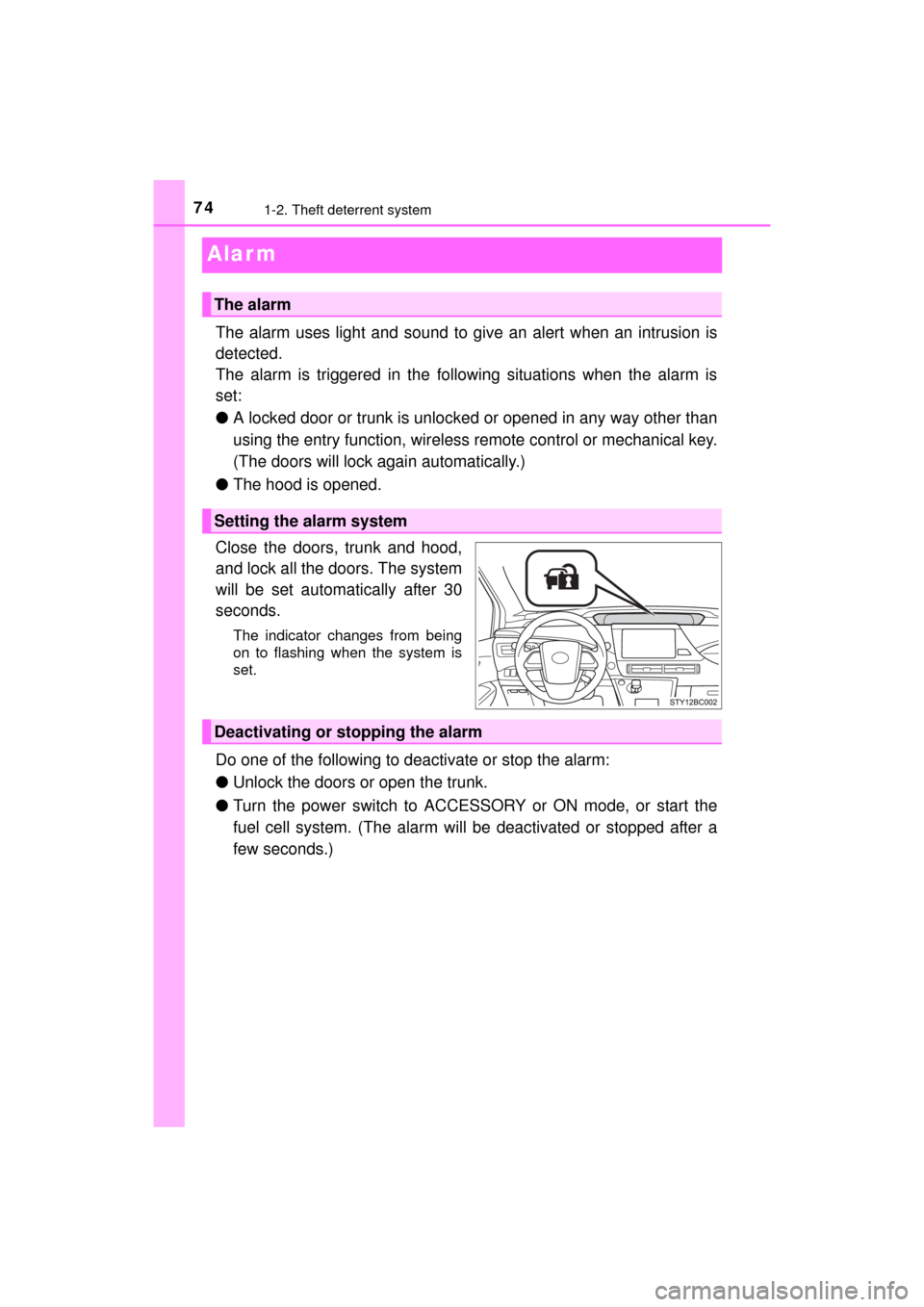
Close the doors, trunk and hood,
and lock all the doors. The system
will be set automatically after 30
seconds.
The indicator changes from being
on to flashing when the system is
set.
Do one of the following to deactivate or stop the alarm:
● Unlock the doors or open the trunk.
● Turn the power switch to ACCESSORY or ON mode, or start the
fuel cell system. (The alarm will be deactivated or stopped after a
few seconds.)
The alarm
Setting the alarm system
Deactivating or stopping the alarm
Page 85 of 464
852. Fuel cell vehicle
2
Fuel cell system
MIRAI_OM_USA_OM62004U
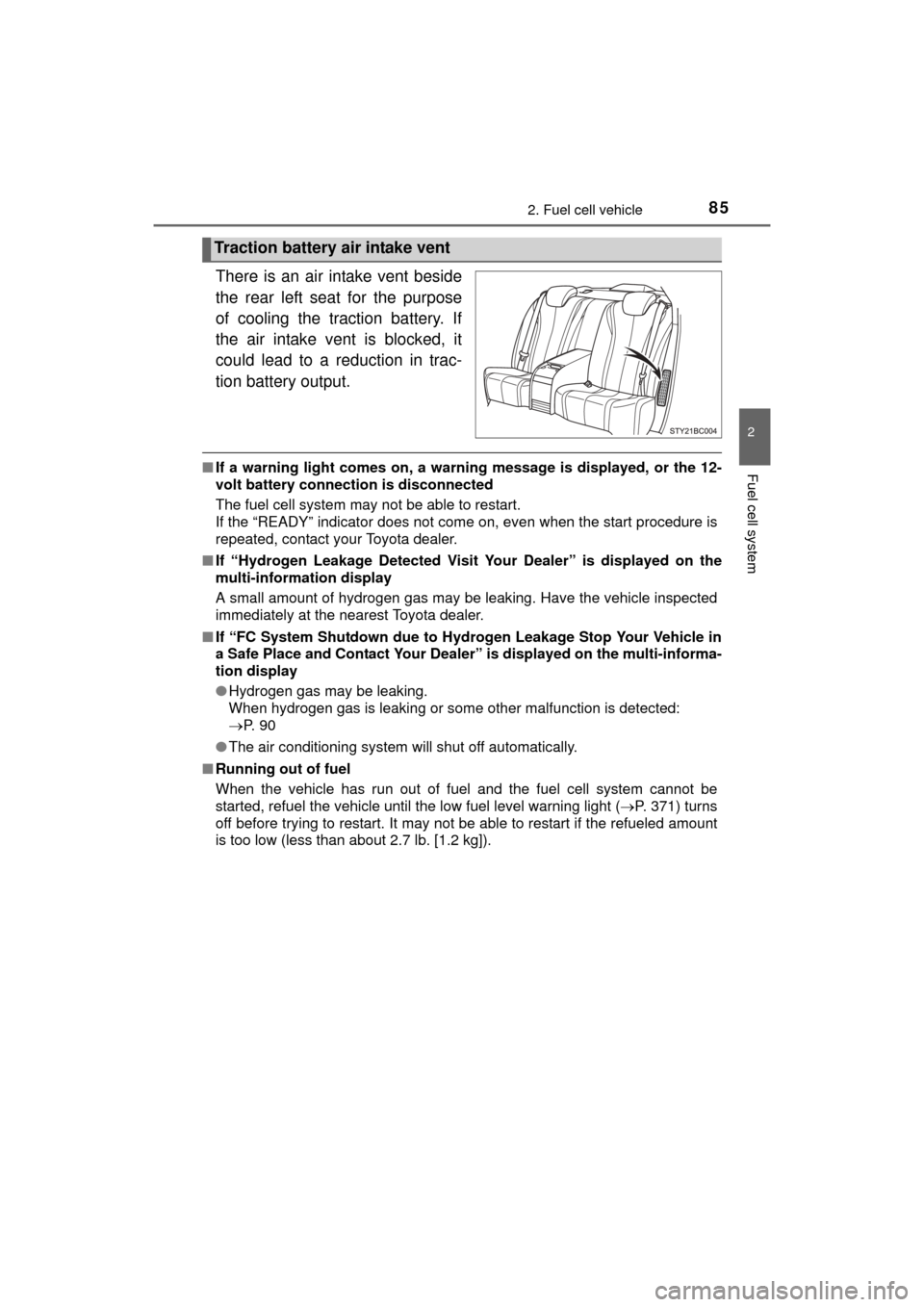
There is an air intake vent beside
the rear left seat for the purpose
of cooling the traction battery. If
the air intake vent is blocked, it
could lead to a reduction in trac-
tion battery output.
■If a warning light comes on, a warn ing message is displayed, or the 12-
volt battery connection is disconnected
The fuel cell system may not be able to restart.
If the “READY” indicator does not come on, even when the start procedure is
repeated, contact your Toyota dealer.
■ If “Hydrogen Leakage Detected Visit Your Dealer” is displayed on the
multi-information display
A small amount of hydrogen gas may be leaking. Have the vehicle inspected
immediately at the nearest Toyota dealer.
■ If “FC System Shutdown due to Hydrogen Leakage Stop Your Vehicle in
a Safe Place and Contact Your Dealer” is displayed on the multi-informa-
tion display
●Hydrogen gas may be leaking.
When hydrogen gas is leaking or some other malfunction is detected:
P. 9 0
● The air conditioning system will shut off automatically.
■ Running out of fuel
When the vehicle has run out of fuel and the fuel cell system cannot be
started, refuel the vehicle until the low fuel level warning light (P. 371) turns
off before trying to restart. It may not be able to restart if the refueled amount
is too low (less than about 2.7 lb. [1.2 kg]).
Traction battery air intake vent
Page 89 of 464
892. Fuel cell vehicle
2
Fuel cell system
MIRAI_OM_USA_OM62004U■
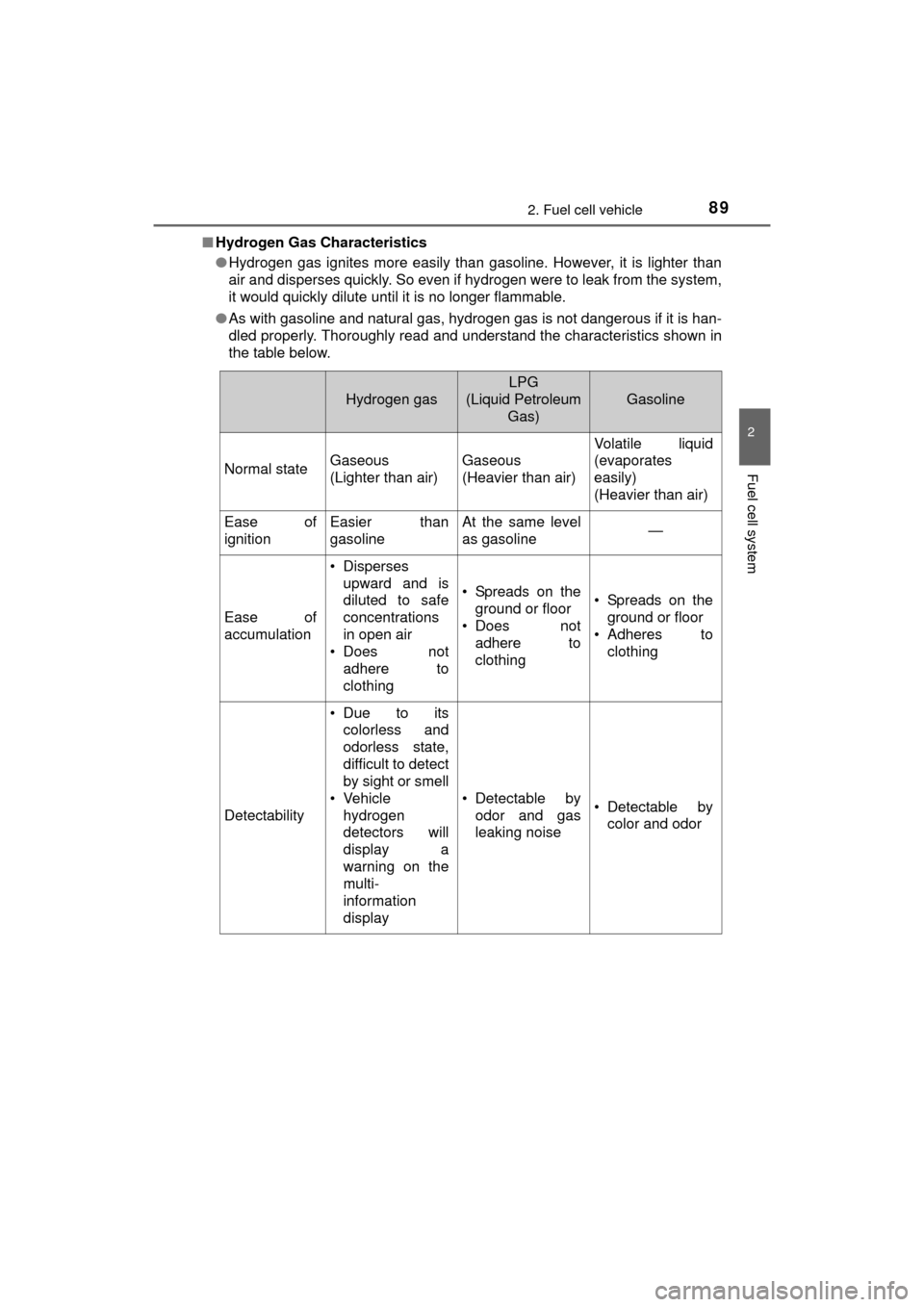
Hydrogen Gas Characteristics
●Hydrogen gas ignites more easily than gasoline. However, it is lighter than
air and disperses quickly. So even if hydrogen were to leak from the system,
it would quickly dilute until it is no longer flammable.
● As with gasoline and natural gas, hydrogen gas is not dangerous if it is han-
dled properly. Thoroughly read and underst and the characteristics shown in
the table below.
Hydrogen gas
LPG
(Liquid Petroleum Gas)
Gasoline
Normal stateGaseous
(Lighter than air)Gaseous
(Heavier than air)
Volatile liquid
(evaporates
easily)
(Heavier than air)
Ease of
ignitionEasier than
gasolineAt the same level
as gasoline—
Ease of
accumulation
• Disperses
upward and is
diluted to safe
concentrations
in open air
• Does not adhere to
clothing
• Spreads on the
ground or floor
• Does not adhere to
clothing• Spreads on the ground or floor
• Adheres to clothing
Detectability
•Due to itscolorless and
odorless state,
difficult to detect
by sight or smell
• Vehicle
hydrogen
detectors will
display a
warning on the
multi-
information
display
• Detectable byodor and gas
leaking noise• Detectable by color and odor
Page 94 of 464
942. Fuel cell vehicle
MIRAI_OM_USA_OM62004U
Advice for driving fuel cell vehicles
◆Fuel cell system indicator usage
Maintaining the fuel cell system indicator to Eco area on the
multi-information display can extend your driving range. (P. 1 1 0 )
◆Accelerator pedal/brake pedal operation
Drive the vehicle smoothly. Avoid abrupt acceleration and decelera-
tion.
Mild acceleration and deceleration can help curb wasteful fuel con-
sumption.
◆When braking
Make sure to depress the brake gently and allow for a long stopping
distance. This enables collection of more electrical energy gener-
ated during deceleration.
◆Heavy traffic
Repeated acceleration and deceleration as well as long stops at
traffic lights, will decrease fuel economy. Check traffic reports
ahead of time and avoid traffic jams as much as possible. If caught
in a traffic jam, gently release the brake pedal to allow the vehicle to
move forward slowly while avoiding overuse of the accelerator
pedal to help curb wasteful fuel consumption.
◆Driving with high power output
Similar to an electric vehicle, a fuel cell vehicle uses the most fuel in
high output driving such as driv ing on a steep uphill or at high
speeds. Moderate the vehicle speed and maintain a steady speed.
To maximize fuel economy and ra nge, pay attention to the fol-
lowing:
Page 97 of 464
97
Instrument cluster3
MIRAI_OM_USA_OM62004U3. Instrument cluster
Warning lights and indicators .......................... 98
Gauges and meters .......... 102
Multi-information display ... 107