ECU TOYOTA MIRAI 2017 1.G Workshop Manual
[x] Cancel search | Manufacturer: TOYOTA, Model Year: 2017, Model line: MIRAI, Model: TOYOTA MIRAI 2017 1.GPages: 464, PDF Size: 12.09 MB
Page 340 of 464
3407-3. Do-it-yourself maintenance
MIRAI_OM_USA_OM62023U
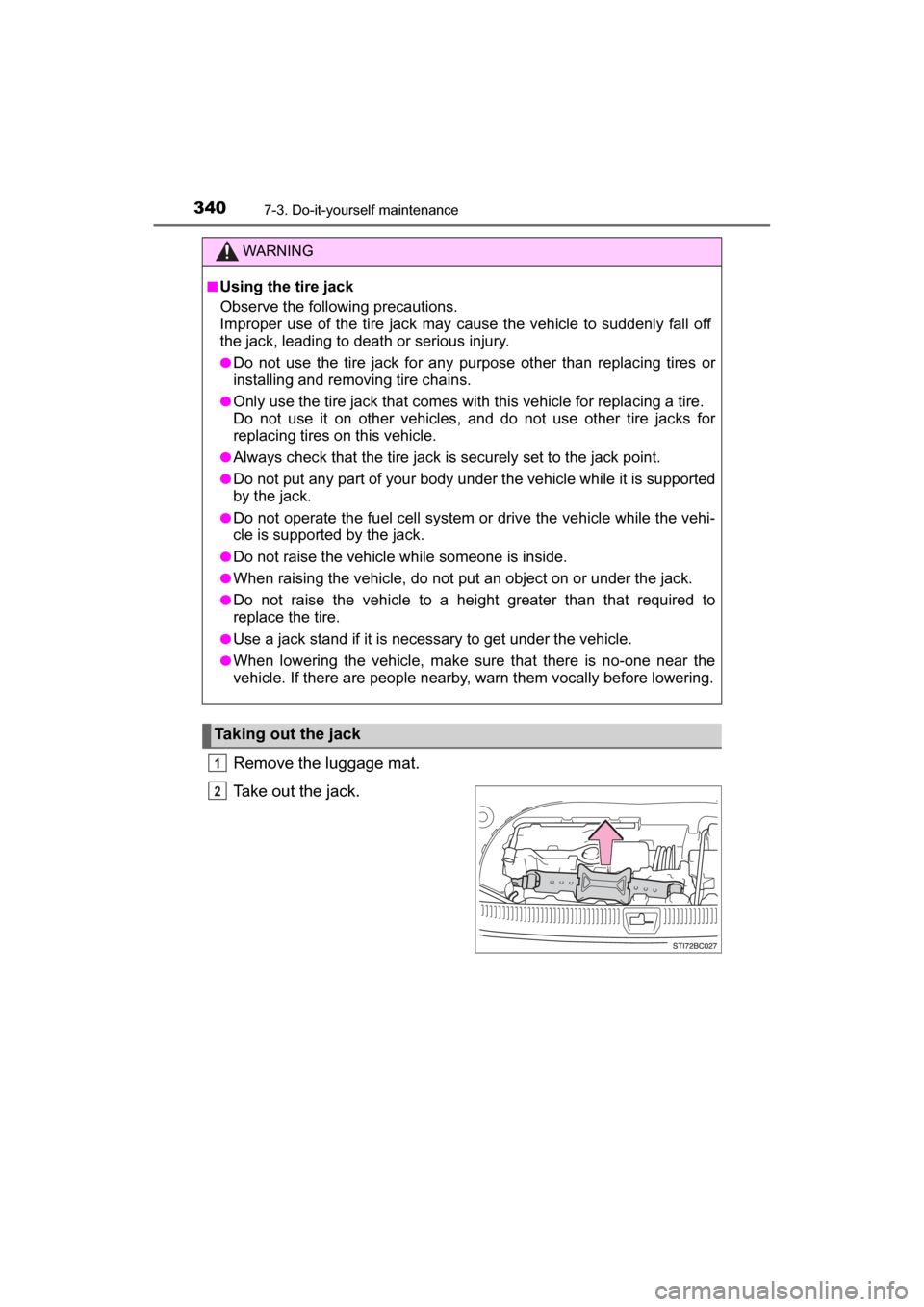
Remove the luggage mat.
Take out the jack.
WARNING
■Using the tire jack
Observe the following precautions.
Improper use of the tire jack may cause the vehicle to suddenly fall off
the jack, leading to death or serious injury.
●Do not use the tire jack for any purpose other than replacing tires or
installing and removing tire chains.
●Only use the tire jack that comes with this vehicle for replacing a tire.
Do not use it on other vehicles, and do not use other tire jacks for
replacing tires on this vehicle.
●Always check that the tire jack is securely set to the jack point.
●Do not put any part of your body under the vehicle while it is supported
by the jack.
●Do not operate the fuel cell system or drive the vehicle while the vehi-
cle is supported by the jack.
●Do not raise the vehicle while someone is inside.
●When raising the vehicle, do not put an object on or under the jack.
●Do not raise the vehicle to a height greater than that required to
replace the tire.
●Use a jack stand if it is necessary to get under the vehicle.
●When lowering the vehicle, make sure that there is no-one near the
vehicle. If there are people nearby, warn them vocally before lowering.
Taking out the jack
1
2
Page 344 of 464
3447-3. Do-it-yourself maintenance
MIRAI_OM_USA_OM62023U
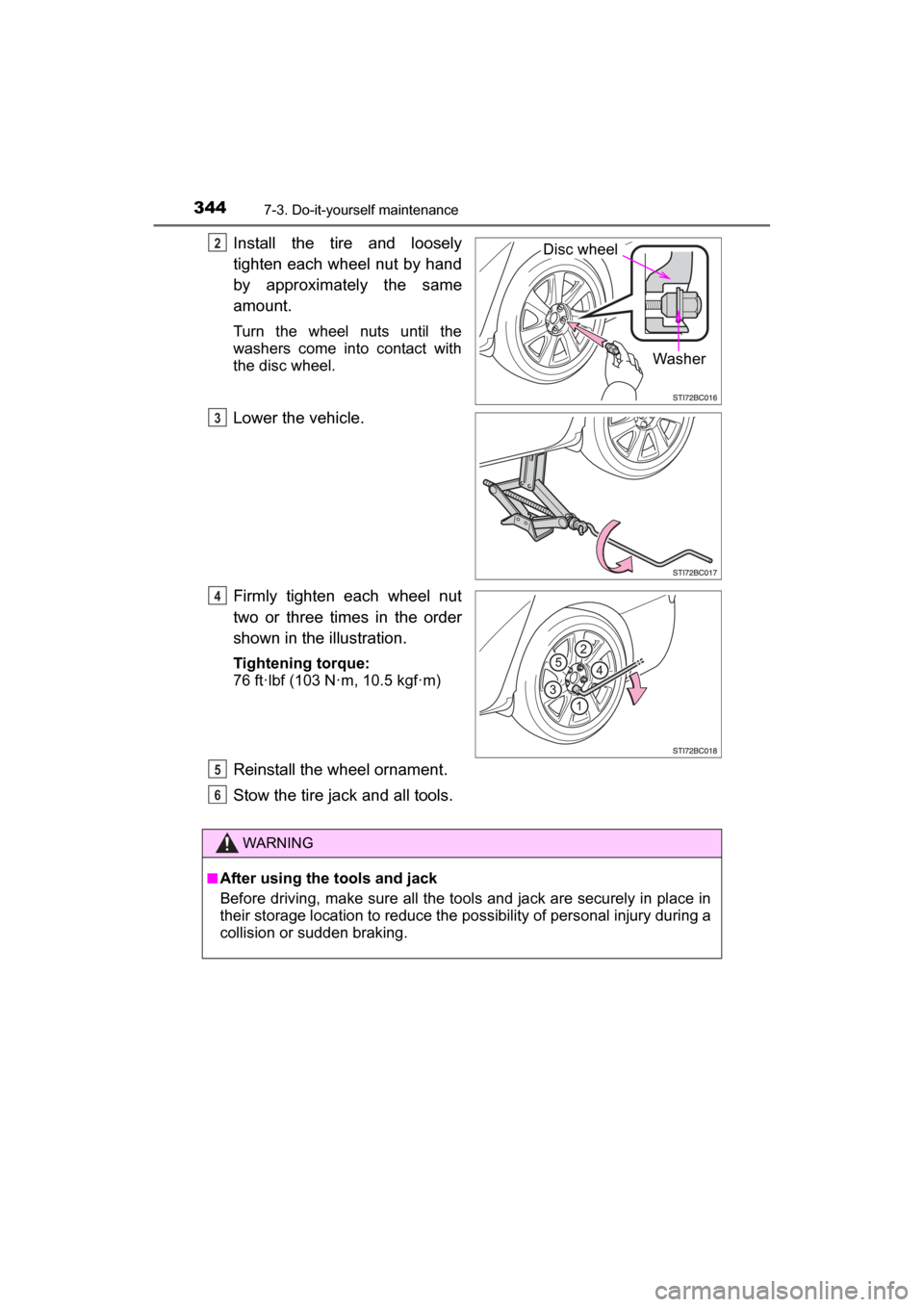
Install the tire and loosely
tighten each wheel nut by hand
by approximately the same
amount.
Turn the wheel nuts until the
washers come into contact with
the disc wheel.
Lower the vehicle.
Firmly tighten each wheel nut
two or three times in the order
shown in the illustration.
Tightening torque:
76 ft·lbf (103 N·m, 10.5 kgf·m)
Reinstall the wheel ornament.
Stow the tire jack and all tools.
Disc wheel
Washer2
3
4
WARNING
■After using the tools and jack
Before driving, make sure all the tools and jack are securely in place in
their storage location to reduce the po ssibility of personal injury during a
collision or sudden braking.
5
6
Page 361 of 464
3618-1. Essential information
MIRAI_OM_USA_OM62023U
8
When trouble arises
If your vehicle has to be stopped in an
emergency
Steadily step on the brake pedal with both feet and firmly depress it.
Do not pump the brake pedal repeatedly as this will increase the effort
required to slow the vehicle.
Shift the shift position to N.
If the shift position is shifted to N
After slowing down, stop the vehicle in a safe place by the road.
Stop the fuel cell system.
If the shift position cannot be shifted to N
Keep depressing the brake pedal with both feet to reduce vehicle
speed as much as possible.
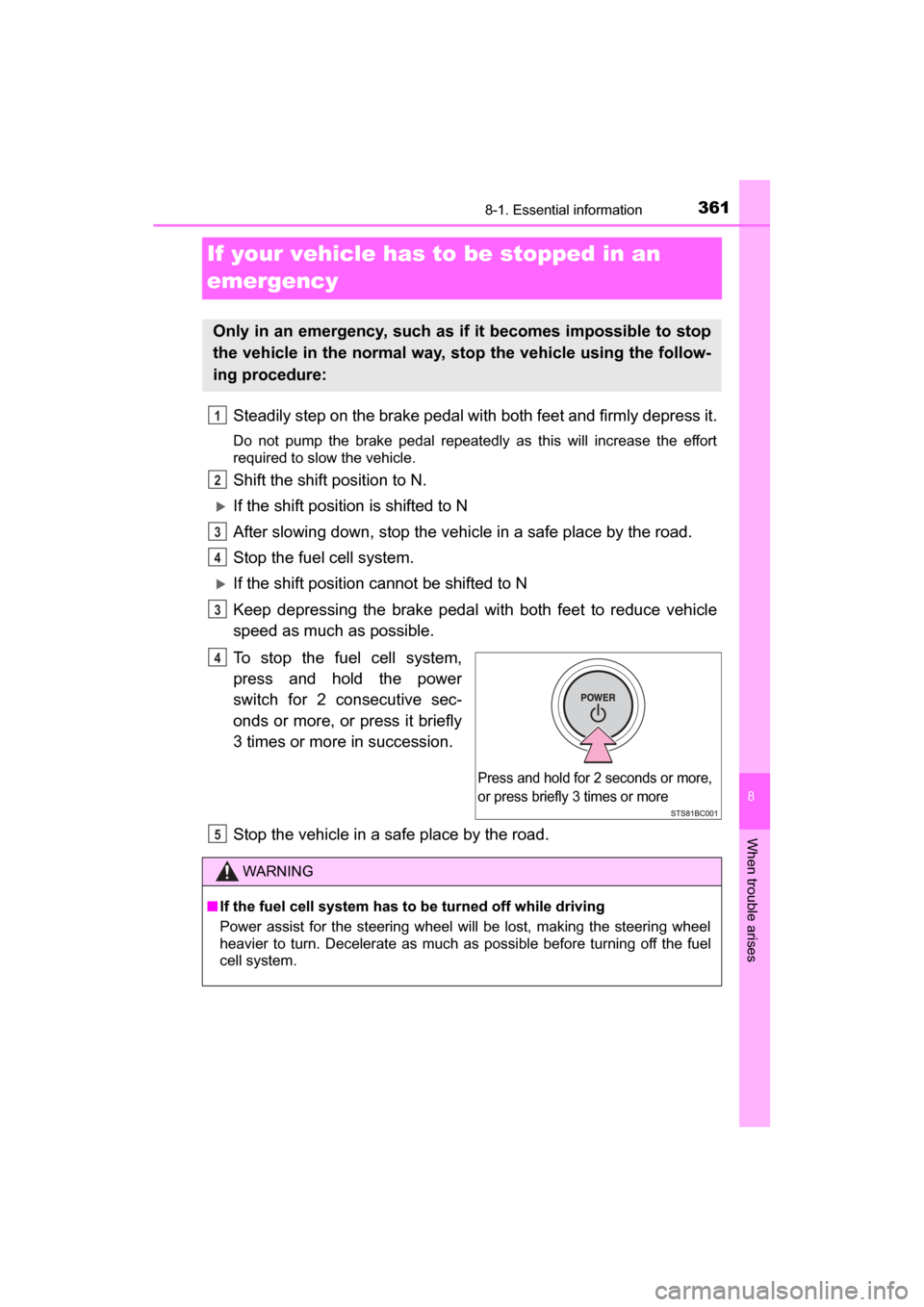
To stop the fuel cell system,
press and hold the power
switch for 2 consecutive sec-
onds or more, or press it briefly
3 times or more in succession.
Stop the vehicle in a safe place by the road.
Only in an emergency, such as if it becomes impossible to stop
the vehicle in the normal way, st op the vehicle using the follow-
ing procedure:
1
2
3
4
3
Press and hold for 2 seconds or more,
or press briefly 3 times or more
4
WARNING
■ If the fuel cell system has to be turned off while driving
Power assist for the steering wheel will be lost, making the steering wheel
heavier to turn. Decelerate as much as possible before turning off the fuel
cell system.
5
Page 364 of 464
3648-2. Steps to take in an emergency
MIRAI_OM_USA_OM62023U
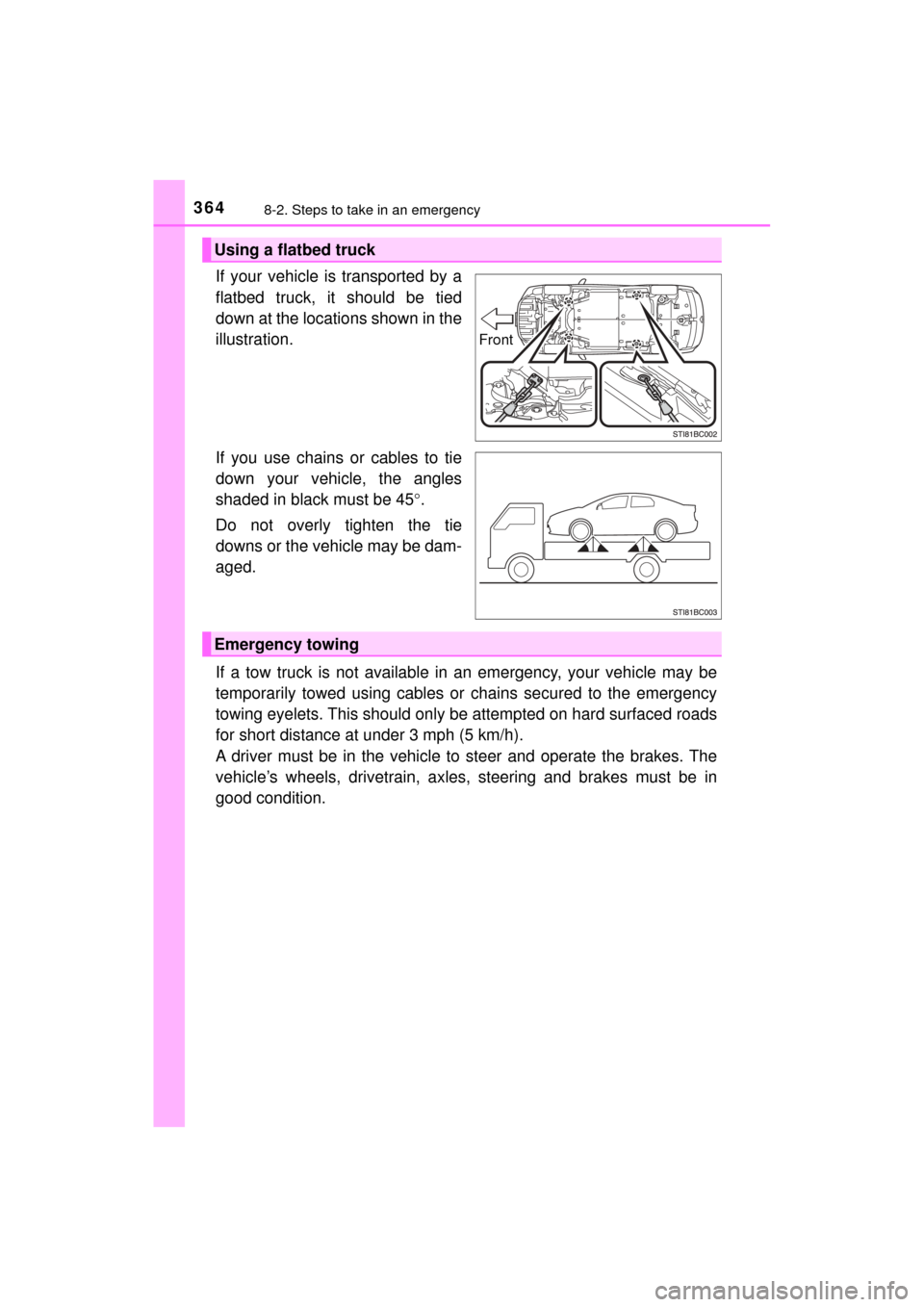
If your vehicle is transported by a
flatbed truck, it should be tied
down at the locations shown in the
illustration.
If you use chains or cables to tie
down your vehicle, the angles
shaded in black must be 45°.
Do not overly tighten the tie
downs or the vehicle may be dam-
aged.
If a tow truck is not available in an emergency, your vehicle may be
temporarily towed using cables or chains secured to the emergency
towing eyelets. This should only be attempted on hard surfaced roads
for short distance at under 3 mph (5 km/h).
A driver must be in the vehicle to steer and operate the brakes. The
vehicle’s wheels, drivetrain, axles, steering and brakes must be in
good condition.
Using a flatbed truck
Front
Emergency towing
Page 365 of 464
3658-2. Steps to take in an emergency
MIRAI_OM_USA_OM62023U
8
When trouble arises
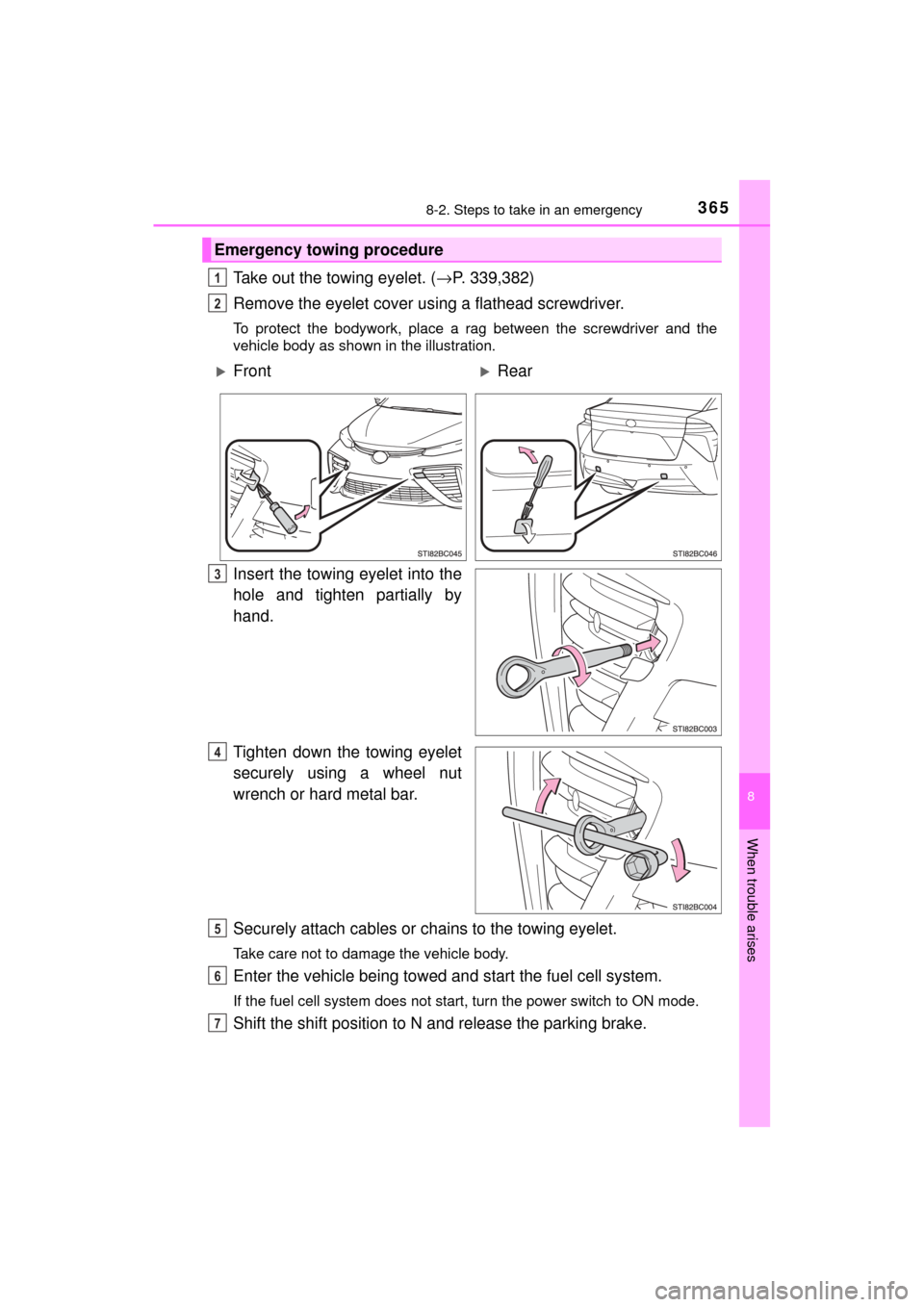
Take out the towing eyelet. (→P. 339,382)
Remove the eyelet cover us ing a flathead screwdriver.
To protect the bodywork, place a rag between the screwdriver and the
vehicle body as shown in the illustration.
Insert the towing eyelet into the
hole and tighten partially by
hand.
Tighten down the towing eyelet
securely using a wheel nut
wrench or hard metal bar.
Securely attach cables or chains to the towing eyelet.
Take care not to damage the vehicle body.
Enter the vehicle being towed and start the fuel cell system.
If the fuel cell system does not start, turn the power switch to ON mode\
.
Shift the shift position to N and release the parking brake.
Emergency towing procedure
1
2
FrontRear
3
4
5
6
7
Page 366 of 464
3668-2. Steps to take in an emergency
MIRAI_OM_USA_OM62023U
■While towing
If the fuel cell system is off, the power assist for the brakes and steering will
not function, making steering and braking more difficult.
■ Wheel nut wrench
Wheel nut wrench is installed in trunk. ( →P. 339, 382)
WARNING
Observe the following precautions.
Failure to do so may result in death or serious injury.
■ When towing the vehicle
■ While towing
● When towing using cables or chains, avoid sudden starts, etc., which
place excessive stress on the towing eyelets, cables or chains. The towing
eyelets, cables or chains may become damaged, broken debris may hit
people, and cause serious damage.
● Do not turn the power switch off.
This may lead to an accident as the front wheels will be locked by the
parking lock.
■ Installing towing eyelets to the vehicle
Make sure that towing eyelets are installed securely.
If not securely installed, towing eyelets may come loose during towing.
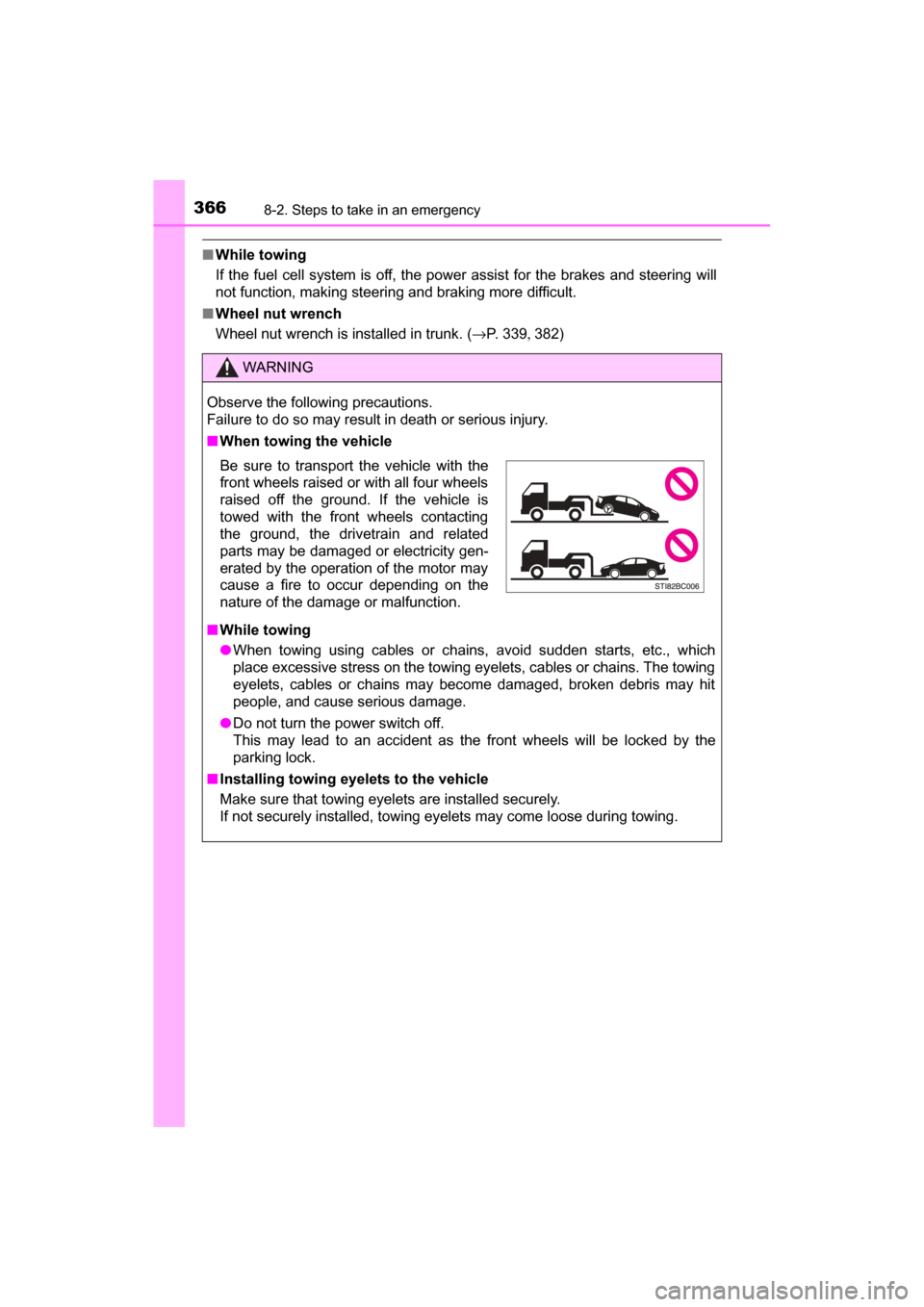
Be sure to transport the vehicle with the
front wheels raised or with all four wheels
raised off the ground. If the vehicle is
towed with the front wheels contacting
the ground, the drivetrain and related
parts may be damaged or electricity gen-
erated by the operation of the motor may
cause a fire to occur depending on the
nature of the damage or malfunction.
Page 367 of 464
3678-2. Steps to take in an emergency
MIRAI_OM_USA_OM62023U
8
When trouble arises
NOTICE
■To prevent damage to the vehicle wh en towing using a wheel-lift type
truck
When raising the vehicle, ensure adequate ground clearance for towing at
the opposite end of the raised vehicle. Without adequate clearance, the
vehicle could be damaged while being towed.
■ To prevent damage to the vehicle wh en towing with a sling-type truck
Do not tow with a sling-type truck, either from the front or rear.
■ To prevent damage to the vehic le during emergency towing
Do not secure cables or chains to the suspension components.
Page 373 of 464

3738-2. Steps to take in an emergency
MIRAI_OM_USA_OM62023U
8
When trouble arises
■SRS warning light
This warning light system monitors the airbag sensor assembly, front impact
sensors, side impact sensors (front door), side impact sensors (front), side
impact sensors (rear), driver’s seat posit ion sensor, driver’s seat belt buckle
switch, front passenger occupant classification system (ECU and sensors),
“AIR BAG ON” indicator light, “AIR BAG OFF” indicator light, front passen-
ger’s seat belt buckle switch, seat belt pretensioners, airbags, interconnect-
ing wiring and power sources. ( →P. 38)
■ Front passenger detection sensor, seat belt reminder and warning
buzzer
● If luggage is placed on the front passenger seat, the front passenger de\
tec-
tion sensor may cause the warning light to flash and the warning buzzer to
sound even if a passenger is not sitting in the seat.
● If a cushion is placed on the seat, the sensor may not detect a passenger,
and the warning light may not operate properly.
■ Electric power steering system warning light (warning buzzer)
When the 12-volt battery charge becomes insufficient or the voltage tempo-
rarily drops, the electric power steer ing system warning light may come on
and the warning buzzer may sound.
■
When the tire pressure warning light comes on
Inspect the appearance of the tire to check that the tire is not punctured.
If the tire is punctured: → P. 381
If the tire is not punctured:
After turning the power switch to off, turn it to ON mode again and make
sure the tire pressure warning light comes on or blinks.
The tire pressure warning light comes on
After the temperature of the tires have lowered sufficiently, check the
tire inflation pressure and adjust it to the specified level.
If the warning light does not go out even after several minutes, check
that the tire inflation pressu re is at the specified level.
If the warning light does not go out even after several minutes, have the
vehicle inspected by your Toyota dealer immediately.
The tire pressure warning light is blinking for 1 minute, and then comes
on
Malfunction in the tire pressure warning system. Have the system
checked by your Toyota dealer immediately.
■The tire pressure warning light may come on due to natural causes
The tire pressure warning light may come on due to natural causes such
as natural air leaks and tire inflat ion pressure changes caused by tem-
perature. In this case, adjusting the ti re inflation pressure will turn off the
warning light (afte r a few minutes).
■Conditions that the tire pressure warning system may not function
properly
→ P. 3 3 6
1
2
Page 378 of 464

3788-2. Steps to take in an emergency
MIRAI_OM_USA_OM62023U■
If “Press Brake When Vehicle is St opped FC System may Overheat” is
displayed
Message is displayed when the accelerator pedal is depressed to maintain
the vehicle position when stopped on an upward slope, etc.
If this continues, the fuel cell system may overheat.
Release the accelerator pedal and depress the brake pedal.
■ If “Accelerator Pedal is Pressed Check The Accelerator Pedal” is dis-
played
The accelerator pedal may be stuck.
If the message does not disappear even when the foot has been removed
from the accelerator pedal, check that the accelerator pedal is not stuck.
■ If “Ion Filter Maintenance Require d Visit Your Dealer” is displayed
Ion filter replacement is necessary. Contact your Toyota dealer.
■ If “Shift System Malfunction Stop Your Vehicle in a Safe Place then See
Owner's Manual” is displayed
The shift position may not be able to be shifted. Stop the vehicle in a safe
place.
Contact your Toyota dealer immediately.
■ If “Shift System Malfunction Shifting Unavailable See Owner’s Manual”
is displayed
The shift position may not be able to be shifted from P to a position other than
P.
Contact your Toyota dealer immediately.
■ If “Shift System Malfunction Wh en Parking, Apply Parking Brake
Securely then See Owner’s Manual” is displayed
● The parking lock mechanism may not operate.
● The automatically P position selection function ( →P. 177) may not operate.
● The power switch may not turn off. In that case, engage the parking brake
and the switch can be turned to off.
● The fuel cell system may not be able to be started.
When parking, choose a flat surface and be sure to engage the parking
brake.
Have the vehicle inspected by your Toyota dealer immediately.
Page 379 of 464
![TOYOTA MIRAI 2017 1.G Workshop Manual 3798-2. Steps to take in an emergency
MIRAI_OM_USA_OM62023U
8
When trouble arises
■If “[P] Switch Malfunction When Parking, Apply Parking Brake Securely
then See Owner’s Manual” is displayed](/img/14/6553/w960_6553-378.png "TOYOTA MIRAI 2017 1.G Workshop Manual 3798-2. Steps to take in an emergency
MIRAI_OM_USA_OM62023U
8
When trouble arises
■If “[P] Switch Malfunction When Parking, Apply Parking Brake Securely
then See Owner’s Manual” is displayed")
3798-2. Steps to take in an emergency
MIRAI_OM_USA_OM62023U
8
When trouble arises
■If “[P] Switch Malfunction When Parking, Apply Parking Brake Securely
then See Owner’s Manual” is displayed
The shift position may not switch to P even though the P position switch is
pressed.
When parking, choose a flat surface and be sure to engage the parking
brake.
Have the vehicle inspected by your Toyota dealer immediately.
■ If “Shift System Malfunction See Owner’s Manual” is displayed
If left as is, the system may not operate properly and an unexpected hazard
or damage may occur.
Have the vehicle inspected by your Toyota dealer immediately.
■ If “Insufficient Aux Battery Charge When Parking, Apply Parking Brake
Securely then See Owner’s Manual” is displayed
●The parking lock mechanism may not operate.
● The power switch may not turn off. In that case, engage the parking brake
and the switch can be turned to off.
● Even after charging the 12-volt battery, the warning message may continue
to be displayed until the shift position is shifted from P to a position other
than P.
● The fuel cell system may not be able to be started.
When parking, choose a flat surface and be sure to engage the parking
brake.
Have the 12-volt battery charged or replaced.
■ If “Insufficient Aux Battery Charge Shift is Unavailable See Owner’s
Manual” is displayed
Due to the voltage of the 12-volt battery being in a declined condition, when
trying to shift the shift position the warning message is displayed.
Have the 12-volt battery charged or replaced.
■ If “Shifting Temporarily Unavailable Wait a Moment and Try Again” is
displayed
A warning message is displayed when the shift lever and P position switch
are repeatedly operated over a short period of time.
Shift the shift position after waiting for short amount of time.
■ If “Shifting to [Br] Mode Unavailable Shift to [D] once, then Shift to [Br]”
is displayed
When the shift position is in P or N, a warning message is displayed when try-
ing to shift to Br mode.
Shift to Br mode after the shift position had been set to D.
■ If “Shifted to [N] Position Shift to [D] once, then Shift to [Br]” is dis-
played
When the shift position is in R, a warning message is displayed when trying to
shift to Br mode.
The shift position is changed to N.
Shift to Br Mode after the shift position has been set to D.