Heat TOYOTA MIRAI 2017 1.G Owners Manual
[x] Cancel search | Manufacturer: TOYOTA, Model Year: 2017, Model line: MIRAI, Model: TOYOTA MIRAI 2017 1.GPages: 464, PDF Size: 12.09 MB
Page 4 of 464

TABLE OF CONTENTS4
MIRAI_OM_USA_OM62023U6-1. Using the air conditioning
system and defogger
Automatic air conditioning system............................. 258
Heated steering wheel/ seat heaters .................... 267
6-2. Using the interior lights Interior lights list ................ 269• Interior lights ................. 270
• Personal lights .............. 270
6-3. Using the storage features List of storage features...... 272• Glove box...................... 273
• Console box .................. 273
• Cup holders .................. 274
• Bottle holders ................ 276
• Auxiliary box ................. 276
Trunk features ................... 277
6-4. Other interior features Other interior features ....... 279• Sun visors ..................... 279
• Vanity mirrors................ 279
• Clock ............................. 280
• Armrest ......................... 281
• Coat hooks.................... 281
• Assist grips ................... 282
• Power outlet .................. 283
• Wireless charger ........... 284
Garage door opener .......... 292
Safety Connect.................. 299 7-1. Maintenance and care
Cleaning and protecting the vehicle exterior .......... 306
Cleaning and protecting the vehicle interior ........... 310
7-2. Maintenance Maintenance requirements ................... 313
General maintenance ........ 315
7-3. Do-it-yourself maintenance
Do-it-yourself service precautions ...................... 318
Hood .................................. 320
Positioning a floor jack....... 321
Motor compartment ........... 323
12-volt battery .................... 328
Tires................................... 332
Replacing the tire............... 339
Tire inflation pressure ........ 346
Wheels............................... 349
Air conditioning filter .......... 351
Electronic key battery ........ 353
Checking and replacing fuses ................................ 355
Light bulbs ......................... 358
6Interior features7Maintenance and care
Page 5 of 464
5
MIRAI_OM_USA_OM62023U
1
9 8 6 5
4
3
2
10
7
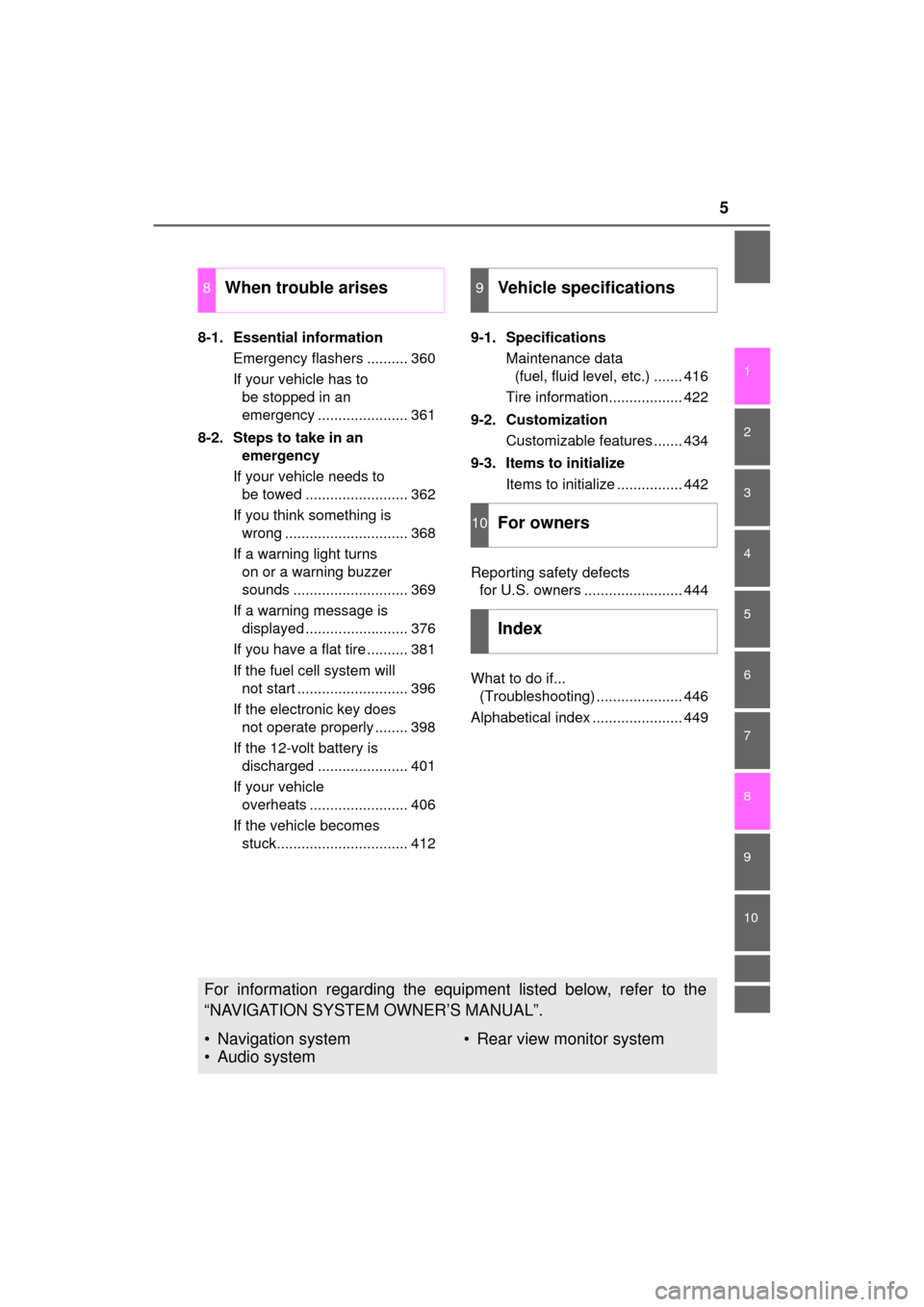
8-1. Essential informationEmergency flashers .......... 360
If your vehicle has to be stopped in an
emergency ...................... 361
8-2. Steps to take in an emergency
If your vehicle needs to be towed ......................... 362
If you think something is wrong .............................. 368
If a warning light turns on or a warning buzzer
sounds ............................ 369
If a warning message is displayed ......................... 376
If you have a flat tire .......... 381
If the fuel cell system will not start ........................... 396
If the electronic key does not operate properly ........ 398
If the 12-volt battery is discharged ...................... 401
If your vehicle overheats ........................ 406
If the vehicle becomes stuck................................ 412 9-1. Specifications
Maintenance data (fuel, fluid level, etc.) ....... 416
Tire information.................. 422
9-2. Customization Customizable features ....... 434
9-3. Items to initialize Items to initialize ................ 442
Reporting safety defects for U.S. owners ........................ 444
What to do if... (Troubleshooting) ..................... 446
Alphabetical index ...................... 449
8When trouble arises9Vehicle specifications
10For owners
Index
For information regarding the equipment listed below, refer to the
“NAVIGATION SYSTEM OWNER’S MANUAL”.
• Navigation system
• Audio system• Rear view monitor system
Page 10 of 464
10
MIRAI_OM_USA_OM62023UThe SRS airbag and seat belt pretensioner devices in your Toyota contain
explosive chemicals. If the vehicle is scrapped with the airbags and seat belt
pretensioners left as they are, this may cause an accident such as fire. Be
sure to have the systems of the SRS airbag and seat belt pretensioner
removed and disposed of by a qualified service shop or by your Toyota dealer
before you scrap your vehicle.
Special handling may apply, See www.dtsc.ca.gov/hazardouswaste/perchlorate.
Your vehicle has components that may contain perchlorate. These compo-
nents may include airbag, seat belt pretensioners, and wireless remote con-
trol batteries.
Scrapping of your Toyota
Perchlorate Material
WARNING
■
General precautions while driving
Driving under the influence: Never drive your vehicle when under the influ-
ence of alcohol or drugs that have impaired your ability to operate your vehi-
cle. Alcohol and certain drugs delay reaction time, impair judgment and
reduce coordination, which could lead to an accident that could result in
death or serious injury.
Defensive driving: Always drive defensively. Anticipate mistakes that other
drivers or pedestrians might make and be ready to avoid accidents.
Driver distraction: Always give your full attention to driving. Anything that
distracts the driver, such as adjusting controls, talking on a cellular phone or
reading can result in a collision with resulting death or serious injury to you,
your occupants or others.
■ General precaution regarding children’s safety
Never leave children unattended in the vehicle, and never allow children to
have or use the key.
Children may be able to start the vehicle or shift the vehicle into neut\
ral.
There is also a danger that children may injure themselves by playing with
the windows, the moon roof, or other features of the vehicle. In addition,
heat build-up or extremely cold temperatures inside the vehicle can be fatal
to children.
Page 15 of 464
15Pictorial index
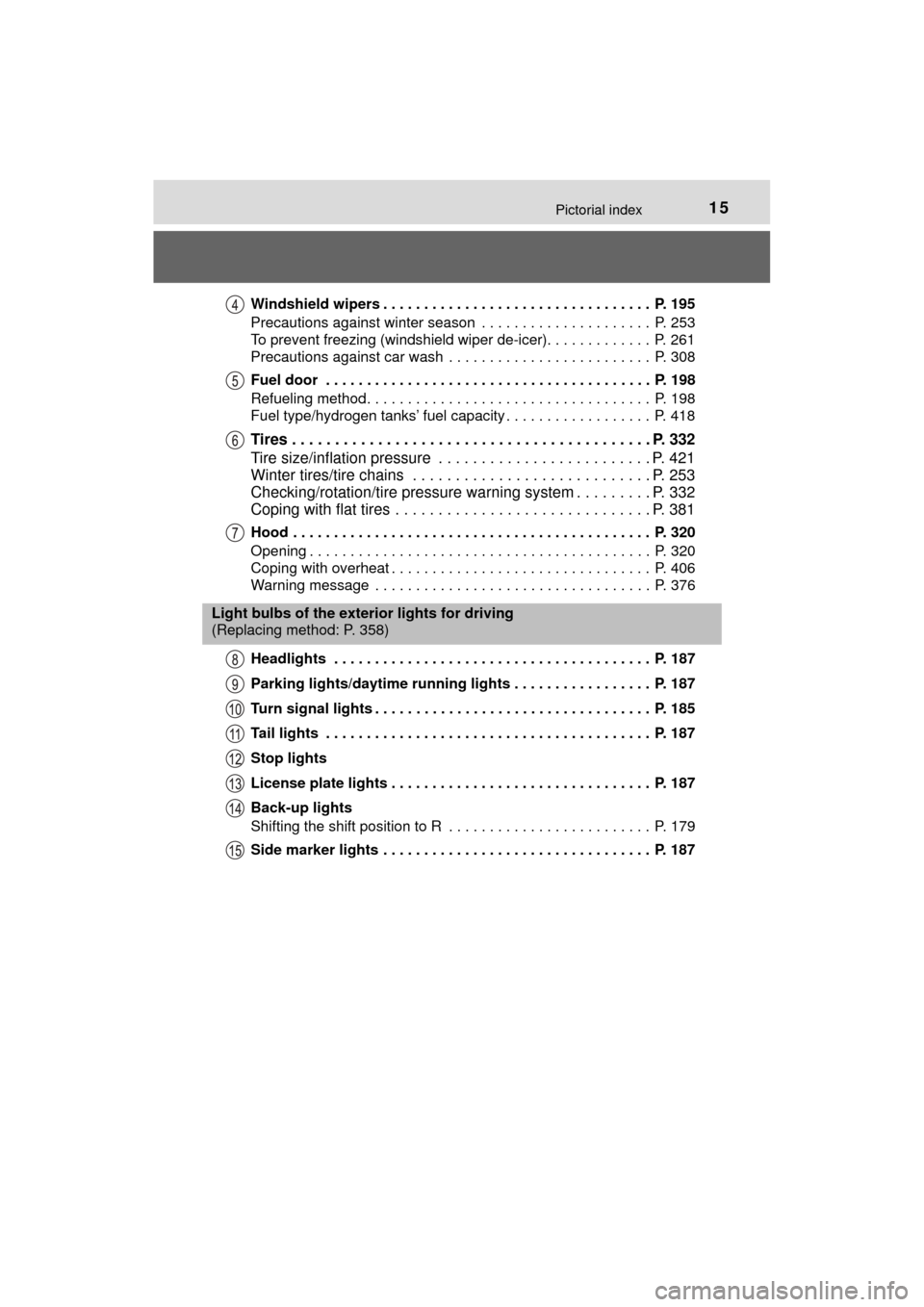
MIRAI_OM_USA_OM62023UWindshield wipers . . . . . . . . . . . . . . . . . . . . . . . . . . . . . . . . . P. 195
Precautions against winter season . . . . . . . . . . . . . . . . . . . . . P. 253
To prevent freezing (windshield wiper de-icer). . . . . . . . . . . . . P. 261
Precautions against car wash . . . . . . . . . . . . . . . . . . . . . . . . . P. 308
Fuel door . . . . . . . . . . . . . . . . . . . . . . . . . . . . . . . . . . . . . . . . P. 198
Refueling method . . . . . . . . . . . . . . . . . . . . . . . . . . . . . . . . . . . P. 198
Fuel type/hydrogen tanks’ fuel capacity . . . . . . . . . . . . . . . . . . P. 418
Tires . . . . . . . . . . . . . . . . . . . . . . . . . . . . . . . . . . . . . . . . . . P. 332
Tire size/inflation pressure . . . . . . . . . . . . . . . . . . . . . . . . . P. 421
Winter tires/tire chains . . . . . . . . . . . . . . . . . . . . . . . . . . . . P. 253
Checking/rotation/tire pressure warning system . . . . . . . . . P. 332
Coping with flat tires . . . . . . . . . . . . . . . . . . . . . . . . . . . . . . P. 381
Hood . . . . . . . . . . . . . . . . . . . . . . . . . . . . . . . . . . . . . . . . . . . . P. 320
Opening . . . . . . . . . . . . . . . . . . . . . . . . . . . . . . . . . . . . . . . . . . P. 320
Coping with overheat . . . . . . . . . . . . . . . . . . . . . . . . . . . . . . . . P. 406
Warning message . . . . . . . . . . . . . . . . . . . . . . . . . . . . . . . . . . P. 376
Headlights . . . . . . . . . . . . . . . . . . . . . . . . . . . . . . . . . . . . . . . P. 187
Parking lights/daytime running lights . . . . . . . . . . . . . . . . . P. 187
Turn signal lights . . . . . . . . . . . . . . . . . . . . . . . . . . . . . . . . . . P. 185
Tail lights . . . . . . . . . . . . . . . . . . . . . . . . . . . . . . . . . . . . . . . . P. 187
Stop lights
License plate lights . . . . . . . . . . . . . . . . . . . . . . . . . . . . . . . . P. 187
Back-up lights
Shifting the shift position to R . . . . . . . . . . . . . . . . . . . . . . . . . P. 179
Side marker lights . . . . . . . . . . . . . . . . . . . . . . . . . . . . . . . . . P. 187
Light bulbs of the exterior lights for driving
(Replacing method: P. 358)
Page 24 of 464
24Pictorial index
MIRAI_OM_USA_OM62023U
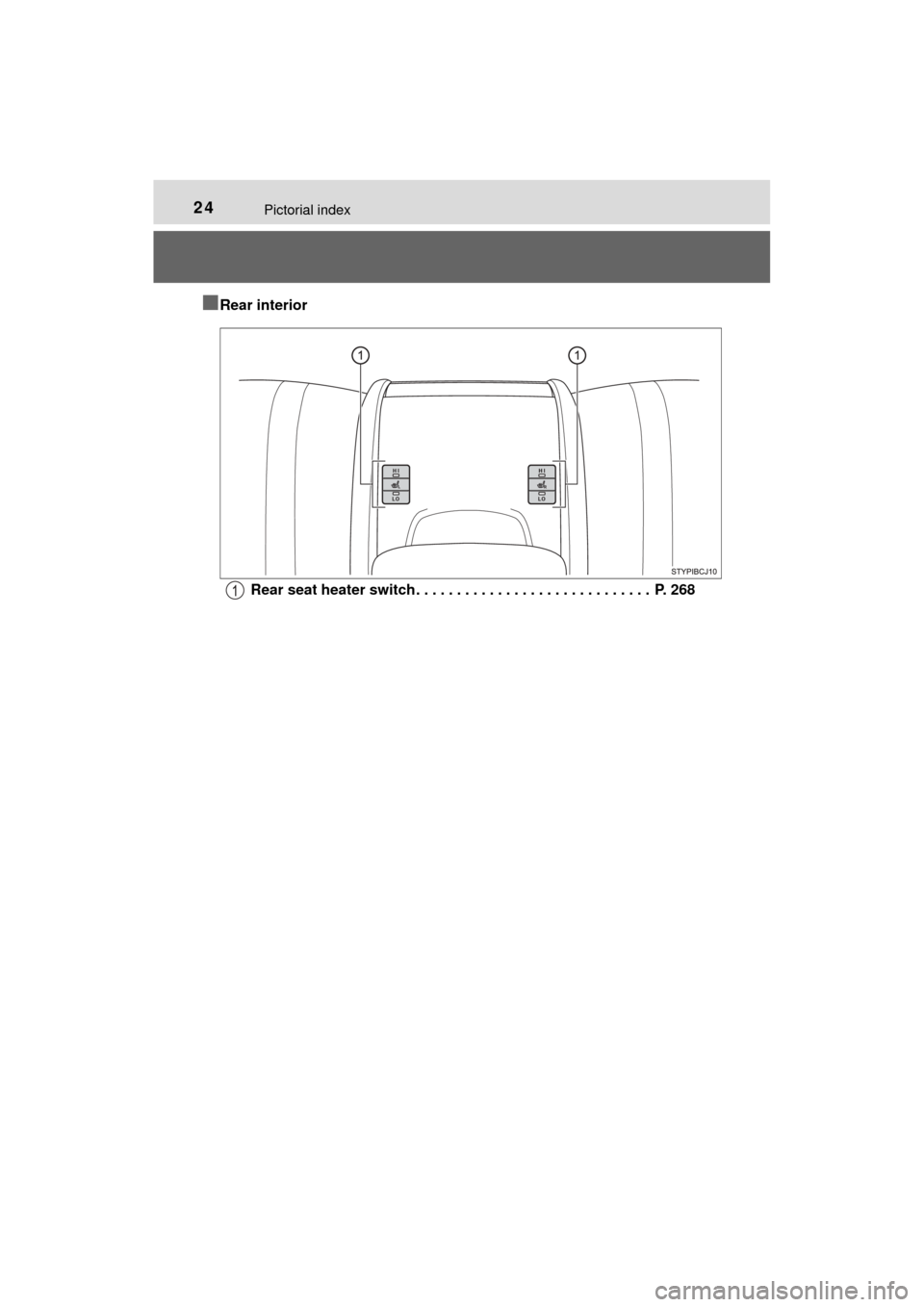
■Rear interiorRear seat heater switch. . . . . . . . . . . . . . . . . . . . . . . . . . . . . P. 268
Page 55 of 464
551-1. For safe use
1
For safety and security
MIRAI_OM_USA_OM62023U
Safety information for children
●It is recommended that children sit in the rear seats to avoid acci-
dental contact with the shift lever, wiper switch, etc.
● Use the rear door child-protector lock or the window lock switch to
avoid children opening the door while driving or operating the
power window accidentally. ( →P. 123, 154)
● Do not let small children operate equipment which may catch or
pinch body parts, such as the pow er window, hood, trunk, seats,
etc.
Observe the following precautions when children are in the vehi-
cle.
Use a child restraint system appropriate for the child, until the
child becomes large enough to pr operly wear the vehicle’s seat
belt.
WARNING
Never leave children unattended in the vehicle, and never allow children to
have or use the key.
Children may be able to start the vehicle or shift the vehicle into neut\
ral.
There is also a danger that children may injure themselves by playing with
the windows or other features of the vehicle. In addition, heat build-up or
extremely cold temperatures inside the vehicle can be fatal to children.
Page 83 of 464
832. Fuel cell vehicle
2
Fuel cell system
MIRAI_OM_USA_OM62023U
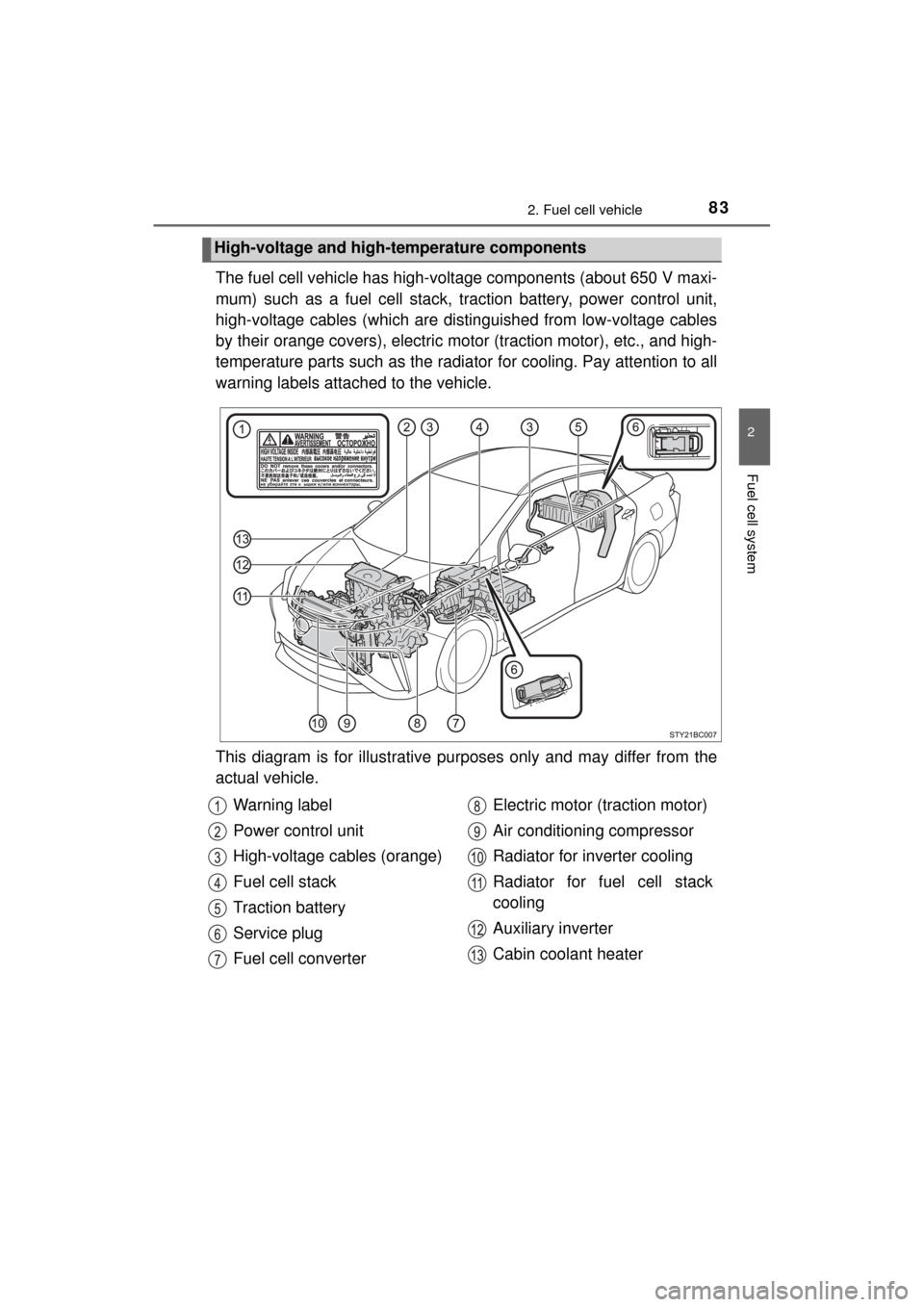
The fuel cell vehicle has high-voltage components (about 650 V maxi-
mum) such as a fuel cell stack, traction battery, power control unit,
high-voltage cables (which are distinguished from low-voltage cables
by their orange covers), electric motor (traction motor), etc., and high-
temperature parts such as the radiator for cooling. Pay attention to all
warning labels attached to the vehicle.
This diagram is for illust rative purposes only and may differ from the
actual vehicle.
High-voltage and high-temperature components
Warning label
Power control unit
High-voltage cables (orange)
Fuel cell stack
Traction battery
Service plug
Fuel cell converter Electric motor (traction motor)
Air conditioning compressor
Radiator for inverter cooling
Radiator for fuel cell stack
cooling
Auxiliary inverter
Cabin coolant heater
Page 93 of 464
932. Fuel cell vehicle
2
Fuel cell system
MIRAI_OM_USA_OM62023U
WARNING
■Traction battery
● Never resell, transfer, or modify the traction battery. To prevent accidents,
traction batteries that have been removed from disposed vehicle are col-
lected through Toyota dealers. Do not dispose of the traction battery your-
self.
If the traction battery is not properly collected, the following may occur,
resulting in death or serious injury:
• The traction battery may be illegally disposed or dumped, and it is haz-
ardous to the environment. Additionally, someone may touch a high-volt-
age part, resulting in an electric shock.
• The traction battery is intended to be used exclusively with your fuel cell vehicle. If the traction battery is used outside of your vehicle or modified
in any way, accidents, such as electric shock, heat generation, smoke
generation, ignition, explosion and electrolyte leakage may occur.
In particular, reselling or transferri ng the traction battery exposes the
receiving party to risks of accidents as they may not be aware of these
dangers. Make sure to inform them of the contents of this Owner’s Man-
ual.
● If your vehicle is disposed without the traction battery having been
removed, there is a danger of serious electric shock in case high-voltage
parts, cables, or their connectors are touched. When disposing of your
vehicle, the traction battery must be disposed by your Toyota dealer, or a
qualified service shop. If the traction battery is not disposed of properly, it
may cause electric shock that can result in death or serious injury.
NOTICE
■ Traction battery air intake vent
● If the traction battery output decreases due to the entry of dust or debris,
foreign material, a warning message is shown on the multi-information dis-
play. Have the vehicle inspected at your Toyota dealer.
● Do not place objects where the air intake vent will be obstructed. This may
lead to a reduction in traction battery power output and damage.
● Clean the air intake vent regularly to prevent clogging.
● Do not allow water or objects to enter the air intake vent, as this may dam-
age the traction battery.
■ Traction Battery
Do not spill a large amount of water near the traction battery in the vehicle.
If water spills onto the traction battery, have the vehicle inspected at your
Toyota dealer.
Page 95 of 464
952. Fuel cell vehicle
2
Fuel cell system
MIRAI_OM_USA_OM62023U
◆Using Eco drive mode
Using Eco drive mode (→P. 181) makes torque generation less
aggressive than normal when stepping on the accelerator pedal,
leading to improvement in fuel economy.
Also, is displayed on the air conditioning screen, indicating
the switch to ECO HEAT/COOL mode ( →P. 260).
◆Air conditioning system on/off
● Turn off the air conditioning sy stem operation switch except
when necessary to help curb fuel consumption.
In summer: When the ambient temper ature is high, use the recircu-
lated air mode. This decreas es the load on the air con-
ditioning system.
In winter: Avoid excess heating. Use the seat heater to minimize
the need for cabin heating ( →P. 268).
● By pushing , ECO HEAT/COOL mode is turned on. This
helps curb fuel consumption even with the air conditioning system
turned on.
◆Checking tire inflation pressure
Make sure to check the tire infl ation pressure frequently. Improper
tire inflation pressure can cause poor fuel economy.
Additionally, snow tire s have more rolling friction and their use on
dry roads lead to poor fuel econom y. Use tires that are appropriate
for the season.
◆Luggage
Avoid carrying unnecessary luggage and unload excess weight in
order avoid poor fuel ec onomy. Installing a large roof rack will also
reduce fuel economy.
Page 106 of 464
1063. Instrument cluster
MIRAI_OM_USA_OM62023U■
Outside temperature display
●In the following situations, the correct outside temperature may not be dis-
played, or the display may take longer than normal to change.
• When stopped, or driving at low speeds (less than 16 mph [25 km/h])
• When the outside temperature has changed suddenly (at the entrance/
exit of a garage, tunnel, etc.)
● When “--” or “E” is displayed, the system may be malfunctioning.
Take your vehicle to your Toyota dealer.
■ Liquid crystal display
Small spots or light spots may appear on the display. This phenomenon is
characteristic of liquid crystal displays, and there is no problem continuing to
use the display.
■ Customization
The meter display can be customized on the multi-information display.
(Customizable features: →P. 439)
NOTICE
■To prevent damage to the fuel cell system and its components
This vehicle is equipped with high coolant temperature warning light
(→ P. 369), instead of, coolant temperature gauge.
The fuel cell system may be overheating if the high coolant temperature
warning light flashes or comes on. In this case, immediately stop the
vehicle in a safe place, and check the fuel cell system after it has cooled
completely.