Rear light TOYOTA MIRAI 2017 1.G Owners Manual
[x] Cancel search | Manufacturer: TOYOTA, Model Year: 2017, Model line: MIRAI, Model: TOYOTA MIRAI 2017 1.GPages: 464, PDF Size: 12.09 MB
Page 2 of 464
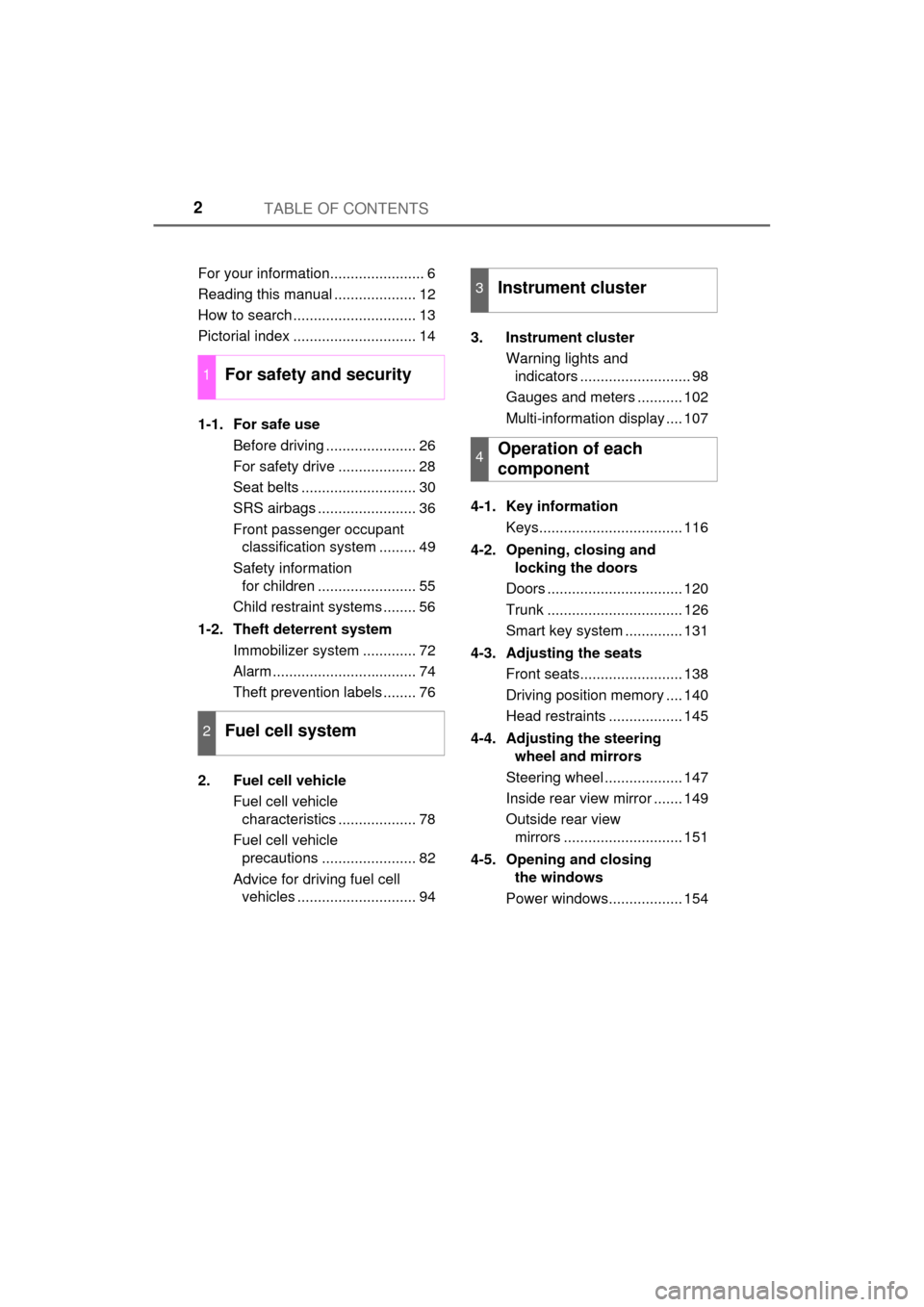
TABLE OF CONTENTS2
MIRAI_OM_USA_OM62023UFor your information....................... 6
Reading this manual .................... 12
How to search .............................. 13
Pictorial index .............................. 14
1-1. For safe use
Before driving ...................... 26
For safety drive ................... 28
Seat belts ............................ 30
SRS airbags ........................ 36
Front passenger occupant classification system ......... 49
Safety information for children ........................ 55
Child restraint systems ........ 56
1-2. Theft deterrent system Immobilizer system ............. 72
Alarm ................................... 74
Theft prevention labels ........ 76
2. Fuel cell vehicle Fuel cell vehicle characteristics ................... 78
Fuel cell vehicle precautions ....................... 82
Advice for driving fuel cell vehicles ............................. 94 3. Instrument cluster
Warning lights and indicators ........................... 98
Gauges and meters ........... 102
Multi-information display .... 107
4-1. Key information Keys................................... 116
4-2. Opening, closing and locking the doors
Doors ................................. 120
Trunk ................................. 126
Smart key system .............. 131
4-3. Adjusting the seats Front seats......................... 138
Driving position memory .... 140
Head restraints .................. 145
4-4. Adjusting the steering wheel and mirrors
Steering wheel ................... 147
Inside rear view mirror ....... 149
Outside rear view mirrors ............................. 151
4-5. Opening and closing the windows
Power windows.................. 154
1For safety and security
2Fuel cell system
3Instrument cluster
4Operation of each
component
Page 5 of 464
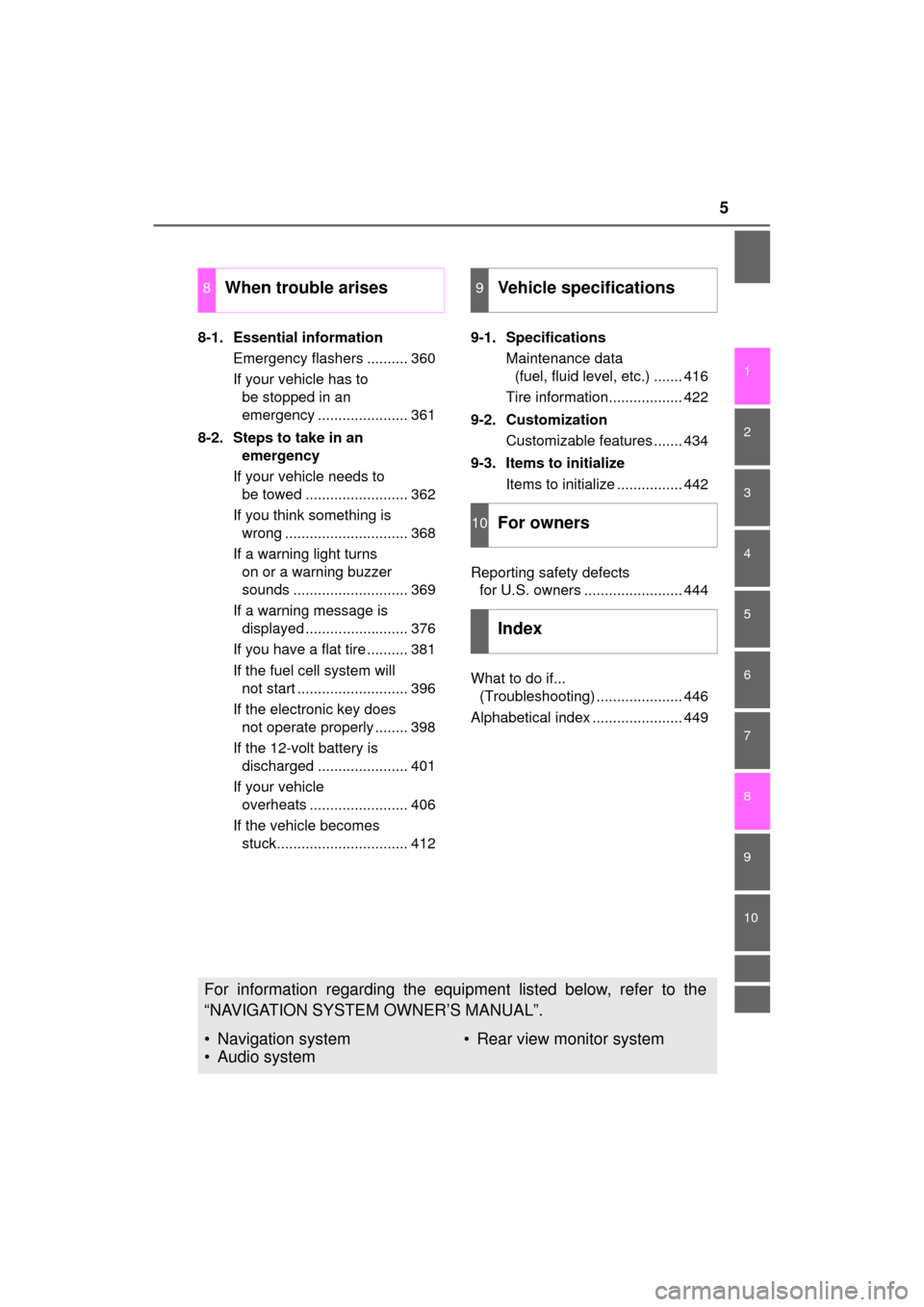
5
MIRAI_OM_USA_OM62023U
1
9 8 6 5
4
3
2
10
7
8-1. Essential informationEmergency flashers .......... 360
If your vehicle has to be stopped in an
emergency ...................... 361
8-2. Steps to take in an emergency
If your vehicle needs to be towed ......................... 362
If you think something is wrong .............................. 368
If a warning light turns on or a warning buzzer
sounds ............................ 369
If a warning message is displayed ......................... 376
If you have a flat tire .......... 381
If the fuel cell system will not start ........................... 396
If the electronic key does not operate properly ........ 398
If the 12-volt battery is discharged ...................... 401
If your vehicle overheats ........................ 406
If the vehicle becomes stuck................................ 412 9-1. Specifications
Maintenance data (fuel, fluid level, etc.) ....... 416
Tire information.................. 422
9-2. Customization Customizable features ....... 434
9-3. Items to initialize Items to initialize ................ 442
Reporting safety defects for U.S. owners ........................ 444
What to do if... (Troubleshooting) ..................... 446
Alphabetical index ...................... 449
8When trouble arises9Vehicle specifications
10For owners
Index
For information regarding the equipment listed below, refer to the
“NAVIGATION SYSTEM OWNER’S MANUAL”.
• Navigation system
• Audio system• Rear view monitor system
Page 14 of 464
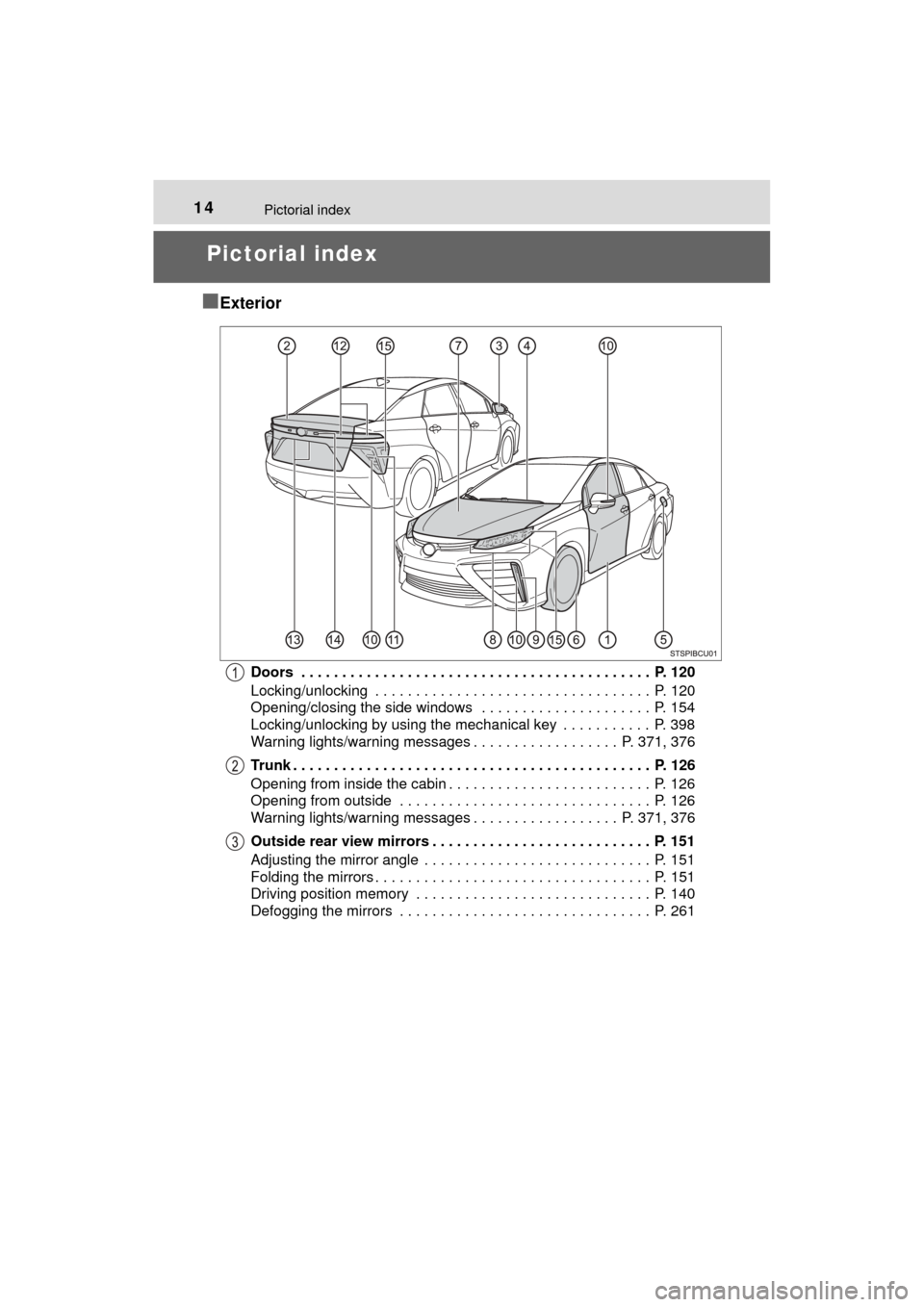
14Pictorial index
MIRAI_OM_USA_OM62023U
Pictorial index
■
Exterior
Doors . . . . . . . . . . . . . . . . . . . . . . . . . . . . . . . . . . . . . . . . . . . P. 120
Locking/unlocking . . . . . . . . . . . . . . . . . . . . . . . . . . . . . . . . . . P. 120
Opening/closing the side windows . . . . . . . . . . . . . . . . . . . . . P. 154
Locking/unlocking by using the mechanical key . . . . . . . . . . . P. 398
Warning lights/warning messages . . . . . . . . . . . . . . . . . . P. 371, 376
Trunk . . . . . . . . . . . . . . . . . . . . . . . . . . . . . . . . . . . . . . . . . . . . P. 126
Opening from inside the cabin . . . . . . . . . . . . . . . . . . . . . . . . . P. 126
Opening from outside . . . . . . . . . . . . . . . . . . . . . . . . . . . . . . . P. 126
Warning lights/warning messages . . . . . . . . . . . . . . . . . . P. 371, 376
Outside rear view mirrors . . . . . . . . . . . . . . . . . . . . . . . . . . . P. 151
Adjusting the mirror angle . . . . . . . . . . . . . . . . . . . . . . . . . . . . P. 151
Folding the mirrors . . . . . . . . . . . . . . . . . . . . . . . . . . . . . . . . . . P. 151
Driving position memory . . . . . . . . . . . . . . . . . . . . . . . . . . . . . P. 140
Defogging the mirrors . . . . . . . . . . . . . . . . . . . . . . . . . . . . . . . P. 261
Page 17 of 464

17Pictorial index
MIRAI_OM_USA_OM62023UParking brake . . . . . . . . . . . . . . . . . . . . . . . . . . . . . . . . . . . . . P. 186
Applying/releasing . . . . . . . . . . . . . . . . . . . . . . . . . . . . . . . . . . P. 186
Precautions against winter season . . . . . . . . . . . . . . . . . . . . . P. 254
Warning buzzer/warning message. . . . . . . . . . . . . . . . . . P. 371, 376
Turn signal lever . . . . . . . . . . . . . . . . . . . . . . . . . . . . . . . . . . P. 185
Headlight switch . . . . . . . . . . . . . . . . . . . . . . . . . . . . . . . . . . P. 187
Headlights/parking lights/side marker lights/tail lights/
daytime running lights . . . . . . . . . . . . . . . . . . . . . . . . . . . . . . . P. 187
Windshield wiper and washer switch . . . . . . . . . . . . . . . . . P. 195
Usage . . . . . . . . . . . . . . . . . . . . . . . . . . . . . . . . . . . . . . . . . . . P. 195
Adding washer fluid . . . . . . . . . . . . . . . . . . . . . . . . . . . . . . . . . P. 327
Emergency flasher switch . . . . . . . . . . . . . . . . . . . . . . . . . . P. 360
Fuel door opener switch . . . . . . . . . . . . . . . . . . . . . . . . . . . . P. 198
Trunk opener switch . . . . . . . . . . . . . . . . . . . . . . . . . . . . . . . P. 126
Hood lock release lever. . . . . . . . . . . . . . . . . . . . . . . . . . . . . P. 320
Tilt and telescopic steering control switch . . . . . . . . . . . . . P. 147
Adjustment . . . . . . . . . . . . . . . . . . . . . . . . . . . . . . . . . . . . . . . . P. 147
Driving position memory . . . . . . . . . . . . . . . . . . . . . . . . . . . . . P. 141
Air conditioning system . . . . . . . . . . . . . . . . . . . . . . . . . . . . P. 258
Usage . . . . . . . . . . . . . . . . . . . . . . . . . . . . . . . . . . . . . . . . . . . P. 258
Rear window defogger . . . . . . . . . . . . . . . . . . . . . . . . . . . . . . . P. 261
Trunk opener main switch . . . . . . . . . . . . . . . . . . . . . . . . . . P. 127
Page 23 of 464
23Pictorial index
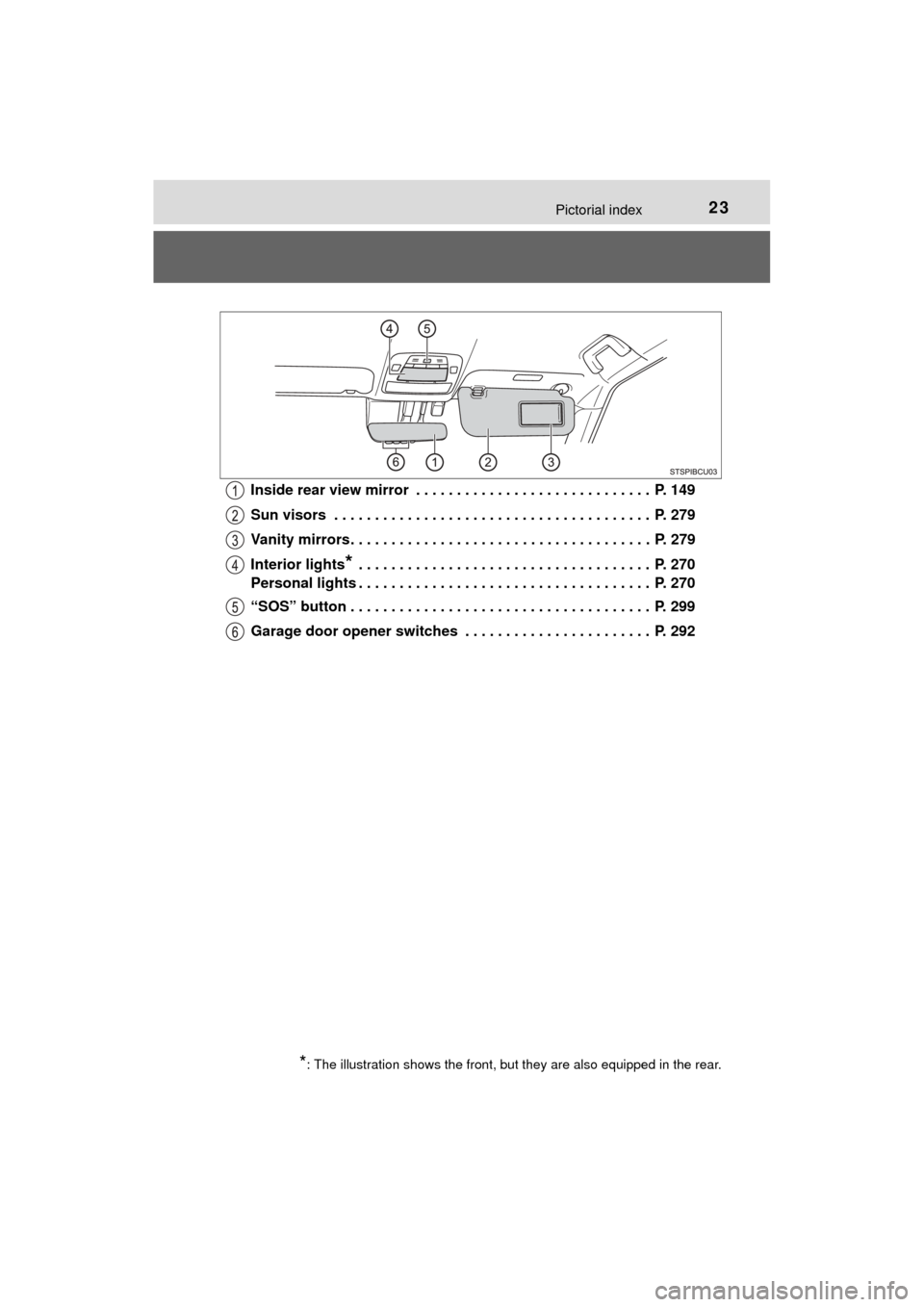
MIRAI_OM_USA_OM62023UInside rear view mirror . . . . . . . . . . . . . . . . . . . . . . . . . . . . . P. 149
Sun visors . . . . . . . . . . . . . . . . . . . . . . . . . . . . . . . . . . . . . . . P. 279
Vanity mirrors . . . . . . . . . . . . . . . . . . . . . . . . . . . . . . . . . . . . . P. 279
Interior lights
* . . . . . . . . . . . . . . . . . . . . . . . . . . . . . . . . . . . . P. 270
Personal lights . . . . . . . . . . . . . . . . . . . . . . . . . . . . . . . . . . . . P. 270
“SOS” button . . . . . . . . . . . . . . . . . . . . . . . . . . . . . . . . . . . . . P. 299
Garage door opener switches . . . . . . . . . . . . . . . . . . . . . . . P. 292
*: The illustration shows the front, but they are also equipped in the rear.
Page 28 of 464
281-1. For safe use
MIRAI_OM_USA_OM62023U
For safety drive
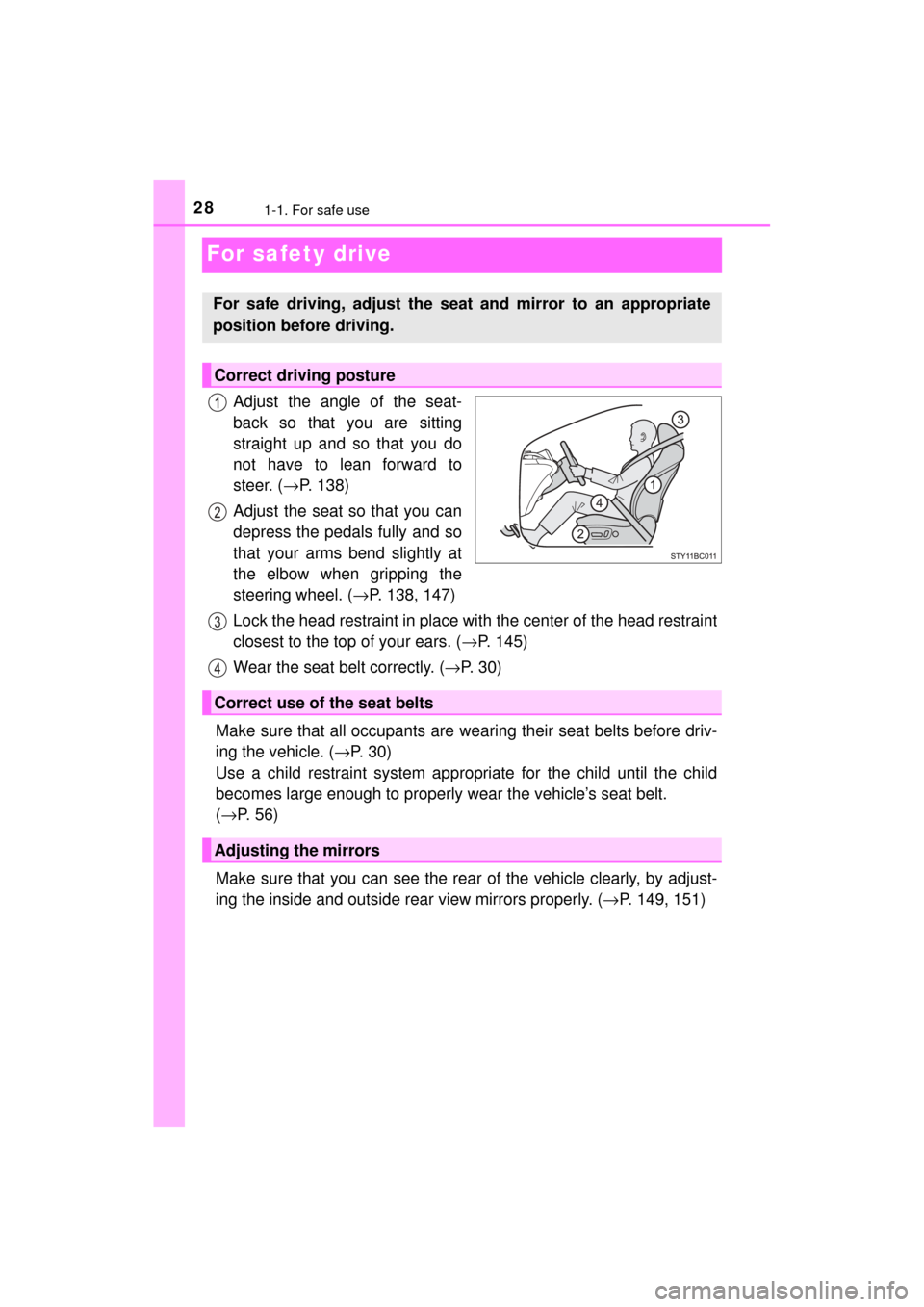
Adjust the angle of the seat-
back so that you are sitting
straight up and so that you do
not have to lean forward to
steer. (→P. 138)
Adjust the seat so that you can
depress the pedals fully and so
that your arms bend slightly at
the elbow when gripping the
steering wheel. ( →P. 138, 147)
Lock the head restraint in place with the center of the head restraint
closest to the top of your ears. ( →P. 145)
Wear the seat belt correctly. ( →P. 3 0 )
Make sure that all occupants are we aring their seat belts before driv-
ing the vehicle. ( →P. 3 0 )
Use a child restraint system appropriate for the child until the child
becomes large enough to properly wear the vehicle’s seat belt.
( → P. 56)
Make sure that you can see the rear of the vehicle clearly, by adjust-
ing the inside and outside rear view mirrors properly. ( →P. 149, 151)
For safe driving, adjust the seat and mirror to an appropriate
position before driving.
Correct driving posture
Correct use of the seat belts
Adjusting the mirrors
Page 38 of 464
381-1. For safe use
MIRAI_OM_USA_OM62023U
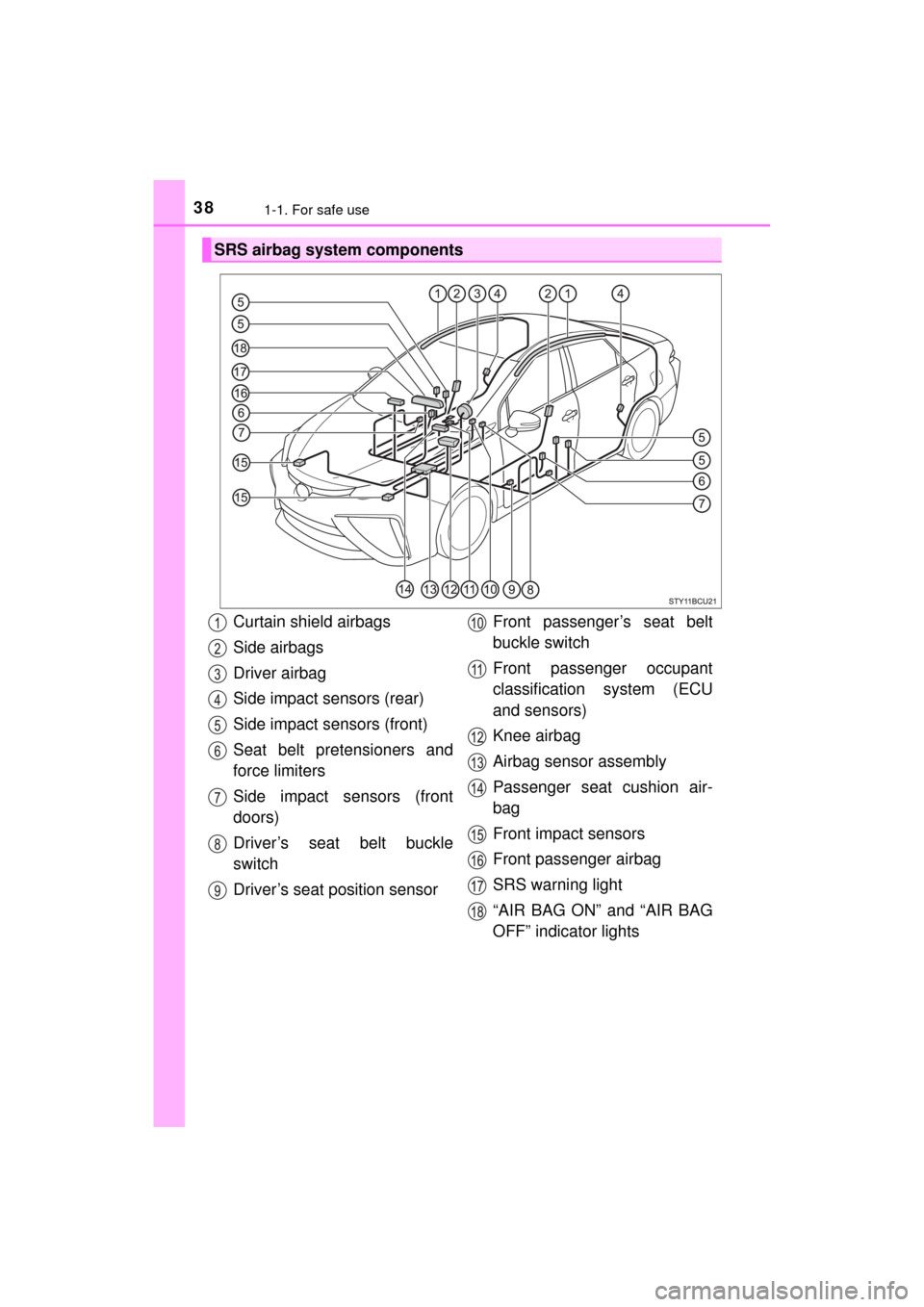
SRS airbag system components
Curtain shield airbags
Side airbags
Driver airbag
Side impact sensors (rear)
Side impact sensors (front)
Seat belt pretensioners and
force limiters
Side impact sensors (front
doors)
Driver’s seat belt buckle
switch
Driver’s seat position sensorFront passenger’s seat belt
buckle switch
Front passenger occupant
classification system (ECU
and sensors)
Knee airbag
Airbag sensor assembly
Passenger seat cushion air-
bag
Front impact sensors
Front passenger airbag
SRS warning light
“AIR BAG ON” and “AIR BAG
OFF” indicator lights
Page 39 of 464

391-1. For safe use
1
For safety and security
MIRAI_OM_USA_OM62023U
Your vehicle is equipped with ADVANCED AIRBAGS designed based
on the US motor vehicle safety standards (FMVSS208). The airbag
sensor assembly (ECU) controls airbag dep loyment based on infor-
mation obtained from the sensors et c. shown in the system compo-
nents diagram above. This informat ion includes crash severity and
occupant information. As the airbags deploy, a chemical reaction in
the inflators quickly fills the airbag s with non-toxic gas to help restrain
the motion of the occupants.
WARNING
■ SRS airbag precautions
Observe the following precautions regarding the SRS airbags.
Failure to do so may cause death or serious injury.
● The driver and all passengers in the vehicle must wear their seat belts
properly.
The SRS airbags are supplemental devices to be used with the seat belts.
● The SRS driver airbag deploys with considerable force, and can cause
death or serious injury especially if the driver is very close to the airbag.
The National Highway Traffic Safety Administration (NHTSA) advises:
Since the risk zone for the driver’s airbag is the first 2 - 3 in. (50 - 75 mm)
of inflation, placing yourself 10 in. (250 mm) from your driver airbag pro-
vides you with a clear margin of safety. This distance is measured from
the center of the steering wheel to your breastbone. If you sit less than 10
in. (250 mm) away now, you can change your driving position in several
ways:
• Move your seat to the rear as far as you can while still reaching the ped-
als comfortably.
• Slightly recline the back of the seat.
Although vehicle designs vary, many drivers can achieve the 10 in. (250
mm) distance, even with the driver seat all the way forward, simply by
reclining the back of the seat somewhat. If reclining the back of your
seat makes it hard to see the road, raise yourself by using a firm, non-
slippery cushion, or raise the seat if your vehicle has that feature.
• If your steering wheel is adjustable, tilt it downward. This points the air-
bag toward your chest instead of your head and neck.
The seat should be adjusted as recommended by NHTSA above, while
still maintaining control of the foot pedals, steering wheel, and your view
of the instrument panel controls.
Page 44 of 464

441-1. For safe use
MIRAI_OM_USA_OM62023U
■If the SRS airbags deploy (inflate)
●Bruising and slight abrasions may result from contact with a deploying
(inflating) SRS airbag.
● A loud noise and white powder will be emitted.
● Parts of the airbag module (steering wheel hub, airbag cover and inflat\
or) as
well as the front seats, parts of the front and rear pillars, and roof side rails,
may be hot for several minutes. The airbag itself may also be hot.
● The windshield may crack.
● For Safety Connect subscribers, if the SRS airbags deploy or in the event of
a severe rear-end collision, the system is designed to send an emergency
call to the response center, notifying them of the vehicle’s location (without
needing to push the “SOS” button) and an agent will attempt to speak with
the occupants to ascertain the level of emergency and assistance required.
If the occupants are unable to communicate, the agent automatically treats
the call as an emergency and helps to dispatch the necessary emergency
services. ( →P. 299)
■ SRS airbag deployment conditions (SRS front airbags)
●The SRS front airbags will deploy in the event of an impact that exceeds the
set threshold level (the level of force corresponding to an approximately 12 -
18 mph [20 - 30 km/h] frontal collision with a fixed wall that does not move or
deform).
However, this threshold velocity will be considerably higher in the following
situations:
• If the vehicle strikes an object, such as a parked vehicle or sign pole, which can move or deform on impact
• If the vehicle is involved in an underride collision, such as a collision in which the front of the vehicle “underrides”, or goes under, the bed of a
truck
● Depending on the type of collision, it is possible that only the seat belt pre-
tensioners will activate.
● The SRS front airbags for the front passenger will not activate if there is no
passenger sitting in the front passenger seat. However, the SRS front air-
bags for the front passenger may deploy if luggage is put in the seat, even if
the seat is unoccupied.
● The SRS seat cushion airbag on the front passenger seat will not operate if
the occupant is not wearing a seat belt.
Page 52 of 464
521-1. For safe use
MIRAI_OM_USA_OM62023U■
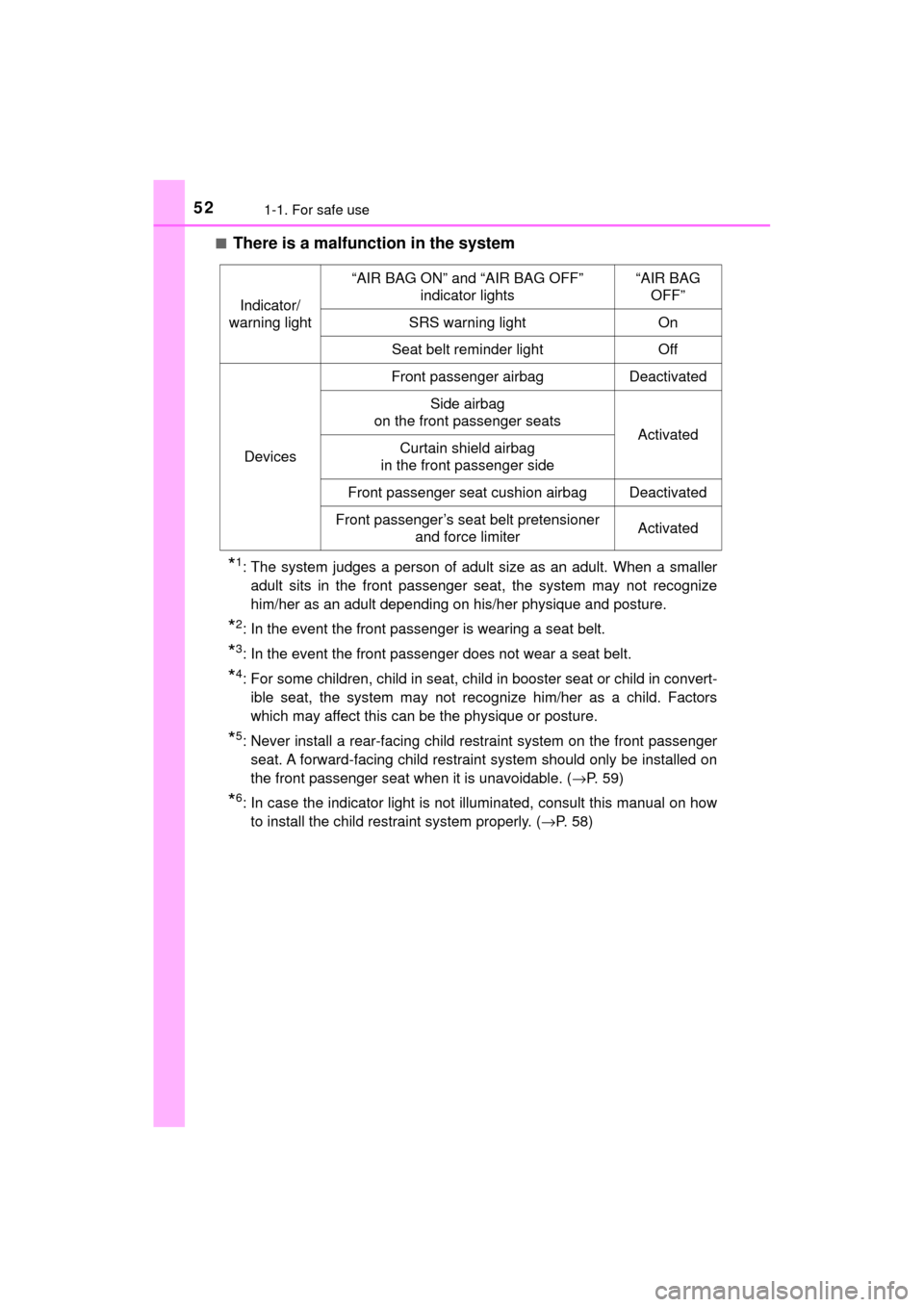
There is a malfunction in the system
*1: The system judges a person of adult size as an adult. When a smaller
adult sits in the front passenger seat, the system may not recognize
him/her as an adult depending on his/her physique and posture.
*2: In the event the front passenger is wearing a seat belt.
*3: In the event the front passenger does not wear a seat belt.
*4: For some children, child in seat, child in booster seat or child in convert-ible seat, the system may not recognize him/her as a child. Factors
which may affect this can be the physique or posture.
*5: Never install a rear-facing child restraint system on the front passengerseat. A forward-facing child restraint system should only be installed on
the front passenger seat when it is unavoidable. ( →P. 59)
*6: In case the indicator light is not illuminated, consult this manual on how
to install the child restraint system properly. ( →P. 58)
Indicator/
warning light
“AIR BAG ON” and “AIR BAG OFF” indicator lights“AIR BAG OFF”
SRS warning lightOn
Seat belt reminder lightOff
Devices
Front passenger airbagDeactivated
Side airbag
on the front passenger seats
ActivatedCurtain shield airbag
in the front passenger side
Front passenger seat cushion airbagDeactivated
Front passenger’s seat belt pretensioner
and force limiterActivated