run flat TOYOTA MIRAI 2017 1.G Owners Manual
[x] Cancel search | Manufacturer: TOYOTA, Model Year: 2017, Model line: MIRAI, Model: TOYOTA MIRAI 2017 1.GPages: 464, PDF Size: 12.09 MB
Page 4 of 464

TABLE OF CONTENTS4
MIRAI_OM_USA_OM62023U6-1. Using the air conditioning
system and defogger
Automatic air conditioning system............................. 258
Heated steering wheel/ seat heaters .................... 267
6-2. Using the interior lights Interior lights list ................ 269• Interior lights ................. 270
• Personal lights .............. 270
6-3. Using the storage features List of storage features...... 272• Glove box...................... 273
• Console box .................. 273
• Cup holders .................. 274
• Bottle holders ................ 276
• Auxiliary box ................. 276
Trunk features ................... 277
6-4. Other interior features Other interior features ....... 279• Sun visors ..................... 279
• Vanity mirrors................ 279
• Clock ............................. 280
• Armrest ......................... 281
• Coat hooks.................... 281
• Assist grips ................... 282
• Power outlet .................. 283
• Wireless charger ........... 284
Garage door opener .......... 292
Safety Connect.................. 299 7-1. Maintenance and care
Cleaning and protecting the vehicle exterior .......... 306
Cleaning and protecting the vehicle interior ........... 310
7-2. Maintenance Maintenance requirements ................... 313
General maintenance ........ 315
7-3. Do-it-yourself maintenance
Do-it-yourself service precautions ...................... 318
Hood .................................. 320
Positioning a floor jack....... 321
Motor compartment ........... 323
12-volt battery .................... 328
Tires................................... 332
Replacing the tire............... 339
Tire inflation pressure ........ 346
Wheels............................... 349
Air conditioning filter .......... 351
Electronic key battery ........ 353
Checking and replacing fuses ................................ 355
Light bulbs ......................... 358
6Interior features7Maintenance and care
Page 15 of 464
15Pictorial index
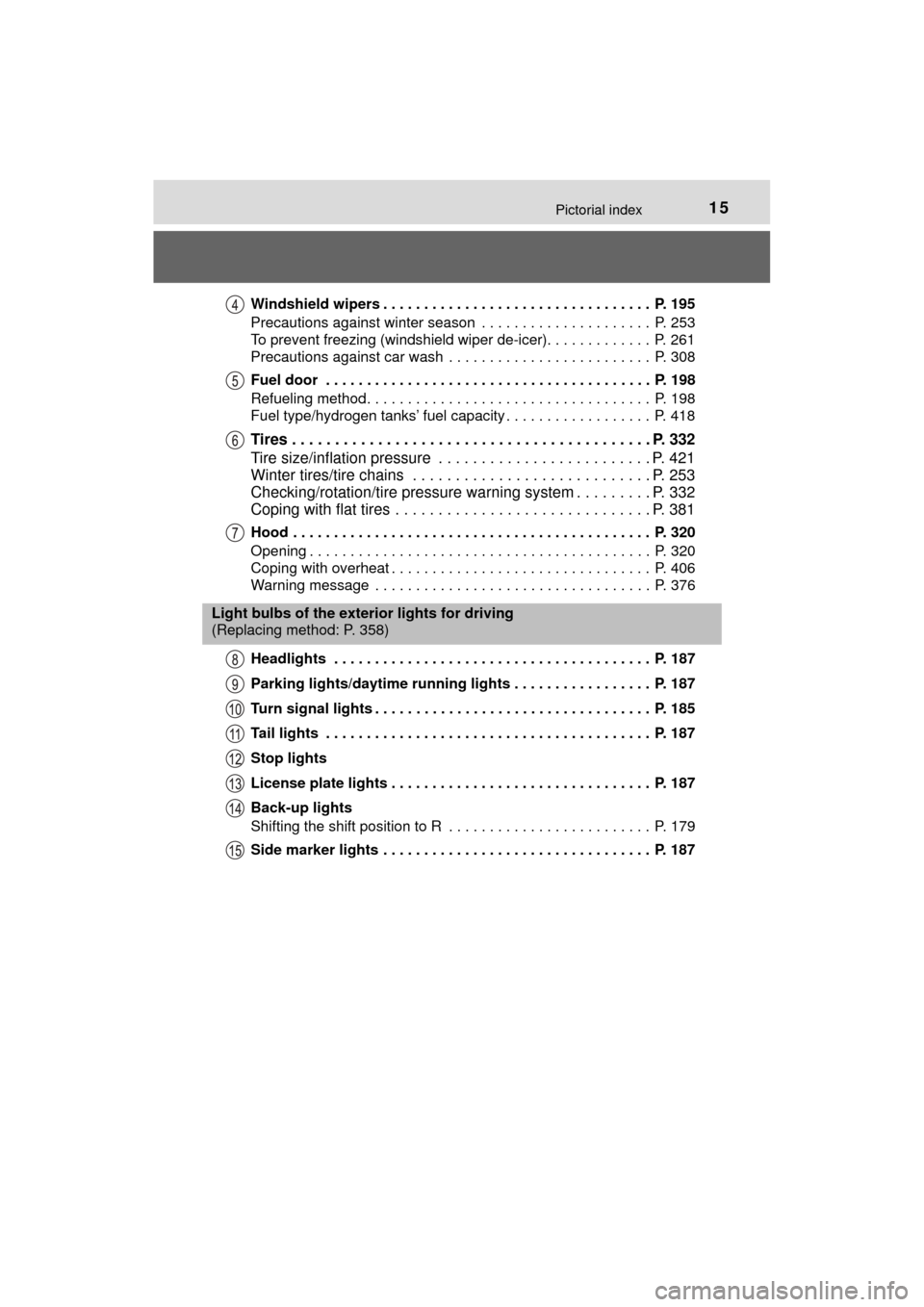
MIRAI_OM_USA_OM62023UWindshield wipers . . . . . . . . . . . . . . . . . . . . . . . . . . . . . . . . . P. 195
Precautions against winter season . . . . . . . . . . . . . . . . . . . . . P. 253
To prevent freezing (windshield wiper de-icer). . . . . . . . . . . . . P. 261
Precautions against car wash . . . . . . . . . . . . . . . . . . . . . . . . . P. 308
Fuel door . . . . . . . . . . . . . . . . . . . . . . . . . . . . . . . . . . . . . . . . P. 198
Refueling method . . . . . . . . . . . . . . . . . . . . . . . . . . . . . . . . . . . P. 198
Fuel type/hydrogen tanks’ fuel capacity . . . . . . . . . . . . . . . . . . P. 418
Tires . . . . . . . . . . . . . . . . . . . . . . . . . . . . . . . . . . . . . . . . . . P. 332
Tire size/inflation pressure . . . . . . . . . . . . . . . . . . . . . . . . . P. 421
Winter tires/tire chains . . . . . . . . . . . . . . . . . . . . . . . . . . . . P. 253
Checking/rotation/tire pressure warning system . . . . . . . . . P. 332
Coping with flat tires . . . . . . . . . . . . . . . . . . . . . . . . . . . . . . P. 381
Hood . . . . . . . . . . . . . . . . . . . . . . . . . . . . . . . . . . . . . . . . . . . . P. 320
Opening . . . . . . . . . . . . . . . . . . . . . . . . . . . . . . . . . . . . . . . . . . P. 320
Coping with overheat . . . . . . . . . . . . . . . . . . . . . . . . . . . . . . . . P. 406
Warning message . . . . . . . . . . . . . . . . . . . . . . . . . . . . . . . . . . P. 376
Headlights . . . . . . . . . . . . . . . . . . . . . . . . . . . . . . . . . . . . . . . P. 187
Parking lights/daytime running lights . . . . . . . . . . . . . . . . . P. 187
Turn signal lights . . . . . . . . . . . . . . . . . . . . . . . . . . . . . . . . . . P. 185
Tail lights . . . . . . . . . . . . . . . . . . . . . . . . . . . . . . . . . . . . . . . . P. 187
Stop lights
License plate lights . . . . . . . . . . . . . . . . . . . . . . . . . . . . . . . . P. 187
Back-up lights
Shifting the shift position to R . . . . . . . . . . . . . . . . . . . . . . . . . P. 179
Side marker lights . . . . . . . . . . . . . . . . . . . . . . . . . . . . . . . . . P. 187
Light bulbs of the exterior lights for driving
(Replacing method: P. 358)
Page 220 of 464

2205-5. Using the driving support systems
MIRAI_OM_USA_OM62023U■
Conditions in which the function may not operate correctly
In the following situations, the camera sensor may be unable to recognize
lane markers causing the lane departure warning function to operate incor-
rectly. However, this does not indicate a malfunction.
●When there are shadows on the road running parallel with lane markers, or
if a shadow covers the lane markers
● When driving through an area with no lane markers, such as a toll booth, a
crossing or before a ticket checkpoint
● When the lane markers are broken, Botts’ dots (raised pavement markers)
or stones
● When lane markers are obscured or partially obscured by sand, dirt, etc.
● When driving on a road surface that is wet due to rain, previous rainfall,
standing water, etc.
● When the lane markers are yellow (These may be more difficult for the sys-
tem to recognize compared to white markers.)
● When the lane markers are on a curb, etc.
● When driving on a particularly bright road surface, such as concrete
● When driving on a road surface that is bright due to reflected light
● When driving in a location where the light level changes rapidly, such as the
entrance to or exit from a tunnel
● When sunlight or the headlights of oncoming vehicles are shining directly
into the camera lens
● When driving on roads that are branching or merging
● When driving on winding roads or roads that are uneven
● When driving on rough or unpaved roads
● When driving on a sharp curve
● When lane markers are extremely narrow or extremely wide
● When the vehicle leans to one side an unusual amount due to a heavy load
or improper tire inflation pressure
● When the following distance between your vehicle and the vehicle ahead is
extremely short
● When the vehicle experiences strong up-and-down motion such as when
driving on an extremely rough road or on a seam in the pavement
● When headlight brightness at nighttime is reduced due to dirt on the lenses,
or when the headlights are misaligned
■ When changing the tires
Depending on the tires used, sufficient performance may not be maintainable.
Page 317 of 464
3177-2. Maintenance
MIRAI_OM_USA_OM62023U
7
Maintenance and care
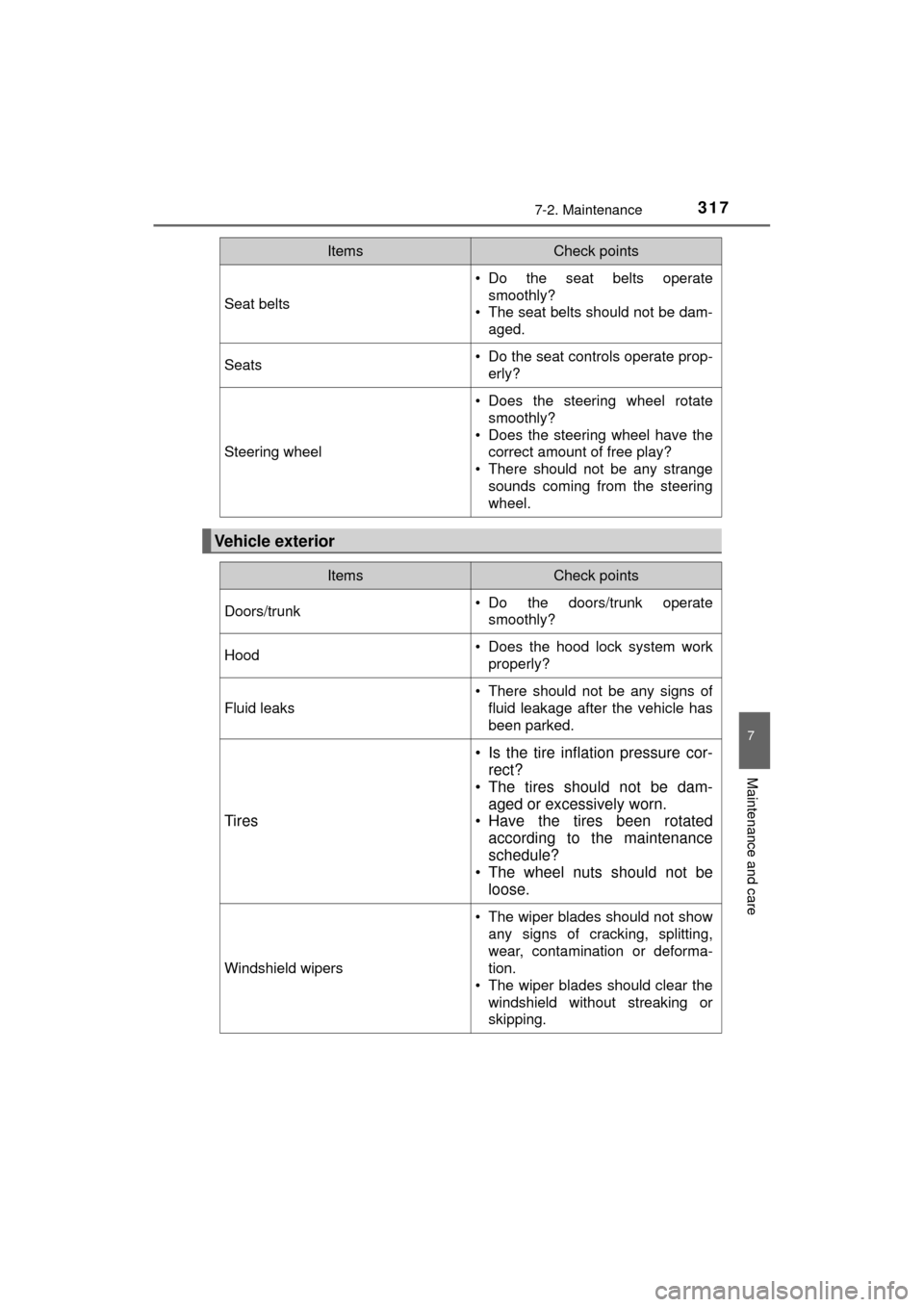
Seat belts
• Do the seat belts operatesmoothly?
• The seat belts should not be dam-
aged.
Seats• Do the seat controls operate prop-erly?
Steering wheel
• Does the steering wheel rotatesmoothly?
• Does the steering wheel have the correct amount of free play?
• There should not be any strange sounds coming from the steering
wheel.
Vehicle exterior
ItemsCheck points
ItemsCheck points
Doors/trunk• Do the doors/trunk operatesmoothly?
Hood• Does the hood lock system workproperly?
Fluid leaks
• There should not be any signs of
fluid leakage after the vehicle has
been parked.
Tires
• Is the tire inflation pressure cor-rect?
• The tires should not be dam- aged or excessively worn.
• Have the tires been rotated
according to the maintenance
schedule?
• The wheel nuts should not be
loose.
Windshield wipers
• The wiper blades should not show
any signs of cracking, splitting,
wear, contamination or deforma-
tion.
• The wiper blades should clear the windshield without streaking or
skipping.
Page 336 of 464

3367-3. Do-it-yourself maintenance
MIRAI_OM_USA_OM62023U■
Situations in which the tire pressure warning system may not oper-
ate properly
●In the following cases, the tire pr
essure warning system may not operate
properly.
• If non-genuine Toyota wheels are used.
• A tire has been replaced with a tire that is not an OE (Original Equip- ment) tire.
• A tire has been replaced with a tire that is not of the specified size.
• Tire chains, etc., are equipped.
• An auxiliary-supported run- flat tire is equipped.
• If a window tint that affects the radio wave signals is installed.
• If there is a lot of snow or ice on the vehicle, particularly around the wheels or wheel housings.
• If the tire inflation pressure is extremely higher than the specified level.
• If wheels without the tire pressure warning valves and transmitters
are used.
• If the ID code on the tire pressure warning valves and transmitters is not registered in the tire pressure warning computer.
●Performance may be affected in the following situations.
• Near a TV tower, electric power plant, gas station, radio station, largedisplay, airport or other facility that generates strong radio waves or
electrical noise
• When carrying a portable radio, cellular phone, cordless phone or other wireless communication device
●When the vehicle is parked, the time taken for the warning to start or go
off could be extended.
●When tire inflation pressure declines rapidly for example when a tire has
burst, the warning may not function.
Page 368 of 464
3688-2. Steps to take in an emergency
MIRAI_OM_USA_OM62023U
If you think something is wrong
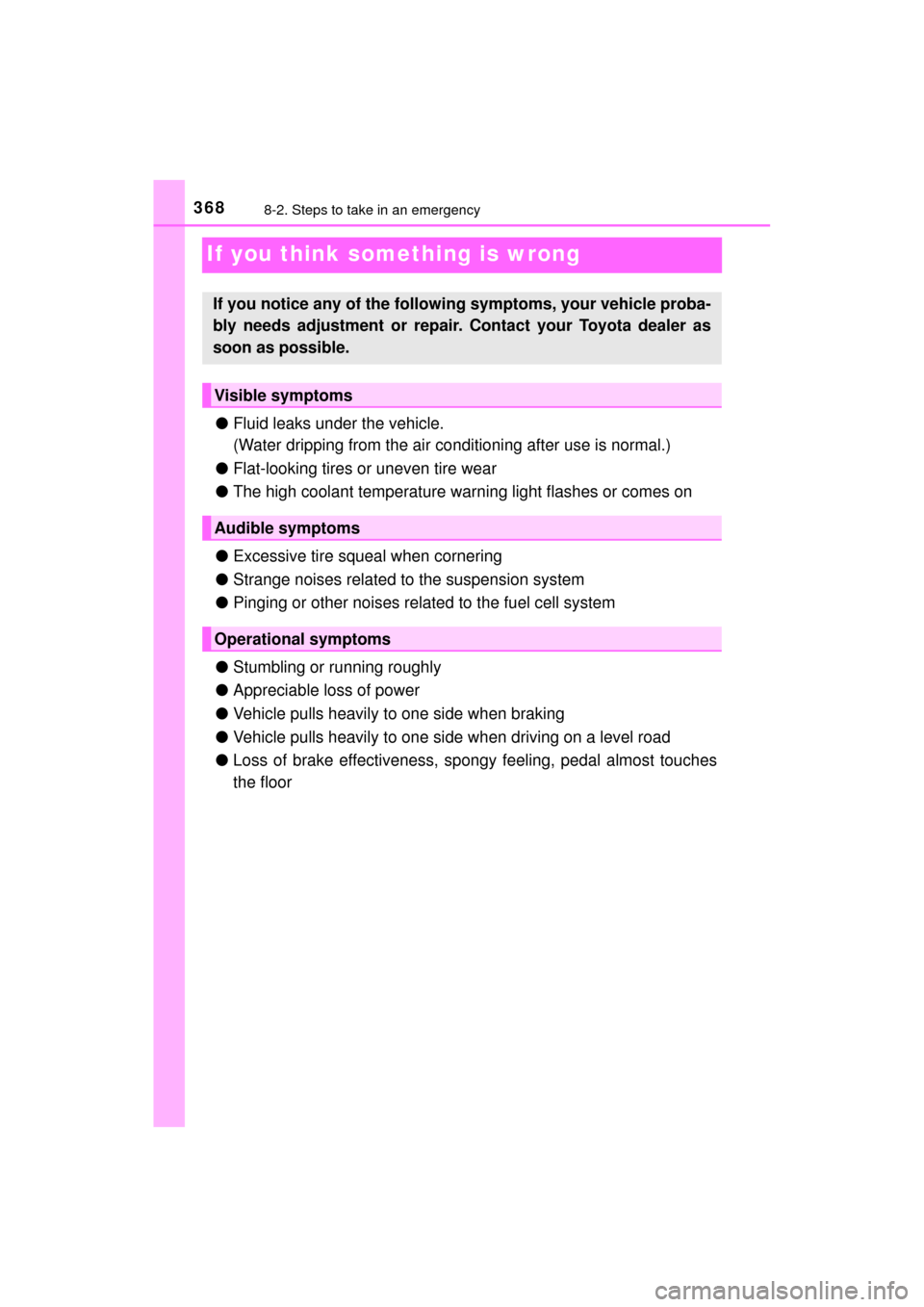
●Fluid leaks under the vehicle.
(Water dripping from the air co nditioning after use is normal.)
● Flat-looking tires or uneven tire wear
● The high coolant temperature warning light flashes or comes on
● Excessive tire squeal when cornering
● Strange noises related to the suspension system
● Pinging or other noises related to the fuel cell system
● Stumbling or running roughly
● Appreciable loss of power
● Vehicle pulls heavily to one side when braking
● Vehicle pulls heavily to one side when driving on a level road
● Loss of brake effectiveness, spon gy feeling, pedal almost touches
the floor
If you notice any of the follow ing symptoms, your vehicle proba-
bly needs adjustment or repair. Contact your Toyota dealer as
soon as possible.
Visible symptoms
Audible symptoms
Operational symptoms
Page 371 of 464
3718-2. Steps to take in an emergency
MIRAI_OM_USA_OM62023U
8
When trouble arises
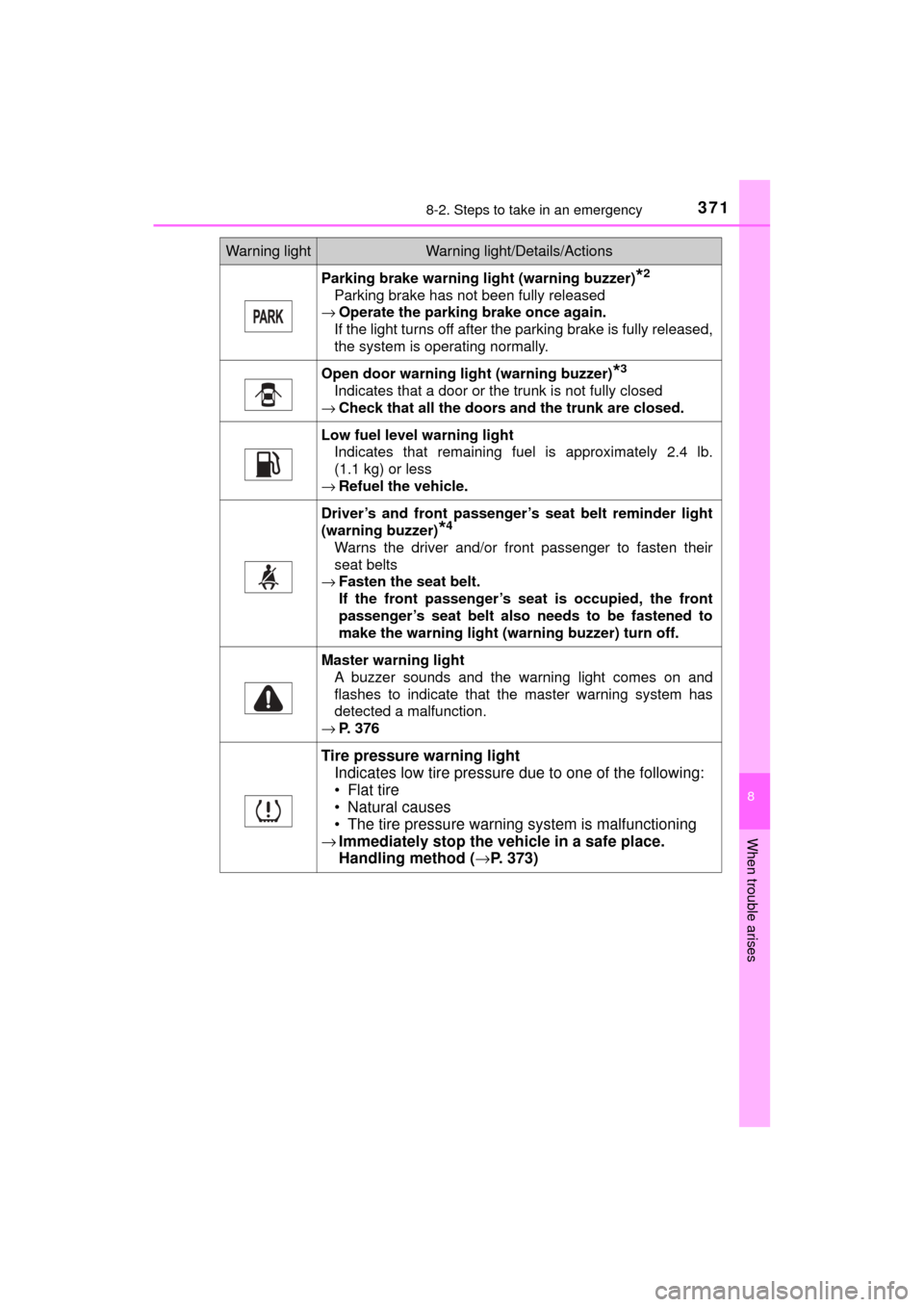
Parking brake warning light (warning buzzer)*2
Parking brake has not been fully released
→ Operate the parking brake once again.
If the light turns off after the parking brake is fully released,
the system is operating normally.
Open door warning light (warning buzzer)*3
Indicates that a door or the trunk is not fully closed
→ Check that all the doors and the trunk are closed.
Low fuel level warning light
Indicates that remaining fuel is approximately 2.4 lb.
(1.1 kg) or less
→ Refuel the vehicle.
Driver’s and front passenger’ s seat belt reminder light
(warning buzzer)
*4
Warns the driver and/or front passenger to fasten their
seat belts
→ Fasten the seat belt.
If the front passenger’s seat is occupied, the front
passenger’s seat belt also needs to be fastened to
make the warning light (warning buzzer) turn off.
Master warning light A buzzer sounds and the warning light comes on and
flashes to indicate that the master warning system has
detected a malfunction.
→ P. 376
Tire pressure warning light
Indicates low tire pressure due to one of the following:
• Flat tire
• Natural causes
• The tire pressure warning system is malfunctioning
→ Immediately stop the vehicle in a safe place.
Handling method ( →P. 373)
Warning lightWarning light/Details/Actions
Page 389 of 464
3898-2. Steps to take in an emergency
MIRAI_OM_USA_OM62023U
8
When trouble arises
With the compressor switch off, disconnect the hose from the valve
on the tire and then pull out the power plug from the power outlet
socket.
Some sealant may leak when the hose is removed.
Install the valve cap onto the valve of the emergency repaired tire.
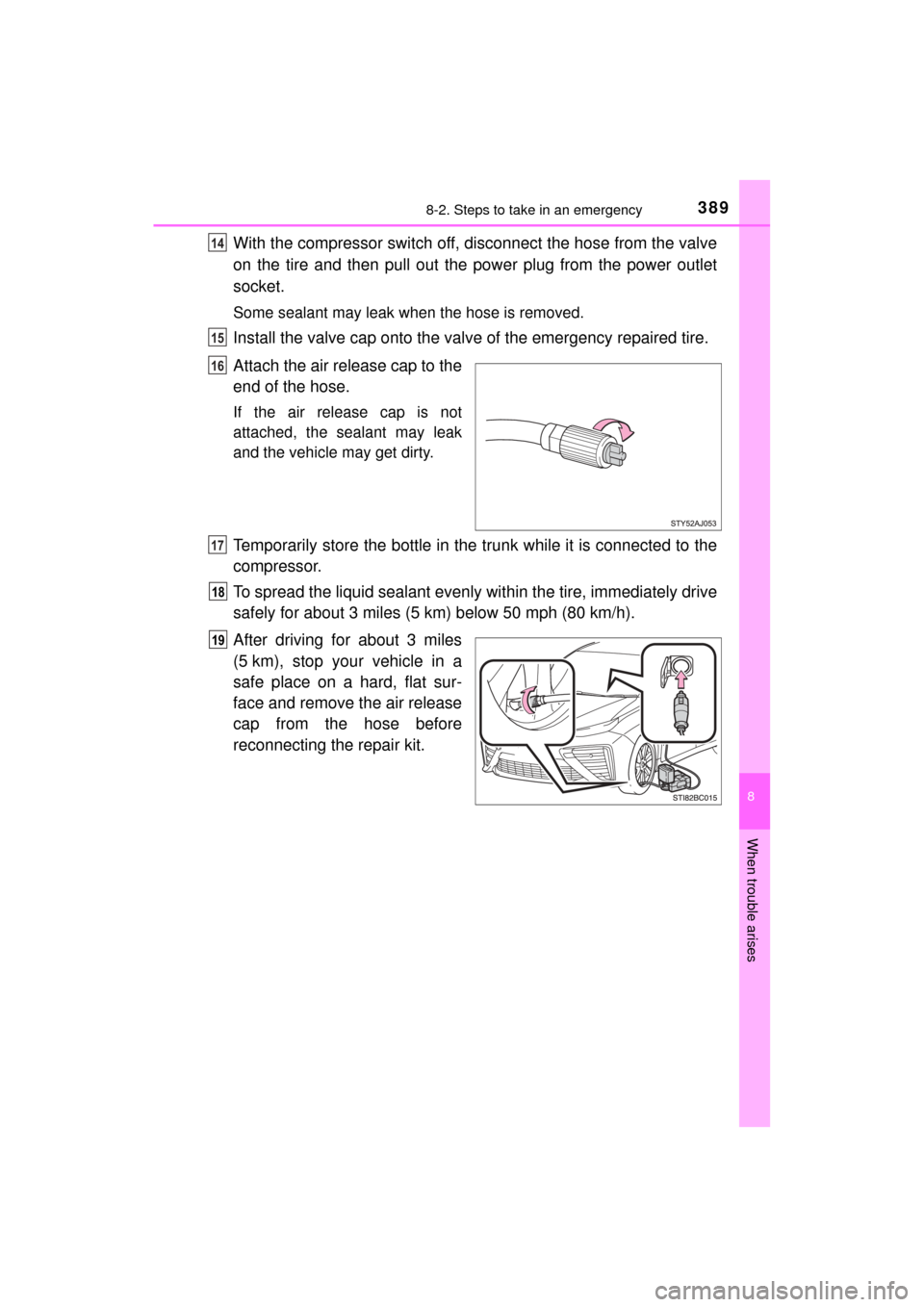
Attach the air release cap to the
end of the hose.
If the air release cap is not
attached, the sealant may leak
and the vehicle may get dirty.
Temporarily store the bottle in the trunk while it is connected to the
compressor.
To spread the liquid sealant evenly within the tire, immediately drive
safely for about 3 miles (5 km) below 50 mph (80 km/h).
After driving for about 3 miles
(5 km), stop your vehicle in a
safe place on a hard, flat sur-
face and remove the air release
cap from the hose before
reconnecting the repair kit.
14
15
16
17
18
19
Page 390 of 464
3908-2. Steps to take in an emergency
MIRAI_OM_USA_OM62023U
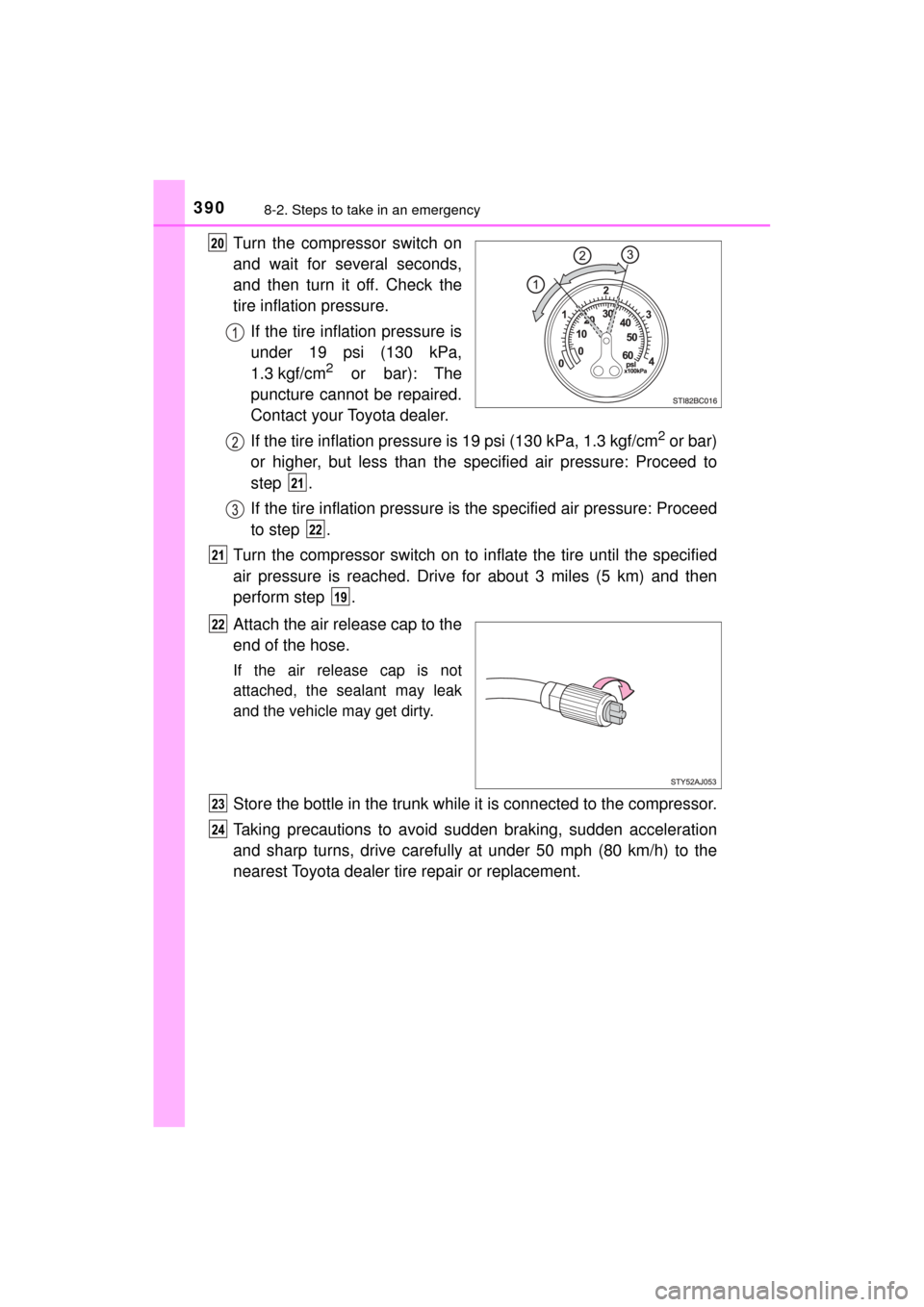
Turn the compressor switch on
and wait for several seconds,
and then turn it off. Check the
tire inflation pressure.If the tire inflation pressure is
under 19 psi (130 kPa,
1.3 kgf/cm
2 or bar): The
puncture cannot be repaired.
Contact your Toyota dealer.
If the tire inflation pressure is 19 psi (130 kPa, 1.3 kgf/cm
2 or bar)
or higher, but less than the specified air pressure: Proceed to
step .
If the tire inflation pressure is the specified air pressure: Proceed
to step .
Turn the compressor switch on to in flate the tire until the specified
air pressure is reached. Drive for about 3 miles (5 km) and then
perform step .
Attach the air release cap to the
end of the hose.
If the air release cap is not
attached, the sealant may leak
and the vehicle may get dirty.
Store the bottle in the trunk while it is connected to the compressor.
Taking precautions to avoid su dden braking, sudden acceleration
and sharp turns, drive carefully at under 50 mph (80 km/h) to the
nearest Toyota dealer tire repair or replacement.
20
21
22
21
19
22
23
24
Page 392 of 464
3928-2. Steps to take in an emergency
MIRAI_OM_USA_OM62023U■
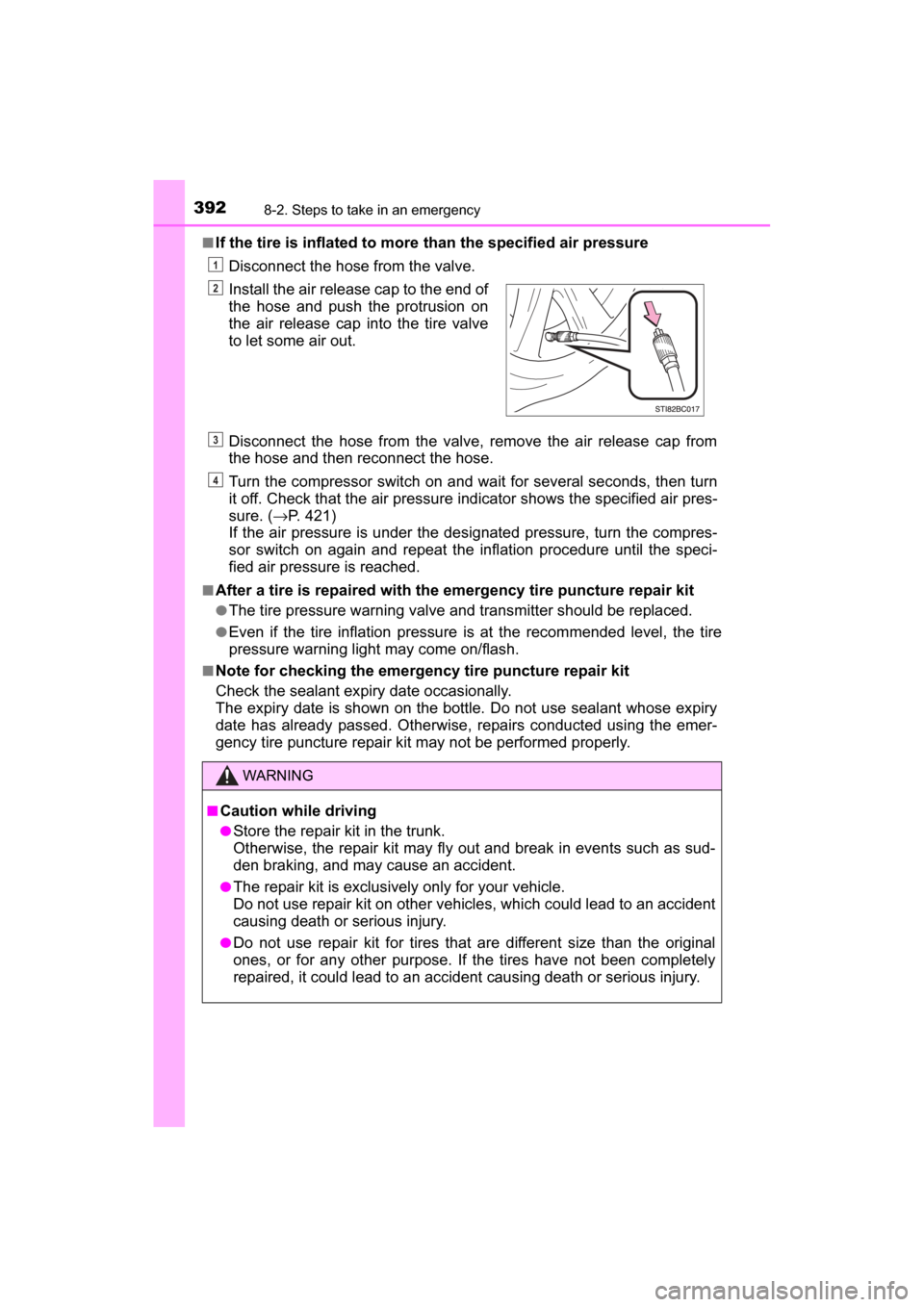
If the tire is inflated to more
than the specified air pressure
Disconnect the hose from the valve.
Disconnect the hose from the valve, remove the air release cap from
the hose and then reconnect the hose.
Turn the compressor switch on and wait for several se conds, then turn
it off. Check that the air pressure indicator shows the specified air pres-
sure. ( →P. 421)
If the air pressure is under the designated pressure, turn the compres-
sor switch on again and repeat the inflation procedure until the speci-
fied air pressure is reached.
■After a tire is repaired with the emergency tire puncture repair kit
●The tire pressure warning valve and transmitter should be replaced.
●Even if the tire inflation pressure is at the recommended level, the tire
pressure warning light may come on/flash.
■Note for checking the emergency tire puncture repair kit
Check the sealant expiry date occasionally.
The expiry date is shown on the bottle. Do not use sealant whose expiry
date has already passed. Otherwise, repairs conducted using the emer-
gency tire puncture repair kit may not be performed properly.Install the air release cap to the end of
the hose and push the protrusion on
the air release cap into the tire valve
to let some air out.
WARNING
■
Caution while driving
●Store the repair kit in the trunk.
Otherwise, the repair kit may fly out and break in events such as sud-
den braking, and may cause an accident.
●The repair kit is exclusively only for your vehicle.
Do not use repair kit on other vehicles, which could lead to an accident
causing death or serious injury.
●Do not use repair kit for tires that are different size than the original
ones, or for any other purpose. If the tires have not been completely
repaired, it could lead to an accide nt causing death or serious injury.
1
2
3
4