transmission TOYOTA MIRAI 2018 Owners Manual (in English)
[x] Cancel search | Manufacturer: TOYOTA, Model Year: 2018, Model line: MIRAI, Model: TOYOTA MIRAI 2018Pages: 464, PDF Size: 8.61 MB
Page 3 of 464

3
MIRAI_OM_USA_OM62025U
1
9 8 6 5
4
3
2
10
7
5-1. Before drivingDriving the vehicle ............. 158
Cargo and luggage............ 166
Vehicle load limits ............. 169
Trailer towing..................... 170
Dinghy towing.................... 171
5-2. Driving procedures Power switch ..................... 172
Transmission ..................... 179
Turn signal lever................ 185
Parking brake .................... 186
5-3. Operating the lights and wipers
Headlight switch ................ 187
Automatic High Beam ....... 190
Windshield wipers and washer ............................ 195
5-4. Refueling Opening the fuel door........ 198 5-5. Using the driving
support systems
Dynamic radar cruise control.............................. 203
LDA (Lane Departure Alert) ................................ 216
Intuitive parking assist ....... 223
Driving assist systems ....... 231
PCS (Pre-Collision System) ........................... 237
BSM (Blind Spot Monitor)......... 244
5-6. Driving tips Winter driving tips .............. 252
5Driving
Page 8 of 464

8
MIRAI_OM_USA_OM62025UYour Toyota is equipped with several sophisticated computers th
at will record
certain data, such as:
• Electric motor speed (traction motor speed)
• Accelerator status
• Brake status
• Vehicle speed
• Shift position
• Traction battery status
The recorded data varies according to the vehicle grade level and options
with which it is equipped. These computers do not record conver sations or
sounds, and only record images outside of the vehicle in certai n situations.
●Data Transmission
Your vehicle may transmit the data recorded in these computers to Toyota
without notification to you.
●Data usage
Toyota may use the data recorded in these computers to diagnose malfunc-
tions, conduct research and development, and improve quality.
Toyota will not disclose the recorded data to a third party exc ept:
• With the consent of the vehicle owner or with the consent of the lessee if the vehicle is leased
• In response to an official request by the police, a court of l aw or a govern-
ment agency
• For use by Toyota in a lawsuit
• For research purposes where the data is not tied to a specific vehicle or
vehicle owner
●Usage of data collected through Safety Connect (U.S.mainland on ly)
If your Toyota has Safety Connect and if you have subscribed to those ser-
vices, please refer to the Safety Connect Telematics Subscription Service
Agreement for information on data collected and its usage.
●To learn more about the vehicle data collected, used and shared by
Toyota, please visit www.toyota.com/privacyvts/
.
Vehicle data recordings
Page 157 of 464

157
5Driving
MIRAI_OM_USA_OM62025U5-1. Before driving
Driving the vehicle ............. 158
Cargo and luggage ........... 166
Vehicle load limits ............. 169
Trailer towing..................... 170
Dinghy towing ................... 171
5-2. Driving procedures Power switch ..................... 172
Transmission ..................... 179
Turn signal lever................ 185
Parking brake .................... 186 5-3. Operating the lights
and wipers
Headlight switch ................ 187
Automatic High Beam ....... 190
Windshield wipers and washer ............................ 195
5-4. Refueling Opening the fuel door ....... 198
5-5. Using the driving support systems
Dynamic radar cruise control ............................. 203
LDA (Lane Departure Alert) ............................... 216
Intuitive parking assist....... 223
Driving assist systems ...... 231
PCS (Pre-Collision System)........................... 237
BSM (Blind Spot Monitor) ........ 244
5-6. Driving tips Winter driving tips ............. 252
Page 162 of 464

1625-1. Before driving
MIRAI_OM_USA_OM62025U
WARNING
Observe the following precautions.
Failure to do so may result in death or serious injury.
■When driving the vehicle
● Do not drive in excess of the speed limit. Even if the legal sp eed limit per-
mits it, do not drive over 85 mph (140 km/h) unless your vehicl e has high-
speed capability tires. Driving over 85 mph (140 km/h) may resu lt in tire
failure, loss of control and possible injury. Be sure to consult a tire dealer
to determine whether the tires on your vehicle are high-speed c apability
tires or not before driving at such speeds.
■ When driving on slippery road surfaces
● Sudden braking, acceleration and steering may cause tire slippa ge and
reduce your ability to control the vehicle.
● Sudden acceleration or regenerative braking due to shifting cou ld cause
the vehicle to skid.
● After driving through a puddle, lightly depress the brake pedal to make
sure that the brakes are functioning properly. Wet brake pads m ay prevent
the brakes from functioning properly. If the brakes on only one side are wet
and not functioning properly, steering control may be affected.
■ When changing the shift position
● Do not let the vehicle roll backward while a forward driving position is
selected, or roll forward while the shift position is in R.
Doing so may result in an accident or damage to the vehicle.
● Do not shift the shift position to P while the vehicle is movin g.
Doing so can damage the transmission and may result in a loss o f vehicle
control.
● Do not shift the shift position to R while the vehicle is movin g forward.
Doing so can damage the transmission and may result in a loss o f vehicle
control.
● Do not shift the shift position to a driving position while the vehicle is mov-
ing backward.
Doing so can damage the transmission and may result in a loss o f vehicle
control.
● Shifting the shift position to N while the vehicle is moving wi ll disengage
the fuel cell system. Regenerative braking is not available with the fuel cell
system disengaged.
● Be careful not to shift the shift position with the accelerator pedal
depressed. Shifting the shift position to any position other th an P or N may
lead to unexpected rapid acceleration of the vehicle that may c ause an
accident and result in death or serious injury.
After shifting the shift position, make sure to check the current shift posi-
tion using the shift position indicator. ( P. 179)
Page 165 of 464
1655-1. Before driving
5
Driving
MIRAI_OM_USA_OM62025U
NOTICE
■Avoiding damage to vehicle parts
● Do not turn the steering wheel fully in either direction and ho ld it there for
an extended period of time.
Doing so may damage the power steering motor.
● When driving over bumps in the road, drive as slowly as possibl e to avoid
damaging the wheels, underside of the vehicle, etc.
■ If you get a flat tire while driving
A flat or damaged tire may cause the following situations. Hold the steering
wheel firmly and gradually depress the brake pedal to slow down the vehi-
cle.
● It may be difficult to control your vehicle.
● The vehicle will make abnormal sounds or vibrations.
● The vehicle will lean abnormally.
Information on what to do in case of a flat tire ( P. 381)
■ When encountering flooded roads
Do not drive on a road that has flooded after heavy rain, etc. Doing so may
cause the following serious damage to the vehicle:
● Fuel cell system stalling
● Short in electrical components
● Fuel cell system damage caused by water immersion
In the event that you drive on a flooded road and the vehicle i s flooded, be
sure to have your Toyota dealer check the following:
● Fuel cell system
● Brake function
● Changes in quantity and quality of transmission fluid, etc.
● Lubricant condition for the bearings and suspension joints (whe re possi-
ble), and the function of all joints, bearings, etc.
If the shift control system is damaged by flooding, it may not be possible to
shift the shift position to P, or from P to other positions. Wh en the shift posi-
tion cannot be changed from P to any other position, the front wheels will
lock, and you will be unable to tow the vehicle with the front wheels on the
ground, as the front wheels may be locked. In this case, transp ort the vehi-
cle with both front wheels or all four wheels lifted.
■ If the vehicle will not shift out of the P position
There is a possibility that the 12-volt battery is discharged. Check the
12-volt battery in this situation.
Page 179 of 464
1795-2. Driving procedures
5
Driving
MIRAI_OM_USA_OM62025U
Transmission
Shift lever
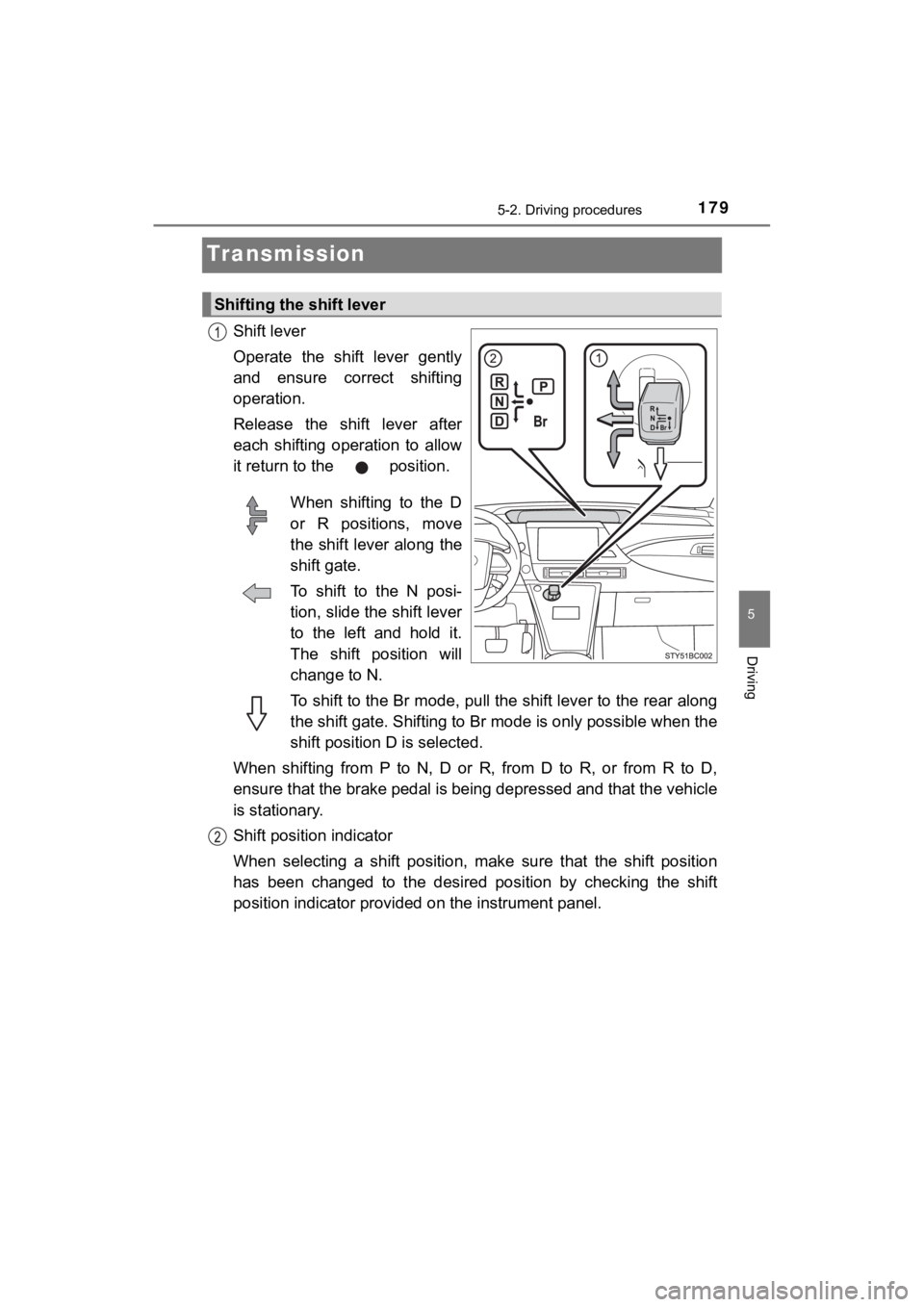
Operate the shift lever gently
and ensure correct shifting
operation.
Release the shift lever after
each shifting operation to allow
it return to the position.When shifting to the D
or R positions, move
the shift lever along the
shift gate.
To shift to the N posi-
tion, slide the shift lever
to the left and hold it.
The shift position will
change to N.
To shift to the Br mode, pull the shift lever to the rear along
the shift gate. Shifting to Br mode is only possible when the
shift position D is selected.
When shifting from P to N, D or R, from D to R, or from R to D,
ensure that the brake pedal is being depressed and that the veh icle
is stationary.
Shift position indicator
When selecting a shift position, make sure that the shift posit ion
has been changed to the desired po sition by checking the shift
position indicator provided on the instrument panel.
Shifting the shift lever
Page 316 of 464
3167-2. Maintenance
MIRAI_OM_USA_OM62025U
Vehicle interior
ItemsCheck points
Accelerator pedal
• The accelerator pedal shouldmove smoothly (without uneven
pedal effort or catching).
Transmission “Park” mechanism
• When parked on a slope and the
shift position is in P, is the vehicle
securely stopped?
Brake pedal
• Does the brake pedal movesmoothly?
• Does the brake pedal have appro-
priate clearance from the floor? (P. 420)
• Does the brake pedal have the
correct amount of free play? (P. 420)
Brakes
• The vehicle should not pull to one
side when the brakes are applied.
• The brakes should work effec-
tively.
• The brake pedal should not feel spongy.
• The brake pedal should not get too close to the floor when the
brakes are applied.
Head restraints• Do the head restraints move
smoothly and lock securely?
Indicators/buzzers• Do the indicators and buzzersfunction properly?
Lights • Do all the lights come on?
Parking brake
• Does the parking brake pedal move smoothly?
• When parked on a slope and the parking brake is on, is the vehicle
securely stopped?
Page 363 of 464
3638-2. Steps to take in an emergency
MIRAI_OM_USA_OM62025U
8
When trouble arises
The following may indicate a problem with your transmission. Contact
your Toyota dealer or commercial towing service before towing.
● The fuel cell system warning message shows on the multi-informa -
tion display and the vehicle does not move.
● The vehicle makes an abnormal sound.
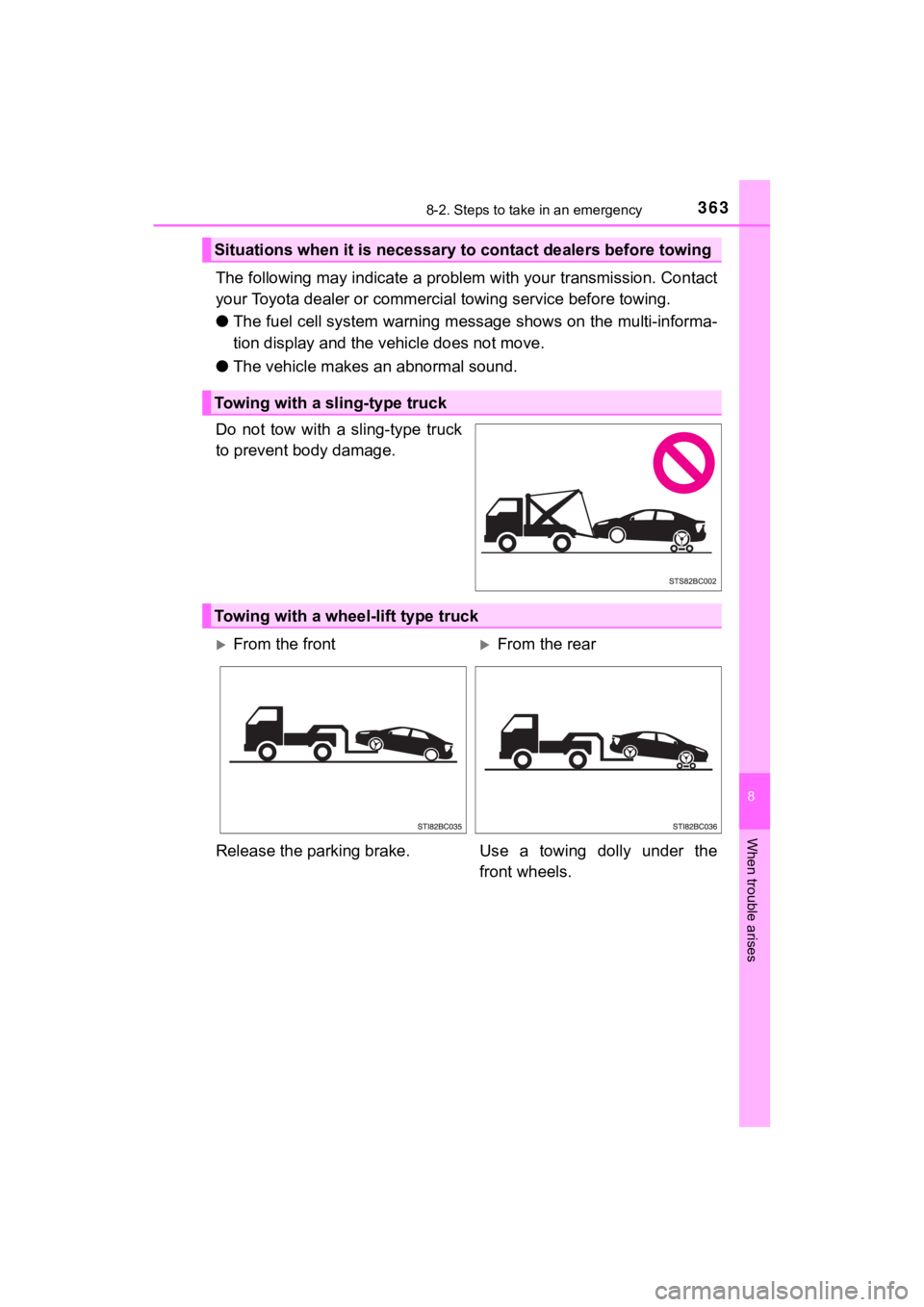
Do not tow with a sling-type truck
to prevent body damage.
Situations when it is necessary to contact dealers before towing
Towing with a sling-type truck
Towing with a wheel-lift type truck
From the frontFrom the rear
Release the parking brake. Us e a towing dolly under the
front wheels.
Page 420 of 464
4209-1. Specifications
MIRAI_OM_USA_OM62025U
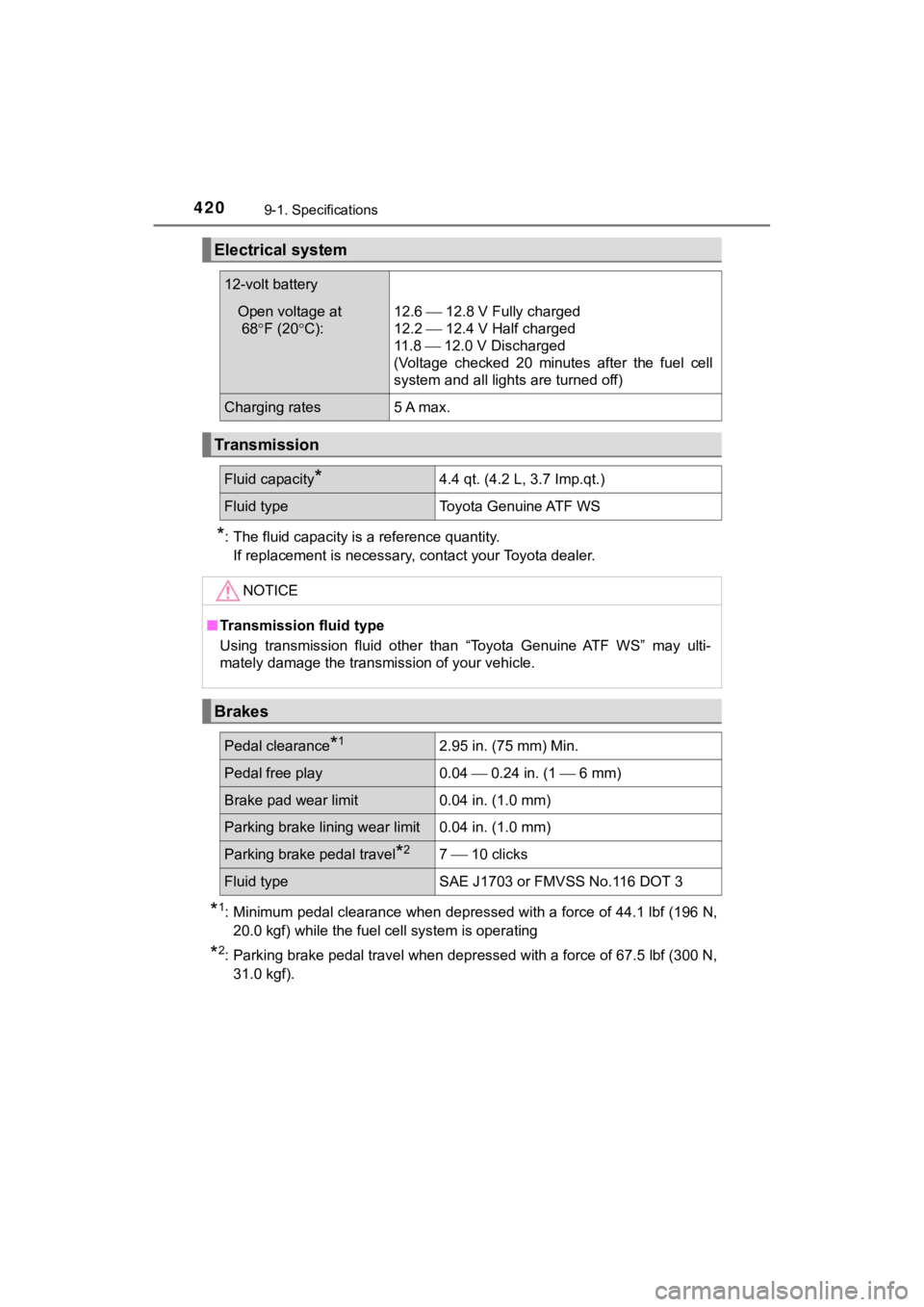
*: The fluid capacity is a reference quantity. If replacement is necessary, contact your Toyota dealer.
*1: Minimum pedal clearance when depressed with a force of 44.1 lb f (196 N,
20.0 kgf) while the fuel cell system is operating
*2: Parking brake pedal travel when depressed with a force of 67.5 lbf (300 N,
31.0 kgf).
Electrical system
12-volt battery
Open voltage at
68 F (20 C):12.6 12.8 V Fully charged
12.2 12.4 V Half charged
11 . 8 12.0 V Discharged
(Voltage checked 20 minutes after the fuel cell
system and all lights are turned off)
Charging rates5 A max.
Transmission
Fluid capacity*4.4 qt. (4.2 L, 3.7 Imp.qt.)
Fluid type Toyota Genuine ATF WS
NOTICE
■Transmission fluid type
Using transmission fluid other than “Toyota Genuine ATF WS” may ulti-
mately damage the transmission of your vehicle.
Brakes
Pedal clearance*12.95 in. (75 mm) Min.
Pedal free play 0.04 0.24 in. (1 6 mm)
Brake pad wear limit0.04 in. (1.0 mm)
Parking brake lining wear limit0.04 in. (1.0 mm)
Parking brake pedal travel*27 10 clicks
Fluid type SAE J1703 or FMVSS No.116 DOT 3
Page 453 of 464

453Alphabetical index
MIRAI_OM_USA_OM62025U
Flat tire...................................... 381
Floor mats .................................. 26
FluidBrake .................................... 420
Transmission ........................ 420
Washer ................................. 327
Front interior lights ................. 268 Wattage ................................ 421
Front passenger occupant classification system .............. 49
Front seats ............................... 138
Adjustment ............................ 138
Cleaning................................ 310
Correct driving posture ........... 28
Driving position memory ....... 140
Head restraints ..................... 145
Power easy access system ......... ....................... 140
Seat heaters ......................... 266
Seat position memory ........... 140
Front side marker lights.......... 187 Light switch ........................... 187
Replacing light bulbs............. 358
Front turn signal lights ........... 185 Replacing light bulbs............. 358
Turn signal lever ................... 185
Fuel
Capacity ................................ 418
Fuel gauge ............................ 102
Hydrogen station information.......................... 464
Refueling............................... 198
Type .............................. 198, 418
Warning light ......................... 371
Fuel cell stack ............................ 86
Fuel cell stack coolant Capacity ................................ 419
Checking ............................... 324 Fuel cell system
Characteristics ........................ 78
Cold temperatures ................ 175
Coolant type ......................... 419
Indicators .............................. 100
Multi-information display ....... 107
Precautions............................. 82
Starting the system ............... 172
Stopping the system ............. 173
Warning lights ......................... 99
Fuel cell system indicator ...... 110
Fuel cell vehicles
Characteristics ........................ 78
Charging the traction battery .................................. 81
Driving advice ......................... 94
Emergency shut off system .... 84
Emergency start function ...... 397
Emergency stops .................. 361
Fuel....................................... 418
Handling hydrogen gas........... 90
High-voltage components ....... 83
Hydrogen gas ......................... 89
Hydrogen-related components.......................... 82
If the 12-volt battery is discharged.......................... 401
If the fuel cell system will not start ........................ 396
Maintenance, repair,
recycling, and disposal ......... 81
F